

Recruiting Outreach: How to Reach Candidates Who Actually Reply
A recruiter we know ran the numbers last quarter: 2,500 applications per open req, 14 roles on her plate, and a team 30% smaller than two years ago. She wasn't losing candidates because of bad messaging. She was losing them because she couldn't get to them fast enough. Recruiting outreach - the proactive, sourced kind - isn't optional anymore. It's the only way to hire at the pace the market demands.
Why Sourced Candidates Win
The math is brutal. Gem's recruiting benchmarks report, which analyzed 140M+ applications, 14M candidates, and roughly 1M hires from January 2021 through December 2024, found that job boards and social sites drive 49% of applications but only 24.6% of hires. Sourced candidates - the ones recruiters actively reach out to - are 5x more likely to be hired than inbound applicants.
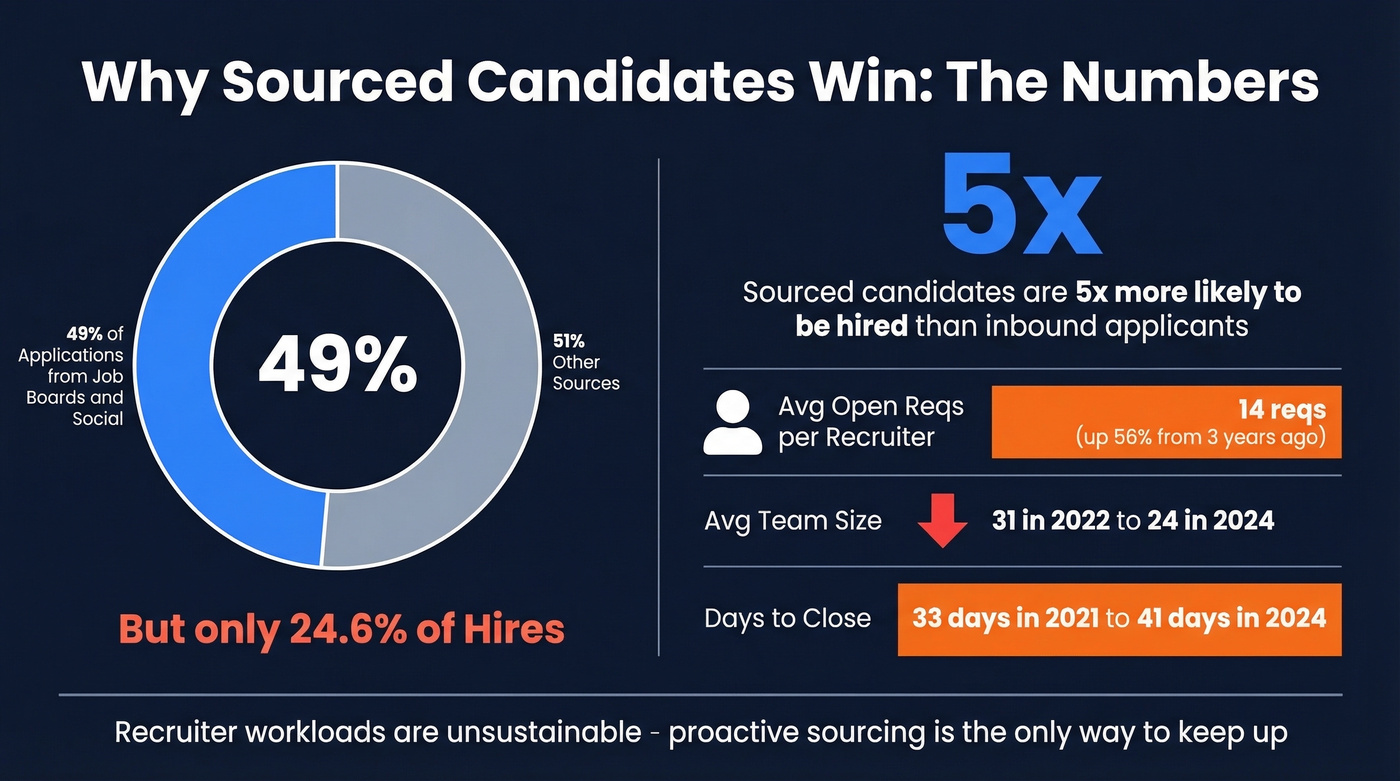
That gap keeps widening because recruiter workloads are unsustainable. The average recruiter now juggles 14 open reqs and 2,500+ applications, 56% more reqs than three years ago. Teams shrank from 31 recruiters on average in 2022 to 24 in 2024. Hiring processes got heavier too: 20 interviews per hire, up from 14 in 2021, and 41 days to close, up from 33. Every extra day and every extra interview loop is time your top candidate spends fielding offers from someone faster.
If you're still relying on inbound to fill your pipeline, you're fishing in the wrong pond. Passive candidate outreach - proactively sourcing people who aren't actively job-hunting - is where the quality lives.
What You Need (Quick Version)
- Channel: Email first. 79.2% of candidates prefer it over other channels.
- Message length: 50-125 words. One phone screen's worth of text.
- Compensation: Include a range. Without it, passive candidates won't reply.
- CTA: Interest-based, not meeting-push. "Would you be open to a conversation?" beats "Let's book 30 minutes." (If you need examples, see Email Call to Action.)
- Follow-ups: 4-5 touches minimum. Most replies come by touches 2-4. (More on timing in When Should You Follow Up on an Email?.)
Channels Compared
Not all channels perform equally, and the cost structures are wildly different.
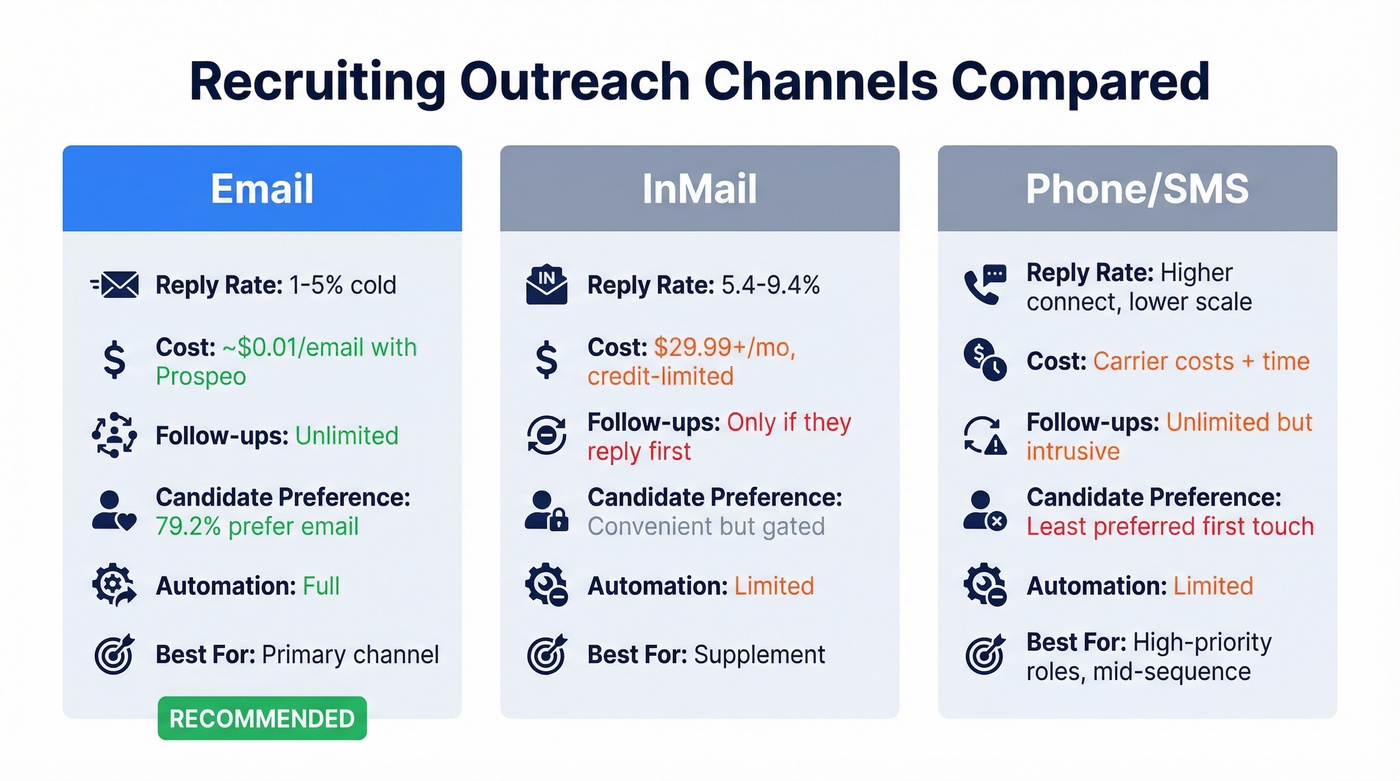
| Factor | InMail | Phone/SMS | |
|---|---|---|---|
| Reply rate | 1-5% (cold) | ~5.44% (no message) to ~9.36% (with message) | Higher connect, lower scale |
| Cost | ~$0.01/email with Prospeo | $29.99+/mo, credit-limited | Carrier costs + time |
| Follow-up ability | Unlimited | Only if recipient replies | Unlimited but intrusive |
| Candidate preference | 79.2% prefer | Convenient but gated | Least preferred first touch |
| Automation | Full | Limited | Limited |
| Best for | Primary channel | Supplement | High-priority roles, mid-sequence |
Email is the workhorse. You control the cadence, you can automate sequences, and there's no credit system throttling your volume. The 1-5% cold reply rate sounds low, but it compounds across a multi-touch sequence - and highly personalized campaigns consistently hit the upper end. (If you want a structure you can reuse, start with a B2B cold email sequence.)
InMail has a higher per-message reply rate. A Belkins study of 20M+ outreach attempts found that connection requests with a personalized message pull a 9.36% reply rate versus 5.44% without one. Combining a direct message with profile visits can push that to 11.87%. But the constraints are real: you can't follow up unless the recipient replies first, credits are limited, and at $29.99/mo minimum just for access, the cost-per-reply math gets ugly at scale. 72% of recruiters use professional networks to connect with passive candidates, which means your message is competing with dozens of others in the same inbox.
Phone is the high-effort, high-impact play for priority roles. A direct call to a passive VP of Engineering signals seriousness in a way no email can. It doesn't scale, though, and most candidates find unsolicited calls intrusive as a first touch. Use it as touch 4 or 5, not touch 1. (If you’re building a calling motion, borrow from a cold calling system.)
The winning approach: email as your primary channel, professional profile engagement as a supplement, and phone reserved for high-priority roles mid-sequence.
How to Write Messages That Get Replies
Here's the uncomfortable truth: your candidates receive 10-30 recruiter messages per week. Standing out isn't about clever tricks. It's about proving you actually did your homework on the person you're writing to.
Subject Lines and Openers
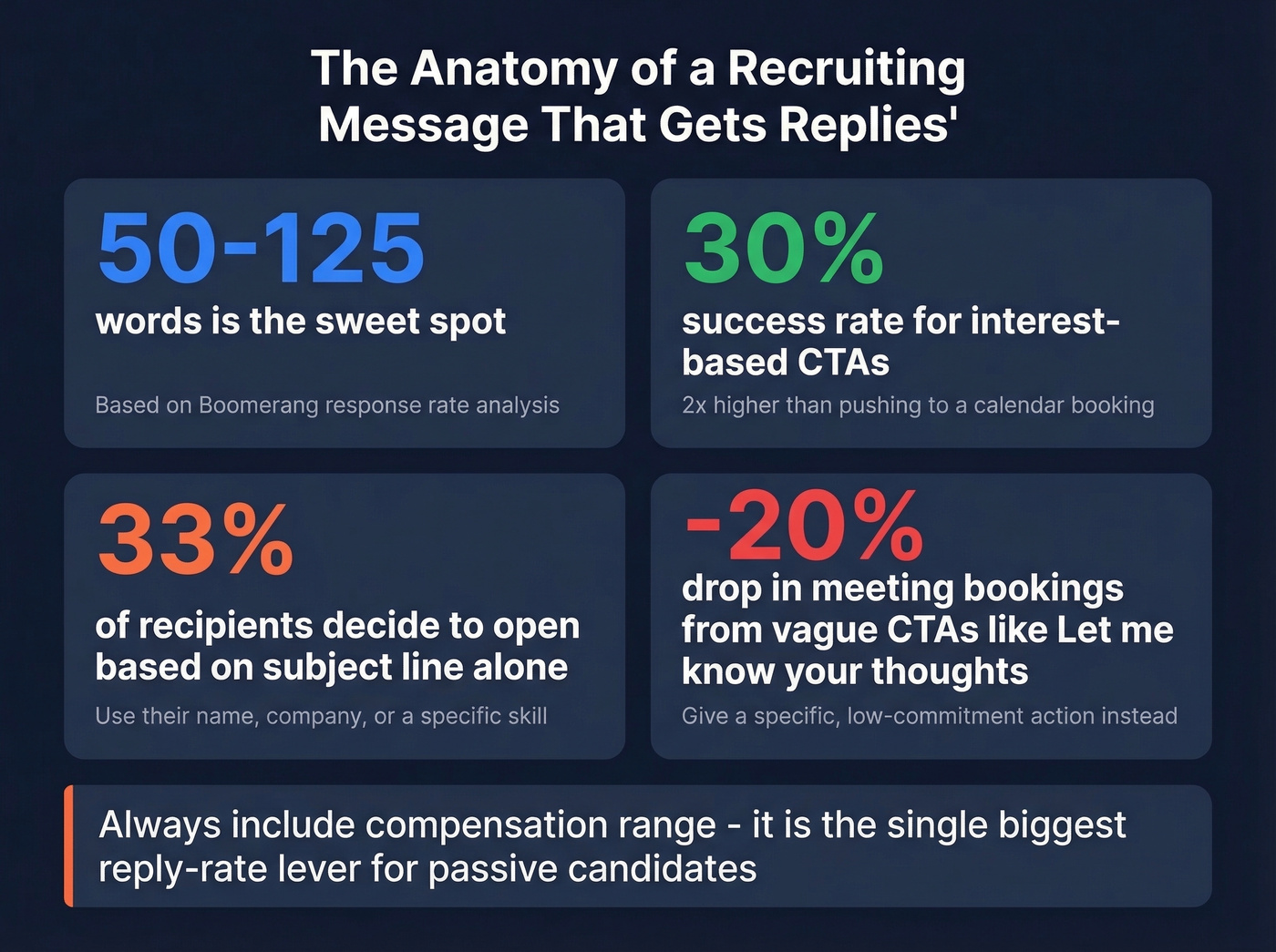
33% of recipients decide whether to open based on the subject line alone. A generic "Exciting Opportunity at [Company]" is dead on arrival.
Use the candidate's name, their current company, or a specific skill. Something like "Your work on [Project] caught our eye" outperforms anything templated. The first two lines matter almost as much - reference a specific project, a recent talk, a published article, or a career move. The candidate needs to feel like you actually looked at their profile, not that you bulk-imported 500 names and hit send. (For more ideas, pull from these email subject line examples.)
Message Structure and Length
The sweet spot is 50-125 words, based on Boomerang's analysis of response rates by message length. That's roughly one phone screen of text. Anything longer and you're asking a stranger to invest too much time before they know if the role is relevant.
Structure it simply: personalized opener (2 lines), bite-sized role summary (2-3 bullets max), and a low-friction CTA. Include the compensation range - it's one of the biggest reply-rate levers for passive candidates, and it's consistently called out as a "deadly sin" when recruiters hide it. Format for mobile. Most candidates read on their phone, and if your message requires scrolling past the fold, it's too long. (If you want to tighten the writing, use a simple email copywriting checklist.)
The Right CTA
This is where most recruiters lose the reply. An interest-based CTA - "Would you be open to a quick conversation about this?" - yields roughly a 30% success rate, about 2x higher than pushing straight to a calendar booking.
Avoid "Let me know your thoughts." It sounds open-ended, but it actually reduces meeting booking rates by about 20%. The candidate doesn't know what to do with it. Give them a specific, low-commitment action: a 15-minute call, a quick question, an expression of interest.
Templates That Actually Work
1. Cold email to passive candidate
Subject: [Specific skill/project] → [Your Company]
Hi [First Name],
Your work on [specific project/achievement] stood out - especially [detail]. We're building [brief team/mission context] at [Company] and think your background in [skill] is a strong fit.
The role is [Title], [remote/hybrid/location], $[range]. Happy to share more details if you're open to a 15-minute conversation.
Best, [Your Name]
2. Follow-up email (5-7 days later)
Hi [First Name],
Wanted to circle back on my note about the [Title] role. We just [recent company news/milestone] and the team is growing fast. Compensation is $[range] plus [key perk].
Worth a quick chat? No pressure either way.
3. Connection request with message
Hi [First Name] - I came across your background in [skill/industry] and thought you'd be a great fit for a [Title] role we're hiring for at [Company]. $[range], [location/remote]. Happy to share details if you're interested.
4. Referral-based outreach
This is your highest-conversion template. Referral candidates move through pipelines faster and accept offers at higher rates. Lead with the mutual connection - it's the entire reason this message gets read.
Hi [First Name],
[Referrer Name] suggested I reach out - they mentioned your expertise in [area]. We're hiring a [Title] at [Company], $[range], and your background looks like a strong match.
Would you be open to a quick conversation this week?
5. CRM re-engagement (past candidate)
Don't sleep on this one. "Rediscovered" candidates - people already in your ATS from past cycles - grew from 29.1% to 44.0% of sourced hires between 2021 and 2024. Your best candidates might already be in your database.
Hi [First Name],
We spoke [timeframe] ago about a role at [Company]. You weren't ready to move then, but I wanted to flag a new [Title] opening that might be a better fit - $[range], [key differentiator].
Still open to exploring? Happy to catch up for 15 minutes.

Your recruiting outreach is only as good as your contact data. Prospeo gives you 98% verified emails and 125M+ direct dials so your sourced candidates actually see your message - not a bounce notification.
Stop losing top candidates to bad data. Start reaching them for $0.01/email.
How to Scale Your Cadence
Most recruiters stop after one or two touches. That's leaving replies on the table.
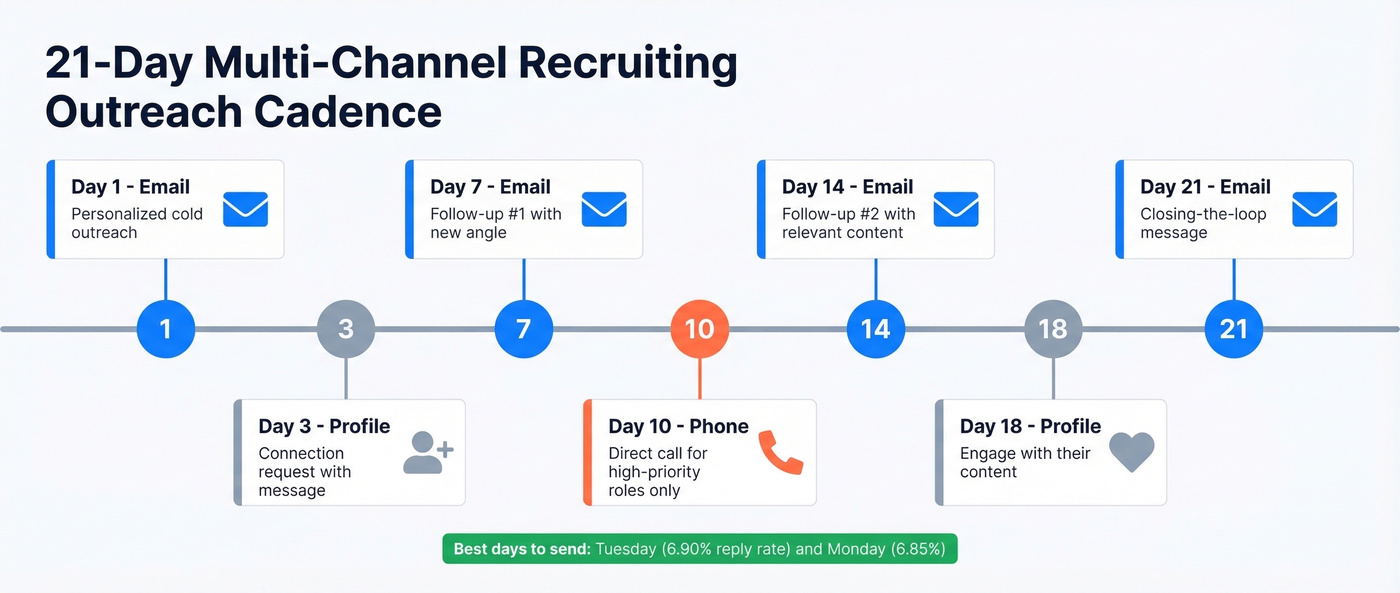
Most replies come in the first 4-5 touches, and results flatten sharply after touch 5. For high-value roles, a multi-channel cadence of 12-15 touches over about three weeks is a strong play. (If you want plug-and-play language, adapt these cold email follow-up templates.)
| Day | Channel | Action |
|---|---|---|
| 1 | Personalized cold outreach | |
| 3 | Professional profile | Connection request with message |
| 7 | Follow-up #1 (new angle or value add) | |
| 10 | Phone | Direct call (high-priority roles only) |
| 14 | Follow-up #2 (share relevant content) | |
| 18 | Professional profile | Engage with their content |
| 21 | Closing-the-loop message |
Best days for outreach? Tuesday at 6.90% reply rate and Monday at 6.85%. Weekends are the worst. Time your first touch and follow-ups accordingly. (For more send-time data, see best time to send cold emails.)
The key to scaling is building this cadence once, then personalizing only the first two lines per candidate. The rest of the sequence - timing, channel mix, follow-up structure - stays templated. That's how a team of four sourcers can run 50+ active sequences without burning out or letting candidates slip through the cracks.
AI in Candidate Sourcing
Let's be honest about where AI helps and where it doesn't. The Belkins study of 20M+ outreach attempts found that AI-assisted first messages pulled a 4.19% reply rate versus 2.60% without AI. That's a meaningful lift for the initial touch. (If you’re building an AI workflow, start with AI cold email outreach.)
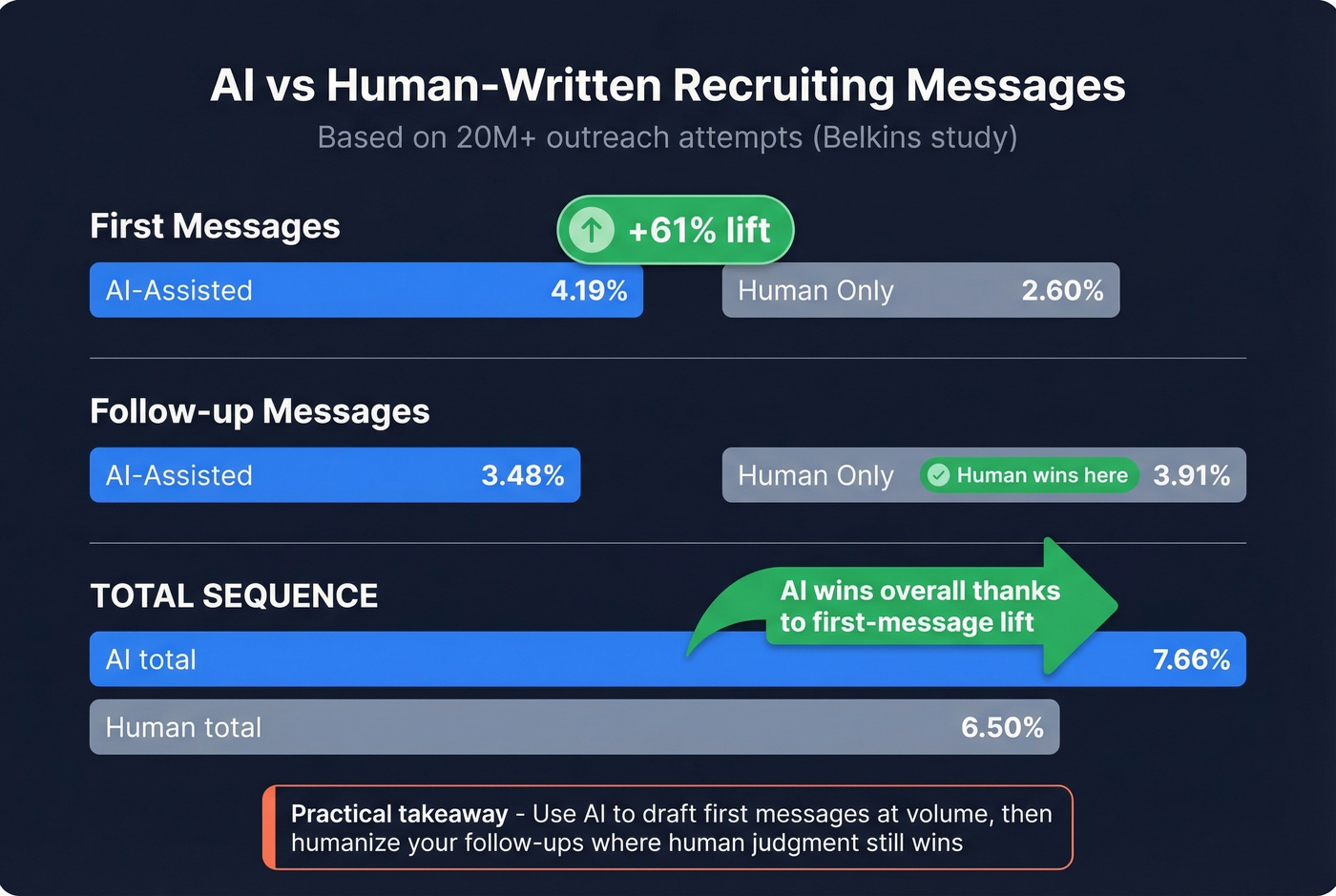
Follow-ups tell a different story. Human-written follow-ups slightly outperformed AI: 3.91% versus 3.48%. The total reply rate across a sequence was still higher with AI at 7.66% vs. 6.50%, so the first-message lift more than compensates.
The practical takeaway: use AI to draft your first messages, especially when you're sourcing at volume and need a personalized opener for each candidate. Then humanize your follow-ups. The candidate who didn't reply to touch 1 needs a genuinely different angle in touch 2 - not a slightly rephrased version of the same pitch. That's where human judgment still wins.
Hot take: If total comp for the role is under $80K, you probably don't need an enterprise recruiting platform. A solid email sequence with verified data and AI-assisted first drafts will outperform a $50K/year ATS add-on that your team barely uses.
Fix Your Data Before Your Messaging
Here's the thing most recruiting teams get wrong: they obsess over subject lines and CTA phrasing while sending to email lists with 20%+ bounce rates. Every bounce damages your sender reputation, which means your next batch of perfectly crafted messages lands in spam instead of inboxes. (If you’re troubleshooting, use this email deliverability guide and then check email bounce rate benchmarks.)
We've tested this ourselves across hundreds of outbound campaigns. Fixing data quality consistently delivers a bigger reply-rate lift than rewriting copy. The same message sent to a verified list versus an unverified one isn't even a fair comparison.
Snyk's sales team saw this firsthand - 50 AEs prospecting 4-6 hours per week, but their bounce rate was running 35-40%. After switching to verified contact data, bounces dropped under 5% and AE-sourced pipeline jumped 180%. Candidate sourcing follows the same physics. Bad emails mean wasted sequences and damaged domains.
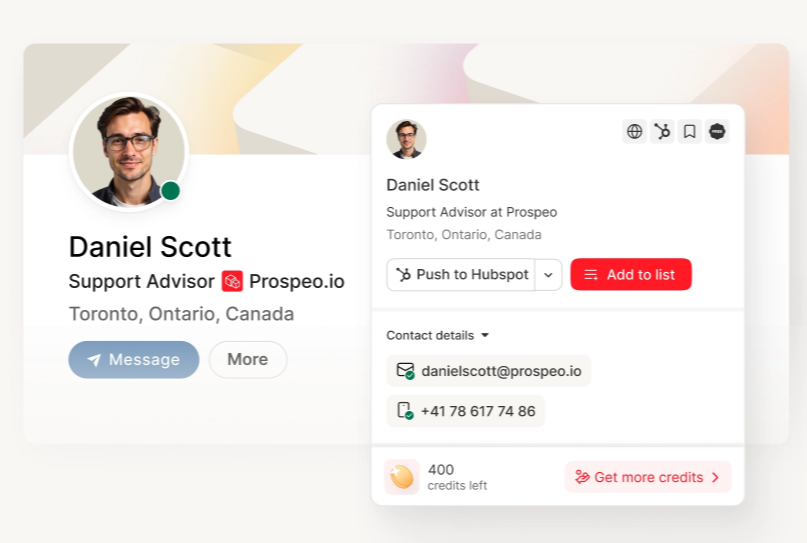
Before you optimize a single word of copy, verify your list. It's the highest-leverage fix in your entire outreach workflow. Prospeo's free tier gives you 75 email verifications plus 100 Chrome extension credits per month - enough to test the accuracy difference yourself before committing to anything.
Running a 4-5 touch recruiting sequence across email and phone? Prospeo's Chrome extension lets you pull verified emails and mobile numbers from any professional profile in one click - 40K+ recruiters and sales pros already use it daily.
Build candidate lists in minutes, not hours. 300M+ profiles with verified contact data.
Metrics That Matter
You can't improve what you don't measure. Track these numbers weekly.
Reply rate is your north star: 1-5% for cold email, 5-9% for InMail with a personalized message. Industry variation is significant - legal and professional services see up to 10.42%, while software/SaaS averages 4.77%.
Open rate is your email health check. Below 40%, your subject lines or deliverability need work. Above 60%, your targeting and subject lines are dialed in.
Response-to-interview conversion measures message quality and role-candidate fit. If replies are high but screens are low, your messaging is overselling or misrepresenting the role.
Offer acceptance rate currently benchmarks at 84%, up from 81% in 2021. If you're below that, your offer stage needs attention - not your outreach.
Bounce rate should be under 5%. Anything above 10% means your data source is the problem, not your outreach. This is the metric that separates teams who think they have a messaging problem from teams who actually have a data problem.
Compliance Essentials
Recruiting outreach operates under real legal constraints. Skip this section at your own risk.
- GDPR lawful basis: Legitimate interest is the standard basis for candidate outreach in the EU/UK. Document it.
- Opt-out link: Every message, every time. Non-negotiable.
- Retention limits: 6-12 months for unsuccessful candidate data unless you have explicit consent to retain longer.
- CCPA rights: California candidates can request access to or deletion of their data. Have a process ready.
- Fines: Up to EUR 20M or 4% of global turnover under GDPR. Enforcement is active.
- RBAC: Limit who on your team can access candidate data. Not everyone needs full database access.
- Bi-annual audits: Review your data handling practices at least twice a year.
Most recruiting teams aren't going to get fined. But one candidate complaint to a data protection authority can trigger an investigation that eats weeks of your time. Build compliance into your workflow from day one - it's far cheaper than retrofitting it after a complaint.
FAQ
What's a good reply rate for recruiting outreach?
Cold email lands between 1-5%, and InMail with a personalized message averages 5-9%. Below 1% consistently means your data quality or list targeting needs work before you blame your copy.
How many follow-ups should a recruiter send?
Four to five touches for email-only sequences. For high-priority multi-channel roles, extend to 12-15 touches over three weeks - most replies come between touches 2 and 4.
Should recruiters use AI to write outreach messages?
For first messages, yes - AI lifts reply rates from 2.60% to 4.19% based on a 20M-message study. For follow-ups, write them yourself. Human-written follow-ups outperform AI at 3.91% vs. 3.48%.
Is email or InMail better for candidate outreach?
Email is the stronger primary channel: unlimited follow-ups, no credit caps, full automation, and 79.2% of candidates prefer it. Use InMail as a supplement on day 3 of your cadence, not as your main tool.
What free tools help verify candidate emails?
Prospeo's free tier includes 75 email verifications and 100 Chrome extension credits per month at 98% accuracy - enough to test data quality on your next sourcing batch without any commitment.