

Target Persona: Build One That Actually Works
A RevOps lead we work with built seven personas last year. Beautiful documents - stock photos, clever names, color-coded PDFs. Six months later, not a single rep could name one. The personas lived in a Notion page nobody opened.
That's the norm, not the exception. Here's how to build a target persona that actually changes how your team sells and markets.
What Is a Target Persona?
A target persona (also called a buyer persona) is a semi-fictional, research-backed composite of your ideal buyer - their goals, objections, decision criteria, and the context that shapes how they buy. It's built from real data and informed assumptions, not vibes.
82% of companies using buyer personas say they've improved their value proposition, yet only 44% of B2B marketers actually use them. That gap exists because most personas are built from assumptions, not research. They describe a buyer instead of describing how that buyer makes decisions.
Here's the thing: if your persona isn't grounded in real conversations, it's not a persona - it's a horoscope. As a baseline, you should tie each persona back to at least five real interviews per role, because patterns start showing up fast once you talk to actual buyers.
The Short Version
If you don't read anything else:
- Interview 5-10 real customers - patterns emerge fast, usually after five conversations.
- Focus on buying decisions, not demographics. Job title matters less than what triggers a purchase.
- Document goals, objections, and decision criteria - the stuff that actually changes your messaging.
- Validate against real market data - make sure your customer persona matches people who actually exist in your addressable market.
- Update every 6 months. Personas get stale fast.
Persona vs. ICP vs. Target Audience
These three terms get used interchangeably, and it causes real confusion. They're different layers of the same system.
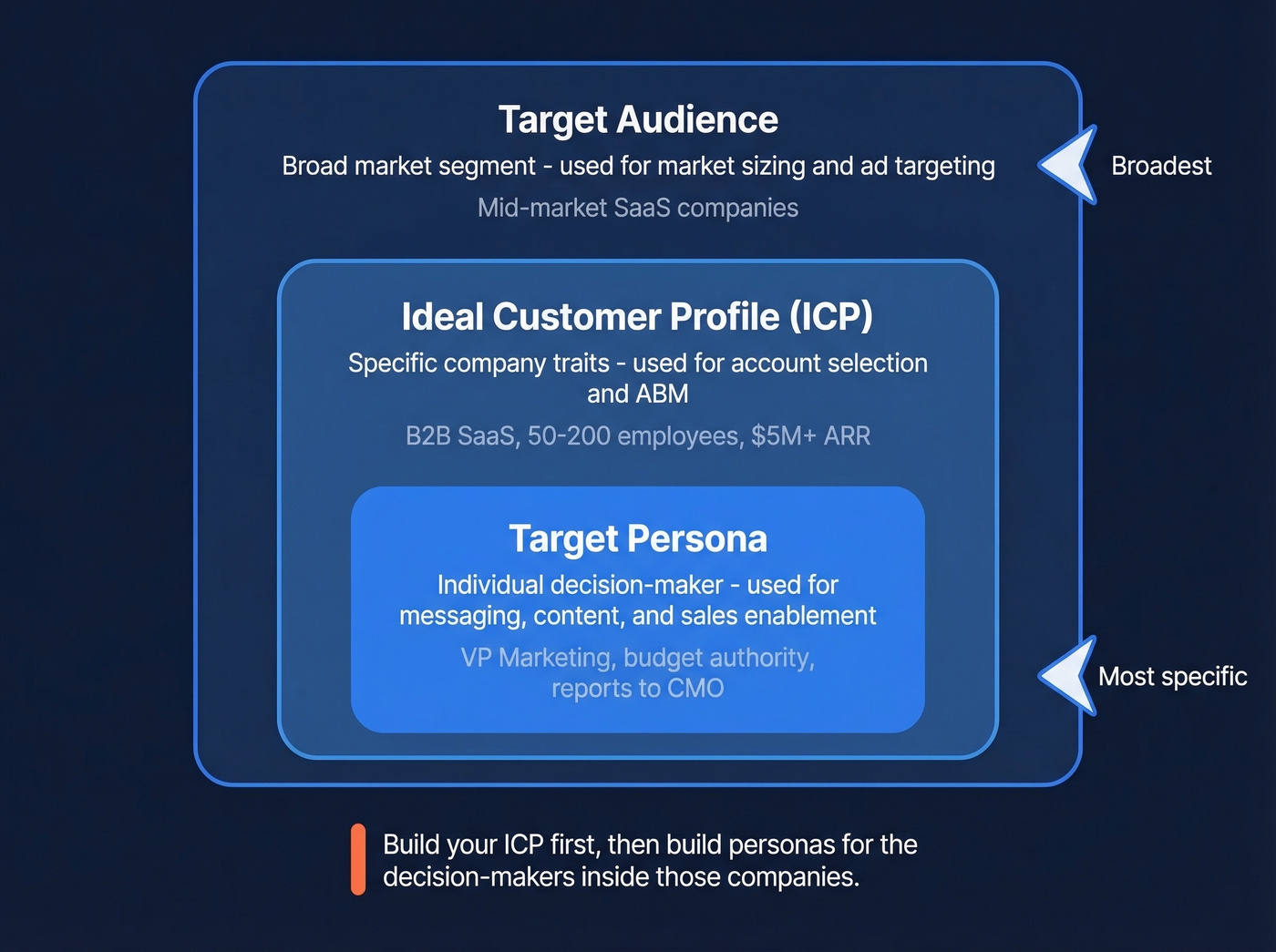
| Target Audience | ICP | Target Persona | |
|---|---|---|---|
| Definition | Broad market segment | Ideal company profile | Decision-maker profile |
| Scope | Industry or category | Specific company traits | Individual buyer |
| Example | "Mid-market SaaS" | "B2B SaaS, 50-200 employees, $5M+ ARR" | "VP Marketing, budget authority, reports to CMO" |
| When to use | Market sizing, ad targeting | Account selection, ABM | Messaging, content, sales enablement |
Build your ICP first - that's the company-level filter. Then build personas for the decision-makers inside those companies. Your ICP should include 7 traits: industry, company size, business model, budget, decision-makers, pain points, and business goals. The persona zooms into the humans behind those traits. If you need a starting point, use an Ideal Customer Profile Template to score and prioritize accounts.
Target audience is the broadest layer. It's useful for paid media and market sizing, but it's too blurry to drive sales conversations or content strategy. You need all three layers working together.
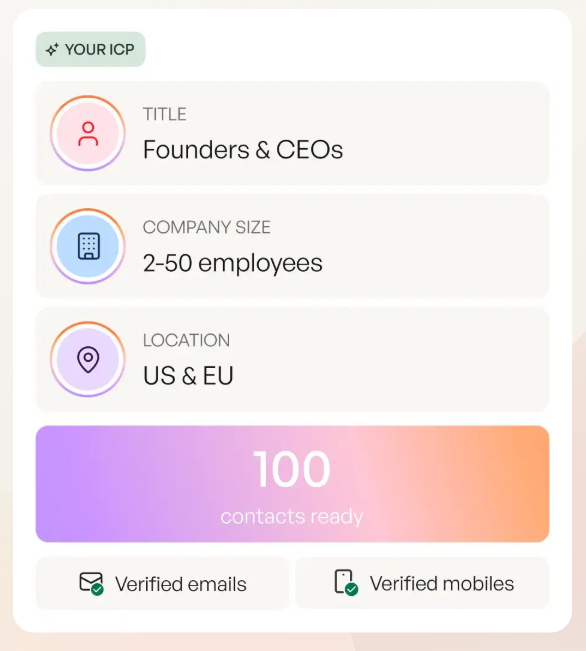
What to Include
B2B and B2C personas share a core structure but diverge on what actually matters. A common practitioner refrain in B2B is blunt: personas built without firmographics and buying committee context are "useless and collect dust." Here's what each type needs.
| Field | B2B | B2C |
|---|---|---|
| Role & seniority | Title, reporting line | Less relevant |
| Company profile | Industry, size, tech stack | N/A |
| Buying committee role | Champion, blocker, influencer | Household decision dynamics |
| Decision criteria | Vendor comparison factors | Price, trust, convenience |
| Goals | Professional KPIs, career motivations | Personal outcomes, lifestyle |
| Pain points | What's broken, what they've tried | Frustrations, unmet needs |
| Objections | Why they'd say no to you | Risk aversion, switching cost |
| Information sources | Analyst reports, peer networks | Social media, reviews, Reddit |
| Psychographics | Attitudes toward risk, innovation | Values, self-perception, identity |
| Emotional triggers | Career impact, team pressure | Status, fear of missing out |
| Real quotes | Verbatim from interviews | Verbatim from interviews |
Notice the psychographics row. Layering in attitudes and self-perceptions - how buyers see themselves and their role - is what separates a persona that informs messaging from one that just describes demographics. A VP of Engineering who sees herself as a "technical founder trapped in management" buys differently than one who identifies as a "scaling leader." That distinction changes your entire pitch.
The cardinal sin in both cases: building a persona that reads like a horoscope. "Sarah is 35, lives in Austin, loves yoga, and values work-life balance" tells you nothing about how to sell to her. If your persona could apply to 50 million people, it's not a persona.
How to Build One Step by Step
Start with Internal Interviews
Before you talk to a single customer, mine the knowledge your team already has. Sales reps, CS managers, and account teams talk to buyers every day. Ask them three questions from the Clariant Creative framework: What questions come up most frequently? What makes buyers happiest, and why? What frustrates buyers, and why?
These conversations surface patterns fast and help you build a hypothesis before customer interviews.
Interview Real Customers
This is the step most teams skip - and it's the one that matters most.
Interview 5-15 people per role. Patterns start emerging after about 5 conversations, and you'll hit saturation well before 15. Analytics show you what buyers do. Interviews reveal why. In one HubSpot example, changing an asset type and headline based on interview feedback lifted conversion rate by 40%. Incorporating behavioral data into your personas can increase conversion rates by up to 73%.
Analyze Behavioral Patterns
Don't just collect quotes - look for behavioral clusters. UXPressia recommends building 8-12 behavioral scales (risk tolerance, research depth, price sensitivity) and mapping each interviewee against them. People who align on 5-9 scales form a natural persona group.
Map the 5 Rings of Buying Insight
Adele Revella's 5 Rings of Buying Insight framework remains the best lens for B2B personas: priority initiatives (what triggered the search), success factors (expected outcomes), perceived barriers (why they won't buy), buyer's journey (how they evaluate), and decision criteria (what makes one option win).
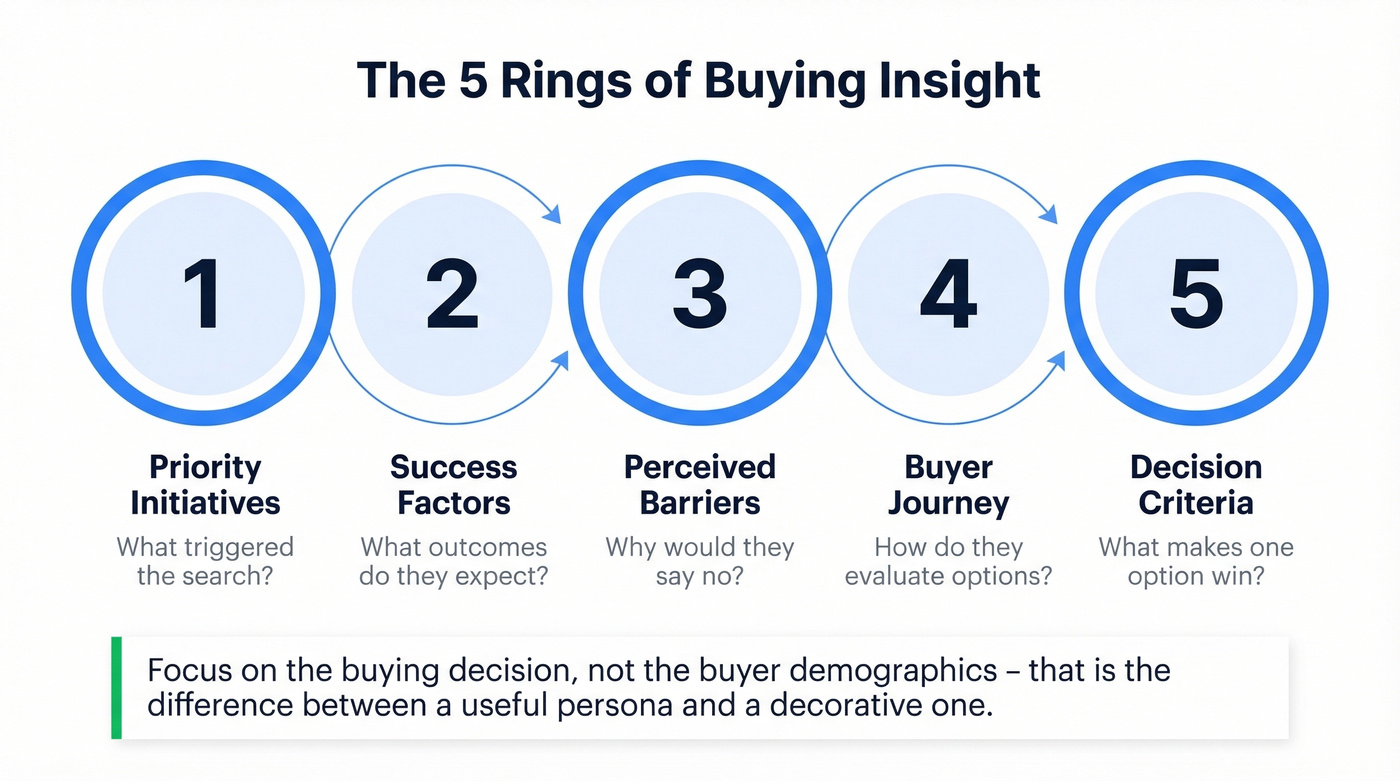
This framework forces you to focus on the buying decision, not the buyer's demographics. That's the difference between a useful persona and a decorative one.
One enrichment technique worth adding: ladder from functional needs to emotional and identity-level motivations. A buyer doesn't just want "faster reporting" - they want to look competent in front of their board. Mapping that chain from feature to identity changes how you write every piece of sales collateral.
Segment, Document, and Validate
Most teams do best with 2-3 prioritized personas. Not 7. Not 10. If two personas share the same objections, decision criteria, and buying journey, they're the same persona with different job titles. Document in whatever format your team will actually open - Notion, PDF, slide deck. Include real customer quotes; verbatim language is more persuasive than your summary.
Let's be honest: if your deals are simple and low-friction, you probably only need one persona. Multi-persona strategies pay off when buying committees, procurement, and segmentation complexity justify the effort. Most early-stage teams would be better served by one deeply researched persona than three shallow ones.
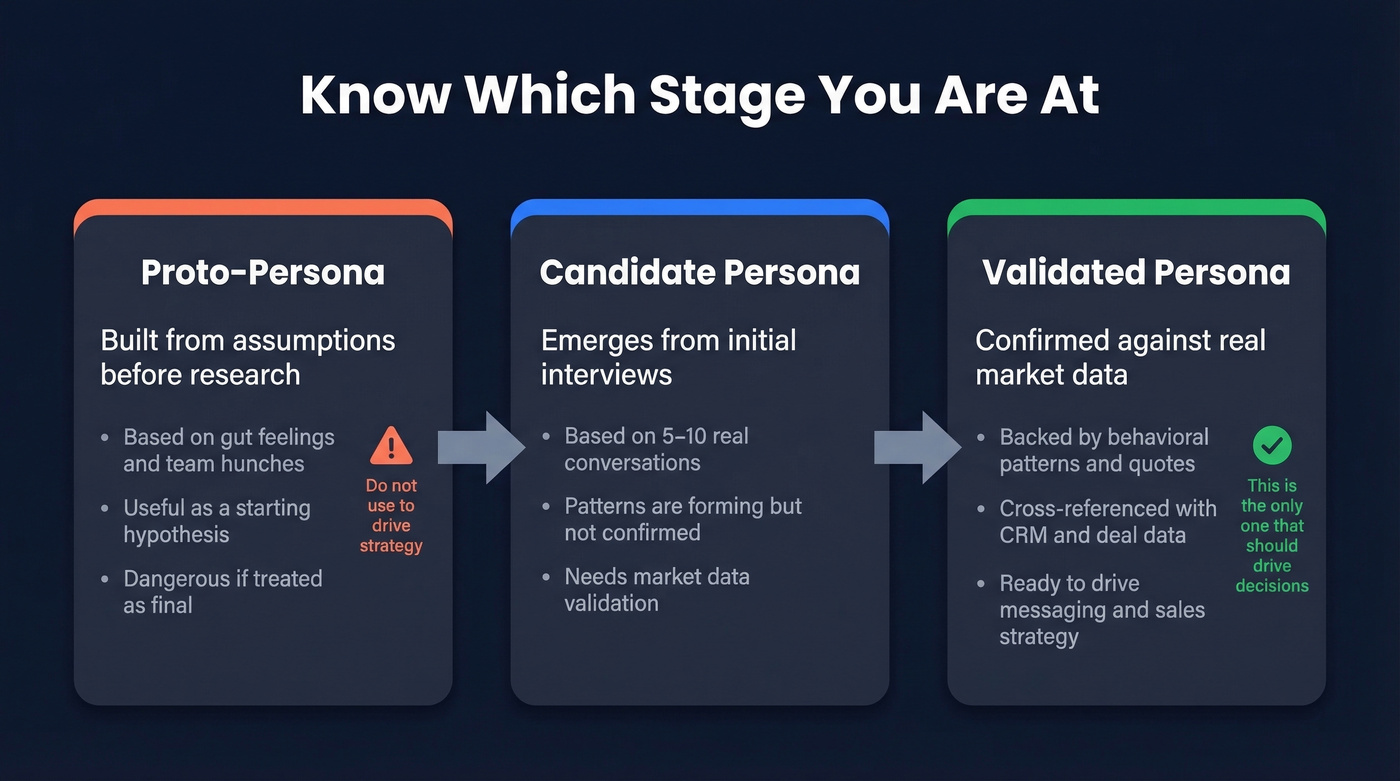
A quick note on persona subtypes. A "proto-persona" is built from assumptions before research - useful as a starting hypothesis but dangerous if treated as final. A "candidate persona" emerges from initial interviews but hasn't been validated against market data yet. Only a validated persona deserves to drive strategy. Know which stage you're at.
Persona Interview Questions to Steal
We've run persona research across dozens of B2B teams, and these questions consistently produce the best insights. Don't read them like a script - the best stuff comes from follow-up questions you didn't plan.
For your internal team:
- What objections come up most often in sales calls?
- Which deals close fastest, and what do those buyers have in common?
- What makes our happiest customers different from churned ones?
- When a deal stalls, what's usually the reason?
For customer interviews - role and context:
- Walk me through a typical week. What takes up most of your time?
- How is your success measured? What metrics does your boss care about?
On the buying decision:
- What triggered you to start looking for a solution like ours?
- Who else was involved in the decision? What did they care about?
- What almost stopped you from buying?
- What other options did you evaluate? Why did you choose us (or not)?
On goals and information sources:
- Where do you go when you're researching a new tool?
- What's the biggest challenge in your role right now?

A persona without real contacts behind it is just a PDF. Prospeo's 30+ search filters - buyer intent, technographics, job changes, department headcount - let you turn every persona field into a live prospect list with 98% verified emails.
Stop describing your ideal buyer. Start reaching them.
Real Persona Examples
B2B - "David, VP of Revenue Operations": David runs RevOps at a Series B SaaS company (80 employees, $12M ARR). His buying trigger: the sales team is complaining about bad data quality, and pipeline coverage is slipping. He evaluates tools based on CRM integration depth, data accuracy, and time-to-value under two weeks. His biggest objection: "We already pay for ZoomInfo - why do we need another tool?" His decision criteria: provable accuracy improvement without a six-month procurement process. If you're building this into outbound, pair the persona with sales prospecting techniques so reps can act on it.
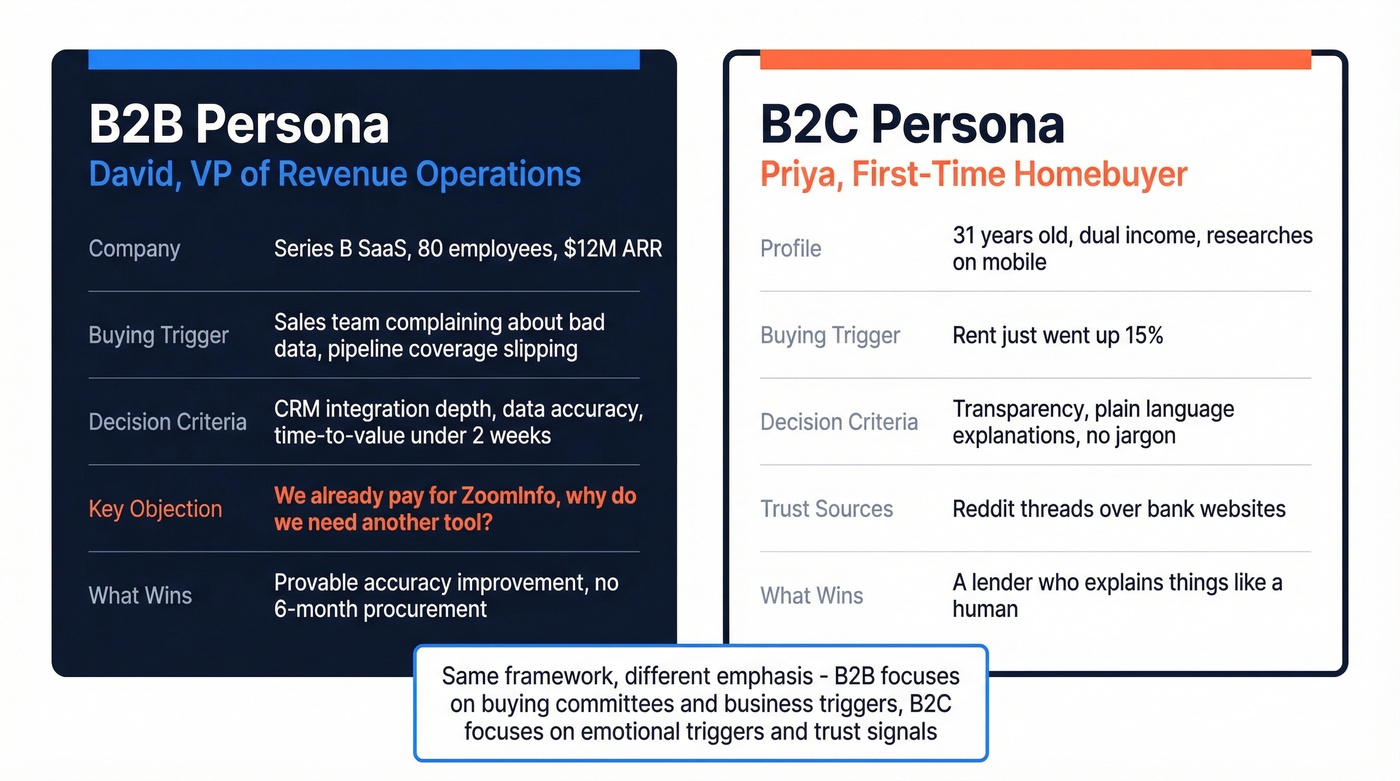
B2C - "Priya, first-time homebuyer": Priya is 31, dual income, researching mortgage options on her phone during her commute. She trusts Reddit threads over bank websites. Her trigger: rent just went up 15%. Her decision criteria: transparency and a lender who explains things without jargon.
David's persona is built around a buying committee, a business trigger, and decision criteria. Priya's is built around an emotional trigger and trust signals. Same framework, different emphasis.
Build a negative persona too - documenting who you don't want to target is just as valuable as defining who you do. Skip this if you're a very early-stage team still figuring out product-market fit; you don't have enough data yet to know who's a bad fit.
Mistakes That Kill Your Personas
Interview real customers before writing anything. Building personas in a conference room based on what marketing thinks buyers care about produces what Reddit calls "fairytale personas" - they collect dust immediately. The consensus on r/sales is pretty clear: if you haven't talked to real buyers, you're guessing.
Focus on buying decisions, objections, and decision criteria. Nobody's marketing persona changed because they learned their buyer "enjoys hiking." Spending half a persona on demographics and hobbies is wasted space.
Create 2-3 personas max. If your sales team can't name your personas unprompted, you have too many. 45% of companies neglect behavioral insights, and it's the single biggest reason personas feel generic. Include how buyers research, evaluate, and decide - not just who they are.
Do this: Update personas every 6 months. Not that: Treat them as a one-time project. Outdated personas can reduce conversion rates by 20-30% compared to maintained ones.
Do this: Include disqualification criteria - who's not a fit. Not that: Make your persona so broad it describes half your addressable market.
Validate Personas with Real Data
A persona document is a hypothesis until you test it against the real market. Run your customer persona criteria as a search in a B2B database - filter by role, industry, company size, intent signals, and technographics. If your persona says "VP of Marketing at SaaS companies with 50-200 employees evaluating new tools," search that exact filter set and see how many real people match.
Too few results? Your persona is too narrow. Too many? You haven't segmented enough. We've used Prospeo's database for exactly this kind of pressure-testing - 30+ search filters across 300M+ professional profiles, including buyer intent powered by 15,000 Bombora topics and a 7-day data refresh cycle, let you validate persona assumptions against live market data instead of guessing. If you're comparing providers, start with B2B company data and data enrichment services to see what "good data" looks like.
Using Personas in Marketing and Sales
Building the persona is only half the work. The other half is making sure it actually shapes how your team operates.
Start by embedding persona language into your content briefs. If your buyer persona says the VP of Marketing cares about "proving ROI to the board," that phrase should appear in your ad copy, landing pages, and case studies. Map each piece of content to a specific persona and a specific stage of their buying journey. When reps prep for calls, they should reference the persona's top objections and tailor their pitch accordingly - not wing it with a generic deck. To make this repeatable, document it in sales battle cards and keep them updated.
In our experience, the teams that get the most value from personas are the ones that treat them as living sales tools, not marketing artifacts. Pin the persona to your CRM dashboard. Add persona-specific objection handling to your sales playbook. If a new rep can't explain your primary persona's top three objections by the end of their first week, something's broken - use a 30-60-90 day plan to operationalize it.
AI Persona Tools Worth Trying in 2026
We evaluated these tools on four criteria: whether they accept inputs beyond demographics, flexibility across B2B and B2C use cases, collaboration features, and export options.
HubSpot Make My Persona
The best free starting point. HubSpot's Make My Persona is completely free - no credit card, no limit on personas. Describe your ideal customer in plain language, and the AI generates a structured persona covering demographics, goals, pain points, information sources, and communication preferences. Export as PDF or share a link. It won't replace real research, but it's a solid framework for organizing what you've learned from interviews.
Other Tools Worth a Look
UXPressia has persona templates and behavioral mapping features, with paid plans starting around $10-$30/user/month. Good for UX and product teams who need visual, research-heavy templates. Xtensio offers persona templates and team collaboration, with individual plans typically in the $10-$20/month range (team plans cost more). Miro isn't a persona tool specifically, but its free plan works well for collaborative persona workshops where you're clustering interview insights in real time.
Keep Personas Alive
The biggest persona failure isn't building a bad one - it's building a good one and never updating it.
46% of teams update personas within 1-4 years, and 28% update quarterly. The teams that update frequently rate their persona effectiveness 5.5 out of 7, compared to 3.9 for infrequent updaters. That gap is enormous.
Set a calendar reminder for every six months. Review win/loss data, re-interview a few customers, and check whether your assumptions still hold. Triggers for an immediate update: M&A activity, entering new markets, regulatory changes, competitive shifts, or a noticeable change in deal velocity. If you're tracking leading indicators, build a simple system for identifying buying signals.
Operationalize your personas or they'll die in a shared drive. Use the persona's actual language - pulled from interview quotes - in ad copy testing. When a new rep onboards, the persona doc should be required reading on day one, not a link buried in a wiki.
You mapped the role, seniority, and company profile. Now validate your persona against real market data. Prospeo's 300M+ profiles let you filter by exact title, company size, tech stack, and intent signals - so you know your persona actually exists at scale.
Validate your persona against 300M+ real professional profiles.
FAQ
How many personas should I create?
Two to three for most teams. Each should represent a meaningfully different buying journey - if two share the same objections and decision criteria, merge them into one.
What's the difference between a persona and an ICP?
An ICP describes the ideal company (industry, size, revenue). A target persona describes the individual decision-maker inside that company - their goals, objections, and how they evaluate vendors.
How do I validate that my persona matches real buyers?
Run your persona criteria through a B2B database - filter by role, industry, company size, and intent signals. If real prospects match your profile, your persona is grounded in reality. Too few results means it's too narrow; too many means you need tighter segmentation.
Can I build a persona without customer interviews?
You can, but it'll be a guess. Analytics show what buyers do - interviews reveal why. Teams that skip interviews produce what practitioners call "fairytale personas" that get ignored within weeks.