

Phone Sales Tips That Actually Work in 2026
A RevOps lead we know ran a call blitz last quarter - 2,000 dials in a week. The team booked 11 meetings. That's a 0.55% conversion rate, which sounds terrible until you realize the industry average isn't much better. Cognism's WHAM report puts the cold call meeting-book rate at roughly 2.4%, down from 4.82% the year before. The problem isn't effort. It's that most tips for phone sales haven't caught up with how prospects actually behave now.
Meanwhile, 46% of unidentified calls go completely unanswered. Prospects screen you because $948M in phone fraud losses trained them to ignore unknown numbers. The reps who still win on the phone aren't dialing harder. They're dialing smarter.
Fix These Three Things This Week
Your opener. State your name, company, and reason for calling in the first 10 seconds. Time-box the ask. Data across 90K+ recorded cold calls shows that stating the reason early - something like "The reason for my call is..." - correlates with 2.1x higher success rates.
Your objection responses. Write down rebuttals to the five stalls that kill your pipeline: "email me instead," "I'm not interested," "I need to talk to my boss," "not now," and "we already have a solution." Rehearse them until they're reflexive. (If you want more reps-ready language, pair this with sales follow-up templates so your post-call emails convert too.)
Your data quality. If 30-40% of your numbers are dead, you're burning two hours of call time for every hour of actual conversations. Verify before you dial. Fix your caller ID reputation. Stop using parallel dialers. This is also where data enrichment services can clean up missing fields before they hit your dialer.
One benchmark to keep in your head: the optimal talk-to-listen ratio is 43% talk, 57% listen. High performers hold that ratio whether they're winning or losing the deal.
2026 Benchmarks Every Caller Needs
| Metric | Benchmark | Source |
|---|---|---|
| Talk/listen ratio | 43% talk / 57% listen | Gong |
| Avg cold call length | ~93 sec | Cognism/WHAM |
| Successful cold call length | ~5 min 50 sec | Gong |
| Meeting-book rate | ~2.4% | Cognism/WHAM |
| Best days to call | Tue / Wed / Thu | ZoomInfo (1.4M calls) |
| Attempts to capture 93% of conversations | 3 calls | Cognism/WHAM |
| Multi-threading win-rate lift ($50K+) | +130% | Gong (1.8M opps) |
| Revenue lift from frequent AI use | +77% | Gong (7.1M opps) |
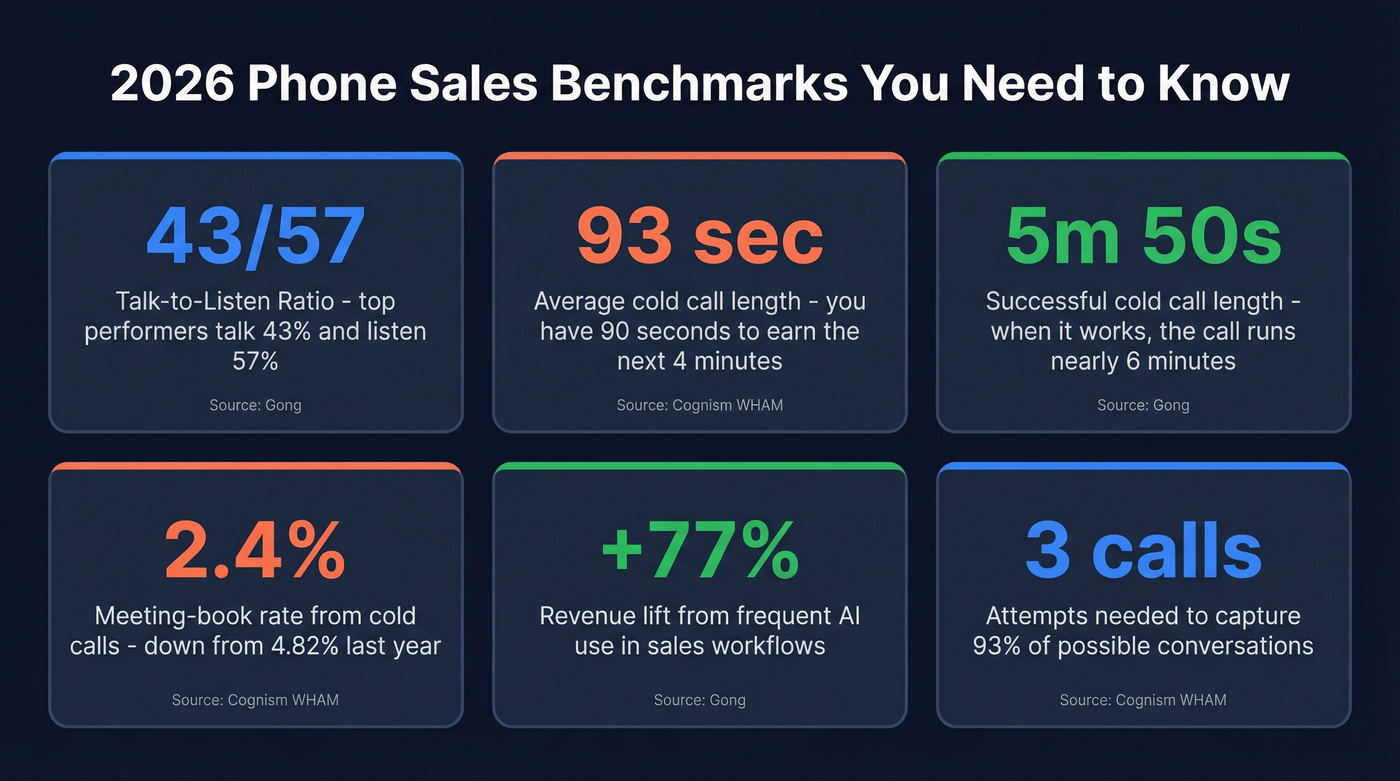
The average cold call lasts 93 seconds. When a cold call actually works, it can run around 5 minutes 50 seconds. That means your first 90 seconds determine whether you earn the other four minutes. Every word matters.
The ZoomInfo timing study confirms what most reps intuit: Tuesday through Thursday are the money days, with Tuesday and Wednesday alone driving 44% of total demos. In EMEA markets, Wednesday shows particularly strong connect rates and call-to-demo conversion. Friday is dead.
Here's the stat nobody's talking about: sellers who frequently use AI generate 77% more revenue than those who don't. Record your calls, feed them into conversation intelligence, and review them weekly. It's the fastest self-improvement loop available right now. (If you're building a repeatable outbound motion, align this with a broader set of sales prospecting techniques so calls and emails reinforce each other.)
The 7-Step Call Flow That Books Meetings
Step 1 - Two-Minute Pre-Call Research
You need three things: the prospect's role and reporting line, one company trigger (funding round, hiring spree, new product launch), and one personal trigger (job change, promotion, conference talk). Two minutes on their company page and professional profile gets you there. If your team struggles to define who to call, start with an ideal customer profile so research time stays under two minutes.
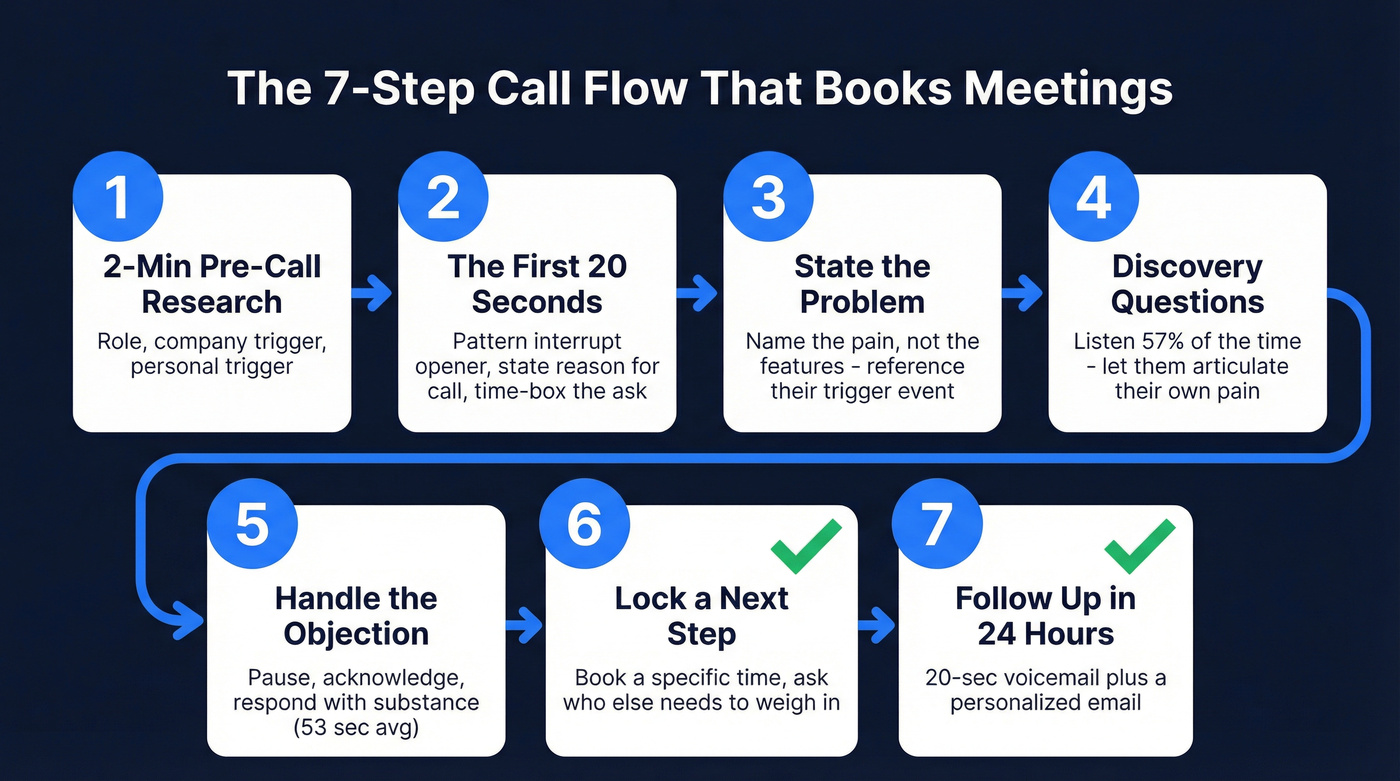
Step 2 - The First 20 Seconds
This is where most calls die. Data across 90K+ recorded cold calls is unambiguous: stating "The reason for my call is..." early correlates with 2.1x higher success. Opening with "Did I catch you at a bad time?" drops your odds by 40%. The pattern-interrupt opener "How've you been?" performs 6.6x better than calls without it.
Here's a template that combines all three signals:
"Hey [Name], it's [Your Name] with [Company]. How've you been? ... Look, I know I'm calling out of the blue - the reason for my call is [one-sentence problem statement]. In just three minutes, I can show you whether this is worth a longer conversation. Does that sound fair?"
The time-box ("three minutes... does that sound fair?") works because it gives the prospect permission to leave. Paradoxically, that makes them more likely to stay. If you want more variations, steal a few talk track examples and A/B test them by persona.
One thing most guides skip: stand up when you dial. Smile, even though nobody can see you. Vary your pace to match the prospect's energy. The phone is an audio-only medium - your vocal tone, cadence, and breathing are the entire first impression. A flat monotone kills calls faster than a bad opener.
Step 3 - State the Problem
Don't pitch features. Name the pain.
"We're seeing a lot of [role] teams at [company size] struggle with [specific problem] - especially after [trigger event]." This frames you as someone who understands their world, not someone reading a script. Watch your word choices too: "investment" lands better than "cost," "partnership" beats "contract." Language framing shapes how prospects feel about the conversation before they've processed the logic.
Step 4 - Discovery Questions
Here's where the 43/57 ratio matters most. Analysis of 1.8M opportunities found that low performers' talk time swings from 54% on won deals to 64% on lost ones. The discipline is in the listening.
Use Clari's discovery framework as a starting point: What solution are you using today? What are your top three complaints about it? What's the business impact if nothing changes? These questions force the prospect to articulate their own pain, which is far more persuasive than you articulating it for them. For a deeper bank of prompts, keep a short list of discovery questions next to your objection matrix.
Step 5 - Handle the Objection
Every cold call hits a wall. The five most common stalls - "email me instead," "I'm not interested," "I need to talk to my boss," "not now," and "we already have a solution" - account for the vast majority of dead calls.
The full objection matrix is below. The key principle: don't rush the rebuttal. Successful cold call monologues average 53 seconds versus 25 seconds on failed calls. Take a breath, acknowledge the objection, and respond with substance. (If this is a recurring issue, build a simple playbook to reduce sales objection rate across the whole team.)
Step 6 - Lock a Specific Next Step
Your goal isn't to close on the first call. It's to earn a calendar invite and a second stakeholder. Analysis of 1.8M opportunities shows closed-won deals have roughly 2x as many buyer contacts as closed-lost. Before you hang up, ask: "Who else would need to weigh in on this?" Then book a specific time - "Tuesday at 2pm, and can we include [stakeholder]?"
Step 7 - Follow Up Within 24 Hours
If you get voicemail, keep it to 20 seconds: your name, company, the problem you solve, and your callback number. Then send the email. Reference something specific from the call. Three attempts capture 93% of possible conversations; after five with no response, move on. If you need a system for this, use a lightweight sequence management approach so follow-ups don't depend on memory.
The 5 Objection Scripts You Need
Print this matrix and tape it to your monitor.
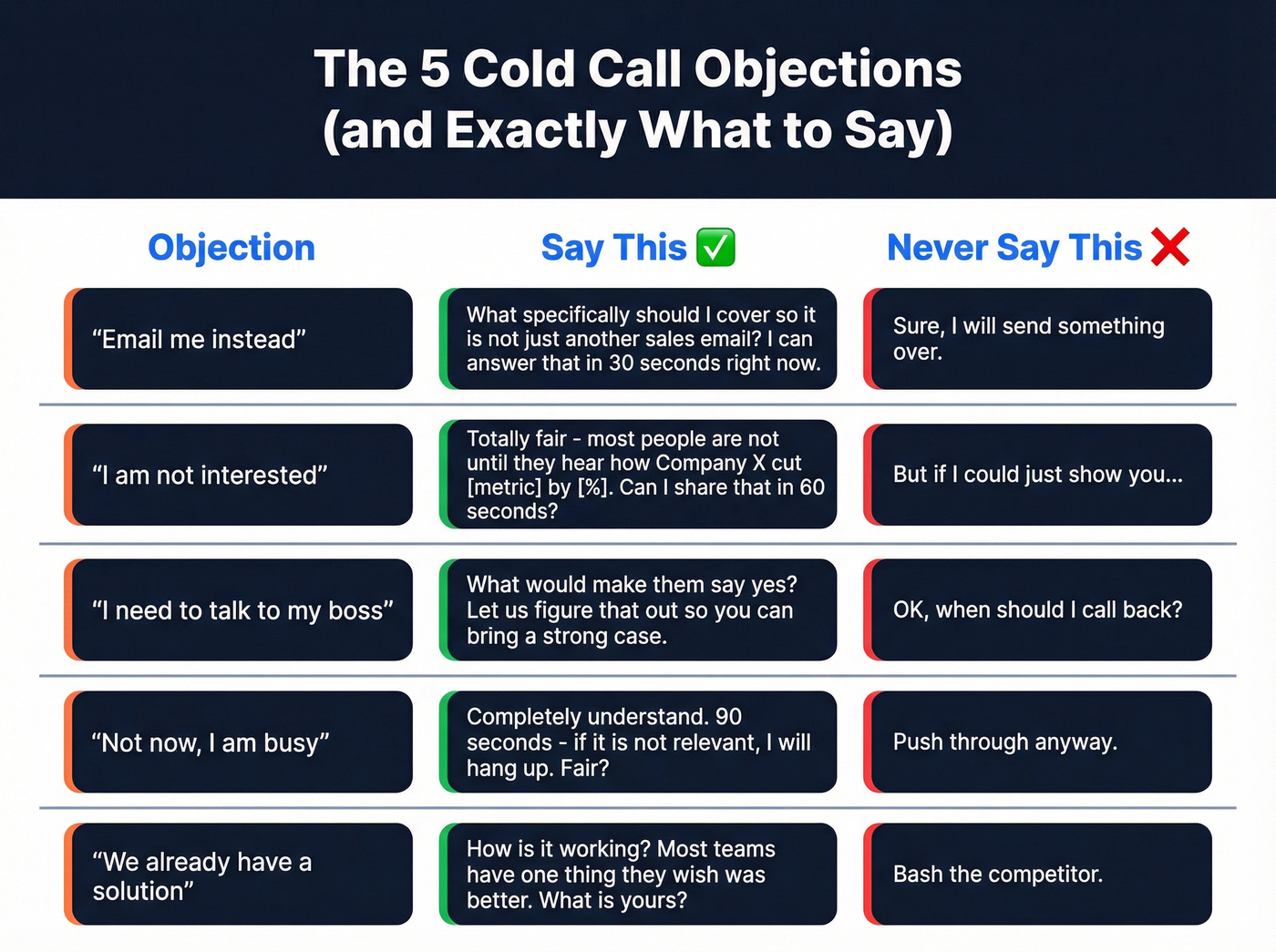
"Email me instead"
Say: "Happy to - what specifically should I cover so it's not just another sales email? Actually, I can answer that in 30 seconds right now."
Never: "Sure, I'll send something over." You'll never hear back.
"I'm not interested"
Say: "Totally fair - most people aren't until they hear how [Company X] cut [metric] by [%]. Can I share that in 60 seconds?"
Never: "But if I could just show you..." That's desperation talking.
"I need to talk to my boss"
Say: "Makes sense - what would make them say yes? Let's figure that out so you can bring a strong case. Can we loop them in Thursday?"
Never: "OK, when should I call back?" No commitment, no progress.
"Not now / I'm busy"
Say: "Completely understand. I'll be brief - 90 seconds. If it's not relevant, I'll hang up. Fair?"
Never: Push through anyway. You just became the annoying caller.
"We already have a solution"
Say: "Great - how's it working? Most teams I talk to have one thing they wish was better. What's yours?"
Never: Bash the competitor. Psychologists call it spontaneous trait transference - negative traits you assign to others get attributed to you.

You just read that 30-40% dead numbers waste two hours of call time for every hour of real conversations. Prospeo's 125M+ verified mobile numbers deliver a 30% pickup rate - nearly 3x the industry average. Every number is refreshed on a 7-day cycle so you're never dialing stale data.
Fix your data before your next call blitz.
When to Call (and When to Stop)
| Day | Verdict | Why |
|---|---|---|
| Monday | Efficient (low volume, high conversion) | 1.19% call-to-demo rate; 4.8% positive rate |
| Tue-Thu | Best overall | 44% of demos on Tue+Wed alone |
| Friday | Skip | Worst across all metrics |
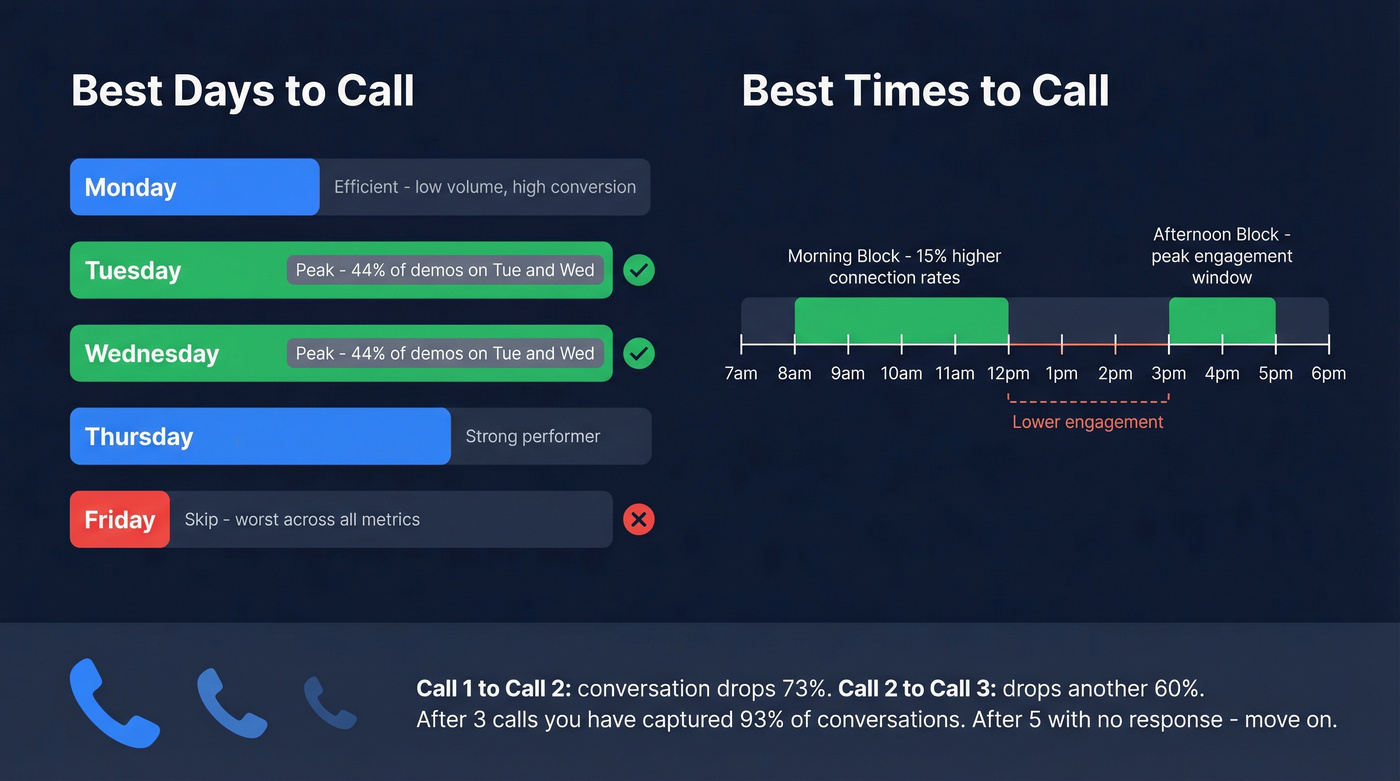
For time of day, an InsideSales study cited by Revenue.io found 8-11am local time delivers 15% higher connection rates, while Revenue.io's own data shows peak engagement at 4-5pm. The practical answer: run two call blocks per day in your prospect's local time zone - one mid-morning, one late afternoon. Test which window converts better for your persona. Vary your callback times too, because prospects learn to screen calls that arrive at the same time each day.
For attempt cadence, conversation likelihood drops 73% between call one and call two, then another 60% by call three. By the third attempt, you've captured 93% of all possible conversations. After five attempts with no conversation, stop and move to the next account.
How to Boost Answer Rates
Look, this is the part that frustrates us most. FTC Consumer Sentinel 2024 recorded 284,659 phone fraud reports totaling $948M in losses. That's the world your cold call enters. Prospects aren't ignoring you personally - they're ignoring every unknown number.
STIR/SHAKEN authentication was supposed to fix this. The originating carrier creates a digital token verifying your identity, and the terminating carrier validates it. In practice, analytics-based reputation scoring still mislabels legitimate business numbers as spam. Authentication helps, but it doesn't solve the problem.
What actually tanks your answer rates: parallel dialers. PhoneBurner's research flags the core issue - when a parallel dialer connects, there's a dead-air delay after the prospect says "hello." That pause triggers both hangups and spam-flag algorithms. Use a single-line power dialer instead. Monitor your caller ID reputation weekly. And before you run any call block, verify the numbers are actually active. (If you're building the stack around this, start with a simple cold calling system so tools and process match.)
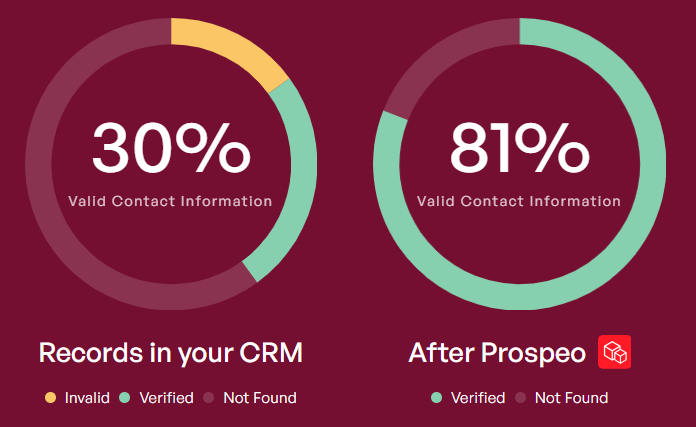
We've seen teams double their connect rates just by switching from stale purchased lists to verified mobile data. Prospeo's 125M+ verified mobile numbers refresh every 7 days and deliver a 30% pickup rate - so you're spending time on real contacts instead of dead ends.
Skip the $30K conversation intelligence platform if your average deal size is under $25K. You probably don't need it. But you absolutely need clean phone data. Most teams overspend on call analytics and underspend on the numbers they're actually dialing. Fix the inputs before you optimize the process. (For a broader view of what to buy, compare a few SDR tools before you commit.)
Multi-Thread the Account
Single-threading is the silent killer of pipeline. Across 1.8M opportunities, 77% of deals involve multiple contacts. Closed-won deals have roughly 2x as many buyer contacts as closed-lost. Multi-threading boosts win rates by 130% on deals over $50K.
The practical move: after every call, ask "Who else is involved in this decision?" Map the buying committee before the second meeting. If your champion says "I'll handle it internally," that's a red flag, not a green light. Get the economic buyer, the technical evaluator, and the end user on separate threads. In our experience, the deals that stall longest are almost always single-threaded - one champion goes on vacation or changes priorities, and the whole opportunity evaporates. (This is also a core motion in account-based selling.)
Compliance Essentials
TCPA violations cost $500-$1,500 per call. DNC fines hit $53,088 per violation. These aren't theoretical risks - they're budget-destroying penalties that accumulate fast on high-volume dial operations.
Caller ID: Transmit accurate caller ID on every call. Make required disclosures upfront.
Do Not Call: Scrub against both the National DNC registry and your entity-specific DNC list before every campaign.
TCPA consent: The FCC ruled that AI-generated voices count as "artificial voices" under TCPA - consent requirements apply to any AI-assisted calling.
Opt-out: Honor opt-out requests via any reasonable method within 10 business days. The one-to-one consent rule takes effect April 2026.
B2B nuance: Some B2B solicitation calls have TSR exemptions, but don't assume you're exempt. Check your specific use case.
Multi-threading lifts win rates by 130% on deals over $50K. But you can't multi-thread without direct dials for every stakeholder. Prospeo gives you verified emails and mobile numbers for entire buying committees - at $0.01 per email and 10 credits per mobile, with 98% email accuracy.
Reach the full buying committee, not just one gatekeeper.
FAQ
What's a good cold call success rate in 2026?
The current benchmark is roughly 2.4% meeting-book rate, down from 4.82% the prior year. Top performers exceed this through better openers, smarter timing, and cleaner data. If you're consistently above 3%, you're outperforming most teams.
How many times should I call before giving up?
Five attempts maximum. You capture 93% of possible conversations by call three and 98.6% by call five. After that, additional dials produce nearly zero incremental conversations. Redirect that energy to fresh accounts.
What's the best opening line for a sales call?
State your name, company, and reason for calling within the first 10 seconds. Data shows "The reason for my call is..." correlates with 2.1x higher success rates. Never open with "Did I catch you at a bad time?" - that drops your odds by 40%.
How do I stop my calls from showing as spam?
Avoid parallel dialers - the dead-air delay after "hello" triggers spam-flag algorithms. Use a single-line power dialer, monitor your caller ID reputation weekly, and verify your numbers are active before dialing. A 7-day refresh cycle on your contact data makes a real difference here, since stale numbers that ring to disconnected lines or reassigned phones are exactly what tanks your caller reputation over time.
What are the highest-impact phone selling techniques for 2026?
Fix your opener (state the reason for your call immediately), clean your data (verify numbers before dialing), and multi-thread every deal (engage 2-3 contacts per account). Layer in vocal delivery - stand up, smile, match the prospect's energy - and you'll outperform the vast majority of reps still running the same playbook from five years ago.