

What a Top Sales Performer Actually Does Differently (Backed by Data)
It's 9:15 AM. You've already updated three Salesforce records, replied to a Slack thread about a deal going nowhere, and sat through a 30-minute "quick sync." You haven't made a single call. Meanwhile, the rep two desks over has already booked a discovery meeting and is halfway through her call block. The difference between you and her isn't talent - it's structure.
The Quota Crisis in Numbers
Most salespeople don't hit quota. RepVue's Cloud Sales Index puts attainment at 43.5%. Forrester pegs average B2B attainment at roughly 47%. Ebsta x Pavilion's benchmarks show 69% of reps fell short, meaning only 31% hit their number.
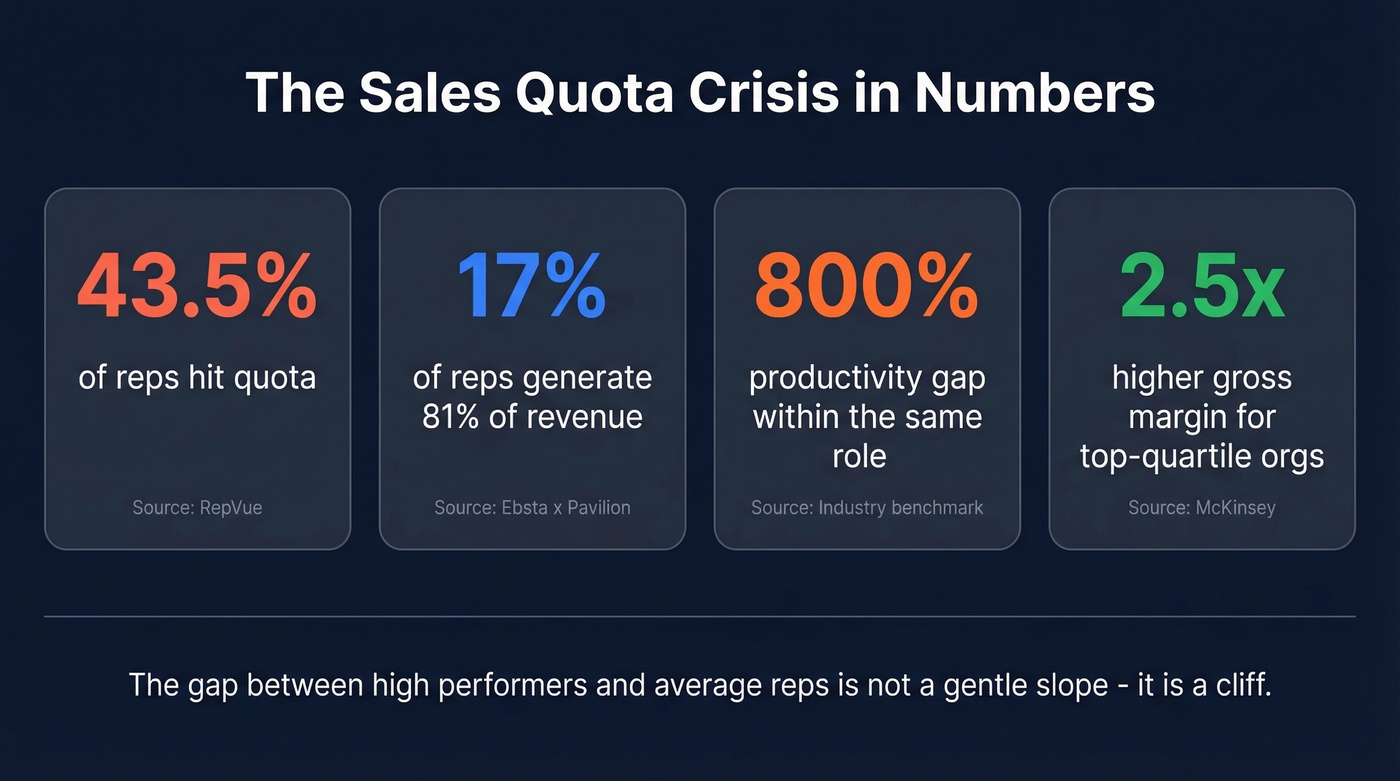
The gap between high performers and average reps isn't a gentle slope. It's a cliff. Ebsta found that 17% of reps generate 81% of revenue - and one widely-circulated benchmark puts the productivity gap as high as 800% within the same role. McKinsey's analysis of roughly 500 B2B companies tells the same story at the org level: top-quartile organizations produce 2.5x higher gross margin per dollar invested in sales compared to the bottom quartile.
You don't need more sales training. You need fewer non-selling tasks, better data, and a system that protects your selling time. That's what the top 17% actually do differently.
TL;DR - Three things that move the number most:
- Protect your first two hours for prospecting. Nothing matters as much as uninterrupted outbound activity before 10 AM.
- Adopt AI tools now. Sellers using AI are 3.7x more likely to hit quota. That's not a rounding error - it's a career advantage.
- Fix your data before your process. Every bounced email and disconnected number is wasted selling time.
What Separates Top Performers from Average Reps
You've read 50 articles telling you to "believe in your product" and "build rapport." Here's what actually moves the number.
Gong's analysis of over 1 million sales calls found that top performing salespeople have business-value conversations 52% more often than below-quota peers. They're not better at small talk - they're better at connecting what they sell to what the buyer cares about. Every call has a commercial purpose.
Process matters more than personality. CSO Insights found that companies with a defined sales process see 18% higher revenue growth, yet only 48% of organizations actually have one that's consistently applied. Half the sales floor is winging it.
Then there's time allocation. McKinsey found that underperformers spend more than 50% of their time on accounts contributing 20% or less of revenue. Elite reps flip that equation - they ruthlessly prioritize high-value accounts and offload everything else. Leaders who shift non-selling tasks to shared services and automation free up roughly 20% more capacity and improve productivity by up to 30%.
| Metric | Average Rep | Top Performer | Source |
|---|---|---|---|
| Quota attainment | 43.5% | 100%+ consistently | RepVue |
| Time selling | ~30-40% | Higher via prioritization + less admin | Salesforce / McKinsey |
| Value conversations | Baseline | 52% more frequent | Gong |
| Prospecting agent adoption | Low | 1.7x higher | Salesforce |
| Lead response time | 47 hours avg | Under 5 minutes | HBR |
| Defined process | 48% consistently applied | Defined + consistently followed | CSO Insights |
Here's the thing: the biggest predictor of quota attainment isn't skill. It's how a rep spends the hours between 8 and 10 AM. We've watched teams transform their pipeline numbers by doing nothing more than blocking those two hours from meetings and Slack. No new training, no new tools - just protected selling time.
The Ideal Daily Routine
Parkinson's Law is real: work expands to fill the time available. High performers don't let it. They time-block their day so revenue-generating activity happens first, and admin gets squeezed into whatever's left.
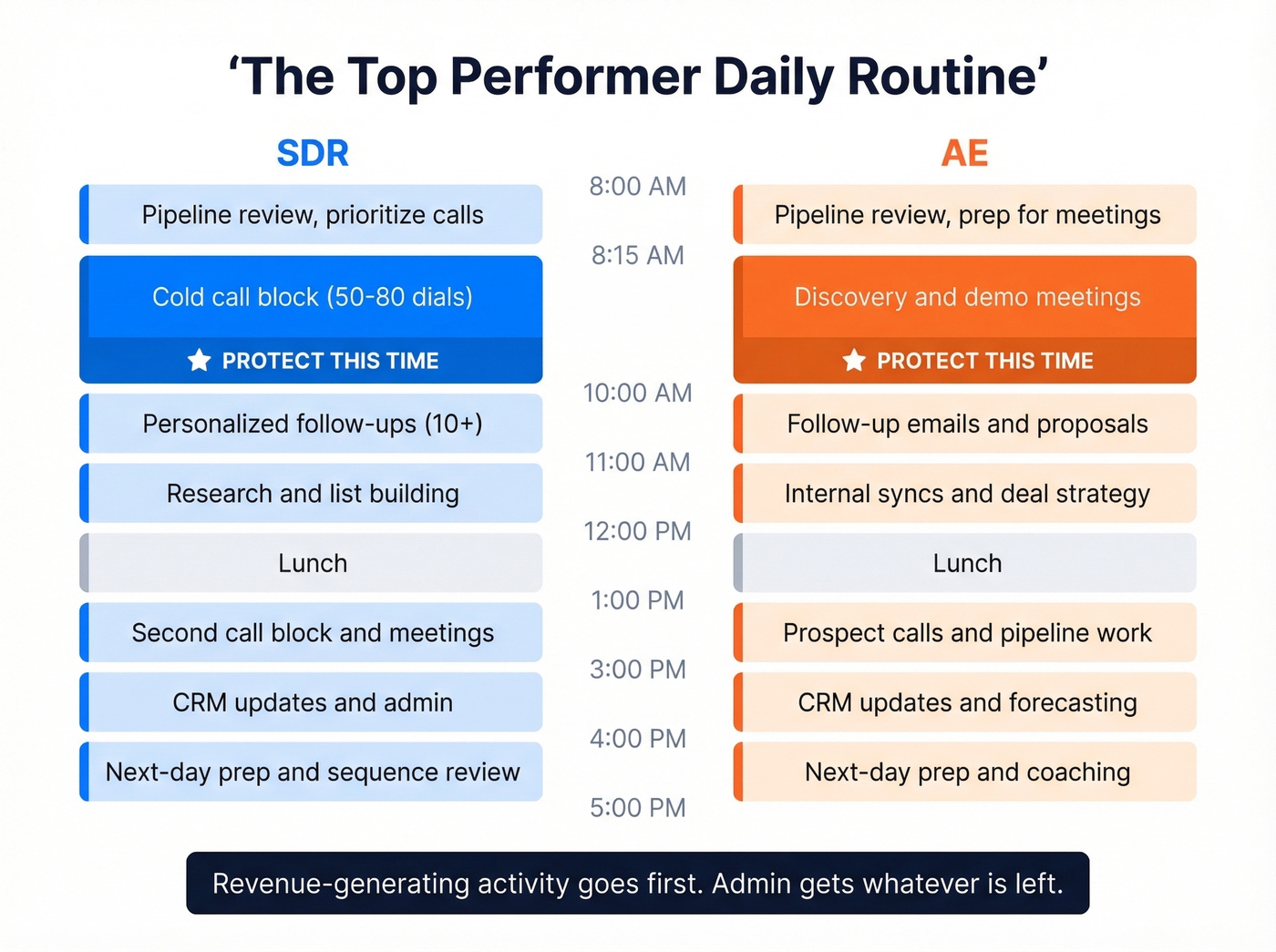
| Time Block | SDR | AE |
|---|---|---|
| 8:00-8:15 | Pipeline review, prioritize calls | Pipeline review, prep for meetings |
| 8:15-10:00 | Cold call block (50-80 dials) | Discovery/demo meetings |
| 10:00-11:00 | Personalized follow-ups (10+) | Follow-up emails, proposals |
| 11:00-12:00 | Research + list building | Internal syncs, deal strategy |
| 12:00-1:00 | Lunch | Lunch |
| 1:00-3:00 | Second call block + meetings | Prospect calls + pipeline work |
| 3:00-4:00 | CRM updates, admin | CRM updates, forecasting |
| 4:00-5:00 | Next-day prep, sequence review | Next-day prep, coaching |
That 10-15 minute pipeline review first thing isn't optional. It's the difference between calling your best prospects at 8:15 versus realizing at 2 PM that you spent the morning on dead leads. Roughly 60% of a rep's time goes to non-selling tasks, so every minute you claw back from admin and internal meetings is a minute generating pipeline.
If you want a tighter playbook for that morning block, start with proven sales prospecting techniques and a short list of high-leverage sales activities.
The AI Edge in 2026
High performers are 1.7x more likely than underperformers to use prospecting agents. Sellers partnering with AI tools are 3.7x more likely to meet quota. These aren't projections - they're current numbers from Salesforce's State of Sales report.
The results are already showing up in production. Salesforce's own SDR agent created 3,200 opportunities in four months by working leads that human reps had scored too low to bother with. That's pipeline from what was essentially sawdust.
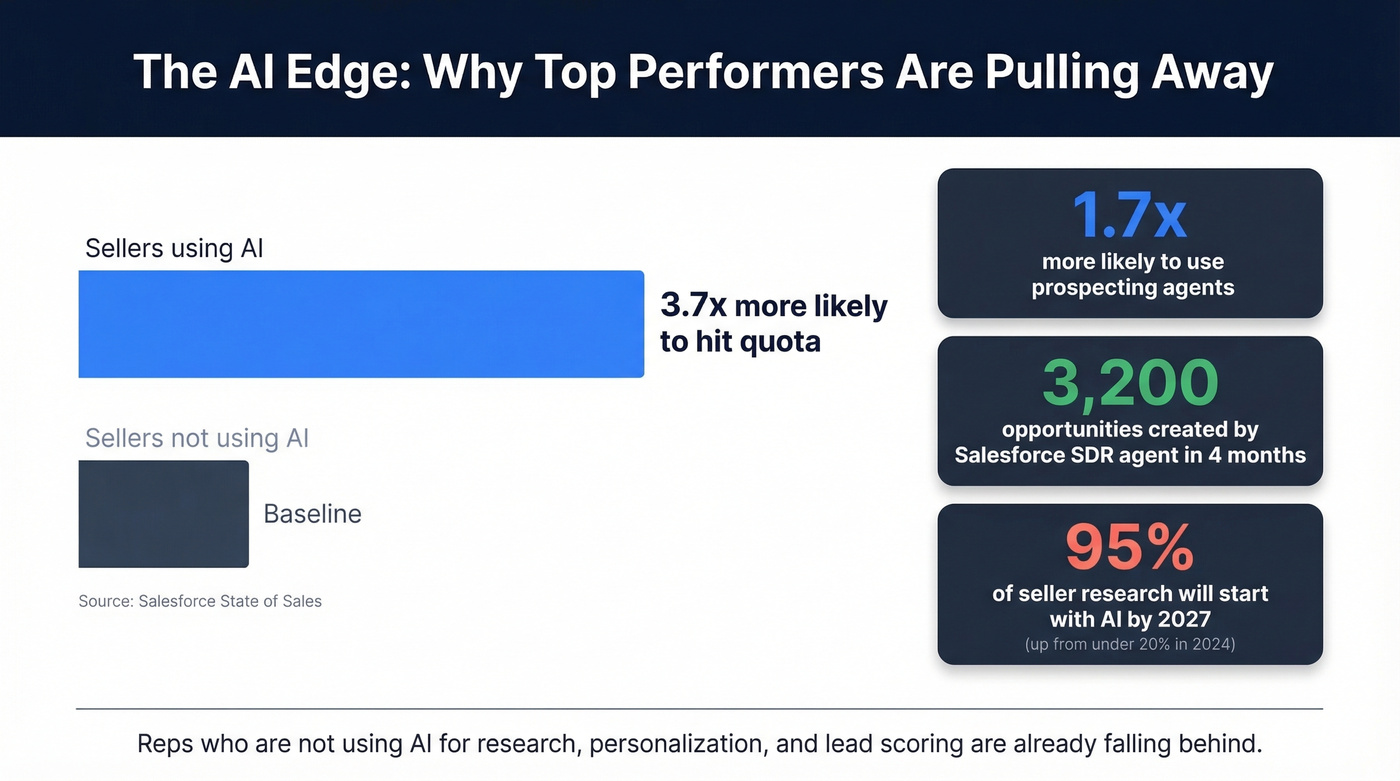
Gartner's research also found that sellers who gather buyer intelligence through AI increase account growth by 5% - a modest-sounding number that compounds fast across a full book of business. By 2027, 95% of seller research workflows will begin with AI, up from less than 20% in 2024. We're in the middle of that shift right now. Reps who aren't using AI for account research, email personalization, and lead scoring are already falling behind. They just don't see it in their numbers yet.
If you're building this into your workflow, focus on tools that improve follow-up quality and speed, like AI sales follow-up and best AI for automating sales follow-ups.

Sellers using AI are 3.7x more likely to hit quota - but AI is only as good as the data feeding it. Prospeo gives you 300M+ profiles with 98% email accuracy, 125M+ verified mobiles, and buyer intent across 15,000 topics. All refreshed every 7 days, not 6 weeks. That's the data layer top performers actually build on.
Stop feeding bad data into good workflows. Start with Prospeo free.
The Hidden Performance Killer: Bad Data
Let's be honest about something most sales content ignores. You just ran a 50-contact call block. Eighteen numbers were disconnected. Seven emails bounced. You spent 90 minutes and reached maybe 15 actual humans. That's not a prospecting problem - it's a data problem.
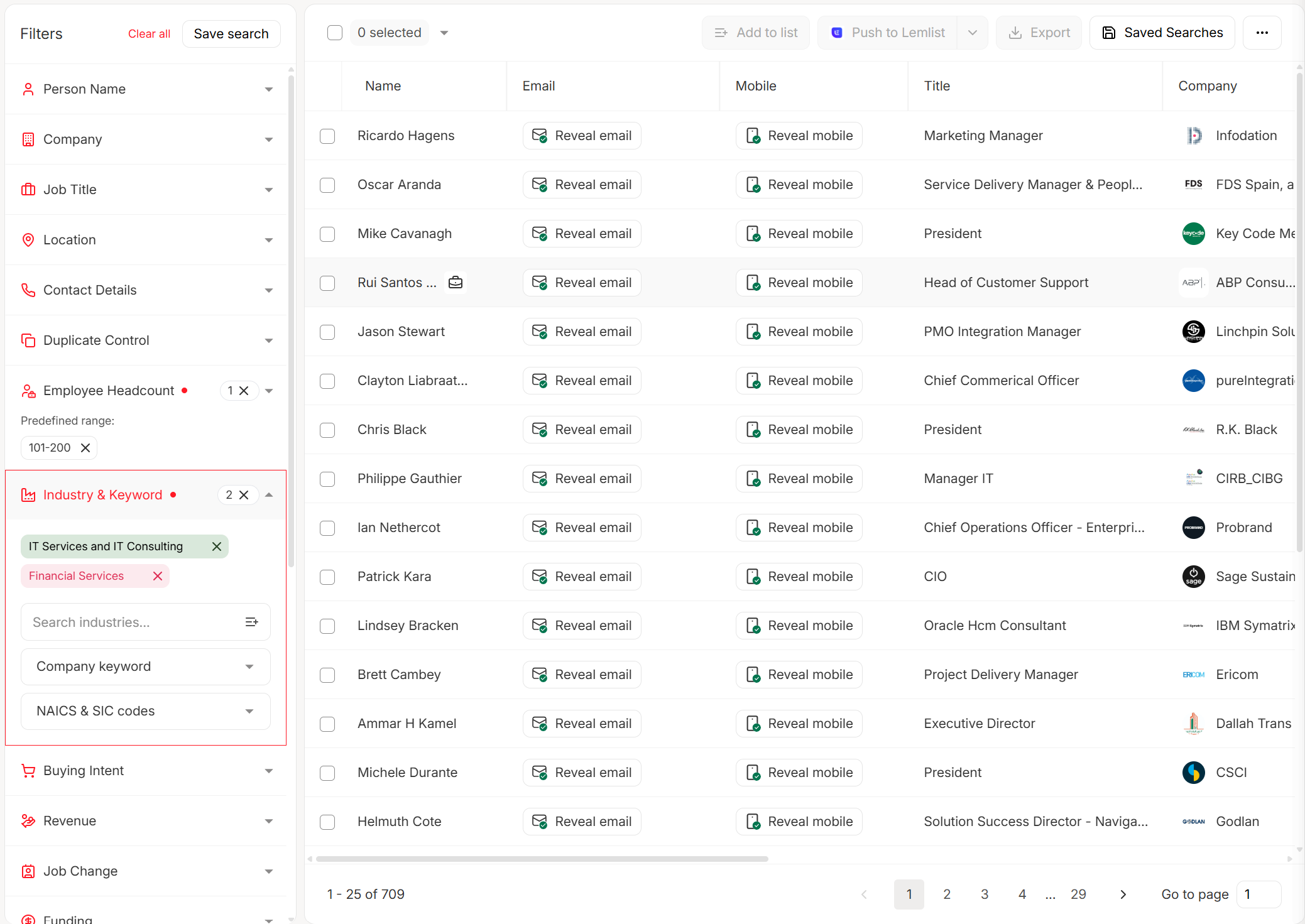
A huge chunk of that 60% non-selling time gets eaten by bad contact data - disconnected numbers, bounced emails, outdated titles. Every bad record chips away at the selling time you fought to protect with your morning time block.
In our experience, the fastest way to reclaim that time is fixing data quality at the source. Prospeo's 98% email accuracy, 30% mobile pickup rate, and 7-day data refresh cycle (versus the six-week industry average) address exactly this. Snyk's 50-person AE team saw the impact firsthand: bounce rates dropped from 35-40% to under 5%, and AE-sourced pipeline jumped 180% with over 200 new opportunities per month. That's what happens when reps stop wasting dials on dead numbers.
If you're seeing bounces, start by benchmarking and fixing your email bounce rate and tightening your email deliverability before you scale volume.
Snyk's 50 AEs dropped bounce rates from 35-40% to under 5% and generated 200+ new opportunities per month. The fix wasn't a new playbook - it was replacing bad contact data with Prospeo's 98% accurate emails and verified direct dials. At $0.01 per email, every rep on your team can prospect like the top 17%.
Reclaim your morning call block. Every number verified, every email deliverable.
Five Mistakes That Keep Average Reps Average
1. Chasing the wrong deals. Gong's million-call dataset shows top performers qualify harder and walk away faster. Average reps cling to bad-fit opportunities because an empty pipeline feels worse than a slow one. It shouldn't.
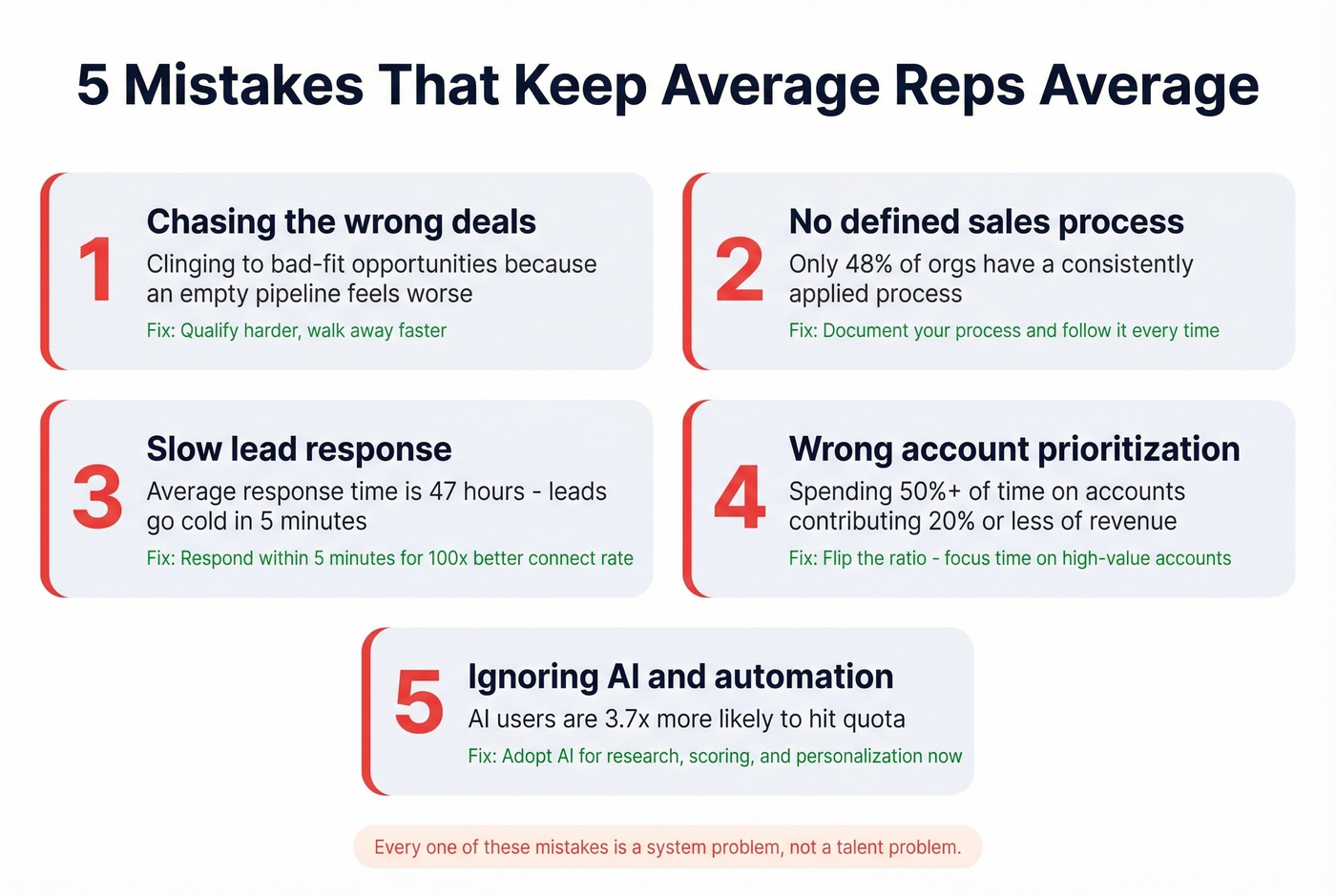
2. No defined sales process. Only 48% of organizations have a consistently applied process. Without one, every rep invents their own - and most of those inventions don't work.
3. Slow lead response. HBR research found that responding within 5 minutes makes you 100x more likely to connect than responding in 30 minutes. The average response time? 47 hours. That's not a follow-up - it's a forgotten lead.
4. Spending time on the wrong accounts. Underperformers burn more than half their time on accounts contributing 20% or less of revenue. Flip the ratio or stay average.
5. Ignoring AI and automation. With a 3.7x quota attainment advantage for AI-adopting sellers, skipping these tools isn't "keeping it old school." It's leaving money on the table. Skip this mistake if you want to skip being average.
To tighten execution here, standardize your messaging with sales follow-up templates and keep your pipeline clean with a real 30-60-90 day plan for sales reps.
How Top Producers Build Their Teams
Sales managers: if 78% of reps missed quota last quarter, the problem isn't the reps. It's the system.
Only 5% of a manager's time goes to coaching. The rest gets absorbed by forecasting calls, pipeline reviews, and CRM audits that measure activity - not execution quality. Your dashboard shows how many calls a rep made, but not whether they asked the right questions. That's a frustrating gap, and it's one most orgs refuse to close because dashboards feel productive even when they aren't.
Three things that actually move team performance:
- Audit where reps spend time and kill low-value account work. If your team mirrors McKinsey's findings, more than half their hours are going to accounts that barely matter.
- Dedicate 30 minutes per rep per week to deal-level coaching - not pipeline review, actual coaching on execution and positioning. There's a massive difference.
- Eliminate data friction so selling hours are actually spent selling. Shifting non-selling work into shared services and automation can free up around 20% more capacity.
The Right Sales Tech Stack
You don't need 15 tools. You need four that work together:
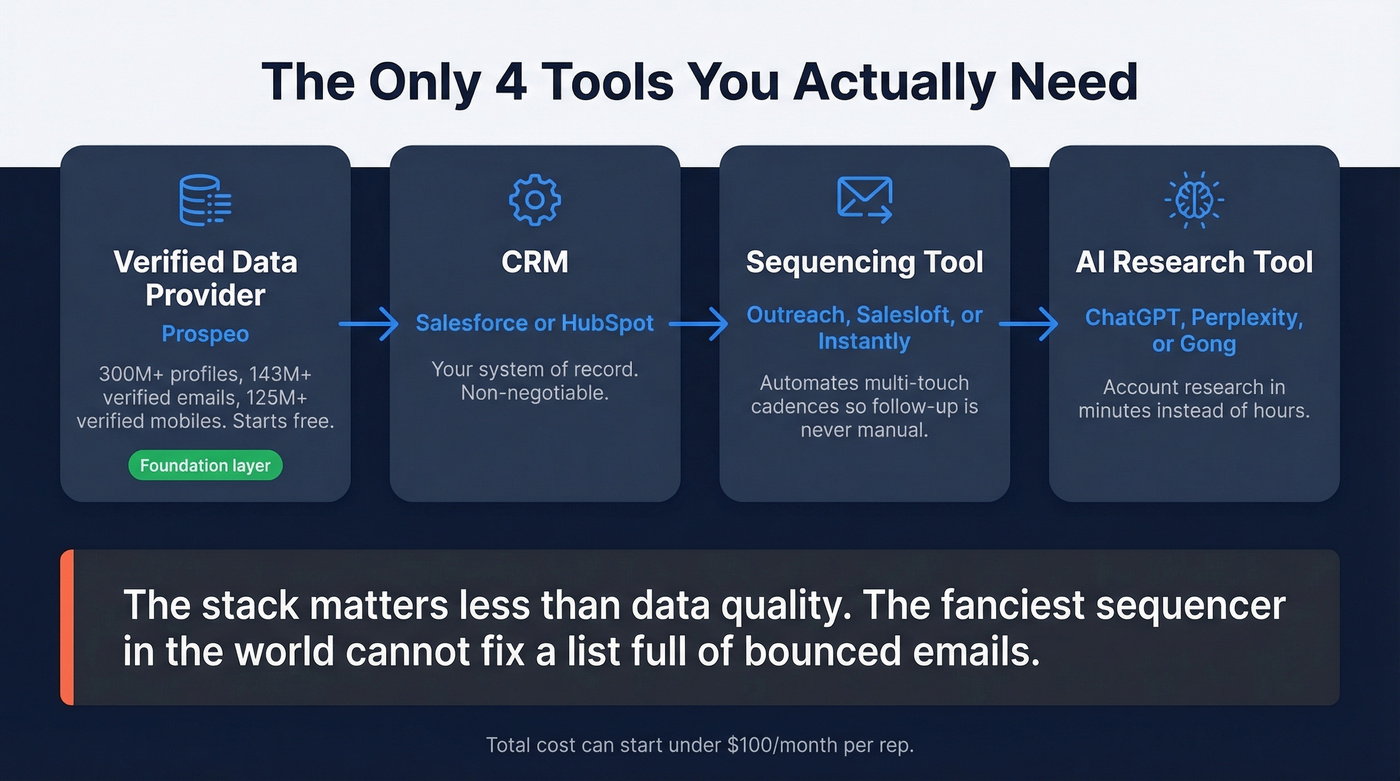
- CRM (Salesforce, HubSpot) - your system of record. Non-negotiable. (If you're evaluating options, see examples of a CRM.)
- Sequencing tool (Outreach, Salesloft, Instantly) - automates multi-touch cadences so follow-up isn't manual.
- AI research tool (ChatGPT, Perplexity, Gong) - account research in minutes instead of hours.
- Verified data provider (Prospeo) - 300M+ profiles, 143M+ verified emails, 125M+ verified mobiles. Starts free, no contracts.
The stack matters less than data quality. Enterprise data platforms run $15-40K/year, but you don't need that budget to get accurate contact data. The fanciest sequencer in the world can't fix a list full of bounced emails.
If you're comparing vendors, start with a shortlist of data enrichment services and broader B2B company data providers.
FAQ
What percentage of sales reps actually hit quota?
About 43.5% according to RepVue's Cloud Sales Index, while Ebsta x Pavilion benchmarks put it at just 31%. It varies by role: SDRs hit quota at 53.2%, while enterprise AEs land at 38.2%. The trend has been declining for several years across B2B sales.
Can you learn to become a top sales performer?
Yes. McKinsey's data across roughly 500 B2B companies shows the gap is mostly structural - time allocation, process discipline, and technology adoption - not innate talent. Fix the system first by protecting selling time, adopting a defined process, and using AI tools. Then refine skills like discovery and negotiation on top of that foundation.
What tools do top performers rely on?
A CRM, a sequencing platform, an AI research tool, and a verified data provider. The stack matters less than data quality - bad contact data wastes more selling time than any missing tool. Start with accurate emails and direct dials, then build your workflow around whatever sequencer and CRM your team already runs.
How much time should reps spend prospecting each day?
Aim for two uninterrupted hours before 10 AM - roughly 50-80 dials for SDRs. Reps who protect this block consistently outperform peers who scatter prospecting throughout the day. Since 60% of a rep's time goes to non-selling tasks, those two hours are often the only real selling window you get.