

Trial Close: The Stage-by-Stage Playbook for 2026
You just ran a 45-minute demo. The prospect nodded along, said "this looks great," and promised to "loop in the team." Then they ghosted. No reply to your follow-up. No reply to the breakup email. Nothing. The deal that felt warm went cold because you never actually checked whether it was warm - you assumed.
That's what happens when you skip the trial close.
Less than 47% of proposals actually convert to wins, and 35% of salespeople say closing is the hardest part of the job. Most of that difficulty isn't about the final ask. It's about everything that didn't happen before it.
The Short Version
Trial closes are diagnostic questions you ask throughout the deal - not just before the final ask. Map them to four stages: problem agreement, solution agreement, power agreement, and commercial agreement. Read every response through a green/yellow/red lens and adjust your next move accordingly. If you remember one thing from this article, use the demo pre-close: "Before we go into pricing, based on everything you've seen today, do you feel this is what you're looking for?"
What Is a Trial Close?
A trial close is a question designed to gauge where a prospect's head is at without asking them to commit. It's a temperature check, not a thermometer shoved down their throat. The key distinction: you're asking for an opinion, not a decision.
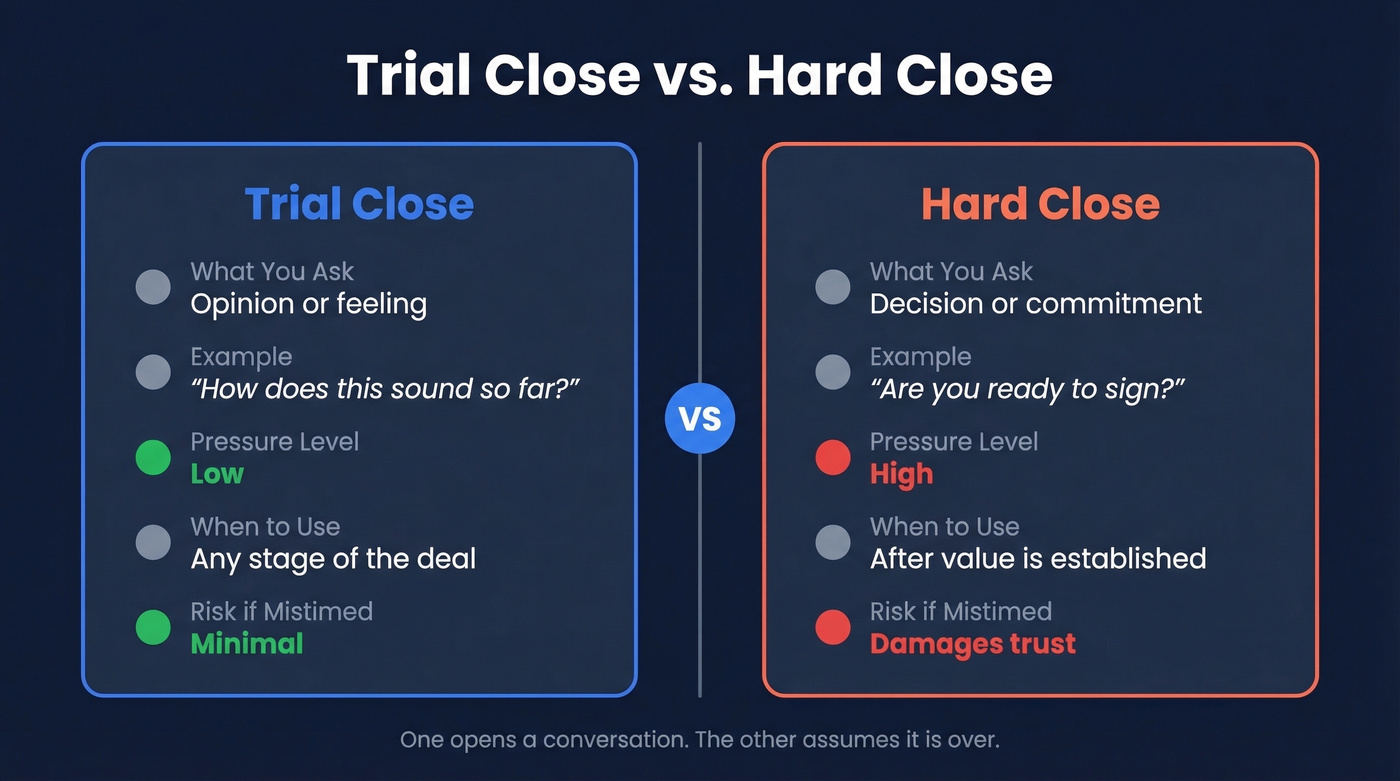
You can use these questions at any stage during the sales process. Their purpose is to build confidence through a series of small confirmations and surface objections before they become deal-killers at the proposal stage.
Here's the thing: most reps confuse trial closes with hard closes. They're fundamentally different tools.
| Trial Close | Hard Close | |
|---|---|---|
| What you ask | Opinion or feeling | Decision or commitment |
| Example | "How does this sound so far?" | "Are you ready to sign?" |
| Pressure level | Low | High |
| When to use | Any stage | After value is established |
| Risk if mistimed | Minimal | Damages trust |
A trial close sounds like "Is there anything missing that you'd need?" A hard close sounds like "Should we schedule implementation for next week or the week after?" One opens a conversation. The other assumes it's over.
Why These Questions Work
Trial closes aren't just a sales trick - they're grounded in well-documented psychology. Two principles do the heavy lifting.
Commitment & Consistency. Once someone says "yes, this solves our problem" out loud, they're psychologically inclined to stay consistent with that statement. Each small agreement makes the next one easier. Micro-agreements stack toward a close.
Loss Aversion. When a prospect verbally acknowledges that your solution fits, walking away from the deal starts to feel like losing something they've already mentally claimed.
The data backs this up: teams with strong questioning skills report 20-30% win rates, while script-heavy, rapid-fire closed-ended approaches see conversion in the low teens. The difference isn't charisma - it's the quality of the questions. In our experience, teams that consistently use temperature-check questions at every stage see 10-20% improvement in late-stage conversion, mostly because objections get handled weeks before the proposal lands.
Trial Close vs. Other Techniques
Trial closes are one tool in a broader toolkit.
| Technique | What It Does | When to Use | Risk Level |
|---|---|---|---|
| Trial / Soft Close | Gauges interest without asking for commitment | Any stage | Low |
| Assumptive Close | Treats the deal as decided | After clear fit confirmed | Medium |
| Summary Close | Recaps value, then asks | Complex deals, multiple stakeholders | Low-Medium |
| Now-or-Never Close | Creates urgency via deadlines | Real deadlines only | High |
| Direct Close | Straightforward ask to move forward | Strong rapport established | Medium |
A word of warning on the now-or-never close: manufactured urgency - fake "this price expires Friday" pressure - damages trust. If the deadline isn't real, don't use it.

Trial closes surface objections early - but only if you're talking to the right people. Prospeo gives you 300M+ verified contacts with 30+ filters including buyer intent and job changes, so every temperature check lands with a real decision-maker.
Stop trial-closing prospects who were never going to buy.
Questions by Deal Stage
Most articles give you a list of 20 generic questions with no context on when to use them. That's useless. The right question at the wrong stage either gets you nothing or creates pressure you didn't intend.
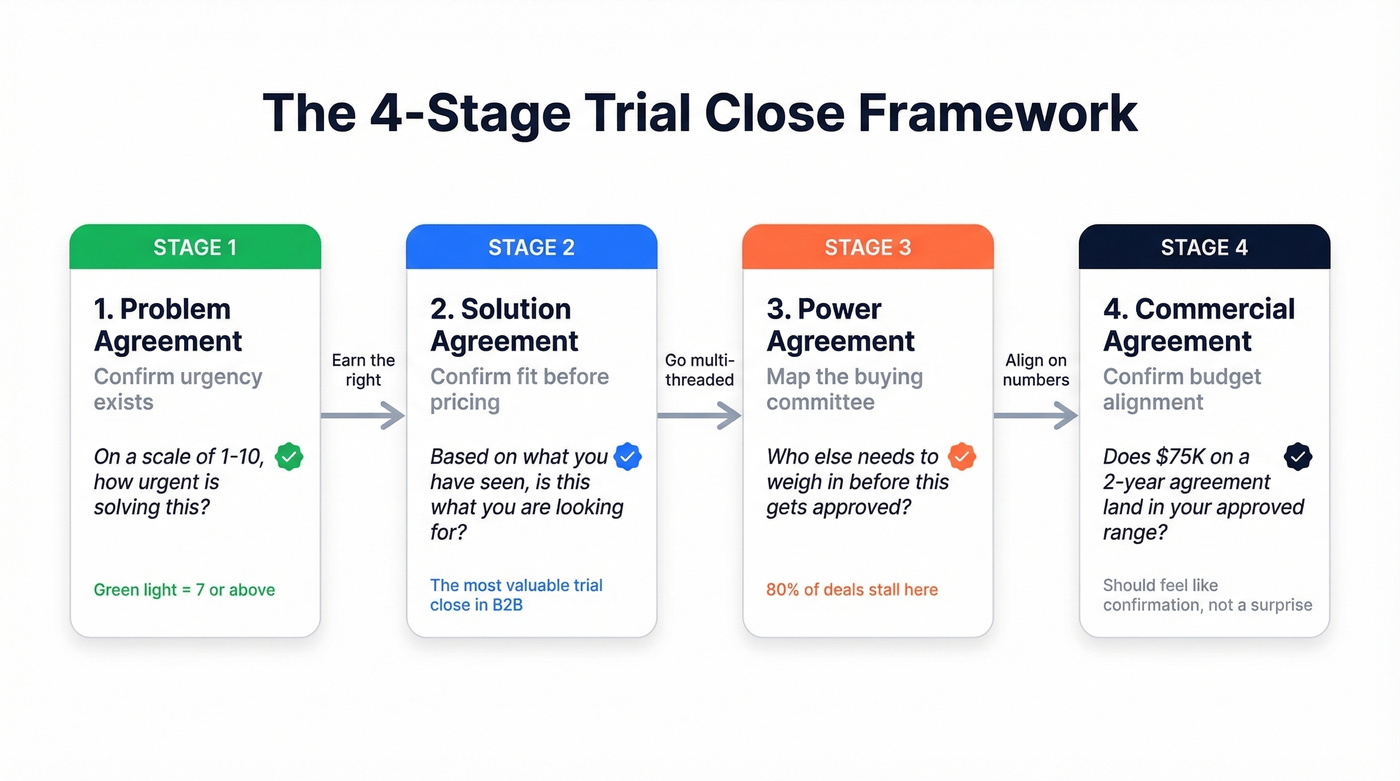
We've mapped trial close questions to four stages - problem, solution, power, and commercial - with specific scripts and guidance on what good and bad answers actually look like.
Problem Agreement
Before you pitch anything, you need to confirm the prospect has a problem worth solving and that they feel urgency around it. 96% of buyers have already researched before they talk to you - your question is confirming what they've already started to believe, not introducing a new idea.
Try these:
- "On a scale of 1 to 10, how urgent is solving [specific problem] for your team right now?"
- "What happens if nothing changes in the next 6 months?"
- "How is this problem affecting [revenue/productivity/team morale] today?"
Anything below a 7 on the urgency scale means you don't have a real opportunity yet. You've got a "nice to have," not a "need to fix." If they say 5, don't push forward to a demo - dig deeper into the pain or move on.
Solution Agreement
This is the demo stage - the moment most reps blow by without checking whether the prospect actually sees the fit.
- "Before we go into plans and pricing, based on everything you've seen today, do you feel this is what you're looking for? If not, it may not make sense to go over pricing."
- "Does this solve the [specific problem] we discussed on our first call?"
- "What concerns do you still have about how this would work for your team?"
That first question - the demo pre-close - is the single most valuable trial close example in B2B sales. It forces a fit confirmation before pricing enters the conversation. If they hesitate, you've surfaced the objection while you still have time to address it. If they say yes, you've got verbal commitment that makes the pricing conversation dramatically easier. If you need a tighter structure for the demo itself, use a product demo checklist so your trial closes land at the right moments.
Power Agreement
Here's where deals go to die. "I'll share this with my boss" isn't progress - it's a polite way of saying you're single-threaded in an account that has 6-11 stakeholders involved in the buying decision.
About 80% of B2B buying decisions stall not because the prospect said no, but because the buying committee couldn't reach consensus. Single-threaded deals over $50K are a red flag.
- "Who else needs to weigh in before this gets approved?"
- "What does your internal approval process look like for a purchase like this?"
- "If you were to recommend this internally, what objections would you expect from [finance/IT/the CEO]?"
- "Can we set up a call with your [VP of Ops / CFO / technical lead] to address their specific concerns?"
You can't gauge readiness from stakeholders you can't reach. Tools like Prospeo help you find verified emails and direct dials for every member of the buying committee, which is how you turn a single-threaded deal into a multi-threaded one. If you want a repeatable way to run multi-threaded motions, borrow from account-based selling best practices.
Commercial Agreement
By this stage, you should already know the answer. If you've done the work in the first three stages, the commercial question is a confirmation, not a surprise.
- "Based on what we've scoped, we're looking at $75K on a two-year agreement. Does that land in the range your team has approved?"
- "Is there anything in the proposal that doesn't align with what we discussed?"
- "What would need to change for you to move forward this quarter?"
Be specific with numbers. Vague pricing conversations produce vague outcomes. For context, close rates vary significantly by industry - Finance sits at 19%, Software at 22%, and Business & Industrial at 27%. Knowing your industry's baseline helps you calibrate expectations. If you want to benchmark your funnel end-to-end, compare against sales conversion rate data.
How to Read the Response
Every answer falls into one of three buckets. Think of it as a traffic light.
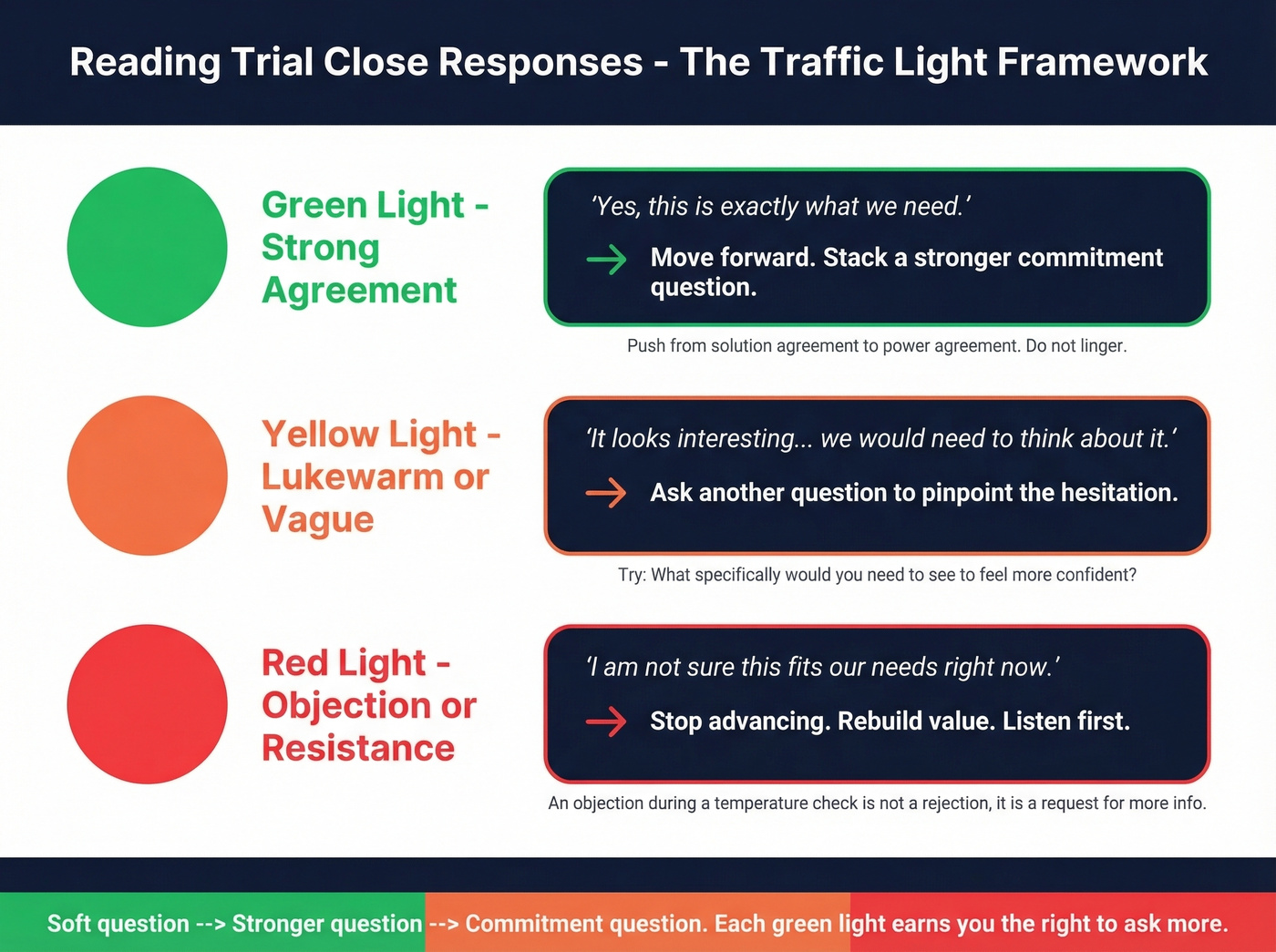
Green - strong agreement. "Yes, this is exactly what we need." Move forward. Stack a slightly stronger commitment question. If you're at solution agreement, push toward power agreement. Don't linger.
Yellow - lukewarm or vague. "It looks interesting" or "We'd need to think about it." Ask another question to pinpoint the hesitation: "What specifically would you need to see to feel more confident?" Yellow doesn't mean stop - it means you haven't earned the right to advance yet. We've seen reps log yellow-light responses as pipeline, and that's exactly how forecasts collapse. This is also where pipeline health discipline matters most.
Red - objection or resistance. "I'm not sure this fits" or "The timing isn't right." Stop and rebuild value. Don't attack the objection with more selling - listen first. An objection during a temperature check isn't a rejection; it means the prospect needs more information. If you want a systematic way to lower pushback, use a reduce sales objection rate approach.
The key principle: stack from soft to stronger commitment. Start with "Does everything make sense so far?" and progress to "Can you see your team benefiting from this?" to "What would need to be true for you to move forward?" Each green light earns you the right to ask a stronger question.
When Trial Closes Backfire
David Lewis wrote a pointed critique of trial closes in the automotive context, arguing they create pressure, shift focus to price, and reduce gross margin. His core example: "If we can come together on terms and numbers, are you willing to buy today?"
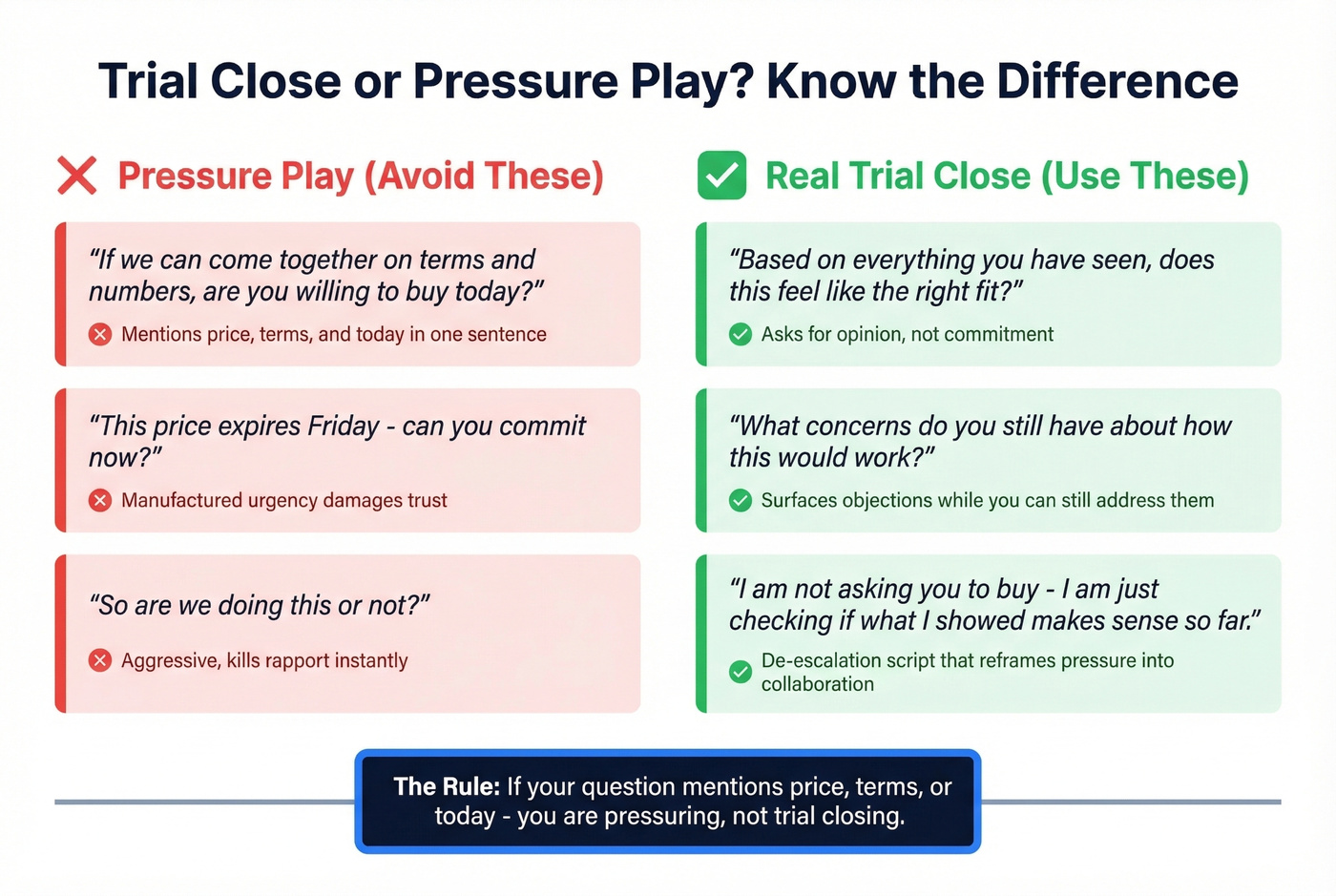
He's right - and that's a terrible example. It mentions price, terms, and "today" in the same sentence. That's not a temperature check; it's a pressure play wearing a trial close costume.
The translation to B2B is straightforward: if your question mentions price, terms, or "today," you're not trial closing - you're pressuring. In our experience, the moment a question mentions price, the prospect shifts from evaluating fit to negotiating cost. Keep those conversations separate.
When a prospect pushes back - "We aren't making a decision today" - de-escalate immediately. The best script I've seen for this comes from an r/sales thread: "Totally - I'm not asking you to buy. I'm just checking whether what I've shown makes sense so far." That single sentence reframes the entire dynamic from pressure to collaboration.
Common Mistakes
Five patterns that kill effectiveness:
Only trial-closing your champion. Your champion might love you. The CFO who controls the budget doesn't know you exist. Multi-thread or lose. If you're building a repeatable outbound motion to reach the full committee, start with sales prospecting techniques.
Asking yes/no questions instead of open-ended ones. "Does this look good?" gets you a polite "yes" with zero information. "What concerns do you still have?" gets you something actionable. For more stage-appropriate prompts, keep a bank of discovery questions.
Treating "maybe" as "yes." Lukewarm responses need follow-up, not forecasting. When they go quiet after a “looks good,” use sales follow-up templates to get a real answer.
Gauging interest on price before establishing value. If the prospect hasn't confirmed the problem is urgent and your solution fits, any pricing conversation is premature. If you want a clean end-to-end structure, align trial closes to the steps to close a sale.
Reaching out to contacts who've changed roles. Stale data means you're asking readiness questions to people who left the company six months ago. A 7-day data refresh cycle - compared to the 6-week industry average - is the difference between reaching the right person and wasting a touchpoint. This is where data enrichment services can keep your CRM from rotting.
Let's be honest: if your deal size is under $25K and you're losing deals, the problem almost certainly isn't your closing technique. It's that you're single-threaded. Fix that before you memorize a single script.
80% of deals stall because you're single-threaded. Prospeo's database maps entire buying committees - verified emails at 98% accuracy and 125M+ direct dials - so you can multi-thread every account before the deal goes dark.
Reach all 6-11 stakeholders, not just your champion.
FAQ
How many trial closes per call?
Stack 2-4 per call, escalating from soft to stronger commitment as you earn green-light responses. The "eight yeses" rule is sales-trainer lore with no data behind it - focus on the pattern, not a quota.
Trial close vs. soft close - what's the difference?
They're functionally the same technique. "Soft close" is the broader category; a trial close emphasizes testing readiness at a specific moment. Most reps and sales trainers use the terms interchangeably.
Do trial closes work in email?
Yes - reframe them as micro-commitment asks. "Based on what I've shared, does it make sense to schedule a 15-minute call with your VP of Ops?" Keep the ask small enough that responding feels easy.
What's the biggest mistake reps make with trial closes?
Only asking their single champion instead of multi-threading the account. Over 80% of B2B deals stall at the committee level, not the champion level. Identify every decision-maker by department and seniority, then run separate temperature checks with each.