


7 Best Unify Alternatives for B2B Outbound Teams in 2026
Unify does a lot of things well - signal aggregation, deliverability tools, AI-powered plays. But when the contact data underneath those plays is stale, none of it matters. You're automating outreach to people who left their company three years ago. That's why so many B2B teams are evaluating Unify alternatives right now.
Unify holds a 4.7/5 on G2 across 42 reviews, and the praise is real - ease of use, automation, responsive support. The complaints tell a different story though: integration issues, a steep learning curve, and missing features like A/B testing. The question isn't whether Unify is good. It's whether it's good enough for what you're paying. Before you switch, figure out what's actually broken: the signals, the data, or the sequencing.
Looking for Ubiquiti UniFi alternatives? Wrong Unify - this guide covers UnifyGTM, the B2B outbound platform.
Our Picks (TL;DR)
| Pick | Best For | Why |
|---|---|---|
| Prospeo | Data accuracy on a budget | 98% email accuracy, 7-day refresh - starting free |
| Apollo.io | All-in-one replacement | 210M+ contacts, free tier, easier setup than Unify |
| Instantly | High-volume email | 5,000 emails/mo for $47 - pair with a data provider |
Why Teams Switch From Unify
The most damning G2 review says it plainly: "Prospecting is a 0/10... outdated profiles... left the company like 3-5 years ago," and "phone number enrichment is very bad." The same reviewer described their Salesforce integration as creating "a mess in our CRM" that took over three months to untangle. That's not a minor inconvenience. That's a quarter of lost productivity.
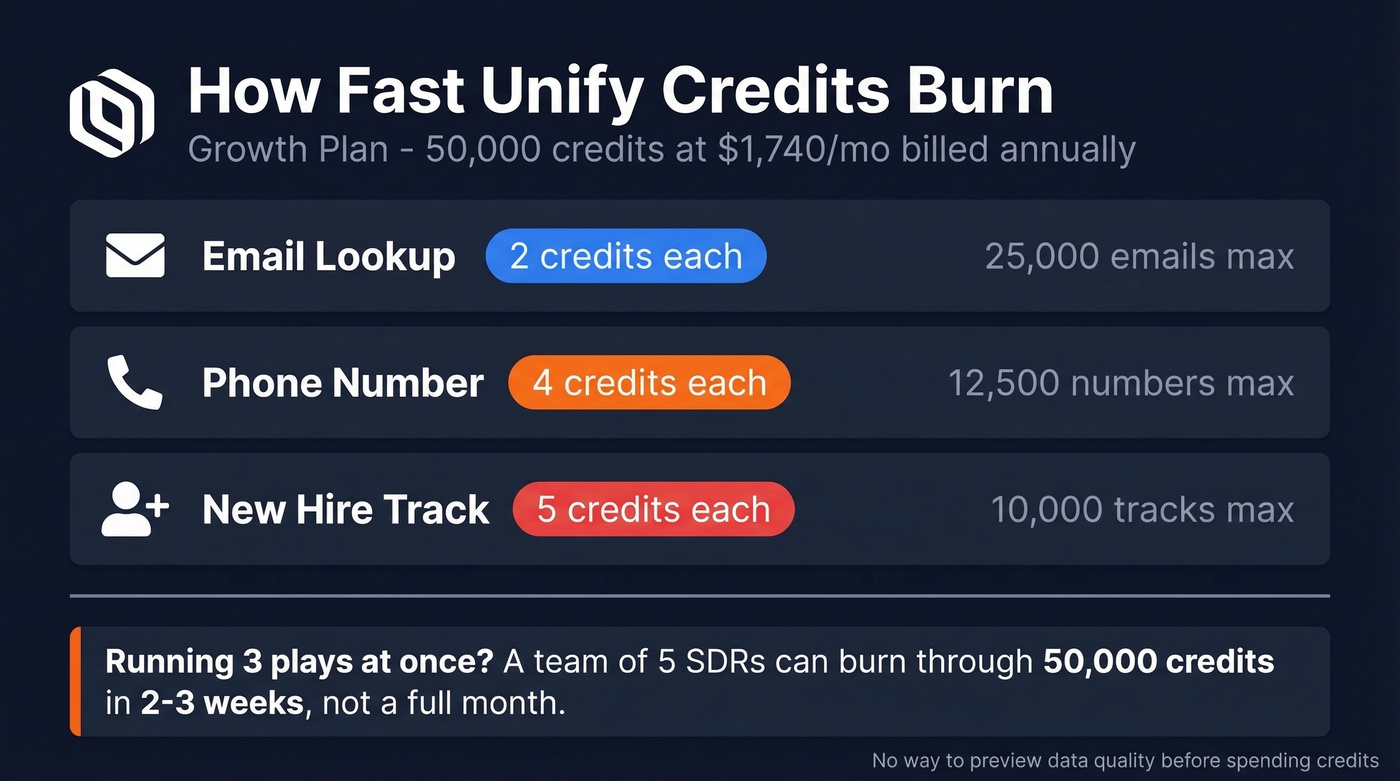
Then there's the credit model. Unify charges 2 credits per email, 4 per phone number, and 5 per new hire track. On the Growth plan, that's 50,000 credits at $1,740/mo billed annually. Monthly plans start at $1,000/mo with just 2,500 credits. Those credits burn fast once you're running multiple plays, and there's no way to preview data quality before you spend them.

Unify charges up to 4 credits per phone number on data reviewers call "outdated" and "very bad." Prospeo delivers 98% email accuracy and 125M+ verified mobiles with a 30% pickup rate - refreshed every 7 days, not every 6 weeks. At ~$0.01 per lead, you stop burning credits on contacts who left their company three years ago.
Fix the data layer first. Start free with 75 verified emails.
Top Unify Alternatives Compared
Prospeo - Best for Data Accuracy
If you're leaving Unify because the data is stale, fix the data layer first.
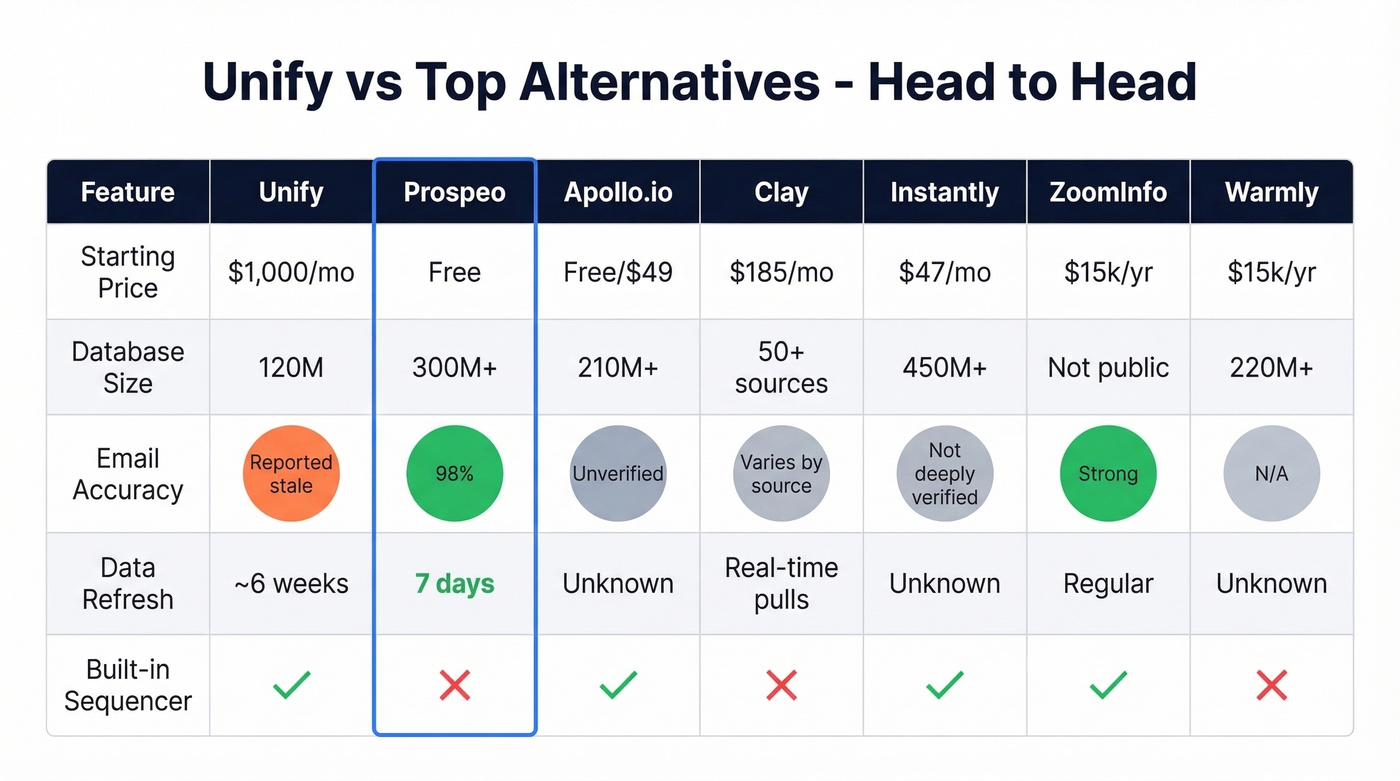
The database covers 300M+ professional profiles with 98% email accuracy and 125M+ verified mobile numbers pulling a 30% pickup rate. What actually sets it apart is the 7-day data refresh cycle - the industry average sits around six weeks, which means most providers are serving you contacts that went stale a month ago. Intent data covers 15,000 Bombora topics, and native integrations push directly into Salesforce, HubSpot, Instantly, Clay, and Lemlist.
We've seen the numbers across our own campaigns: teams using Prospeo book 26% more meetings than ZoomInfo users and 35% more than Apollo users. Snyk's 50-person sales team cut bounce rates from 35% to under 5% and grew AE-sourced pipeline 180% after switching. The free tier gives you 75 emails and 100 Chrome extension credits per month, with paid plans working out to roughly $0.01 per lead.

Skip Prospeo if you specifically need managed mailbox infrastructure and AI play orchestration in one platform. For that, pair Prospeo's data with a sequencing tool like Instantly or Lemlist.
If you’re tightening your outbound stack, it also helps to benchmark against other sales prospecting databases and data enrichment services before you commit.
Apollo.io - All-in-One Replacement
Apollo is the closest match to Unify without the price tag. It covers 210M+ contacts, includes a built-in sequencer, and gets called "easier to set up" and "more usable" in head-to-head comparisons across review sites.
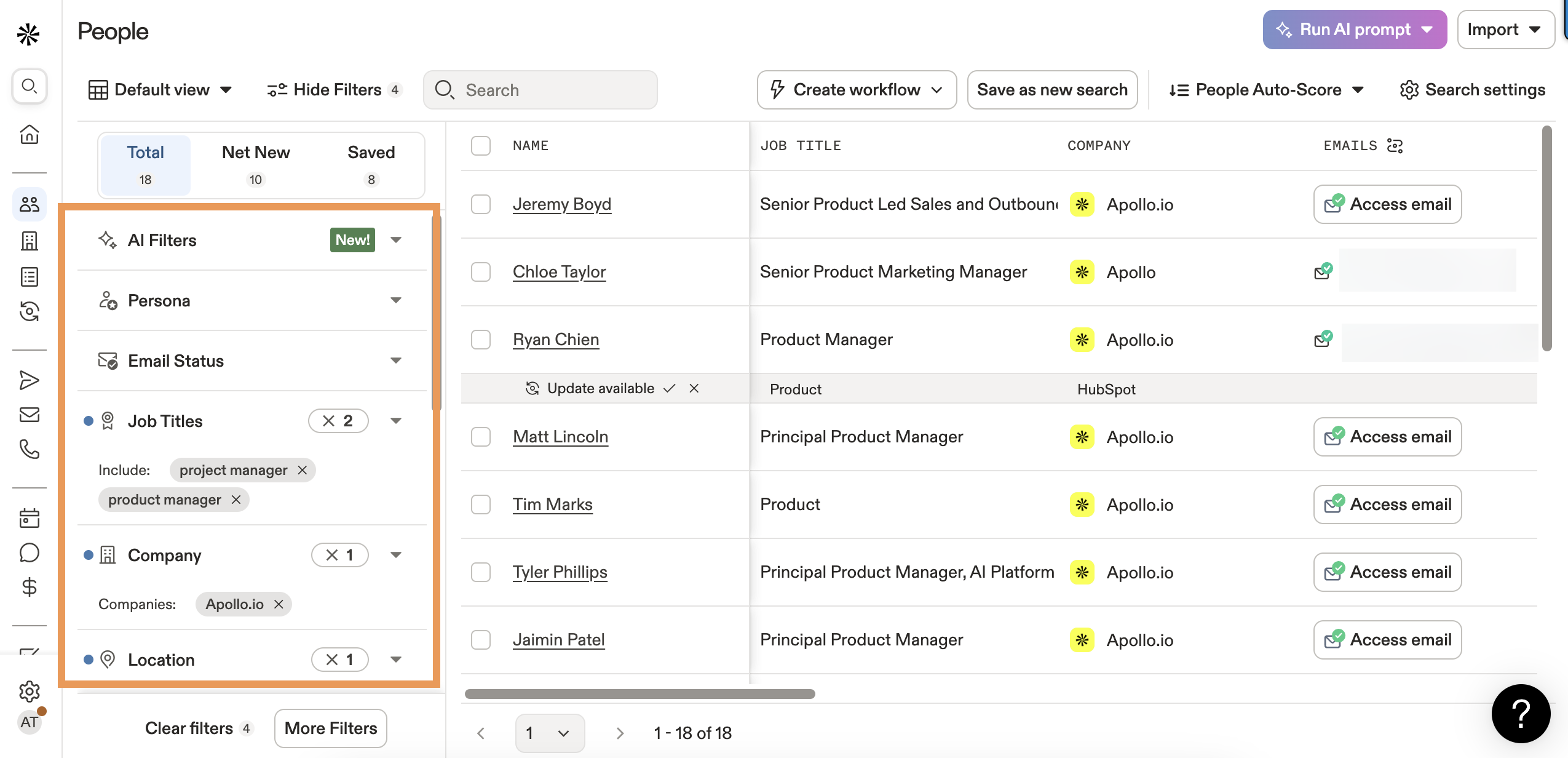
The free tier includes basic contact access and 2 sequences. Paid plans run $49/mo (Basic), $79/mo (Professional), and $119/mo (Organization, minimum 3 seats). Credits don't roll over. In our testing, Apollo's data isn't verified through proprietary infrastructure, which means noticeably more bounces on emails and phones - and bounces kill domain reputation. If you're coming from Unify partly because of bad data, Apollo improves things but doesn't solve the root problem. If bounce is your pain point, start with email bounce rate fundamentals and a proper email deliverability guide.
Clay - Best for Enrichment Workflows
Clay isn't an all-in-one like Unify. It's a workflow builder that pulls from 50+ data providers and lets GTM engineers orchestrate exactly the enrichment and outreach logic they need.
Clay overhauled its pricing in March 2026, introducing a dual-currency model: Data Credits for enrichment and Actions for platform operations. The Launch plan runs $185/mo, Growth is $495/mo - both significantly cheaper than the old Pro tier at $800/mo. Data costs dropped 50-90% across top enrichments, and a "no-result-no-charge" policy means you don't pay for empty lookups. GTM engineers on r/sales confirmed the data cost cuts but flagged the dual-currency complexity as a real learning curve. If you’re building around Clay, this pairs well with a structured lead generation workflow and tighter lead enrichment rules.
Instantly - Best for Email Volume
Instantly's Outreach Growth plan gives you 5,000 emails/mo, unlimited email accounts, and unlimited warmup for $47/mo. Hypergrowth bumps that to 100,000 emails for $97/mo. Their leads database covers 450M+ contacts starting at $47/mo on a separate plan.
Here's the thing: Instantly is a sequencer with a database bolted on, not a signal-based GTM platform. The database is large but not deeply verified. We've seen teams cut bounce rates in half just by swapping in a dedicated data provider alongside Instantly's sequencing - a complete outbound stack under $100/mo that outperforms Unify's data quality at a fifth of the cost. If you’re scaling volume, keep an eye on email velocity and the best way to send bulk email without getting blacklisted.
ZoomInfo - Enterprise Incumbent
ZoomInfo runs $15,000-$40,000/year with annual contracts required. Massive database, broad feature set, enterprise pricing with enterprise sales cycles. If you're on Unify's $1,000-$1,740/mo plans, ZoomInfo is likely overkill - and the contract lock-in is a step backward from what you already have.
Warmly - Website Visitor ID
Warmly starts at $15,000/year and focuses on identifying anonymous website visitors with 220M+ people profiles. Strong fit if your primary need is inbound visitor identification rather than outbound prospecting - a different use case than Unify entirely.
Common Room - PLG Signals
Common Room starts at $1,000/month for 35,000 contacts and 2 seats, aggregating signals across community, product, and website activity. Starter includes 240k IP enrichments/year and just 6 Bombora topics - scaling requires custom pricing. Best for product-led growth teams, but without a GTM engineer to build workflows around those signals, the data just sits there.
Pricing Comparison
| Tool | Starting Price | Database Size | Best For |
|---|---|---|---|
| Unify | $1,000-$1,740/mo | 120M contacts | Signal-based GTM (all-in-one) |
| Prospeo | Free / ~$0.01/lead | 300M+ profiles | Data accuracy |
| Apollo.io | Free / $49/mo | 210M+ contacts | All-in-one outbound |
| Clay | $185/mo | 50+ data providers | Enrichment workflows |
| Instantly | $47/mo | 450M+ leads | High-volume email |
| ZoomInfo | ~$15,000/yr | Not public | Enterprise sales intel |
| Warmly | $15,000/yr | 220M+ profiles | Website visitor ID |
| Common Room | $1,000/mo | N/A (signals) | PLG signal tracking |
The Data-Platform-Sequencer Framework
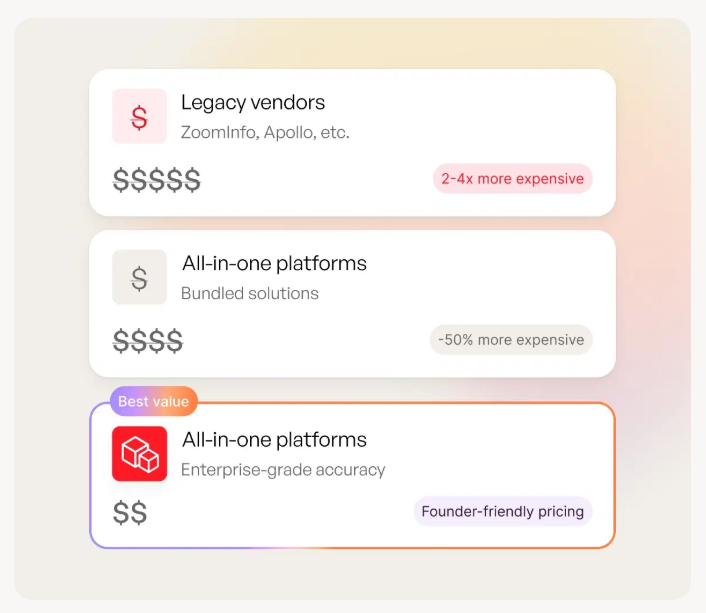
Let's be honest: most teams shopping for Unify alternatives don't need another all-in-one platform. They need to unbundle the problem. We've watched dozens of teams go through this decision, and it almost always comes down to one of three broken layers.
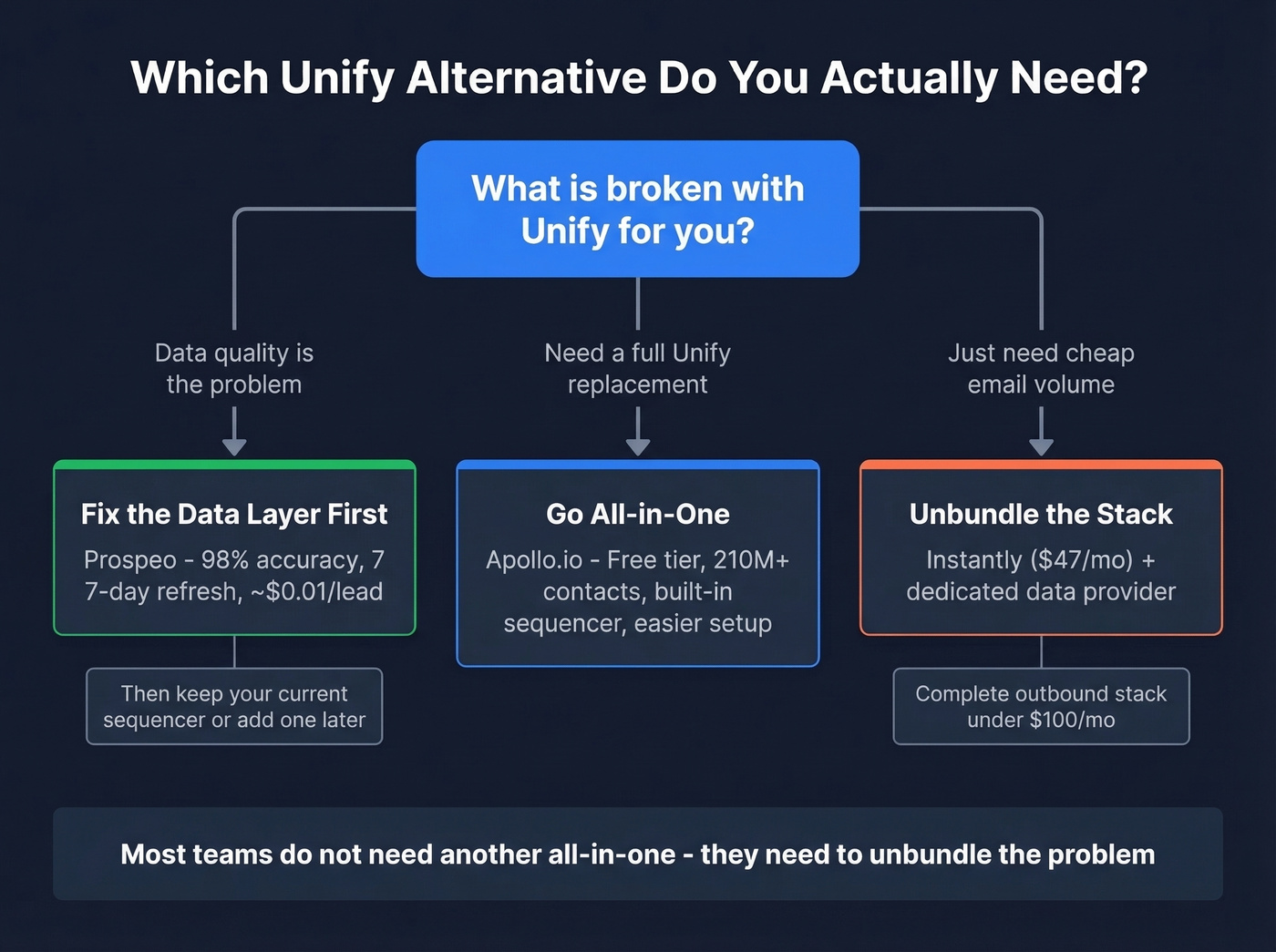
If data quality is the issue, fix the data layer first with a dedicated provider, then decide if you need a new sequencer. Stale contacts and bounced emails are a data problem, not a platform problem. (If you’re diagnosing why lists decay, start with lead generation metrics and firmographic and technographic data.)
If you want a direct Unify replacement, go with Apollo. Closest feature set, easier setup, and a free tier to validate before committing.
For teams that just need cheap email volume, Instantly paired with a dedicated data provider gets you there. $47/mo handles the sequencing engine; add verified contacts on top and you've got a stack that costs less than a single month of Unify.
One tool we deliberately left off: 6sense. At $100k+/year with 4-12 week implementations, it's overkill for teams operating at Unify budgets. If your average deal size is under five figures, you almost certainly don't need that level of signal infrastructure.
Snyk's 50-person sales team dropped bounce rates from 35% to under 5% and grew AE-sourced pipeline 180% after switching to Prospeo. No annual contracts, no "talk to sales" gates - just 300M+ profiles with a 7-day refresh cycle that keeps your outbound hitting real inboxes.
Build a complete outbound stack under $100/mo that outperforms Unify's data.
FAQ
What does Unify actually cost?
Unify runs $1,000 to $1,740/month depending on plan and billing cycle. The Growth plan costs $1,740/mo billed annually with 50,000 credits. Credits cost 2 per email and 4 per phone - heavy prospecting burns through them in weeks.
Is there a free Unify alternative?
Apollo.io offers a free tier with basic contact access and 2 sequences. Prospeo gives you 75 free emails and 100 Chrome extension credits monthly with no contract or credit card required. Both let you validate fit before spending anything.
What's the best option for small outbound teams?
Pair a free data tier with Instantly at $47/mo. That gives small teams verified contacts and email automation for under $100/month total - better data accuracy than Unify at roughly 5-10% of the cost.