


Unify Pros and Cons: Pricing, Credits & Verdict (2026)
You just got the Unify GTM demo. The Plays looked slick, the intent signals sounded powerful, and the rep made warm outbound feel like autopilot. Now you need the real pros and cons - not the sales deck version.
We dug through every review, pricing page, and credit table we could find. Here's what actually matters.
Quick Verdict
Best for: Mid-market teams (10-50 reps) on HubSpot or Salesforce who want intent-driven outbound in one platform.
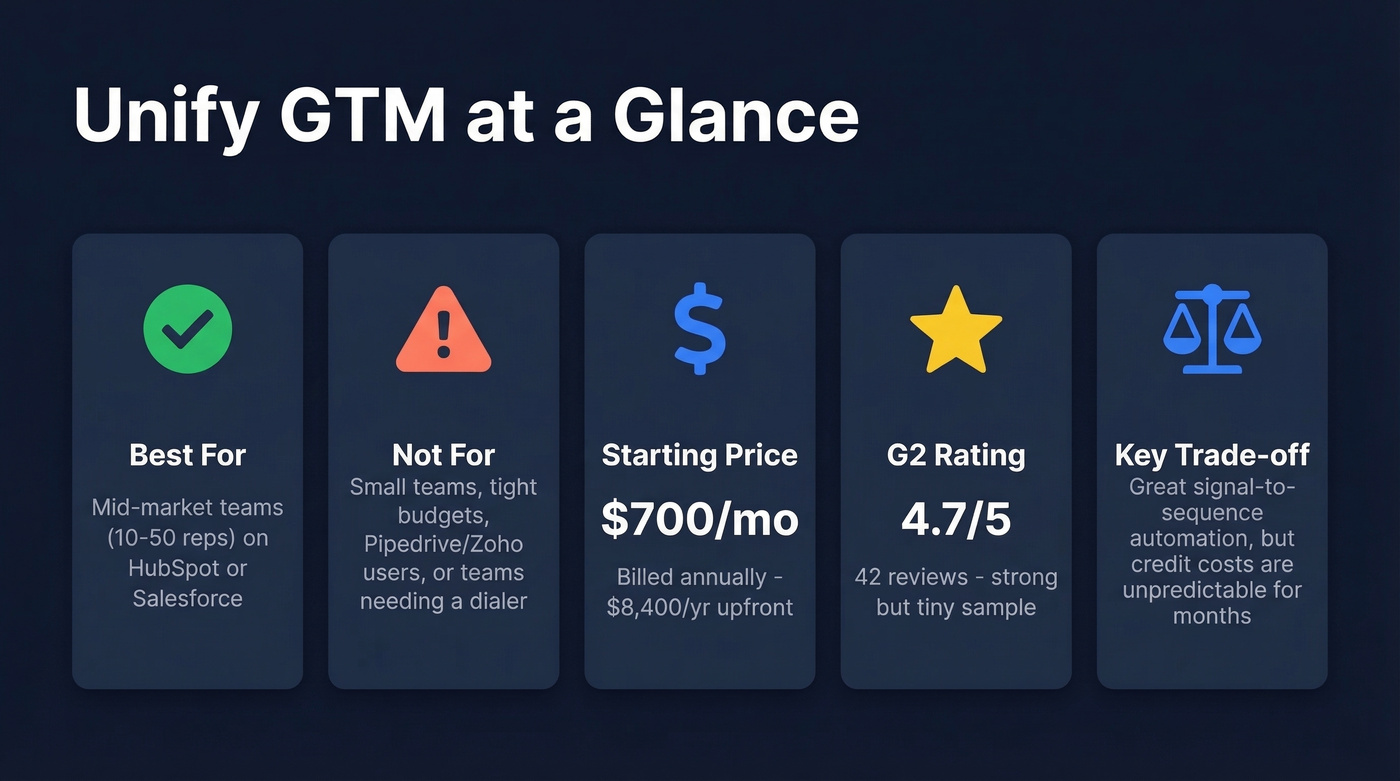
Not for: Small teams on tight budgets, anyone needing a built-in dialer, or shops running Pipedrive/Zoho.
Price: Growth starts at $700/mo billed annually ($8,400/yr upfront). No free tier.
G2 rating: 4.7/5 (42 reviews) - strong scores, tiny sample.
Key trade-off: Signal-to-sequence automation that genuinely saves time, but a credit system that makes monthly costs unpredictable until you've run it for a quarter.
Make Sure It's the Right "Unify"
If you landed here expecting Ubiquiti UniFi networking gear - wrong product. Unify GTM is a warm outbound platform backed by Emergence Capital and the OpenAI Startup Fund. It captures buyer intent signals and turns them into automated outbound sequences. UniFi makes access points and switches. Totally different world.
What Unify GTM Does
Unify combines intent data and outbound execution into one workflow. It captures 25+ intent signals - website visits, G2 research, job changes, champion tracking, social signals - then enriches contacts through 30+ data sources, builds automated "Plays" that qualify and enroll prospects into sequences, and handles deliverability with managed warmup, bounce protection, mailbox rotation, and domain rotation. The platform claims its managed deliverability has prevented 75% of bounces for customers. Everything syncs bi-directionally with HubSpot or Salesforce every 15 minutes.

The consolidation pitch works best when you're already on HubSpot or Salesforce and currently stitching together 3+ separate outbound tools.
Strengths That Stand Out
The Plays builder is genuinely easy to use. It's the most-cited positive across user reviews, and in our testing, a basic workflow took about 30 minutes to configure without any RevOps help. The automation layer is the real draw: signal detection flows into enrichment flows into sequence enrollment with zero manual steps. For teams drowning in lead routing, that's hours back every week.
Consolidation is the other big win. Replacing your intent tool, enrichment vendor, sequencer, and deliverability platform with one product cuts vendor management overhead significantly. Users also consistently praise the support team, which is rare for a platform this young.
The reported 120M contact database isn't the biggest out there - Apollo and ZoomInfo are larger - but the multi-vendor waterfall approach improves match rates over single-source tools. If you're comparing providers, start with this breakdown of B2B company data.
Here's the thing, though: Unify GTM has almost no organic Reddit or community discussion yet. With 42 G2 reviews (compare that to Apollo's 9,510 at the same 4.7 rating), this is still very early-stage software. The strong reviews are encouraging. The sample is small.

Unify's credit system makes costs unpredictable until you've burned through a full quarter. Prospeo charges ~$0.01/email with 98% accuracy, a 7-day data refresh cycle, and zero annual commitments. 300M+ profiles, 30+ search filters, and you only pay for verified results.
Skip the credit math. Get clean data from day one.
Drawbacks Worth Knowing
Setup isn't instant. Plays, credits, signals, AI agents - there's a lot to configure. We've seen teams need 2-4 weeks before reps are actually producing pipeline. If you need output by next Monday, skip this one.
If you're planning rollout, a structured 30-60-90 day plan helps avoid false starts.
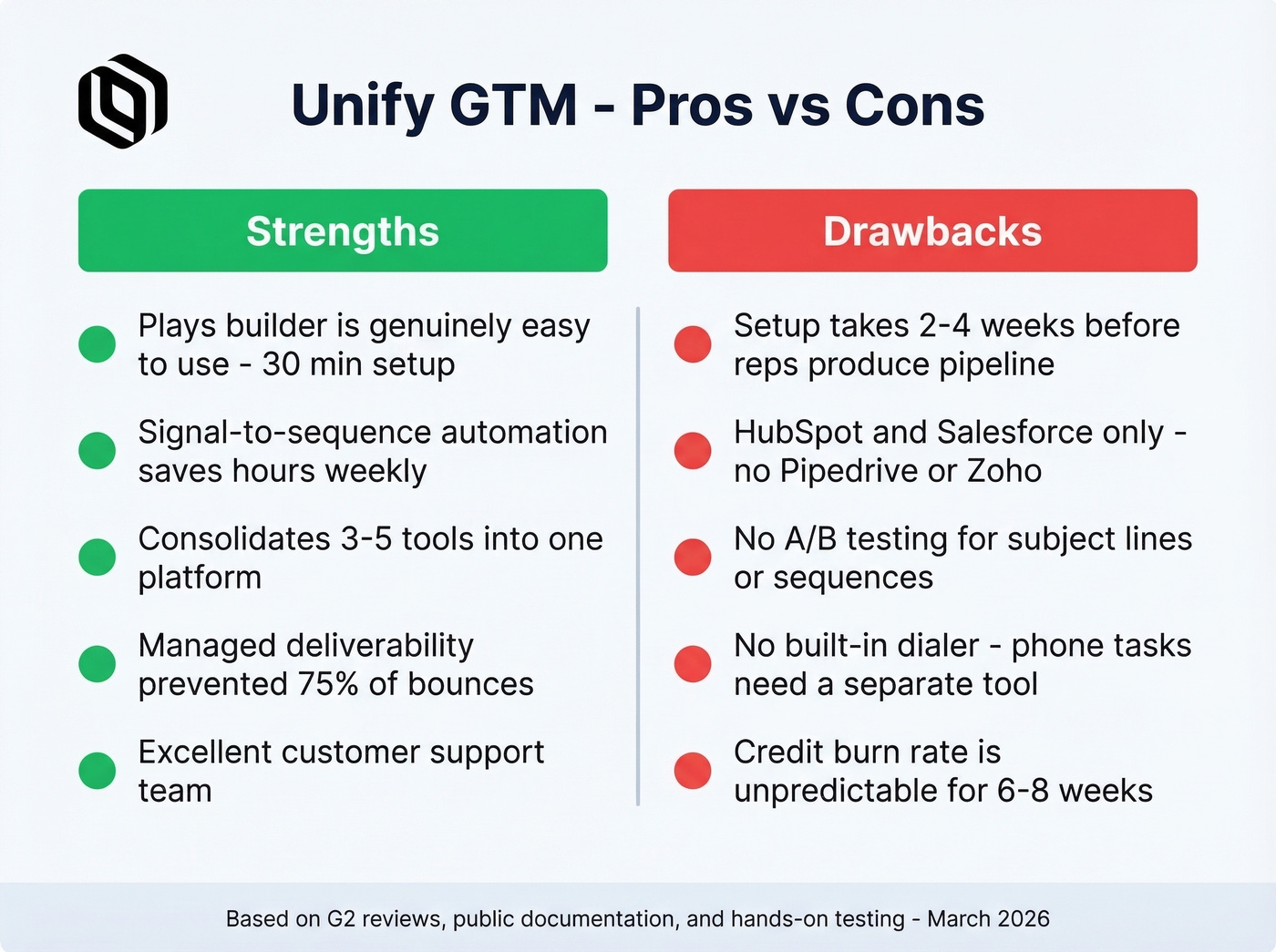
CRM support is a hard wall. HubSpot and Salesforce only. No Pipedrive, no Zoho, and API access is still in beta. If your CRM isn't on that list, Unify is a non-starter. (If you're evaluating options, here are more examples of a CRM to compare.)
No A/B testing. You can't split-test subject lines or sequences natively - a surprising gap at this price point. If this is a must-have, use a dedicated subject line tester alongside your sequencer.
The "all-in-one" has a phone-shaped hole. Email sequencing is solid, but there's no built-in dialer. Call tasks get created; you need a separate tool to make them. One G2 reviewer titled their review "Creates Chaos, Not Solutions", claiming Plays "simply do not work." That's one voice out of 42, but it sits alongside the 85% five-star distribution and shouldn't be ignored.
Pricing You'll Actually Pay
| Plan | Monthly Cost | Credits | Active Plays | Users |
|---|---|---|---|---|
| Growth | $700/mo (annual) | 30,000 | 2 | 3 platform, 1 sending |
| Pro | ~$2k-$5k/mo | 100,000 | Unlimited | 5 platform, 2 sending |
| Enterprise | ~$5k-$8k/mo | 200,000 | Unlimited | 10 platform, 5 sending |
Add-ons stack fast: $40/mo per extra platform user, $100/mo per sending user, and $20-$25/mo per managed mailbox. A team running 20 mailboxes adds $400-$500/mo on top of base. All plans require annual contracts.
Let's be honest: that $8,400/yr upfront commitment on Growth is real money before you've sent a single sequence. Most teams under 10 reps will get better ROI from a dedicated data tool plus a standalone sequencer. If you're weighing vendors, this list of data enrichment services is a good starting point.
How Credits Work
Every action burns credits at different rates. Company reveals cost 0.1, email lookups cost 2, phone numbers cost 4, champion tracking costs 1/mo, and AI agent runs cost 1 each.
If you're trying to reduce waste, start by verifying before you send - here's a practical email deliverability guide.
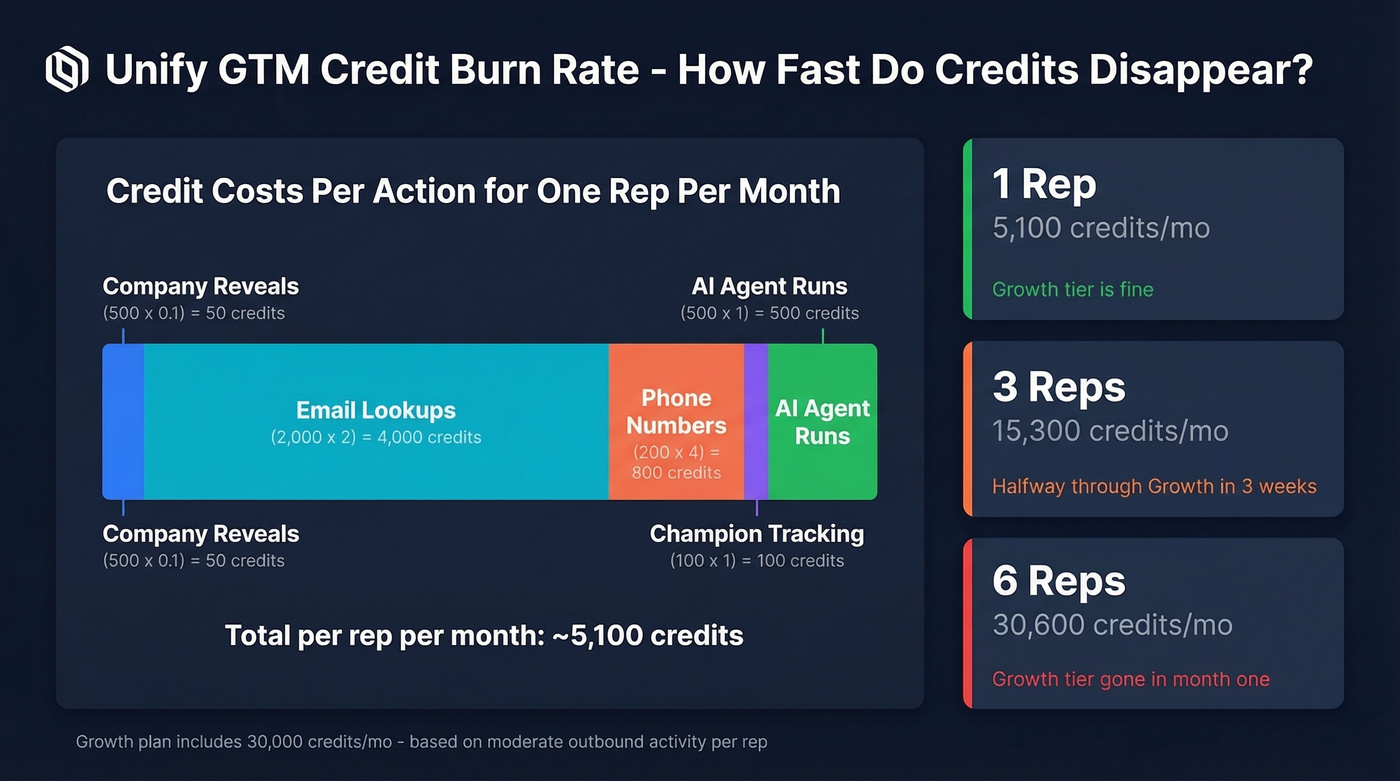
A realistic month for one rep - revealing 500 companies, pulling 2,000 emails, grabbing 200 phones, tracking 100 champions, running 500 AI tasks - burns about 5,100 credits. That's well within Growth's 30,000 budget. But ramp to 3 reps running aggressive Plays and credits evaporate fast. We've seen teams blow through Growth-tier credits in 3 weeks, and you won't know your true burn rate until you've run the system for 6-8 weeks.
Alternatives Worth a Look
| Tool | Best For | Starting Price | Biggest Limitation |
|---|---|---|---|
| Apollo | All-in-one on a budget | $49/user/mo | Weaker intent signals |
| ZoomInfo | US database depth | ~$15k-$25k/yr | Expensive, complex |
| 6sense | Enterprise ABM + intent | ~$50k+/yr | Overkill for SMBs |
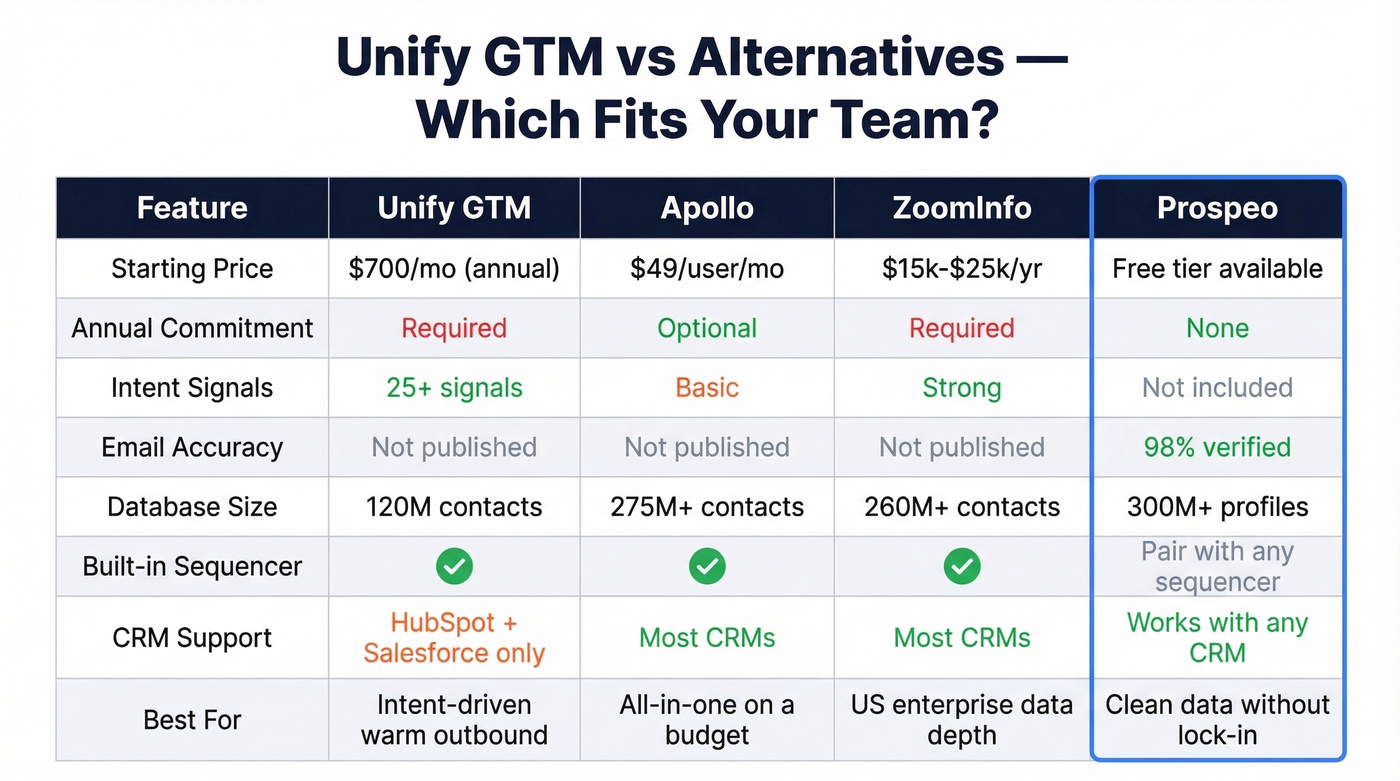
If your core problem is data quality rather than workflow automation, Prospeo is the cleaner path - 300M+ profiles with 98% email accuracy on a 7-day refresh cycle, no annual contracts, and a free tier to test with. Pair it with whatever sequencer you already run and you skip the credit complexity entirely. (If you're building a stack, these outbound lead generation tools can help round it out.)
For teams that want the full intent-to-sequence pipeline and have the budget, Unify is genuinely differentiated. For everyone else, assembling best-of-breed tools gives you more flexibility and lower risk.
If your real problem is data quality - not workflow automation - you don't need a $8,400/yr platform. Prospeo delivers 98% email accuracy across 300M+ profiles, refreshed every 7 days. Pair it with your existing sequencer and keep full control of your stack.
Get 75 verified emails free and see the accuracy difference yourself.
FAQ
Is Unify GTM worth it for small teams?
For most teams under 10 reps, the $8,400/yr upfront commitment on Growth is hard to justify. You get only 2 active Plays and 1 sending user. A standalone data tool paired with a $49/mo sequencer delivers similar output at a fraction of the cost and without the annual lock-in.
Does Unify have a free trial?
No. Unify GTM offers no free tier and no self-serve trial. You have to book a demo and commit to an annual contract starting at $700/mo. Ask for a 30-day pilot during negotiation - some teams have secured one, but it's not standard.
How accurate is Unify's contact data?
Unify waterfalls across 30+ data vendors, which improves match rates over single-source tools. They don't publish a verified accuracy rate, though. For comparison, Prospeo publishes 98% email accuracy with a 5-step verification process and 7-day refresh cycle.
Can I use Unify without HubSpot or Salesforce?
No. CRM integration is limited to HubSpot and Salesforce with bi-directional sync. Pipedrive, Zoho, and other CRMs aren't supported, and API access remains in beta. Confirm your CRM compatibility before you even book the demo.
Unify GTM is a strong platform for teams that want intent-driven warm outbound without stitching together five tools. But weigh the trade-offs carefully: credit unpredictability, no dialer, and HubSpot/Salesforce-only CRM support are real constraints. For the right team, it's a time-saver. For the wrong one, it's an expensive experiment you're locked into for a year.