

USP in Sales: The Practitioner's Guide to Building and Using One
You're on your 47th cold call of the day. The prospect picks up, and before you finish your second sentence, they hit you with it: "You're the third person to call me this week with the same pitch. Why should I talk to you?" That scenario - the one that demands a sharp USP in sales - plays out thousands of times daily. A commercial real estate broker on Reddit framed it perfectly: what's your reason someone should choose you instead of the 1,000 other brokers who've already called?
Here's the uncomfortable part: 81% of sales reps say buyers research solutions before they ever speak to a rep. By the time they're on the phone with you, they've already seen your competitors' messaging. If yours sounds identical, you're dead on arrival.
What a USP Actually Is
The term goes back to Rosser Reeves in the 1940s - an ad man who argued every campaign needs one specific reason the product is worth buying. In sales, the concept is sharper. The SaaS community on Reddit draws a useful line: a UVP (unique value proposition) is broader, more marketing-oriented, and values-based. A USP is specific, sales-oriented, and gives the buyer a clear reason to purchase right now.
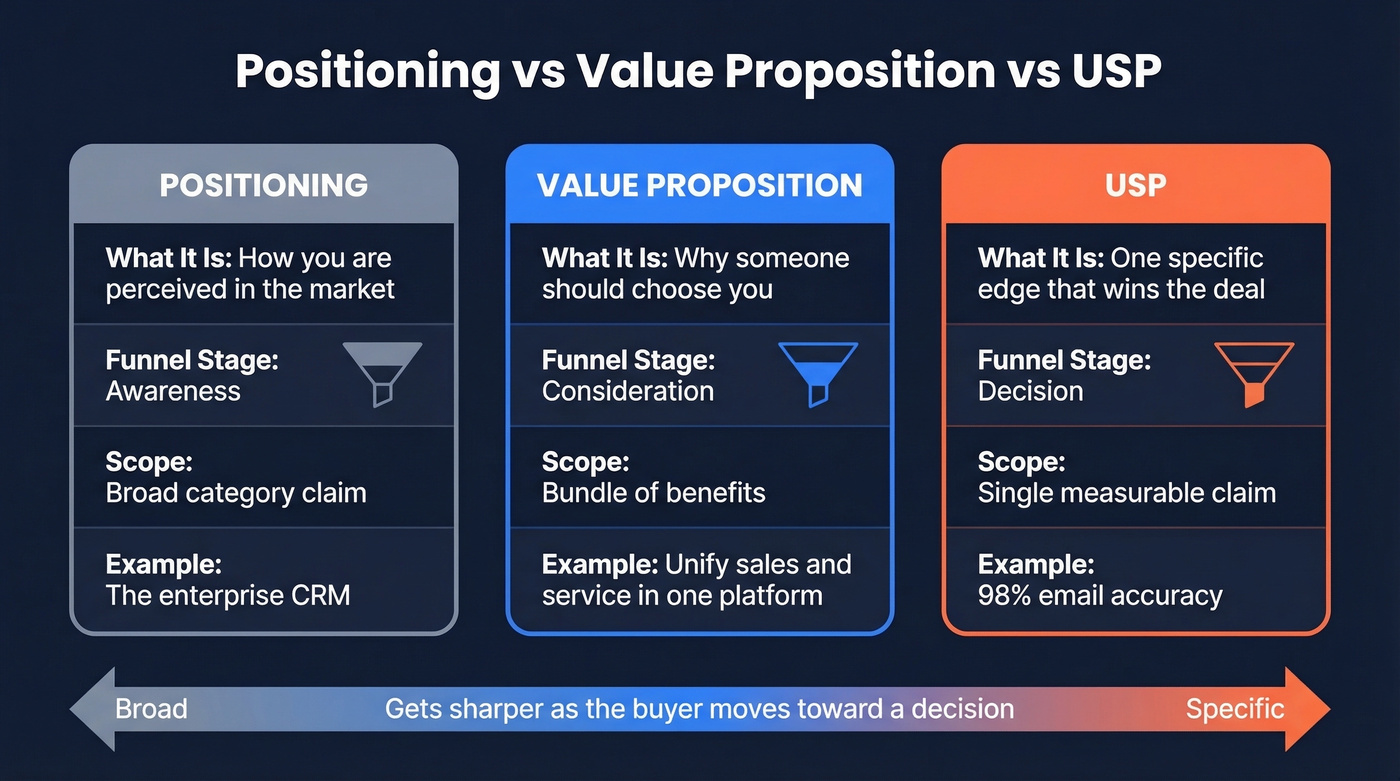
Most sales teams confuse three related but distinct concepts:
| Concept | What It Is | Funnel Stage | Example |
|---|---|---|---|
| Positioning | How you're perceived | Awareness | "The enterprise CRM" |
| Value Proposition | Why choose you | Consideration | "Unify sales + service" |
| USP | One specific edge | Decision | "98% email accuracy" |
Positioning is a category claim. A value proposition is a bundle of benefits. A USP is a scalpel - one measurable, defensible reason you win the deal.
Why Differentiation Matters More in 2026
The B2B buying journey has compressed fast. Somewhere between 50% and 90% of that journey is now completed before a buyer ever talks to a rep, and 80% of B2B sales interactions are expected to occur through digital channels. Your reps get fewer at-bats. Each one counts more. Clear differentiation can improve competitive win rates by 10-20%.
Deals closed within 50 days have a 47% win rate. After that threshold, win rates drop to 20% or lower - which means your USP can't be something reps "get around to" in the third meeting. It needs to land in the first 15 seconds: on the first call, in the first email, during the first demo. Compressed cycles reward teams that differentiate instantly and punish those who rely on "we'll show them over time."
Your USP Is Probably Wrong
Most companies think they know why they lose deals. They don't.
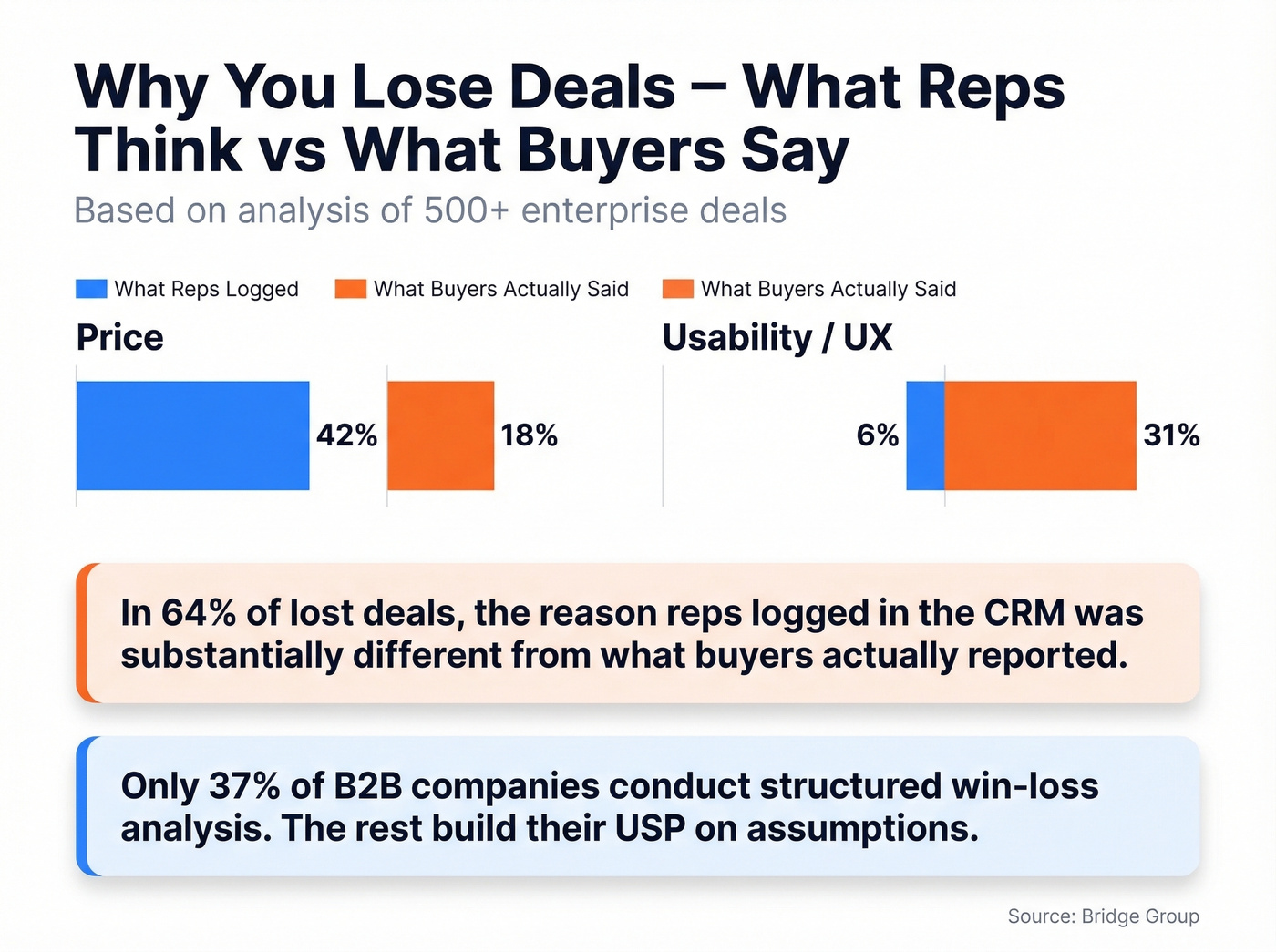
A Bridge Group study of 500 enterprise deals found that in 64% of cases, the loss reason reps logged in the CRM differed substantially from what buyers actually said when interviewed independently. The gaps are stark: sales teams attributed 42% of losses to price, but buyers cited price as the primary factor in only 18% of the cases. Meanwhile, reps flagged usability as the reason in just 6% of deals - buyers said UX was their primary concern 31% of the time.
Only 37% of B2B companies even conduct structured win/loss analysis. The rest are building their unique selling proposition on internal assumptions that are provably wrong. If your USP includes "best-in-class" or "innovative," you don't have a USP. You have a press release.
Let's be honest: most B2B companies don't actually have a differentiation problem. They have a listening problem. They've never sat across from a buyer who chose the competitor and asked "why?" until the real answer came out. Fix the listening, and the USP writes itself.
Five Criteria of a Sales-Ready USP
Stop trying to be unique. Start trying to be specific. Salesforce frames it as three guiding questions: who do you serve, what do you do differently, and how do you do it? A selling proposition that works in actual sales conversations passes five tests:
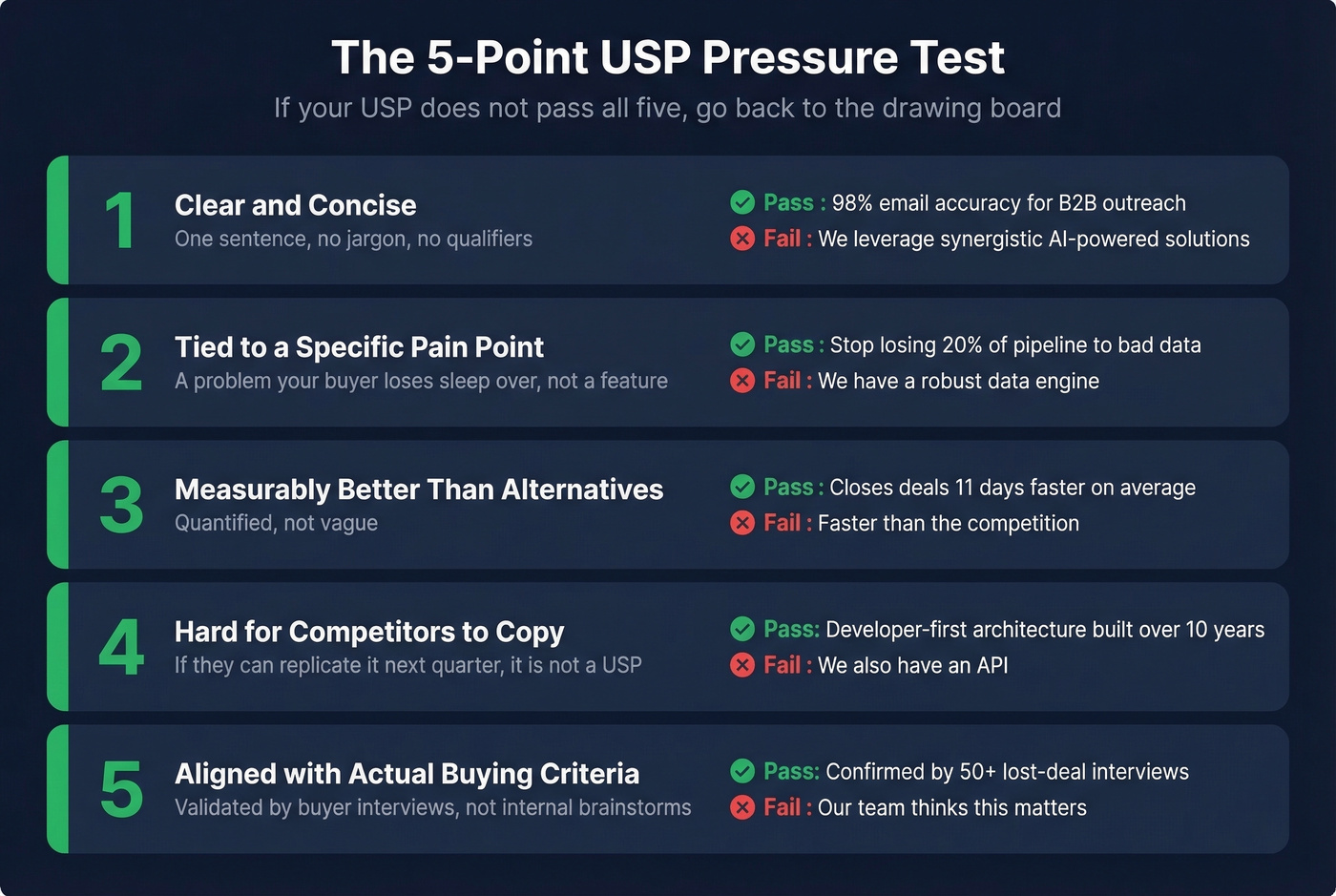
- Clear and concise - one sentence, no jargon, no qualifiers
- Tied to a specific pain point - not a feature, but a problem your buyer loses sleep over
- Measurably better than alternatives - "faster" doesn't count; "closes deals 11 days faster" does
- Difficult for competitors to replicate - if they can copy it next quarter, it's not a USP
- Aligned with your ICP's actual buying criteria - validated by buyer interviews, not your marketing team's brainstorm
The pressure test is simple. Take your USP and ask "so what?" Keep asking until you reach something the buyer actually cares about. "We have AI-powered analytics" - so what? - "You'll spot pipeline risk 2 weeks earlier" - so what? - "You'll save 15% of deals that would've slipped." That last one is a USP. The first one is a feature.

A sharp USP is worthless if it never reaches the buyer. 98% email accuracy, 7-day data refresh, and 125M+ verified mobiles mean your differentiator lands in real inboxes - not bounce logs.
Stop perfecting your pitch and sending it to dead addresses.
How to Build Your USP
1. Interview lost deals. Not your reps - the actual buyers who said no. Ask what drove their decision. You'll find the real buying criteria differ from what your CRM says. We've run these interviews for our own outbound campaigns, and the gap between what we assumed and what buyers told us was humbling every single time.
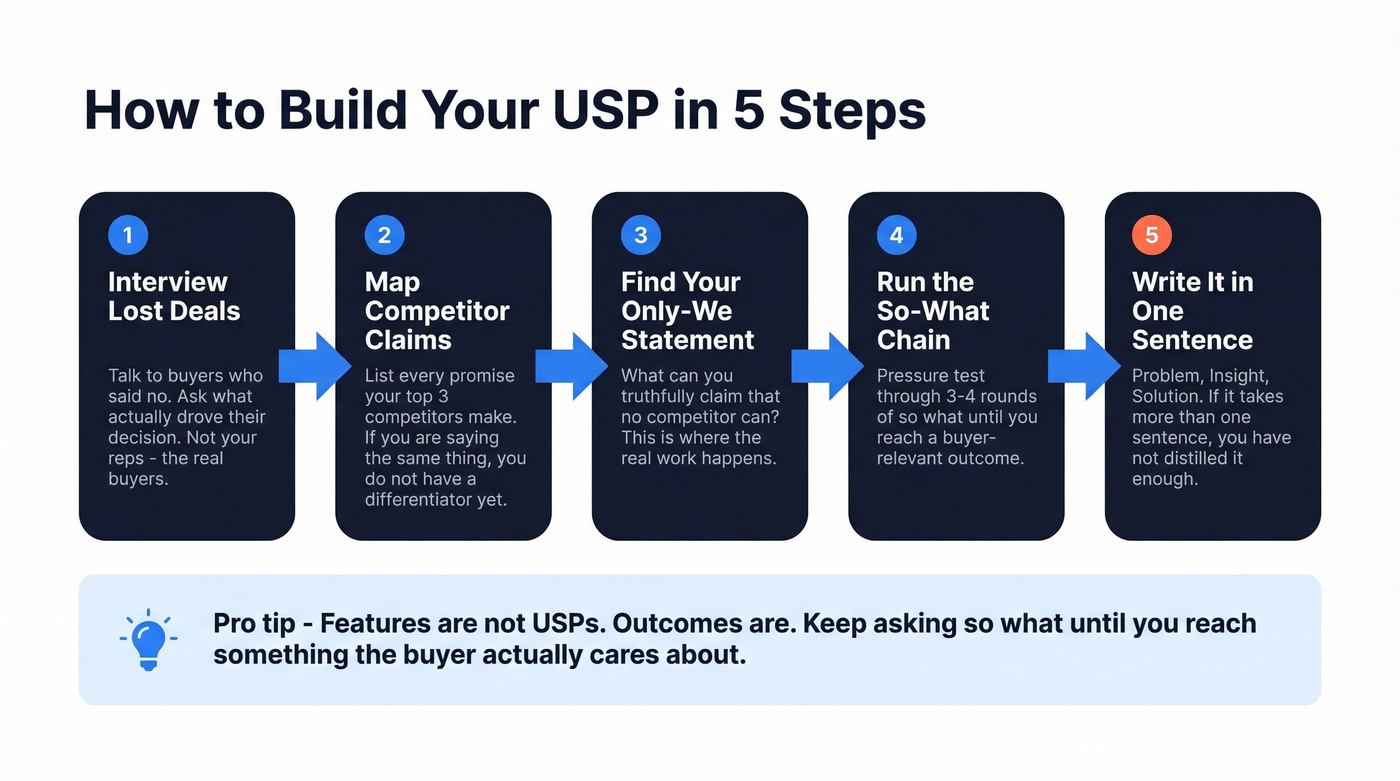
2. Map competitor claims. List every promise your top 3 competitors make. If you're saying the same thing, you don't have a differentiator yet.
3. Identify your "only we" statement. What can you say that no competitor can truthfully claim? This is where most teams get stuck - and where the real work happens.
4. Run the "so what?" chain. Take your "only we" statement and pressure-test it through 3-4 rounds of "so what?" until you land on a buyer-relevant outcome. Features aren't USPs. Outcomes are.
5. Write it in one sentence. Use the Problem-Insight-Solution framework: name the problem your buyer faces, share the insight that makes your approach different from what they've already tried, and state the measurable result. If it takes more than one sentence, you haven't distilled it enough.
Deploying Your USP in Sales Conversations
Cold Emails
Your prospect's inbox is full of identical pitches. Five hundred cold emails that all say "we help companies grow revenue" - the prospect deletes every one. Your unique selling proposition is the only thing that earns a reply.
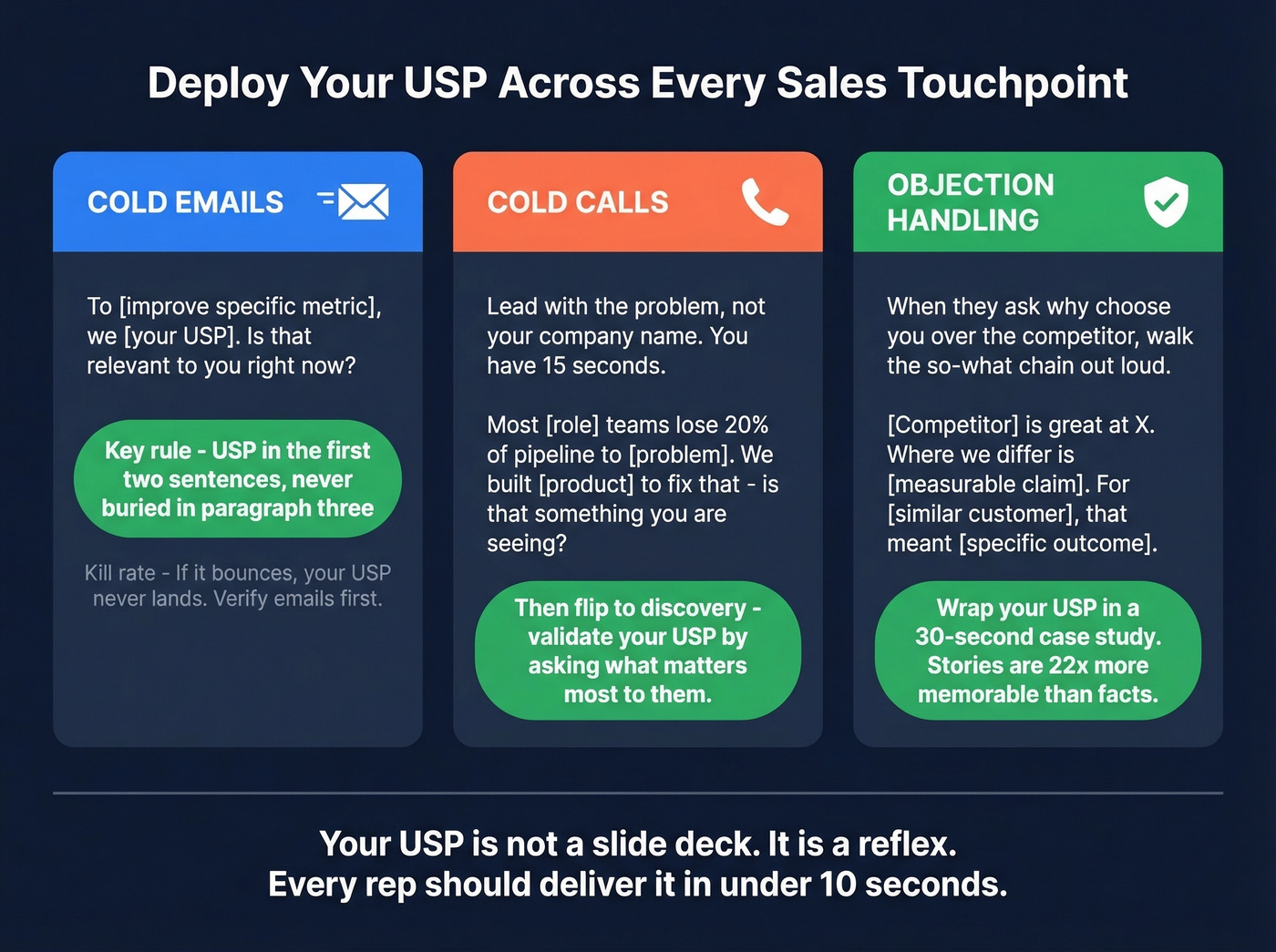
Use the value-add template structure: "To {improve this specific metric}, we {your USP}. Is that relevant to you right now?" Short, specific, easy to respond to.
One thing that kills even a great cold email: sending it to a dead address. High bounce rates don't just waste your outreach - they tank your domain reputation. Prospeo verifies emails in real time at 98% accuracy, so your pitch actually reaches a human inbox instead of bouncing into the void. If you're tightening deliverability, start with your email bounce rates and a proper email deliverability guide.
Cold Calls and Discovery
You've got 15 seconds before the prospect decides whether to keep listening. Lead with the problem, not your company name. "Most [role] teams we talk to are losing 20% of pipeline to [specific problem]. We built [product] specifically to fix that - is that something you're seeing?"
Then flip to discovery. The best reps don't just deliver their differentiator - they validate it in real time. Ask: "When you're evaluating tools like ours, what's the single biggest factor in your decision?" If the answer aligns with your USP, you're in. If it doesn't, you just learned something more valuable than a closed deal. (If you want a tighter structure, use a discovery questions framework.)
Objection Handling
"Why should I choose you over [competitor]?" This is the moment your USP earns its keep. Don't respond with a feature list. Walk the "so what?" chain out loud.
The strongest reps use LCD messaging - lowest common denominator language that strips jargon and speaks to the buyer's simplest, most urgent concern. Instead of rattling off technical specs, distill your differentiator into terms any stakeholder in the room can immediately grasp. "[Competitor] is great at X. Where we're different is [measurable claim]. For [customer similar to them], that meant [specific outcome]." Stories are 22x more memorable than facts - wrap your USP in a 30-second case study, not a spec sheet. This is also where sales communication and competitive sales training pay off fast.
B2B USP Examples That Work
Stripe
Before Stripe, integrating payments meant weeks of work with clunky APIs and painful documentation. Stripe made it a few lines of code. The USP: payments infrastructure built for developers. It's specific (developers, not "businesses"), and it's genuinely hard to replicate - the developer experience is baked into the product architecture. The archetype here is "built for a specific buyer that competitors ignore."
HubSpot
Every point solution you add creates integration headaches and data silos. HubSpot bet that consolidation itself is the differentiator - marketing, sales, service, CMS in one system. The archetype: "eliminates a cost or risk that competitors create." In our experience, the reps who close the most competitive deals against HubSpot can recite exactly which integration pain they solve better. That's the power of a clear selling proposition on both sides.
Domino's and FedEx
"30 minutes or it's free." "When it absolutely, positively has to be there overnight." Both are decades old. Both still work as teaching examples because they hit every criterion: measurable, specific, and risk-reversing. The lesson isn't about pizza or packages - it's about making a promise so concrete that the buyer can hold you to it.
Now give me one from this decade that's half as clear. I'll wait.

You just built a USP that passes the 'so what?' test. Now deploy it at scale - Prospeo's 300M+ profiles with 30+ filters let you target the exact ICP who cares about your differentiator, at $0.01 per email.
Pair your sharpest message with the most accurate data in B2B.
Operationalize It Across Your Team
A USP that lives on your website but not in your reps' mouths is a marketing asset, not a sales weapon. Organizations with a sales enablement strategy achieve 49% higher win rates on forecasted deals and are 80% more likely to increase win rates with a unified enablement platform. Enablement also cuts onboarding time by 40-50% - new reps ramp faster when they know exactly what to say and why. (If you're formalizing this, a sales enablement strategy usually starts with repeatable assets and coaching.)
Your selling proposition needs to live in every daily touchpoint:
- Battlecards - one-line USP at the top, with "so what?" chain for each competitor (see Sales Battle Cards)
- Email templates - USP baked into the first two sentences, not buried in paragraph three (use proven sales follow-up templates)
- Pitch decks - USP on slide 2, before the product tour (borrow frameworks from sales deck storytelling)
- Onboarding materials - new reps should recite the USP by end of week one (tie it to a 30-60-90 day plan)
- Website and ads - A/B test your USP in landing page headlines and email subject lines; if version A outperforms by 15%+, you've validated it empirically (use these email subject line examples)
We've seen teams nail the USP in a workshop, then watch it evaporate because nobody embedded it into the daily workflow. Build it into every touchpoint - or accept that only your top 2-3 reps will ever use it consistently.
Skip this section if you're a solo founder doing your own outbound. You don't need battlecards. You need to internalize your differentiator so deeply that it comes out naturally in every conversation, and then write it down only when you hire rep number two.
FAQ
What's the difference between a USP and a tagline?
A tagline is a branding device - catchy, broad, memorable. A USP is a specific, defensible claim about why you're measurably better for a defined buyer. "Just Do It" is a tagline. "30 minutes or it's free" is a USP. Your sales team needs the latter.
Can a company have more than one USP?
You can have multiple differentiators, but your sales team should lead with one. Reps who try to communicate three selling propositions at once communicate none. Pick the one that matters most to your ICP's primary buying criterion and save the others for specific objection scenarios.
How do I know if my USP is working?
Track competitive win rates and run quarterly win/loss interviews with buyers - not just reps. If your win rate on competitive deals improves and buyers cite your differentiator unprompted, it's landing. Below 5% improvement after two quarters, revisit your messaging.
How often should I revisit my USP?
Every quarter, minimum. Markets shift, competitors copy your positioning, and buyer priorities evolve. The USP you built in Q1 might be table stakes by Q4. Tie your review cadence to your win/loss analysis cycle so you're always working from fresh data, not stale assumptions.
Your USP in sales isn't a one-time exercise. Revisit it every quarter with fresh win/loss data - because the market moves, and your differentiation needs to move with it.