

How to Write a Warm Follow Up Email That Actually Gets a Reply
You had a great 30-minute demo last Tuesday. The prospect was nodding, asking smart questions, even mentioned budget timelines. You send a follow-up the next day: "Hey, just following up on our conversation!" And then... nothing.
That word "just" made your email feel optional - something the recipient could safely ignore, because you signaled it wasn't important enough to demand a real response. A warm follow up email needs to earn attention, not apologize for asking for it.
What Makes a Follow-Up "Warm"?
A warm follow-up goes to someone who already knows you exist. You've met at an event, run a demo, been introduced by a mutual contact, or they downloaded your whitepaper. That prior interaction is the entire difference.
Cold email averages a 3.43% reply rate. Warm follow-ups pull 10-30% because the recipient has context - they remember the conversation, the handshake, the referral. You're not introducing yourself. You're continuing something.
When to Send Your Follow-Up
Timing matters more than most reps think. Too fast feels desperate. Too slow and the conversation goes cold again.
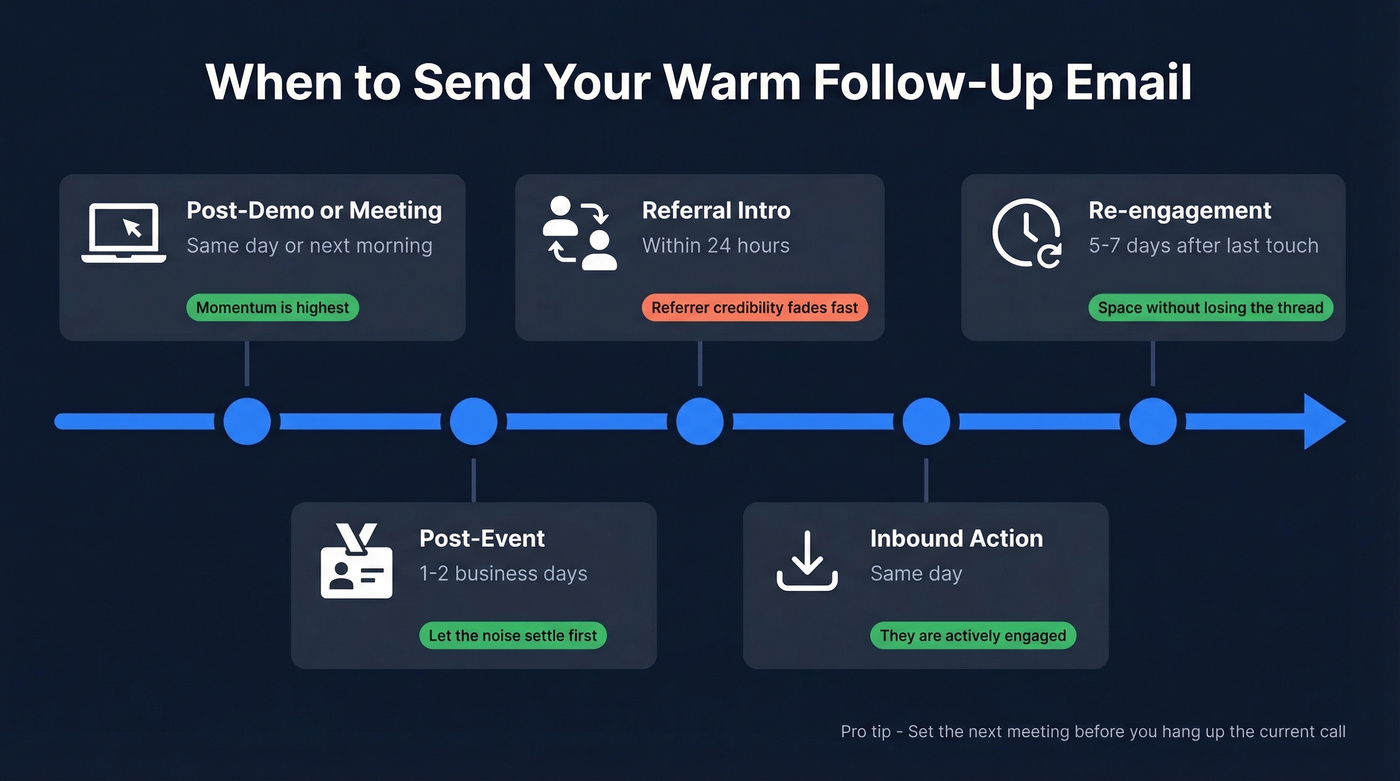
| Scenario | Best Timing | Why |
|---|---|---|
| Post-demo/meeting | Same day or next AM | Momentum is highest |
| Post-event | 1-2 business days | Let the noise settle |
| Referral intro | Within 24 hours | Referrer's credibility fades |
| Inbound action | Same day | They're actively engaged |
| Re-engagement | 5-7 days after last touch | Space without losing thread |
High-urgency signals - they asked about pricing, mentioned a deadline - mean same-day. Casual networking conversations benefit from a day's breathing room.
Here's the single best timing hack, and it isn't about the follow-up at all: set the next meeting before you hang up the current call. "I'll send over that case study - can we lock in 15 minutes Thursday to discuss?" Now your follow-up email confirms a commitment instead of requesting one. I've watched this shift materially improve reply rates for teams that adopt it.
A like or comment on their post right before your email lands also reinforces the warm signal. It puts your name in their feed so the email feels like a continuation, not a cold ping.
Templates That Earn Replies
Every template below follows a simple structure: reference the connection, deliver value, close with a soft ask. If you want more options, borrow from these sales follow-up templates and adapt them to your context.
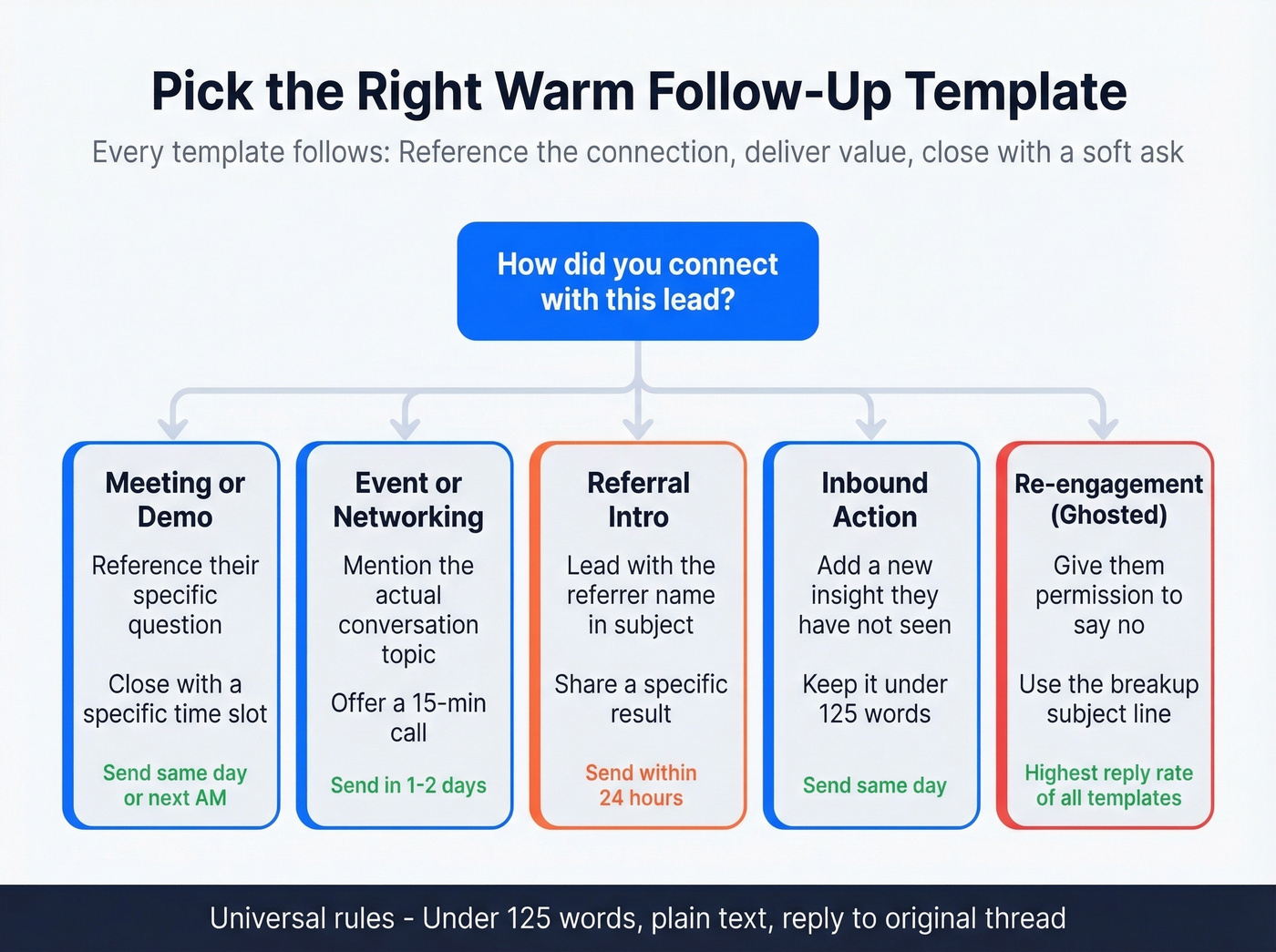
Keep each email under 125 words and send it as a reply to your original thread - plain text, no HTML formatting. Emails that look like quick notes get treated like quick notes. Emails that look like marketing get archived.
After a Meeting or Demo
Subject: Next steps from our [product] walkthrough
Hi [Name],
Great conversation yesterday - especially your question about [specific topic they raised]. I pulled together a short case study from a similar team that cut their [metric] by 30% after implementing.
[Link to case study]
I'm finalizing my calendar for next week. Would Thursday at 2 PM work to walk through pricing together?
The scheduling ask comes from a technique r/sales practitioners swear by - "finalizing my schedule" creates a real constraint without sounding pushy. If you want a tighter structure for the meeting itself, use a product demo checklist so your follow-up can reference clear next steps.
After an Event or Networking Conversation
Don't write "Great meeting you at SaaStr." That's forgettable. Reference the actual conversation:
Subject: Good meeting you at [Event Name]
Hi [Name],
Really enjoyed our conversation about [specific topic] at [event]. You mentioned [challenge they described] - I've seen a few teams solve that with [brief approach].
Would a 15-minute call next week be useful? Happy to share what's worked.
After a Referral Introduction
Subject: [Referrer's name] suggested we connect
Hi [Name],
[Referrer] mentioned you're working on [specific challenge]. We helped [similar company] tackle the same problem and saw [specific result].
I'd love 15 minutes to see if there's a fit. What does your Tuesday look like?
Lead with the referrer's name in the subject line. Nothing else in the email carries as much weight. If you're replying to an intro thread, this email after introduction guide can help you keep it crisp.
After an Inbound Action
Most reps recap the content the prospect already read. That's wasted space. Add something new instead - a perspective, a relevant example, a specific recommendation they won't find in the resource:
Subject: Saw you grabbed our [resource name]
Hi [Name],
Most teams reading that are trying to solve [problem the resource addresses]. If that's you, I have a couple of ideas specific to [their industry/role].
Worth a quick call this week?
If you need help tightening the ask, use these email call to action rules to keep it low-friction.
Re-Engagement After Ghosting
The "should I close this out?" subject line works because it gives the recipient permission to say no - which paradoxically makes them more likely to re-engage.
Warm leads often go silent after 2-3 follow-ups over 1-2 weeks. That's exactly why this breakup email earns its place in your sequence:
Subject: Should I close this out?
Hi [Name],
I know things get busy. I don't want to keep pinging you if the timing's off. If [original problem] is still on your radar, I'm happy to pick back up. If not, no hard feelings - just let me know and I'll stop reaching out.
Either way, hope [specific thing they mentioned] is going well.
In our experience, the re-engagement email gets the highest reply rate of any template on this list. People respond to an easy exit.

A perfect warm follow-up means nothing if it bounces. Prospeo delivers 98% email accuracy with 5-step verification - so your carefully crafted post-demo email actually lands in their inbox, not a dead address.
Stop losing warm leads to bad data. Verify before you send.
Subject Lines That Signal Warmth
Every warm follow-up subject line should reference the prior interaction:
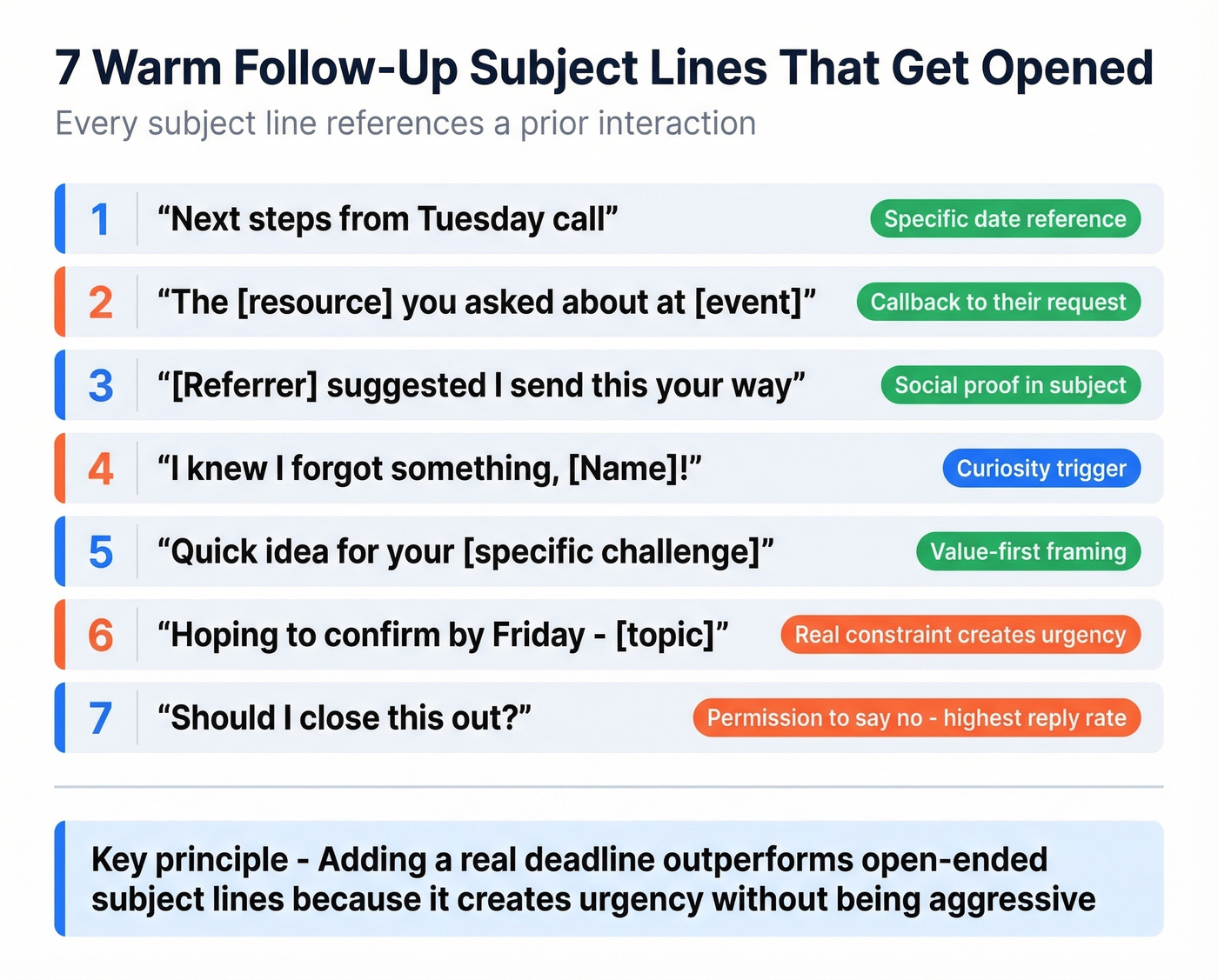
- "Next steps from Tuesday's call"
- "The [resource] you asked about at [event]"
- "[Referrer] suggested I send this your way"
- "I knew I forgot something, [Name]!"
- "Quick idea for your [specific challenge]"
- "Hoping to confirm by Friday - [topic]"
- "Should I close this out?"
If you want more variations, pull ideas from these email subject line examples and keep them tied to the prior touch.
Adding a real constraint - "hoping to confirm by Friday" - outperforms open-ended subject lines because it creates urgency without being aggressive.
Five Mistakes That Kill Reply Rates
Bumping with no new info. Every follow-up needs to bring something: a resource, a new angle, a data point. "Just wanted to make sure you saw my last email" isn't a reason to send.
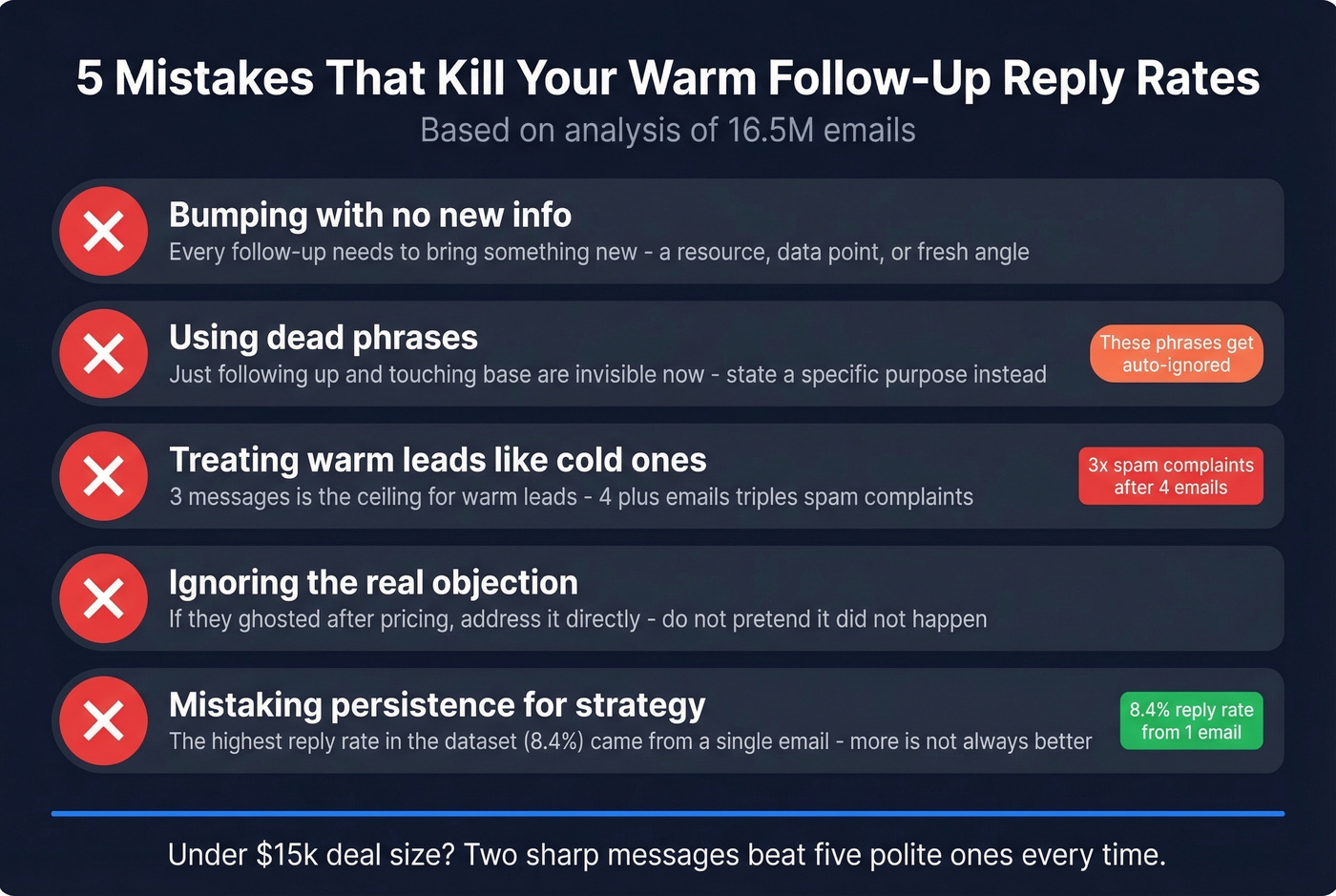
Using dead phrases. "Just following up," "touching base," and "checking in" are overused to the point of invisibility. Replace them with a specific purpose for writing. If you catch yourself defaulting to "checking in," use these alternatives for how to say just checking in professionally.
Treating warm like cold. Warm leads don't need 8-12 touchpoints. Three messages is the ceiling. A Belkins analysis of 16.5M emails found that 4+ emails in a sequence more than triples unsubscribe and spam complaint rates - and that's for cold outreach. Warm leads have even less tolerance. The same data shows SMBs start at 9.2% reply rates and rebound after a dip, while enterprise prospects ghost quickly and punish persistence. Adjust accordingly.
Ignoring the real objection. If someone went silent after seeing pricing, don't pretend it didn't happen. Address it head-on: "I know the investment is significant - here's how [similar company] justified it internally." (This is also where better discovery questions prevent surprises later.)
Mistaking persistence for strategy. That "80% of sales require 5 follow-ups" stat floating around? It's about cold outreach. The highest reply rate in Belkins' dataset - 8.4% - came from a single email. More isn't always better.
Let's be honest: if your average deal size is under $15k, three follow-ups is generous. We've seen teams get better results from two sharp messages than five polite ones. The quality of what you say matters infinitely more than how many times you say it.
Make Sure Your Follow-Up Lands

You can nail the timing, reference the exact conversation, craft the perfect warm follow up email - and none of it matters if the email bounces. People change jobs constantly. Companies switch providers without warning. A perfect email that bounces is worse than a mediocre email that lands, and it chips away at your sender reputation every time it happens.
Skip this step if you're only following up with one or two people you spoke to yesterday. But for teams running warm sequences at any kind of scale, verifying addresses before you hit send is non-negotiable. Prospeo handles this in real time with 98% accuracy and a 7-day data refresh cycle, so your carefully crafted follow-up actually reaches someone. If you’re troubleshooting deliverability, start with this email deliverability guide and then monitor your email bounce rate.
When a warm lead ghosts your email, sometimes the fastest path back is a direct dial. Prospeo gives you 125M+ verified mobile numbers with a 30% pickup rate - so your re-engagement isn't limited to their inbox.
Skip the inbox. Call the leads who stopped replying.
FAQ
How do you write a warm follow up email?
Reference your prior interaction - a meeting, event, or referral - so the recipient immediately has context. Deliver something valuable like a resource, insight, or new angle, then close with a low-friction ask like a 15-minute call. Keep the whole message under 125 words, send it as a reply to your original thread, and use plain text so it reads like a personal note rather than a newsletter.
How many follow-ups should I send to a warm lead?
Three is the ceiling. A Belkins study of 16.5M emails shows that 4+ messages more than triples spam complaints - even in cold sequences. If someone hasn't replied after three well-crafted messages, the timing is wrong. Park the lead and revisit when you have a genuine new reason to reach out.
What's the difference between a warm and cold follow-up?
A warm follow-up goes to someone you've already interacted with - they have context about you and your offer. Cold follow-ups target strangers. Warm emails pull 10-30% reply rates versus roughly 3.43% for cold because the recipient remembers the conversation, referral, or event that connects you.
How do I make sure my follow-up email doesn't bounce?
Verify the address before hitting send. People change roles constantly, and inboxes get deactivated without warning. Real-time verification tools catch stale addresses before they damage your sender reputation - something that's especially important if you're running warm sequences across dozens of contacts each week.