

What Is a Lead Generation Company - and Do You Actually Need One?
The global lead generation market is on track to [hit $295B by 2027](https://www.businesswire.com/news/home/20210126005925/en/Global-Content-Marketing-Market-Trajectory-Analytics-Report-2020-2027-Lead-Generation-is-Projected-to-Account-for-US%24295.1-Billion-of-the-Total-%24829.6-Billion-Industry - ResearchAndMarkets.com). That's a lot of money chasing a simple promise: someone else fills your pipeline so your reps can close.
Here's the thing - marketing agencies, data platforms, and outbound firms get lumped together under "lead generation company," but they're fundamentally different businesses solving different problems. And the distinction matters more than most people realize, because companies that follow up with a lead within five minutes are 9x more likely to convert them. So the real question isn't just who generates your leads. It's whether you can act on them fast enough once they show up.
The Quick Version
Lead gen companies fall into three buckets: agencies that run outreach for you, data platforms that give you the contacts, and hybrid services somewhere in between.
Most agencies cost $1,500-$5,000/month, with full-service outsourced SDR teams often running $10,000+/month. If your real problem is finding accurate contact data - not strategy or SDR bandwidth - a self-serve platform like Prospeo handles that with credit-based pricing at roughly $0.01 per verified email, no contracts, and 98% email accuracy.
Lead Generation Company, Defined
A lead generation company is an intermediary that finds and qualifies potential buyers for your sales team. They use some combination of outbound prospecting, paid media, content syndication, or data intelligence to deliver leads - people who match your ideal customer profile. The goal: your reps spend time selling instead of searching.
The confusion starts because people lump these providers in with marketing agencies. They're not the same thing.
| Lead Gen Company | Marketing Agency | |
|---|---|---|
| Focus | Qualified leads ready for sales | Brand, traffic, awareness |
| KPIs | CPL, lead-to-appointment rate | Traffic, engagement, reach |
| Timeline | Results in 30-60 days | 3-12 month horizon |
| Pricing | Retainer or per-lead | Retainer or % of ad spend |
A marketing agency builds your brand over time. A lead gen firm fills your calendar with meetings this quarter. Both matter, but they solve different problems on different timescales.
Types of Lead Generation Companies
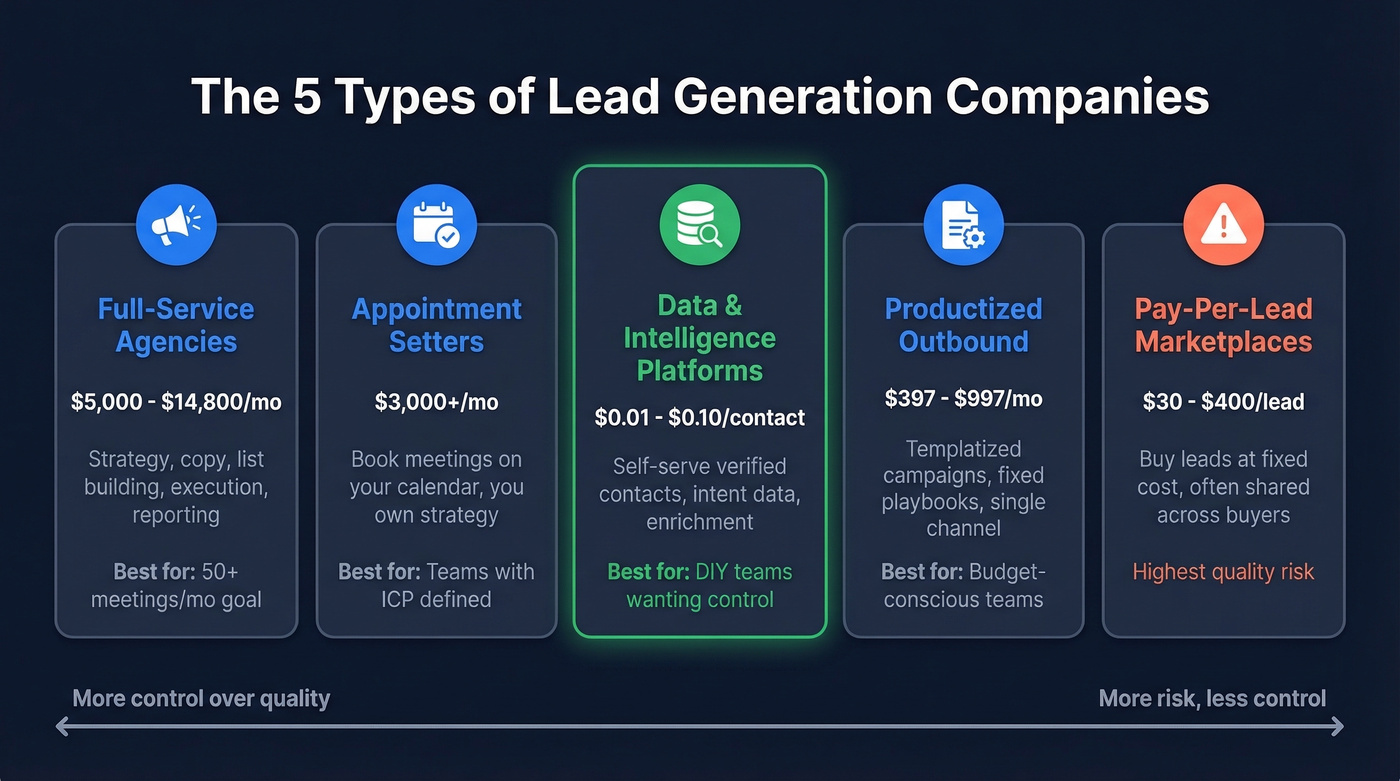
The term covers five distinct business models. Knowing which type you're evaluating saves you from comparing apples to forklifts.
Full-Service Agencies
These firms run your entire outbound operation - strategy, copywriting, list building, multi-channel execution, and reporting. Published benchmarks include Belkins ($5,000-$14,800/mo) and Cience ($4,200-$9,000/mo). You're essentially outsourcing an SDR team. Best for companies that need high appointment volume and don't want to hire internally.
We've seen teams go this route when they need 50+ booked meetings per month and can't ramp internal reps fast enough. The tradeoff is cost and control - you're paying a premium, and someone else owns your messaging.
Appointment-Setting Firms
A narrower slice: they book meetings on your calendar. Period. SalesBread (from $3,000/mo) and SalesRoads are common examples. You own the strategy; they handle execution and follow-up. These tend to be cheaper and more focused than full-service agencies, which makes them a solid middle ground for teams that have their ICP dialed in but lack the bandwidth to do cold outreach at scale.
Data & Intelligence Platforms
These aren't agencies - they're self-serve tools that give your team the raw material to prospect on their own. Prospeo, ZoomInfo, and Cognism all fall here, but they're very different in practice.
Prospeo covers 300M+ professional profiles with 98% email accuracy and a 7-day data refresh cycle, plus buyer intent data across 15,000 topics. ZoomInfo is the enterprise incumbent with the broadest US database, typically costing $15,000-$40,000/year depending on seats and modules. Cognism is strong for teams selling into EMEA with a heavy compliance focus, with custom pricing that usually lands around $15,000-$30,000/year.
Instead of paying $5K-$10K/month for someone else to prospect, you're paying a data subscription and doing outreach yourself.
Productized Outbound Services
Templatized, channel-specific services sold at fixed prices. Cleverly ($397-$997/mo) runs done-for-you outbound campaigns with standardized playbooks. Lower cost, less customization.
Pay-Per-Lead Marketplaces
Platforms where you buy leads at a fixed cost per contact or per appointment. The upside is predictable unit economics. The downside - and it's a big one - is that leads are often shared across multiple buyers. The consensus on r/LeadGeneration is that this model carries the highest quality risk of any approach.

Most lead gen agencies charge $5,000-$14,800/month to do what a self-serve data platform handles for a fraction of the cost. Prospeo gives you 300M+ profiles, 98% email accuracy, and buyer intent across 15,000 topics - so your team prospects on its own terms, not an agency's timeline.
Skip the retainer. Build your own pipeline at $0.01 per verified email.
What Does It Actually Cost?
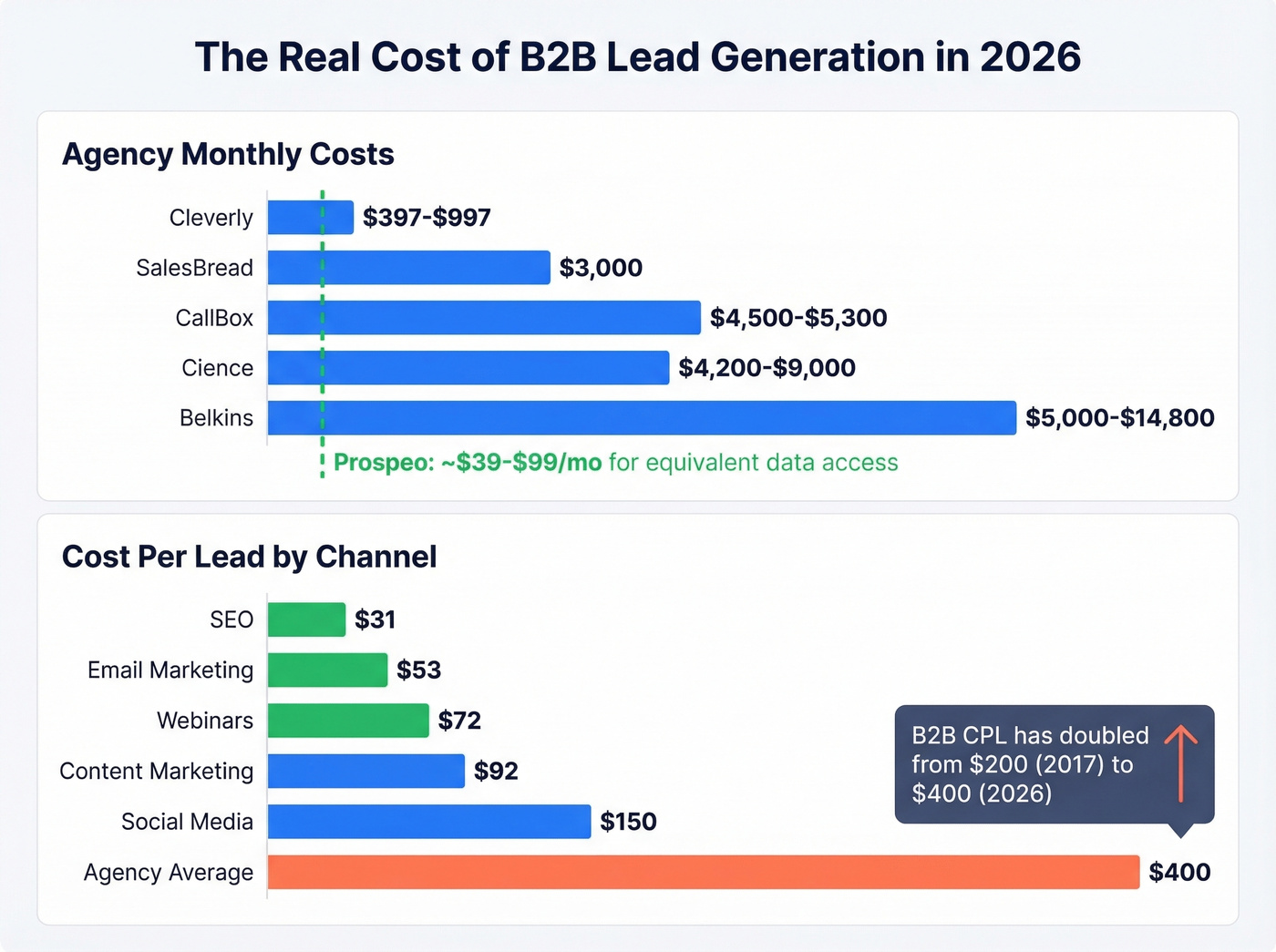
Let's be honest: if your average deal is under $5K, you almost certainly shouldn't be paying an agency for leads. The math doesn't work. A $400 CPL on a $3K deal leaves nothing for anyone.
Now, the actual numbers:
| Model | Typical Range | Notes |
|---|---|---|
| Monthly retainer | $500-$5,000/mo (common); $10,000-$20,000+/mo (full teams) | Most common for agencies |
| Cost per lead | $30-$400/lead | Varies by industry |
| Cost per qualified lead or meeting | $150-$1,200 | Higher intent, higher price |
| Setup fee (one-time) | $5,000-$15,000 | Common with enterprise agencies |
| % of ad spend | 12-18% | Paid media-focused firms |
Named agencies so you have real benchmarks:
| Agency | Approx. Monthly Cost |
|---|---|
| Cleverly | $397-$997 |
| SalesBread | From $3,000 + setup |
| CallBox | $4,500-$5,300 |
| Cience | $4,200-$9,000 |
| Belkins | $5,000-$14,800 |
B2B cost per lead has climbed from ~$200 in 2017 to ~$400 as of recent benchmarks. B2B SaaS CPL averages $100-$320 per lead. Financial services and legal run $400-$650+. For context, the cheapest channels for lead generation are SEO ($31 CPL), email ($53), and webinars ($72) - worth knowing when you're evaluating what an agency charges for multi-channel work.
How These Providers Actually Operate
Skip the sales decks. Understanding the mechanics helps you separate good providers from expensive ones.
Demand proof, not promises. Case studies with MQL-to-SQL rates, appointment volumes, and pipeline contribution. If they can't show numbers, they don't have them.
Check channel coverage. Email, phone, paid, content syndication - or just one channel? 89% of B2B marketers use LinkedIn for lead gen, and 73% say webinars produce their best-quality leads. Match their capabilities to where your buyers actually engage.
Require CRM integration and lead-level reporting. Aggregate dashboards hide bad data. You need every lead, its source, and its qualification status flowing into Salesforce or HubSpot - not a spreadsheet emailed on Fridays. (If you want a clean setup, start with lead status definitions and lead scoring.)
Ask how they qualify leads. If they can't define an MQL threshold or a scoring model, they're sending you form fills, not prospects.
Verify compliance. GDPR, TCPA, CCPA - ask how they handle consent and opt-outs. Some providers have GDPR-native infrastructure; others treat it as an afterthought. In February 2024, the CFPB issued guidance targeting manipulation of comparison-shopping tools for financial products due to kickbacks. Don't find out the hard way.
Negotiate contract terms. Push for a 7-30 day rejection window for invalid or duplicate leads, dedupe clauses in writing, and a performance exit after month 2-3. We've seen teams locked into 12-month deals with no out - don't be that team.
Red Flags and Scams
79% of leads never convert due to poor nurturing and qualification. Bad providers make that number worse. Watch for these:
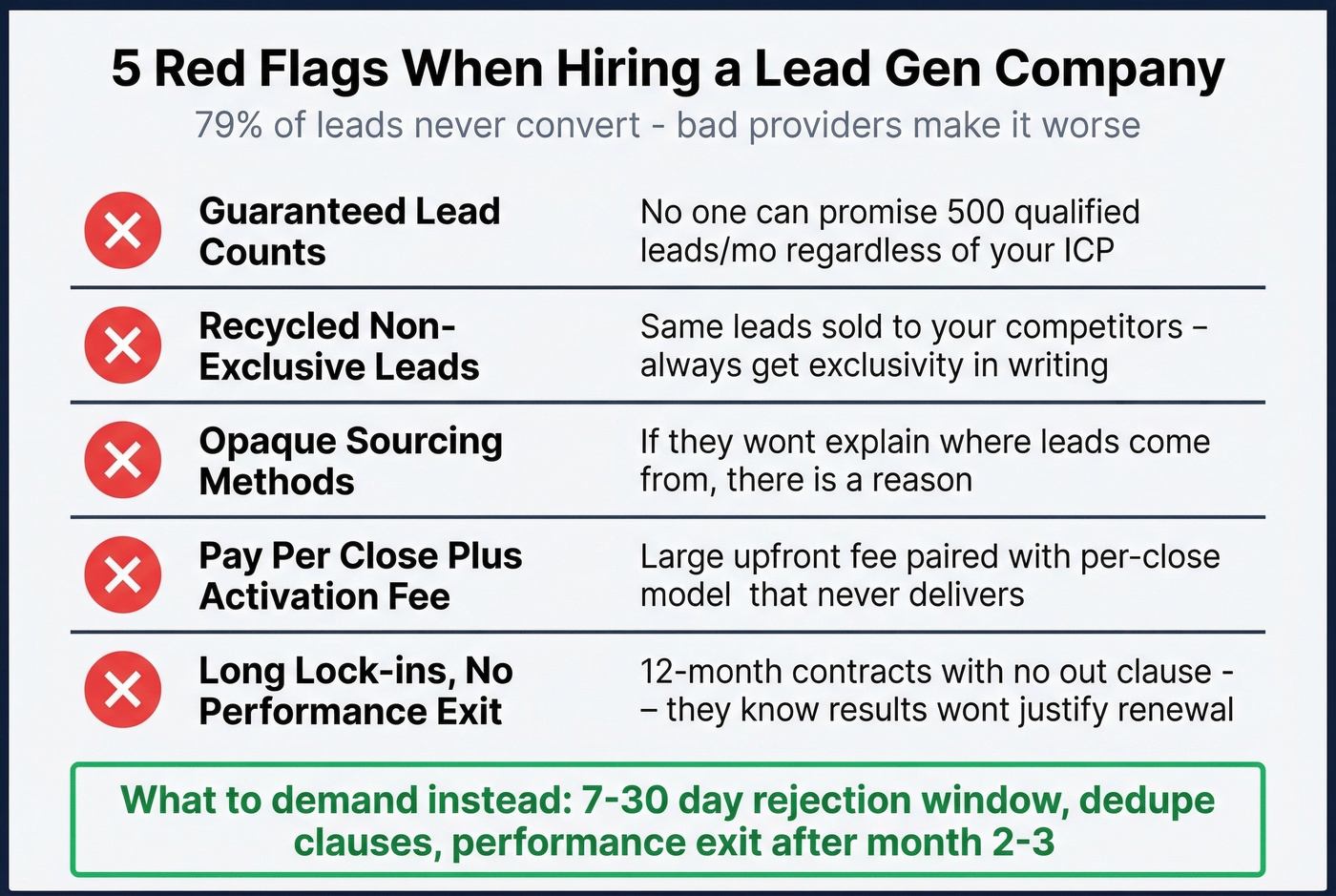
Guaranteed lead counts. No legitimate provider can guarantee a specific number of qualified leads. If they promise 500 leads/month regardless of your ICP, they're selling volume, not quality.
Recycled, non-exclusive leads. A common complaint on r/LeadGeneration is providers selling the same leads to multiple clients. Ask directly and get exclusivity in the contract.
Opaque sourcing methods. If they won't explain where leads come from, there's a reason. Some agencies outsource list building to freelancers on Upwork and mark it up 5x.
"Pay per close + activation fee" structures. Especially common in real estate lead gen - a large upfront activation fee paired with a per-close model that never delivers closings. Reddit threads call this out repeatedly.
Long lock-ins with no performance clauses. A 6-month minimum is reasonable if there's a performance exit after month 2-3. A 12-month lock-in with no out? That's a provider who knows their results won't justify renewal.
When to Hire vs. DIY
Most articles assume you need an agency. You probably don't. You need better data.
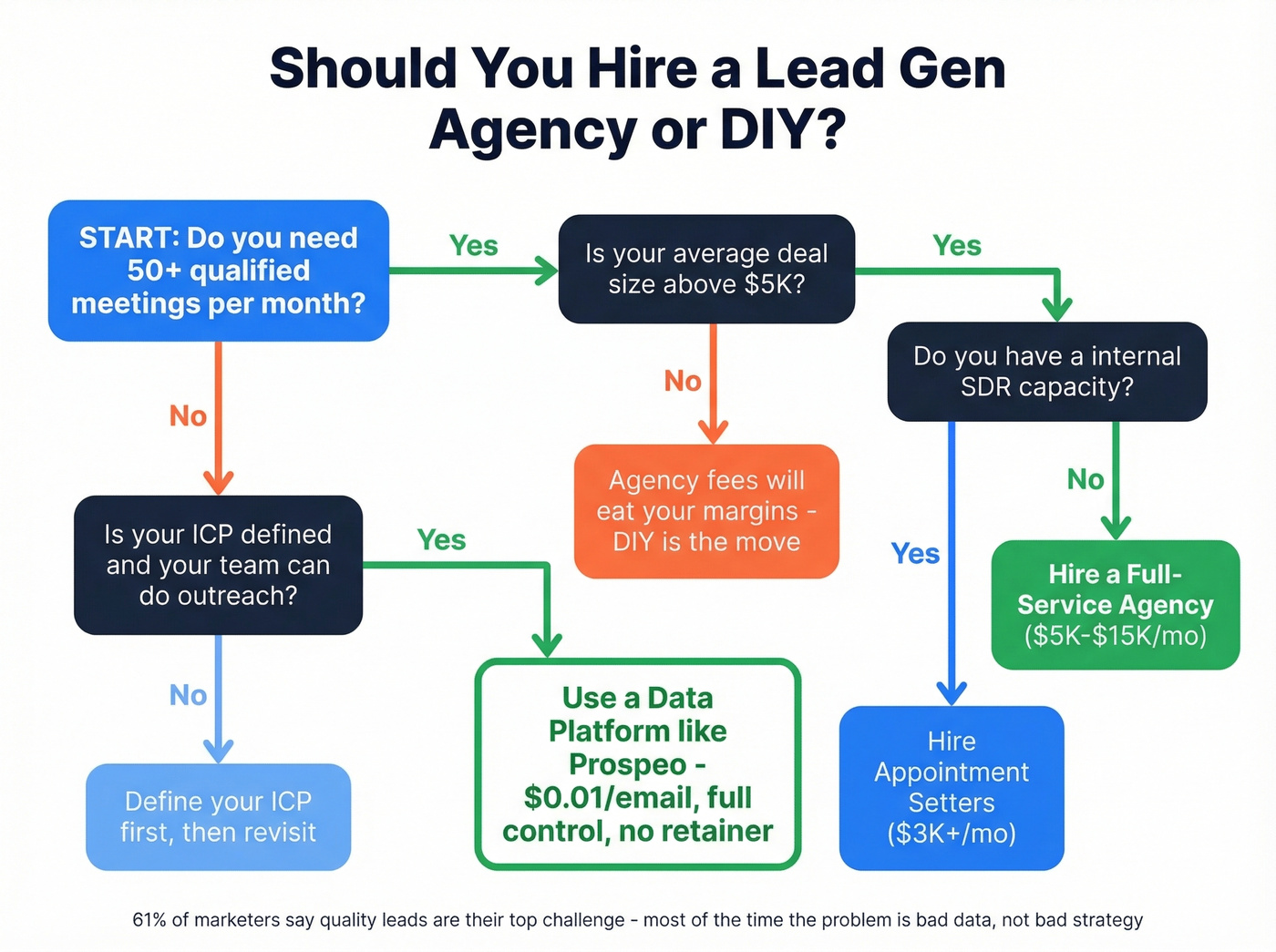
Hire an agency when:
- You need 50+ qualified appointments per month and lack SDR capacity
- Outbound requires multi-channel orchestration across email, phone, paid, and events
- Average deal size justifies $5K+/month in lead gen spend
DIY when:
- Your ICP is defined and your team can handle outreach
- Deal sizes sit in the low four figures - agency fees would eat your margins
- You want control over messaging, cadence, and data quality (use proven sales prospecting techniques and a tight lead generation workflow)
61% of marketers say generating quality leads is their top challenge. But for most of them, the problem isn't strategy - it's bad data. Outdated emails, wrong phone numbers, contacts who changed jobs six months ago. (If you're fixing this systematically, start with data enrichment services and lead enrichment.)

That's where a self-serve data platform replaces a $5,000/month agency. One customer, Meritt, tripled their pipeline from $100K to $300K per week after switching their data source. Why pay $30-$400 per lead from an agency when you can pull verified contacts yourself for pennies? (If you're building lists in-house, see Clay list building and how to generate an email list.)
The article above shows B2B cost per lead has doubled to ~$400. With Prospeo's 30+ search filters, 7-day data refresh, and 125M+ verified mobile numbers, your reps find and reach decision-makers directly - no middleman markup, no shared leads, no stale data.
Stop buying leads. Start owning your pipeline with data you can trust.
FAQ
Is hiring a lead generation company worth it?
If your average deal exceeds $5K and you lack SDR bandwidth, agencies typically deliver positive ROI within 60-90 days. Below that deal-size threshold, self-serve data tools cost 90% less and give you direct control over targeting and cadence.
What's a good cost per lead?
B2B SaaS averages $100-$320 per lead. Lower-ticket industries see $50-$100. Legal and financial services run $400-$650+. SEO-sourced leads average just $31 CPL - the cheapest channel by far.
How long before results?
Expect 30-60 days for pipeline to build. If an agency can't show qualified leads or booked meetings by month two, your contract should allow an exit.
What's the difference between an agency and a data provider?
Agencies run outreach for you - emails, calls, meetings - at $3,000-$15,000/month. Data providers give you verified contact information so your team runs outreach directly, often at a fraction of the cost.
How do I avoid lead gen scams?
Demand lead-level reporting in your CRM, a 7-30 day rejection window for invalid leads, and case studies with conversion metrics. Walk away from guaranteed counts, shared-lead models, and non-refundable activation fees.