

What Is Business Development - and What Do BD Professionals Actually Do?
You just got promoted to BD Manager. Or maybe you're a founder who knows you need a business development function but can't quite articulate what that means beyond "get more revenue." Either way, you're asking the same question everyone asks: what is business development, exactly?
You're not alone. BD School surveyed hundreds of professionals and found 101 different definitions. The role sits at the intersection of sales, marketing, partnerships, and strategy, which is exactly why it's so hard to pin down.
Here's our hot take: most companies don't actually have a business development problem. They have a definition problem. They lump BD into sales, measure it with sales metrics, and wonder why their market expansion stalls. Once you separate the two, everything clicks.
Quick Overview
Business development is the strategic process of identifying and creating growth opportunities through new markets, partnerships, and customer relationships. It's not sales - sales closes deals; BD opens doors.
Every BD function needs five things to work:
- A clear strategy tied to company growth goals
- 5-7 KPIs that measure outcomes, not activity
- A CRM that doesn't make your team want to quit
- Verified contact data so outreach doesn't bounce
- Patience - BD compounds over quarters, not days
Defining Business Development
Investopedia defines the discipline as the process of planning for future growth by identifying new opportunities, forming partnerships, and adding value to a company. That's accurate, but it's also vague enough to mean almost anything.
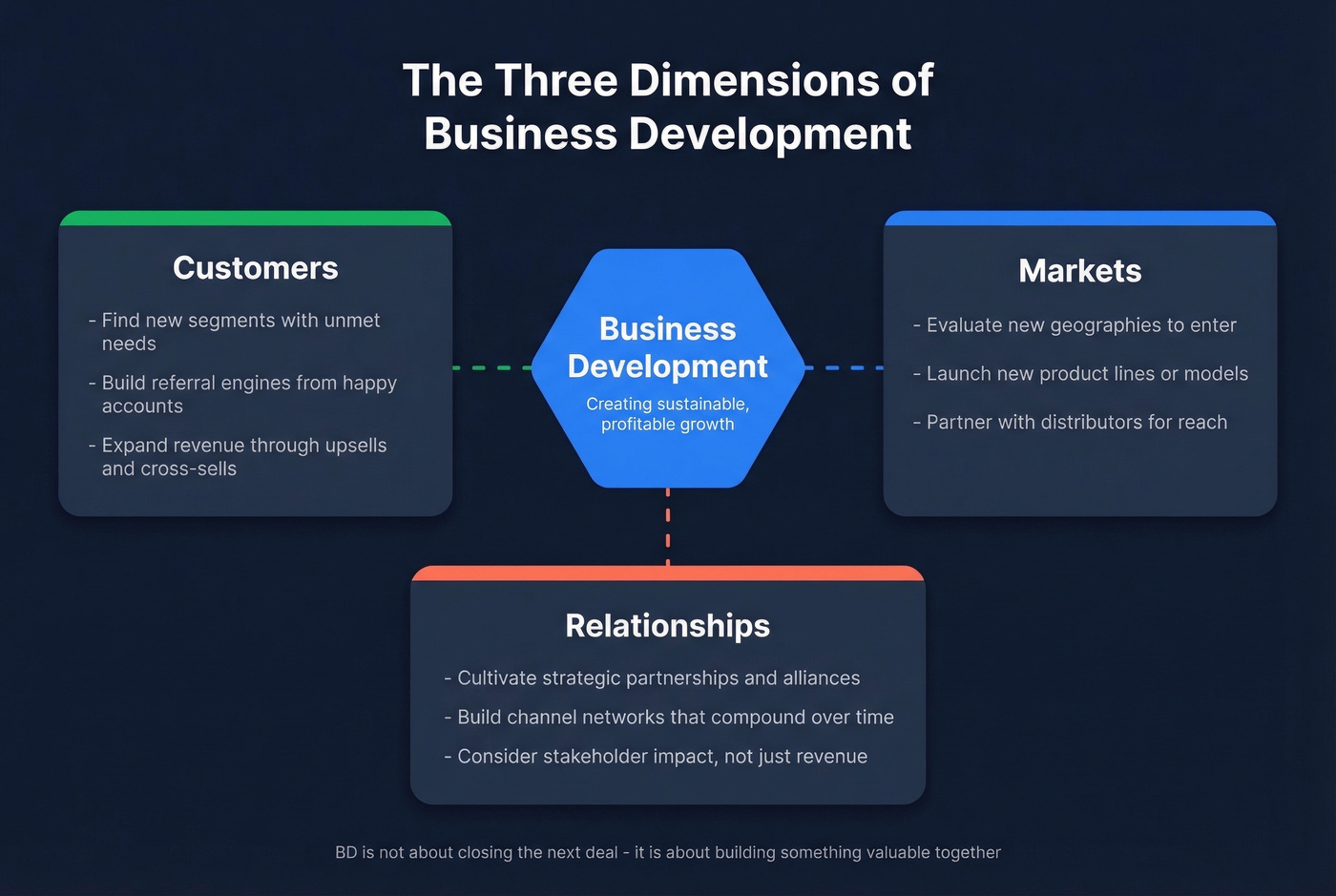
A more useful framing: BD is the strategic identification and resolution of growth challenges across three dimensions - customers, markets, and relationships. BD School's working definition nails it: it's about creating sustainable, profitable growth opportunities, not just closing the next deal.
Break it into three components and it gets concrete fast. Customers means finding new segments, understanding unmet needs, and building referral engines. Markets means evaluating whether to enter a new geography, launch a new product line, or partner with a distributor. Relationships means cultivating partnerships, alliances, and channel networks that compound over time.
Ethical BD practices matter more than most guides acknowledge. The best BD professionals consider stakeholder impact - environmental, community, and employee - not just revenue. This isn't altruism; it's risk management. Partnerships built on extractive terms collapse. (If you want a deeper framework, see ethics in sales.)
The reason BD gets confused with sales is that both involve talking to prospects. But the intent is different. A salesperson asks "will you buy this?" A BD professional asks "what would it take to build something valuable together?"
Business Development vs. Sales vs. Marketing
Investopedia uses a clean analogy: sales is hunting, BD is farming. Hunters go after known prey with a defined weapon - a pitch, a demo, a proposal. Farmers invest in soil, seeds, and irrigation. The payoff comes later, but it scales.
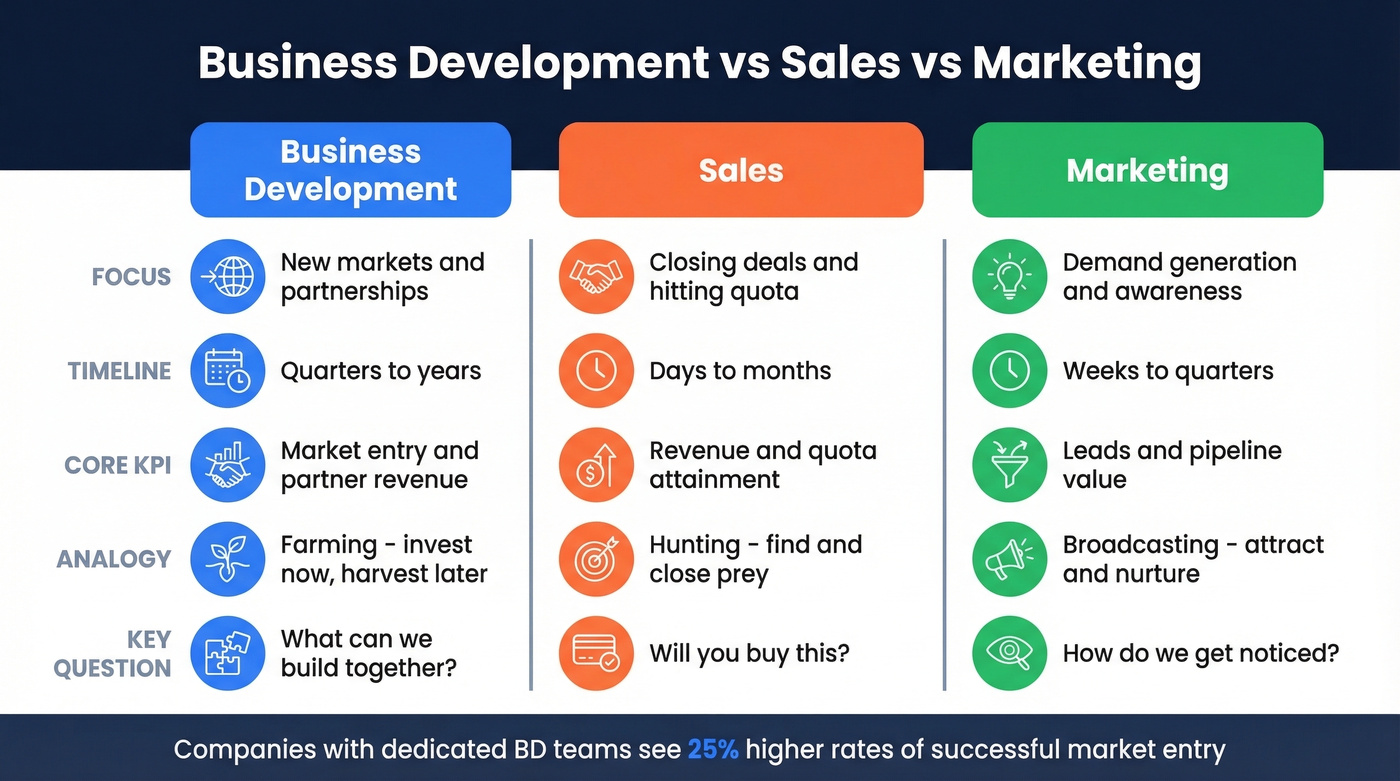
| Business Development | Sales | Marketing | |
|---|---|---|---|
| Focus | New markets, partnerships | Closing deals | Demand generation |
| Timeline | Quarters to years | Days to months | Weeks to quarters |
| Core KPI | Market entry, partnerships | Revenue, quota | Leads, pipeline |
| Success metric | Doors opened | Deals closed | Awareness built |
The overlap is real - a BDR qualifies leads that sales closes, while marketing generates the inbound pipeline that BD supplements with outbound. But the strategic altitude is different. BD thinks about which markets to enter next quarter. Sales thinks about which deals to close this month.
Salesmotion's breakdown puts a number on the cost of blending the roles: companies with dedicated BD teams see 25% higher rates of successful market entry than organizations where sales handles both functions.
What BD Professionals Actually Do
Day-to-Day Responsibilities
BD touches more departments than any other revenue function. Investopedia's cross-department model shows it intersecting with sales, marketing, manufacturing, human resources, accounting/finance, product development, and vendor management - all in a single week.
A BD lead evaluating a new market has to decide: do we go solo or partner with a local distributor? That decision pulls in legal, finance, and operations. A BD manager looking to improve margins might recommend outsourcing non-core work like billing or customer service - that's an HR and ops conversation. Someone running partnership development coordinates between product for integration requirements, marketing for co-marketing, and sales for channel enablement.
The day-to-day isn't glamorous. It's research, outreach, relationship nurturing, internal alignment meetings, and a lot of follow-up. Practitioners consistently recommend a conversation-first approach - commenting, helping, and building trust before ever making an ask. The soft CTA beats the cold pitch almost every time. (For practical follow-up language, see sales follow-up templates.)
One pattern we see repeatedly in high-performing BD teams: they prioritize retention over acquisition. Expanding revenue within existing accounts through upsells, cross-sells, and referrals is cheaper and faster than hunting net-new logos.
The BD Career Ladder
The typical progression runs BDR to Senior BDR to BD Manager to VP of Business Development to CRO. Each step shifts the balance from execution to strategy, and the transitions typically take 2-3 years of consistent performance at each level.
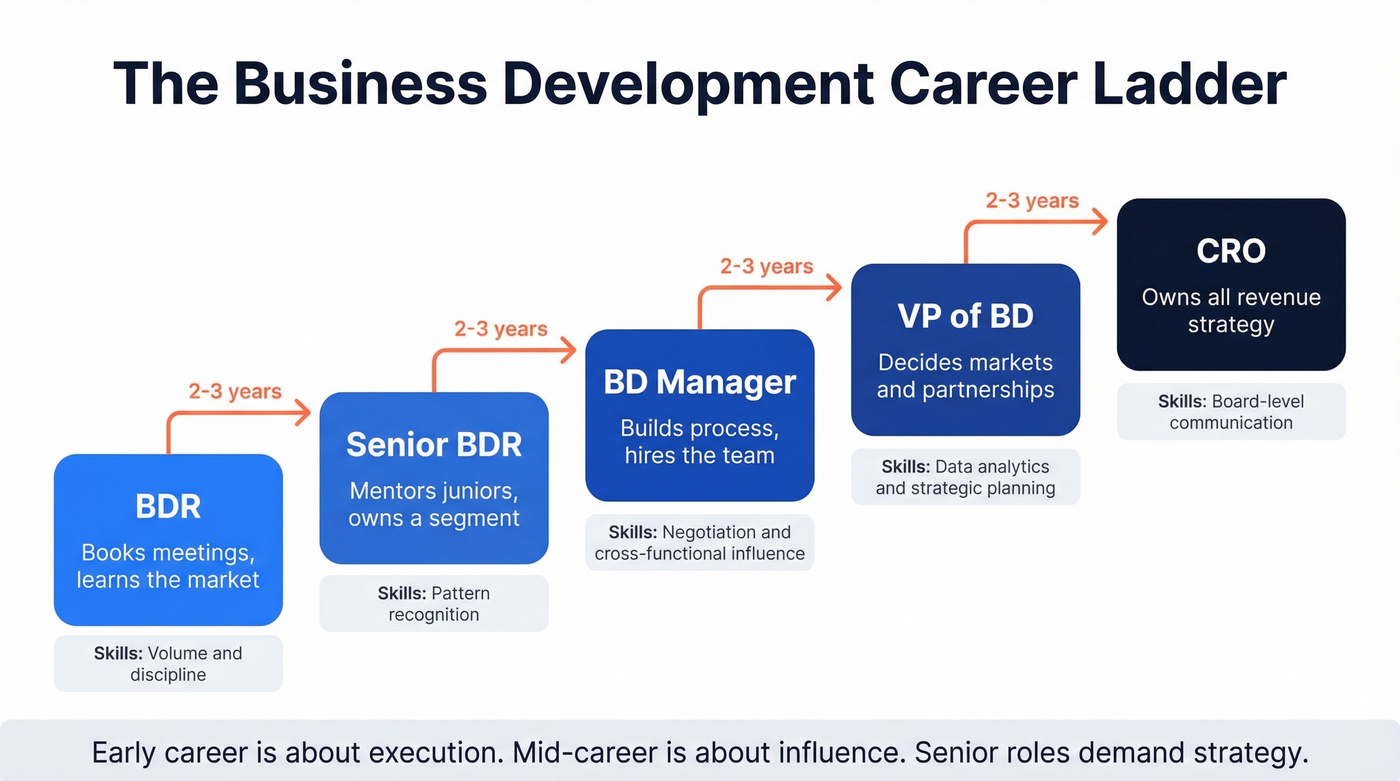
A BDR is booking meetings and learning the market. A Senior BDR is mentoring juniors and owning a segment. A BD Manager is building process and hiring. A VP is deciding which markets to enter and which partnerships to pursue.
The skill shift matters: early career is about volume and discipline. Mid-career is about negotiation and cross-functional influence. Senior roles demand data analytics, strategic planning, and the ability to present to a board. (If negotiation is a gap, start with anchor in negotiation.)
Zendesk highlights an interesting concept called "new business development" - launching a product or service under a new business model in a relatively unknown market. Think of a dine-in restaurant that starts delivery or partners with Grubhub. That's not sales. That's BD creating an entirely new revenue channel, and the professionals who can think at that level are the ones who make VP.

Your BD strategy is only as strong as your ability to reach decision-makers. Prospeo gives BD teams 300M+ verified profiles with 30+ filters - buyer intent, technographics, funding, headcount growth - so you target the right markets and contacts from day one.
Stop farming dead leads. Start opening doors that actually exist.
How to Build a BD Strategy
Zendesk outlines a 10-step framework, but let's be honest - a one-page BD plan beats a binder nobody reads. Here are the six steps that actually matter:
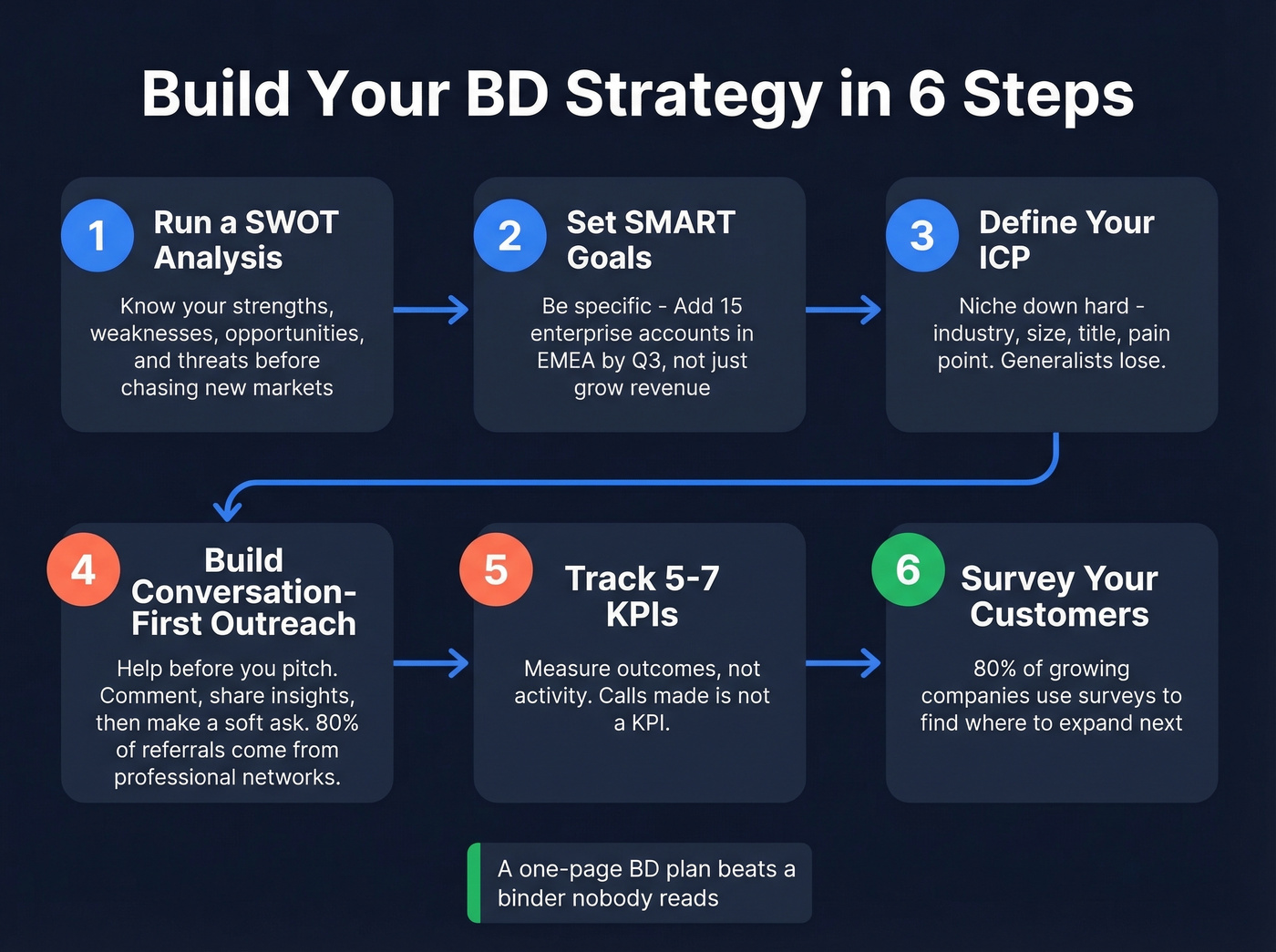
1. Run a SWOT analysis. Know your strengths, weaknesses, opportunities, and threats before you start chasing new markets. This takes an afternoon, not a quarter.
2. Set SMART goals. "Grow revenue" isn't a goal. "Add 15 net-new enterprise accounts in EMEA by Q3" is. Specificity forces clarity about what BD is actually responsible for.
3. Define your ICP - and niche down hard. Who are you targeting? Industry, company size, title, pain point. The BD teams that struggle most are the generalists trying to serve everyone. In our experience, teams that niche into a specific vertical or company stage outperform generalists by a wide margin. People buy specific outcomes - "fix churn with better onboarding" lands better than "help businesses grow." (Use an ideal customer profile template if you need a starting point.)
4. Build a conversation-first outreach motion. The practitioner playbook is clear: start by helping, not pitching. Comment on their content, share relevant insights, then make a soft ask. Cold DMs without context are dead. And don't sleep on professional networks - one practitioner reported that 80% of their referrals came through a professional network in 2024. Your outreach motion should include a referral and warm-intro strategy, not just cold outbound. (For more tactics, see sales prospecting techniques.)
5. Track 5-7 KPIs. Not 15. We cover which ones below.
6. Survey your customers. 80% of companies that see year-over-year growth use surveys to collect customer experience data. Your existing customers are the best source of intelligence for where to expand next.
How to Measure BD Success
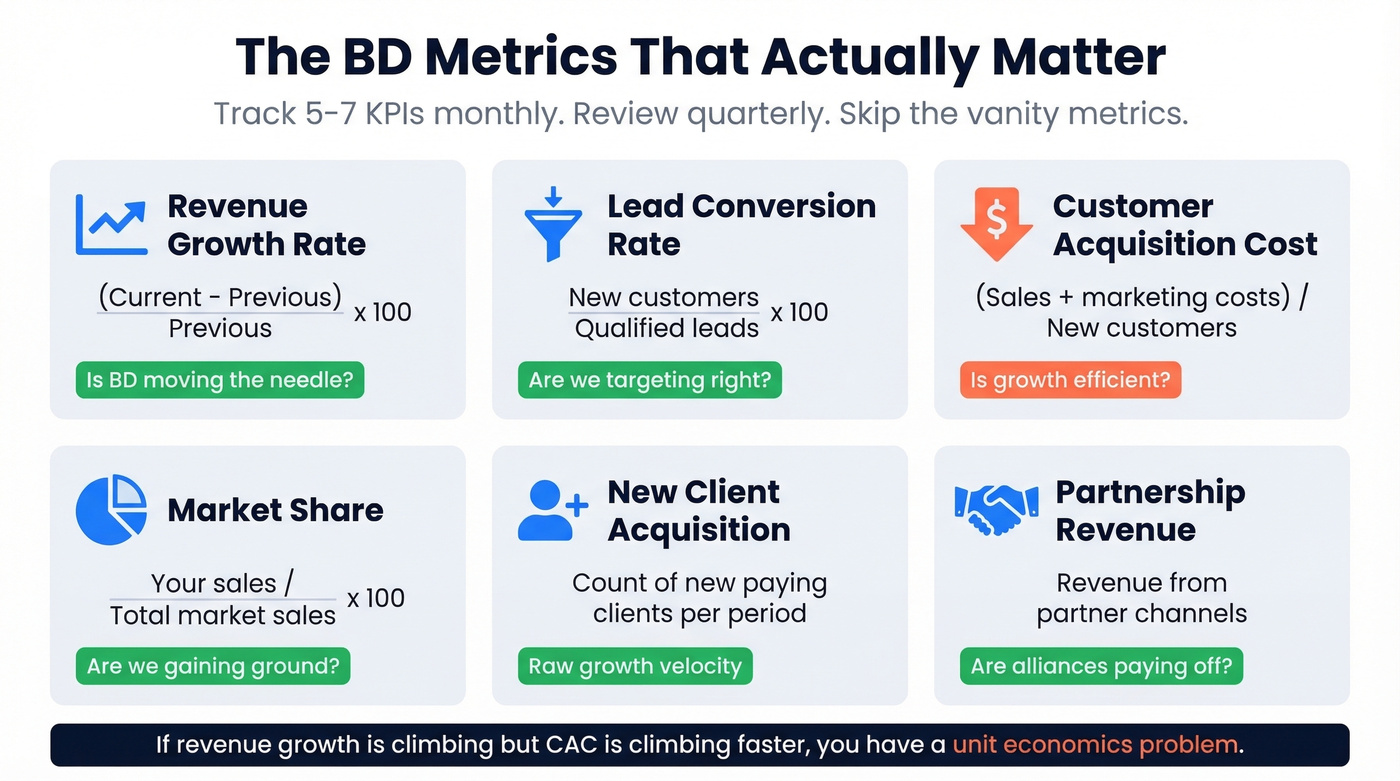
The biggest measurement mistake is tracking activity instead of outcomes. Calls made, emails sent, meetings booked - these are inputs, not results. ExecViva recommends focusing on five to seven core KPIs to avoid metric overload.
| KPI | Formula | What It Tells You |
|---|---|---|
| Revenue growth rate | (Current - Previous) / Previous x 100 | Is BD moving the needle? |
| Lead conversion rate | New customers / Qualified leads x 100 | Are we targeting right? |
| CAC | (Sales + marketing costs) / New customers | Is growth efficient? |
| Market share | Your sales / Total market sales x 100 | Are we gaining ground? |
| New client acquisition | Count of new paying clients per period | Raw growth velocity |
| Partnership revenue | Revenue from partner channels | Are alliances paying off? |
Track these monthly. Review them quarterly. If your revenue growth rate is climbing but CAC is climbing faster, your BD strategy has a unit economics problem. If lead conversion is high but new client acquisition is flat, you don't have enough top-of-funnel. The numbers tell you where to focus - but only if you're measuring the right ones. (Related: pipeline health.)
The BD Tech Stack
CRM: Your Command Center
A CRM for BD needs six non-negotiable features: bulk prospect management with enrichment, automatic activity logging, visual pipelines, task automation, team collaboration, and custom reporting. If your CRM can't do all six, you're working around it instead of with it. (If you're comparing options, see examples of a CRM.)
Salesforce runs $25-$300/user/month depending on tier - Essentials for small teams, Enterprise for complex orgs. HubSpot offers a genuinely useful free tier that handles contact management, deal pipelines, and scheduling. For most BD teams under 20 people, HubSpot free plus a paid data layer is the sweet spot.
Here's the thing: a CRM is only as good as the data inside it.
Contact Data and Verification
This is where most BD operations quietly fail. You're sending 500 emails a week, and a chunk bounce. Your reps spend hours finding contact info that turns out to be stale. Your domain reputation takes a hit, deliverability drops, and suddenly your entire outreach motion is underwater. (If this is happening, start with email bounce rate and email deliverability guide.)
We've watched this happen to teams running on unverified data - high bounce rates tank sender reputation, and even the good emails stop landing. Prospeo covers 300M+ professional profiles with 98% email accuracy and a 7-day data refresh cycle, which means BD teams can build targeted prospect lists using 30+ search filters by role, industry, company size, technographics, and buyer intent without worrying about stale records.

AI in the BD Workflow
2026's biggest shift in BD isn't a new framework - it's AI tooling. The best BD teams now use AI for call transcription with actionable next steps, research automation that summarizes a prospect's company before the first touchpoint, and personalized outreach at scale that doesn't read like a mail merge. These tools don't replace the relationship-building that makes BD work. They compress the research and admin time that used to eat half a rep's week. (If you're building this out, see generative AI sales tools.)
High-performing BD teams prioritize conversations over cold pitches. That starts with verified contact data. Prospeo delivers 98% email accuracy and 125M+ direct dials on a 7-day refresh cycle - so your outreach lands, not bounces.
Every partnership starts with a conversation. Make sure yours gets delivered.
Common Mistakes
Mistaking activity for progress. Calls, demos, and coffee meetings feel productive. They're not - unless they're with qualified accounts moving toward a decision.
Trading durable value for quotas. BD is farming, not hunting. The moment you start optimizing for this quarter's number at the expense of next year's partnerships, you've lost the plot.
Pitching before trust. One Forbes contributor called it "proposing on the first date." Build credibility first. The ask comes later.
Keeping no-decision deals alive. Dead opportunities clog your pipeline and distort your forecast. Kill them early and focus on winnable ones.
Neglecting strategic partnerships. Solo growth has a ceiling. The BD teams that scale fastest build external networks, channel partners, and co-marketing alliances that create compounding returns over multiple quarters.
Running outreach on bad data. This one's silent but devastating. High bounce rates tank your domain reputation, and even the good emails stop landing. Verify every email before it hits your outbound sequence. That's table stakes.
BD as a Career in 2026
The World Economic Forum's Future of Jobs report puts BD and sales roles among the most in-demand functions tied to business transformation. The demand isn't slowing down - the shift toward partnerships, ecosystem plays, and market expansion is making the discipline more strategic than ever.
Here's what the compensation looks like:
| Level | Annual Salary |
|---|---|
| Entry-level BDR | ~$26,500 |
| Average BDR | $59,559 |
| Senior BDR | ~$95,500 |
| NYC (total comp) | $99,348 |
| San Francisco | $108,091 |
| Washington DC | $96,070 |
| Los Angeles | $74,050 |
| Chicago | $55,664 |
The skills that matter most: negotiation, data analytics, communication, and project management. We've seen the best BD professionals combine strategic thinking with operational discipline - they can pitch a partnership to a C-suite and then build the tracking spreadsheet to measure whether it's working.
Real talk: if you're considering BD as a career, the ceiling is high - CRO is a BD career path - but the early years are grind-heavy. BDR work is repetitive. The payoff comes when you move from execution to strategy, and that transition usually takes 3-5 years of consistent performance. If you're selling deals under $15k, you might not even need a dedicated BD function yet. But once you're selling into enterprise or expanding into new markets, BD becomes the highest-impact hire you can make.
Skip BD entirely if your company hasn't nailed product-market fit. No amount of partnership development or market expansion strategy fixes a product people don't want.
One underrated tip for early-career professionals: document every partnership outcome and market entry result so you can quantify your impact when it's time to move up.
FAQ
Is business development the same as sales?
No. BD creates multi-quarter opportunities - new markets, partnerships, strategic relationships - while sales closes near-term deals against quota. Companies with dedicated BD teams see 25% higher market entry rates than organizations where sales handles both functions. The two complement each other but measure different outcomes.
What does a business development representative earn?
The average BDR earns about $59,559/year in the US. Entry-level starts around $26,500; senior BDRs reach $95,500. In high-cost metros like NYC and San Francisco, total comp exceeds $99,000.
What tools do BD teams need?
At minimum: a CRM for pipeline management, a contact data platform for verified prospect emails and direct dials, and a framework for tracking 5-7 core KPIs. Add a sequencing tool for outbound at scale and you've got a functional BD stack for under $200/month.
What skills matter most for a BD career?
Negotiation, data analytics, cross-functional communication, and project management are the four highest-impact skills. Early-career reps should focus on volume and discipline; mid-career professionals need strategic planning and the ability to influence without authority.