

What Is Prospecting in Business? The Complete 2026 Guide
80% of sales happen between the 5th and 12th contact - yet 44% of reps quit after one follow-up. That gap between persistence and reality? It's where prospecting lives. And it's the single skill that separates teams with full pipelines from teams wondering why nothing's closing.
Prospecting Definition in Business
Gartner's definition (as quoted by Outreach) frames prospecting as the initial step in the sales process: identifying and contacting potential customers who meet criteria indicating ability and likelihood to buy. Clean definition. Too narrow for how prospecting actually works in 2026.
Prospecting isn't just a sales tactic. Founders prospect investors. Recruiters prospect candidates. Partnerships teams prospect channel partners. The mechanics are identical across all of these: define who you're looking for, find them, reach out with something relevant, and qualify whether there's a fit.
What makes prospecting distinct from other go-to-market activities is its directness. You're not waiting for someone to fill out a form. You're going to them. That's both its power and its difficulty - you're interrupting someone's day, so you'd better have a reason.
The 2026 version looks different from even five years ago. Data tools have made it possible to find almost anyone's contact information, and AI has made research faster. But the fundamentals haven't changed: relevance beats volume, timing beats persistence, and verified data beats a bigger database every time.
The Short Version
- Prospecting = actively finding and qualifying potential buyers (or partners, investors, hires - it's a business skill, not just a sales tactic).
- The process: define your ICP, watch for trigger events, build a verified list, reach out with relevance, qualify fit.
- The 2026 reality: 5.1% average cold email response rate, [2.3% cold call meeting rate](https://www.cognism.com/blog/cold-calling-success-rates) - data quality and timing matter more than volume.
- Start with three tools: a verified data source, a sequencing tool, and a CRM. That's it.
Prospecting vs. Lead Generation
These terms get used interchangeably, but they're different motions with different owners.
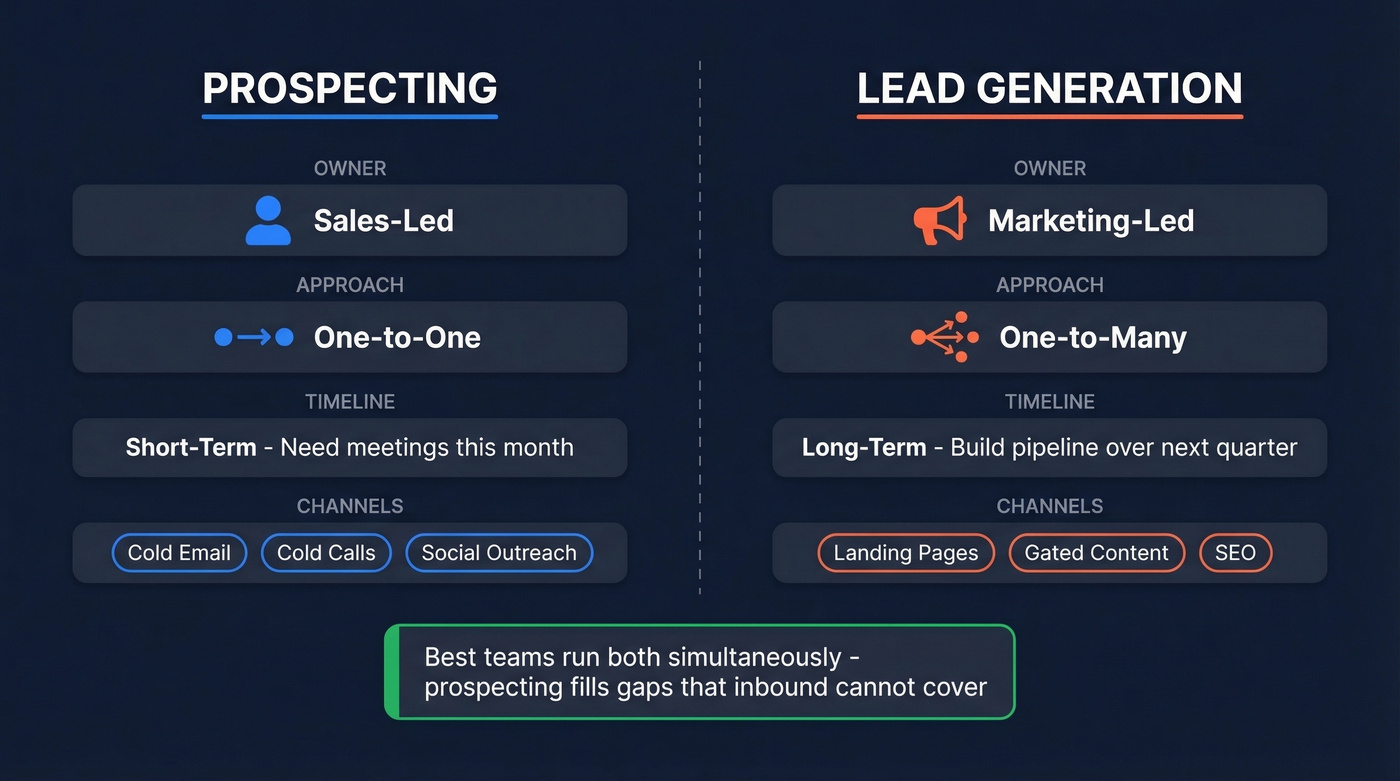
| Prospecting | Lead Generation | |
|---|---|---|
| Owner | Sales-led | Marketing-led |
| Approach | One-to-one | One-to-many |
| Timeline | Short-term | Long-term |
| Examples | Cold email, calls, social | Landing pages, gated content |
The practical decision rule: use prospecting when your pipeline is light and you need meetings this month. Use lead generation when time is on your side and you want warmer leads flowing in over the next quarter. Most healthy revenue teams run both simultaneously - prospecting fills gaps that inbound can't cover.
Why It Matters for Revenue Teams
42% of salespeople rank prospecting as the hardest part of their job. It's also the part that determines everything downstream.
Inside sales reps spend only [30% of their time actively selling](https://www.forbes.com/sites/kenkrogue/2018/01/10/why-sales-reps-spend-less-than-36-of-time-selling-and-less-than-18-in-crm/). The rest goes to research, admin, and - here's the painful part - up to 40% of their time just searching for someone to call. That's not a productivity problem. That's a prospecting infrastructure problem.
And when reps do get through? 58% of buyers say sales meetings aren't valuable to them. Your outreach has to earn the meeting with relevance, not just persistence.
The Prospecting Process Step by Step
This isn't one activity. It's a sequence of decisions, each one compounding the next. Skip a step and the whole chain breaks.
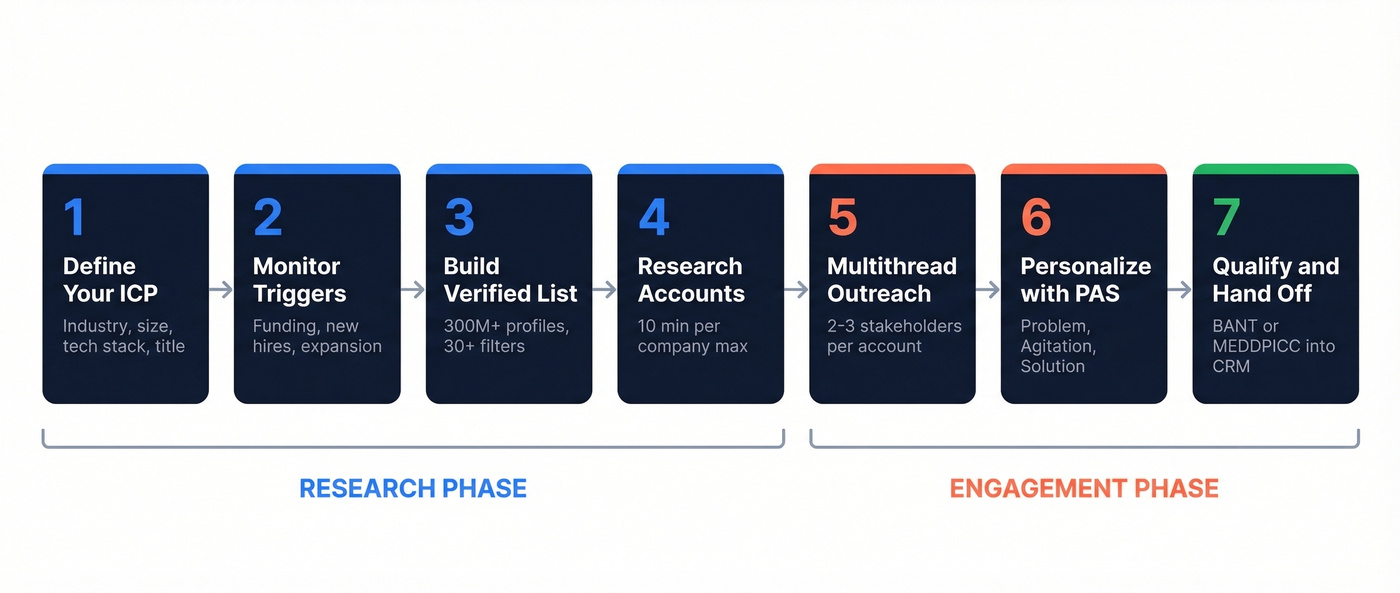
Define Your ICP
Start with who you're actually trying to reach. Industry, company size, tech stack, department, title - get specific. A vague ICP produces vague results. The best prospectors we've worked with can describe their ideal buyer in two sentences flat.
Here's the thing: if your average deal size sits below $10K, you probably don't need a 50-field ICP scoring model. Two or three firmographic filters and one intent signal will outperform a complex scoring matrix that nobody maintains.
Monitor Trigger Events
This is where most teams fall short. A perfect ICP fit means nothing if nothing's changed inside the company. Trigger events - funding raised, new executive hire, market expansion, lost vendor, job postings in a specific function - signal that someone might actually be ready to buy.
Set up alerts for these events. Reach out within days, not weeks. The window closes fast. (If you want a system for this, see tracking sales triggers.)
Build a Verified List
This is where data quality makes or breaks your campaign. Stale emails bounce. Wrong numbers waste time. Bad data tanks your domain reputation.
Use a platform with a fast refresh cycle and multi-step verification. Prospeo's database, for example, covers 300M+ professional profiles with 30+ search filters - buyer intent, technographics, job change, headcount growth, department headcount, funding, and revenue - all refreshed every 7 days.

Research Each Account
Time-box this to 10 minutes per company. Spend the first 3 minutes on recent news and financial signals. Spend the next 3 on tech stack and hiring patterns. Use the final 4 minutes on contact-level research - who reports to whom, what they've posted recently, whether they've changed roles. This structure prevents the "research rabbit hole" that eats hours without producing better outreach.
Multithread Your Outreach
Don't pin your entire deal on a single contact. Reach out to 2-3 stakeholders within the same account - the end user, the budget holder, and the champion. Multithreading increases your odds of finding the person who actually cares about the problem you solve, and it builds internal consensus before you even get to a demo.
Personalize with a Framework
Generic emails get ignored. Mentioning a commonality with the prospect lifts acceptance rates by 46%. But personalization doesn't mean writing a novel. Use the PAS framework - Problem, Agitation, Solution - to keep every email tight and relevant.
A template that works:
Subject: [Trigger event] at [Company]
Hi [First Name],
Saw [Company] just [trigger event - e.g., raised a Series B / opened a new office / posted 5 SDR roles]. That usually means [pain point this creates].
We help [similar companies] [specific outcome - e.g., cut list-building time by 80% while keeping bounce rates under 3%].
Worth a 15-minute call this week?
Three lines. One trigger. One outcome. One ask.
Qualify the Fit
Use BANT or MEDDPICC to determine whether the prospect has budget, authority, need, and timeline. Not every reply is a qualified opportunity. The qualification step prevents your pipeline from filling with deals that'll never close. Understanding the prospect definition in a business context - someone who fits your ICP and has a real reason to buy - keeps your qualification criteria sharp.
Hand Off to the Pipeline
Once qualified, move the prospect into your CRM with full context: what triggered the outreach, what they responded to, where they are in their buying process. The handoff between prospecting and closing is where deals die if context gets lost.

The article says reps waste 40% of their time searching for someone to call. Prospeo's 30+ search filters - buyer intent, job changes, technographics, funding - let you build verified prospect lists in minutes, not hours. 300M+ profiles. 98% email accuracy. $0.01 per lead.
Cut your list-building from 15 hours to 2. Start for free.
Methods That Work in 2026
Not every channel performs equally. Here's what the data says.
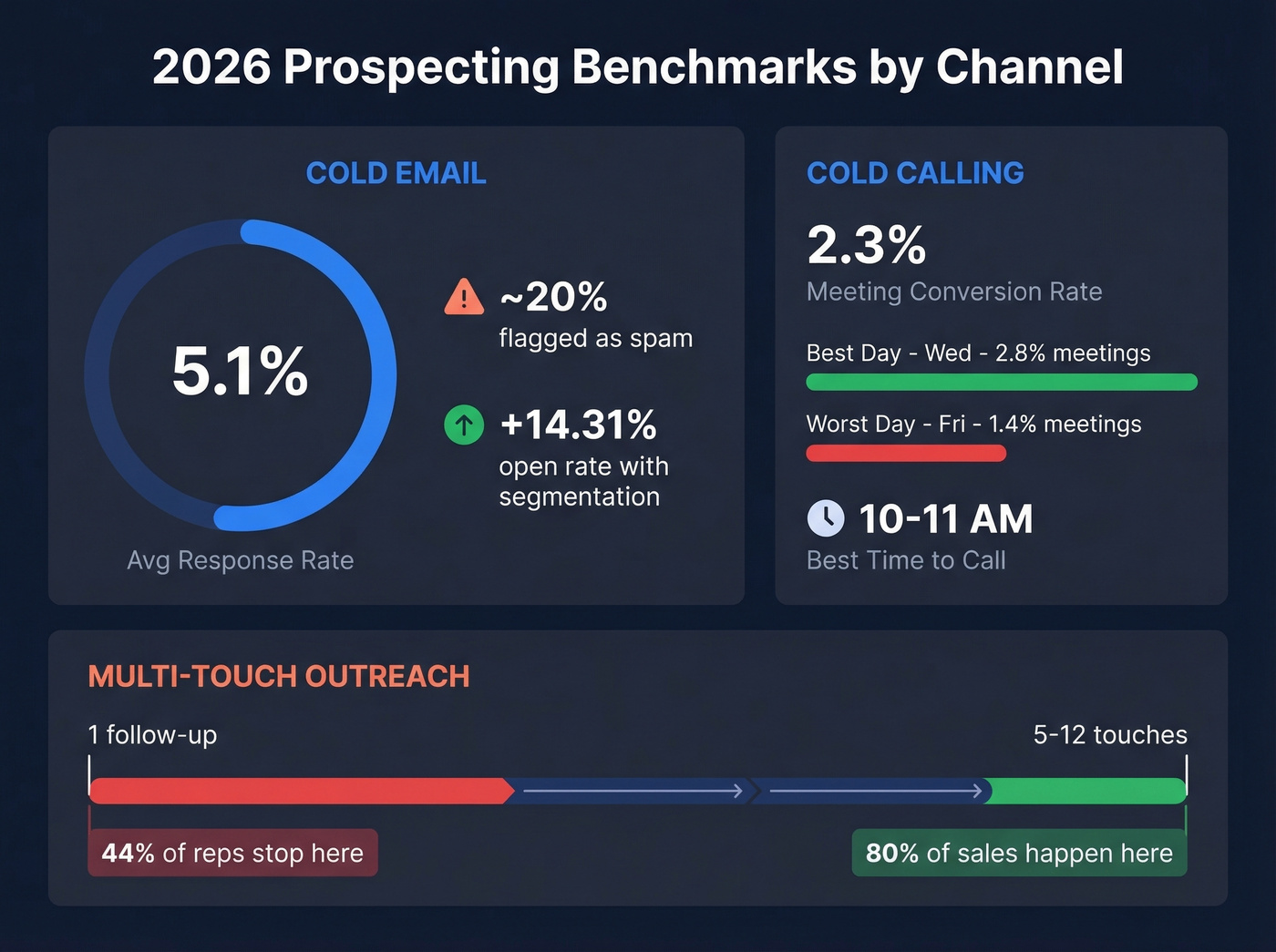
| Channel | Key Metric | Benchmark |
|---|---|---|
| Cold email | Avg response rate | 5.1% |
| Cold email | Flagged as spam | ~20% |
| Cold calling | Meeting conversion | 2.3% |
| Cold calling | Best day (Wed) | 12.1% connect / 2.8% meeting |
| Cold calling | Worst day (Fri) | 7.4% connect / 1.4% meeting |
| Cold calling | Best time | 10-11 AM local |
| Multi-touch | Sales after 5-12th touch | 80% |
Cold Email
The average response rate sits at 5.1%, with most campaigns falling between 1% and 5%. Advanced personalization can double that. The catch: ~20% of cold emails are flagged as spam, which means deliverability hygiene isn't optional - it's the prerequisite. Segmented campaigns see 14.31% higher open rates, so even basic list segmentation pays off immediately.
Cold Calling
2.3% of cold calls result in a booked meeting. Wednesday is the best day. Friday is the worst. Call between 10-11 AM local time and avoid the lunch hour - connect rates drop 44% between noon and 1 PM.
Social Selling
Prospects engage most at industry events (34%), on LinkedIn (21%), and via text (21%). Social selling works especially well for enterprise deals - slower to scale, but it creates warmer conversations than pure cold outreach.
Video Prospecting
A short, personalized video (60-90 seconds) embedded in an email or message stands out in a sea of text. It's not scalable for thousands of prospects, but for high-value accounts, a 1-minute Loom addressing a specific pain point gets replies that templated emails never will.
Referrals
Still the highest-conversion channel by a wide margin. A warm introduction from a mutual connection bypasses almost every objection. Build referral asks into your post-sale process and you'll never run out of warm leads.
The Multi-Touch Reality
43% of buyers say they're fine with five or more outreach attempts before getting through. Yet most reps give up after one follow-up. The math is clear: persistence across channels wins.
Mistakes That Kill Your Pipeline
Mass impersonal emails. Emails to large untargeted lists get 67% fewer replies than smaller, targeted groups. Segment or suffer.
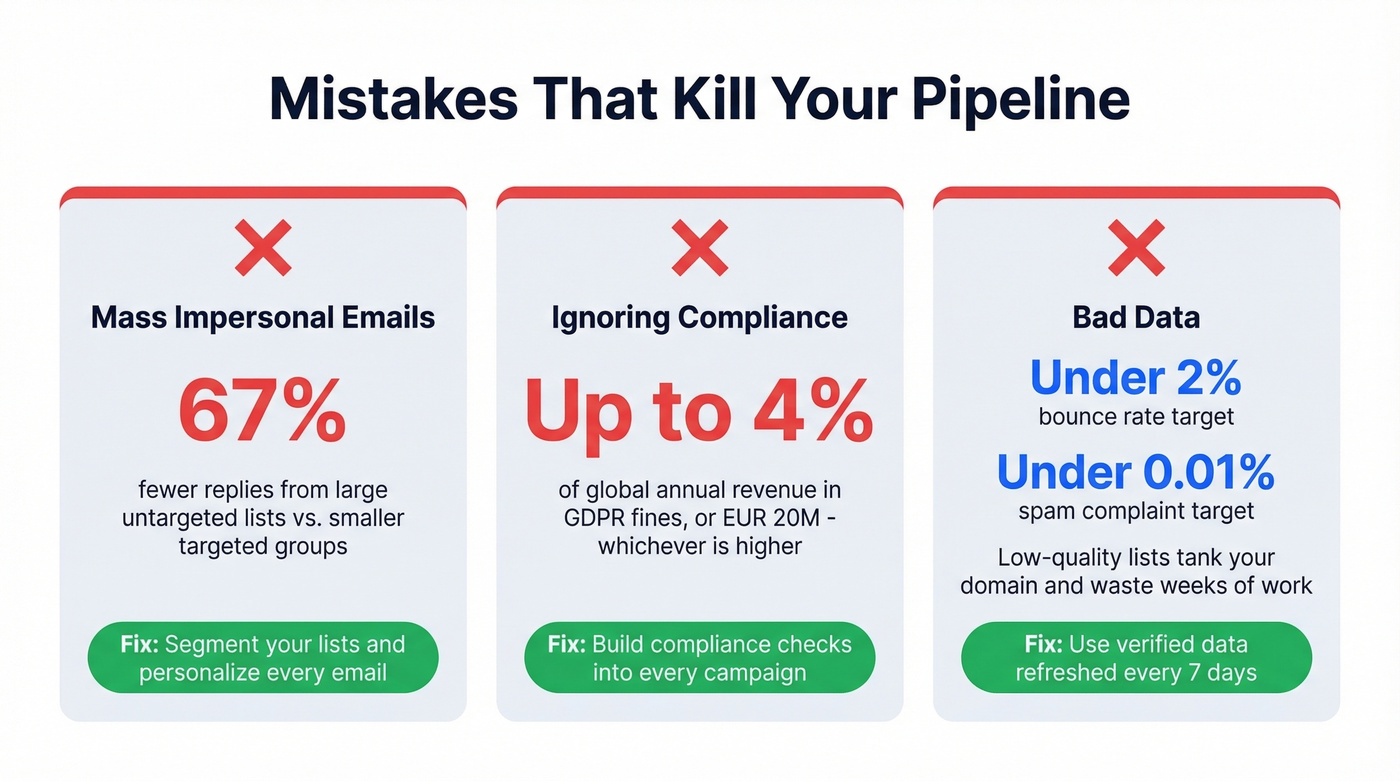
Ignoring compliance. GDPR fines run up to 4% of global annual revenue or EUR 20M - whichever is higher. CAN-SPAM, CASL, and state-level privacy laws add more risk. This isn't optional.
Bad data. Your bounce rate needs to stay under 2% and spam complaints under 0.01%. Low-quality lists can tank an entire campaign - domains get flagged, reply rates crater, and weeks of work get wasted. Before launching any campaign, verify your list with a tool that catches spam traps, honeypots, and catch-all domains. (More on this in our email deliverability guide.)

Single-channel outreach. Email alone isn't enough. Phone alone isn't enough. The teams booking the most meetings combine email, phone, and social in coordinated sequences.
Giving up too early. 44% of reps quit after one follow-up. 80% of sales happen between the 5th and 12th contact. Do the math.
No measurement. Real talk - we've seen teams run the same broken sequence for months because nobody looked at the numbers. If you're not tracking conversion rates, cost per lead, and response rates by channel, you're flying blind.
AI and Prospecting in 2026
Sellers spend roughly 25% of their time actually selling to customers. Bain's research shows AI can double that by absorbing the surrounding low-value work - research, data entry, sequence management, personalization drafts.
Early adopters are seeing 30%+ improvement in win rates when AI improves conversion across funnel steps, not just automates individual tasks. The concrete use cases working right now: using ChatGPT to analyze 10-K filings and tailor messaging to specific business challenges, automating account research that used to take 30 minutes per company, and generating personalized first lines at scale. (If you're building this into outbound, start with AI cold email outreach.)
But the limitations are real. Fragmented workflows, poor data quality, and process variance across teams mean most organizations can't just "turn on AI" and see results. The biggest risk is automating inefficiencies without redesigning the underlying process. AI makes good workflows faster. It makes bad ones fail at scale.
How to Measure Prospecting Success
Four KPIs matter most.
Conversion rate - qualified opportunities divided by prospects contacted. This is your north star. It tells you whether your targeting and messaging are working together.
Cost per lead - total prospecting cost divided by qualified leads generated. A worked example: $5,000 in allocated labor cost + $500 in tool costs = $5,500 total. Divide by 410 qualified leads = ~$13.40 per qualified lead. That's a healthy number for most B2B motions.
Average conversion time measures days from first touch to qualified opportunity. The B2B average is roughly 3 months, but this varies wildly by deal size and buying committee complexity. For teams that sell into enterprise accounts with 6+ stakeholders, expect 4-6 months; for SMB deals with a single decision-maker, you might see qualified opportunities in under 30 days.
Customer retention rate matters because acquiring the wrong prospects costs you twice - once to close them, once to replace them when they churn. (If churn is creeping up, run a proper churn analysis.)
For ROI, the formula is straightforward: (Revenue Generated - Cost of Sales) / Cost of Sales x 100. Track this at the campaign level, not just the team level, and you'll quickly see which channels and sequences deserve more investment.
Essential Prospecting Tools
You need three categories. Don't overcomplicate this.
Data and Email Finding
At roughly $0.01 per email with a free tier (75 emails/month), it's enterprise-grade data without enterprise pricing. Meritt tripled their pipeline from $100K to $300K/week and cut bounce rate from 35% to under 4%; Stack Optimize built from $0 to $1M ARR with deliverability 94%+ and bounce under 3%.
For alternatives: ZoomInfo ($15K-40K/yr) has the deepest US database but comes with significant cost and contract commitments. Apollo offers a free tier with paid plans from ~$49/mo - solid for SMBs. Cognism (typically ~$1K-3K/mo) wins on EMEA compliance and mobile verification. If you're comparing providers, start with a shortlist of sales prospecting databases.
Sequencing
Outreach (~$100-150/user/mo) is the enterprise standard. For smaller teams, Instantly (~$30-97/mo) and Lemlist (~$32-55/mo) offer strong cold email automation at a fraction of the price. Skip Outreach if you're under 10 reps - the complexity isn't worth it at that scale. (If you're building sequences from scratch, use a proven B2B cold email sequence.)
CRM
HubSpot's free CRM handles most early-stage needs, with Sales Hub starting at $20/user/mo. Pipedrive (from $14/user/mo) is a clean, pipeline-focused alternative for teams that don't need marketing automation baked in. If you want more options, here are more examples of a CRM.
Bad data tanks your domain reputation and kills your prospecting before it starts. Prospeo refreshes every record every 7 days - 6x faster than the industry average - with 5-step verification, spam-trap removal, and catch-all handling. Teams using Prospeo see bounce rates drop below 4%.
Prospect with data you can actually trust. 75 free emails to prove it.
FAQ
What's the difference between a lead and a prospect?
A lead is anyone who's shown interest - downloaded a guide, filled out a form, visited your pricing page. A prospect is someone you've actively identified and qualified as fitting your ideal customer profile. Leads come to you; prospects are found by you.
How many touches does it take to book a meeting?
Most sales happen between the 5th and 12th contact. 43% of buyers say they're fine with five or more outreach attempts - yet 44% of reps give up after just one follow-up. Persistence across email, phone, and social is a genuine competitive advantage.
Is cold outreach still effective in 2026?
Yes, but only with verified data and personalization. The average cold email response rate is 5.1%, and advanced personalization can double that. The key is list quality - ~20% of cold emails land in spam when contacts aren't properly verified.
What tools do I need to start prospecting?
Three: a verified data source for finding contact information, a sequencing tool for automated follow-ups, and a CRM to track your pipeline. Everything else is optional until you've maxed out those three.
Does prospecting only apply to sales?
No. Prospecting in business extends well beyond the sales floor - founders prospect investors, recruiters prospect candidates, and partnerships teams prospect channel partners. The fundamentals - define your target, find them, reach out with relevance, qualify fit - are identical across every business function.