

What Is Sales Development? The Complete Operational Guide for 2026
61% of B2B sales professionals say lead generation is their biggest hurdle. Not closing deals, not negotiating contracts - just getting enough qualified humans into the pipeline. That's the problem sales development exists to solve, and most companies still get the function wrong.
Your CEO asks why marketing generated 2,000 MQLs last quarter but the pipeline barely moved. The answer is almost always the same: there's no dedicated function converting those leads into real conversations. Marketing generates interest. Closers close. But someone has to sit in the middle, qualify the noise, and hand off actual opportunities. That someone is your SDR team.
Sales Development Defined
Sales development is an organizational function - not just a job title. It's the bridge between marketing and sales, responsible for one thing: turning raw leads and cold prospects into qualified pipeline that closers can work.
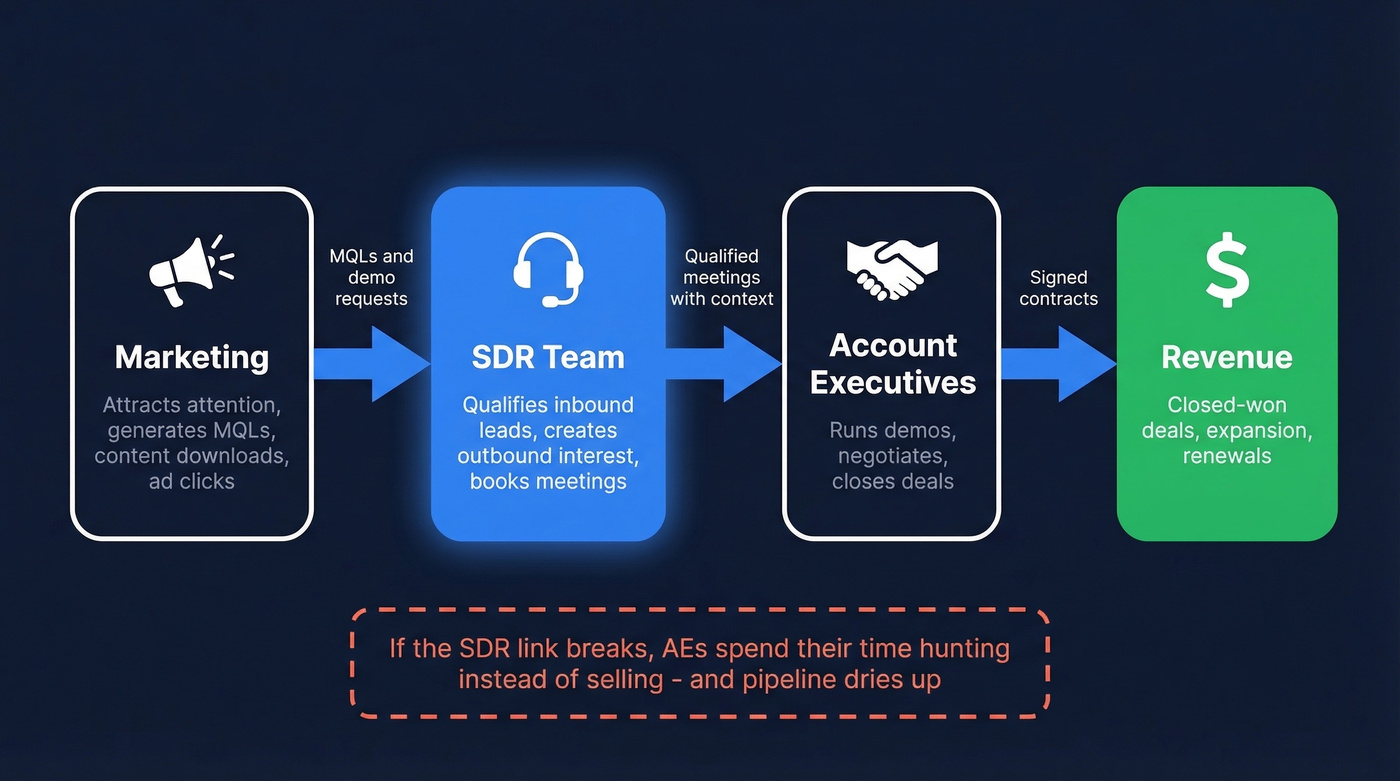
The concept traces back to Oracle in the 1980s, where dedicated teams were first spun up to qualify inbound interest before passing it to account executives. The model has evolved dramatically, but the core output hasn't changed. The function creates pipeline. Everything else - the cadences, the tools, the frameworks - is infrastructure supporting that single goal.
Here's how it flows: Marketing attracts attention. SDRs qualify it (inbound) and create new interest from scratch (outbound). Account executives close. Revenue happens. If any link in that chain breaks, pipeline dries up. The SDR function is the link most companies underinvest in - and the one that determines whether your AEs spend their time selling or hunting.
What an SDR Team Actually Does
The day-to-day sales development process breaks into five core activities, and every one of them feeds the next.
Prospecting is where it starts. SDRs and BDRs identify target accounts and contacts that match the ideal customer profile - researching companies, building lists, and finding verified contact data like emails, direct dials, and org charts.
Outreach in 2026 is multi-channel by default: phone, email, social, and increasingly video. The best teams run structured cadences of 8-12 touches across channels over 2-4 weeks. A single cold email doesn't cut it anymore. If a rep sends one email and moves on, that's not prospecting - that's wishful thinking.
Once a prospect responds, qualification separates tire-kickers from real buyers. Reps ask discovery questions, assess fit against defined criteria, and determine whether a lead deserves an AE's time. The prospects who aren't ready today go into a nurture track. Someone who says "not now" often means "ask me in 90 days," and good teams track these and re-engage at the right moment.
The final step is handoff: passing a qualified meeting or opportunity to an AE with context, notes, and next steps. A sloppy handoff wastes everything upstream. We've seen reps book 30 meetings a month and still underperform because their handoff notes were two sentences of nothing.
SDR vs. BDR vs. Business Development
Ask ten organizations to define these roles and you'll get ten different answers. Here's the most common framework.
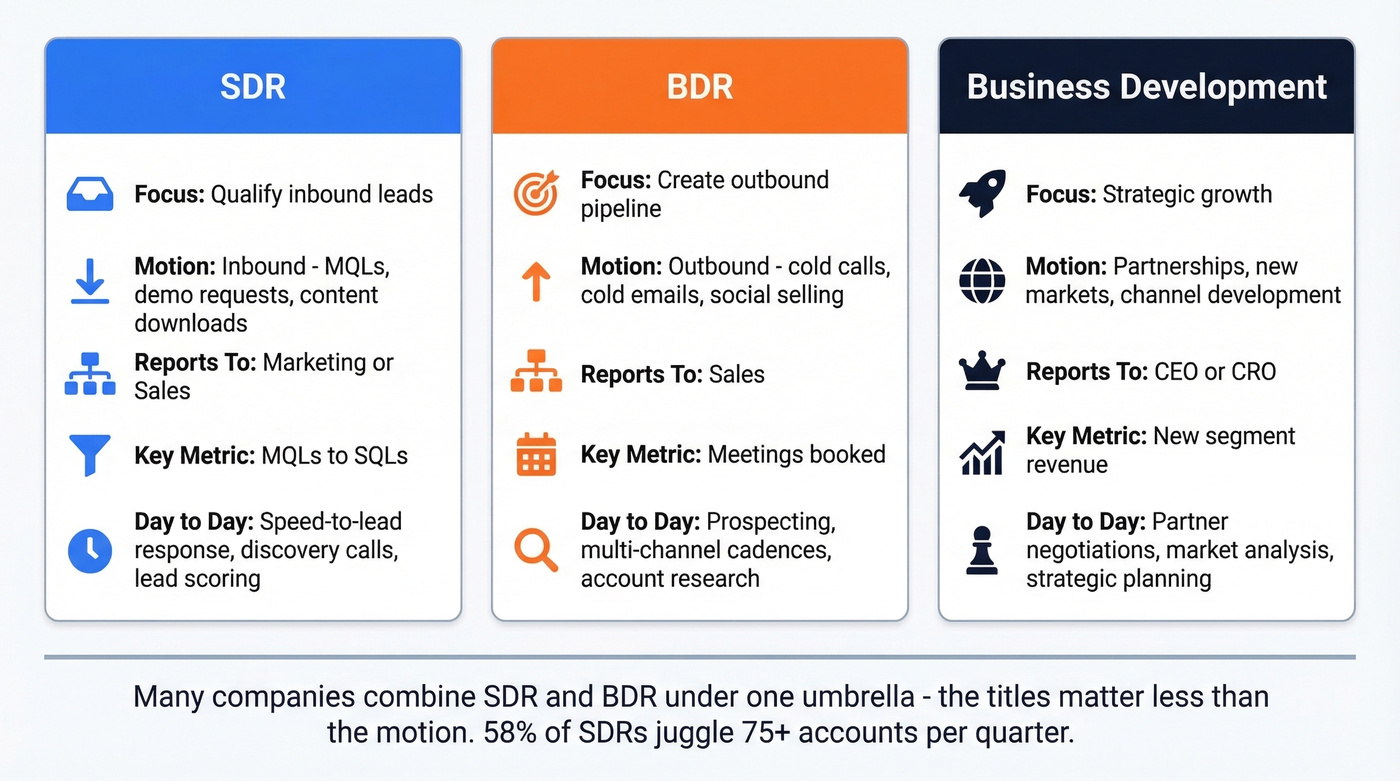
| Role | Primary Focus | Typical Motion | Reports To | Key Metric |
|---|---|---|---|---|
| SDR | Qualify inbound leads | Inbound | Marketing or Sales | MQLs to SQLs |
| BDR | Create outbound pipeline | Outbound | Sales | Meetings booked |
| Biz Dev | Strategic growth | Partnerships/new markets | CEO or CRO | New segment revenue |
The SDR typically works marketing-generated leads - MQLs, demo requests, content downloads. The BDR creates interest from scratch through cold outreach. Business development is a different animal entirely: strategic growth work like partnerships, new market entry, and channel development. Not tactical pipeline creation.
In practice, many companies don't separate SDR and BDR at all. They run "inbound SDRs" and "outbound SDRs" under one umbrella. The titles matter less than the motion. What matters is that 58% of SDRs juggle more than 75 accounts per quarter - regardless of what their business card says.
KPIs and Benchmarks That Matter
You can measure the wrong things with great precision. Here are the metrics that actually drive results for an SDR team.
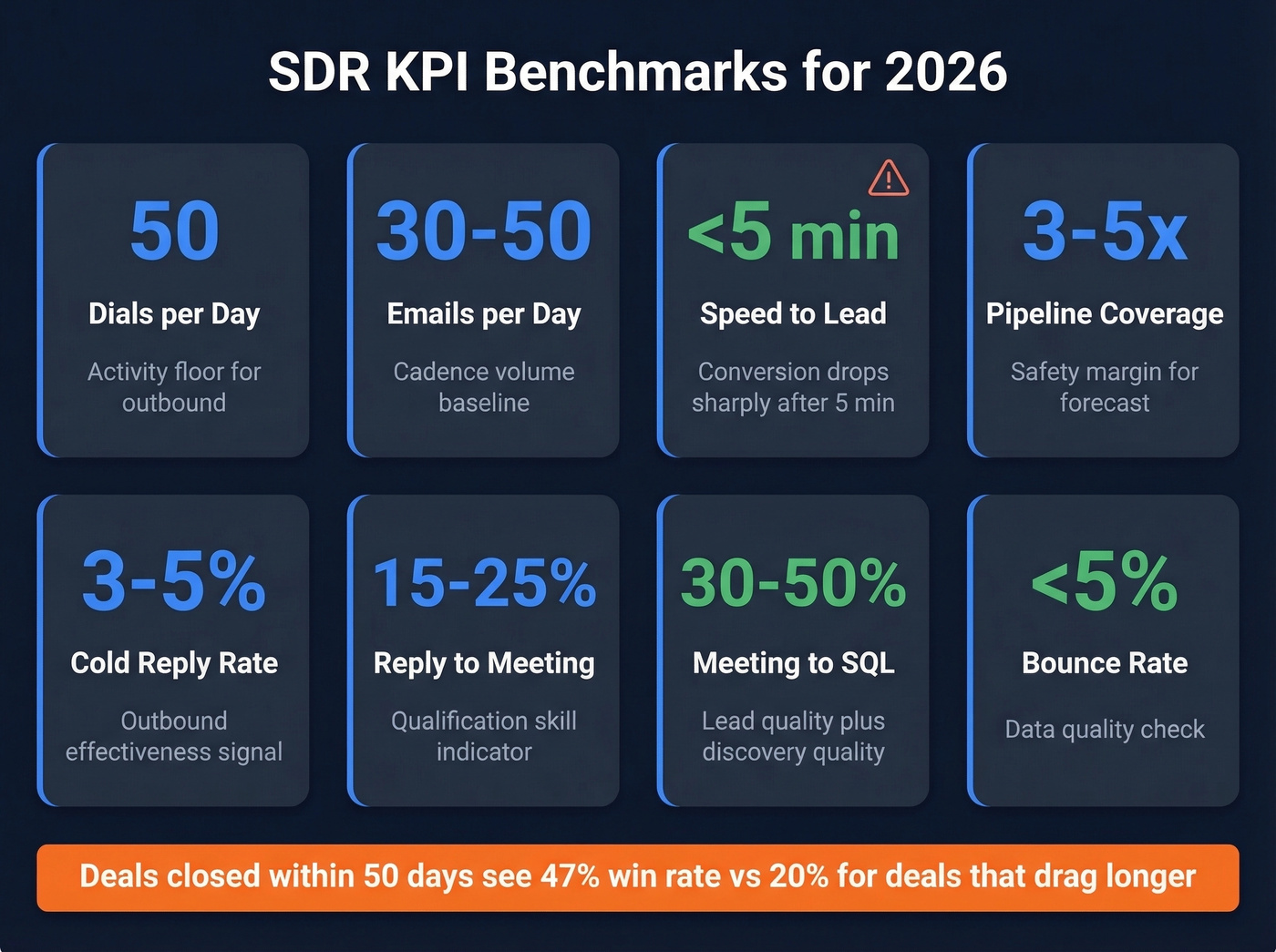
| Metric | Benchmark | Why It Matters |
|---|---|---|
| Dials per day | ~50 | Activity floor for outbound |
| Emails per day | 30-50 | Cadence volume baseline |
| Speed-to-lead | <5 minutes | Conversion drops sharply after 5 min |
| Pipeline coverage | 3-5x quota | Safety margin for forecast |
| Cold reply rate | 3-5% | Outbound effectiveness signal |
| Reply-to-meeting | 15-25% | Qualification skill indicator |
| Meeting-to-SQL | 30-50% | Lead quality + discovery quality |
| Bounce rate | <5% | Data quality check |
The speed-to-lead benchmark deserves special attention. Routing inbound leads within five minutes dramatically improves conversion. Every minute after that, the prospect is cooling off - or talking to a competitor.
One deal velocity stat worth internalizing: teams that close deals within 50 days see a 47% win rate, compared to just 20% for deals that drag beyond that window. Speed matters at every stage, not just the top of the funnel.
A coaching heuristic we've found useful: if a rep can't keep a prospect on the phone longer than two minutes consistently, that's a coaching flag. Call duration is a proxy for conversation quality, and it's one of the most underused metrics in SDR management.
On bounce rates - if your email bounce rate exceeds 5%, the problem is your data, not your reps. Prospeo verifies emails at 98% accuracy with a 7-day refresh cycle, which keeps your reps selling instead of chasing dead addresses. (If you want the deeper breakdown, see our guide to email bounce rate.)

Your SDR team's output is only as good as the data they work. When 58% of reps juggle 75+ accounts, every bounced email and wrong number kills productivity. Prospeo delivers 98% email accuracy, 125M+ verified mobiles with a 30% pickup rate, and refreshes every record every 7 days - so your reps spend time selling, not chasing dead contacts.
Give your SDRs pipeline-grade data at $0.01 per verified email.
How to Structure the Organization
Where does the SDR team sit in the org? According to the Tenbound Sales Development Report, 55% of companies place the function under Sales, while 35% put it under Marketing. The right answer depends on your primary motion.
If your pipeline is mostly inbound or ABM-driven, reporting into Marketing makes sense - the SDR team is essentially an extension of demand gen. If outbound is the primary motion, reporting into Sales keeps alignment tight with AEs and quota.
For capacity planning, one SDR can realistically work about 300 MQLs per month on the inbound side - roughly 15 leads per day across 20 working days. For outbound-heavy orgs, a 2:1 SDR-to-AE ratio is common, and 3:1 shows up in high-volume outbound models.
When should you build in-house versus outsource? If the pipeline function is core to your growth engine and you're past $2M ARR, build internally. If you're testing a new market or motion and need speed, outsourced SDR teams can validate the model before you commit to headcount. Just know that outsourced teams rarely match the product knowledge and brand alignment of an internal team.
Qualification Frameworks SDRs Use
Most SDR teams don't follow one framework religiously. They cherry-pick elements and build a qualification checklist that fits their ICP and deal complexity. But it helps to know the originals.
BANT vs. SPIN
BANT - Budget, Authority, Need, Timeline - is the transactional workhorse. Simple enough for entry-level reps to execute on day one, and it works well when buying signals are clear. SPIN - Situation, Problem, Implication, Need-payoff - takes the opposite approach: it's built for consultative sales where the prospect doesn't yet realize the full scope of their problem.
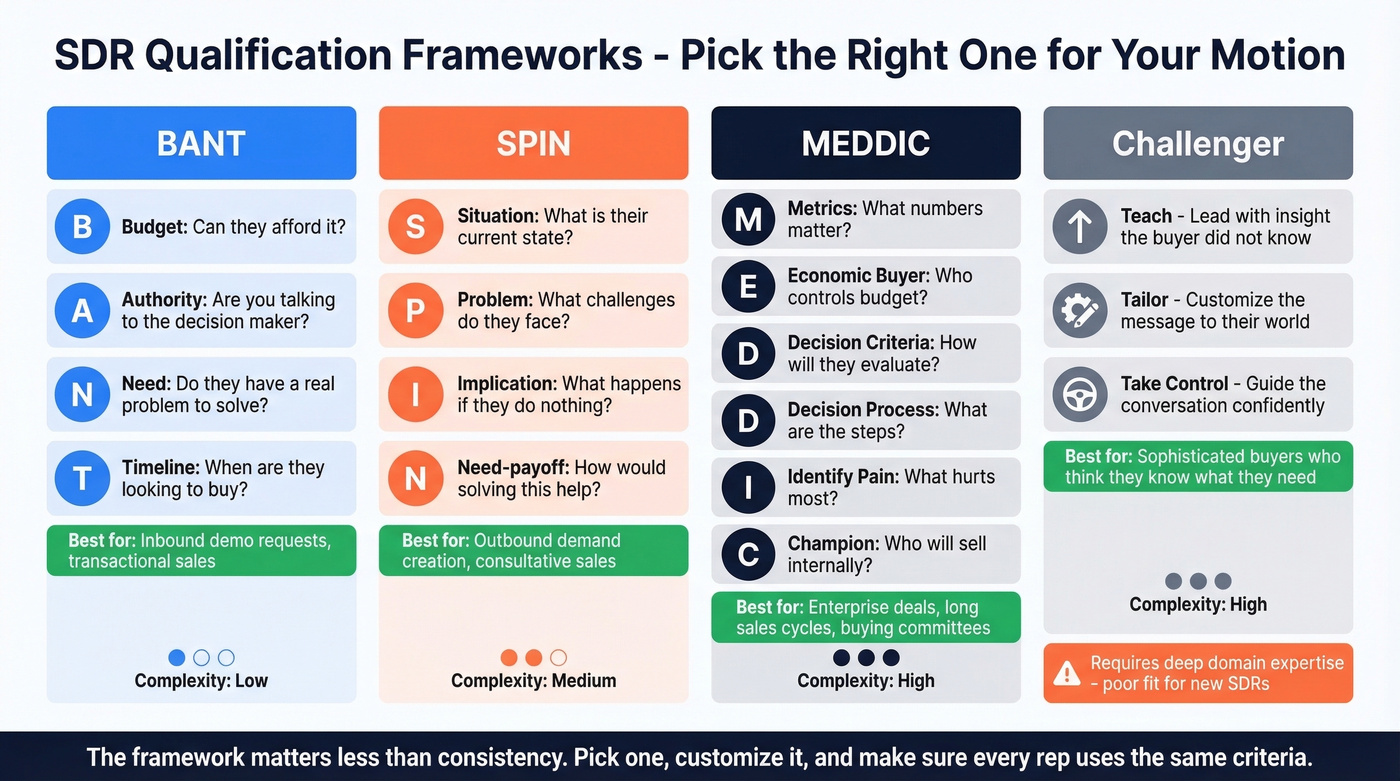
If your reps are mostly qualifying inbound demo requests, BANT is fine. For outbound demand creation, SPIN's problem-exploration structure will serve them better.
MEDDIC
Metrics, Economic Buyer, Decision Criteria, Decision Process, Identify Pain, Champion. Skip this unless you're running enterprise deals with long sales cycles and multiple stakeholders. When you do need it, it's the most rigorous framework available for mapping complex buying committees. (If you're going deeper, use these MEDDIC discovery questions to standardize calls.)
Challenger
This flips the script entirely. Instead of asking questions, the rep leads with insight - teach, tailor, take control. It works in markets where buyers think they already know what they need, but it requires deep domain expertise. Poor fit for brand-new SDRs. Powerful for experienced reps selling into sophisticated buyers.
Let's be honest: the framework matters less than consistency. Pick one, customize it, and make sure every rep uses the same qualification criteria. If your process only works when your best rep runs it, it's not a system - it's luck.
SDR Salary and Compensation
Based on Glassdoor data from 10,000+ salary submissions, here's where SDR comp lands in 2026.
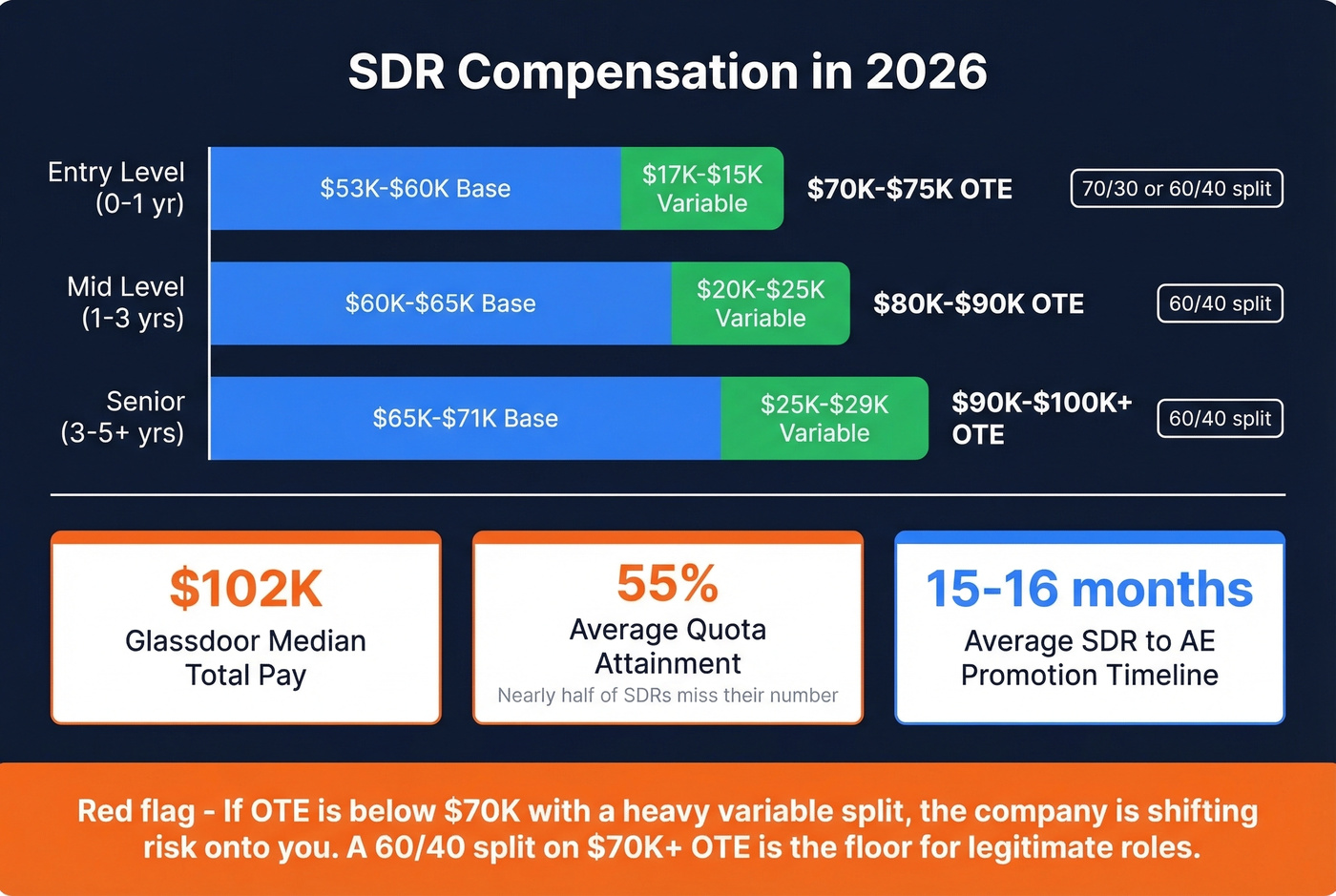
| Experience Level | Base Salary | OTE | Variable Split |
|---|---|---|---|
| Entry (0-1 yr) | $53K-$60K | $70K-$75K | 60/40 or 70/30 |
| Mid (1-3 yrs) | $60K-$65K | $80K-$90K | 60/40 |
| Senior (3-5+ yrs) | $65K-$71K | $90K-$100K+ | 60/40 |
Glassdoor's median total pay sits at $102K per year, with a range of $83K-$128K. Base pay runs $53K-$71K, with additional compensation adding $30K-$57K on top.
The 60/40 base-to-variable split is standard for mid-market companies. Early-stage startups often skew 70/30 to reduce risk for new hires. Average quota attainment hovers around 55% - which means nearly half of SDRs aren't hitting their number. That's an industry-wide structural problem, not a reflection of individual talent. (If you're benchmarking offers, see our guide to OTE in Sales.)
A word of caution on comp offers: on r/salesdevelopment, entry-level SDRs regularly flag commission-heavy packages where the "OTE" is really just a $40K base with an expected $40K in variable that requires unrealistic quota attainment. If you're evaluating offers, a 60/40 split on a $70K+ OTE is the floor for legitimate roles. Anything below that, and the company is shifting risk onto you.
The average promotion timeline from SDR to AE has stretched to 15-16 months post-pandemic, up from about 12 months. Plan accordingly if you're using the role as a pipeline for your closing team.
Building the SDR Tech Stack
A modern SDR stack has four layers. You don't need twenty tools - you need the right four or five, integrated tightly. (If you want a full shortlist, start with our roundup of the best SDR tools.)
| Category | Tool(s) | Starting Price | What It Does |
|---|---|---|---|
| CRM | Salesforce, HubSpot, Pipedrive | Free-$300+/user/mo | System of record for pipeline |
| B2B Data | Prospeo | Free (75 emails/mo), ~$39/mo paid | Verified contacts + intent signals |
| Sequencing | Outreach, Salesloft, Lemlist | ~$39-$200/user/mo | Multi-channel cadence automation |
| Dialers & Intel | Gong, Orum, Nooks | ~$100-$250/user/mo | Call analytics + power dialing |
| Scheduling | Calendly | Free-$20/user/mo | Meeting booking |
CRM
Everything starts here. Salesforce runs ~$25-$330/user/mo depending on edition and it's the enterprise default. HubSpot offers a free CRM with Sales Hub paid plans starting around $20/user/mo - a strong option for teams under 50 reps. Pipedrive ($14-$79/seat/mo) is lean, fast, and built for pipeline-focused teams that don't need the Salesforce ecosystem. (If you're comparing options, see examples of a CRM.)
B2B Data and Verification
If you're building a stack from scratch, start with three things: a CRM, a verified data provider, and a sequencing tool.
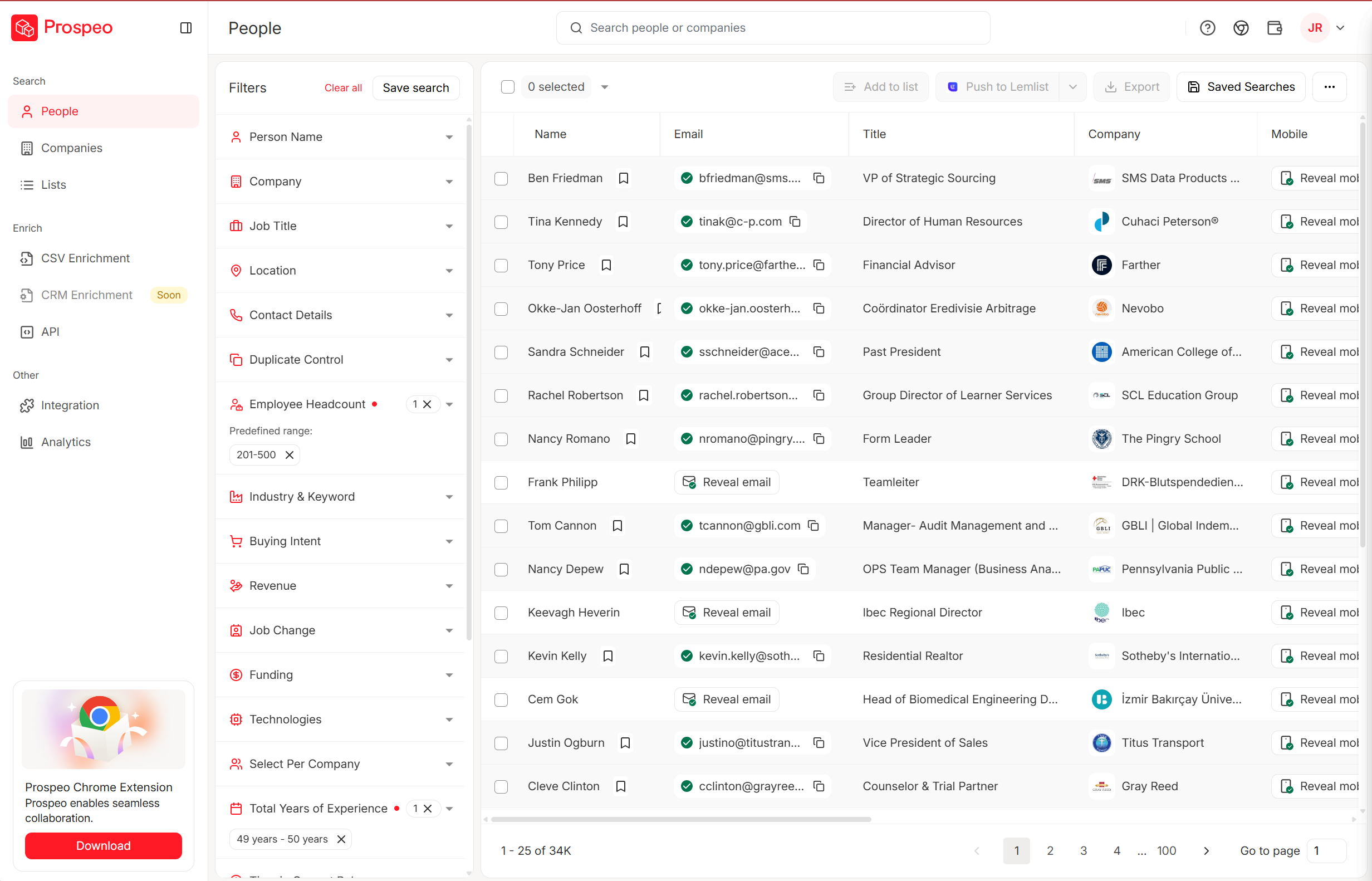
For data, Prospeo covers 300M+ professional profiles with 143M+ verified emails at 98% accuracy and 125M+ verified mobile numbers with a 30% pickup rate. The 7-day data refresh cycle is the real differentiator - the industry average is six weeks, which means most databases serve stale contacts by the time your reps dial. The Chrome extension lets reps find verified emails and direct dials from any website in one click, and 30+ search filters including buyer intent, technographics, job changes, and funding signals make list building fast. Native integrations push into Salesforce, HubSpot, Lemlist, Instantly, and Outreach. Pricing starts free with 75 verified emails per month, paid plans from ~$39/mo, no contracts. (If you're evaluating vendors, compare data enrichment services before you commit.)
Sequencing
Outreach and Salesloft are the two dominant platforms, both running ~$100-$200/user/mo. They handle multi-step cadences across email, phone, and social with analytics that show which sequences convert. For smaller teams, Lemlist (~$39-$99/mo) and Instantly (~$30-$100/mo) offer solid sequencing at a fraction of the cost. If you need copy that converts, keep a set of sales follow-up templates on hand.
Dialers and Conversation Intelligence
Gong (~$100-$150/user/mo) is a leading conversation intelligence platform - teams using it close deals roughly 11 days faster and improve win rates by about 10 percentage points on deals over $50K. For scheduling, Calendly's free tier handles most SDR needs, with paid plans from ~$10/user/mo. AI-powered dialers like Orum and Nooks (~$100-$250/user/mo) are gaining traction for teams running high-volume outbound - they auto-dial through lists and connect reps only when a human picks up.
The article above says it clearly: if your bounce rate exceeds 5%, the problem is your data. Prospeo's 5-step verification and 7-day refresh cycle keep bounce rates under 2% - while competitors let records go stale for 6 weeks. Teams using Prospeo book 26% more meetings than ZoomInfo users and 35% more than Apollo.
Stop blaming your reps for bad data. Fix the source.
The Future of Sales Development in 2026
Here's the thing: spray and pray is dead, and activity metrics are dying right alongside it. When AI can send 10,000 personalized emails in an hour, "emails per day" stops being a useful KPI. The SDR role isn't disappearing - it's shapeshifting into something more valuable.
45% of high-performing sales teams have adopted hybrid human-AI models, where AI handles research, prospect identification, and first-touch personalization while humans focus on complex qualification and relationship building. The time savings are real: among teams using AI SDR tools, 40% save 4-7 hours per week on prospecting alone. LivePerson reduced per-prospect research time from 20 minutes to 2 minutes and saw a 35% lift in engagement rates. (If you're building this motion, our guide to generative AI lead generation is a good next read.)
The comparative metrics tell a clear story about where AI excels and where it falls short. AI answers technical questions immediately 87% of the time versus 15% for human SDRs. Time to technical qualification drops from 8.3 days to 2.1 days. Calls requiring technical follow-up fall from 73% with humans to 22% with AI. Technical buyer satisfaction scores 8.4/10 for AI versus 6.2/10 for human reps - largely because 95% of human SDRs can't articulate the technical value prop when pressed.
But AI can't build trust with a VP who's been burned by three vendors this year. It can't read the room on a discovery call. It can't navigate internal politics at a target account.
The emerging consensus among sales leaders is that the SDR of 2026 is a "market detective" and orchestrator - someone who interprets signals, coordinates multi-threaded outreach, and builds relationships that AI can't replicate. Channel saturation is the other force reshaping the function. Automation can overload a channel into oblivion, which means the teams that win will be the ones finding underused channels while competitors blast the same inboxes. The future isn't more touches - it's smarter ones.
FAQ
Is sales development the same as sales?
No. Sales development creates and qualifies pipeline; account executives convert that pipeline into closed revenue. They share a revenue goal but operate with different metrics, skills, and daily workflows. Think of it as the difference between sourcing opportunities and closing them.
Is the SDR role entry-level?
Usually, yes - most SDRs promote to AE within 15-16 months. But top performers manage 75+ accounts per quarter and generate six figures in pipeline monthly. It's one of the highest-leverage entry points into tech sales.
Is AI replacing SDRs in 2026?
Not replacing - augmenting. 45% of high-performing teams run hybrid human-AI models where AI handles research and first-touch personalization while humans own nuanced qualification and relationship building.
What tools do SDR teams need to get started?
At minimum: a CRM (HubSpot's free tier works), a verified data provider (Prospeo's free tier covers 75 emails/month at 98% accuracy), and a sequencing tool (Lemlist from ~$39/mo). That three-tool stack covers pipeline tracking, contact sourcing, and multi-channel outreach.
What's the difference between lead generation and sales development?
Lead generation identifies interest - content downloads, webinar signups, ad clicks. Sales development qualifies that interest, adds outbound prospecting, and converts both into booked meetings for closers. One captures demand; the other activates it.