

What Is Sales Engineering? A Practitioner's Guide to the Role
It's 4 PM on a Thursday. An AE pings you: "Can you jump on a demo in 20 minutes? Prospect wants to see the API integration." No discovery notes. No context on the buying committee. No idea if this deal is $20k or $200k. You pull up the account, build a story on the fly, and walk into a room full of people whose names you learned three minutes ago.
That's sales engineering in practice - not the polished version you'll find in a job description.
The role sits at the intersection of deep technical knowledge and commercial instinct, and it's one of the most misunderstood jobs in B2B. Let's break it down.
The Quick Version
Sales engineering is the discipline of securing the technical win - proving to a buying committee that your product solves their problem before the AE closes the deal. It's part demo artist, part solutions architect, part translator between engineering and business stakeholders. The role exists because modern B2B deals involve 6-10 stakeholders, and someone needs to handle the technical evaluation while the AE manages the relationship and commercial terms. Median total comp sits around $150k-$200k, with senior SEs clearing well above that. If you're technically curious, enjoy solving problems live, and don't mind sales pressure, it's one of the best careers in tech.
Why Sales Engineering Exists
The discipline boils down to one thing: getting the technical win. That means demonstrating - through demos, proof-of-concepts, architecture reviews, and technical deep dives - that your product meets the prospect's requirements. The AE owns the relationship and the commercial close. The SE owns the technical evaluation.
This distinction matters because B2B buying has gotten genuinely complex. Deals routinely involve 6-10 stakeholders across IT, security, procurement, and the business unit. For nearly 80% of sales engineers, typical deal sizes reach almost $100,000. Nobody signs at that price point without a thorough technical evaluation. That's where you come in.
The SE doesn't just "do demos." You translate product capabilities into business outcomes for a room full of people with different priorities. The CISO cares about compliance. The VP of Engineering cares about integration complexity. The CFO cares about ROI. You speak all three languages in the same meeting.
Core Sales Engineer Responsibilities
The Deal Cycle
Forget whatever HR wrote on the job posting. The deal cycle is your real job description:
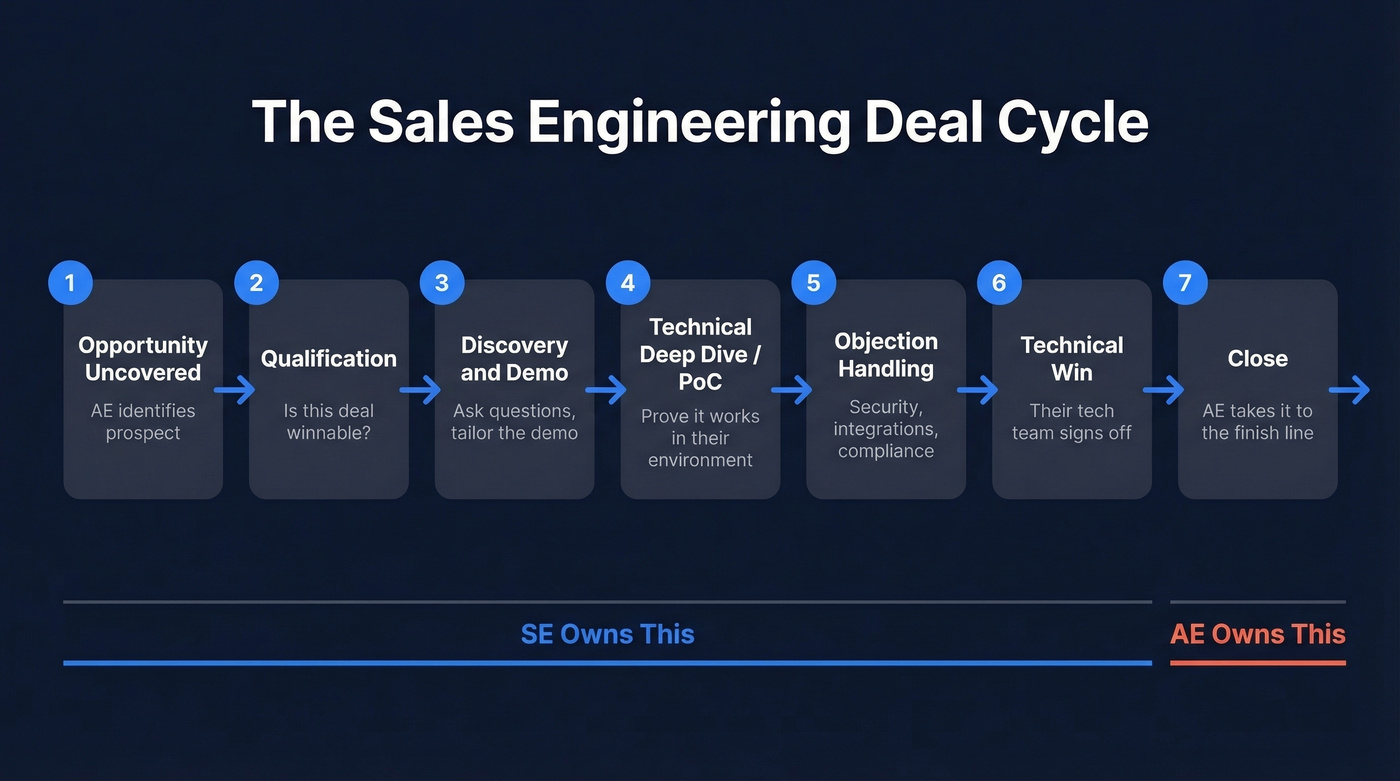
Opportunity uncovered. An AE identifies a prospect. You get looped in when there's a technical component to evaluate - which, in enterprise software, is almost always.
Qualification. You help determine whether the prospect's technical environment, requirements, and timeline make this a winnable deal. This is where you save the org from wasting cycles on bad fits (and why strong sales qualification frameworks matter).
Discovery and demo. The first real engagement. You're asking questions as much as showing product. What's their current stack? Where are the pain points? What does success look like technically? Then you tailor the demo to those answers - not a canned walkthrough (use a tight product demo checklist to stay consistent).
Technical deep dive / PoC. For larger deals, the prospect wants proof. You build a proof-of-concept in their environment, run a technical deep dive with their engineering team, or both. This is where deals are won or lost.
Objection handling. Security questionnaires, integration concerns, performance benchmarks, compliance requirements. You're fielding all of it (and you’ll get faster at it with a repeatable reduce sales objection rate process).
Technical win. The prospect's technical team signs off. They believe the product works. This is your finish line.
Close. The AE takes it from here - negotiation, procurement, legal. You might get pulled back in for last-minute technical questions, but the heavy lifting is done.
A Typical Day
Morning starts with a pipeline standup - reviewing active deals, flagging which ones need technical support this week, and triaging demo requests. The average SE supports about five AEs, which explains the constant context-switching. By 10 AM, you're in your first demo. Maybe a discovery call for a new opportunity, followed by a deep-dive session with a prospect's infrastructure team.
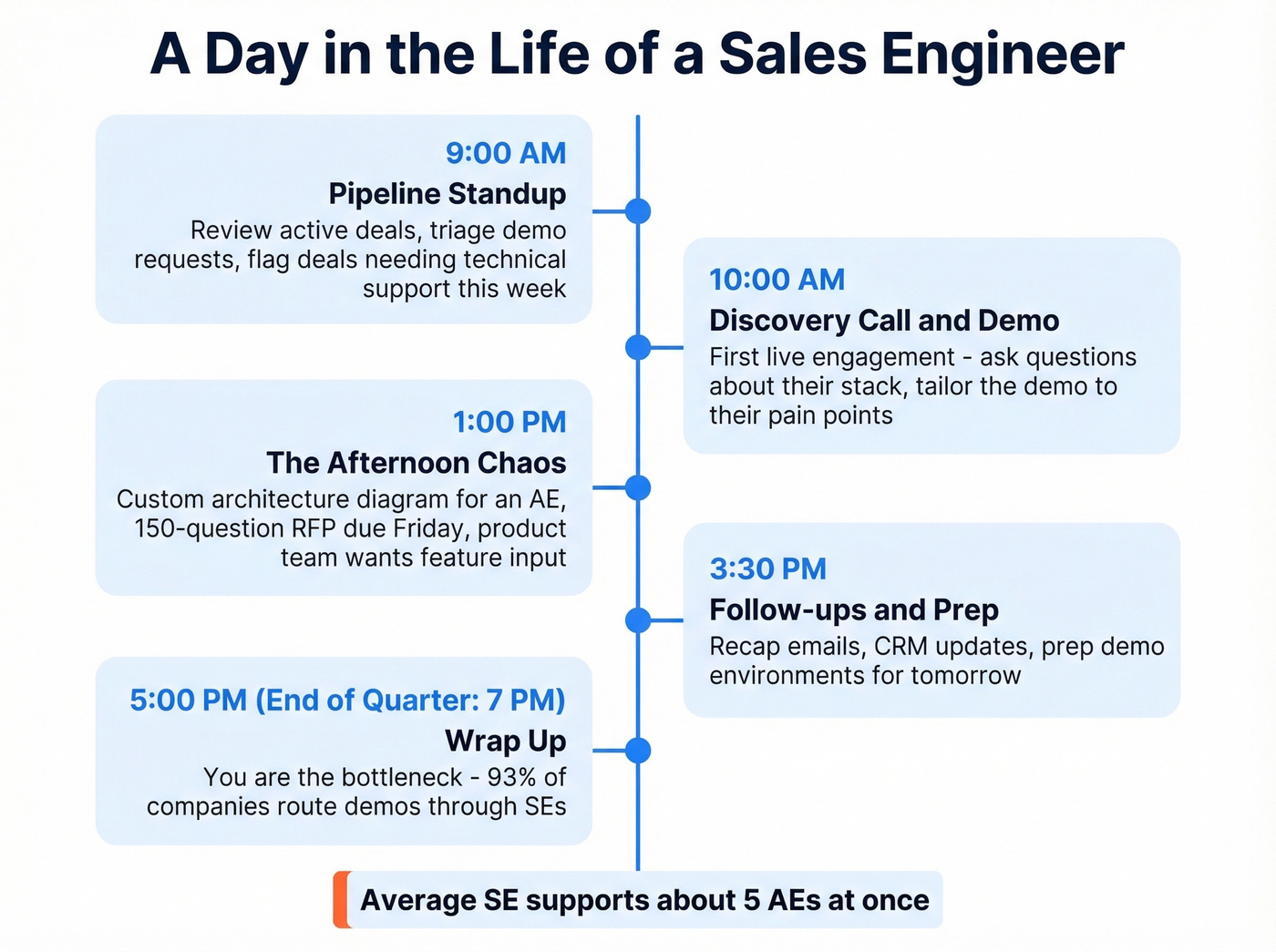
Afternoon gets chaotic. An AE needs a custom architecture diagram for a meeting tomorrow. An RFP lands with 150 questions due Friday. Product wants your input on a feature request that came up in three separate deals. You're toggling between technical depth and commercial urgency every 30 minutes.
Late afternoon is follow-ups - sending recap emails, updating CRM notes, prepping demo environments for tomorrow. End of quarter? Add two hours. You're the bottleneck - 93% of companies route demos through SEs, and pipeline doesn't care about your calendar.
SE vs Solutions Engineer vs Solutions Architect
The title taxonomy in pre-sales is genuinely messy. Here's what you'll actually see in the wild:
| Title | Typical Context | Key Difference |
|---|---|---|
| Sales Engineer | SaaS, enterprise tech | Classic pre-sales role |
| Pre-Sales Engineer | Enterprise, consulting | Same role, emphasizes pre-deal focus |
| Solutions Engineer | Cloud, platform cos | Same role, trendier name |
| Solutions Consultant | Consulting-adjacent | More advisory framing |
| Customer Engineer | Google, some startups | Google's branding for SE |
| Application Engineer | Legacy hardware, MFG | Can be more post-sales |
| Solutions Architect | Varies wildly | Pre-sales OR post-sales |
The title tells you almost nothing - read the job description. If it mentions demos, PoCs, working with AEs, and technical evaluations, it's a sales engineering role regardless of what they call it. A pre-sales engineer at one company has the exact same responsibilities as a "solutions consultant" at another.
Here's the split that actually matters: pre-sales roles (SE, Solutions Engineer, Customer Engineer) focus on winning new business. Post-sales roles (Application Engineer, some Solutions Architects) focus on implementation and retention. When you see "Solutions Architect" on a job board, check which side of the deal it sits on before applying.
Skills That Matter
The best SEs aren't the most technical people in the room. They're the most technical people who can also read a room. The relationship between engineers and sales teams is what makes this role unique - you need fluency in both worlds (and strong sales communication habits).
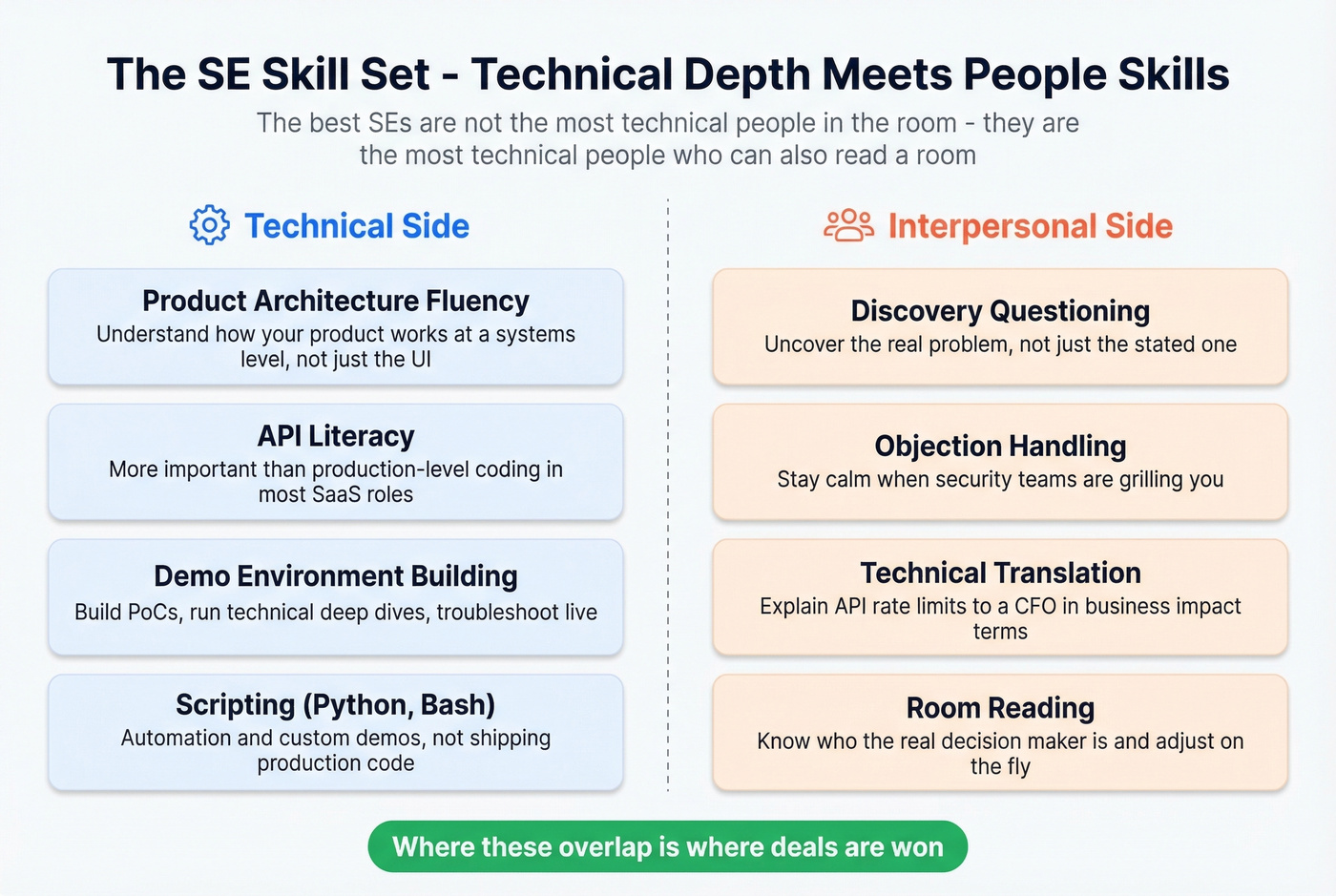
Technical side. You need product architecture fluency - understanding how your product works at a systems level, not just the UI. API literacy matters more than production-level coding in most SaaS roles. You should be comfortable building demo environments, running PoCs, and troubleshooting live. Scripting in Python or Bash helps for automation and custom demos, but you're not shipping code to production.
Interpersonal side. Discovery questioning is the skill that separates good SEs from great ones. You need to uncover the real problem, not just the stated one (a solid bank of discovery questions helps). Objection handling requires staying calm when a prospect's security team is grilling you. And translating technical concepts for non-technical buyers - explaining API rate limits to a CFO in terms of business impact - is a daily requirement.
The BLS notes that a bachelor's degree in engineering or a related field is typical, but it's not always required. We've seen plenty of SEs break in from technical support, customer success, or even AE roles where they had strong technical aptitude.

SEs juggle 5 AEs and dozens of stakeholders per deal. Prospeo gives you 98% accurate emails and 125M+ verified mobile numbers so you can reach every member of a buying committee - without bounced emails killing your credibility before the demo even starts.
Stop prepping demos for contacts that don't exist. Get verified data.
Salary and Compensation in 2026
What the Data Says
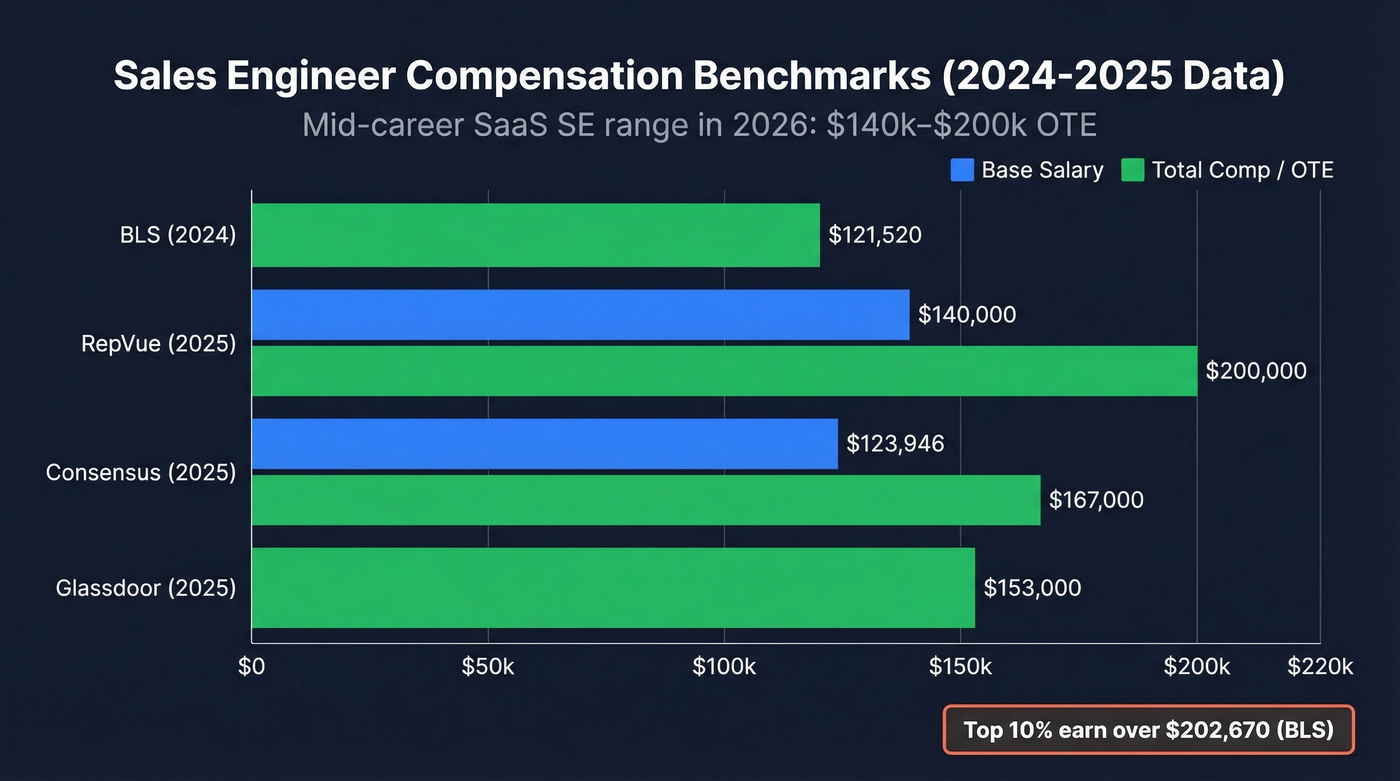
SE comp data varies by source because each one measures differently. Here's how the major benchmarks stack up:
| Source | Base Salary | Total Comp / OTE | Date |
|---|---|---|---|
| BLS | - | $121,520 (median) | 2024 |
| RepVue | $140,000 | $200,000 | 2025 |
| Consensus | $123,946 | ~$167,000 | 2025 |
| Glassdoor | - | $153,000 | 2025 |
The BLS number is a broad median across the whole "sales engineer" category - including hardware and industrial roles that pay less than SaaS. RepVue skews toward tech companies where comp runs higher. The real range for a mid-career SaaS SE in 2026 is $140k-$200k OTE, with senior and principal roles pushing well above that. The BLS top 10% earns over $202,670.
How SE Comp Plans Work
Most SE comp plans follow a base-plus-variable structure. In our experience, the 70/30 split is the most common in SaaS - it balances stability with performance incentive without making the SE feel like they're carrying a full sales quota.
| Context | Split | Example |
|---|---|---|
| SaaS / Enterprise | 70/30 | $140k base / $60k var |
| Heavy-Eval Deals | 60/40 | $120k base / $80k var |
| Hardware / Industrial | 80/20 | $100k base / $25k var |
Variable comp typically ties to team or territory quota attainment - you're rarely carrying an individual number the way an AE does. Some orgs add kickers for PoC wins, technical win rate, or strategic deal involvement.
Here's what an early-career offer actually looks like. One SE on r/salesengineers shared their comp at 2 years of experience in observability (commercial segment): $105k base, $125k OTE, $15k/year equity with a $10k refresher. With overattainment, total comp landed around $150k-$155k. Solid starting point, but not AE money - and that gap is a real tension in the role.
How Sales Engineers Are Measured
No two orgs measure SEs the same way, which is both a feature and a bug. But the KPIs that matter cluster around four areas.
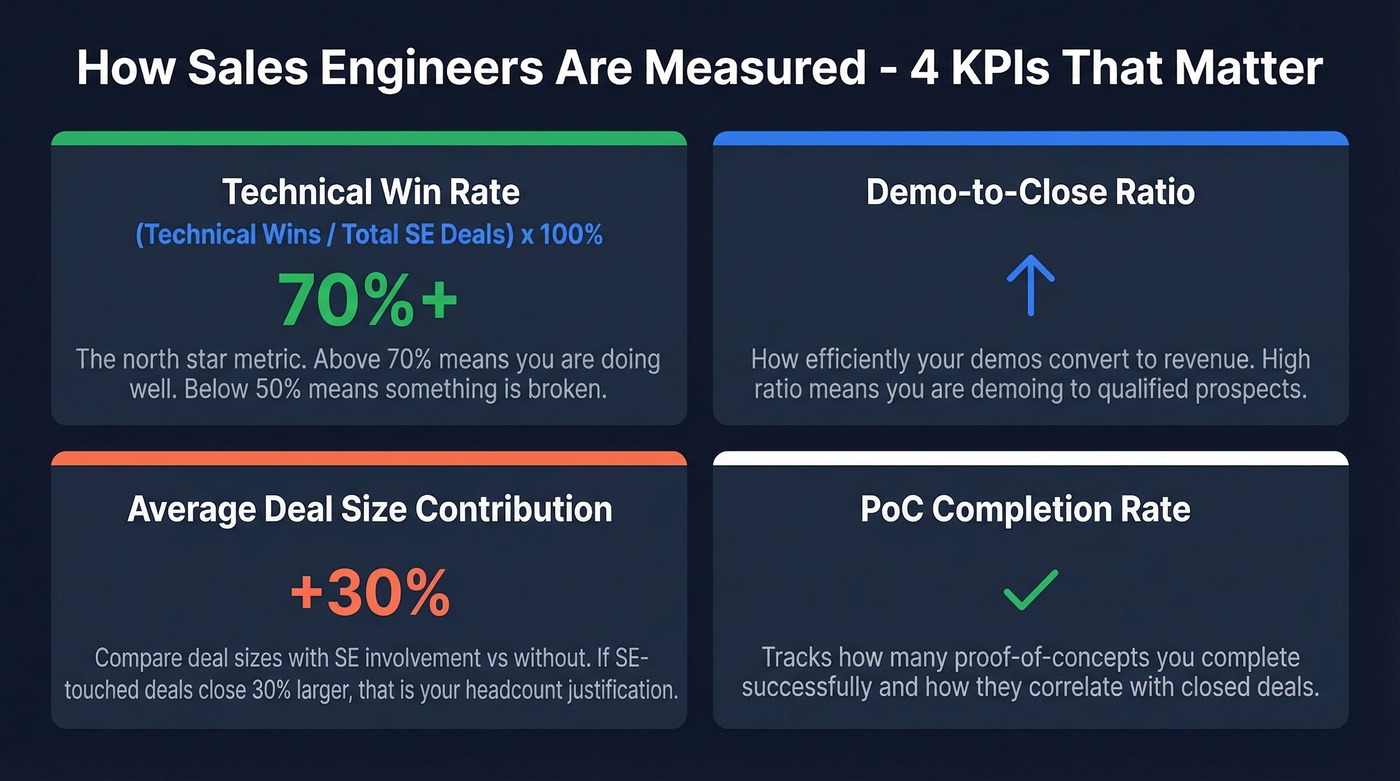
Technical Win Rate is the north star: (Technical Wins / Total SE-Involved Deals) x 100%. If you're winning 70%+ of the deals you touch technically, you're doing well. Below 50%, something's broken - either qualification is weak or your product has gaps. We've talked to SE leaders who track this as their single most important metric, and they're right.
Demo-to-close ratio tracks how efficiently your demos convert to revenue. High ratio means you're demoing to qualified prospects. Low ratio means you're a demo jukebox.
Average deal size contribution compares deal sizes with SE involvement versus without. This is how you prove your ROI to leadership - if SE-touched deals close 30% larger, that's your justification for headcount.
Operational metrics round it out: time to technical win, demo/PoC turnaround time, and engagements per deal. These help SE leaders identify bottleneck patterns and allocate resources across the team.
The Sales Engineering Tech Stack
The modern SE tech stack has expanded significantly, and AI is accelerating the shift. Here's what many SE teams are running in 2026:
CRM. Salesforce (~$25-$330/user/month depending on edition) or HubSpot (free CRM tier, paid seats ~$20-$150+/user/month). You live here whether you like it or not (and it helps to know a few examples of a CRM setups).
Conversation intelligence. Gong (~$100-$200+/user/month depending on package) for call recording, deal intelligence, and coaching. Table stakes for any SE team doing more than a handful of demos per week.
Demo automation. Consensus or Storylane (~$1k-$5k+/month depending on seats) for interactive, self-serve demos. 41% of demo views happen outside business hours - that's demand you're leaving on the table without async demos (more tactics in software demo tips).
RFP automation. Tools like SiftHub or Responsive to speed up and auto-populate questionnaires. Allego reported a 90% auto-fill rate on RFP workflows - the kind of time savings that actually changes your week.
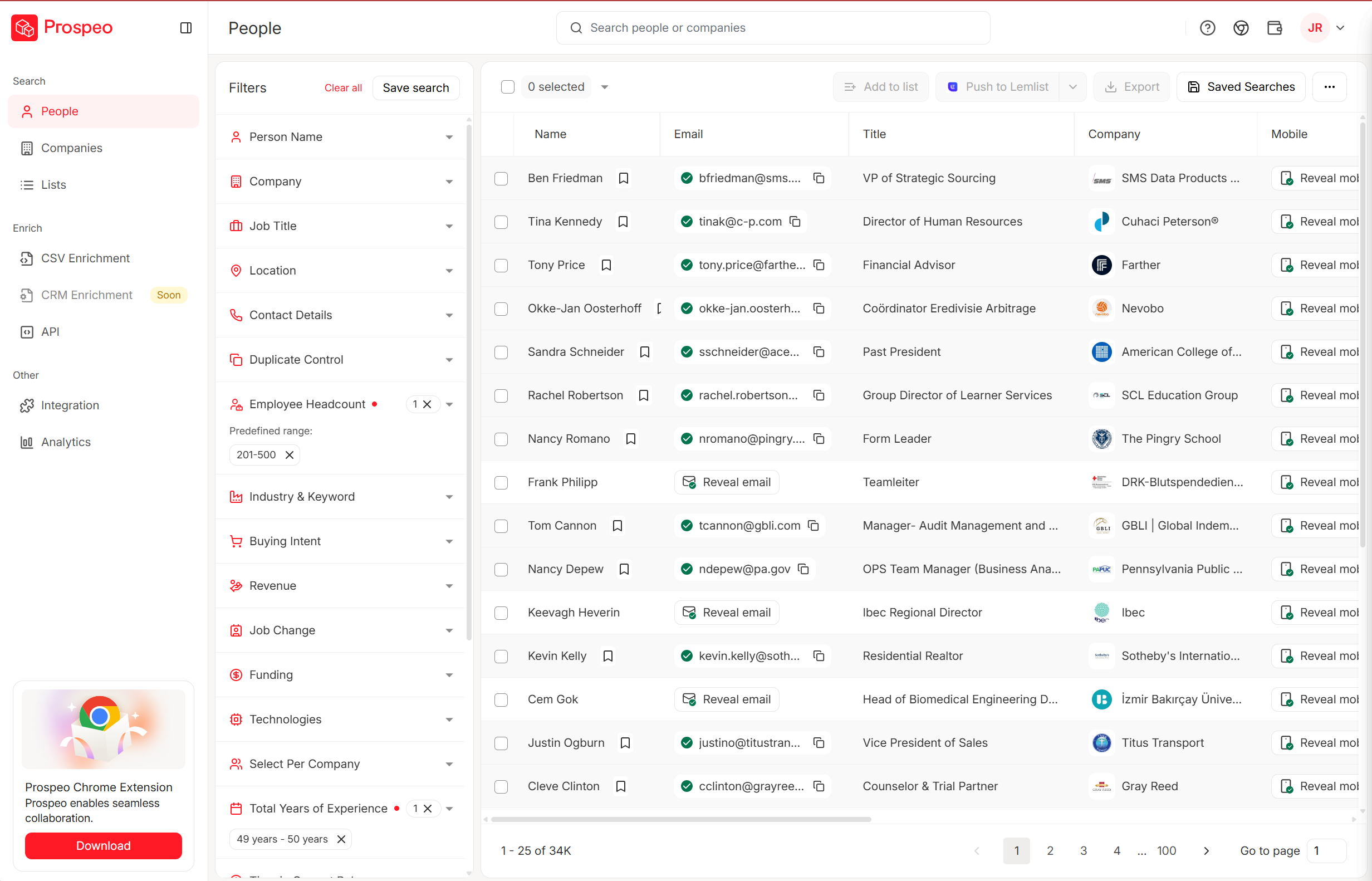
Data and prospecting. SEs need accurate contact data to map buying committees, prep for discovery, and support AEs with account intelligence. Prospeo handles this well - 300M+ professional profiles with 98% email accuracy and verified direct dials, refreshed every 7 days. You can search by 30+ filters including technographics and buyer intent, which matters when you're trying to identify every stakeholder in a deal before the first call (see more firmographic and technographic data use cases).
Everything else. CPQ tools (Salesforce CPQ, DealHub) for pricing, Loom for async video follow-ups, Mixpanel for product analytics, and Otter AI for transcription.
Here's the thing about AI in this space: it doesn't replace sales engineers - it replaces the admin work that keeps SEs from doing their actual job. Auto-filling RFPs, generating deal briefs, prepping demo storylines from CRM data. The human skills - live solutioning, reading a room, influencing a buying committee - aren't going anywhere. If your SE team spends more time on admin than on deals, you have a tools problem, not a headcount problem.
The Trade-Offs
Let's be honest about the friction.
The comp gap between SEs and AEs is real. In some orgs, AE OTE runs $100k-$150k higher than SE OTE. You're doing deeply technical work that directly influences whether deals close, and your AE partner makes significantly more. That stings.
There's also an inherent trust tension nobody talks about: prospects know you're incentivized to sell. Building credibility with a technical audience that's naturally skeptical of vendor-side engineers is part of the job. The SEs who thrive treat this as a feature - earning trust by being honest about product limitations is what separates a trusted advisor from a demo monkey.
The demo workload has its own problems. 23% of SEs say more than half their demos are unqualified. 39% say sales doesn't share discovery info soon enough. 31% want more time and context before prospect meetings. The "demo jukebox" pattern - cranking through back-to-back demos without strategic input - is the fastest path to burnout. And 79% of SEs spend more than an hour per week just cleaning and maintaining demo environments, which is pure overhead that doesn't move deals forward.
None of this means the role isn't worth it. But going in with clear eyes about the friction points makes you better at navigating them. The consensus on r/salesengineers is that what keeps people in the role is being the driver of the technical win - the person who actually proves the product works. That satisfaction is hard to find elsewhere.
Career Path and How to Break In
The Ladder (and the Lateral Moves)
The vertical path: SE, Senior SE, Principal/Staff SE, SE Manager, Director of Solutions Engineering, VP. Expect roughly 2-3 years per level, though high performers compress that timeline.
The lateral moves are where it gets interesting. Product management is the most common exit - SEs understand customer problems and product capabilities better than almost anyone. Solutions architecture (post-sales), customer success leadership, RevOps, and founding a company are all well-trodden paths. The SE skill set - technical depth plus commercial awareness - transfers broadly, which is part of why the role attracts ambitious people who don't want to be locked into one track.
Getting Your First SE Role
Three common entry paths: an engineering degree combined with sales interest, moving from technical support or implementation into pre-sales, or transitioning from an AE role where you had strong technical aptitude. Skip this path if you hate ambiguity - the role lives in the gray zone between "pure engineering" and "pure sales," and that discomfort never fully goes away.
Certifications like AWS Solutions Architect, Azure, Cisco, or Salesforce Admin help differentiate you, especially with a non-traditional background.
The typical interview process runs three stages: an HR screen, a technical interview with the hiring manager covering architecture and product knowledge, and a final-round demo presentation where you present to a mock buying committee. The demo round is where most candidates get eliminated - practice relentlessly. Record yourself, watch it back, cringe, and do it again until the cringe fades.
The BLS projects 5% job growth through 2034 with roughly 5,000 openings per year across 56,800 current positions. Steady demand, not explosive, but the SaaS segment is growing faster than the aggregate.
That 6-10 person buying committee won't evaluate itself. Prospeo's 30+ search filters - including technographics and department headcount - let SEs map the full technical evaluation team in minutes, not hours. At $0.01 per email, building account maps costs less than your morning coffee.
Spend your time on PoCs, not prospect research. Let the data work for you.
FAQ
Is sales engineering a good career?
Yes - one of the strongest in B2B tech. Median total comp ranges from $150k-$200k in SaaS, demand is steady with ~5,000 annual openings, and the work combines intellectual variety with direct revenue impact. The ceiling is high and the skills transfer broadly into product, leadership, or founding roles.
Do sales engineers need to code?
API fluency matters more than production-level coding for most SaaS SE roles. You should be comfortable reading documentation, writing basic scripts for demos or PoCs, and understanding system architecture. Full-stack development is a bonus, not a requirement.
What's the difference between an SE and an AE?
The AE owns the relationship and commercial outcome - pricing, negotiation, contract. The SE owns the technical win - demos, PoCs, and technical objection handling. They're partners on the same deal with distinct responsibilities and separate comp structures.
Will AI replace sales engineers?
No. AI automates administrative overhead - RFP responses, demo prep, deal briefs. The human skills that define the role - live solutioning, reading a room, influencing a buying committee - aren't going anywhere. AI makes SEs more productive, not redundant.
What tools help SEs map buying committees?
CRM (Salesforce or HubSpot), conversation intelligence (Gong), and a B2B data platform for stakeholder mapping. Prospeo is strong here - 30+ search filters including technographics and intent data let you identify every evaluator in an account before the first call, with 98% email accuracy and verified direct dials.