

1:Few ABM: How to Build and Run the Only ABM Tier Most Companies Need
1:few ABM is the highest-leverage play in B2B marketing, and most teams skip it entirely. They slap a 500-company list on paid social, send generic nurture emails, and call it "account-based." That's filtered demand gen with a better slide deck.
Here's the short version: group 5-10 accounts into clusters by shared pain point, target every stakeholder with company-level personalization across email plus one more channel. Your minimum stack is a CRM, marketing automation, intent data, and verified contacts. No $100k platform required.
What 1:Few ABM Actually Is
ITSMA coined "account-based marketing" in 2003 and formalized three tiers: strategic (1:1), ABM Lite (1:few), and programmatic (1:many). Understanding the differences across these tiers matters before you decide where to invest. The 1:few tier hits the sweet spot - enough personalization to move deals, enough scale to justify the effort. 81% of practitioners say ABM delivers higher ROI than traditional marketing.
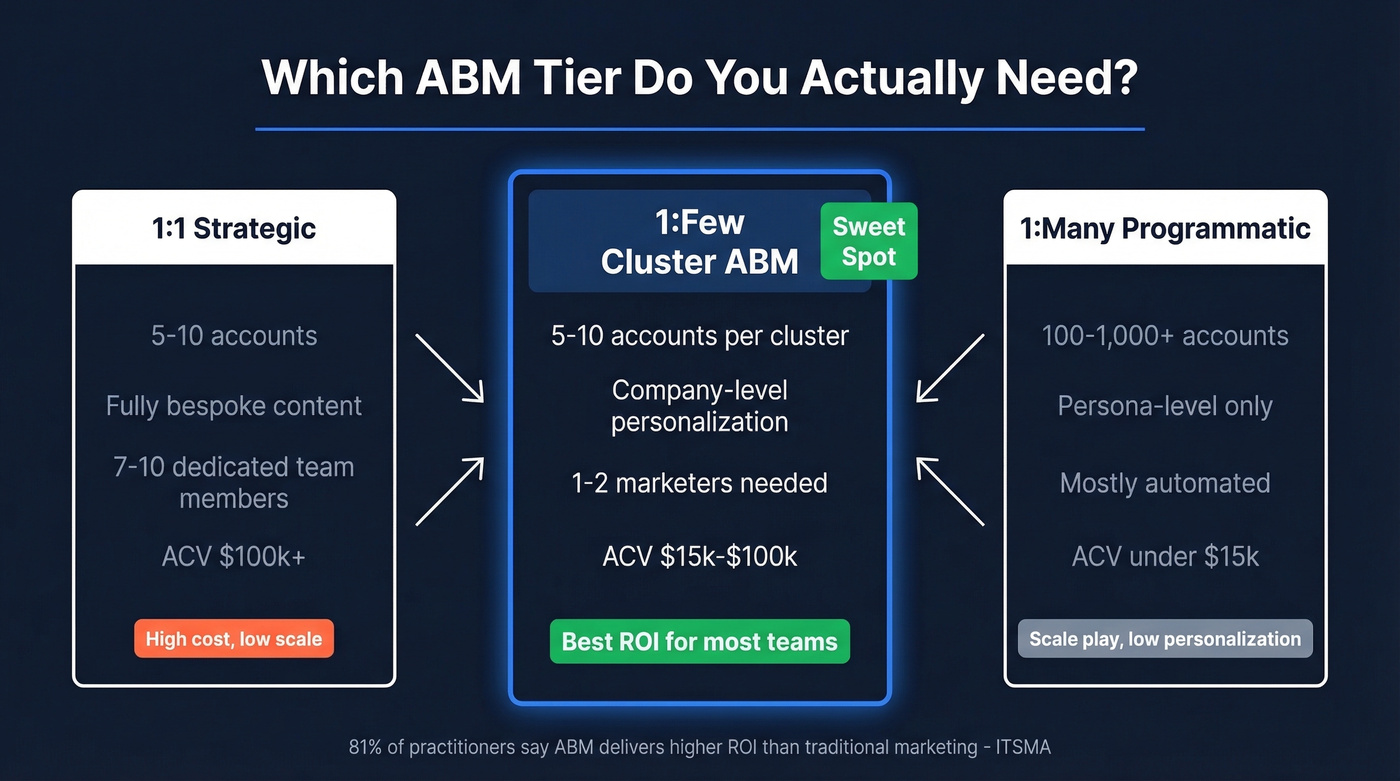
| Tier | Accounts | Personalization | Typical Team |
|---|---|---|---|
| 1:1 | 5-10 | Fully bespoke | 7-10 dedicated |
| 1:few | 5-10/cluster (up to 15) | Company-level | 1-2 marketers |
| 1:many | 100-1,000+ | Persona-level | Automated |
When Does Cluster ABM Beat Other Tiers?
71% of practitioners now run ABM, and 40% integrate it directly with demand generation - which often means they're running demand gen and calling it ABM. The consensus on r/sales and r/marketing backs this up: most teams target a broad list with minimal messaging variation. That's programmatic ABM at best.
Use the 1:few approach when your deal sizes justify personalization but not a dedicated marketer per account, when you can identify clusters sharing a specific pain point, and when your buying committees run 12+ people deep. Score accounts on fit, behavior, and intent. High fit plus active intent signals? That's your cluster. Sky-high fit with deep engagement? That gets 1:1 treatment.
Let's be honest: if your average contract value sits below $15k, you probably don't need cluster-level personalization at all. Run 1:many ABM with good segmentation and save the budget. But above $15k ACV with a multi-stakeholder sale? The 1:few tier is where the real returns live.
How to Build Your Clusters
Clustering is where programs succeed or fail. Four layers matter, and skipping any of them turns your "clusters" into glorified firmographic buckets.
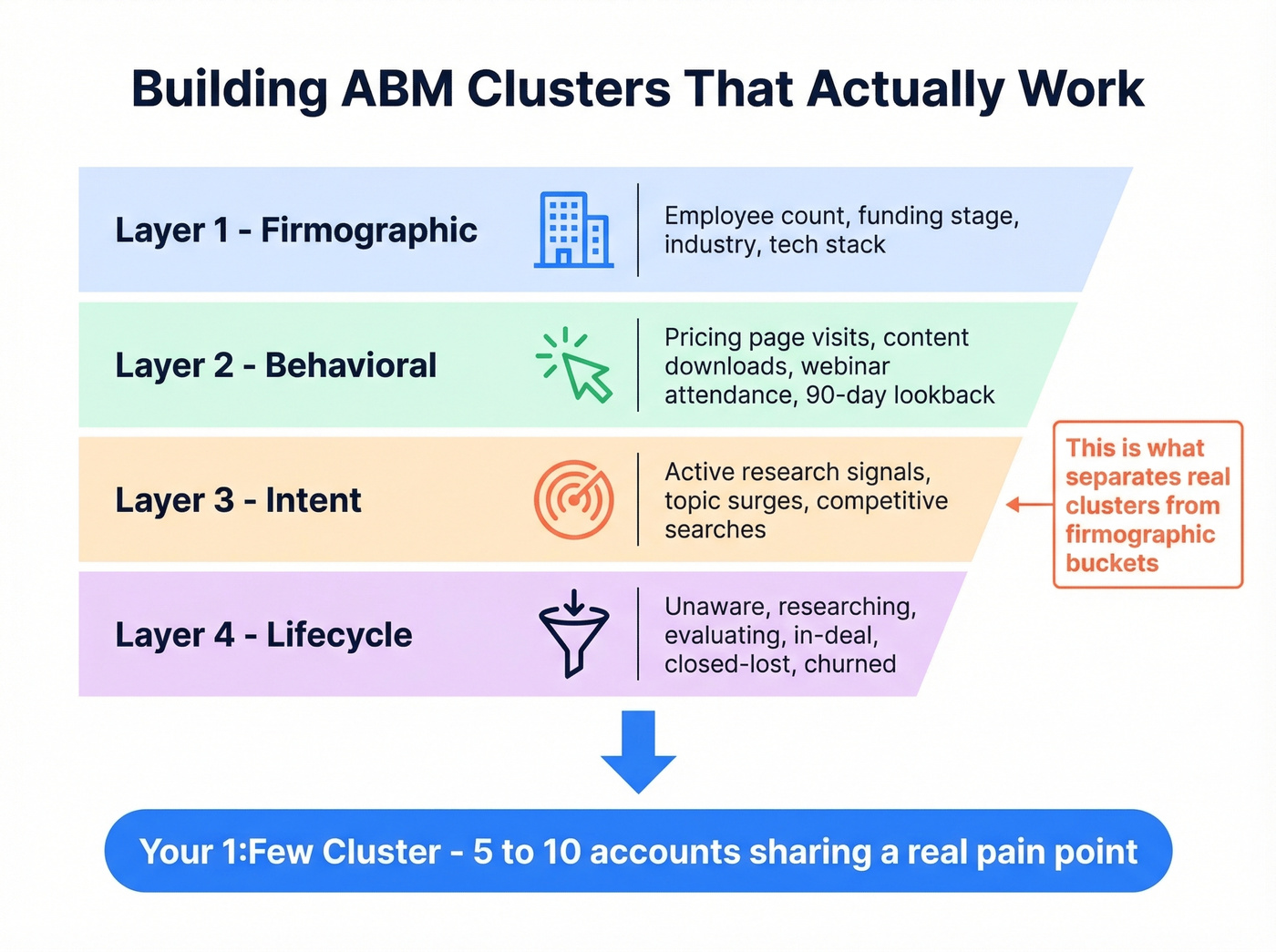
Layer 1 - Firmographic. Employee count, funding stage, industry, tech stack. Example: Series B-D SaaS companies with 200-1,000 employees running Salesforce plus a data warehouse. (If you need a tighter definition of what to include, start with firmographic buckets.)
Layer 2 - Behavioral. Engagement signals from your own properties - pricing page visits, competitor comparison downloads, webinar attendance. Use a 90-day lookback to find accounts that engaged but didn't convert.
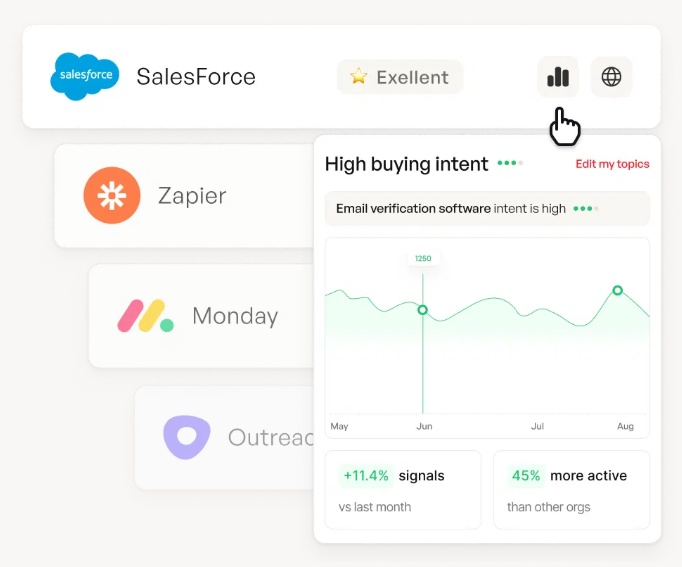
Layer 3 - Intent. This is what separates real clusters from firmographic buckets. Intent data reveals which accounts are actively researching your solution category before you build the cluster. Without it, you're guessing. If you want a practical framework for scoring, use intent-based segmentation.
Layer 4 - Lifecycle. Unaware, researching, evaluating, in-deal, closed-lost, or churned? A cluster of "evaluating" accounts gets different messaging than "researching" ones. Mixing lifecycle stages in the same cluster is one of the fastest ways to tank reply rates, because the messaging can't serve both audiences well. (This is also where lead scoring helps keep clusters clean.)
Nuvolo's campaign shows the logic in action: they used Bombora intent data to segment accounts by solution topic, dropped surging accounts into HubSpot nurture sequences, ran display ads by job title, and routed responders to segment-specific landing pages. Their clusters ran closer to 50-100 accounts - bigger than the 5-10 clusters many teams use for tighter company-level personalization - but the segmentation principle applies at any size.
The Minimum Viable Tech Stack
You don't need Demandbase at $25k-$100k+/year or 6sense at $30k-$120k+/year to start.
| Function | Options | Cost Range |
|---|---|---|
| CRM | Salesforce, HubSpot | ~$25-$150/user/mo |
| Marketing automation | HubSpot, Marketo | ~$800-$3,200/mo |
| Intent data | Bombora, or bundled via contact tools | ~$25k+/yr standalone |
| Contact data | Prospeo, ZoomInfo | Free-$40k+/yr |
| Activation | Email + display/social | $500-$5,000/mo |
Running 1:few ABM means reaching every stakeholder in a buying committee that averages 12+ people. If your emails bounce, your personalized campaign never lands. We've watched teams invest weeks in cluster strategy and messaging only to hit 30%+ bounce rates because they skimped on data quality - that's the whole program, wasted. If you're troubleshooting this, start with email bounce rate benchmarks and fixes.
Prospeo bundles contact data and intent signals into one tool: 300M+ professional profiles with 98% email accuracy on a 7-day refresh cycle, plus intent data covering 15,000 Bombora topics for clustering. The free tier starts at 75 emails/month, and paid plans run roughly $0.01/email - compare that to a standalone Bombora contract at $25k-$50k+/year. (If you're evaluating vendors, see data enrichment services.)

Enterprise platforms like RollWorks (often $10k-$25k/year) add orchestration and analytics. They're accelerants, not prerequisites. If you're comparing options, check Metadata.io alternatives.

Your 1:few ABM program dies at a 30% bounce rate. Prospeo delivers 98% email accuracy on a 7-day refresh cycle, plus intent data across 15,000 Bombora topics - so you can cluster accounts by real buying signals and actually reach every stakeholder.
Stop wasting cluster strategy on bounced emails. Start at $0.01/contact.
Running the Campaign
Email dominates ABM execution - 92% of programs use it as a primary channel. Targeted ABM emails pull reply rates of 10-34%, compared to 2-10% for generic cold outreach. Keep emails under 100 words and tailor by role, not just persona. If you need copy patterns that work, use these sales follow-up templates.
Multi-threading is non-negotiable. You're reaching 5-12 contacts per account, each getting role-specific messaging. The VP of Engineering gets a different email than the CFO - and not just a different subject line, but a different value proposition entirely. For c-suite outreach, lead with strategic business outcomes and ROI language. Executives don't care about feature lists. (This is also where account-based selling best practices can keep sales and marketing aligned.)
A 2025 benchmark across 211 companies and $5.5M in ad spend shows how teams connect professional-network ads to pipeline and revenue influence when they stitch ad data to CRM outcomes. Use paid social as a visibility layer, but keep email as the primary driver.
Beyond email, in-person events drive results for 72% of ABM programs. Direct mail still pulls 15-25% response rates when it's targeted and creative. Skip direct mail if your clusters are international - shipping costs and customs delays kill the timing advantage. If you want a channel-by-channel breakdown, see direct mail for lead generation.
Mistakes That Kill 1:Few Programs
Setting MQL goals. Measure account-stage progression, not form fills. ABM isn't lead gen.
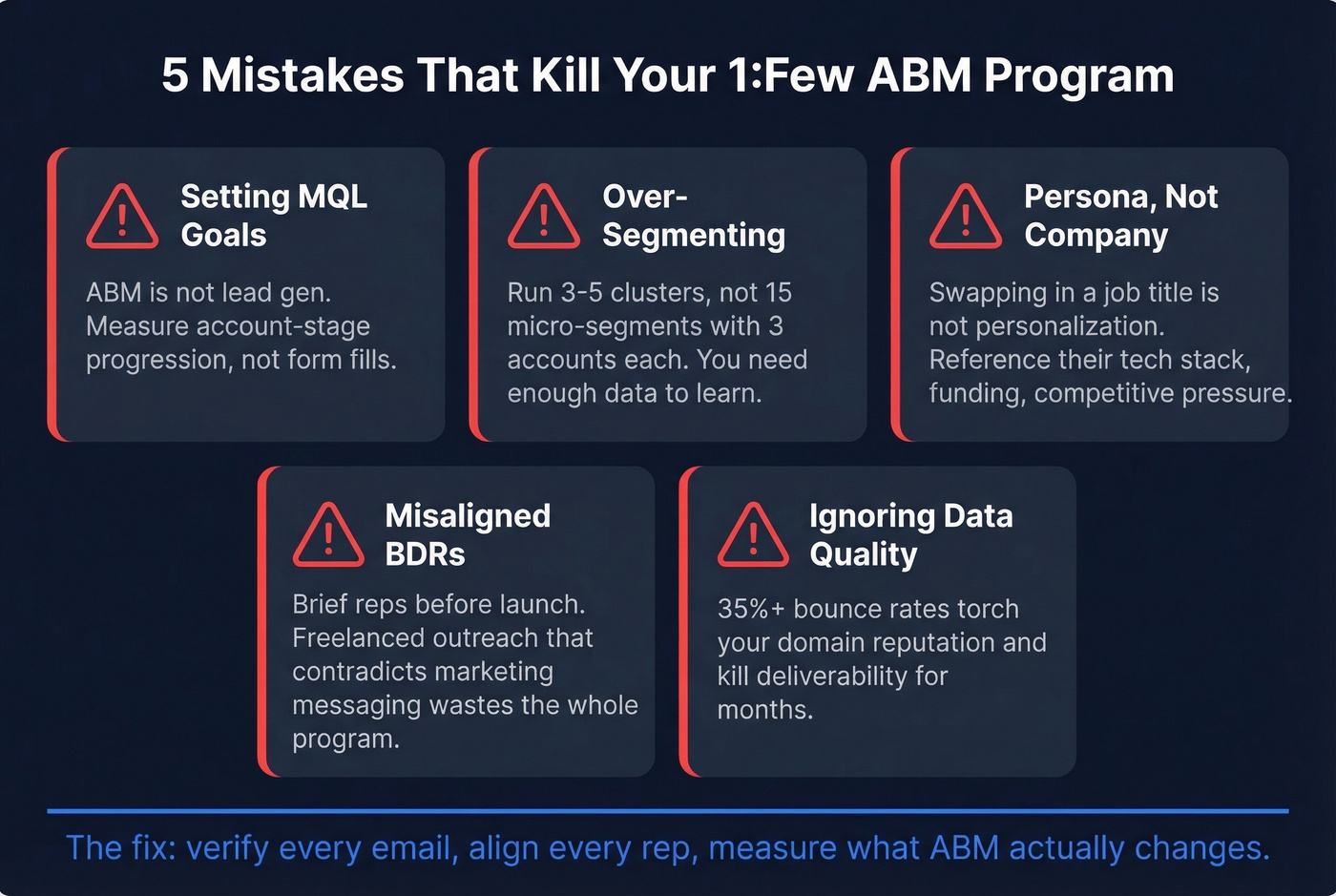
Over-segmenting. Run 3-5 clusters with enough accounts to learn from. Fifteen micro-segments with 3 accounts each starves every segment of data, and you'll never know what's working.
Personalizing by persona, not company. Reference the account's specific situation - tech stack, recent funding, competitive pressure. Swapping in "VP of Sales" isn't personalization. It's a mail merge. If you want a tighter process, use a personalized outreach framework.
Misaligning BDRs. Brief reps on campaign messaging before launch. We've seen freelanced outreach that directly contradicts marketing messaging - it confuses prospects and wastes the entire program investment.
Ignoring data quality. Verify every email before launch. Teams that run campaigns on stale data hit 35%+ bounce rates, which torches domain reputation and kills deliverability for months afterward. Use an email deliverability guide to fix the root causes.
Multi-threading 5-12 contacts per account means you need verified emails for every buyer on the committee. Prospeo covers 300M+ profiles with 30+ filters - intent, technographics, job title, headcount growth - purpose-built for ABM list building without a $100k platform.
Reach every stakeholder in the buying committee, not just the ones with public emails.
Real Results From 1:Few Campaigns
CipherHealth ran contact-level ad targeting with Slack alerts on engagement and generated an 83% pipeline lift, a 20% revenue lift, and $122.70 in influenced revenue per $1 spent. That last number alone justifies the entire ABM investment thesis.
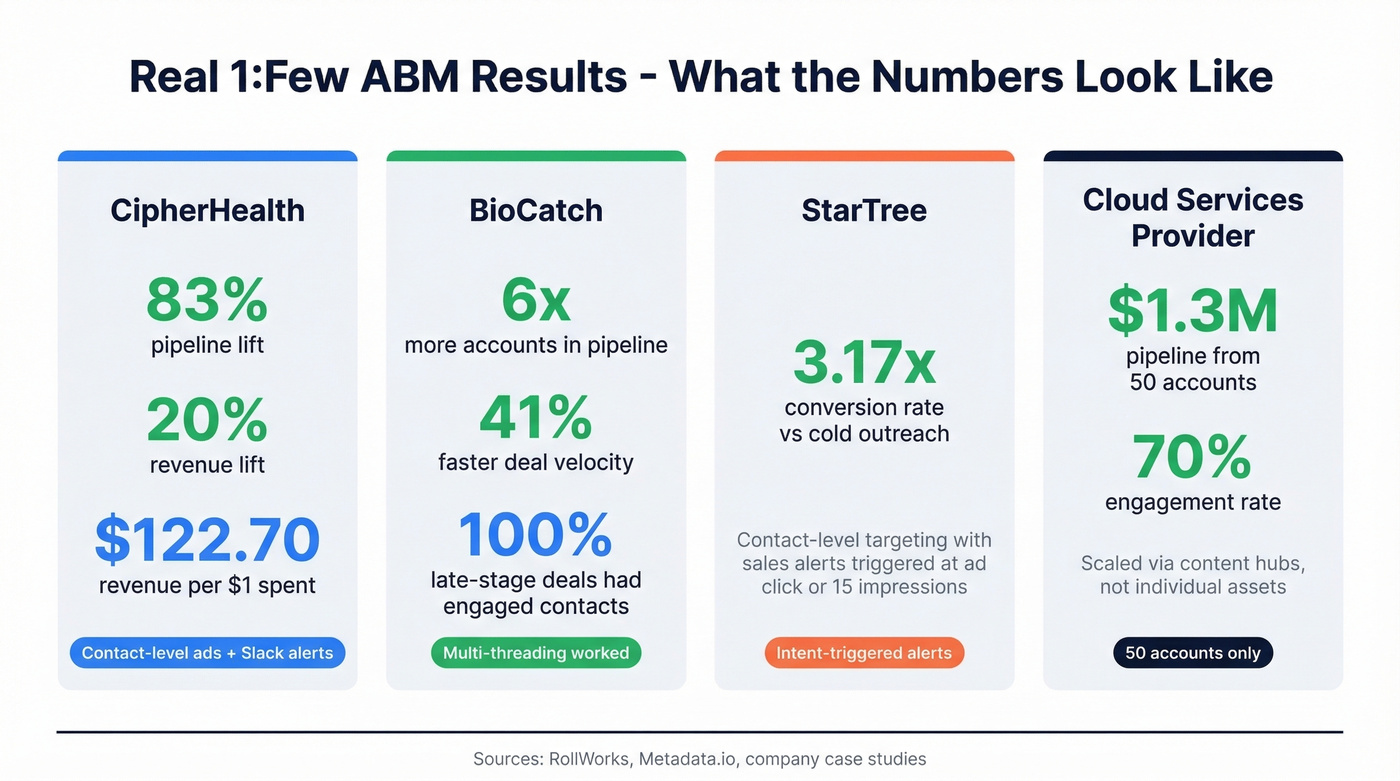
BioCatch: 6x more accounts in pipeline, 41% faster deal velocity. 100% of late-stage deals had an engaged contact - meaning the multi-threading worked exactly as designed.
StarTree: 3.17x conversion rate increase vs. cold outreach using contact-level targeting with sales alerts triggered at ad click or 15 impressions.
Cloud services provider: $1.3M in pipeline from just 50 accounts, 70% engagement rate. They scaled personalization through content hubs rather than individual assets, which kept production costs manageable while still delivering account-relevant experiences.
Measuring Without Enterprise Tools
Track four things: account engagement score, pipeline velocity, average deal size, and revenue per $1 spent. That's your core dashboard. If you want a broader view of what to monitor, use pipeline health metrics.
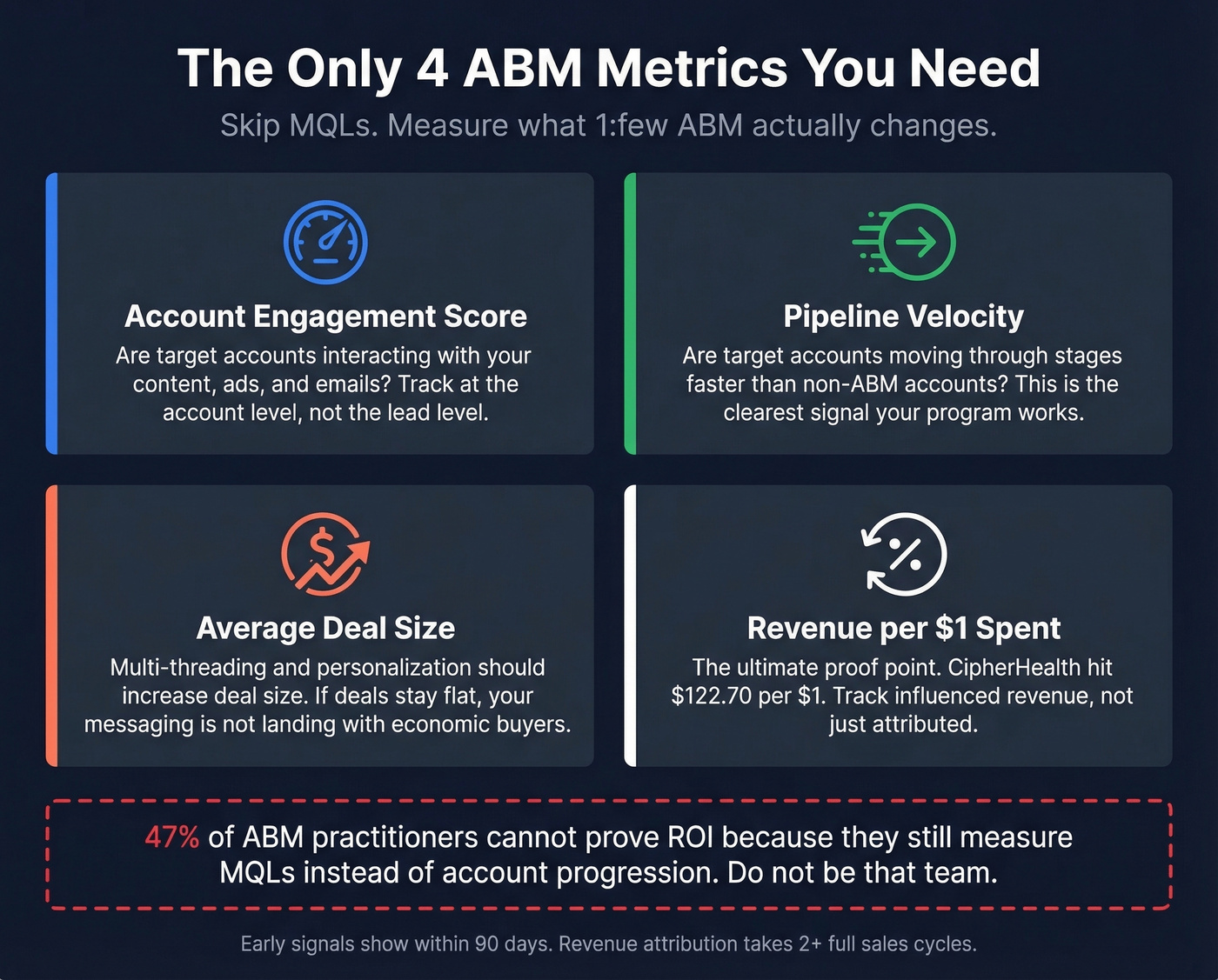
The attribution traps are real. Cookie loss breaks tracking. LinkedIn has a 90-day attribution window that misses longer sales cycles. 47% of ABM practitioners can't prove ROI - partly because they're still measuring MQLs instead of account progression. Measure what ABM actually changes: are target accounts moving through stages faster, and are deals getting bigger?
On the AI front, 45% of practitioners see promise for personalization, but nearly 70% find current AI effectiveness limited. Don't bet your program on AI-generated "personalization" yet. Human-written, account-specific messaging still wins.
FAQ
How many accounts should each cluster contain?
Five to ten is the sweet spot, up to 15 if the accounts are truly similar. Larger clusters dilute company-level personalization. The key constraint: every account must share a specific pain point or business trigger, not just firmographic similarity.
Can I run 1:few ABM without a dedicated platform?
Yes. A CRM, marketing automation, an intent data source, and verified contact data is enough to launch. Prospeo's free tier covers 75 verified emails and 15,000 intent topics - enough to pilot a first cluster without signing a contract. Enterprise platforms add orchestration after you've proven the model works.
How long before results appear?
Expect 45-60 days to launch and 6-12 months for meaningful pipeline impact. Early signals like account engagement and meeting rates show up within 90 days. Revenue attribution takes two or more full sales cycles - so set expectations with leadership before you start, not after.