

How to Write a 3rd Follow-Up Email That Actually Gets a Reply
You sent a solid cold email on Monday. A thoughtful follow-up later that week. It's now the following week, and your inbox is still empty. That 3rd follow-up email is sitting in your drafts, and you're stuck between "one more try" and "I'm being annoying."
Here's the quick version: a single cold email gets an 8.4% reply rate, and it drops from there. By the third touch, you're at 5.75%, and 4+ emails more than triple unsubscribe and spam complaint rates. Your third follow-up is almost certainly your last productive email - so make it count. Add new value (not "just checking in"), keep it under 100 words, send it 7-10 days after your 2nd email, and use a short, personalized subject line. If you get nothing back, send a breakup email. Don't send a 4th follow-up.
Should You Even Send a Third Follow-Up?
Yes - but barely. You're right at the edge of diminishing returns.
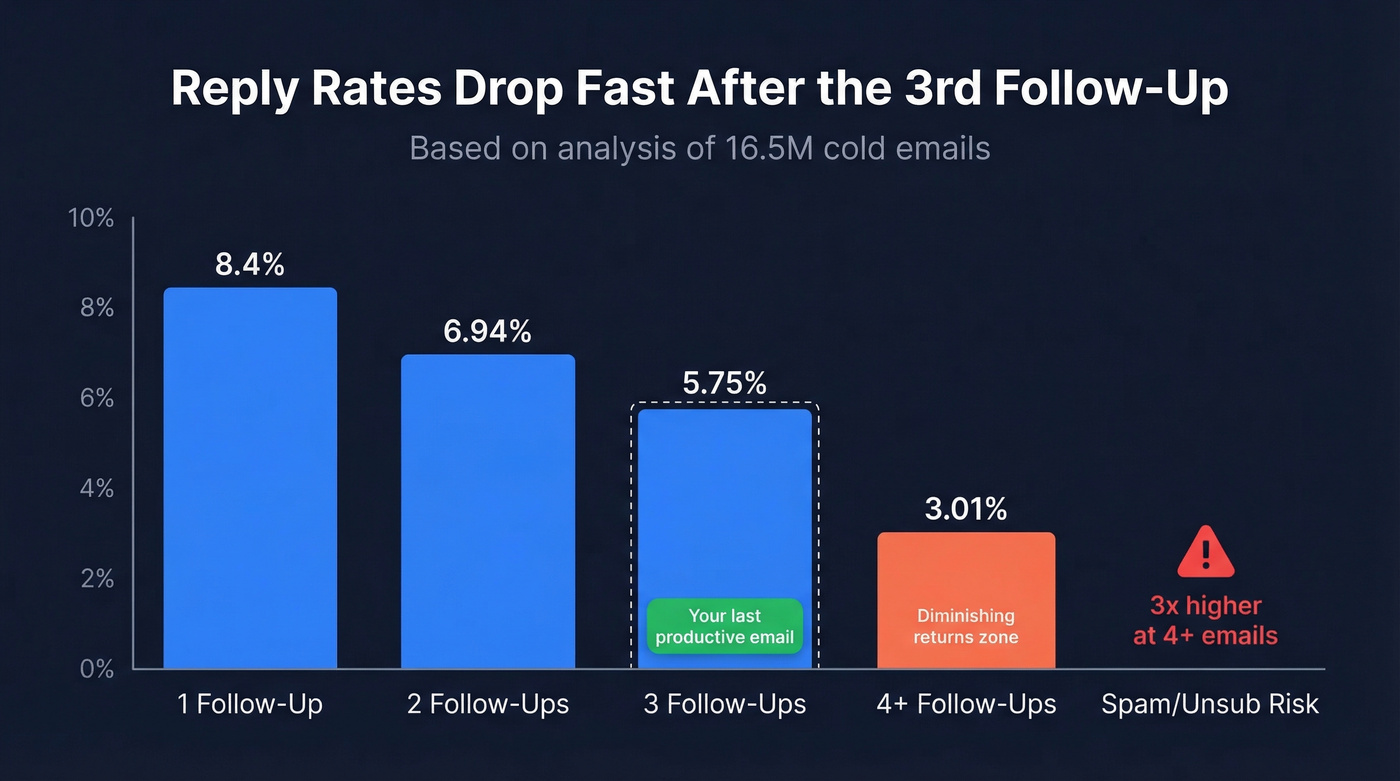
A Belkins study of 16.5M cold emails maps the decline clearly: 6.94% reply rate after two follow-ups, 5.75% after three, 3.01% after four. Woodpecker's benchmarks confirm the pattern - even a single follow-up lifts reply rates by 22%, but anything beyond three adds only a fraction of replies while increasing the risk of being labeled spam.
One Reddit sales rep reported their best close came on the third email - short and casual. The prospect replied that the timing had simply been wrong before. That's the third follow-up in a nutshell: you're not persuading anyone new. You're catching the right person at the right moment.
Enterprise prospects at 1,000+ employee companies are far less tolerant of persistence and tend to ghost faster. Small businesses are more forgiving. If you're selling into the Fortune 500, your message needs to be significantly sharper than if you're emailing a 20-person startup.
When to Send It
Timing matters more than most reps think. We've found this cadence works well:
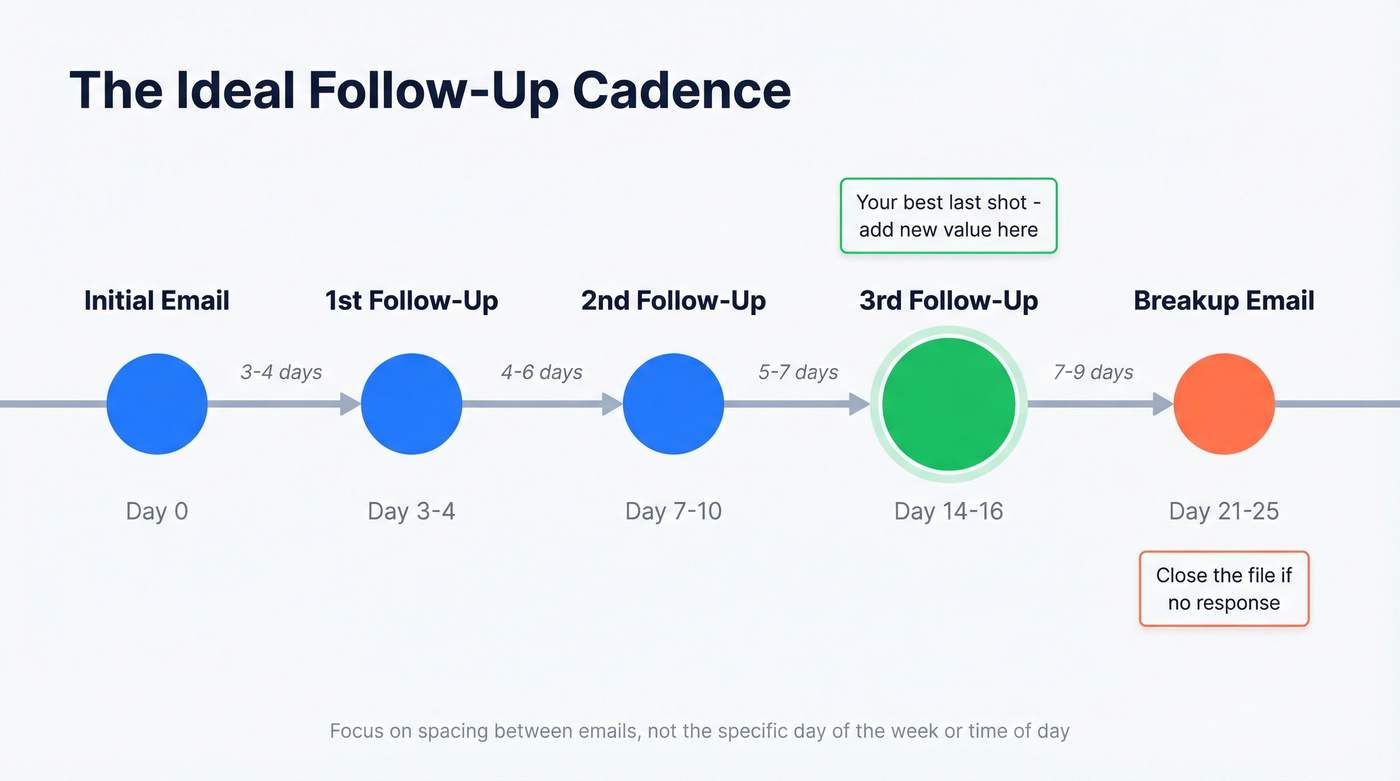
- Initial email: Day 0
- 1st follow-up: Day 3-4
- 2nd follow-up: Day 7-10
- 3rd follow-up: Day 14-16
- Breakup email: Day 21-25
Too soon reads as desperate, too late loses the thread. The good news? Send day and time don't meaningfully move the needle. Focus on spacing, not scheduling. (If you want the data, see best time to send cold emails.)
How to Write a Strong Third Touch
The cardinal rule: don't just bump the thread. Each follow-up needs to earn its place in someone's inbox by adding something new.
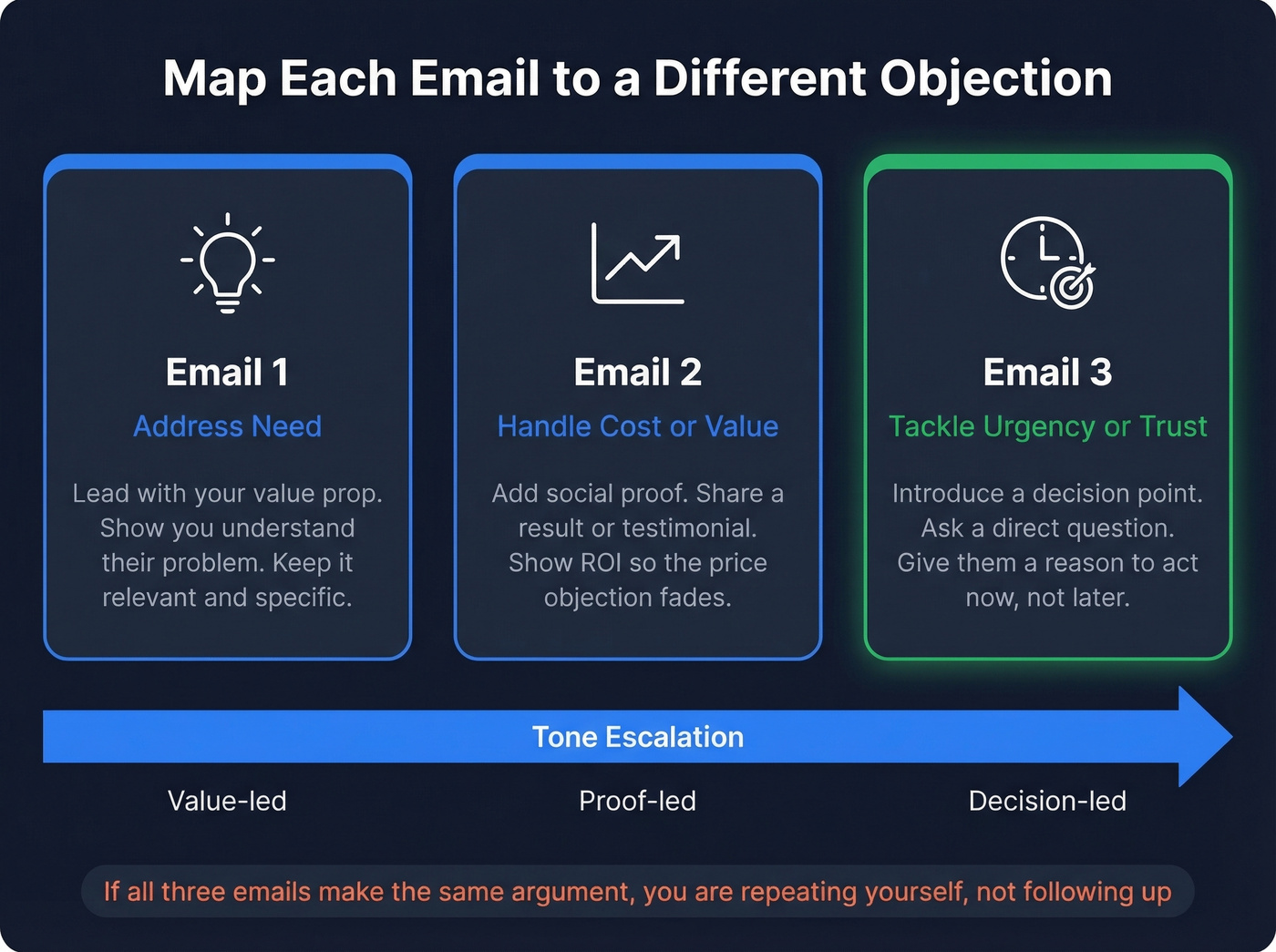
Map each email to a different objection. Your first email addresses need, your second handles cost or value, and your third tackles urgency or trust. If all three emails make the same argument, you're not following up - you're repeating yourself. (More on this in our AI sales follow-up guide.)
Keep it in the same thread. Threading preserves context and feels more natural. Don't start a new subject line unless you're completely changing your angle.
Stay under 100 words. By email three, your prospect has already decided whether your value prop is interesting. A long email won't change their mind. A short, direct one might catch them at the right moment. If you need help tightening copy, use a simple email copywriting checklist.
Escalate tone deliberately. Email 1 leads with value, Email 2 adds social proof, Email 3 introduces urgency or a clear decision point. That progression feels natural rather than nagging. This is also easier to manage inside a B2B cold email sequence.

Your 3rd follow-up only works if it reaches a real inbox. Teams using unverified data burn domains and waste their best copy on bounced addresses. Prospeo verifies emails in real time with 98% accuracy - so your last productive touch actually lands.
Don't waste your sharpest follow-up on a dead address.
Subject Lines That Get Opened
A Belkins study of 5.5M emails found personalized subject lines hit a 46% open rate vs. 35% without personalization. The sweet spot is 2-4 words, and questions outperform statements. Urgency language - "ASAP," "urgent," "time-sensitive" - actually drags open rates below 36%.
If you're threading (recommended), keep the original subject. If you're starting fresh, try:
- "Quick question about [company]"
- "Still any interest?"
- "[First name], should I stop reaching out?"
- "Let's cut to the chase"
Short, personal, question-based. That's the formula. For more options, pull from these email subject line examples and refine with subject lines that get opened.
Templates That Work
Template A - Value-Add with a Case Study
Hi [First name],
Since my last note, we helped [similar company] cut their [metric] by 23% in 6 weeks. Thought it might be relevant given [specific detail about their situation].
Worth a 15-minute look?
Template B - The Direct Question
Hi [First name],
Simple question: is [solving X problem] a priority this quarter, or should I circle back later?
Either answer helps.
Template C - Breakup / Close the File
Hi [First name],
I haven't heard back, so I'm guessing the timing isn't right. Should I go ahead and close the file on this?
If anything changes, I'm easy to find.
Template D - Channel Switch
Hi [First name],
Email might not be the best channel for this. Would a 5-minute call work better? Happy to work around your schedule - [calendar link].
The same Belkins data shows message + profile visit combos hit 11.87% reply rates - worth trying if email alone isn't landing. If you want more plug-and-play options, use these cold email follow-up templates.
Mistakes That Kill Your Third Follow-Up
Bumping with no new information. "Just checking in" and "wanted to circle back" are two of the fastest ways to get archived. Every follow-up needs a new angle, a new data point, or a new question. (If you keep defaulting to that phrase, see how to say just checking in professionally.)
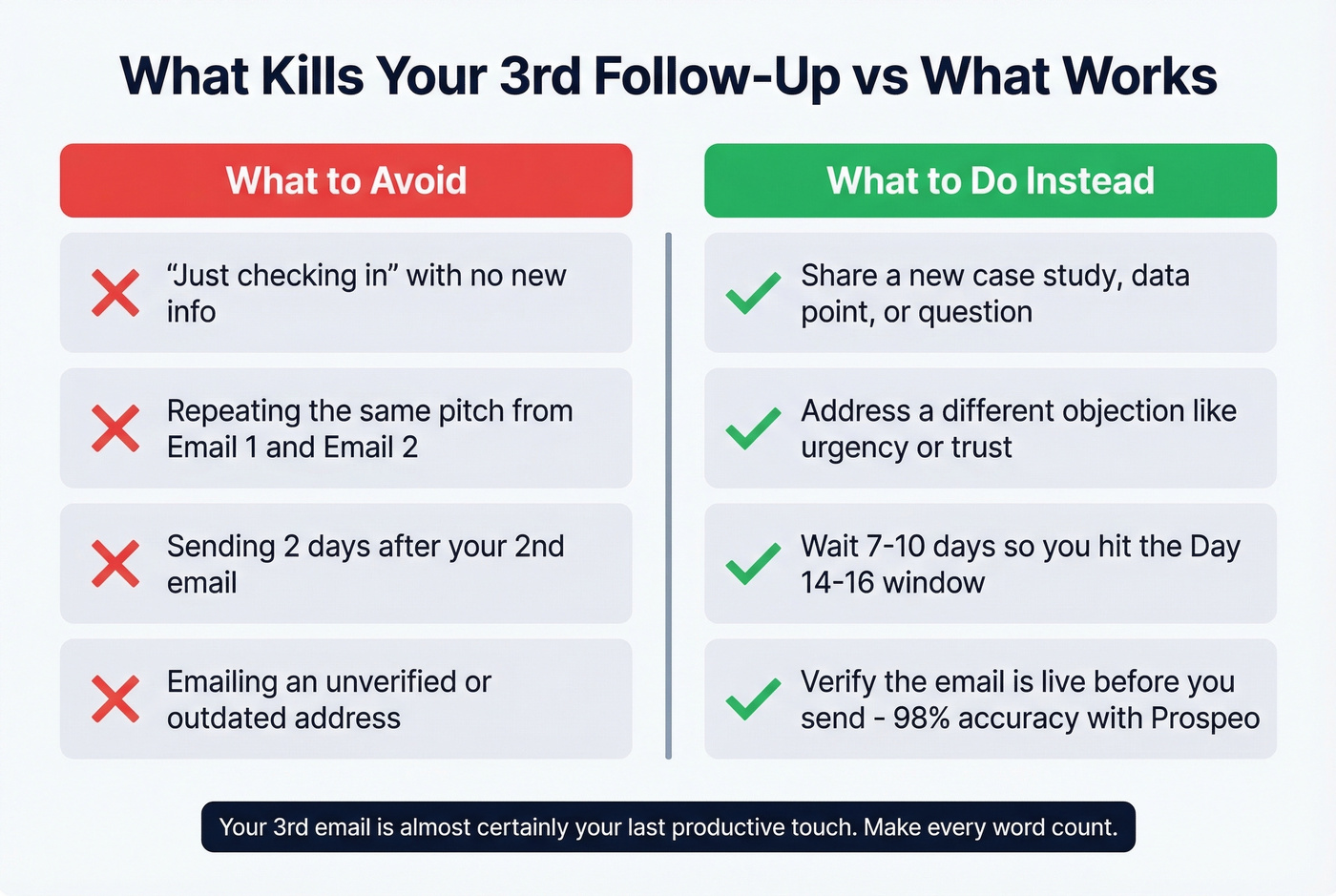
Repeating the same argument. If emails 1, 2, and 3 all pitch the same feature, you're not addressing objections - you're ignoring them. Map each touch to a different reason someone might say no.
Wrong timing. Sending your third email two days after your second reads as pushy. Waiting three weeks means they've forgotten who you are. The Day 14-16 window hits the sweet spot.
Bad data. Here's the thing - if your prospect changed roles six months ago or the email address is dead, no amount of copywriting will save you. Before you send email #3, verify the address is still live. We've seen teams burn entire domains because they kept hammering bounced addresses. Prospeo checks emails in real time with 98% accuracy, and the free tier covers 75 verifications a month. Your best copy is wasted on a dead inbox. If you're troubleshooting this, start with email bounce rate and then work through an email deliverability guide.
When to Send a Breakup Email Instead
If your 3rd follow-up email gets zero engagement - no opens, no clicks, nothing - look at data and deliverability before you rewrite your copy. Either the address is bad, you're landing in spam, or the prospect genuinely isn't interested.
Breakup emails work surprisingly well. They generate 10-30% response rates because the "should I close your file?" framing triggers loss aversion. Send it around Day 21-25 of your sequence. If that doesn't land either, move on.
Let's be honest: most teams send too many follow-ups, not too few. If your first two emails didn't generate any interest, a 4th and 5th won't either. The reps who consistently book meetings aren't the ones who follow up seven times - they're the ones who move on faster and spend that time finding better-fit prospects with verified contact data.
The reps who book more meetings aren't sending more follow-ups - they're moving on faster to better-fit prospects with verified contact data. Prospeo gives you 300M+ profiles with 30+ filters so you spend less time chasing ghosts and more time reaching buyers who are ready to talk.
Stop following up on dead leads. Find better ones in seconds.
FAQ
How many follow-up emails should I send?
Two to three. Data confirms diminishing returns after the 3rd touch - reply rates drop from 5.75% to 3.01% on the fourth email, and spam complaints more than triple. Quality beats quantity every time.
Should I use the same subject line on my 3rd follow-up email?
Yes, if you're replying in the same thread, which is the recommended approach. Threading preserves context and boosts open rates. Only use a new subject line if you're completely changing your angle or switching from value-add to breakup.
What if they open my emails but never reply?
Opens without replies usually mean your message isn't compelling enough - not that they're uninterested. Try a direct yes-or-no question or a breakup email to force a decision. If you're seeing zero opens, verify the email address before sending again.
Is a third follow-up email after no response worth the effort?
At scale, absolutely. The data shows a 5.75% reply rate on the third touch - lower than earlier emails but still meaningful when you're running hundreds of sequences. Bring something new: a fresh case study, a direct question, or a breakup angle. Skip this approach if your first two emails had zero opens - that's a deliverability or data quality problem, not a messaging one.