

The 7 Stages of the Sales Cycle - Backed by Real Numbers
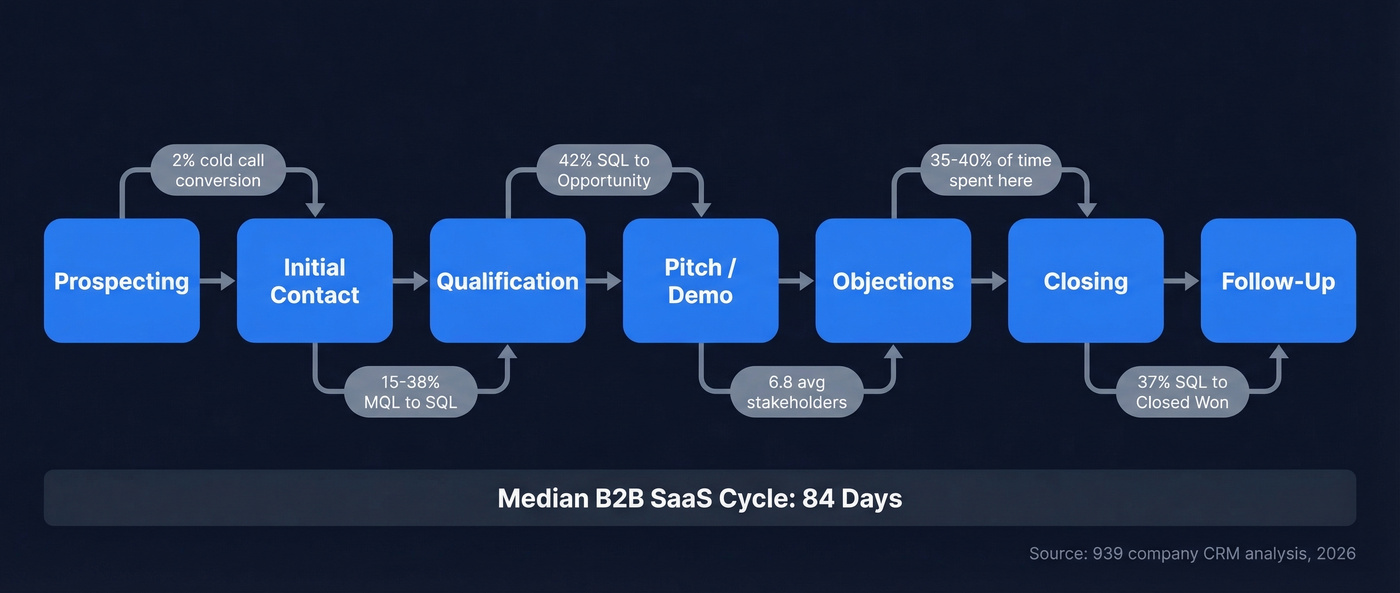
Most breakdowns of the 7 stages of the sales cycle list the same steps with the same generic advice. None tell you how long each stage should take, where deals actually stall, or what the conversion rate between stages looks like. That's useless when your VP asks why deals take 120 days and you don't have numbers to diagnose the bottleneck.
Here's the quick version:
| Stage | One-Liner |
|---|---|
| Prospecting | Find the right people |
| Initial Contact | Earn the first reply |
| Qualification | Confirm they can buy |
| Pitch / Demo | Show the value |
| Objections | Align the committee |
| Closing | Get ink on paper |
| Follow-Up | Turn wins into referrals |
The median B2B SaaS cycle is 84 days - 22% longer than 2022, based on CRM timestamp analysis of 939 companies. Meanwhile, 84% of reps missed quota last year. The stages haven't changed. The environment has.
One quick distinction before we dig in: the sales cycle is the timeline a deal moves through (the "what"). The sales process is the methodology your team follows (the "how"). Most teams conflate them. Don't.
Sales Cycle Stages, Explained
Prospecting
This is where your cycle length gets set - for better or worse. It takes an average of 7 contacts to close a deal, and cold calls convert to sales roughly 2% of the time. Channel choice matters enormously: referral-sourced leads close in 20-60 days, cold calling runs 60-110 days, and trade shows stretch to 150 days for complex deals.
The trap is prospecting on unverified data. Bounced emails and dead phone numbers don't just waste rep time - they add weeks to your cycle before you even reach Stage 2. We've seen teams cut three weeks off their cycle just by cleaning up their contact data before a single email goes out. A tool like Prospeo verifies emails at 98% accuracy and provides verified mobile numbers before outreach starts, so reps aren't burning the most important stage on bad numbers. If you want a broader view of options, compare data enrichment services before you lock in a workflow.

Initial Contact
80% of B2B interactions now happen in digital channels, and 72% of customers only engage with personalized messaging. Your first touch needs to be relevant, specific, and short. Reps who lead with a product monologue lose the conversation before it starts. Tighten your outreach with proven sales prospecting techniques and keep your messaging consistent.
Lead with a question about their problem, not a pitch about your features.
Qualification
Ask any AE running 90+ day cycles and they'll tell you the same thing: deals don't die at the demo - they die because unqualified leads clogged the pipeline weeks earlier. MQL-to-SQL conversion runs just 15-21% across broader B2B, meaning 4 out of 5 marketing-qualified leads never become sales-qualified. B2B SaaS specifically runs higher at ~38%, but even that means you're losing the majority. If you’re not already using a consistent scoring model, start with a practical lead scoring setup.
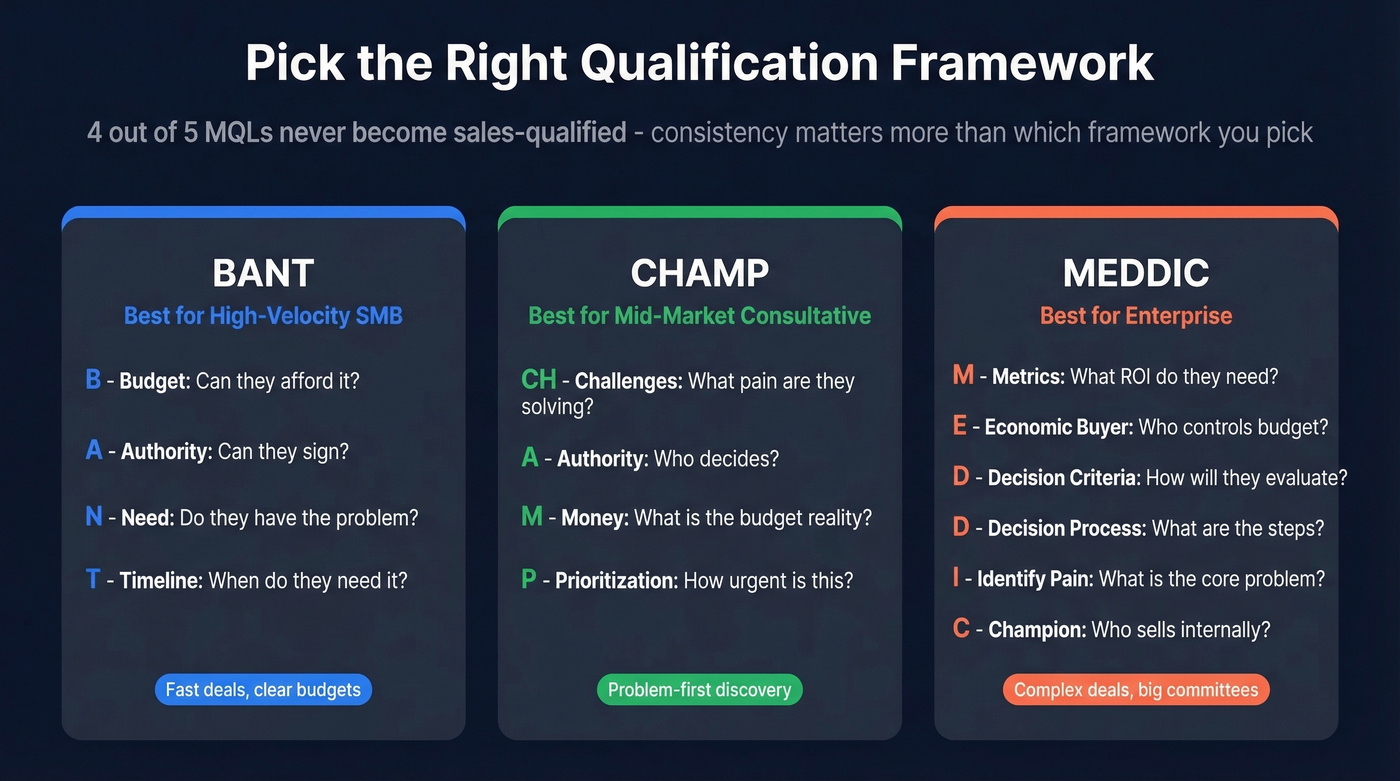
Consistency matters more than which framework you pick. If you need a starting point: BANT for high-velocity SMB deals, CHAMP for mid-market consultative sales, MEDDIC for enterprise. Every unqualified deal that enters your pipeline inflates your cycle length and tanks your win rate. This is the stage where disciplined execution separates high-performing teams from everyone else.
Pitch / Demo
Here's the stat that should change how you schedule your week: proposals sent within 24 hours of the demo close 35% faster. Despite that, SQL-to-Opportunity conversion sits at just 42% in B2B SaaS - meaning you lose more than half your qualified leads at this stage. If your demos feel feature-heavy, use a tighter product demo checklist to keep the conversation anchored on outcomes.
The reason is almost always the same: reps overemphasize features over value. Your prospect doesn't care about your architecture diagram. They care about whether you solve the problem they described in Stage 3.
Handling Objections
Here's where teams blow it: speaking to the wrong stakeholder. Buying committees now average 6.8 people - up from 5.4 in 2020 - and that number hits 7 for mid-sized firms with 100-500 employees. Objections aren't coming from one person; they're coming from legal, IT, procurement, and the end user's manager. This is where team selling and clear stakeholder mapping stop deals from stalling.
Map every decision-maker before this stage, not during it. If you're hearing objections from someone who can't actually approve the deal, you're wasting cycles on the wrong conversation entirely.
Closing
Negotiation-to-close consumes 35-40% of total enterprise cycle time. Let that sink in. More than a third of your entire deal timeline is spent after the buyer already wants to buy. Legal and procurement are the #1 cause of delayed closes - not buyer hesitation. SQL-to-Closed Won runs 37% in B2B SaaS. If you know legal review takes 3 weeks at a Fortune 500, build that into your timeline from the demo stage. For negotiation structure, borrow a few principles from anchor in negotiation so you don’t give away time (or margin) unnecessarily.
Follow-Up and Referrals
Most teams treat closing as the end. It's not - it's the beginning of your cheapest pipeline source. Referral-sourced deals close in 20-60 days versus 60-110 for cold outreach. Deals with 7-9 relationships took 58% less time to close than those with fewer contacts. Every closed deal should generate at least one referral ask. If your reps aren't doing this systematically, you're leaving the fastest pipeline channel on the table. Use battle-tested sales follow-up templates to standardize the motion without sounding robotic.

Bad contact data adds weeks to your sales cycle before you even reach Stage 2. Prospeo gives your reps 98% accurate emails and 125M+ verified mobile numbers - refreshed every 7 days, not every 6 weeks. Teams using Prospeo cut bounce rates from 35% to under 4% and tripled their pipeline.
Stop losing deals at prospecting. Start with data that connects.
2026 Sales Cycle Benchmarks
Your cycle isn't "too long" or "too short" in a vacuum - it depends on what you sell, to whom, and at what price point. Compare your actual stage-to-stage conversion against these numbers to find where your funnel leaks. If you want a clean way to diagnose where the drop-offs happen, track funnel metrics alongside stage duration.
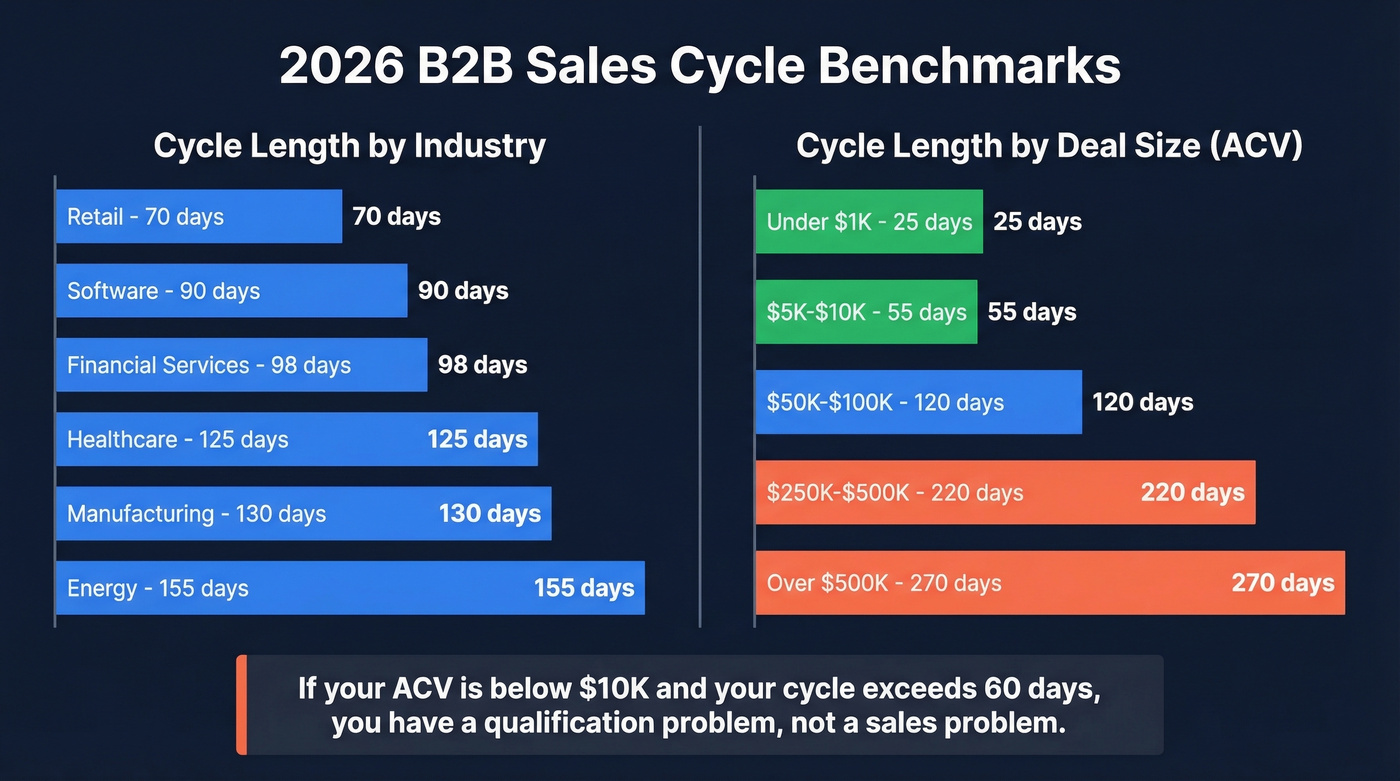
By Industry:
| Industry | Avg. Cycle |
|---|---|
| Retail | 70 days |
| Software | 90 days |
| Financial Services | 98 days |
| Healthcare | 125 days |
| Manufacturing | 130 days |
| Energy | 155 days |
By Deal Size (ACV):
| ACV Range | Avg. Cycle |
|---|---|
| Under $1K | 25 days |
| $5K-$10K | 55 days |
| $50K-$100K | 120 days |
| $250K-$500K | 220 days |
| Over $500K | 270 days |
By Stage (Software, 90-Day Cycle):
| Stage | Days |
|---|---|
| Initial Contact | 14 |
| Proposal | 30 |
| Negotiation | 25 |
| Closing | 21 |
Company size follows a similar pattern: teams selling to companies with 1-10 employees average 38-day cycles, while 10,001+ employee targets stretch to 185 days. If you’re benchmarking your own funnel, compare against broader sales pipeline benchmarks to see what “normal” looks like by segment.
Let's be honest: if your ACV is below $10K and your cycle exceeds 60 days, you don't have a sales problem - you have a qualification problem. You're letting unqualified deals linger in the pipeline instead of disqualifying fast and moving on.
How to Shorten Your Sales Cycle
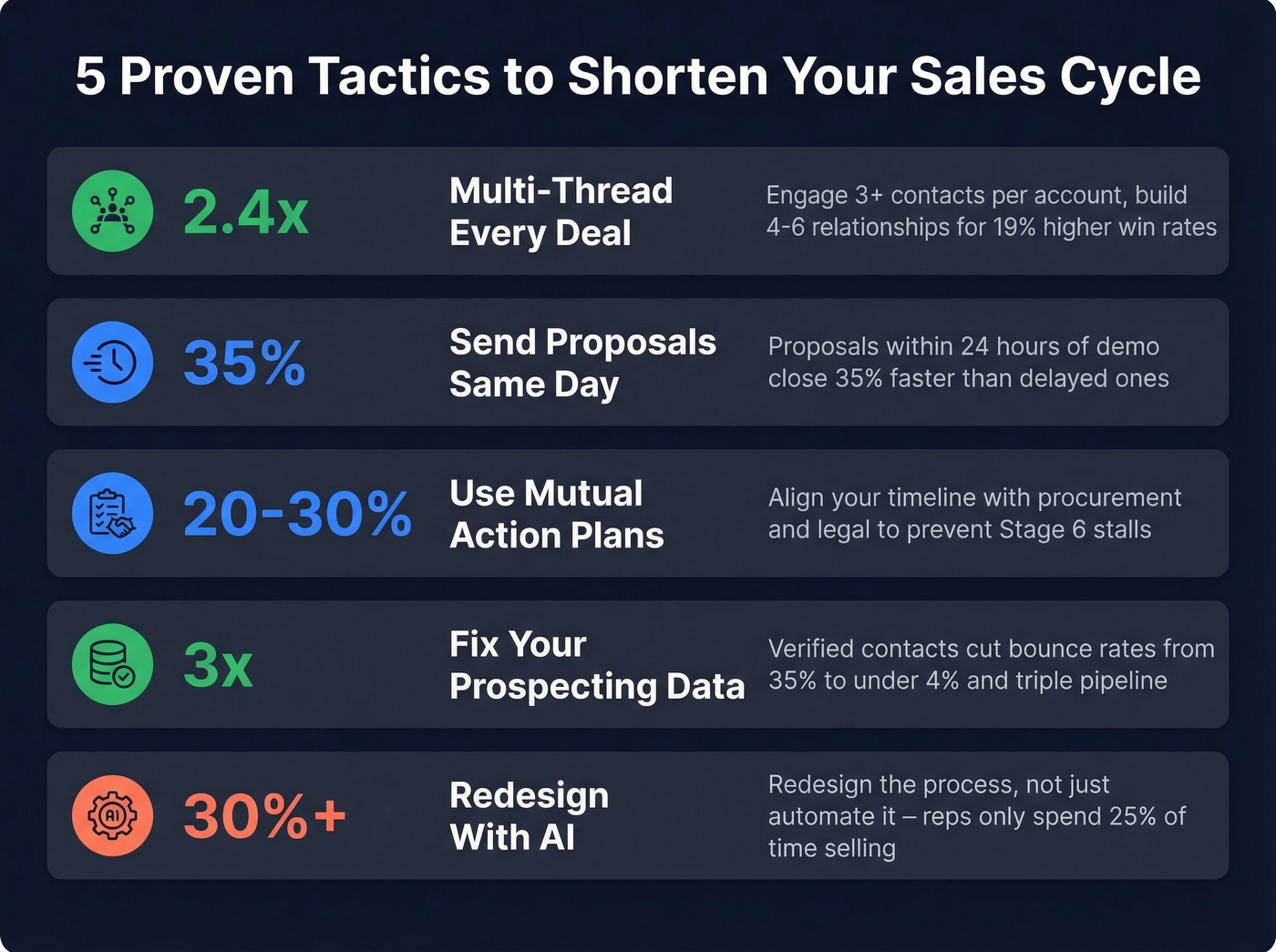
Five tactics with quantified impact - not theory. Knowing the 7 stages of the sales cycle is table stakes; compressing the time between them is where revenue teams win.
Multi-Thread Every Deal
Deals with 3+ contacts engaged close 2.4x faster. Building 4-6 relationships drives a 19% increase in win rates. This isn't optional - it's the single highest-leverage tactic on this list. In our experience, the teams that skip multi-threading are the same ones wondering why "sure thing" deals go dark after the demo.
Send Proposals the Same Day
Proposals sent within 24 hours of the demo close 35% faster. Every day of delay lets momentum die and competitors creep in. We've started treating this as a hard rule on our team, and the difference is noticeable within a single quarter.
Use Mutual Action Plans
MAPs reduce cycle time by 20-30%. They align your timeline with the buyer's internal process - especially procurement and legal - so nothing stalls in Stage 6. The consensus on r/sales backs this up: deals don't die at the demo, they die in procurement. A shared timeline with clear owners and deadlines keeps both sides accountable.
Fix Your Prospecting Data
Meritt tripled pipeline from $100K to $300K/week and cut their bounce rate from 35% to under 4% by switching to verified contact data. Bad emails don't just hurt deliverability - they add weeks to your cycle before you even reach Stage 2. Skip this step if your bounce rate is already under 5% and your connect rates are healthy; otherwise, it's the first thing to fix. If you’re troubleshooting deliverability, start with your email bounce rate and work backward to list quality.
Redesign With AI, Don't Just Automate
Sellers spend roughly 25% of their time actually selling. AI-driven process redesign can deliver 30%+ improvement in win rates - but only when you're redesigning the process, not just automating existing inefficiencies. Automating a broken qualification stage just produces bad leads faster. If you’re rebuilding the system end-to-end, use a structured sales process optimization approach so automation doesn’t amplify the wrong steps.
With buying committees averaging 6.8 people, you need every decision-maker's direct contact - not a generic info@ address. Prospeo's 300M+ profile database with 30+ filters lets you map the full committee before your first demo, not during objection handling.
Map every stakeholder at $0.01 per verified email.
FAQ
What are the 7 stages of the sales cycle?
The seven stages are prospecting, initial contact, qualification, pitch/demo, handling objections, closing, and follow-up/referrals. The biggest conversion leaks happen at qualification (60-85% of MQLs drop off) and closing (negotiation consumes 35-40% of enterprise cycle time).
What's the average B2B sales cycle length?
The median B2B SaaS sales cycle is 84 days, based on CRM analysis of 939 companies. It ranges from 25 days for sub-$1K ACV deals to 270+ days for contracts over $500K. Software averages 90 days; healthcare and manufacturing run 125-130 days.
How is the sales cycle different from the sales process?
The cycle is the timeline a deal moves through from first contact to closed-won. The process is the methodology your team follows to move it. Cycle equals "what happens," process equals "how you make it happen." Conflating the two makes it harder to diagnose where deals stall.
How do you calculate sales cycle length?
Sum the days from first contact to closed-won for all deals in a period, then divide by the number of deals. Use CRM timestamps - manual tracking introduces too much error. Segment by deal size and source for actionable insights.
What's the fastest way to shorten a long sales cycle?
Multi-thread every deal. Engaging 3+ contacts closes deals 2.4x faster and boosts win rates by 19%. Pair that with verified prospecting data to cut bounce rates below 4%, eliminating weeks of wasted outreach at Stage 1.