

=== CURRENT ARTICLE (slug: abm-1-few) ===
1:Few ABM: How to Build a Program That Generates Pipeline
A marketing team of one closed £750K+ by promoting 12 accounts from 1:many into a 1:few ABM cluster. That's the gap most teams never cross - and it's not because they lack budget or talent. It's because they skip the boring middle tier entirely.
The Quick Version
1:few ABM targets 15-30 accounts grouped by shared traits - same vertical, similar tech stack, comparable deal size - with moderate personalization across the buying committee. It's the sweet spot for $50K-$250K ACV deals.
You need a segmentation framework, 13-20 touchpoints per contact per year, and clean contact data across every buying committee member. Budget $200K-$600K annually. Expect meaningful pipeline in 6-12 months, not 90 days.
What Is 1:Few ABM?
You'll also hear it called ABM Lite or Cluster ABM. Instead of hyper-personalizing everything for a single whale account or blasting a thousand logos with the same campaign, you group accounts that share enough characteristics to justify semi-personalized plays.
Top B2B marketers achieve 81% higher ROI with account-based marketing compared to traditional demand gen, based on a Demandbase survey of 300+ global marketers. For most mid-market teams, a 1:few program is the right starting point - not 1:1, which burns budget fast, and not 1:many, which often amounts to glorified email blasts.
1:1 vs 1:Few vs 1:Many
| Dimension | 1:1 | 1:Few | 1:Many |
|---|---|---|---|
| Accounts | 5-10 | 15-30 | 100-1,000+ |
| Annual budget | $30K-$100K/acct | $200K-$600K total | $100K-$300K total |
| Ideal ACV | $500K+ | $50K-$250K | <$50K |
| Personalization | Fully bespoke | Semi-personalized | Templated |
| Team size | 7-10 dedicated | 3-5 people | 2-3 people |
| Start here if... | You have 5 whale accounts worth $500K+ each | You have mid-market deals and a small team | You need to qualify 100+ accounts fast |
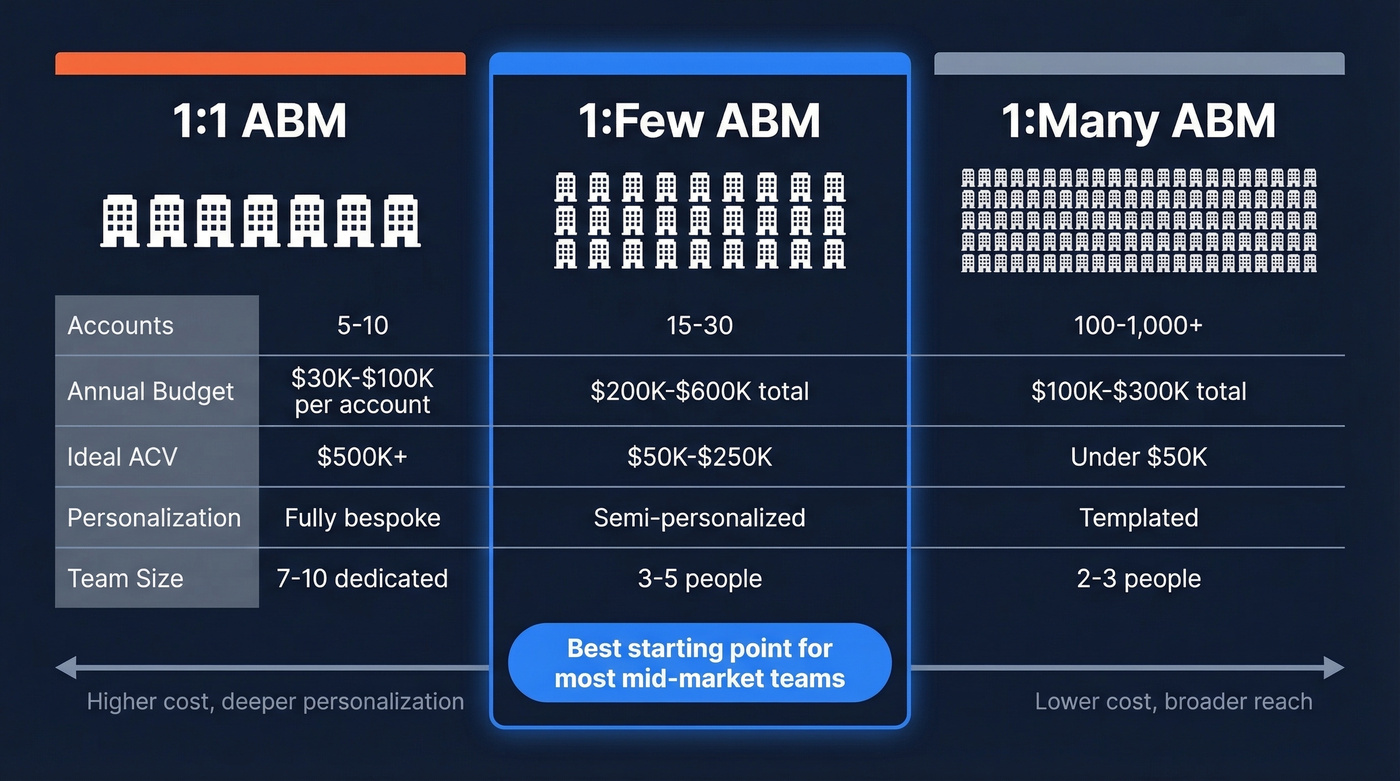
Most mature programs run all three tiers simultaneously. The typical path: 1:many for qualification, 1:few for pipeline development, 1:1 for your top strategic accounts. You graduate accounts upward as they engage.
How to Build Account Clusters
Here's where most programs fail before they start. There's a reason ABM gets dismissed as "demand gen with a wish list." Sales hands marketing 80 logos they'd love to close, and suddenly you're running 1:many with extra steps. We use a 4-layer segmentation framework:
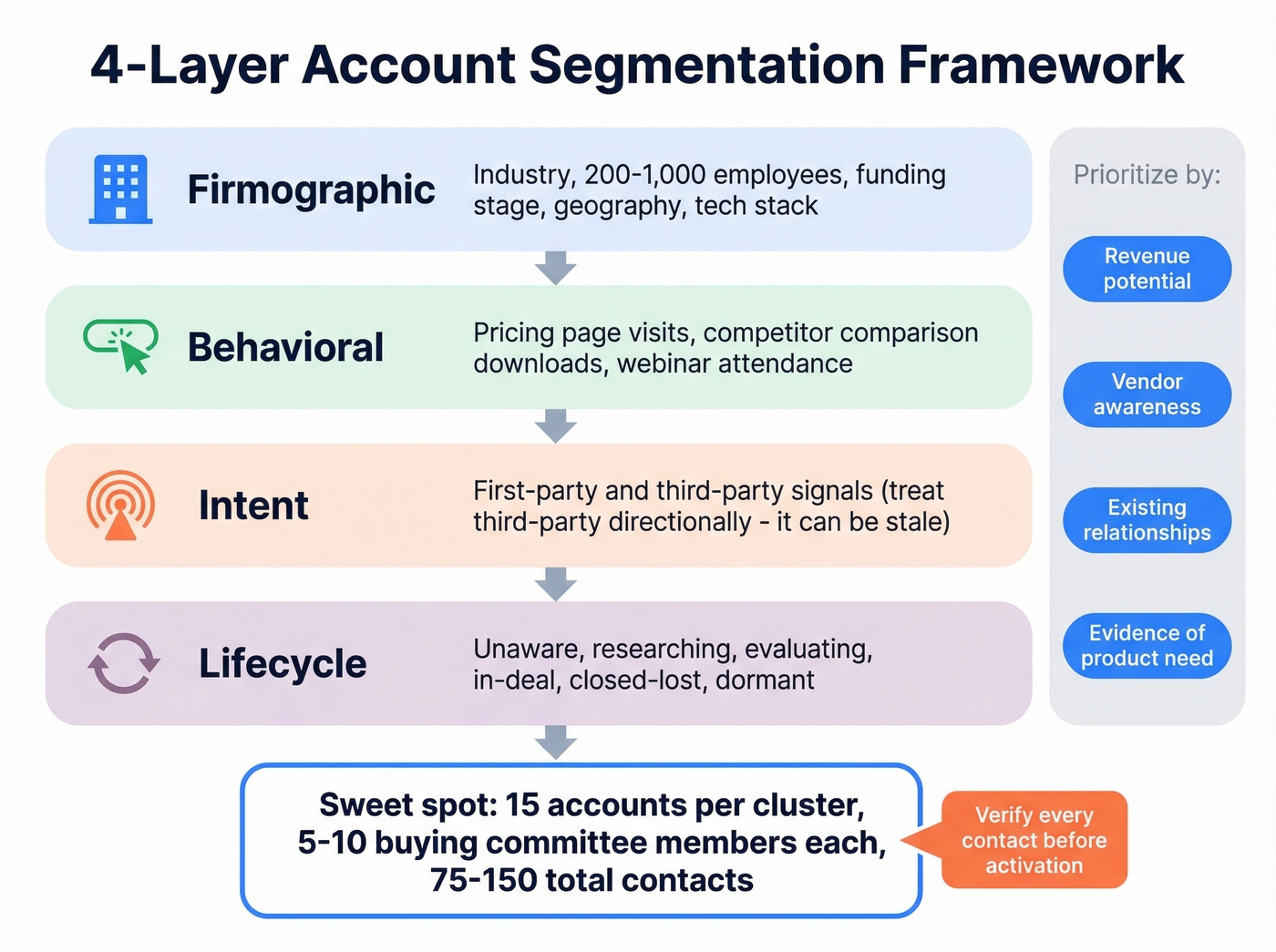
- Firmographic: Industry, employee count between 200 and 1,000, funding stage, geography, tech stack
- Behavioral: Pricing page visits, competitor comparison downloads, webinar attendance
- Intent: First- and third-party signals (treat third-party directionally - it can be stale)
- Lifecycle: Unaware, researching, evaluating, in-deal, closed-lost, dormant
Prioritize using four pillars: revenue potential, vendor awareness, existing relationships, and evidence of product need like hiring signals, annual report initiatives, or legacy tech gaps. Never add low-tier accounts just because a rep is excited about the logo.
The sweet spot is 15 accounts per cluster. Fewer than 10 and you're doing 1:1 without the budget. More than 30 and personalization becomes fiction. Each account has 5-10 buying committee members, so a single cluster generates 75-150 contacts who need verified data. Verify every contact before activation with a tool like Prospeo, or you're building a program on bounced emails and wasted ad spend.

A 1:few ABM cluster of 15 accounts means 75-150 buying committee contacts who all need verified data. One bounced email is a wasted touchpoint - and a hit to your domain reputation. Prospeo delivers 98% email accuracy across 300M+ profiles, refreshed every 7 days, so your 13-20 touchpoints per contact actually land.
Stop building ABM programs on data that bounces.
Running a 1:Few Program
Start with a 6-8 week strategy phase. Define success metrics, build the account selection matrix, map buying committees, and create your content plan before a single email goes out. Skip this and you'll spend months course-correcting.
For content, apply the 80/20 rule: 80% templated assets that speak to the cluster's shared pain points, 20% personalized per account. In our experience, this ratio is the difference between a program that ships and one that dies in the planning phase. Create one hero asset - a benchmark study, a custom ROI model, an industry-specific playbook - then atomize it into emails, ad creatives, one-pagers, and event talking points.
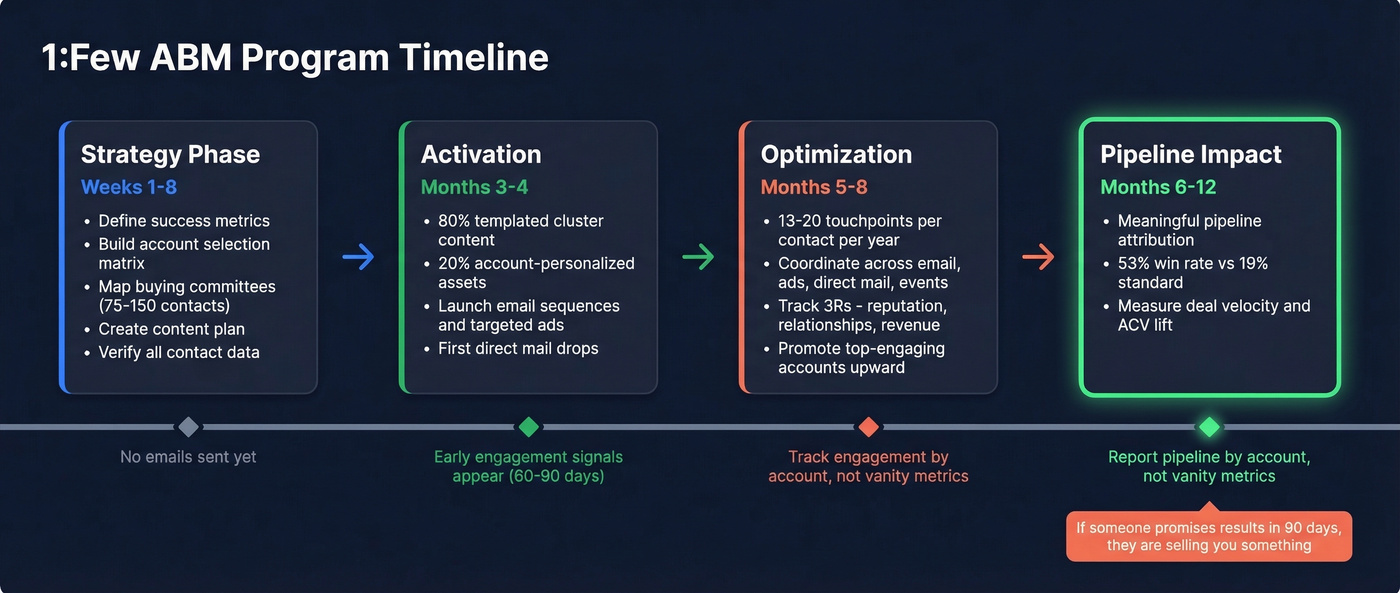
Your activation target is 13-20 touchpoints per contact per year across email sequences, targeted ads, direct mail, events, and web personalization. Direct mail deserves special attention. Campaigns that include it are 27% more likely to deliver top-ranking sales performance, and in a world where every inbox is drowning, a well-timed physical package cuts through noise that digital channels can't. (If you want a deeper playbook, see our guide to direct mail for lead generation.)
Let's be honest: if someone tells you a 1:few program will show pipeline results in 90 days, they're selling you something. Plan for 6-12 months.
What to Measure
Lead with early signals. Account engagement rate, intent spikes on target topics, content downloads from buying committee members, new relationships within target accounts - these tell you whether your targeting is sound before pipeline numbers materialize. To keep reporting consistent, align these with your broader funnel metrics and lead generation metrics.
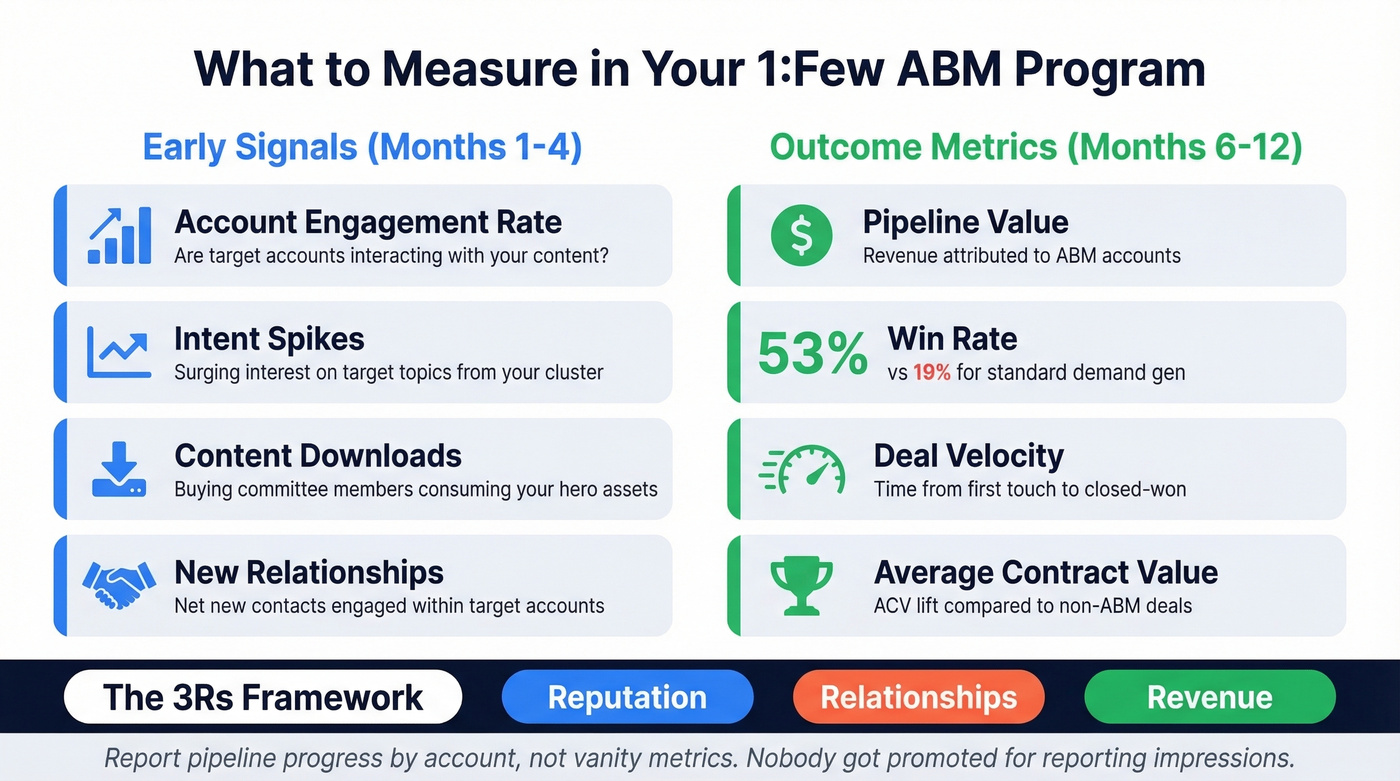
Then track the outcomes leadership actually cares about: pipeline value attributed to ABM accounts, win rate (accounts receiving an account-based approach close at 53% vs 19% for standard demand gen), deal velocity, and average contract value. That win rate gap alone justifies the investment for most teams. If you need a baseline, compare against sales pipeline benchmarks and monitor pipeline health.
Report using the 3Rs: reputation, relationships, revenue. Show leadership pipeline progress by account, not vanity metrics. Nobody got promoted for reporting impressions.
Tools You Actually Need
You don't need a $100K tech stack. We've seen teams waste months evaluating enterprise ABM platforms when all they needed was a CRM, verified contacts, and an intent layer. (If you're rebuilding your data layer, start with data enrichment services and a clear lead enrichment workflow.)
If your average deal is under six figures, skip the $60K orchestration platform. Spend that budget on better data and direct mail instead.
Orchestration
Demandbase and 6sense are the enterprise standards at $30K-$100K+/year. Powerful, but overkill for teams just starting cluster ABM. For teams under 500 employees running their first 1:few program, a well-configured HubSpot or Salesforce instance with good data hygiene gets you 80% of the way there. If you're pressure-testing options, here are a few examples of a CRM to compare.
Data and Contact Verification
This is where your program lives or dies. If 20% of your buying committee emails bounce, 20% of your touchpoints evaporate - and your domain reputation takes the hit. Prospeo delivers 98% email accuracy on a 7-day data refresh cycle, with 300M+ professional profiles and 125M+ verified mobile numbers. That buying committee depth is exactly what 1:few programs demand. Free tier available, paid plans from ~$39/mo. For deliverability hygiene, track your email bounce rate and use email reputation tools.
Intent
Bombora as a standalone layer runs $25K-$50K+/year. Prospeo also offers intent data tracking 15,000 topics via Bombora, so you can layer buyer intent with contact data in one platform instead of stitching together multiple vendors.
Content and Direct Mail
PathFactory for content experience tracking runs ~$2K-$5K/month. Reachdesk for physical touchpoints costs ~$1K-$3K/month plus gifting. Both are worth it for 1:few programs where every touchpoint needs to land.
CRM
Salesforce or HubSpot. You already have one. HubSpot Marketing Hub starts from $800/month.
Real Example: BlueBotics
BlueBotics ran ABM with a marketing team of one - literally one person. They started with a 1:many awareness layer across 400 global accounts, then promoted 12 best-fit accounts into a 1:few cluster based on engagement signals. The results: 100% account engagement across all 12 targets, ~160 new relationships, 15 sales conversations, £4M+ in opportunities, and £750K+ closed.
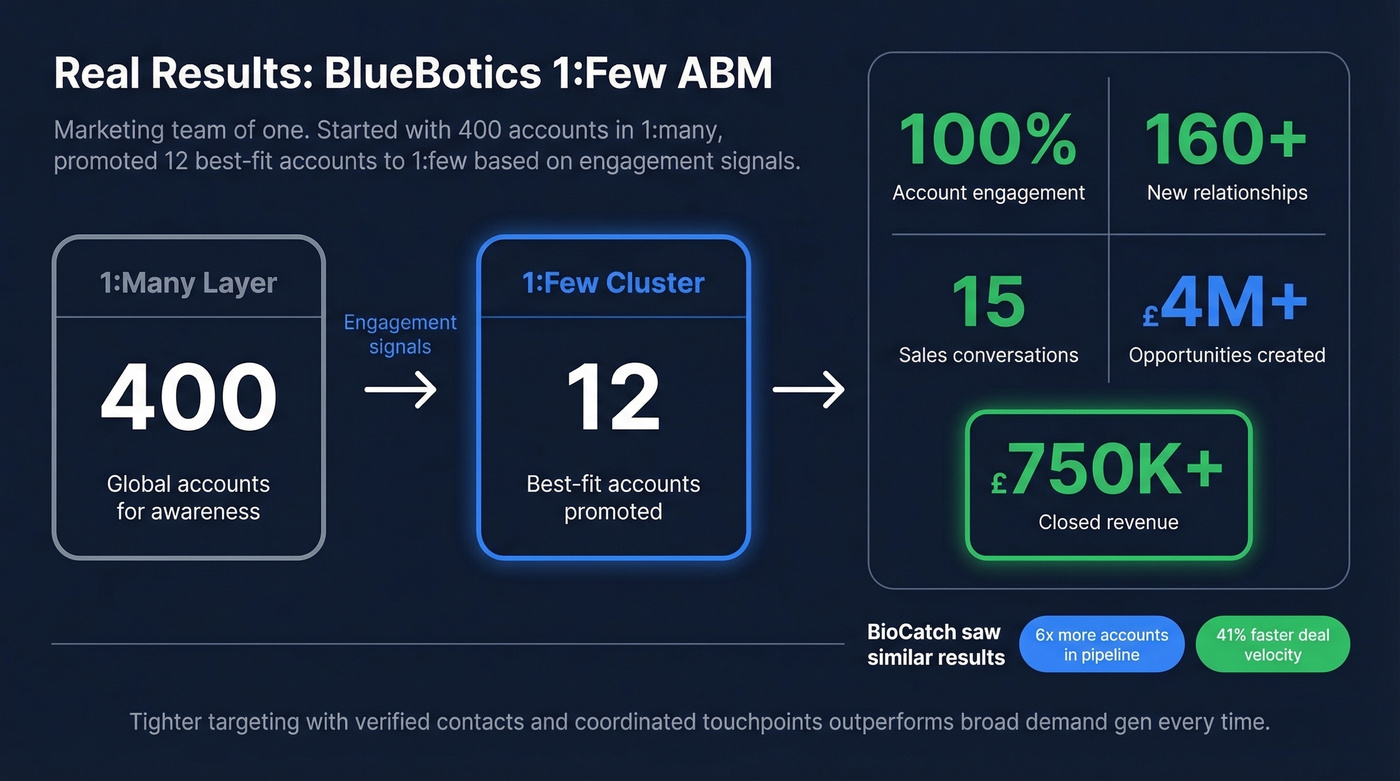
BioCatch ran a similar contact-level approach and saw 6x more accounts in pipeline with 41% faster deal velocity.
The pattern holds across both cases. Tighter targeting with verified contacts and coordinated touchpoints outperforms broad demand gen every time. The consensus on r/sales echoes this - the teams that win at ABM aren't the ones with the biggest budgets, they're the ones with the cleanest data and the most disciplined account selection. If you want to operationalize that discipline, use an Ideal Customer Profile scoring rubric and an intent based segmentation model.
Mapping buying committees across 15-30 accounts requires deep contact coverage - emails, direct dials, and job-level data. Prospeo gives you 143M+ verified emails and 125M+ mobile numbers with 30+ filters for role, seniority, tech stack, and intent signals. Layer Bombora intent data on top without a separate $25K contract.
Get the contact depth your 1:few program demands at $0.01 per email.
FAQ
How many accounts belong in a 1:few cluster?
Target 15-30 accounts, with 15 as the sweet spot. Fewer than 10 is effectively 1:1 without the budget. More than 30 makes personalization impossible and you're running 1:many with extra steps.
How long before results appear?
Budget 6-8 weeks for strategy alone. Meaningful pipeline impact takes 6-12 months. Early engagement signals - ad clicks, content downloads from buying committees - should appear within 60-90 days if your targeting is sound.
What's the top reason these programs fail?
Bad contact data. It's not strategy, it's not content, it's not budget. When a fifth of your buying committee emails bounce, a fifth of your carefully planned touchpoints vanish and your sender reputation degrades. Verify every record before activation, use CRM enrichment to fill gaps across your target accounts, and refresh your data at least monthly. Our team has watched programs with solid strategy collapse because nobody bothered to validate the contact list.