

How to Select ABM Accounts That Actually Convert
Your VP of Sales just emailed a spreadsheet with 200 "priority" accounts. No scoring criteria, no intent signals, no ICP validation - just names pulled from memory. You're supposed to build an ABM program around this.
Here's the problem with bad ABM account selection: a 771-marketer survey pegs average ABM ROI at 137%, but that number assumes you're picking the right accounts. 60% of marketers struggle with account selection, and most teams never fix it. They just keep running campaigns against a list nobody validated.
Five Mistakes That Kill Target Account Selection
1. Sales wish lists with no data behind them. We've seen teams waste entire quarters building campaigns against accounts that were never going to buy. Require ICP validation - firmographics, technographics, and buying signals - for every account on the list.
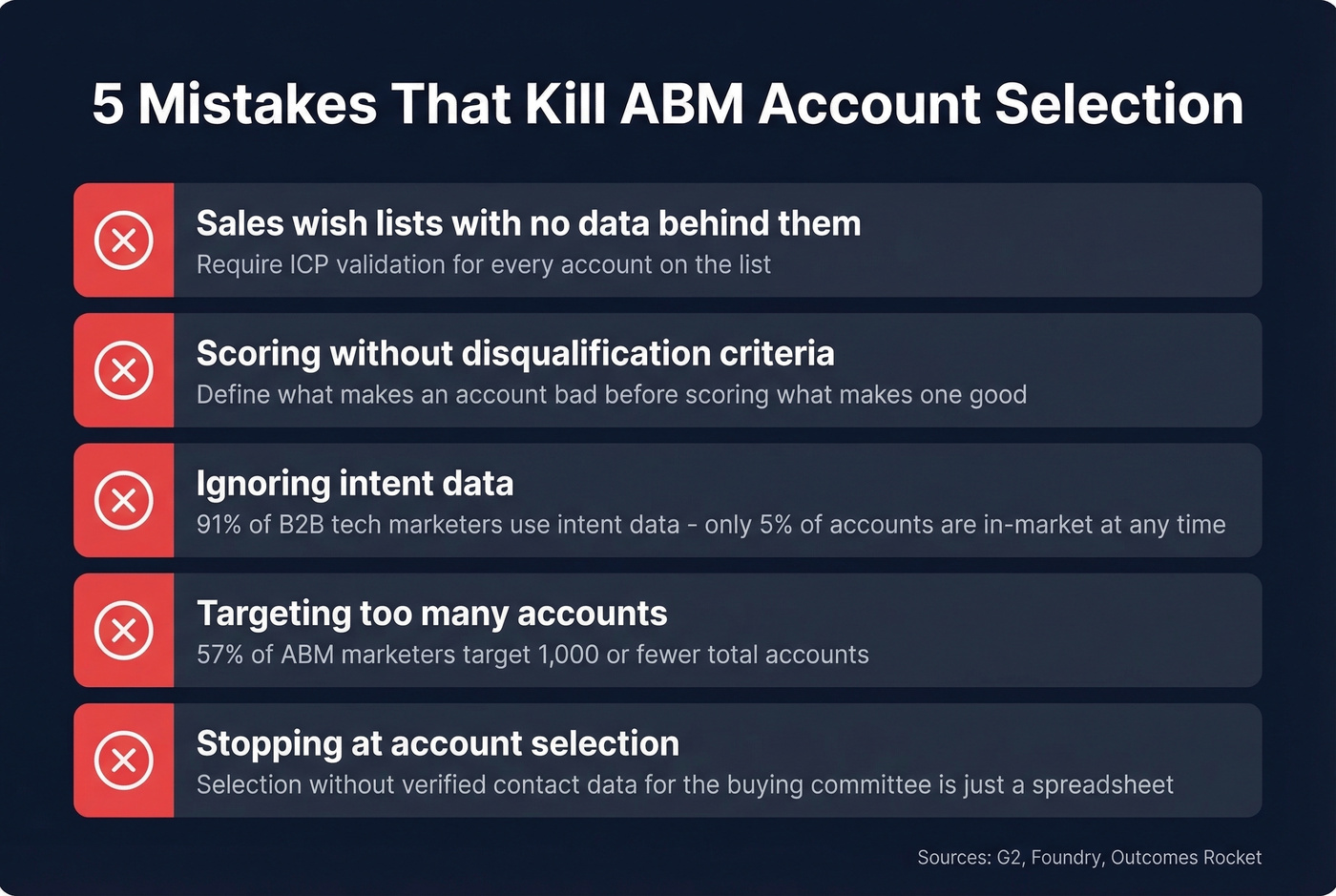
2. Scoring without disqualification criteria. Teams obsess over what makes an account good and forget to define what makes one bad. Drain the swamp first.
3. Ignoring intent data. 91% of B2B tech marketers use intent data to prioritize accounts. Without it, you're guessing which targets are in-market, and only about 5% are at any given time.
4. Targeting too many accounts. 57% of ABM marketers target 1,000 or fewer total. If your "ABM list" has 5,000 accounts, you're running demand gen with a fancy label. How many accounts you can serve is a resource question, not an ambition question.
5. Stopping at account selection. Selection without verified contact data for the buying committee is a spreadsheet exercise. Neither Bombora nor 6sense provides contact-level data - you still need a separate source for emails and phone numbers to actually reach the people who matter.

ABM account selection without contact data is a spreadsheet exercise. Prospeo enriches your target account list with 98% accurate emails, 125M+ verified mobiles, and intent data across 15,000 Bombora topics - so you know which accounts are in-market before you spend a dollar on personalized plays.
Stop selecting accounts you can't actually reach.
The 4-Step Scoring Framework
Some practitioners frame the process as a "betting exercise" - segmenting into cluster ICP, future pipeline, and active focus lists. Others take a use-case-driven approach. Both have merit. But in our experience, a weighted scoring model gives most teams the clearest path from "we have a list" to "we have pipeline."
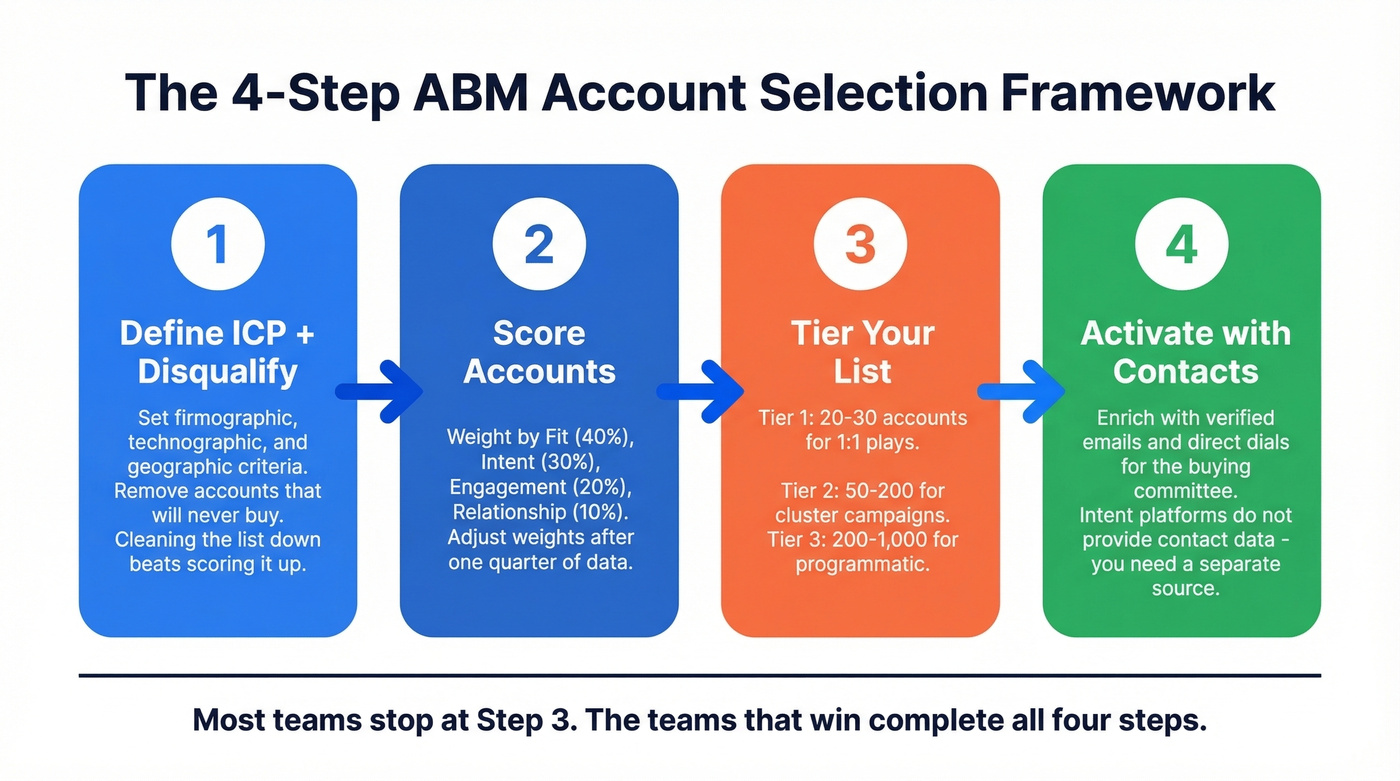
Let's walk through it.
Step 1: Define ICP + Disqualification Criteria
Start with what qualifies an account: industry, revenue range, employee count, tech stack, geography. Then define what disqualifies one. Locked into a competitor's 3-year contract? Remove them. Under 50 employees when your product needs 200+ seats? Gone.
Cleaning the list down is more valuable than scoring the list up.
Step 2: Score Accounts (40/30/20/10)
Use this weighting model as a starting point and adjust after one quarter of data:
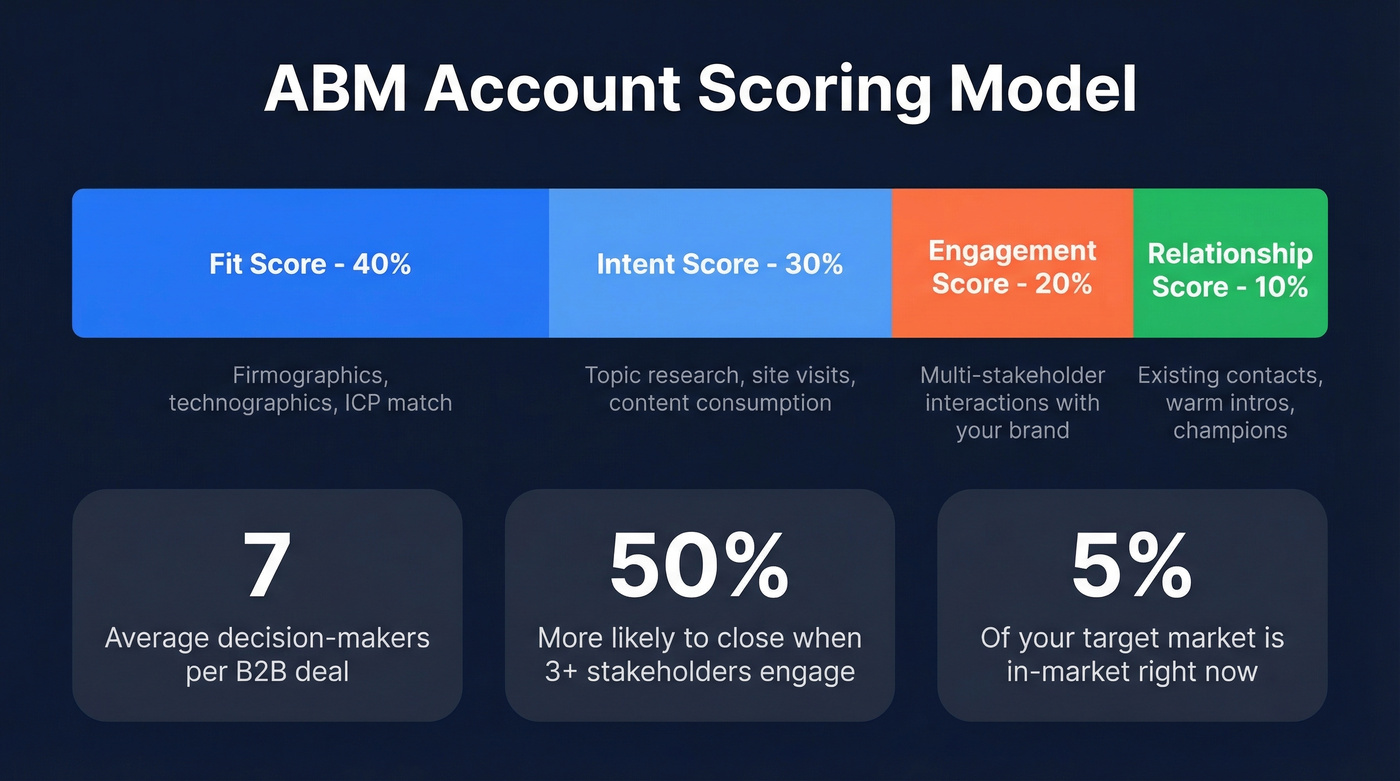
- Fit Score (40%) - Firmographics, technographics, ideal customer profile match. This is where you identify the best accounts based on hard data, not gut feel. (If you need a quick refresher on data types, see firmographics and technographics.)
- Intent Score (30%) - Topic research, site visits, content consumption. Are they actively looking? (More on intent-based segmentation.)
- Engagement Score (20%) - Multi-stakeholder interactions with your brand. When three stakeholders from the same company engage, you're 50% more likely to convert that opportunity to closed-won.
- Relationship Score (10%) - Existing contacts, warm intros, champion presence. Track former customers or users who've changed jobs into target accounts; these warm connections convert at significantly higher rates.
B2B deals involve an average of 7 decision-makers. Individual lead scores aren't enough. (If your team is still thinking in lead-only terms, align this with a modern lead scoring model.)
Step 3: Tier Your List
- Tier 1 (1:1): 20-30 accounts. Fully personalized plays - custom content, dedicated BDR coverage, executive engagement.
- Tier 2 (1:Few): 50-200 accounts. Cluster campaigns grouped by industry or pain point.
- Tier 3 (1:Many): 200-1,000 accounts. Programmatic targeting with lighter personalization.
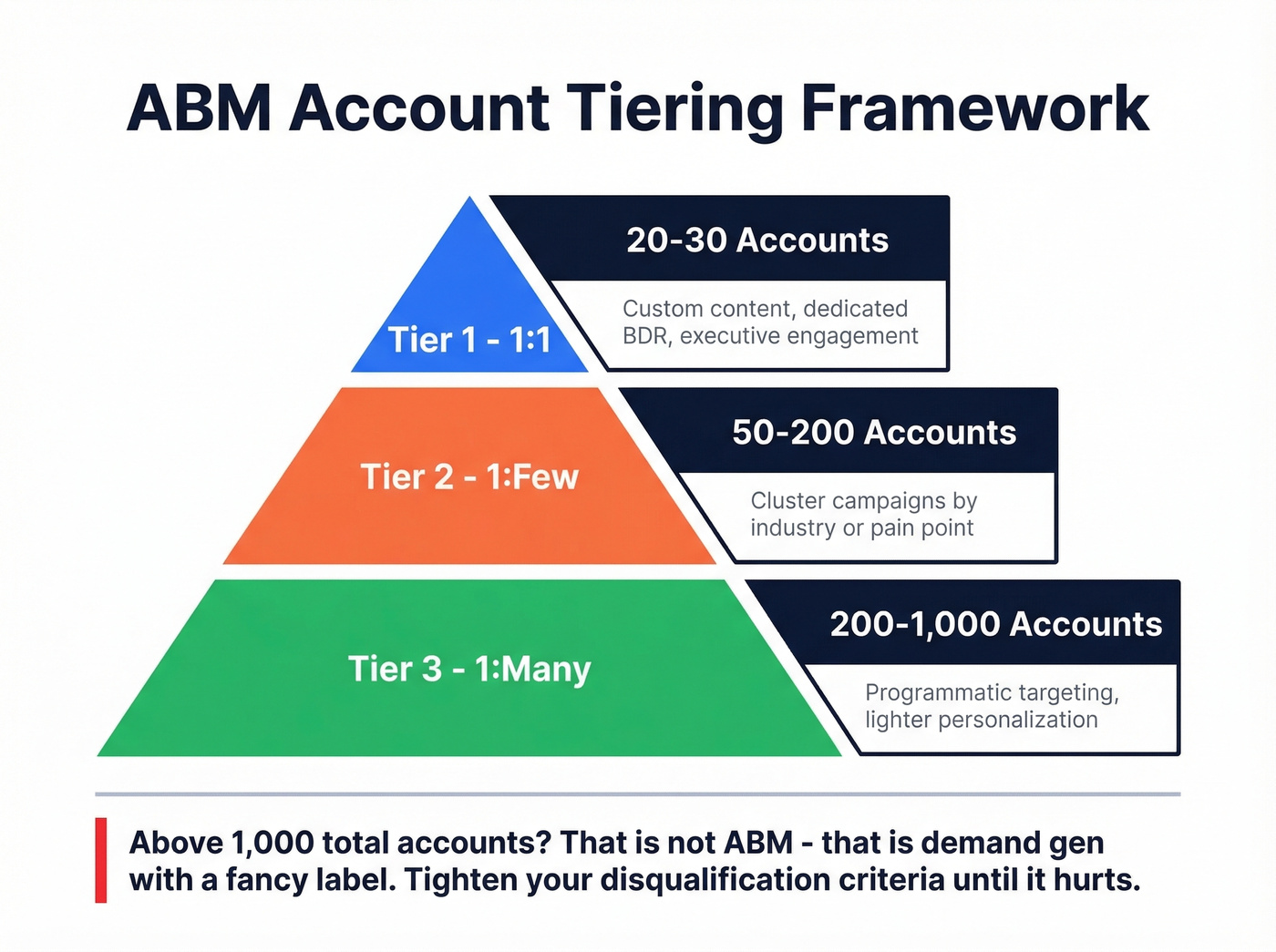
Here's the thing: if you're above 1,000 total accounts, you don't have an ABM program. You have a target account list pretending to be one. Tighten your disqualification criteria until it hurts.
Step 4: Activate with Contact Data
Every ABM guide stops at tiering. But you can't run account-based plays without verified emails and direct dials for the buying committee. Upload your target account list via CSV or push it through a Salesforce or HubSpot integration with Prospeo, and you'll get verified contact data back in minutes - 98% email accuracy, 125M+ verified mobiles, with intent data across 15,000 Bombora topics to confirm your Tier 1 accounts are actually in-market before you spend $5,000 on a personalized microsite. (If you're comparing vendors, start with a shortlist of data enrichment services.)
What Intent Data Actually Costs
| Vendor | Annual Cost | What You Get |
|---|---|---|
| Bombora | $25K-$80K | Topic-level intent data |
| 6sense | $35K-$150K+ | ABM platform + predictive |
| Demandbase | $40K-$120K | ABM platform + intent + ads |
| ZoomInfo Intent | $7K-$36K | Streaming intent add-on |
| G2 Buyer Intent | $10K-$87K+ | Category-level buyer signals |
| ZenABM | $59-$399/mo | Budget-friendly intent + ABM |
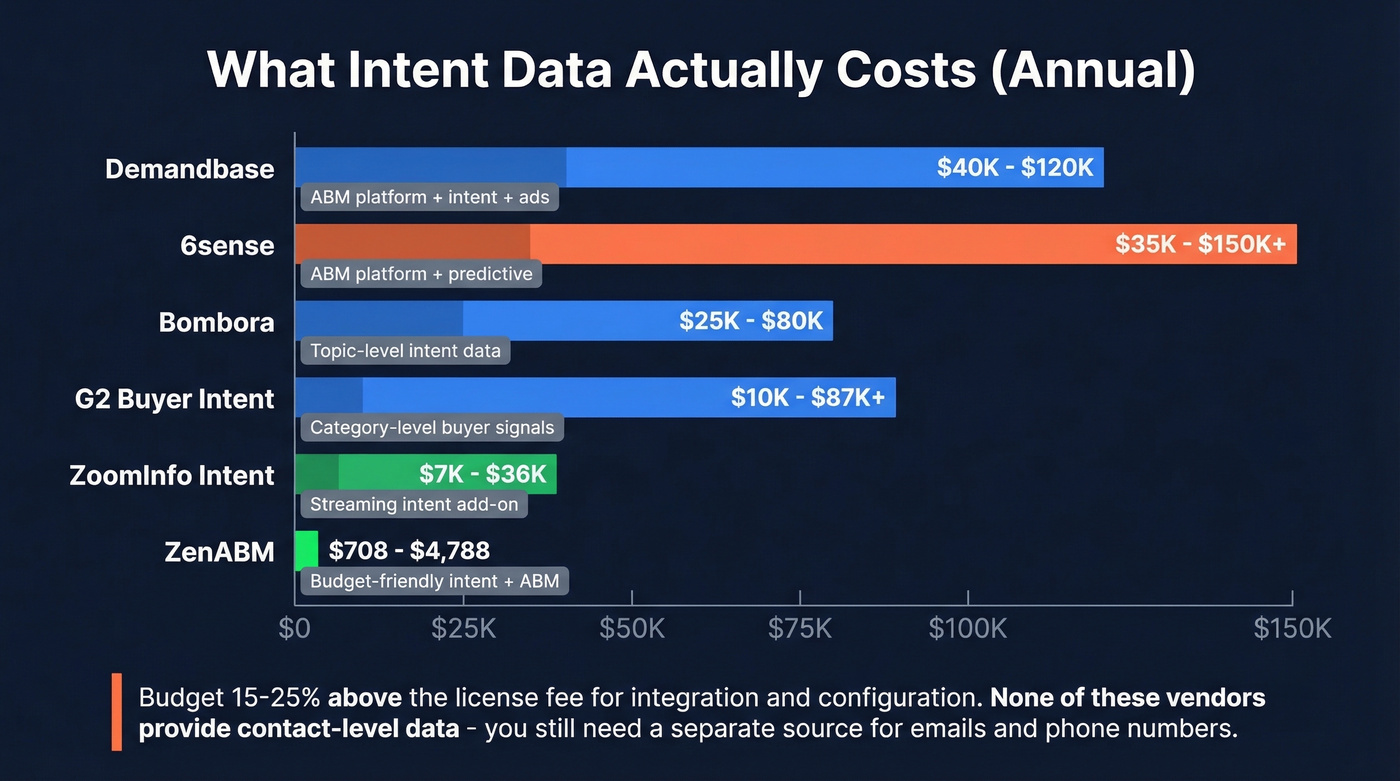
Budget 15-25% above the license fee for integration and configuration. If you're a 10-person sales team, you don't need a $60K intent platform. Start with first-party signals - site visits, content engagement, event attendance. First-party intent is free, and it's often more actionable than third-party signals for early-stage programs.
None of these vendors provide contact-level data. You'll still need a separate source for the emails and phone numbers that let you reach the buying committee. (If you're building lists from scratch, use a repeatable lead generation workflow.)
What a Real ABM Rebuild Looks Like
A practitioner on r/b2bmarketing shared a rebuild case worth studying. Their pilot failed because sales flagged random "priority" accounts with no data behind the selections - the exact mistake we covered above.
The rebuild unified the target account list using Salesforce + 6sense + HG Insights + historical sales notes. They activated with Mutiny microsites aligned to each account's funnel stage, BDR emails linking to the pages, and Marketo automation for follow-up. In 90 days: 100% reach of target accounts, 56% engagement signals, 63% meeting-to-opportunity conversion, and 17% of new opportunity goals closed.
The biggest unlock? Treating ABM account selection as a system - not a campaign - and uniting sales and marketing around a shared, data-validated list. We've seen this pattern repeat across our own customer base: the teams that win aren't the ones with the fanciest tech stack, they're the ones where sales and marketing actually agree on which accounts matter and why. (This is also where marketing enablement and data-driven selling make the process stick.)
Intent platforms like 6sense and Demandbase don't give you contact data. Prospeo does - 300M+ profiles, 30+ filters for ICP scoring, and a 7-day data refresh so your Tier 1 buying committees never go stale. Upload your ABM list via CSV or CRM and get verified contacts back in minutes.
Turn your tiered account list into booked meetings at $0.01 per email.
FAQ
How many accounts should I target for ABM?
Most successful programs target fewer than 1,000 accounts total. For 1:1 ABM, aim for 20-30 accounts with fully personalized plays. The industry benchmark is 38 accounts pursued at a time - go much higher and you dilute resources across tiers.
How often should I refresh my target account list?
Quarterly at minimum. Intent signals shift constantly, and only about 5% of your target market is in-market at any given time. Reassess scores each quarter, swap out stale accounts, and promote newly active ones from Tier 3 to Tier 1.
What if I don't have budget for intent data?
Start with first-party signals: site visits, content downloads, event attendance. Pair those with a contact data platform that offers a free tier - Prospeo gives you 75 emails and 100 Chrome extension credits per month at no cost - so you can enrich your list with verified emails and direct dials without a big commitment. You can build a strong program for under $100/month and add third-party intent later when pipeline justifies the spend.