

How to Build an ABM List That Won't Decay in 90 Days
Most ABM lists fail before a single email is sent. Teams spend weeks researching accounts, mapping stakeholders, and building tiered personalization - then by launch day, half the contacts have changed roles. B2B contact data decays at roughly 30% per year. That means your entire Tier 1 account list turns over before you've finished Q3.
We've seen this pattern play out dozens of times: marketing builds a beautiful ABM list, sales flags "dream logos" with no data behind the picks, the pilot stalls, and leadership blames ABM as a strategy instead of the list as the problem. The fix isn't more accounts. It's better ones - scored properly, verified continuously, and pruned ruthlessly.
Every competitor guide tells you to expand your list. We're telling you the opposite: cut it in half and double your investment per account.
What You Actually Need
An account-based marketing list is only as good as its data quality and scoring discipline. You need three things: a clear ICP that filters accounts out (not just in), a scoring framework like FIRE to prioritize the 5% of your market that's actually in-market, and verified contact data that doesn't rot before your first send. Most programs target 150-500 accounts across three tiers. Below is the complete playbook with template, pricing, and the mistakes that kill ABM programs before they start.
How an ABM List Differs from a Lead List
An ABM list isn't a lead list with a fancier name. It's a curated set of target accounts - companies, not people - selected before any outreach happens. Each account has been chosen because it matches your ICP and shows signals that it's worth pursuing right now.
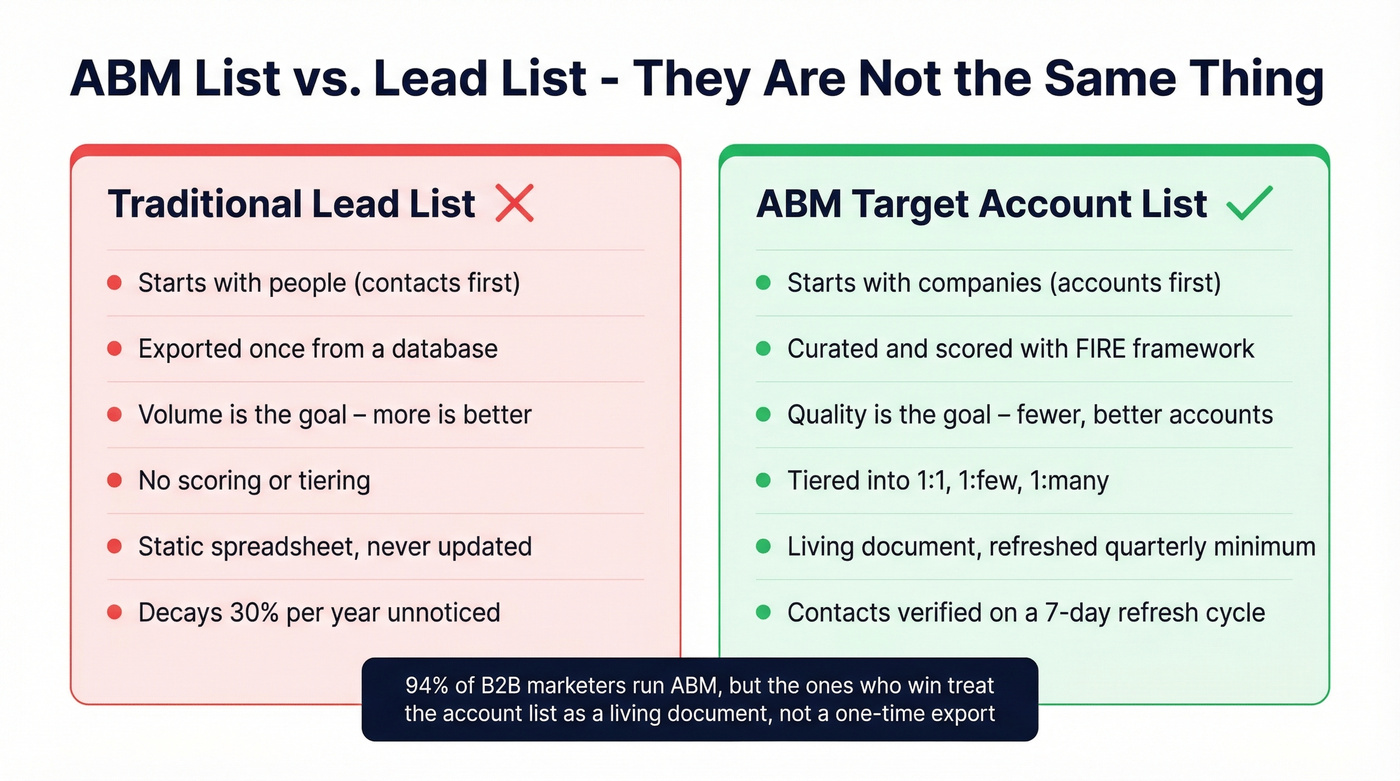
The contact list comes second. Once you've selected the accounts, you map the buying committee within each one: the champion, the economic buyer, the technical evaluator, the blocker. 94% of B2B marketers now run some form of ABM, but the ones who succeed treat the account list as a living document, not a static spreadsheet exported once and forgotten. Understanding this distinction - that an ABM target list centers on companies first, contacts second - is what separates programs that scale from programs that stall.
Ideal List Size
Smaller than you think.
The average ABM program targets 150-500 accounts. Most successful programs target fewer than 1,000 total, with Tier 1 as few as 20-30 accounts. Only about 5% of your target market is in-market at any given time, and without intent data telling you which 5% that is, you're carpet-bombing. The instinct to add more accounts is what turns ABM into spray-and-pray with a fancier name.
A 200-account prospecting list where every account is scored, tiered, and verified will outperform a 2,000-account list where half the contacts bounce. The average B2B deal involves roughly 7 decision-makers. Multiply that across even 200 accounts and you're managing 1,400 contacts - that's plenty of complexity without inflating the account list itself.
The ABM List Template
Most ABM templates floating around are too thin - company name, industry, revenue, done. That's a firmographic filter, not an account plan. Here's the full field schema you actually need:
| Field Category | Fields |
|---|---|
| Firmographics | Company name, industry, employee count, annual revenue, tech stack |
| Relationship | Status (new/existing/churned), source that flagged account |
| Buying Committee | Champion, economic buyer, technical evaluator, blocker, end user |
| Contact Details | Name, title, verified email, direct dial, channel preference |
| Engagement | Engagement status, last touchpoint, funnel stage |
| Competitive | Incumbent vendors, contract renewal dates, switching triggers |
Filled example row: Acme Corp, SaaS/MarTech, 450 employees, $62M revenue, runs HubSpot + Outreach. Source: Bombora intent surge on "sales engagement platforms." Champion: VP Sales Ops (Sarah Chen). Economic buyer: CRO. Incumbent: Salesloft, contract renews Q3. Switching trigger: headcount growth + new CRO hire.
The competitive fields are the ones most teams skip - and they're the ones sales actually uses. Knowing that a prospect's Salesloft contract renews in Q3 changes your entire outreach timeline.

Your ABM template is only as good as the contact data filling it. Prospeo's 300M+ profiles with 98% verified emails and 125M+ direct dials mean your buying committee maps stay accurate - with a 7-day refresh cycle that kills the 30% annual decay problem before it starts.
Stop losing Tier 1 accounts to bounced emails and dead numbers.
How to Build Your ABM Target List Step by Step
Define Your ICP
Your ICP should filter accounts out, not just in. If marketing and sales can't independently build similar lists from the same ICP definition, you don't have an ICP - you have a slide deck. Get specific: industry, revenue range, tech stack signals, headcount, geography. The tighter the filter, the better the list.
Consolidate Internal Data
Before you buy a single external data source, mine what you already have. Unify Salesforce or HubSpot data with historical sales notes, past win/loss analysis, and any existing intent signals.
A practitioner on r/b2bmarketing shared how they rebuilt a stalled ABM pilot by combining Salesforce + 6sense + HG Insights + sales notes into a single unified target list. The data was already there. It just wasn't connected.
Score with the FIRE Framework
FIRE stands for Fit, Intent, Recency, and Engagement. It's the clearest prioritization model we've found for account scoring, first outlined by Demand Gen Report.
Fit is your ICP match - firmographics, technographics, headcount. Intent is third-party signal data showing the account is researching your category. Recency timestamps when that intent fired; a surge from last week matters more than one from three months ago. Engagement is first-party: have they visited your site, opened emails, attended a webinar?
The tiering logic flows directly from FIRE:
- Tier 1: All four signals present. These get 1:1 treatment.
- Tier 2: Fit + Intent + Recency, but limited engagement. Warm them up.
- Tier 3: High fit only. They match your ICP but haven't shown buying signals yet.
Here's a concrete scoring example: Fit score of 80+ based on firmographic match, intent surge within the last 14 days, 3+ first-party engagement touches in the past 30 days. An account hitting all four thresholds is Tier 1. Miss engagement? Tier 2. Fit only? Tier 3. Intent data tells you which 5% is ready to buy - without it, you're guessing.
Tier Your Accounts
Once you've scored with FIRE, allocate your accounts into tiers with clear resource boundaries:
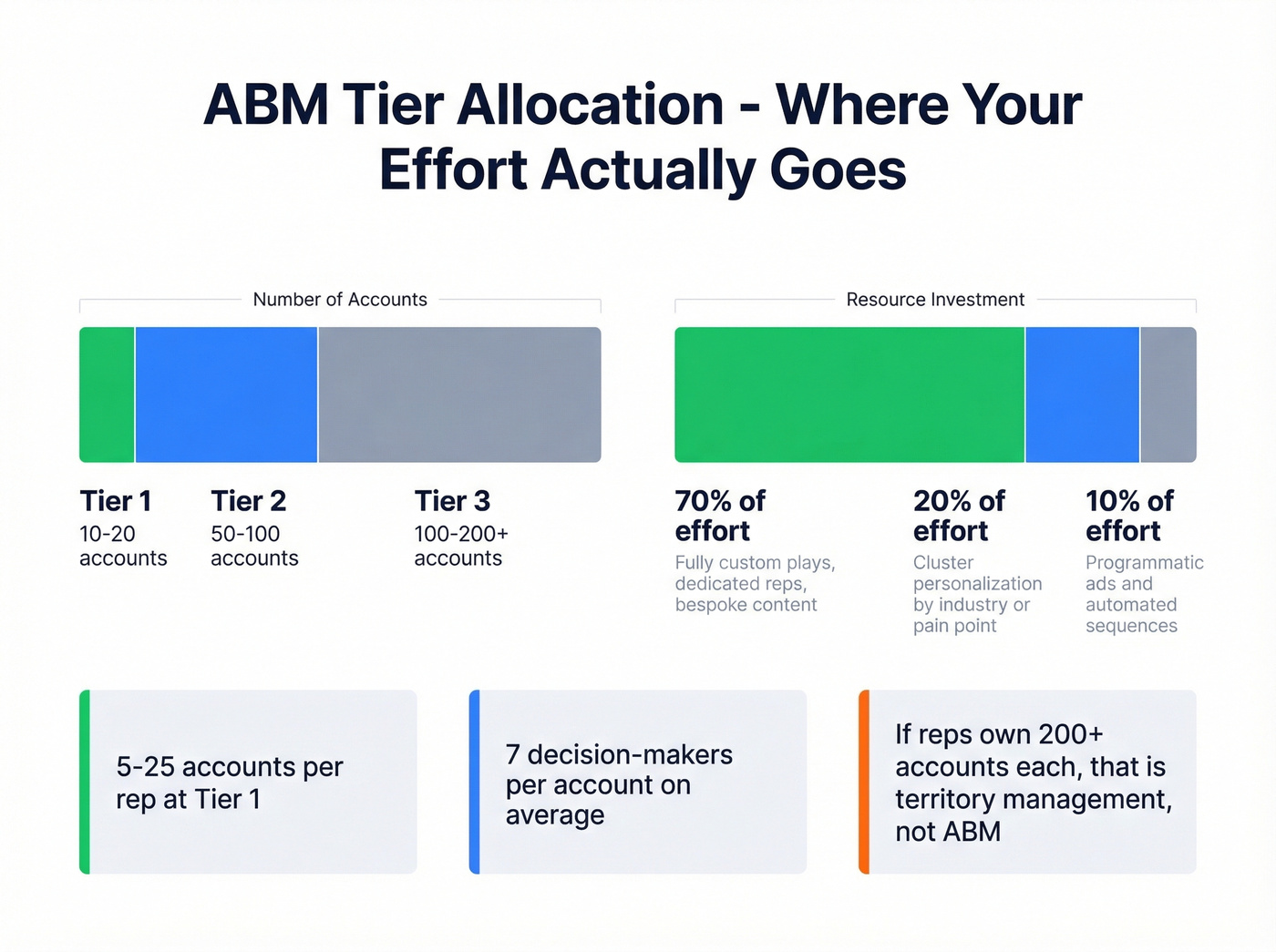
- Tier 1 (1:1): 10-20 accounts. Fully custom plays, dedicated reps, personalized content. This is where 70% of your ABM effort goes.
- Tier 2 (1:few): 50-100 accounts. Cluster-based personalization by industry or pain point. 20% of effort.
- Tier 3 (1:many): 100-200+ accounts. Programmatic ABM - targeted ads, automated sequences. 10% of effort.
High-maturity programs run 5-25 accounts per rep at the Tier 1 level. If your reps are "owning" 200 accounts each, that's not ABM - it's territory management with extra steps.
Enrich and Verify Contacts
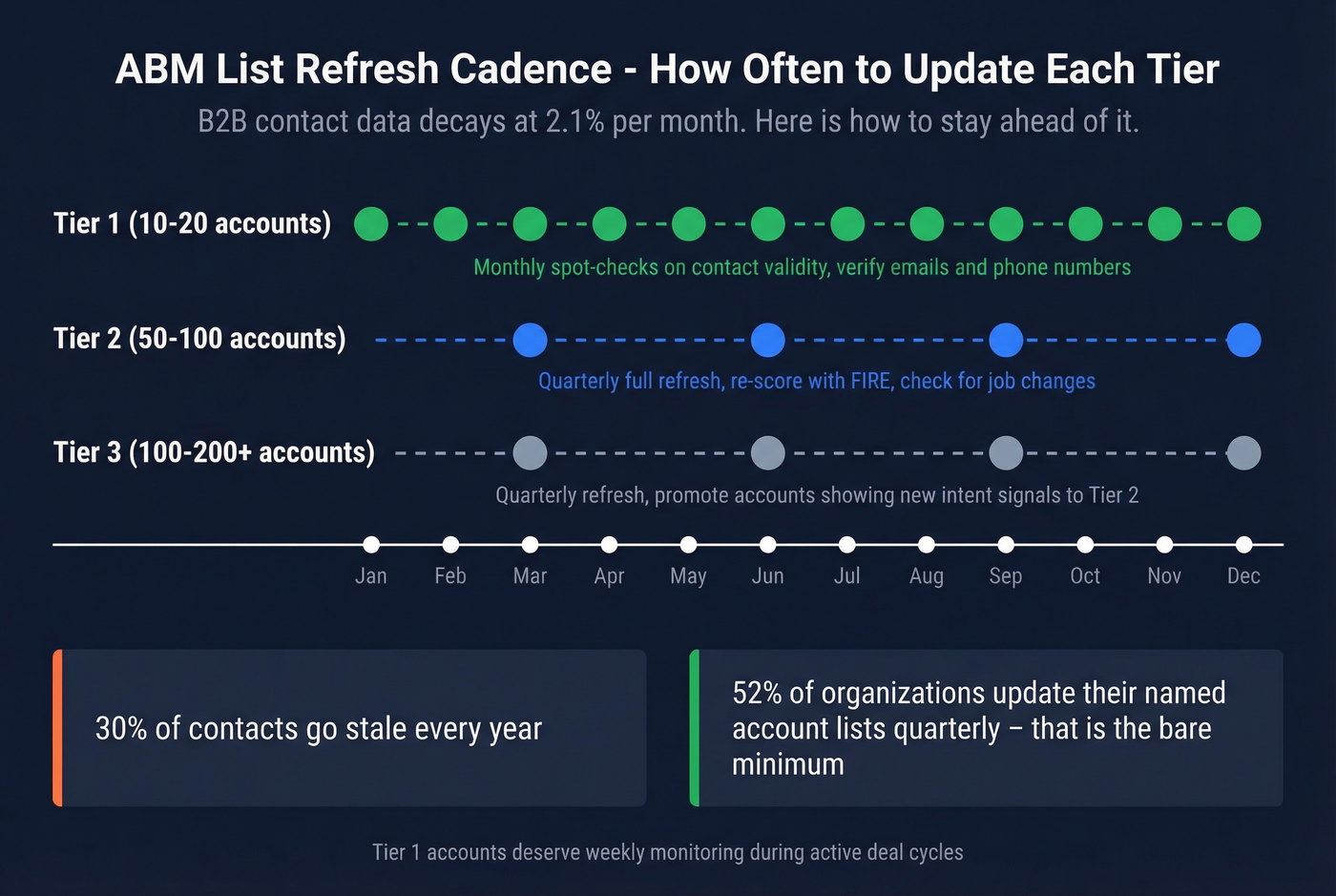
Now you map the buying committee. Target at least 5 stakeholders per account: champion, economic buyer, technical evaluator, blocker, and end user. B2B contact data decays at 2.1% per month - enrichment without verification just adds more unverified records to a decaying list.
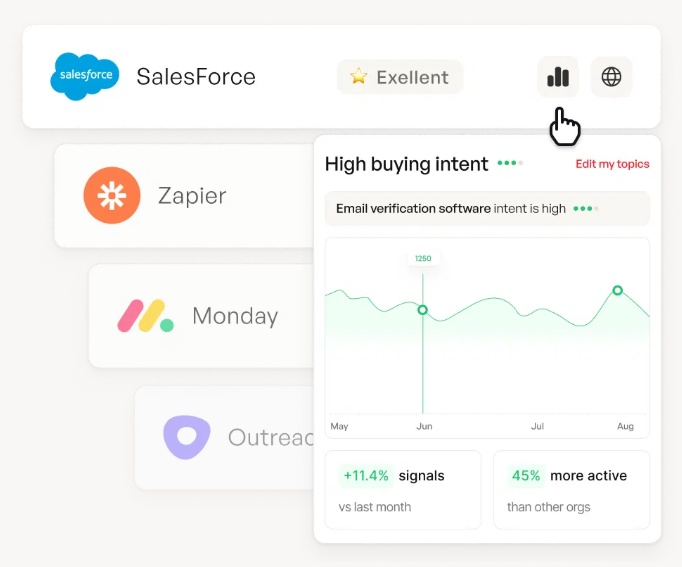
Prospeo handles both steps in one workflow. Search by 30+ filters including buyer intent, technographics, job changes, headcount growth, funding rounds, and revenue, then export verified contacts directly. The database covers 300M+ professional profiles with 143M+ verified emails at 98% accuracy and 125M+ verified mobile numbers, all on a 7-day refresh cycle. The free tier gives you 75 emails plus 100 Chrome extension credits per month - enough to enrich a pilot Tier 1 list before committing budget. If you’re comparing options, start with data enrichment services and then validate against your deliverability goals.

Set a Refresh Cadence
52% of organizations update their named account lists quarterly. That's the minimum. For Tier 1 accounts, run monthly spot-checks on contact validity. A quarterly full refresh across all tiers keeps decay from silently killing your program. If you want to scale this, you can automate target account lists so refreshes don’t depend on calendar reminders.
ABM Tool Stack - What It Actually Costs
Here's the pricing table nobody else publishes. Building an ABM list isn't cheap, but the cost varies wildly depending on whether you're buying a full platform or assembling a focused stack. If you’re building from scratch, it helps to benchmark against sales prospecting databases and best B2B company data providers before you commit.
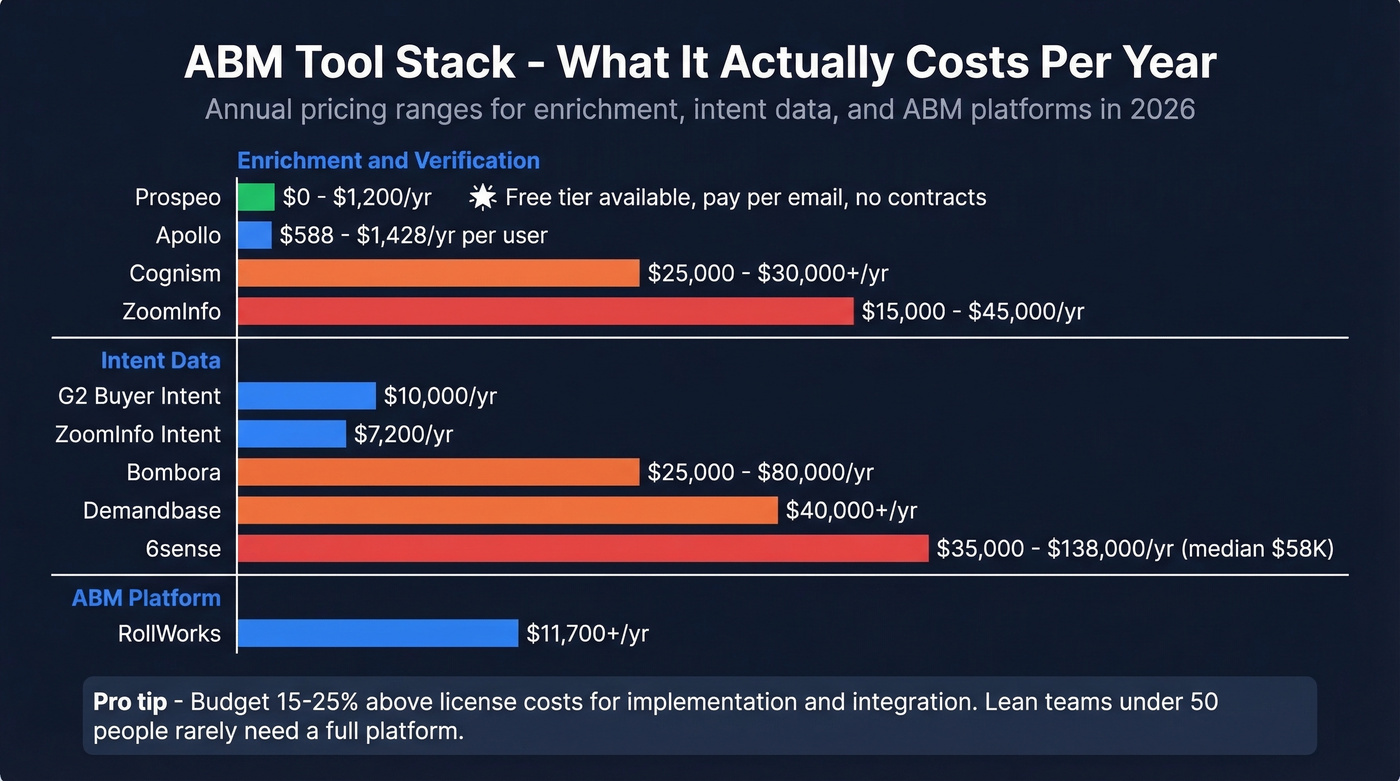
| Category | Tool | Price Range |
|---|---|---|
| Enrichment & Verification | Prospeo | Free tier available; ~$0.01/email, no contracts |
| Enrichment & Verification | ZoomInfo | $15K-$45K/yr |
| Enrichment & Verification | Apollo | $49-$119/user/mo |
| Enrichment & Verification | Cognism | ~$25K + $2,500/user |
| Intent Data | Bombora | $25K-$80K/yr |
| Intent Data | 6sense | ~$58K/yr median |
| Intent Data | Demandbase | ~$40K/yr starting |
| Intent Data | G2 Buyer Intent | ~$10K/yr (add-on) |
| Intent Data | ZoomInfo Intent | ~$7,200/yr |
| ABM Platform | RollWorks | From $975/mo |
6sense contracts start around $35K/year, but the median lands at $58K across 204 observed transactions, with a range spanning $10K-$138K depending on seat count and modules. Demandbase customers report outcomes like 3X conversions (Adobe) and 52% revenue lift (SAP Concur) - but those results come with $40K+ annual commitments and months of implementation.
Budget 15-25% above license costs for implementation, integration, and optimization. A useful heuristic: spend 1% of expected ACV for deals in the $50K-$150K range, 3% for deals between $150K-$300K, and 5% for deals above $300K.
Let's be honest about platform vs. stack. Enterprise ABM platforms cost $35K-$100K+/year. If you're a team under 50 people, you need accurate data and a scoring spreadsheet, not a platform. In our experience, the data feed approach - plugging Bombora intent into your existing CRM and pairing it with a verification tool - almost always wins over a monolithic platform for lean teams. A 6sense deployment takes 3-6 months to fully operationalize. Bombora, as a data feed, can be live in 2-6 weeks with CRM sync and weekly surge reporting.
Real-World Example
That r/b2bmarketing case study captures the full ABM list lifecycle. Their pilot stalled because sales had flagged random priority accounts with no real data behind the picks. Classic gut-feel targeting.
The rebuild started with unifying the target list from four sources: Salesforce closed-won/lost data, 6sense intent signals, HG Insights technographics, and historical sales notes. Once the list was data-backed and scored, they activated it through Mutiny personalized microsites - different CTAs, social proof, and resources by industry and funnel stage. BDRs emailed microsite links directly. Non-responders got routed through Marketo for automated follow-up sequences.
Results in 90 days: 100% of target accounts reached, 56% showed engagement signals, 63% meeting-to-opportunity conversion, and 17% of new opportunity goals closed. The biggest unlock wasn't a tool - it was treating ABM as a system, not a campaign.
Mistakes That Kill ABM Programs
Gut-feel account selection. Sales picks their "dream logos" with no data behind the choices. Require every nominated account to pass FIRE scoring before it hits the list. If you need a baseline, align on a shared ideal customer profile and document the disqualifiers.
Measuring MQLs instead of account engagement. ABM isn't lead gen. If you're counting individual leads instead of tracking account-level engagement progression, you're measuring the wrong thing. Track account penetration rate, engagement velocity, and pipeline per account. This is also where clean funnel metrics make ABM reporting defensible.
Generic content to "personalized" accounts. Slapping a company logo on a templated email isn't personalization. Build content mapped to each account's specific pain points, competitive landscape, and buying stage. For outbound, pair this with personalized outreach so reps aren’t improvising.
No governance. We've watched teams where nobody owns the list, there are no rules for adding or removing accounts, and the list grows 3x in a year while producing the same pipeline. Assign a single owner - usually RevOps - set quarterly review cadences, and define clear add/remove criteria. If you’re formalizing ownership, a RevOps Manager playbook helps.
Growing the list instead of pruning it. This is the big one. An account that's shown zero engagement after two quarters of Tier 2 treatment should be demoted or dropped entirely. Build a "sunset rule": if an account doesn't hit engagement thresholds within a defined window, it comes off the active list. Skip this step and you'll wonder why your ABM metrics look identical to your old demand gen numbers.
FIRE scoring needs intent data to work. Prospeo tracks 15,000 Bombora intent topics layered with technographics, job changes, and headcount growth - so you find the 5% of accounts actually in-market right now, not three months ago.
Find which target accounts are ready to buy today for $0.01 per email.
FAQ
What's the difference between an ABM list and a lead list?
An ABM list is a proactively curated set of target accounts scored by fit and intent signals. A lead list is reactive - inbound contacts who've already shown interest. ABM operates at the account level to drive outreach strategy; lead gen operates at the contact level and responds to existing demand.
How often should I refresh my ABM list?
Quarterly full refresh is the baseline - 52% of organizations follow this cadence. For Tier 1, run monthly contact validity checks. B2B data decays 22-30% annually, so a 500-contact list loses roughly 110-150 valid records per year without maintenance.
What's the minimum viable size for an ABM pilot?
Tier 1 can start with 10-20 accounts, and a total list of 50-100 accounts is enough for a pilot. Don't scale until you've proven the FIRE framework works on a small set and sales is bought in. Premature expansion is the most common ABM failure mode.
What's a good free tool for enriching ABM contacts?
Prospeo's free tier includes 75 verified emails and 100 Chrome extension credits per month - enough to enrich a pilot Tier 1 list of 10-15 accounts with full buying committees. Apollo offers 50 credits/month on its free plan but with lower email accuracy.