

Account Development Representative: Everything You Need to Know in 2026
You're scanning a job listing that says "account development representative." You assume it means growing existing accounts - upselling, cross-selling, expanding into new departments. Then you show up to the interview and they hand you a cold call list.
The ADR title is one of the most inconsistently used in B2B sales. That confusion costs candidates months and costs hiring managers good talent. Let's fix that.
The Quick Version
- ADR typically means expansion. The role focuses on growing revenue inside existing customer accounts - not hunting net-new logos. Always verify the actual responsibilities before accepting.
- Median total comp is $113K/year. That's a base of $63K-$85K plus $30K-$56K in variable, per Glassdoor data from roughly 1,700 salary submissions.
- It's not the same as SDR or BDR. The role sits between customer success and sales, owning the expansion motion that neither team fully covers.
What Does an ADR Actually Do?
An account development representative focuses on expanding business relationships within existing customer accounts. That's the clean definition, and it's the one HubSpot uses in their glossary - ADRs work exclusively with established clients to find upsell and cross-sell opportunities.
The simplest way to think about it: SDRs are hunters, ADRs are farmers. SDRs break into new territory. ADRs cultivate the land you already own and make it produce more. Superhuman Prospecting puts it directly: "An account development representative is not another name for an SDR." The distinction matters because the skills, comp, and daily work are fundamentally different.
The ADR bridges customer success and sales. CS owns adoption and retention. Sales owns new logos. The ADR owns the revenue that lives in between - the expansion pipeline that most orgs leave on the table because nobody's explicitly responsible for it.
The ADR Title Problem
Here's the frustrating reality: you can apply to two ADR jobs and find completely different roles.
The Sales Enablement Collective nailed it: "If you asked ten organizations, you'd probably get ten different answers" about what separates SDRs, BDRs, and ADRs. A thread on r/sales captures this perfectly - the candidate assumed "account development" meant nurturing existing accounts, a reasonable interpretation. They got to the interview and discovered the role was net-new cold outreach only. No existing accounts in sight.
Never accept a title at face value. Ask three questions before your second interview: What percentage of my pipeline comes from existing customers? Am I measured on new logo acquisition or expansion revenue? Who owns the account after the initial close? The answers tell you whether you're walking into an ADR role or an SDR role with a fancier title. Reading the job description carefully - not just the title - is the single best way to avoid this mismatch.
ADR vs SDR vs BDR
| ADR | SDR | BDR | |
|---|---|---|---|
| Focus | Expansion (existing) | Inbound qualification | Outbound prospecting |
| Account type | Current customers | New prospects (MQLs) | Net-new targets |
| Typical comp | $113K median total | $45K-$81K total | ~$80K OTE |
| Account load | 20-50 named accounts | 75+ accounts/quarter | 50-100 target accounts |
| Reports to | Sales / expansion leadership | Head of Sales (68%) | Head of Sales |
| Key metric | Expansion pipeline | Meetings booked | Qualified opportunities |
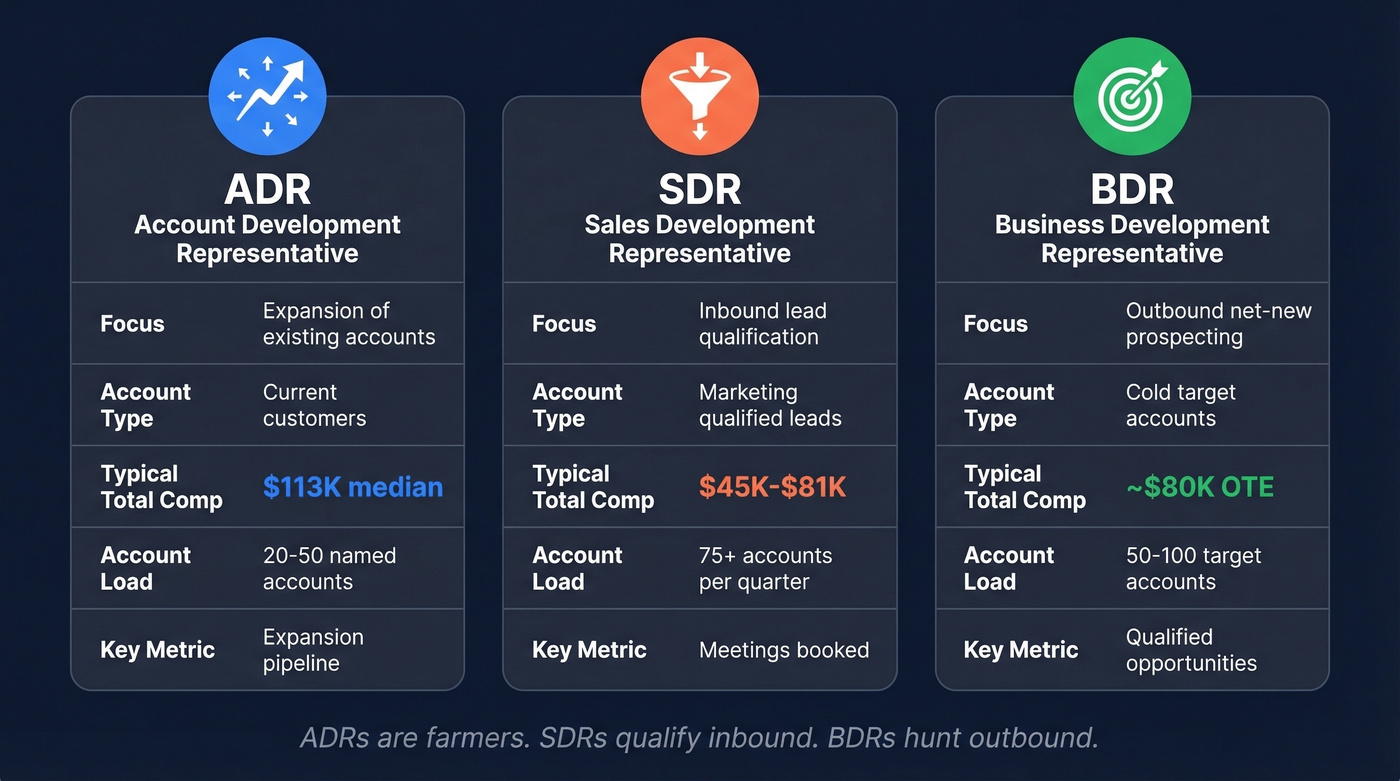
A few things jump out. Comp is the obvious one: ADRs earn more because the role requires deeper account knowledge and longer sales cycles. The PayScale SDR average base/Salary) of $51,244 looks modest next to the ADR's $63K-$85K base range, and that gap widens with variable comp.
Then there's account load. The SEC Gold Standard Prospecting Report found that 58% of SDRs juggle more than 75 accounts per quarter. ADRs work a smaller book - 20 to 50 named accounts - but go much deeper into each one. It's depth over breadth, and the economics reflect that.
Reporting lines tell a story too. Per Bridge Group data, 68% of SDR teams report to the head of sales, with inbound SDR teams 2.1x more likely to report to marketing. ADRs usually sit under sales or a dedicated expansion motion because the work is revenue-driven, not lead-driven.
Core Responsibilities and Daily Rhythm
Picture this: your company's biggest customer just expanded into three new regions. They're running your product in North America, but APAC and EMEA don't even know it exists. Someone needs to map the org chart, identify decision-makers in each region, build relationships with stakeholders who've never heard your name, and turn a single-location deal into a company-wide contract.
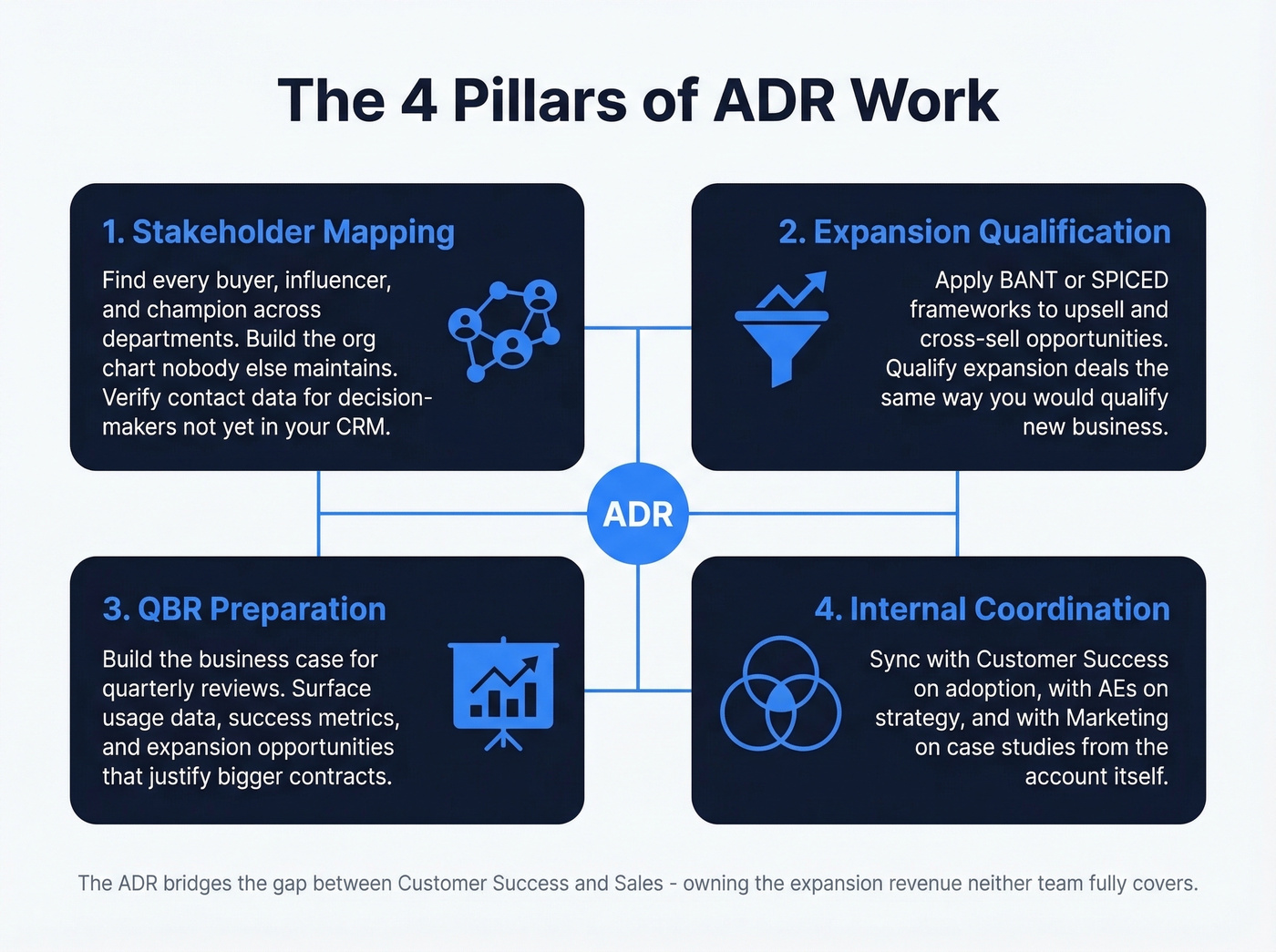
That's the ADR.
Core responsibilities break down into four areas:
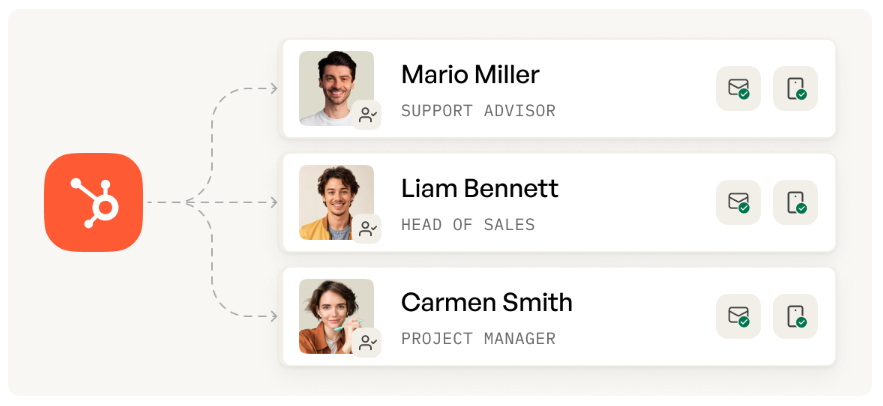
Stakeholder mapping and multithreading - identifying every buyer, influencer, and champion across departments, often finding verified contact data for decision-makers not yet in your CRM.
Expansion qualification - applying frameworks like BANT or SPICED to upsell and cross-sell opportunities within existing accounts.
QBR preparation - building the business case for quarterly business reviews that surface expansion opportunities. (If you need a refresher, see QBR meaning and a list of QBR questions.)
Internal coordination - working with CS to understand product adoption, with AEs to align on account strategy, and with marketing to use case studies from the account's own success.
One r/sales poster described ADR outreach as warmer when you're reaching other branches of an organization that already uses your product - a good mental model. You're not cold-calling strangers. You're reaching into an organization that already pays you, finding the people who should be using your product but aren't, and building the case for expansion.
A Typical ADR Day
| Time | Activity |
|---|---|
| 8:00-9:00 | Review account health dashboards, stakeholder research, enrich missing contacts |
| 9:00-11:00 | Outreach - emails and calls to new stakeholders in target accounts |
| 11:00-12:00 | Internal sync with CS, CRM updates, log activities |
| 1:00-3:00 | Discovery calls, QBR prep, expansion proposals |
| 3:00-5:00 | Follow-ups, account planning, pipeline review, next-day prep |
The rhythm differs from an SDR's day. Less raw volume, more strategic depth. You might send 15-20 personalized emails instead of 40 templated ones, but each one references the account's specific usage patterns and expansion potential. If you want to sharpen the basics, start with these sales prospecting techniques and sales activities examples.

Stakeholder mapping is the ADR's superpower - but only if you have verified contact data. Prospeo gives you 300M+ profiles with 98% email accuracy and 125M+ verified mobiles, so you can multithread into every department of your named accounts without bouncing.
Stop guessing who to reach. Start expanding accounts with data that connects.
ADR Salary and Compensation in 2026
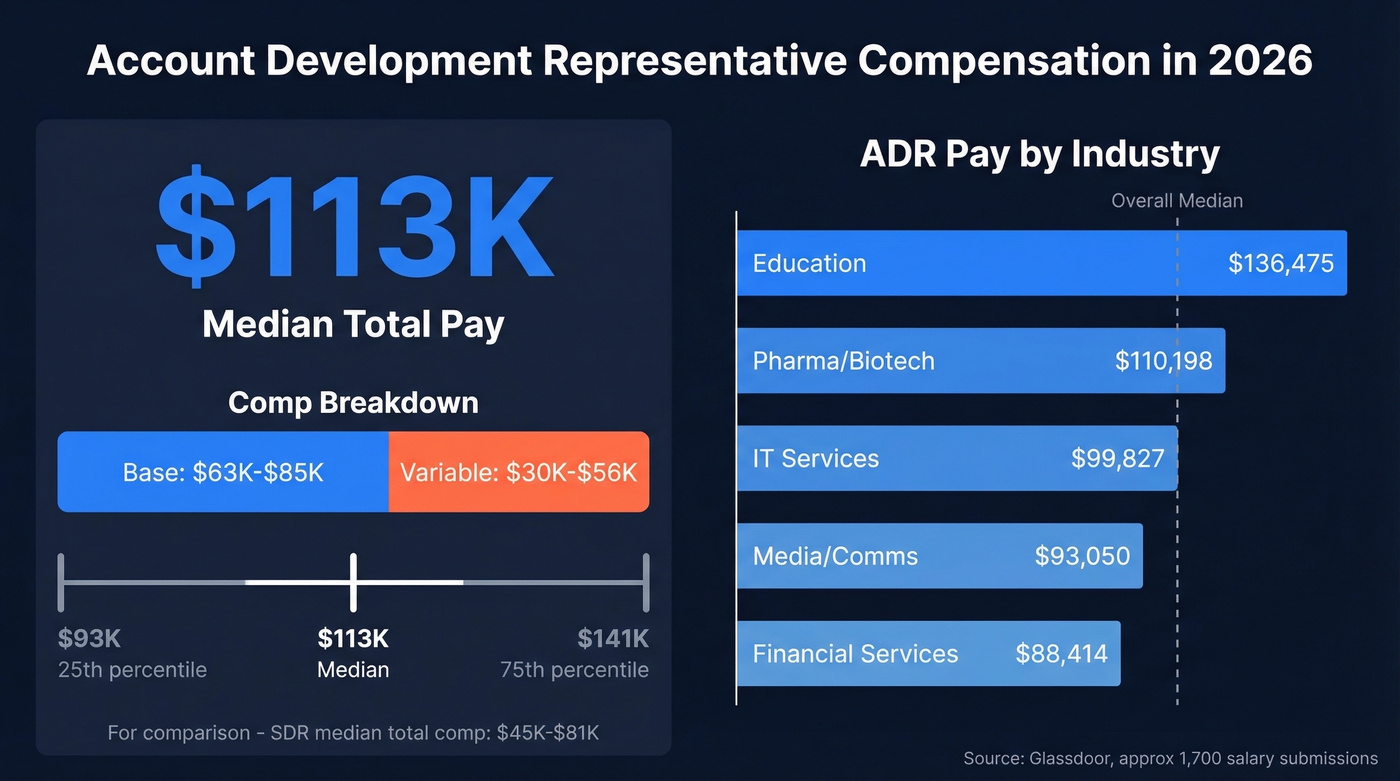
The Glassdoor dataset - based on roughly 1,700 salary submissions - puts the US median total pay for ADRs at $113K/year. The 25th-to-75th percentile range runs $93K-$141K, with a base of $63K-$85K plus $30K-$56K in variable comp tied to expansion pipeline, meetings booked, and revenue closed. (If you're benchmarking offers, it helps to understand OTE in sales too.)
Comp by Industry
| Industry | Median Total Pay |
|---|---|
| Education | $136,475 |
| Pharma/Biotech | $110,198 |
| IT Services | $99,827 |
| Media/Comms | $93,050 |
| Financial Services | $88,414 |
Some large companies show very high ADR pay bands on Glassdoor. Intel ranges $173K-$286K total. Cisco runs $162K-$264K. Google sits at $169K-$252K. These are outliers, but they show the ceiling at companies that invest heavily in expansion.
For context, PayScale reports an average SDR base of $51,244, with total pay ranging $45K-$81K. Built In's remote SDR data shows an average total comp of $89,980 - still below the ADR median. The gap reflects the higher skill requirements and strategic nature of expansion work.
KPIs and Performance Benchmarks
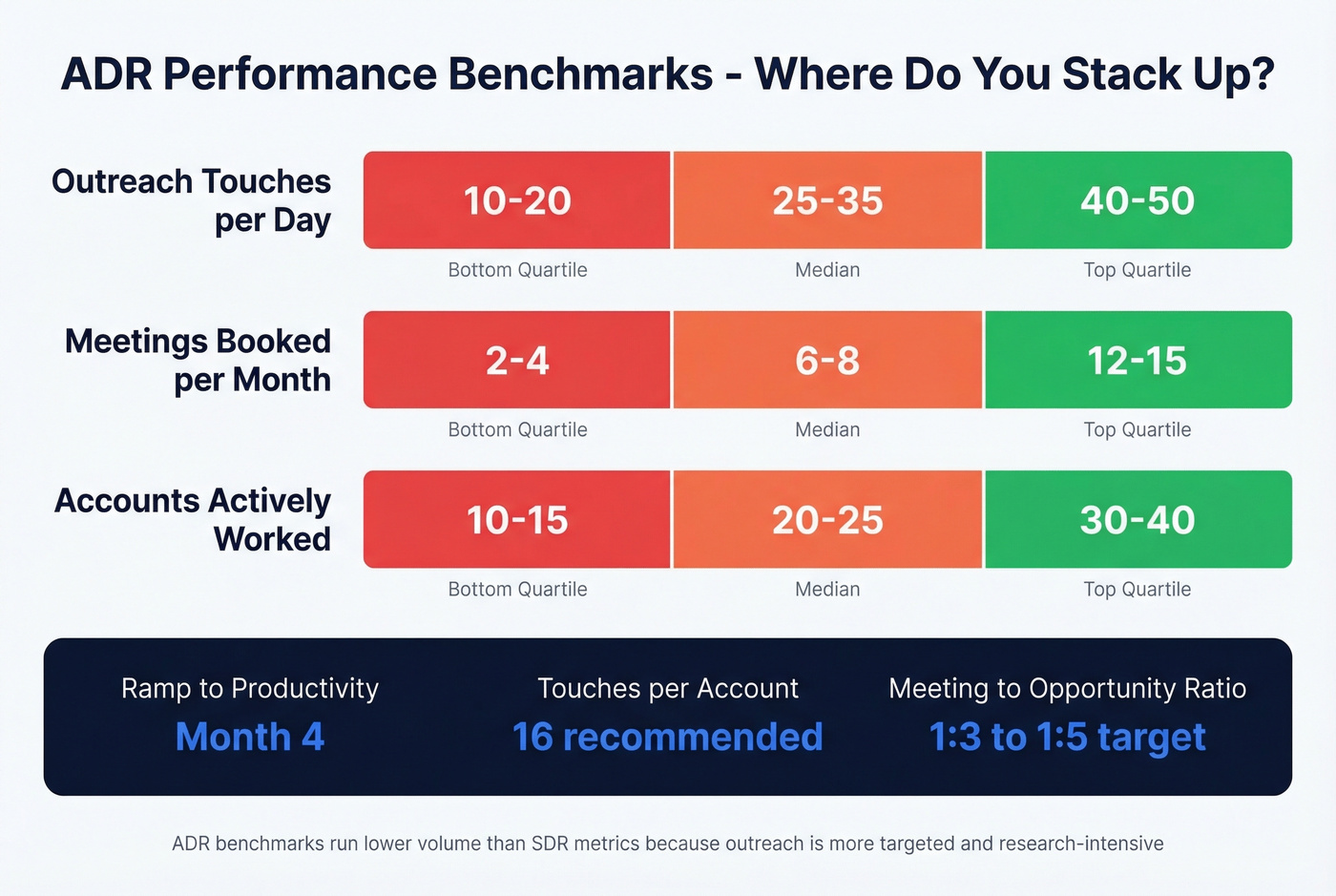
ADR-specific benchmarks are harder to find than SDR metrics because fewer companies have formalized the role. We've adapted well-established sales development benchmarks for the expansion motion based on what we've seen work across sales teams. (If you're building dashboards, these pipeline health metrics are a good companion.)
Activity Benchmarks
| Metric | Top Quartile | Median | Bottom Quartile |
|---|---|---|---|
| Outreach touches/day | 40-50 | 25-35 | 10-20 |
| Meetings booked/month | 12-15 | 6-8 | 2-4 |
| Accounts actively worked | 30-40 | 20-25 | 10-15 |
These numbers run lower than raw SDR benchmarks - where median calls per day hit 50-60 - because ADR outreach is more targeted and research-intensive. You're not dialing through a list; you're building a case for each conversation. TOPO recommends 16 touches per account, and Gartner says it takes 18+ dials to connect.
Beyond activity, ADRs should track net revenue retention contribution (how much expansion revenue you drive relative to churn), account penetration rate (percentage of target departments engaged), and meeting-to-opportunity conversion (a strong target is 1:3 to 1:5). Expect ramp to full productivity by month four. Many teams formalize this ramp with a 30-60-90 day plan for sales reps.
Essential Skills
| Hard Skills | Soft Skills |
|---|---|
| Account planning - territory and account-level strategies with clear expansion targets | Consultative communication - advising existing customers, not pitching cold prospects |
| Multithreading - engaging 3-5+ stakeholders per account simultaneously | Patience - expansion cycles run 2-6 months; this isn't a quick-close game |
| Qualification frameworks - BANT, MEDDIC, or SPICED applied to upsell/cross-sell | Cross-functional collaboration - working daily with CS, AEs, product, and marketing |
| CRM hygiene - clean records, logged relationships, tracked engagement | Pattern recognition - spotting expansion signals in usage data and org changes |
| Stakeholder mapping - org structures, budget holders, internal champions | Relationship depth - building trust across multiple levels of an organization |
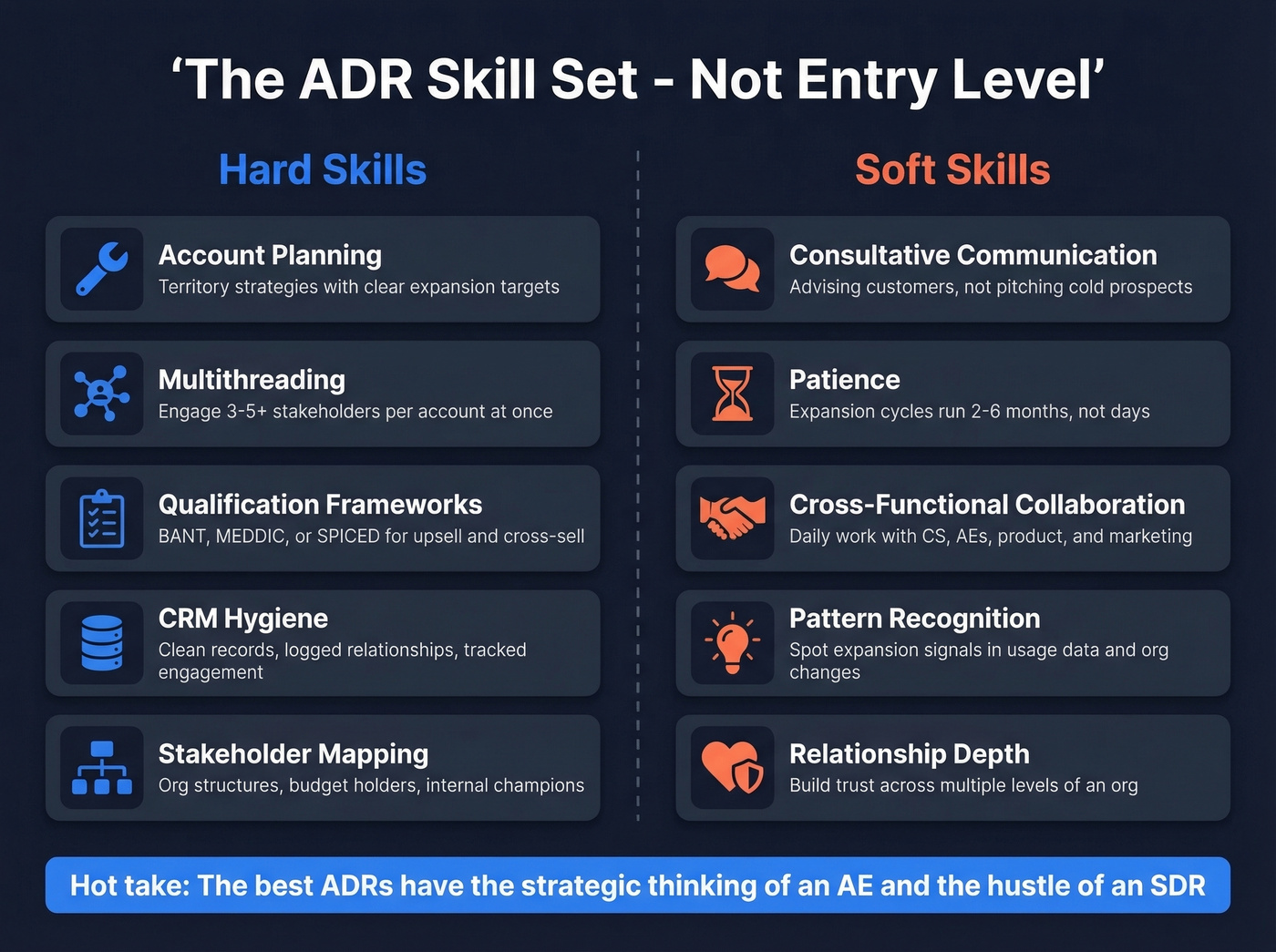
Here's our hot take: stop treating ADR as entry-level. In our experience, companies that staff ADRs with junior reps and measure them on call volume consistently underperform those that measure on expansion pipeline. The best ADRs have the strategic thinking of an AE and the hustle of an SDR. If you're selling deals under $15K, you probably don't need a dedicated ADR. But for six-figure contracts with multi-department potential, this role pays for itself fast.
The personality fit matters too. SDRs thrive on variety and quick wins - new conversations every day, fast feedback loops. ADRs thrive on depth and long games. If you get restless working the same 30 accounts for months, skip this role. If you love the puzzle of mapping an organization and finding the thread that unravels a company-wide deal, you'll love it.
The ADR Tech Stack
CRM: Salesforce (~$25-$300/user/month) or HubSpot (free CRM, Sales Hub ~$20-$150/user/month). Every ADR lives in their CRM - it's where account history, stakeholder maps, and expansion pipeline live. (If you're evaluating options, here are examples of a CRM and some of the best contact management software.)
Sales engagement: Outreach or Salesloft (~$100-$150/user/month each) for sequencing multi-touch outreach to new stakeholders within existing accounts. The key difference from SDR usage: ADR sequences are more personalized and reference the existing relationship. If you're standardizing messaging, keep a set of sales follow-up templates handy.
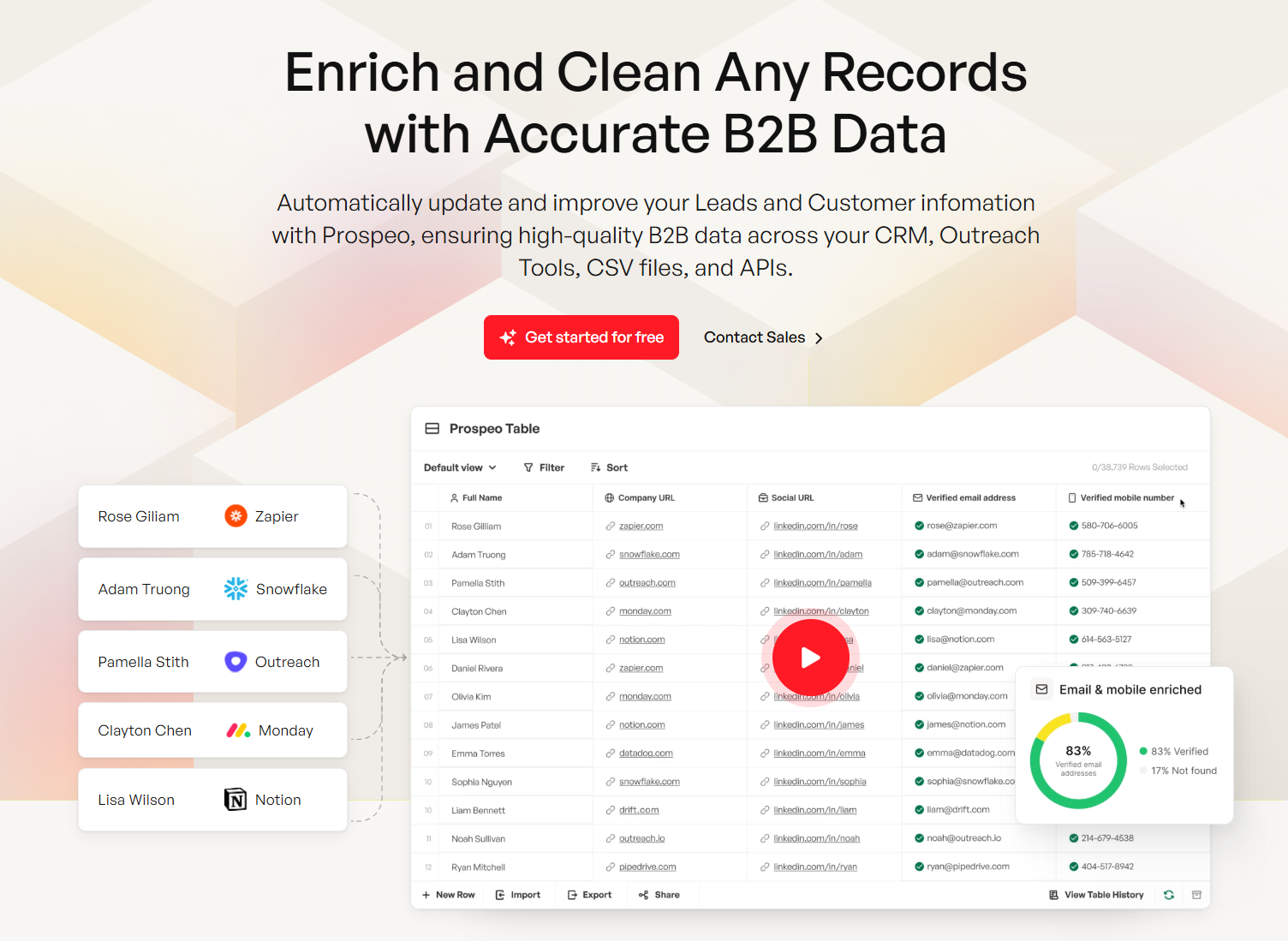
Data and enrichment: This is where ADRs often hit a wall. Your CRM has the original buyer's contact info, but you need to reach the VP of Engineering in the London office, the procurement lead in Singapore, and the department head who just got promoted. Those contacts aren't in your system. Tools like Prospeo solve this - its database covers 300M+ professional profiles with 98% email accuracy, and CRM enrichment returns 50+ data points per contact. Data refreshes every 7 days, which matters when you're tracking job changes and new hires within target accounts. If you're comparing vendors, start with these data enrichment services.
For comparison, ZoomInfo (~$15-40K/year) offers a broader platform with intent data and workflow tools, but at a price point that's hard to justify if your primary need is accurate contact data for expansion.
Analytics and communication: Gong (~$100-$150/user/month) for call intelligence, Clari (enterprise pricing, typically $30K+/year) for pipeline forecasting, Tableau (~$70/user/month standalone) for account health metrics. Slack and Zoom for the constant internal coordination that expansion work demands.
How to Prepare for an ADR Interview
ADR interviews test strategic thinking, not just hustle. Expect questions across these categories:
Account planning: "Walk me through how you'd build an account plan for a target account." Strong answers start with the existing relationship - what they've bought, who the champion is, what their usage looks like - then identify whitespace by department, geography, or product line.
Outreach: "Craft a first-touch email to a VP who doesn't know you, but whose company is already a customer." The key is using the existing relationship. Reference the account's success, name-drop the internal champion (with permission), and make the ask specific.
Qualification: "What's your preferred framework and how would you apply it to an expansion opportunity?" The best answer explains why expansion qualification differs from new-business qualification. Budget already exists in the org. Authority is distributed across more stakeholders. Need is proven by current usage.
Objection handling: Prepare a story where you turned a "we're happy with what we have" into a booked meeting. The interviewer wants to see patience and consultative skill, not aggressive closing.
ADR Career Path
The typical progression runs: Entry-level sales -> ADR (1-3 yrs) -> AE / AM / CS Leader -> VP Sales
From ADR, three paths open up. Account Executive if you love closing and want to own the full sales cycle - OTE jumps to $150K+ at most mid-market companies. Account Manager if you prefer relationship management and long-term account growth over net-new hunting. Customer Success leadership if you're drawn to the retention and adoption side - ADR experience gives you a revenue-focused perspective that pure CS managers often lack.
The timeline from ADR to AE is typically 1-3 years. Top performers at fast-growing companies make the jump in 12-18 months. At larger enterprises, expect closer to 2-3 years.
The account development representative role has become one of the best-kept secrets in B2B sales careers. You get strategic account experience, higher comp than SDRs, and a clearer path to senior roles - all because you're working with customers who already trust your company.
ADRs work 20-50 named accounts and need depth, not volume. Prospeo's CRM enrichment returns 50+ data points per contact at a 92% match rate - filling gaps in your org charts so no expansion opportunity slips through the cracks.
Enrich your named accounts and surface every decision-maker you're missing.
FAQ
Is an ADR the same as an SDR?
No. ADRs expand existing accounts through upsell, cross-sell, and multi-department growth. SDRs generate new pipeline from cold or inbound leads. Titles vary across companies - always confirm actual responsibilities before accepting an offer.
What should you look for in an ADR job description?
Focus on whether the role targets existing customers or net-new logos, what percentage of pipeline comes from expansion revenue, and which team the ADR reports into. A well-written posting will clearly state the account type, quota structure, and core KPIs. Vagueness on all three is a red flag.
What's a good ADR salary in 2026?
Median total pay is $113K/year in the US, with a base of $63K-$85K plus variable comp. Enterprise tech companies like Intel and Cisco can push well above $200K for experienced ADRs working strategic accounts.
How do ADRs find contacts for stakeholders not in the CRM?
Most ADRs use enrichment tools to surface verified emails and direct dials for new stakeholders within existing accounts. ZoomInfo is the legacy option at $15-40K/year; newer platforms offer comparable data at a fraction of the cost.
How long does it take to get promoted from ADR?
Typically 1-3 years to move into an AE, AM, or CS leadership role. Top performers at fast-growing companies make the jump in 12-18 months; larger enterprises usually require 2-3 years of tenure.