

The Account Management Process That Actually Works in 2026
Your biggest account just went dark. The primary contact left three months ago, nobody updated the CRM, and the renewal is in 60 days. The new VP doesn't know your name. You're scrambling to rebuild a relationship that took two years to build, and procurement is already shopping alternatives.
This scenario plays out constantly. Fewer than 20% of companies have fully embedded account planning into their operations. The other 80% run on tribal knowledge, stale spreadsheets, and the hope that their champion doesn't change jobs. That's not an account management process - it's a prayer.
What You Need (Quick Version)
Account management is a repeatable discipline built on three pillars: a scoring model to pick the right accounts, living account plans that update on signals rather than calendars, and numeric benchmarks so you know if it's working. The 8-step framework below gives you the operational artifacts. If you only read one section, read "Score and Tier Your Accounts" - it's where most programs fail first.
Why Growing Existing Accounts Matters
The economics aren't subtle. Selling to existing key accounts is 60-70% more likely to close compared to 5-20% for net-new prospects. A 5% increase in customer retention can boost profits by up to 95%. And with median SaaS revenue growth dropping from 47% in 2024 to 26% in 2026, expansion revenue from existing accounts isn't optional - it's how you hit the number.
RAIN Group's benchmark research sharpens the gap: the best organizations are 3.1x more likely to grow key account revenue by 20%+, 3.4x more likely to grow profit by 20%+, and 4.5x more likely to see year-over-year client satisfaction improvement. 87% of companies don't make that cut. Most teams leave expansion revenue on the table because they don't have a structured approach - they have a collection of habits.
AM vs. Customer Success vs. Sales
Confusing these three roles is why retention numbers suffer at most companies. Sales closes. Customer success ensures adoption. Account management grows revenue. When you blur the lines, AMs do onboarding work, CSMs avoid commercial conversations, and nobody owns expansion.
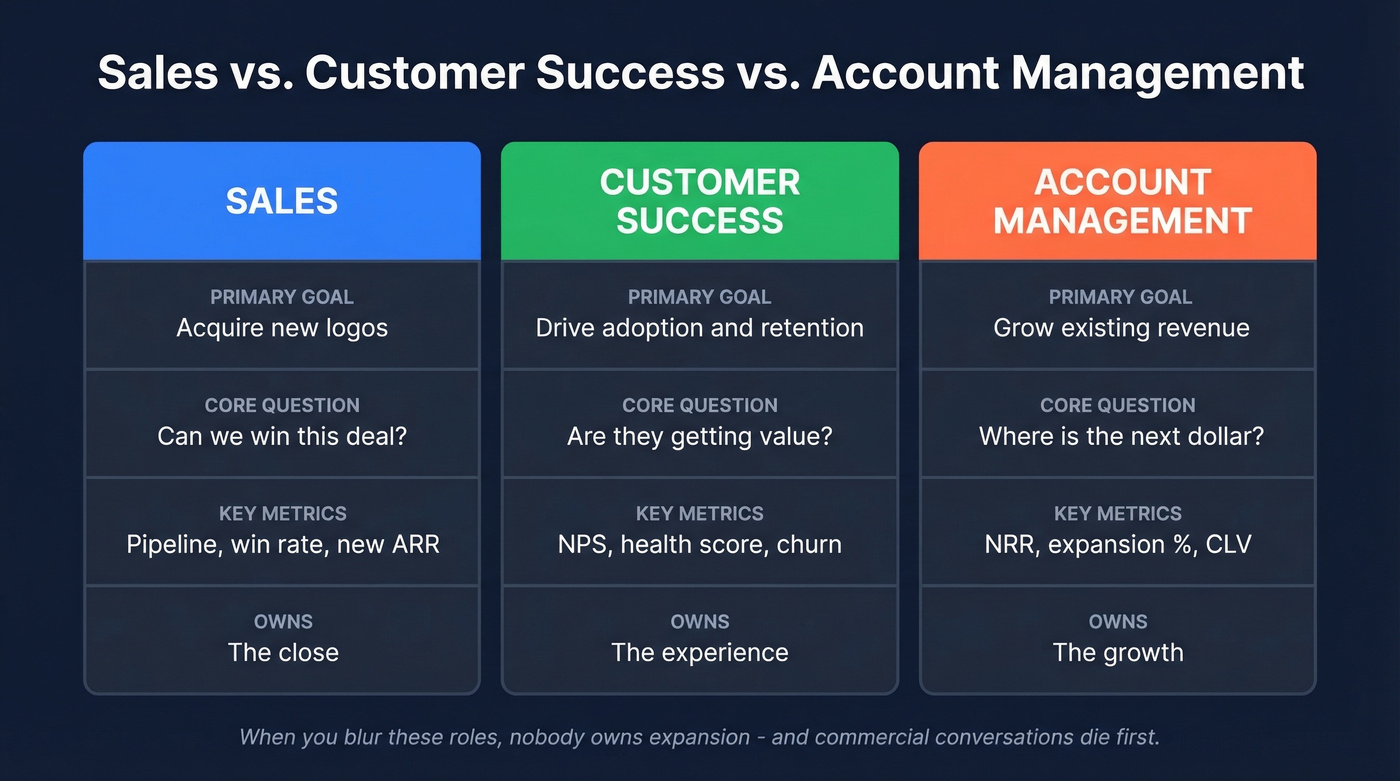
| Role | Primary Goal | Key Metrics | Typical Tools |
|---|---|---|---|
| Sales | Acquire new logos | Pipeline, win rate, new ARR | CRM, sequencer |
| Customer Success | Drive adoption & retention | NPS, health score, churn | Gainsight, Totango |
| Account Management | Grow existing revenue | NRR, expansion %, CLV | CRM, KAM platform |
The overlap between AM and CS is real, but the intent is different. CSMs ask "are they getting value?" AMs ask "where's the next dollar?" Both questions matter. Assigning them to the same person usually means one gets neglected - and in our experience, it's always the commercial conversation that dies first.

Your account plan says 11 stakeholders. How many verified emails and direct dials do you actually have? Prospeo gives AMs 98% accurate emails and 125M+ verified mobiles - so when your champion leaves, you reach the new decision-maker the same week.
Stop losing renewals because you lost a contact. Build the full map now.
The 8-Step Account Management Process
Step 1 - Define AM at Your Company
Before you build anything, get alignment on what account management actually is in your organization. As monday.com's guide frames it: sales acquires, account management retains and expands. Your AMs aren't "sales lite." They're relationship architects with commercial responsibility.
If leadership thinks AM is just "keeping clients happy," you've already lost. That's customer success, and it's a different job with different metrics.
Step 2 - Score and Tier Your Accounts
This is where most programs fail. The instinct is to tier accounts by current spend. That instinct is wrong. Organizations that select key accounts by current spend are 51% less likely to see increased revenue growth from those accounts.
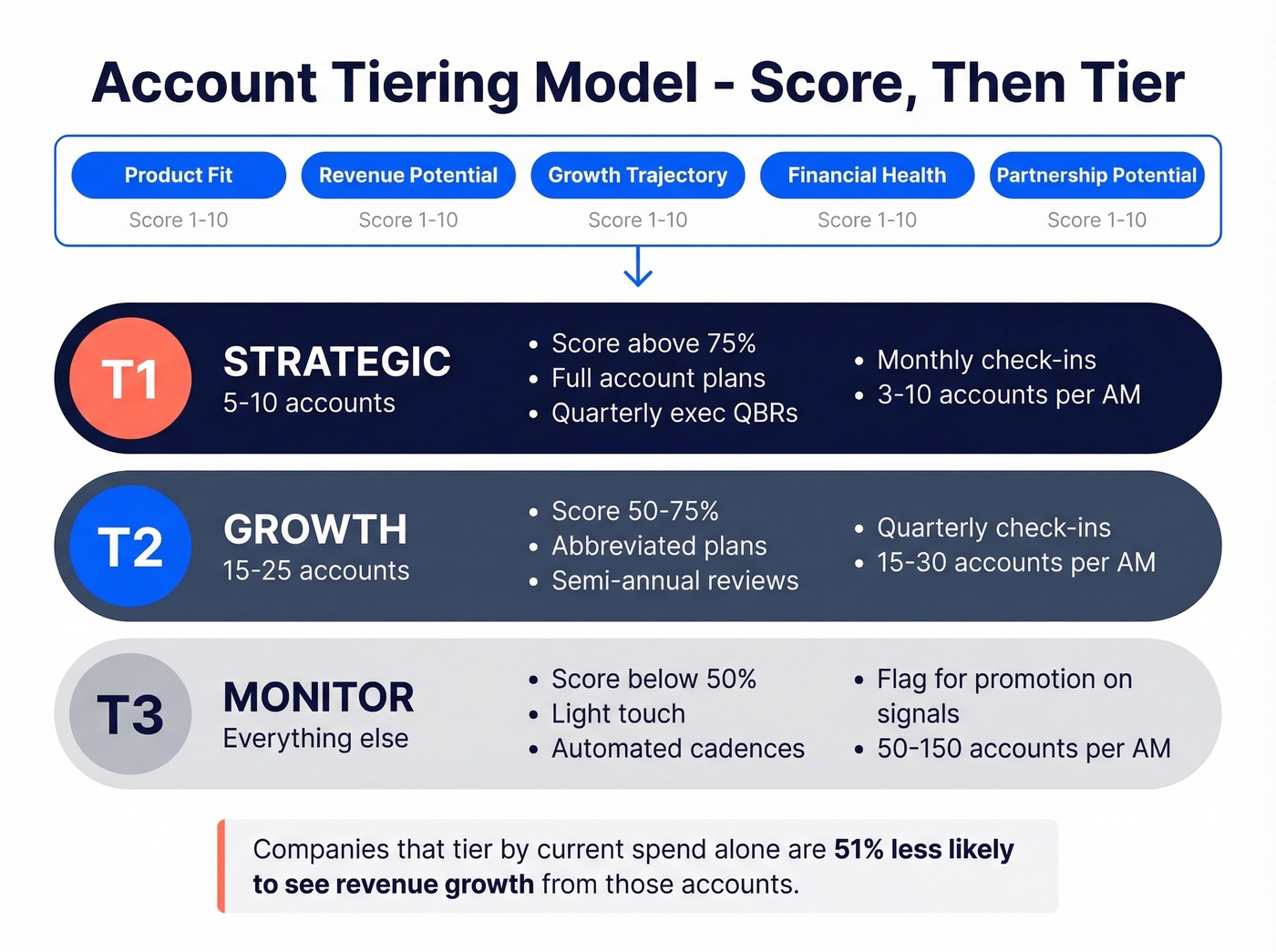
Use a weighted scoring model instead. Pick 3-5 criteria - product fit, revenue potential, growth trajectory, financial health, partnership potential - and score each account 1-10 per criterion. The highest totals become your strategic accounts.
- Tier 1 (Strategic): 5-10 accounts. Full account plans, quarterly executive reviews. These are your growth engines.
- Tier 2 (Growth): 15-25 accounts. Abbreviated plans, semi-annual reviews. Solid revenue, real expansion potential.
- Tier 3 (Monitor): Everything else. Light touch, automated cadences, flag for promotion when signals change.
Accounts scoring above 75% on your criteria get a full plan. Between 50-75%, a lighter plan. Below 50%, deprioritize and monitor.
Step 3 - Assign Ownership and Set Capacity
Capacity planning is the unglamorous work that makes everything else possible. Rough ranges by tier: an AM can handle 3-10 strategic accounts, 15-30 mid-tier accounts, or 50-150 long-tail accounts. These ranges shift based on deal complexity and ACV.
The r/msp community highlights this tension perfectly - the time you spend on a $3K/month client versus a $12K/month client shouldn't be the same, but without explicit tiering, it often is. AMs default to whoever's loudest, not whoever's most valuable. A well-defined workflow prevents this by mapping exactly which activities each AM performs at each tier, eliminating guesswork about where to spend time.
Don't create "Captain Super-KAM." A single AM without cross-functional support - no solutions engineering, no exec sponsorship, no product team access - will burn out and underdeliver. Account management is a team sport, even if one person owns the relationship.
Step 4 - Build Your Account Plan
A good account plan has eight sections. Not three, not twenty. DemandFarm's template structure nails this:
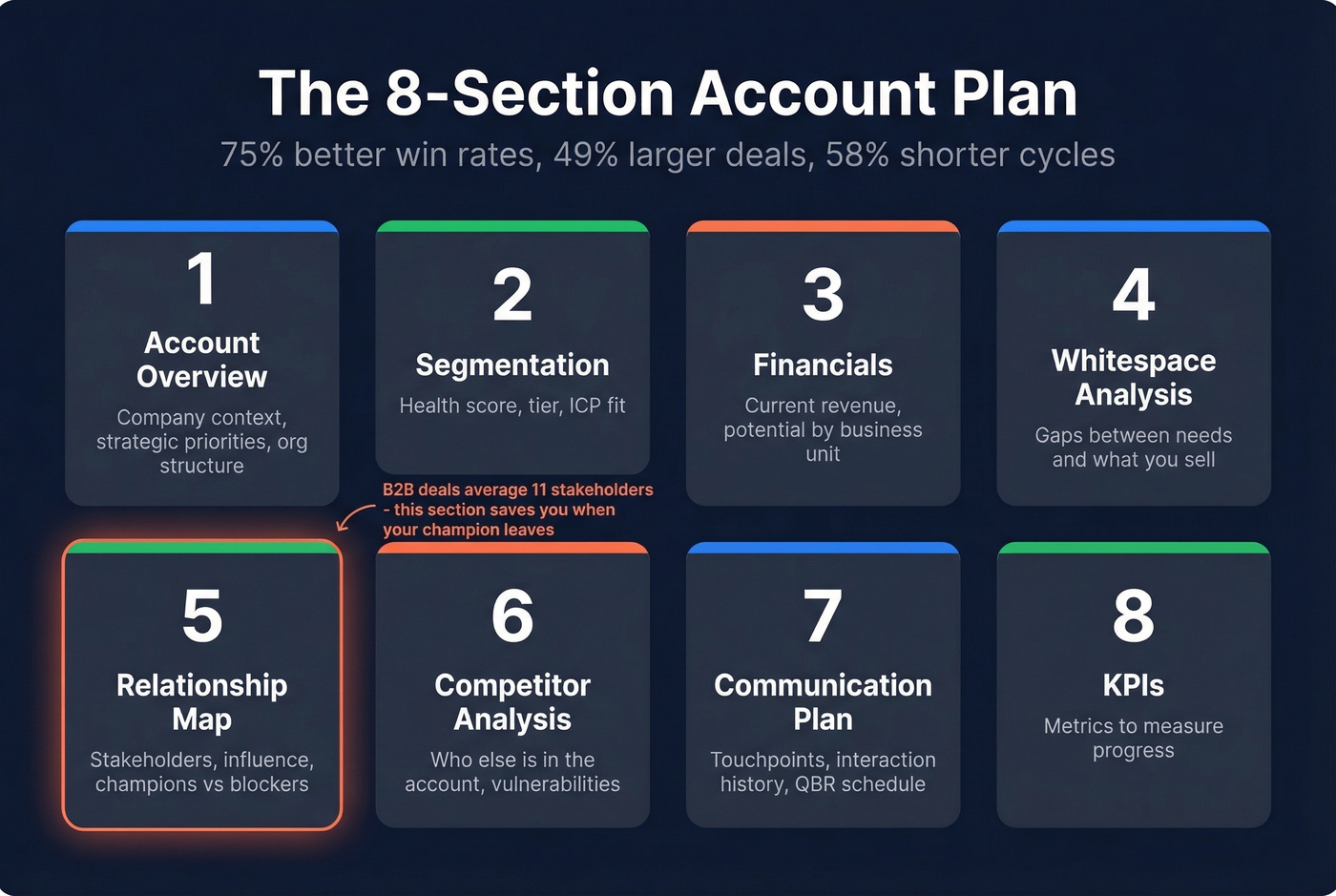
- Account overview - company context, strategic priorities, org structure
- Account segmentation - health score, tier, ICP fit
- Account financials - current revenue, revenue potential by business unit
- Whitespace analysis - gaps between what the customer needs and what you sell them
- Relationship mapping - stakeholders, influence levels, champions vs. blockers
- Competitor analysis - who else is in the account, where you're vulnerable
- Communication planning - interaction history, planned touchpoints, QBR schedule
- KPIs - the metrics you'll use to measure progress
Organizations with embedded account planning report 75% better win rates, 49% increased deal size, and 58% shorter sales cycles. Those numbers alone justify the effort.
Here's the thing - B2B deals average 11 stakeholders. If your account plan doesn't include a stakeholder map with influence levels and reporting lines, you're flying blind. Relationship mapping isn't optional; it's the section that saves you when your champion leaves. And frame the plan around increasing your client's decision confidence, not just your revenue targets. Gartner's research links frequently updated account plans with stronger customer decision confidence, which directly accelerates deal velocity.
Step 5 - Set Cadences by Tier
Not every account deserves a monthly check-in. Match your cadence to the tier:
| Tier | Review Type | Frequency |
|---|---|---|
| Tier 1 (Strategic) | Exec QBR + monthly check-in | Quarterly QBR, monthly ops |
| Tier 2 (Growth) | Business review + check-in | Semi-annual review, quarterly check-in |
| Tier 3 (Monitor) | Ad hoc | As needed, automated health alerts |
QBRs are operational - metrics, roadmap, tactical issues. EBRs are strategic - business outcomes, partnership direction, executive alignment. Your Tier 1 accounts need both. Tier 2 accounts need QBRs. Tier 3 accounts need a pulse check and a flag system. Consistent meeting tracking across all tiers ensures no scheduled touchpoint falls through the cracks and gives leadership visibility into engagement frequency.
Step 6 - Execute the First 90 Days
We've seen the first 90 days determine whether an AM program lives or dies.
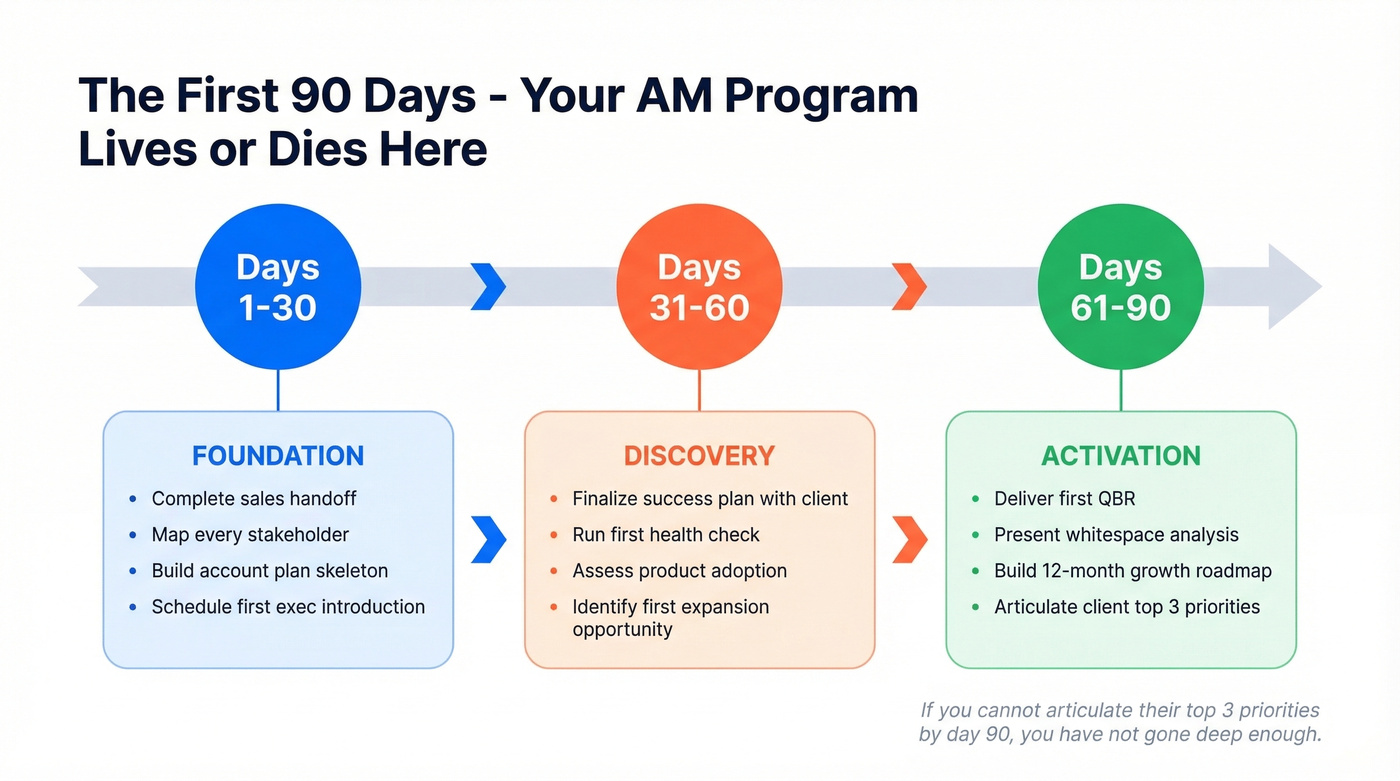
Days 1-30: Complete the onboarding handoff from sales. Map every stakeholder. Get the account plan skeleton in place. Schedule the first executive introduction.
Days 31-60: Finalize the success plan with the client. Run the first health check - are they adopting what they bought? Identify the first expansion opportunity, even if you don't pitch it yet.
Days 61-90: Deliver the first QBR. Present the whitespace analysis. By day 90, you should have a clear picture of where this account is going over the next 12 months - and the client should feel like you understand their business better than your competitors do. If you can't articulate their top three strategic priorities by this point, you haven't gone deep enough.
Step 7 - Measure What Matters
Most AM teams track too many metrics or the wrong ones. Three metrics matter most: net revenue retention, expansion revenue as a percentage of new ARR, and stakeholder engagement depth. Everything else is supporting data.
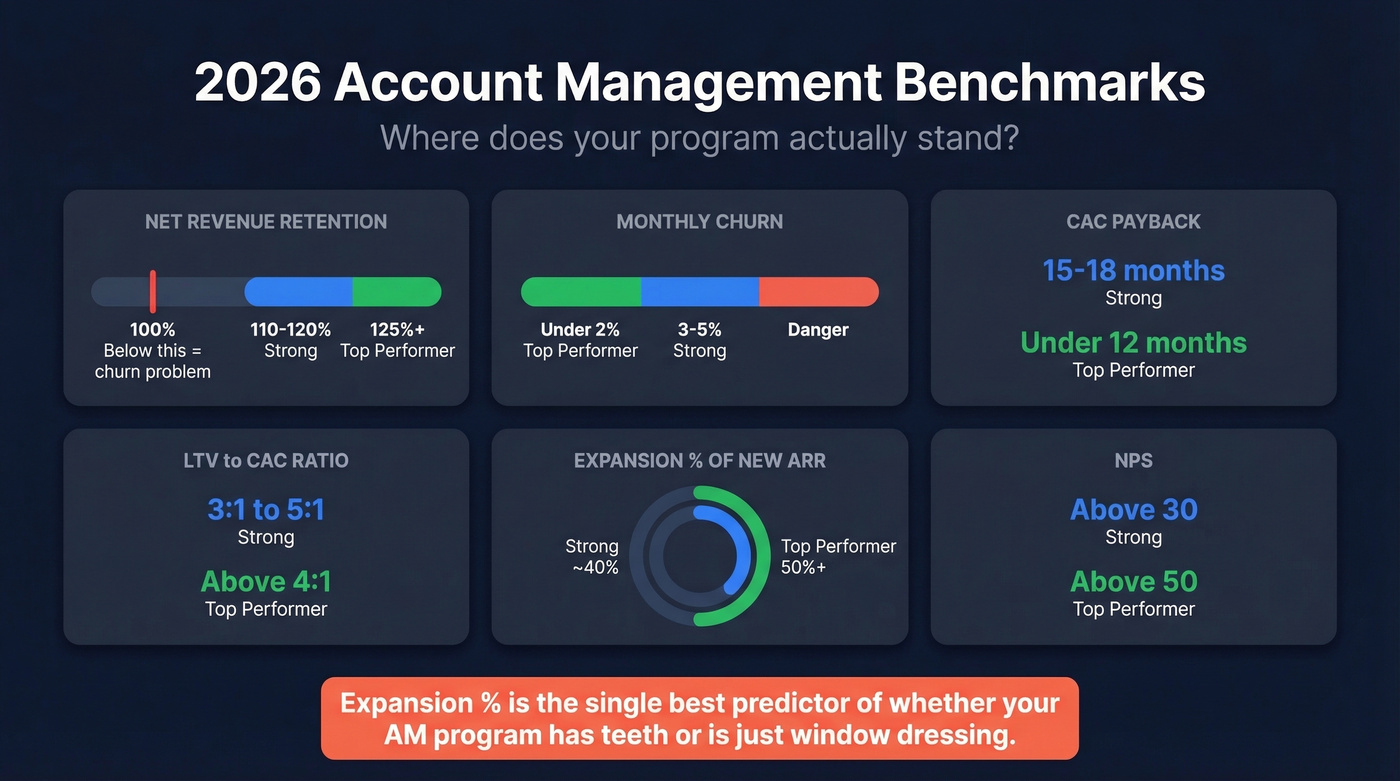
Here are the 2026 benchmark ranges so you know where "good" actually sits:
| Metric | Strong | Top Performer | What It Tells You |
|---|---|---|---|
| NRR | 110-120% | 125%+ | Are you growing inside accounts? |
| Monthly churn | Under 3-5% | Under 2% | Are you keeping them? |
| CAC payback | 15-18 months | Under 12 months | How fast do accounts pay back? |
| LTV:CAC | 3:1-5:1 | Above 4:1 | Are unit economics healthy? |
| Expansion % of new ARR | ~40% | 50%+ | How much growth is organic? |
| NPS | Above 30 | Above 50 | Do they actually like you? |
If your NRR is below 100%, you don't have an account management program - you have a churn problem wearing a relationship hat.
Expansion revenue percentage is the metric that separates teams doing real AM from teams doing glorified support. We track it religiously on our own accounts, and it's the single best predictor of whether an AM program has teeth or is just window dressing.
Step 8 - Review, Recalibrate, Repeat
Static account plans are dead plans. Only 5% of B2B accounts are actively looking to buy at any given time, which means buying signals change constantly.
Your plans should update on signals, not calendars. Usage drops, stakeholder changes, funding events, job changes, competitive mentions in earnings calls - these are the triggers that should prompt a plan review. Waiting for the quarterly review to discover your champion left two months ago is how you lose renewals.
We've watched teams triple expansion revenue just by moving from annual to signal-driven plan updates. If your account plans only get refreshed before QBRs, they're not living documents. They're presentation prep.
The AM Tech Stack Beyond CRM
Let's be honest: your CRM isn't an account management tool. It tracks pipeline and logs activities. It doesn't tell you which accounts are showing buying signals, whether your stakeholder map is current, or where the whitespace opportunities sit. Treating Salesforce as your AM system is how you end up with spreadsheet sprawl.
A functional AM tech stack has three layers:
Layer 1 - CRM for workflow. Salesforce (from ~$25/user/mo), HubSpot (free tier available), or Pipedrive (from ~$14/month, billed annually). This is your system of record, not your system of intelligence. If you're evaluating options, start with a few examples of a CRM to compare pricing and fit.
Layer 2 - Data platform for contact accuracy and intent signals. This is where most stacks have a gap. You need something that keeps contact records fresh and surfaces in-market signals automatically. Prospeo handles this with CRM and CSV enrichment that returns 50+ data points per contact at a 92% match rate, records that refresh every 7 days, and intent data tracking 15,000 topics via Bombora. Your AMs see which accounts are actively researching solutions and which contacts have changed roles - without manual research. If you're comparing vendors, see our roundup of data enrichment services.
Layer 3 - Communication tool for cadence management. Outreach, Salesloft, or a well-configured calendar system. The point is systematized touchpoints, not ad hoc "I should probably check in." If you need a repeatable system, borrow a few sales follow-up templates and standardize them by tier.
For enterprise teams managing 50+ strategic accounts, specialized platforms like DemandFarm or Kapta add relationship mapping and whitespace visualization on top of your CRM. But here's the hot take: you don't need account management software to start. You need a process and clean data. The fanciest KAM platform won't save you if your contact data is stale and your plans haven't been updated since January.
Relationship mapping is only as good as the contact data behind it. Prospeo refreshes 300M+ profiles every 7 days - catching job changes, new stakeholders, and org shifts before your next QBR. At $0.01 per email, enriching every account in your book costs less than one lost renewal.
Catch job changes in days, not months. Your accounts depend on it.
10 Strategies That Separate Top Performers
1. Treat KAM as a distinct function. It's a different business model requiring strategy, cross-functional alignment, and patience. Define AM with its own metrics and career path - not as a side gig for senior reps.
2. Score on potential, not history. Organizations that select key accounts by current spend are 51% less likely to grow revenue from those accounts. Weight your scoring toward future opportunity using an Ideal Customer Profile and a simple rubric.
3. Build support pods. The "Captain Super-KAM" model guarantees mediocrity. Assign a solutions engineer, exec sponsor, and product liaison for every Tier 1 account. This is classic team selling in practice.
4. Kill static plans. If your plan hasn't been updated since it was created, it's fiction. Set signal-driven triggers that force a review when something changes. If you need a system for this, use a lightweight approach to tracking sales triggers.
5. Layer intelligence on top of CRM. CRMs track pipeline. They don't map relationships, score account health, or surface whitespace. Add a data enrichment platform and a KAM tool. Start by tightening your contact management so stakeholder maps don't rot.
6. Go proactive. Surprise fire drills mean nobody's monitoring signals. Build an early warning system around usage drops, stakeholder departures, and competitive mentions. A simple churn analysis workflow helps you spot risk earlier.
7. Report value back to the client. When you don't document delivered value, renewals become price conversations. Build a "value delivered" slide into every QBR. If you want to level up the meeting itself, use a bank of QBR questions to ask.
8. Don't boil the ocean. Start with tiering, account plans for Tier 1, and a QBR cadence. Add complexity later.
9. Get senior sponsorship early. AM programs without leadership buy-in die quietly. Create a beachhead case study - one strategy that grew a strategic customer by 70% makes it very hard for leadership to reject the program.
10. Stack quick wins. If you can't show results in the first 90 days, internal support evaporates. Pick one Tier 1 account, run the full process, and document the outcome before you try to scale. If you need a structure, adapt a 30-60-90 day plan to account management.
FAQ
What are the steps in an account management process?
Score and tier accounts, assign ownership with capacity limits, build living account plans, set communication cadences by tier, execute a structured first 90 days, measure NRR and expansion revenue, and recalibrate on signals rather than calendars. Organizations following all eight steps report 75% better win rates and 49% larger deals.
How many accounts should one AM handle?
Practical ranges: 3-10 strategic accounts, 15-30 mid-tier, or 50-150 long-tail. A $500K enterprise account needs roughly 10x the attention of a $5K SMB account, so capacity should reflect ACV and deal complexity - not a flat headcount ratio.
What's the difference between account management and customer success?
Account management focuses on revenue growth - upsells, cross-sells, renewals. Customer success focuses on product adoption and proactive issue prevention. Different goals, different metrics, different roles. Companies that merge them usually underperform on both.
How do you keep stakeholder maps current between QBRs?
Use a data enrichment tool that flags job changes and new hires automatically. Pair that with automated CRM alerts on contact-level changes so AMs catch champion departures and new decision-makers without manual research. The goal is a stakeholder map that's never more than a week stale.
How should teams handle renewal management?
Start renewal preparation at least 120 days before the contract end date. Your account plan should flag renewal timelines automatically, and the AM should present a "value delivered" summary well before procurement enters the conversation. Treating renewals as a last-minute scramble costs you negotiating power and gives competitors an opening.