

Acquisition Email: What It Means, How to Do It Right, and What Most Guides Skip
Your SDR team sent 5,000 emails last quarter and 1,800 bounced. The domain got flagged, reply rates cratered, and marketing is blaming sales for "burning the brand." That's not an email problem - it's a data problem disguised as an email problem.
This guide covers both sides of acquisition email - cold outreach and list building - with the benchmarks, compliance rules, and workflows that actually move the needle.
What Is an Acquisition Email?
The term means two different things depending on who you ask, and most guides don't bother clarifying which one they're talking about.
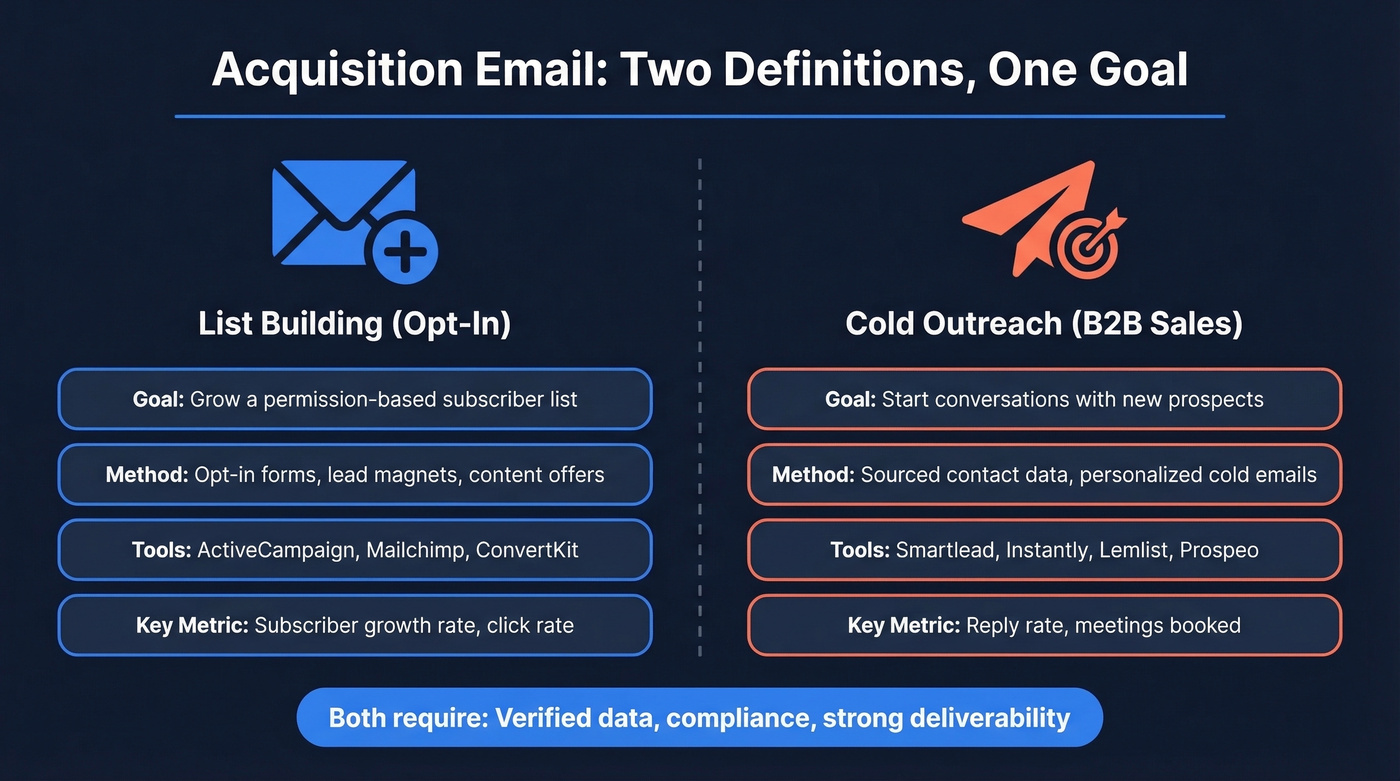
The list-building definition: ActiveCampaign and most email marketing platforms define email acquisition as growing a permission-based subscriber list - getting people to hand over their email address through opt-in forms, lead magnets, and content offers. You're acquiring the address, not the customer (yet). This is sometimes called a self-service customer acquisition email approach, where prospects opt in on their own terms without a sales rep involved.
The cold outreach definition: In B2B sales, acquisition email means emailing prospects you don't have an existing relationship with. You've sourced their contact data, crafted a relevant message, and you're reaching out cold to start a conversation. Benchmark Email frames it this way - using email as a channel to acquire customers, not just subscribers. (If you're building this motion, start with these sales prospecting techniques.)
Some platforms like Zeta Global frame it as paid inbox advertising - renting access to someone else's audience. That's a different model from what we cover here. And if you landed here looking for M&A announcement emails, Encharge has templates for those.
Both definitions share a core truth: you're reaching someone new. The compliance requirements, deliverability stakes, and data quality demands apply equally. The difference is in the tooling and the metrics you track.
What You Need (Quick Version)
For cold outreach:
- Verified prospect data with 98%+ email accuracy
- A dedicated sending tool - Smartlead, Instantly, or Lemlist (~$30-100+/mo per user) (see more SDR tools)
- Proper email authentication - SPF, DKIM, DMARC configured before you send a single message
- A warm-up period - don't blast 500 emails from a fresh domain on day one (use safe email velocity limits)
For opt-in list building:
- An email platform - ActiveCampaign (starts around $19-30/mo) or Mailchimp (from about $13/mo)
- A compelling lead magnet or content offer
- Optimized signup forms with fewer fields and smarter triggers
- Double opt-in to keep your list clean from the start
Either way, data quality is the single biggest factor separating campaigns that convert from campaigns that get you blacklisted. (If you're sourcing contacts, compare options in our guide to email list providers.)
Why Email Still Wins for Acquisition
Email has an image problem, not a performance problem. People associate it with spam because most of it is spam - poorly targeted, unverified lists, generic templates. That's not an indictment of the channel. That's an indictment of how most teams execute it.
The real advantage of email over paid channels is ownership. You don't rent your email list from Meta's algorithm or Google's auction. You don't wake up to a 40% CPL increase because a competitor started bidding on your keywords. Email is infrastructure you control. As third-party cookies disappear and paid acquisition costs keep climbing, first-party email data becomes the most valuable asset in your marketing stack - and research shows 83% of customers are willing to share data for personalized experiences.
Here's the thing: most B2B teams under $50M ARR don't need a sophisticated martech stack. They need 500 verified emails sent to the right people with a relevant message. In our experience, cold email consistently runs $20-50 per qualified meeting for well-executed campaigns. Try getting that from LinkedIn ads or Google PPC in a competitive B2B vertical.
Benchmarks You Should Know
Let's ground this in real numbers. Acquisition email spans two different worlds - opt-in lifecycle campaigns and cold outbound - and the benchmarks look nothing alike.
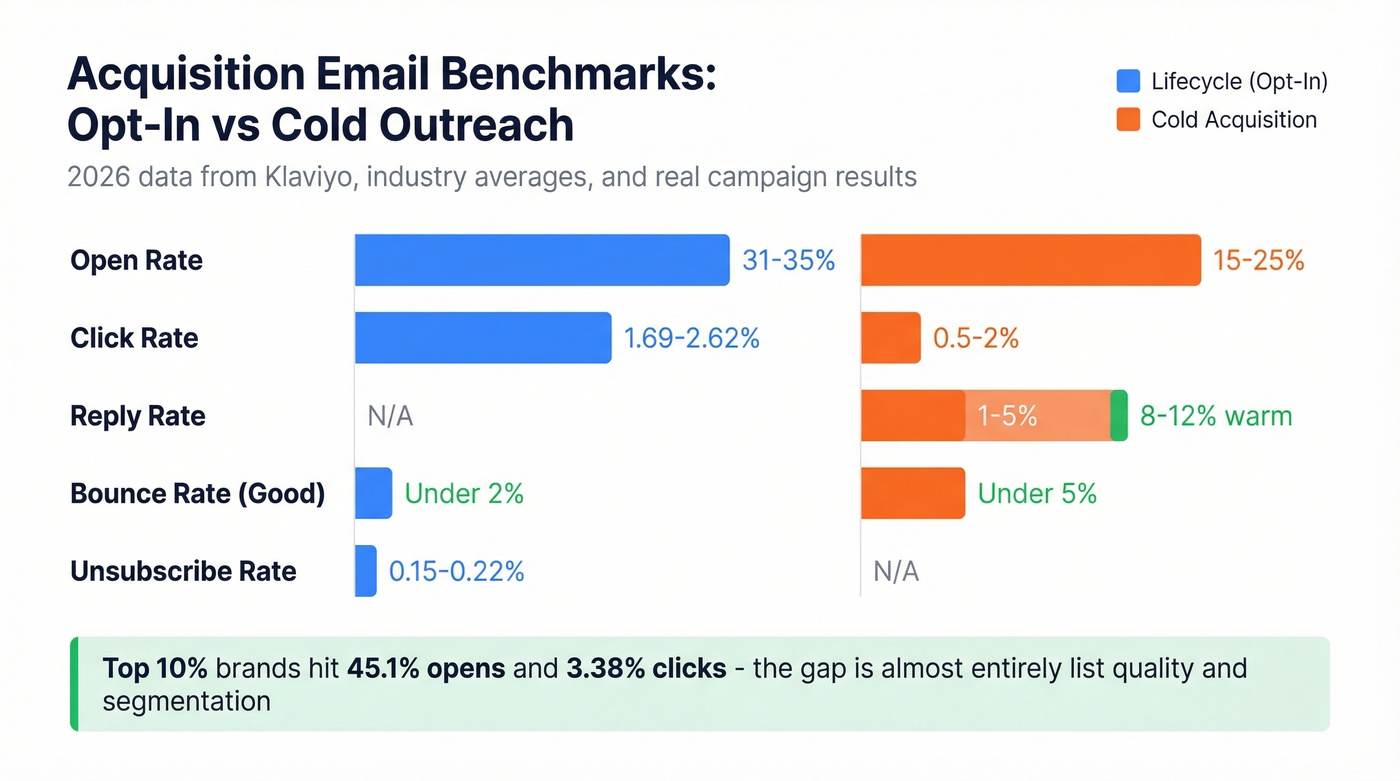
| Metric | Lifecycle (Opt-in) | Cold Acquisition |
|---|---|---|
| Open rate | 31-35% | 15-25% |
| Click rate | 1.69-2.62% | 0.5-2% |
| Reply rate | N/A | 1-5% cold, 8-12% warm |
| Bounce rate (good) | Under 2% | Under 5% |
| Unsubscribe rate | 0.15-0.22% | N/A (cold) |
Klaviyo's 2026 benchmarks, drawn from 183,000+ brands, put the average email campaign open rate at 31% with a 1.69% click rate. Top-performing brands hit 45.1% opens and 3.38% clicks. The gap between average and top-10% is massive - and it's almost entirely explained by list quality and segmentation, not subject line tricks. (If you want to go deeper on clicks, use this click rate formula in email marketing.)
The automated flow numbers tell an even more interesting story: 5.58% average click rate versus 1.69% for campaigns, and flows convert at 2.11% placed-order rate versus 0.16% for campaigns. Triggered, behavioral emails crush batch-and-blast every time.
One critical caveat: open rates are increasingly unreliable. Apple Mail Privacy Protection inflates open rates by triggering tracking pixels automatically. Click rate and reply rate are the metrics that actually tell you something in 2026.
Now, here's what verified data does to these numbers in practice. Snyk's team of 50 AEs was running bounce rates of 35-40% before switching to Prospeo. After the switch, bounces dropped under 5%, AE-sourced pipeline jumped 180%, and they were generating 200+ new opportunities per month. Bad data doesn't just waste sends - it actively destroys your sender reputation, which tanks deliverability for every email that follows. (If you're diagnosing bounces, start with email bounce rate.)
The Compliance Checklist
Acquisition email operates in a legal framework that most sales teams understand vaguely and follow loosely. That's a $53,088 mistake - per email.
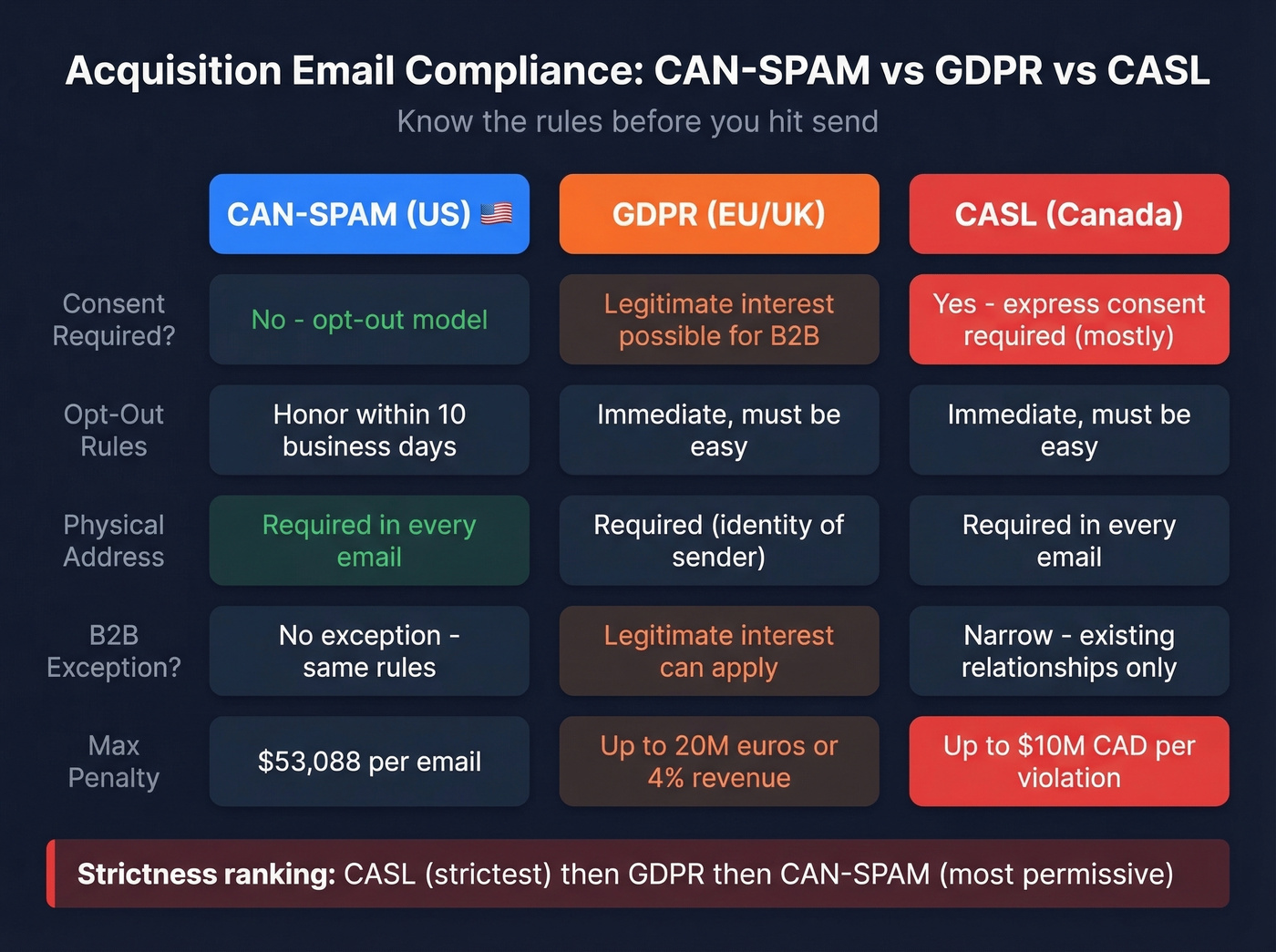
Here's what CAN-SPAM requires for every commercial email you send in the US:
- Accurate header information - your "From," "To," and routing info can't be misleading
- No deceptive subject lines - the subject must reflect the content
- Identify the message as an ad - this needs to be clear and conspicuous
- Include your physical postal address - a PO box or registered commercial mail agent works
- Provide a clear opt-out mechanism - must be easy to find and execute
- Honor opt-outs within 10 business days - and the opt-out mechanism must remain functional for 30 days after sending
- Don't sell or transfer opted-out addresses - except to a compliance vendor
The part that catches most B2B teams off guard: CAN-SPAM makes no exception for business-to-business email. The FTC is explicit about this. Every cold email to a VP of Engineering gets the same legal treatment as a promotional blast to consumers.
For GDPR (EU/UK), the rules are stricter. B2B cold email is possible under "legitimate interest," but you need a documented basis for why the recipient would reasonably expect to hear from you. Blanket scraping and blasting doesn't qualify. CASL (Canada) is the strictest of all - it requires express consent in most cases, with narrow exceptions for existing business relationships.
Real talk: most B2B teams in the US operate under CAN-SPAM and treat GDPR as a "we'll deal with it if we expand to Europe" problem. That's a risk calculation, not a compliance strategy. (If you're unsure about list sourcing, read Is It Illegal to Buy Email Lists?.)

This article opened with 1,800 bounced emails and a flagged domain. That's what happens with unverified acquisition lists. Prospeo's 5-step verification delivers 98% email accuracy - Snyk cut bounce rates from 35% to under 5% and generated 200+ new opportunities per month.
Stop burning your domain on bad data. Start with emails that land.
Deliverability Setup for 2026
Getting past spam filters in 2026 is harder than it was two years ago. Google, Yahoo, and Microsoft have all tightened their bulk sender requirements, and the bar keeps rising.
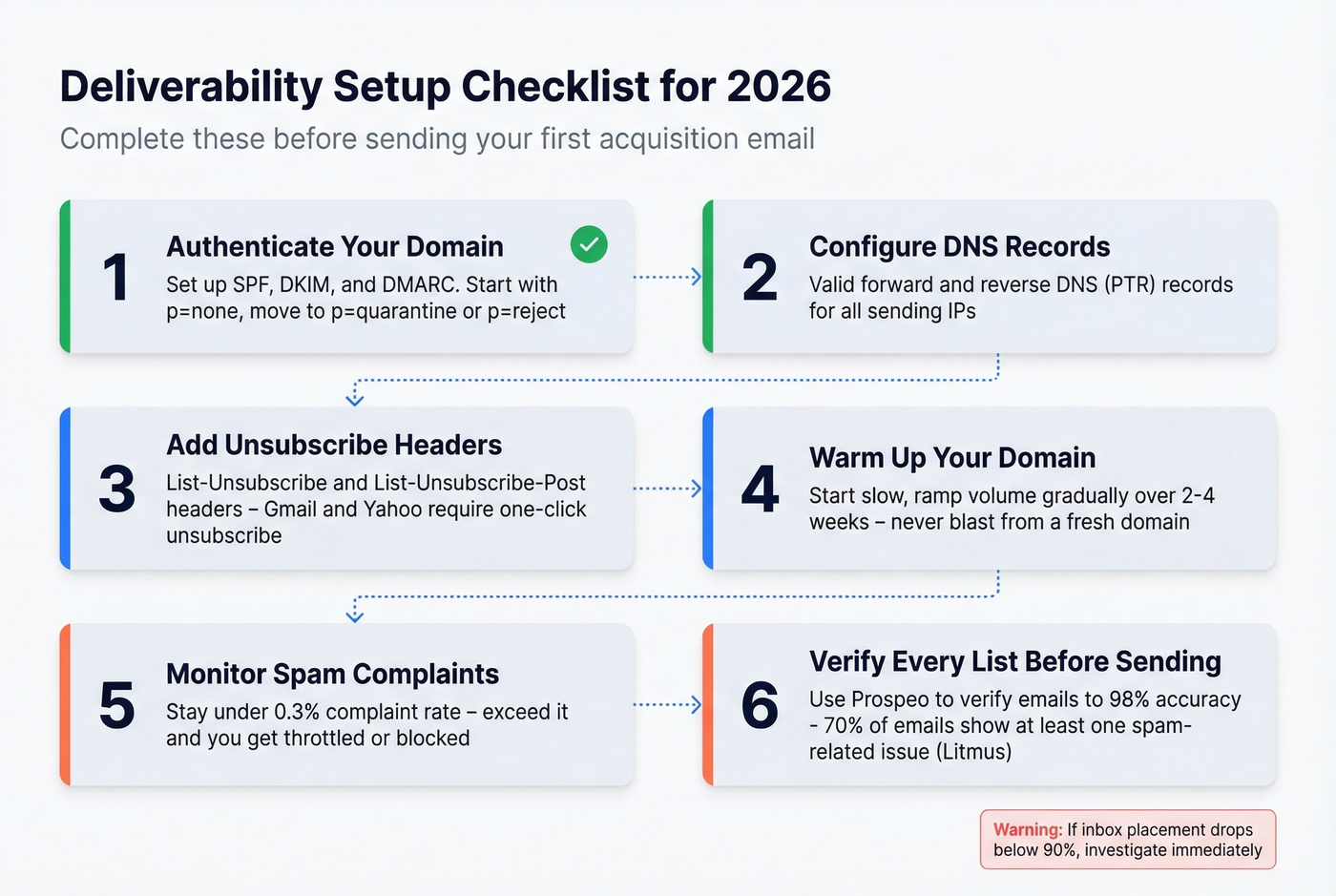
The non-negotiable technical checklist:
- SPF, DKIM, and DMARC - all three, configured correctly. DMARC at minimum
p=none, thoughp=quarantineorp=rejectis better for reputation. - Valid forward and reverse DNS (PTR) records for your sending IPs
- One-click unsubscribe via
List-UnsubscribeandList-Unsubscribe-Postheaders - Gmail and Yahoo require this - Spam complaints under 0.3% - exceed it consistently and you're getting throttled or blocked
- Unsubscribe processing within 2 days - not 10, not a week
- ARC headers for forwarded messages to preserve authentication results
Litmus found that 70% of emails show at least one spam-related issue. Most senders are closer to the edge than they think. If you drop below 90% inbox placement, investigate immediately. (For a full diagnostic flow, use our email deliverability guide.)
Verification before sending is non-negotiable. Sending to unverified lists in 2026 is like driving without insurance: you might be fine for a while, but the crash will be expensive.
How to Build a Prospect List
Every guide spends 80% of its word count on subject lines and templates. That's backwards. The single biggest determinant of campaign success is whether you're emailing real people at real addresses who have some reason to care about what you're selling.
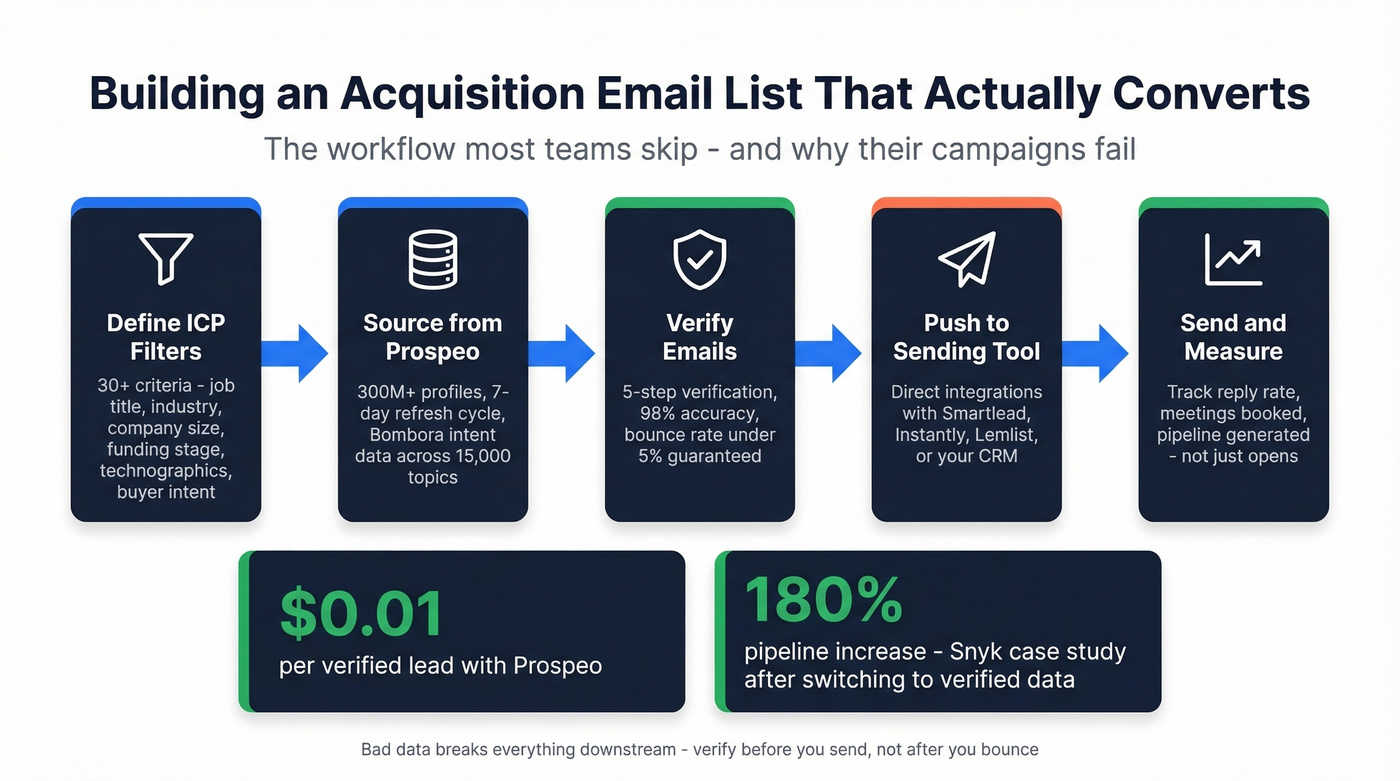
We've seen this pattern repeatedly: a team invests in a slick sequence tool, writes compelling copy, warms up their domains properly - and then feeds the whole machine a list where 30% of the emails bounce. The domain gets flagged within a week. The copy didn't matter. The warm-up didn't matter. The data was bad, and everything downstream broke. (If you're building lists at scale, see our lead generation workflow.)

Prospeo solves this at the source. The database covers 300M+ professional profiles with 98% email accuracy and a 7-day refresh cycle - compared to the 6-week industry average. You can filter by 30+ criteria including buyer intent powered by Bombora across 15,000 topics, technographics, job changes, headcount growth, funding stage, and revenue. Set your filters, preview results, export verified contacts, and push them directly to Smartlead, Instantly, Lemlist, or your CRM. (To tighten targeting, use an ideal customer profile scorecard.)
The Meritt team is a good example of what clean data does. They were running a 35% bounce rate before switching. After, bounces dropped under 4% and pipeline tripled from $100K to $300K per week. Connect rates went from single digits to 20-25%.
At roughly $0.01 per lead with a free tier of 75 emails per month, that's a fraction of what enterprise data platforms charge. Compare that to running a third-party campaign through a vendor like Data Axle or Claritas, where minimum spends often start around $5K+ per campaign.
Acquisition email ROI lives or dies on list quality. Prospeo gives you 300M+ profiles with 30+ filters - buyer intent, technographics, job changes, funding - so every cold email hits someone who actually matches your ICP. All at $0.01 per email with a 7-day data refresh cycle.
Build acquisition lists that convert instead of lists that bounce.
Templates That Convert
64% of recipients decide whether to open an email based on the subject line. But a great subject line with a generic body just creates a faster path to the trash folder. (If you need options, pull from these email subject line examples.)
The intro/value prop leads with who you are and why you're reaching out in one sentence. Second sentence delivers a specific, quantified value claim. Close with a low-friction ask - "worth a 15-minute call?" not "let me know when you're free for a demo."
The pain-point opener names a specific problem the prospect's role deals with. Use intent signals or job posting data to identify real pain. "I noticed you're hiring three SDRs - scaling outbound without burning domains is brutal" hits harder than "I help companies grow." The specificity is what earns the reply.
The social proof template works best as a before/after. Lead with a result from a similar company: "We helped [company in their industry] cut bounce rates from 35% to under 4% and triple pipeline." Vague claims like "we help companies like yours" are meaningless - the reader's brain discards them instantly.
The follow-up sequence should add value, not just nudge. Day 1: initial email. Day 4: reply with one new piece of value - a relevant stat, a case study, a specific observation about their company. Day 9: final attempt, shorter and more direct. One follow-up is expected; three is persistent; five is spam. (If you want plug-and-play copy, use these sales follow-up templates.)
For subject lines, keep them under 50 characters, avoid spam trigger words, and personalize beyond {first_name}. "[Mutual connection] suggested I reach out" outperforms "[First name], quick question" every time - when you actually have the mutual connection.
Self-Service List-Building Strategies
If your acquisition strategy is opt-in rather than cold outreach, you're creating reasons for people to give you their email voluntarily. This self-service model puts the prospect in control - they discover your brand, see value, and opt in without a sales rep ever touching the interaction.
The highest-leverage tactic is reducing friction on your signup forms. Companies often see conversion rates double when they cut form fields from four down to one. Name and email is fine - job title and company can come later through progressive profiling.
Pop-up timing matters more than pop-up design. The best-performing triggers are 30-second time delays, 50% scroll depth, and exit intent - not the instant page-load pop-up that everyone hates. Buffer tested this aggressively and saw a 130% increase in monthly signups by adding eight new signup sources across their site.
Lead magnets still work when they're genuinely useful: templates, calculators, benchmark reports, free tools. "Download our guide" converts worse than "Get the 2026 cold email benchmark spreadsheet." Specificity wins.
For platforms, ActiveCampaign is our recommendation for anyone past the beginner stage. Its conditional automation flows, lead scoring, and segmentation capabilities are meaningfully better than what Mailchimp offers until its higher tiers - you can build branching sequences that trigger based on engagement behavior like opens, clicks, and site visits, then score leads automatically so sales only gets notified when someone crosses a threshold. Mailchimp is fine if you need simplicity and are just getting started.
Measuring Performance
Cold outreach and list building require different scorecards.
Cold outreach: Reply rate is the metric that matters most - aim for 3-5% minimum. Track meeting/booking rate downstream, keep bounce rate under 5% (under 2% is excellent), and monitor domain reputation via Google Postmaster Tools. (If you're getting throttled, start with how to improve sender reputation.)
List building: Focus on subscriber growth rate (net new minus unsubscribes), click-through rate benchmarked against the 2.62% all-industry average, and revenue per email if you're in e-commerce. Engagement means clicks, not opens - Apple MPP makes open rates unreliable.
I've seen campaigns report 45% open rates that generated zero replies. Track what people do after opening - clicks, replies, conversions - not whether a tracking pixel fired.
Skip this section if your pipeline is healthy. But if it's thin, the fix is almost always upstream: better data, tighter targeting, more relevant messaging. Most teams underinvest in acquisition and over-optimize retention.
FAQ
Is acquisition email the same as spam?
No. Spam is unsolicited bulk email sent without targeting, compliance, or relevance. A proper acquisition email uses verified data, authentication (SPF/DKIM/DMARC), and relevant messaging directed at specific prospects. The difference is intent and execution - spam is a firehose, targeted outreach is a rifle.
What's a good reply rate for cold outreach?
For well-targeted cold campaigns, 1-5% reply rates are typical. Warm campaigns layering intent data or referrals can hit 8-12%. Above 5% on purely cold email means your data quality and messaging are both working. Below 1%, something's broken - usually the list.
Do I need consent to send acquisition emails?
In the US, CAN-SPAM allows commercial email without prior consent but requires an opt-out mechanism, physical address, honest headers, and honoring unsubscribes within 10 business days. GDPR (EU/UK) requires a legitimate interest basis. CASL (Canada) requires express consent in most scenarios.
What tools help with data quality?
Prospeo offers 98% email accuracy with a 7-day refresh cycle and a free tier of 75 emails/month - strong for teams that need verified contacts without enterprise pricing. Hunter and Snov.io are lighter alternatives for lower-volume prospecting. For opt-in list management, ActiveCampaign and Mailchimp handle subscriber hygiene and engagement scoring.
What's the difference between acquisition and retention email?
Acquisition email targets people who aren't yet customers - you're starting a relationship. Retention email nurtures existing subscribers or buyers to drive repeat engagement and revenue. They require different data sources, different compliance approaches, and different success metrics.