

The AI Email Marketing Strategy Playbook for 2026
You turned on AI copy generation, built more automations than your team can track, and tripled your send volume in six months. Revenue stayed flat. Unsubscribes climbed.
56% of marketing orgs are actively implementing AI, and 73% say it plays a role in personalization - but most are just sending more emails faster, not sending better ones. Meanwhile, 70% of marketing teams report their employer provides zero generative AI training. AI made you faster. It didn't make you smarter. That's the gap a real AI email marketing strategy closes, and that's what this playbook delivers.
The 10-Minute Version
If you only have 10 minutes on Monday morning, do these three things:
- Segment by lifecycle stage before you automate anything. Non-buyers, first-time buyers, repeat customers, and VIPs should never get the same email.
- Protect deliverability with proper authentication (SPF/DKIM/DMARC) and list hygiene before scaling AI sends. Volume without infrastructure is a domain reputation death sentence.
- Measure clicks and conversions - not opens. Open rate is broken. Revenue per recipient is the metric that matters.
2026 Benchmarks - What Good Looks Like
You can't optimize what you can't measure. Here's where performance sits right now, based on two large ESP datasets.
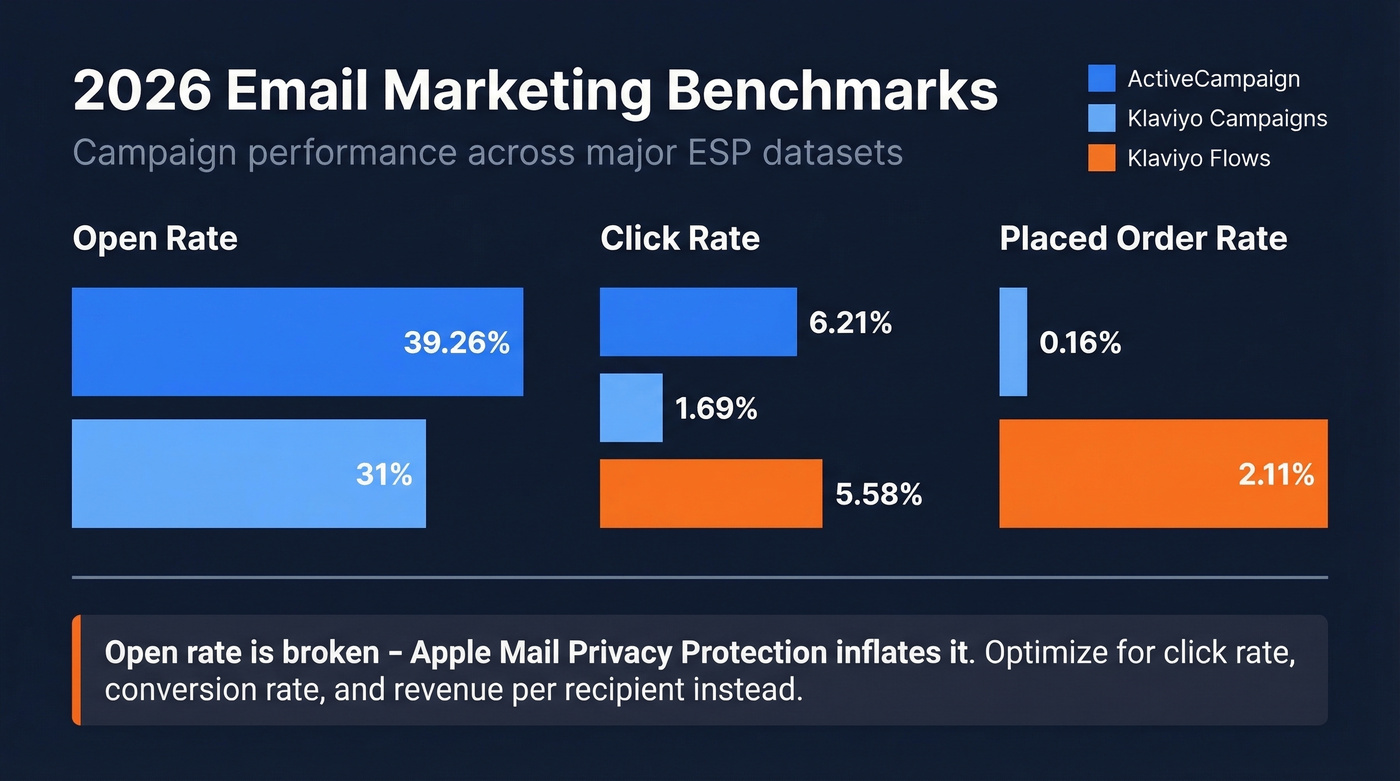
| Metric | ActiveCampaign (2025 sends) | Klaviyo Campaigns (183K+ brands) | Klaviyo Flows |
|---|---|---|---|
| Open rate | 39.26% | 31% | N/A |
| Click rate | 6.21% | 1.69% | 5.58% |
| Placed order rate | N/A | 0.16% | 2.11% |
| Top 10% click rate | N/A | 3.38% | 10.48% |
The gap between ActiveCampaign's 6.21% click rate and Klaviyo's 1.69% isn't because one platform is "better." It's because the datasets aren't apples-to-apples. ActiveCampaign's benchmarks reflect its customer base across multiple industries and campaign types, while Klaviyo's are ecommerce-centric and split between campaigns vs. automated flows. Your benchmark depends on your vertical and your email mix, not your ESP.
Open rate is directional at best. Apple Mail Privacy Protection auto-opens emails, inflating the number for anyone with a meaningful iOS audience. Optimize for click rate, conversion rate, and revenue per recipient - those are the numbers that survive inbox filtering changes.
7-Step AI Email Marketing Strategy Framework
Most AI email advice boils down to "use AI to write subject lines and optimize send times." That's tactics without a system. We've tested this framework across dozens of campaigns, and the order matters - skipping steps is how teams end up with higher volume and lower revenue.
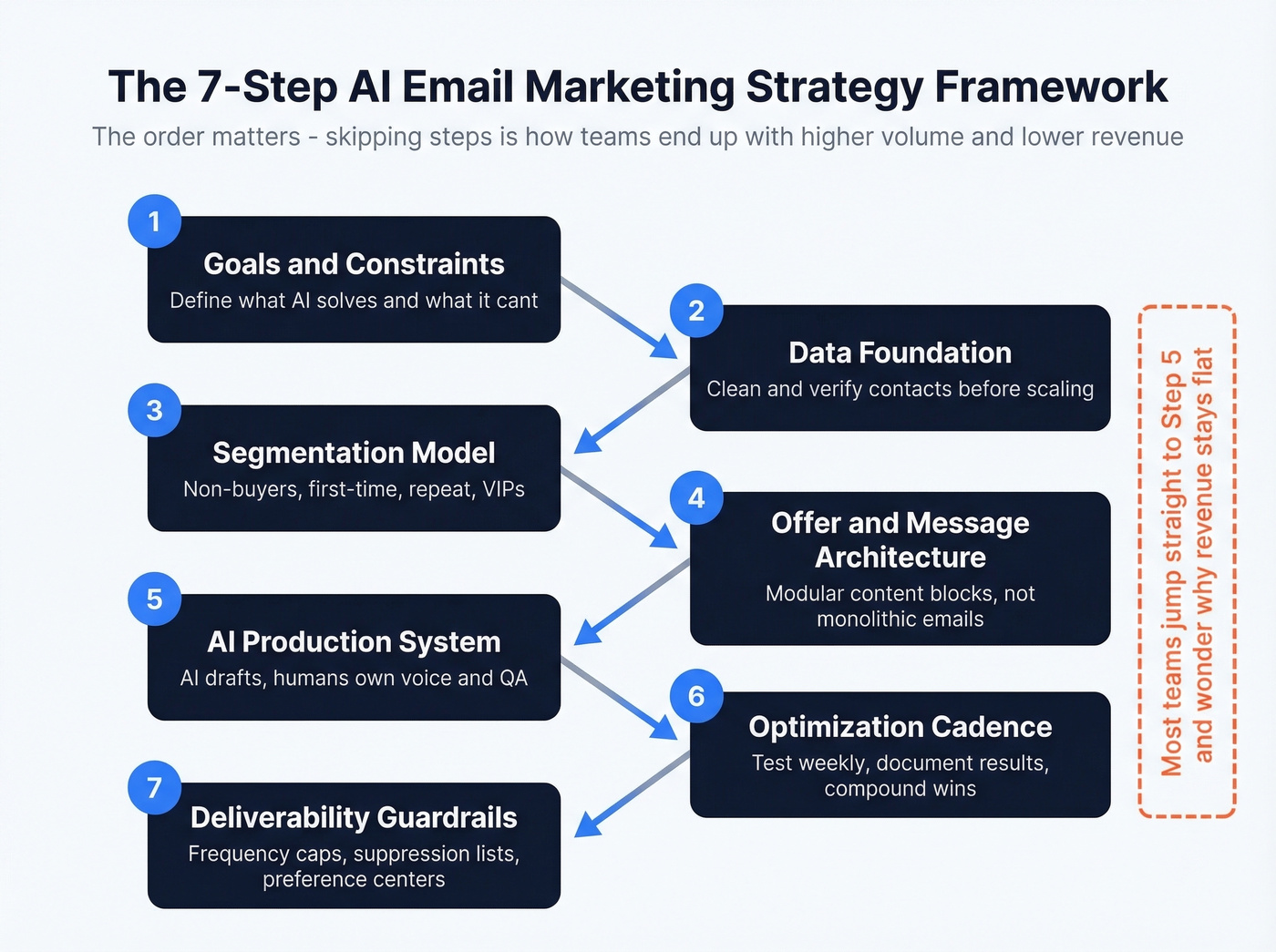
Step 1: Goals and Constraints
Define what AI is solving and what it can't. Two distinct types of AI are at play: predictive AI (send-time optimization, churn scoring, next-best-action) and generative AI (drafting copy, subject lines, image variants). Predictive AI excels at pattern recognition across large datasets. Generative AI excels at speed and scale. Neither is good at strategy, relevance, or brand voice.
Here's the thing: AI makes your current strategy louder. If the strategy is bad, AI amplifies the damage. Before you touch a single AI tool, answer two questions - what's the revenue goal for email this quarter, and what's the maximum send frequency your audience will tolerate? Everything else flows from those constraints.
Step 2: Data Foundation
Your segmentation is only as good as your contact data. Stale emails, invalid addresses, and outdated job titles don't just hurt open rates - they destroy deliverability when AI scales your volume. Inbox providers watch bounce rates and engagement signals in real time, and when you scale volume with bad data, small problems become big deliverability problems overnight.
Before scaling AI-driven email campaigns, clean and enrich your contact data. Prospeo verifies emails in real time with 98% accuracy and refreshes records every 7 days, so your segmentation starts from clean data instead of guesswork. Upload a CSV, run bulk verification, and know exactly which addresses are valid before your first AI-generated campaign goes out.
Step 3: Segmentation Model
Most guides say "segment your list." Let's talk about what that actually means in practice.
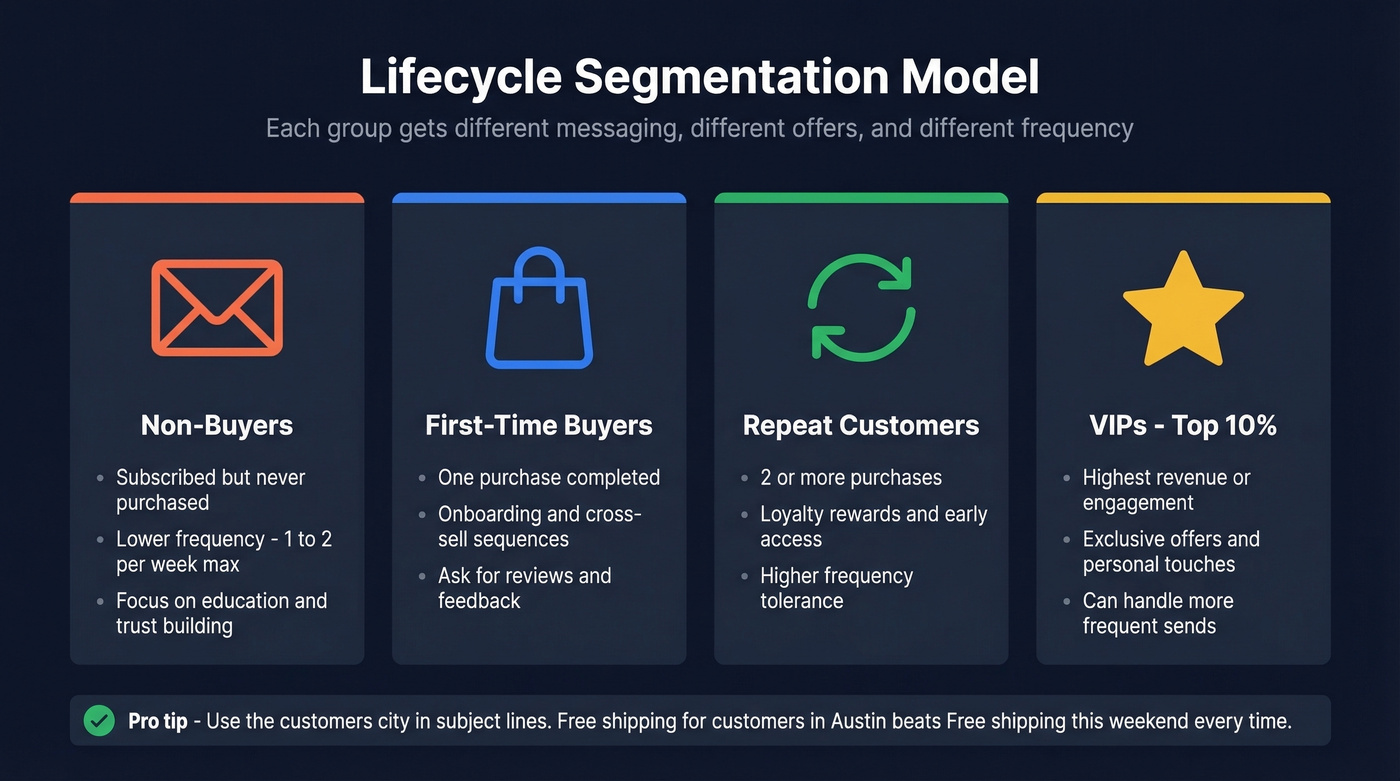
At minimum, you need four lifecycle stages: non-buyers who've subscribed but never purchased, first-time buyers, repeat customers with two or more purchases, and VIPs in the top 10% by revenue or engagement. Each group gets different messaging, different offers, and different frequency. A practitioner who managed email for 40+ ecommerce brands found that splitting by these segments improved opens and revenue while reducing unsubscribes.
One tactic that consistently doubled open rates in their testing: using the customer's city in the subject line. "Free shipping for customers in Austin" beats "Free shipping this weekend" every time. That's not AI magic - it's data hygiene meeting basic personalization. (If you want more examples, see AI Email Personalization.)
For B2B teams, layer in signal-based segmentation. Job changes, funding rounds, and hiring surges are buying signals that most marketers ignore entirely. New executives enter a 90-day buying window where they're actively evaluating vendors, and only 5% of sales teams personalize every email to capture those moments. If you're in B2B, segment by intent signals, not just firmographics. (Related: how to identify buyer intent signals and technographics.)
Step 4: Offer and Message Architecture
Build modular content blocks, not monolithic emails. Create a variant library - three subject line angles, two hero image options, two CTA treatments - and let AI assemble combinations matched to each segment. The architecture matters more than any individual piece of copy.
The trap is what Entrepreneur calls "personalization without insight": AI-generated dynamic blocks and timed schedules that look personalized but aren't grounded in customer intent. The result is higher unsubscribe rates and stagnant revenue. Match the offer to the segment's actual behavior, not just their name and location.
Step 5: AI Production System
Use AI for the grunt work - first drafts, subject line variants, tone adjustments, copy alternatives. Humans own voice, strategy, and final QA. Tools like Litmus Assistant can suggest subject lines and copy alternatives in different tones, which speeds up production without surrendering editorial control. (If you're evaluating tools, compare options in our AI email writer guide.)
Here's a contrarian take: fewer, higher-signal variants with strict QA beat 50 AI-generated versions every time. Salesforce found that AI enabled 10x more A/B variants for some marketers, but more variants only help if you have a system to measure winners and kill losers. Without that system, you're just creating more noise.
One responsible AI note: always disclose AI-generated content where regulations require it, and never let AI fabricate customer testimonials or fake social proof. The speed gains aren't worth the trust damage.
Step 6: Optimization Cadence
Test weekly. Subject lines, send times, and segment splits are the three highest-leverage variables. (For timing, see best days to send email marketing.)
Run each test for a statistically significant sample, declare a winner, then resend the winner to non-openers with a new subject line. That resend tactic alone can add 25-50% more revenue per campaign. The discipline isn't in running tests - it's in documenting results and compounding learnings. Keep a shared log of what won, what lost, and why. After 12 weeks, you'll have a playbook worth more than any AI tool.
Step 7: Deliverability Guardrails
This step gets its own section below, but the framework version is simple: set frequency caps per segment, maintain suppression lists for disengaged contacts with no engagement in 90+ days, and offer a preference center so subscribers can choose frequency instead of unsubscribing entirely.

AI scales your email volume - bad data scales your bounce rate. Prospeo verifies emails with 98% accuracy on a 7-day refresh cycle, so every AI-generated campaign lands on real inboxes. Upload your list and know which addresses are valid before you hit send.
Clean data is the foundation. Build yours for $0.01 per email.
Deliverability in AI-Filtered Inboxes
Modern spam filters don't just check keywords. They're ML models evaluating sender reputation, engagement behavior, content structure, and real-time user interactions - opens, clicks, replies, deletions, even scroll depth on mobile. Two recipients can see the same campaign land in completely different places.
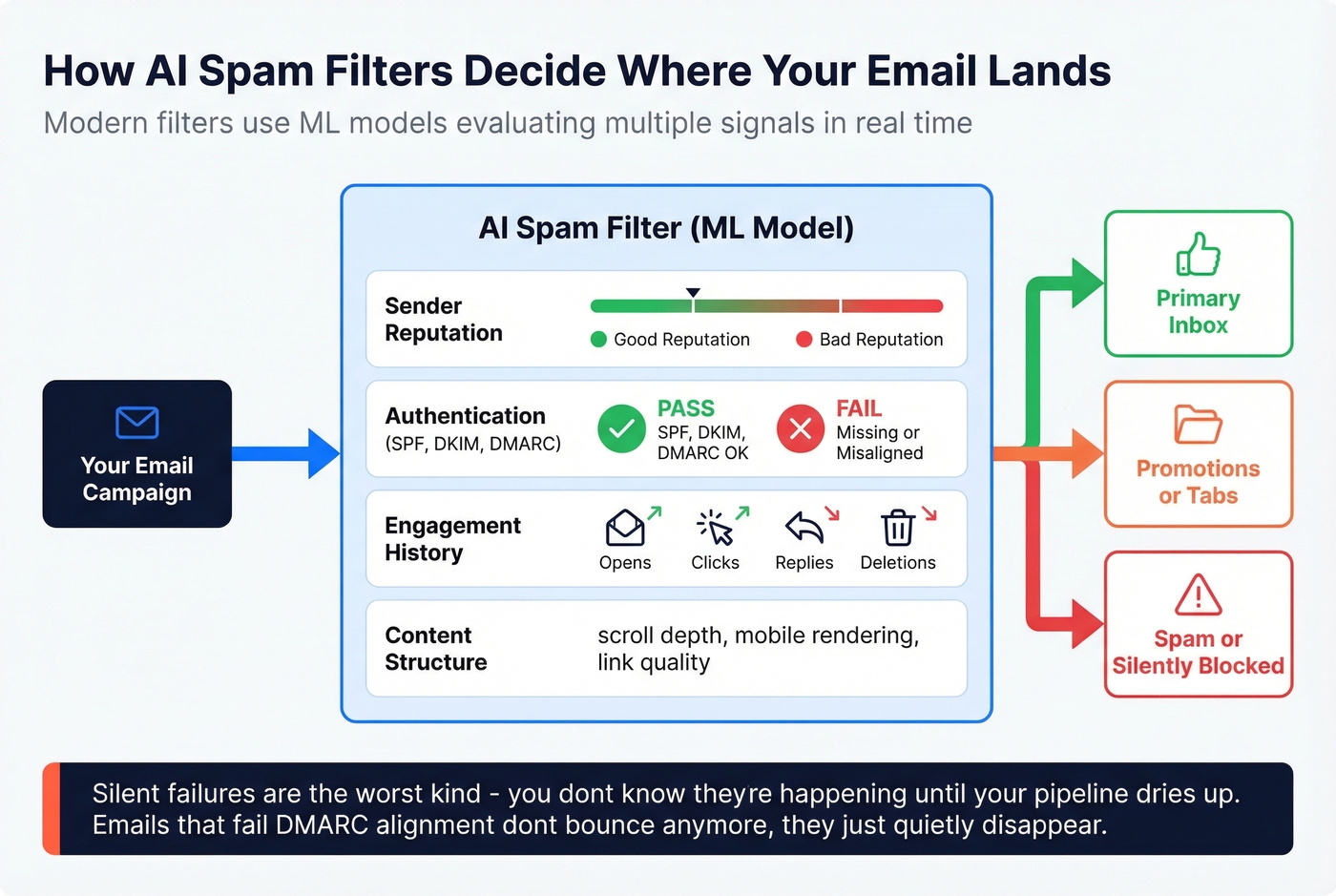
Google tightened email filtering in late 2025 and early 2026, and the bar for authentication is higher than "just have the records." Having SPF, DKIM, and DMARC configured isn't enough - they must be correct, aligned, and actively enforced. Emails that fail alignment don't bounce anymore. They quietly land in spam, get delayed, or get selectively blocked. Silent failures are the worst kind because you don't know they're happening until your pipeline dries up. (If you need a deeper walkthrough, start with sender authentication and then run an email reputation check.) Your deliverability checklist:
- Align your SPF record with your sending domain - no multiple SPF records, and watch DNS lookup limits
- Match DKIM signatures to the From domain, not just the sending IP
- Move your DMARC policy beyond p=none (major providers treat p=none as incomplete)
- Clean your list before every major campaign or import (see spam trap removal)
- Suppress contacts with zero engagement in 90+ days
- Set frequency caps per segment - VIPs can handle more; non-buyers can't
Three Failure Modes That Kill AI Email Programs
We've seen the same three patterns destroy AI-powered email campaigns over and over.
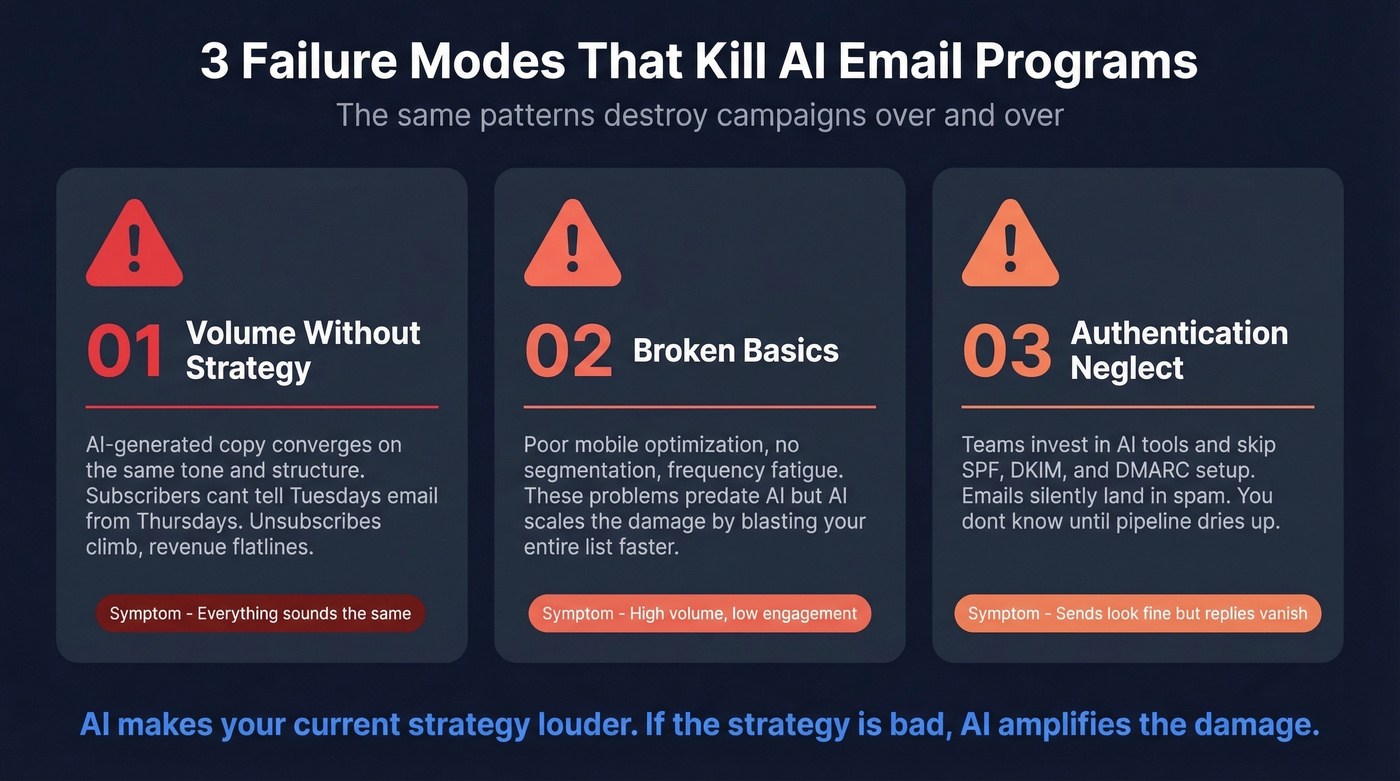
Failure mode 1: Volume without strategy. Your team ships emails faster than ever, but they all sound the same. AI-generated copy converges on the same tone, the same structures, the same calls to action. Subscribers can't tell Tuesday's email from Thursday's. Unsubscribes climb, revenue flatlines. The consensus on r/EmailWhisperers is blunt: brands are leaning on automation instead of strategy.
Failure mode 2: Broken basics. Poor mobile optimization, no segmentation, and frequency fatigue predate AI - but AI makes them worse by scaling the damage. Blasting your entire list with AI-personalized content is still blasting your entire list. (If you're doing high-volume sends, keep an outbound email spam prevention checklist handy.)
Failure mode 3: Authentication neglect. Teams invest in AI tools and ignore SPF/DKIM/DMARC alignment, then wonder why inbox placement dropped 20% after scaling sends. Fix the plumbing before you turn up the water pressure. (More: inbox placement.)
Tool Stack - What You Actually Need
You don't need 12 tools. You need four categories covered, and most SMB teams can do it for $100-300/mo total.
| Category | Tools | Price Range |
|---|---|---|
| ESP | ActiveCampaign, Klaviyo, Brevo, Mailchimp | ~$20-$300/mo |
| AI copy assistant | Jasper, ChatGPT, Claude | $0-$60/mo |
| QA / testing | Litmus | ~$80-$150/mo |
| Data / verification | Prospeo | ~$0.01/email, free tier |
Look - if your average deal size is under $15K, you probably don't need an $800/mo enterprise marketing stack. Most teams get 80% of the results from a $150/mo setup.
ActiveCampaign starts around $29/mo and is the most powerful automation builder in the SMB tier, but the learning curve is brutal and pricing ramps fast with contact count. Klaviyo starts around $20/mo and scales steeply - expect $100+/mo around 10K contacts. It's the obvious pick for Shopify/Woo ecommerce with genuinely strong segmentation and predictive analytics, but it's overpriced outside pure ecommerce. Brevo is the cost-control play with a free tier at 300 emails/day, plus SMS and a light CRM. Mailchimp's free tier covers up to 500 contacts for teams just getting started.
Skip the enterprise stacks like HubSpot Marketing Hub and Salesforce Marketing Cloud ($800+/mo) unless you're managing 50,000+ contacts and need the CRM depth to justify the spend. (If you're consolidating systems, map it against a RevOps tech stack.)
Job changes, funding rounds, hiring surges - the buying signals this article recommends segmenting by are already in Prospeo's database. Filter 300M+ profiles by intent data across 15,000 topics and layer in technographics, headcount growth, and job changes to build segments that actually convert.
Stop segmenting by firmographics alone. Segment by real buying signals.
FAQ
Will AI hurt my email deliverability?
Not directly - but AI-driven campaigns increase sending volume and variant count, which amplifies existing list-quality and authentication problems. Fix SPF/DKIM/DMARC alignment and clean your list before scaling. The AI itself isn't the risk; the volume it enables is.
What metrics should I track instead of open rate?
Click rate, conversion rate, revenue per recipient, and placed order rate for ecommerce. Open rate is unreliable due to Apple MPP auto-opens. Revenue per recipient is the single metric that connects email performance to actual business outcomes.
How many AI-generated variants should I test?
Start with 2-3 subject line variants per segment per send. More variants only help if you have a system to measure winners and kill losers quickly. In our experience, most teams get more lift from tighter segments than from more variants.
What's a good free tool for keeping contact data clean?
Prospeo offers a free tier with 75 email verifications per month and includes catch-all handling plus spam-trap removal. For teams outgrowing free plans, its credit-based pricing runs about $0.01 per email - significantly cheaper than enterprise verification tools.