

The Best AI Tools for B2B Marketing: What Actually Works in 2026
Every "AI tools for B2B marketing" list looks the same - thirty tools, no pricing, no accuracy data, and a suspiciously generous review of whoever's sponsoring the post. 89% of revenue orgs now use AI, and the performance gap is real: 83% of AI-using sales teams report revenue growth versus 66% without. The question isn't whether to adopt AI. It's which tools actually move pipeline and which ones just burn budget.
After testing and deploying most of these across real B2B teams, here's what we know: you need 3-5 tools, not 15, and the right combination depends entirely on where AI creates the most impact for your specific motion. We're giving you real pricing, accuracy benchmarks, and honest opinions on 14 tools - organized by the B2B marketing functions that actually drive revenue.
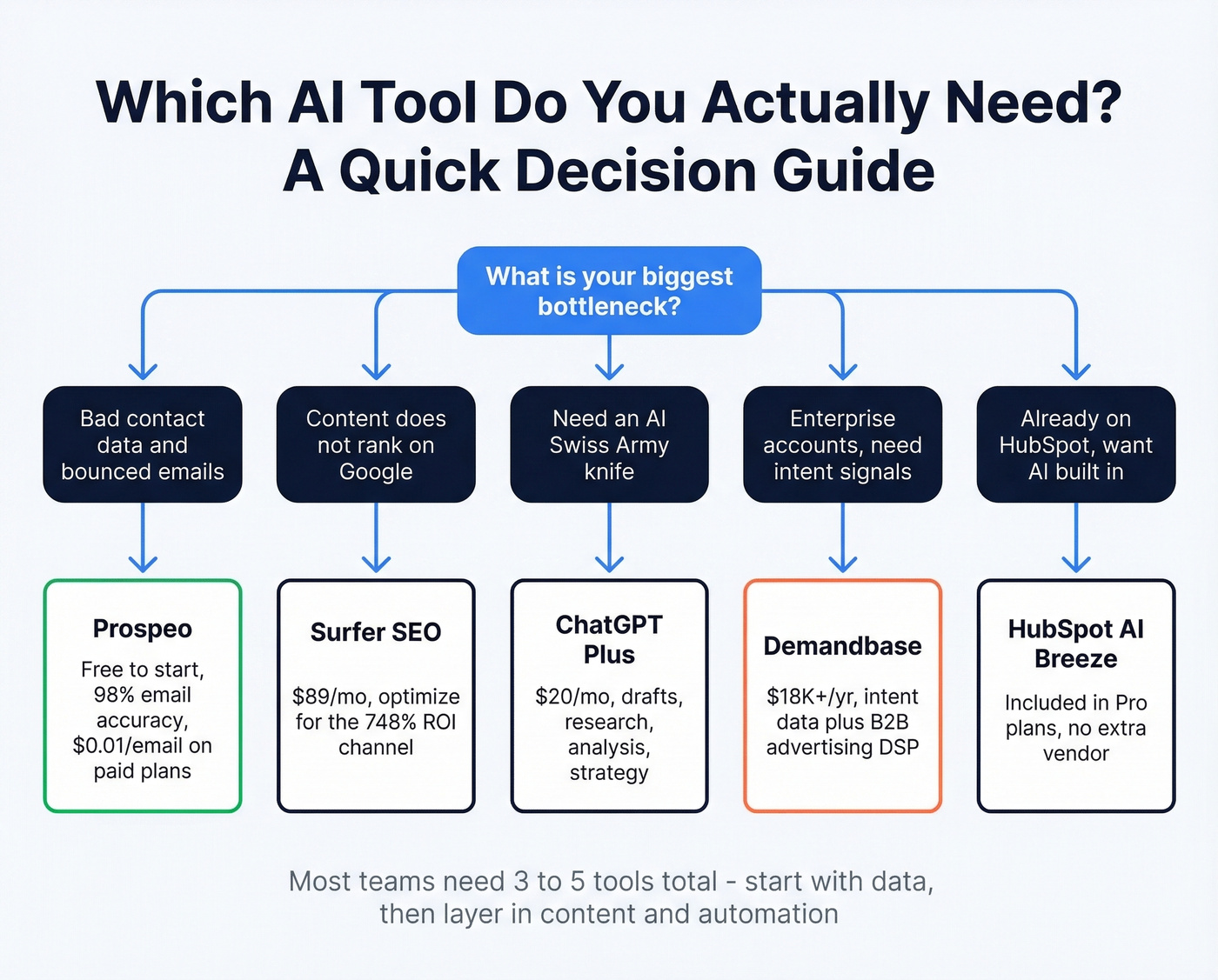
Our Picks (TL;DR)
If you don't read another word, here's the cheat sheet.
| Category | Tool | Starting Price | Best For |
|---|---|---|---|
| B2B data & prospecting | Prospeo | Free (75 emails/mo) | 98% email accuracy, verified mobiles |
| Content & SEO | Surfer SEO | $89/mo | AI content optimization |
| All-in-one (small teams) | ChatGPT Plus | $20/mo | Content, strategy, analysis |
| Enterprise ABM | Demandbase | ~$18K+/yr | Intent data + B2B advertising |
| Workflow automation | HubSpot AI (Breeze) | Included in Pro plans | Teams already on HubSpot |
These aren't the only good tools - they're the ones that deliver the most ROI per dollar in their categories.
Where AI Creates the Most ROI in B2B
Not all B2B marketing channels benefit equally from AI. Before picking tools, know where the highest-ROI channels sit - because that's where AI amplification matters most.
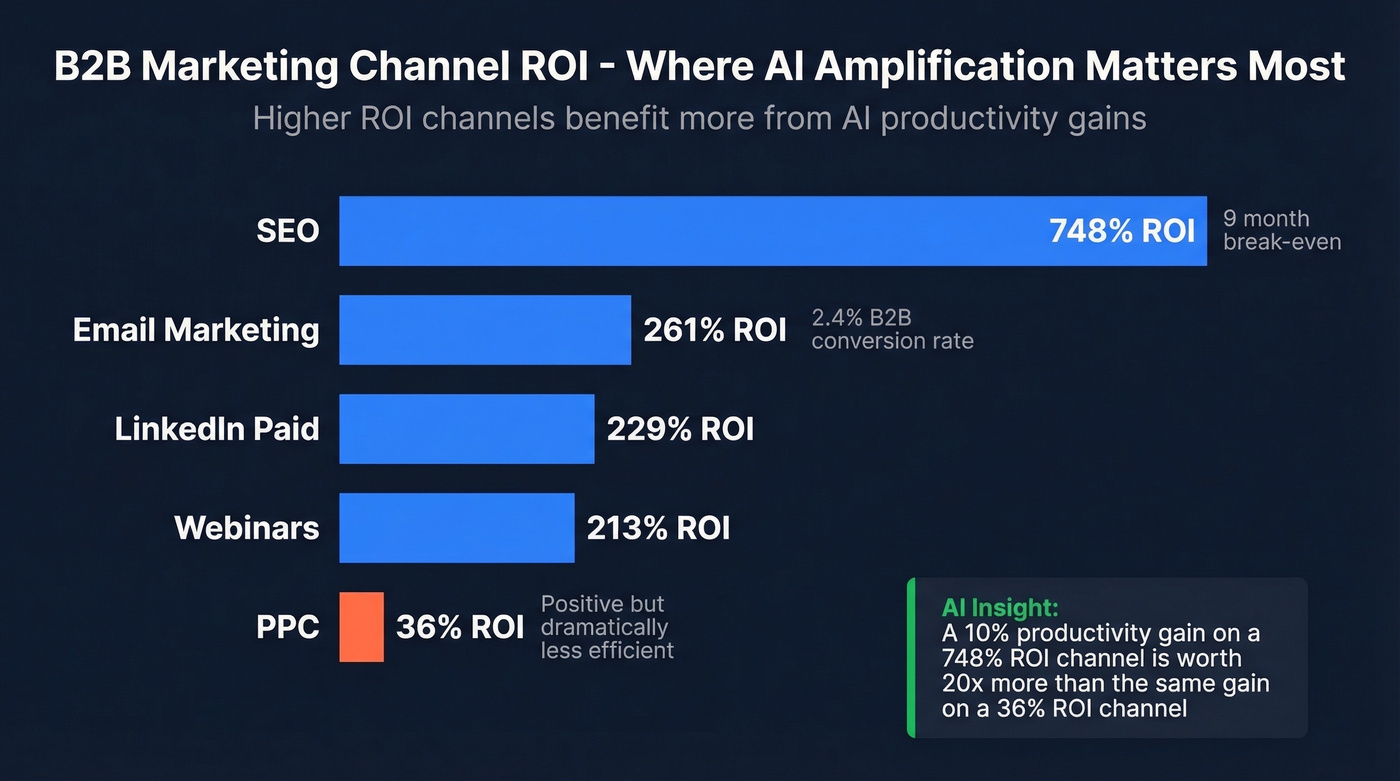
SEO delivers roughly 748% ROI over a three-year window, with break-even around nine months. Email marketing runs about 261% ROI with a 2.4% B2B conversion rate. LinkedIn paid sits at 229%, webinars come in at 213%, and PPC delivers just 36% ROI - still positive, but dramatically less efficient.
McKinsey estimates that generative AI boosts marketing productivity 5-15% and sales productivity 3-5%. Those aren't transformative numbers on their own. The compounding effect comes from applying AI to the highest-ROI channels - using it to scale SEO content production, verify email lists before outbound, or automate ABM targeting. A 10% productivity gain on a 748% ROI channel is worth far more than a 10% gain on a 36% ROI channel. That's how AI-powered marketing growth actually works: not a single magic tool, but strategic application on channels that already convert.
The next frontier is agentic workflows - AI systems that don't just assist individual tasks but orchestrate multi-step processes across tools autonomously. Model Context Protocol (MCP) is emerging as the connective tissue that lets AI agents interact with your CRM, enrichment tools, and sequencers in a single chain. We're early, but the teams building agentic pipelines today (think Clay enrichment into AI scoring into automated sequence assignment) are already seeing 2-3x the throughput of teams using these tools in isolation.
That logic drives the tool categories below. We've organized them by B2B marketing function, starting with the foundation layer - data - and working up through content, automation, ABM, and emerging categories.
14 Tools Tested Across Every B2B Function
B2B Data & Prospecting
Every AI marketing tool downstream - your ABM platform, your sequencer, your enrichment workflows - is only as good as the contact data feeding it. AI prospecting saves 4-7 hours per rep per week, but only if the data is clean. This category is the foundation.
Prospeo
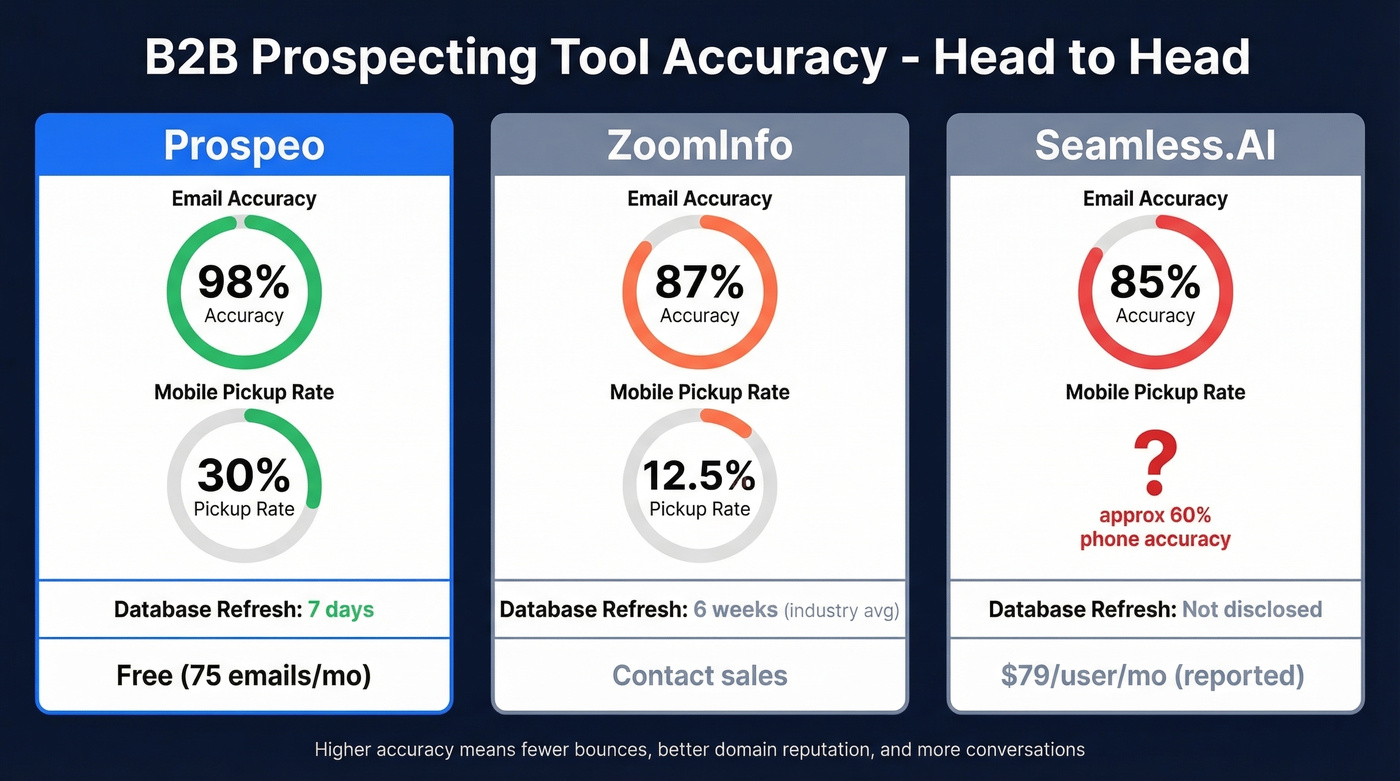
Prospeo's database covers 300M+ professional profiles, 143M+ verified emails, and 125M+ verified mobile numbers. All of it refreshes on a 7-day cycle - the industry average is six weeks, which means most databases serve you contacts who changed jobs a month ago.
The accuracy gap is the real differentiator. 98% email accuracy and a 30% mobile pickup rate, compared to ZoomInfo at 87% email accuracy and 12.5% mobile pickup, or Seamless.AI at ~85% email accuracy. When you're running outbound at scale, that accuracy gap translates directly into fewer bounces, better domain reputation, and more conversations.

The platform includes 30+ search filters - buyer intent powered by Bombora across 15,000 topics, technographics, job change signals, headcount growth, and funding data - plus native integrations with Salesforce, HubSpot, Lemlist, Instantly, and Clay. Real results: Snyk saw AE-sourced pipeline jump 180% after switching, and Meritt tripled their pipeline from $100K to $300K per week.
Use this if you need verified contact data as the foundation for outbound, ABM, or enrichment workflows. Pricing starts free with 75 emails per month; paid plans run about $0.01 per email with no annual contracts.
Apollo.io
Apollo is the obvious starting point for SMB teams that want prospecting and outreach in one tool. The free tier is genuinely useful - limited credits, a basic sequencer, and access to a massive contact database. Paid plans start at $49/user/month and scale up with more credits and features.
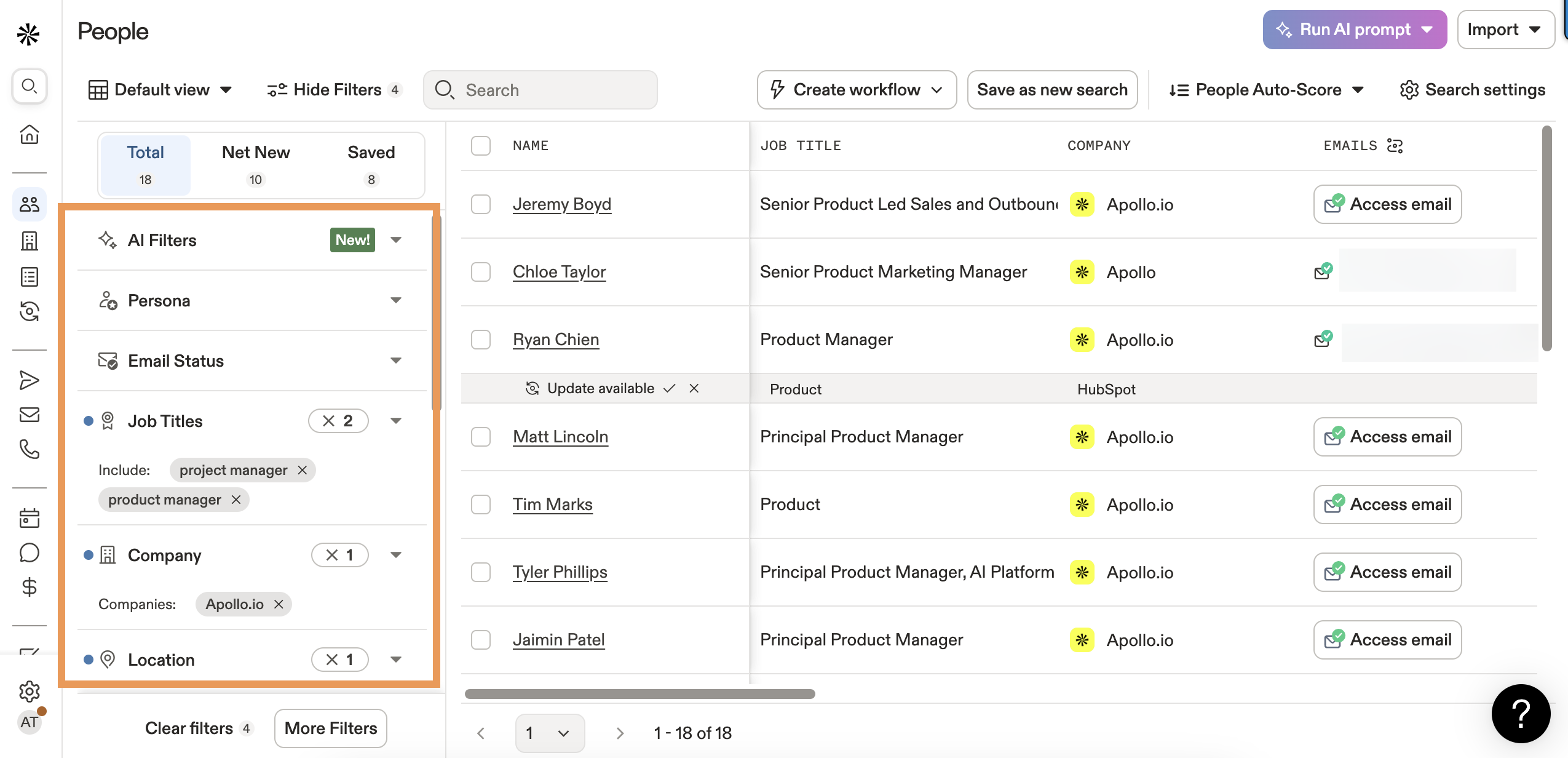
Where Apollo shines is the all-in-one workflow: find a prospect, add them to a sequence, and track engagement without leaving the platform. Where it falls short is data accuracy - email verification rates run lower, and mobile number coverage is thinner, particularly outside North America. We've seen teams start on Apollo for the convenience, then layer in a verification step before sequences go live.
Use this if you're a small team that wants prospecting plus outreach in one platform and you're willing to verify emails separately. Skip this if email deliverability is mission-critical and you can't afford bounces above 3-4%.
Seamless.AI
Seamless.AI offers a free plan with 1,000 credits per year - enough to test, not enough to run a campaign. The real pricing is opaque: you have to talk to sales, but user-reported Pro pricing lands around $79/user/month with 1,000 credits included. Extra credits cost $49 per 500, which adds up fast.
Use this if you need a quick-start prospecting tool and don't mind the credit model. Skip this if you care about pricing transparency or phone number accuracy - users on Reddit consistently report ~85% email accuracy and ~60% phone accuracy, and the top complaint is that credits burn faster than expected with no clear way to predict monthly spend.
Clay
Clay isn't a database - it's an orchestration layer. You pipe data from multiple sources through waterfall enrichment workflows. Starting at $134/month for 2,000 enrichment credits, it's best for RevOps teams building complex, multi-source data pipelines. This is where agentic AI gets practical: Clay lets you chain enrichment, scoring, and routing steps that run autonomously once configured. (If you're building lists inside Clay, see Clay enrichment workflows.)
Content Creation & SEO
SEO is the highest-ROI B2B marketing channel. These tools help you produce and optimize content at the pace AI enables.
ChatGPT
ChatGPT is table stakes. The free tier handles basic drafting, the Plus plan at $20/month unlocks GPT-4o and longer context windows, and the Team plan at $25/user/month adds workspace features. For B2B marketing, the strongest use cases are email draft generation, ICP research, competitive analysis, and content brief creation.
The limitation everyone knows but few plan around: hallucinations. 73% of marketing leaders cite hallucinations as a concern. For B2B content where accuracy matters - pricing pages, technical documentation, case studies - you need a human review layer. ChatGPT is a first-draft machine, not a publish button.
Surfer SEO
Surfer SEO turns ChatGPT drafts into content that actually ranks. The Essential plan runs $89/month, Scale is $129/month, and Scale AI hits $219/month with AI-generated articles included.
Given that SEO delivers 748% ROI, spending $89-$129/month to maximize that channel is one of the highest-return investments on this list. Skip this if you're not producing at least 4-8 pieces of content per month - the ROI doesn't justify it for occasional publishers.
Jasper
Jasper runs $39/user/month for Creator and $59/user/month for Pro. Its brand voice features are genuinely useful for teams with multiple writers who need consistent output.
Here's the thing, though - ChatGPT has closed the gap significantly. Jasper made more sense when GPT-3.5 was the baseline. Now it's a nice-to-have for brand consistency, not a must-have for content generation. If you're closing deals under $10K, you probably don't need it. ChatGPT Plus at $20/month covers 90% of what Jasper does, and the $19-$39/user/month difference adds up fast across a team.
Marketing Automation & CRM
HubSpot AI (Breeze)
HubSpot's AI features - branded as Breeze - are baked into Professional and Enterprise plans. You get predictive lead scoring, AI content generation, and workflow automation without adding another vendor to your stack.
Use this if you're already on HubSpot. The AI features are a natural extension of what you're already paying for, and they eliminate the integration headaches of bolting on separate tools. Skip this if you're not on HubSpot - buying a full CRM just for AI features makes no sense when cheaper point solutions exist.
Zapier deserves a quick mention here: free for 100 tasks/month, $19.99/month for Professional. It's the glue that connects tools that don't natively integrate, and almost every B2B marketing stack needs it. (If you're evaluating options, compare CRM automation software before you commit.)
ABM & Intent Data
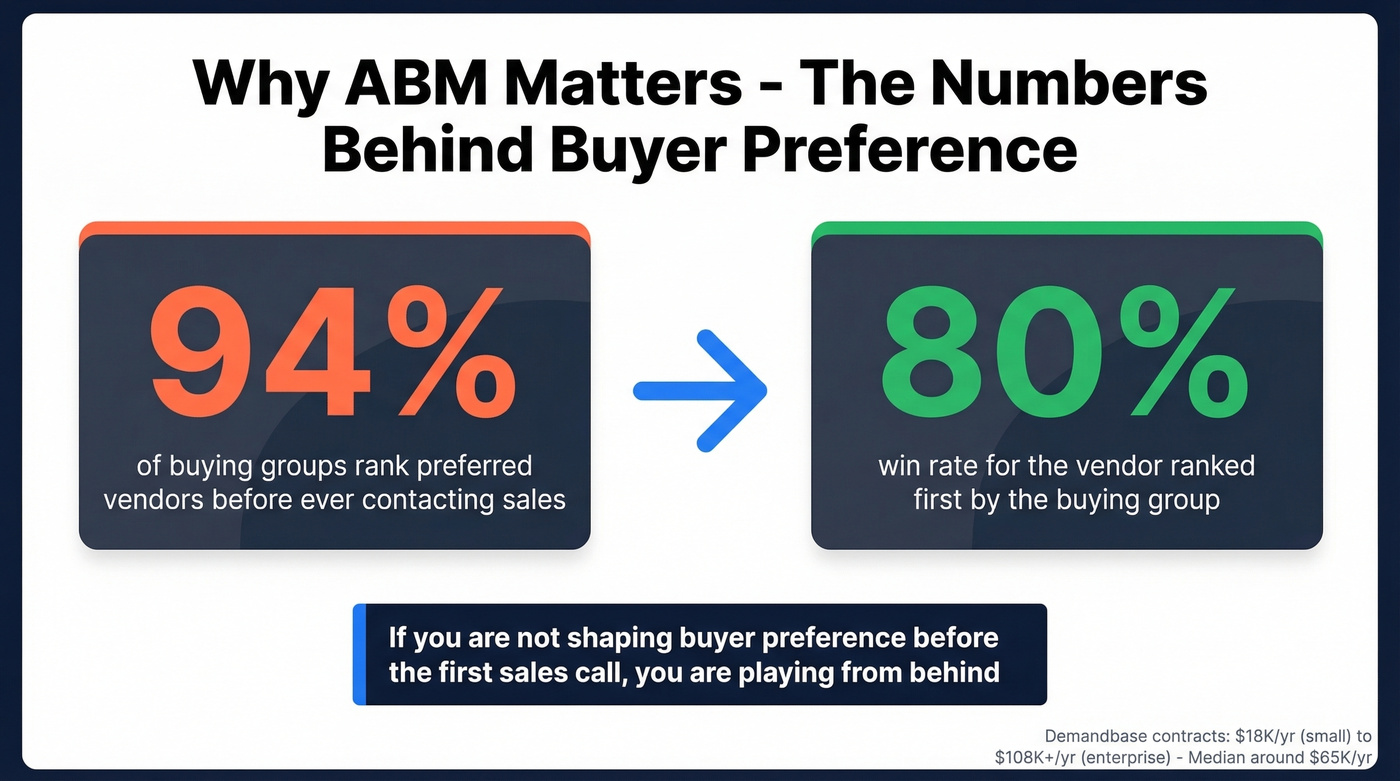
Here's a stat that should change how you think about ABM: 94% of buying groups rank preferred vendors before contacting sales, and the vendor ranked first wins roughly 80% of the time. If you're not shaping that preference before the first sales call, you're playing from behind.
Demandbase
Demandbase is the enterprise ABM platform most teams evaluate first, and for good reason. It combines intent data, account identification, and a native B2B advertising DSP in one platform. Gartner Peer Insights rates it 4.5/5 across 261 ratings, and G2 has it at 4.4/5 across 1,900+ reviews.
Let's talk pricing, because Demandbase won't. Contracts typically start around $18K/year for smaller companies, scale to about $42.8K-$60.8K for mid-market, and hit $58.5K-$108.6K+ for enterprise. The median contract runs about $65K/year. This is real money, and the pricing opacity is the #1 complaint in user reviews.
The strengths are genuine: intent data quality is among the best in market, Salesforce integration runs deep, and the advertising DSP lets you run account-targeted display without a separate ad platform. The tradeoffs are real too - company-level visitor identification only (not individual contacts), a steep learning curve, and 4-8 week implementation timelines. Compared to ZoomInfo's marketing product, Demandbase wins on advertising capabilities but lacks ZoomInfo's contact-level database depth. (If you're building a program from scratch, use an ABM project plan to avoid tool-led chaos.)
6sense
6sense is Demandbase's primary competitor, rated 4.4/5 on Gartner Peer Insights across 263 ratings. Custom pricing, typically $30K-$100K+/year depending on modules and company size.
Mature programs using 6sense report 208% more marketing-generated revenue and 171% higher contract values versus non-ABM approaches. Skip this if you don't have at least one person dedicated to ABM operations - the platform's power is wasted without someone configuring and optimizing it continuously. (Benchmarks help here: see account-based marketing benchmarks.)
Conversational AI & Video
Drift
Drift runs custom pricing - typically $2,500-$5,000+/month. AI chatbot lead qualification for high-traffic B2B websites with complex buying journeys. Worth it if you're getting 50K+ monthly visitors; overkill for most SMBs.
Synthesia
Synthesia starts at $18/month for Starter and $34/month for Creator. AI-generated video for sales enablement, product demos, and training content. The B2B use case is personalized outreach videos at scale without a production team - account-specific demo walkthroughs or onboarding videos generated in minutes instead of days.
Predictive Analytics & Forecasting
79% of sales orgs miss their forecast by more than 10%. That's the problem this category solves.
Clari
At $100-120/user/month, Clari isn't cheap, but AI forecasting platforms deliver 90-98% precision versus 60-75% for manual methods. Use this if you're a VP of Sales or RevOps leader tired of spreadsheet forecasts that miss by double digits. Skip this if your team is under 20 reps - the per-user cost doesn't justify itself until you have enough pipeline complexity to benefit from AI-driven forecasting.
Salesforce Einstein is worth a look for existing Salesforce orgs: $50-220/user/month per module, adding forecasting and lead scoring as add-ons rather than a separate platform. (If forecasting misses are a symptom, audit your sales pipeline management first.)
AI Search Visibility
This is the emerging category most B2B marketers are ignoring - and they shouldn't be. If your brand doesn't appear in ChatGPT, Perplexity, or Google's AI Overviews when buyers ask about your category, you're invisible to a growing segment of B2B researchers. The practice is called AI engine optimization (AEO), and it's becoming as important as traditional SEO for brand discovery.
Otterly AI tracks your brand's presence across LLM responses at $29/month for 15 prompts or $189/month for 100 prompts. Profound offers a more robust alternative at $99-$399/month covering multiple AI engines. I haven't tested this category deeply enough to recommend one tool confidently, but the category itself is a must-watch for any B2B marketing team investing in organic visibility.
Honorable mentions: Grammarly (free-$15/user/month+) for B2B content polish, Copy.ai for marketing copy workflows, and AdCreative.ai ($19-$141/month) for AI-generated ad creative. Good tools, but not category-defining for most B2B teams.

Every AI tool in your B2B marketing stack amplifies what you feed it. Bad data in, wasted budget out. Prospeo's 98% email accuracy and 7-day data refresh mean your AI-powered sequences, ABM campaigns, and enrichment workflows start with contacts that actually connect.
Build your AI marketing stack on data that doesn't bounce.
Teams using Prospeo book 35% more meetings than Apollo users and 26% more than ZoomInfo - at $0.01 per email with no annual contract. Layer 30+ filters including Bombora intent data across 15,000 topics to feed your AI workflows with in-market buyers, not stale lists.
Stop paying enterprise prices for data your AI tools can't trust.
Complete Pricing Comparison
Bookmark this - it's the pricing table most listicles won't give you.
| Tool | Category | Free Tier | Starting Price | Pricing Model |
|---|---|---|---|---|
| Prospeo | Data & prospecting | Yes (75 emails/mo) | ~$0.01/email | Credits, published |
| Apollo.io | Data & prospecting | Yes | $49/user/mo | Per user, published |
| Seamless.AI | Data & prospecting | Yes (1K credits/yr) | ~$79/user/mo | Per user + credits, contact sales |
| Clay | Enrichment | No | $134/mo | Credits, published |
| ChatGPT | Content & strategy | Yes | $20/mo (Plus) | Flat / per user, published |
| Surfer SEO | Content & SEO | No | $89/mo | Flat, published |
| Jasper | Content | No | $39/user/mo | Per user, published |
| HubSpot (Breeze) | Automation & CRM | Limited | Pro/Enterprise | Per tier, published |
| Demandbase | ABM & intent | No | ~$18K/yr | Custom annual, contact sales |
| 6sense | ABM & intent | No | ~$30K/yr | Custom annual, contact sales |
| Clari | Forecasting | No | ~$100/user/mo | Per user, user-reported |
| Drift | Conversational AI | No | ~$2,500/mo | Custom, contact sales |
| Synthesia | Video | No | $18/mo | Flat, published |
| Otterly AI | AI visibility | No | $29/mo | Flat, published |

Implementation Mistakes That Kill ROI
The tools above are good. Most teams still fail with them. Here are the five mistakes we see repeatedly.
Treating AI as an IT project instead of a workflow transformation. Buying a tool isn't adopting AI. If your reps' daily workflows don't change - if they're still manually researching prospects the same way - you've just added a line item to your tech budget. Every tool needs a workflow redesign attached to it.
Buying tools before fixing data quality. This is the most expensive mistake on the list. Feeding garbage data to a $65K/year ABM platform doesn't produce better targeting - it produces expensive garbage targeting. Before deploying any AI outbound or ABM tool, verify your contact data with real-time verification that catches bad emails before they burn your domain reputation. Start there, then layer on the fancy stuff. (If you need a shortlist, start with the best email verifier tools and the best data enrichment tools.)
Falling for the AI SDR hype without understanding the tradeoff. AI SDRs can process 1,000+ contacts per day versus 50-80 for a human rep. Impressive. But meeting-to-opportunity conversion drops from 25% to 15% - a 40% quality gap. The AI SDR market is projected to hit $15B by 2030, but these tools carry 50-70% annual churn, and Gartner predicts 40%+ of agentic AI projects will be abandoned by 2027. Use AI SDRs as a supplement, not a replacement. (If you're evaluating vendors, start with AI SDR software.)
Tool sprawl without integration. Five to eight tools that don't talk to each other create more work than they eliminate. Before adding a new tool, ask: does it integrate natively with what I already have? If the answer is "we'll connect it through Zapier," that's a yellow flag. If the answer is "we'll export CSVs," that's a red one. The consensus on r/sales is pretty clear - the most effective stacks combine a data provider, a sequencer, ChatGPT, and Zapier as glue. Four tools, not fourteen. (For a tighter blueprint, see a RevOps tech stack.)
Messaging the technology instead of the outcome. Your buyers don't care that you use AI. They care about faster response times, more relevant outreach, and better solutions. If your marketing copy leads with "AI-powered," you've already lost the plot.
How to Build Your Stack
Two recommended stacks to make this concrete.
The $500/month stack for startups and small teams: Prospeo for verified contact data and intent signals, ChatGPT Plus for content and research, Surfer SEO for content optimization, and Zapier to connect everything. Total: roughly $320-$420/month. This covers prospecting, content, SEO, and basic automation - the four highest-ROI activities for a lean B2B marketing team. (If you're still building the motion, use this B2B startup marketing strategy as your baseline.)
The enterprise ABM stack: Demandbase or 6sense as your ABM platform, a data verification layer ensuring your contact records are fresh and accurate, Clari for revenue forecasting, and Drift for conversational lead qualification. Total: $50K-$150K+/year depending on scale. Even at enterprise budgets, you still need a data quality layer sitting underneath the ABM platform, verifying and enriching the contacts those platforms identify.
Look - every additional tool adds integration complexity, training overhead, and renewal negotiations. Pick the AI tools for B2B marketing that serve your highest-ROI channels, make sure they integrate cleanly, and resist the urge to add more until you've fully adopted what you have. Teams that also invest in field marketing AI - using location-based intent signals and event-triggered outreach - are finding that the same data infrastructure powers both digital and in-person pipeline generation.
FAQ
What's the best free AI tool for B2B marketing?
ChatGPT's free tier handles content drafting and strategy. Prospeo's free plan gives you 75 verified emails per month with 98% accuracy. Apollo.io's free tier offers limited database access with a basic sequencer. Start with all three before paying for anything - they cover content, data, and outreach at zero cost.
How much should a B2B team budget for AI tools?
Small teams should expect $200-$500/month across data, content, and automation. Mid-market teams typically spend $2K-$5K/month. Enterprise ABM programs run $5K-$15K+/month. The most common mistake is overspending early - start lean and add tools only when you've maxed out what you have.
Do AI marketing tools replace B2B marketers?
No. AI boosts marketing productivity 5-15%, but 73% of marketing leaders cite hallucinations as a top concern. These tools handle volume - first drafts, data enrichment, lead scoring - while humans handle strategy, judgment, and the relationship-building that closes deals.
What's the biggest mistake teams make with AI marketing tools?
Buying tools before fixing data quality. Every downstream tool in your stack fails when the underlying contact data is stale or inaccurate. A $65K ABM platform running on 60% accurate emails is just an expensive way to burn your sender reputation. Verify data first, then layer on automation.
Are AI SDR tools worth it for B2B outbound?
As a supplement, yes - they process 1,000+ contacts per day versus 50-80 for a human rep. But meeting-to-opportunity conversion drops from 25% to 15%, a 40% quality gap. Use AI SDRs for top-of-funnel volume and keep human reps on high-value target accounts.