

How to Build an Automated Email Funnel (With Copy-Paste Workflows)
Automated email flows drive 15% higher open rates and 152% higher click rates than broadcast campaigns. When they're built right, a single automated email funnel handles 60-80% of your email revenue on autopilot. The problem? Most teams either never build one or build it wrong - stacking too many triggers, ignoring data quality, and wondering why their deliverability craters after month two.
Here's how to do it right, with exact timing templates you can steal today.
You need five automated flows: welcome, abandoned cart, post-purchase, re-engagement, and lead nurture. Together they should drive the bulk of your email revenue. Pick one tool, verify your list before you activate anything, and launch your welcome series first. The rest of this article gives you the exact blueprints.
What Is an Email Funnel?
An automated email funnel is a sequence of emails triggered by a specific action - not blasted to your whole list on a Tuesday morning. Every workflow has four components: a trigger (what starts it), a filter (who qualifies), a delay (how long to wait), and an exit condition (when to stop).
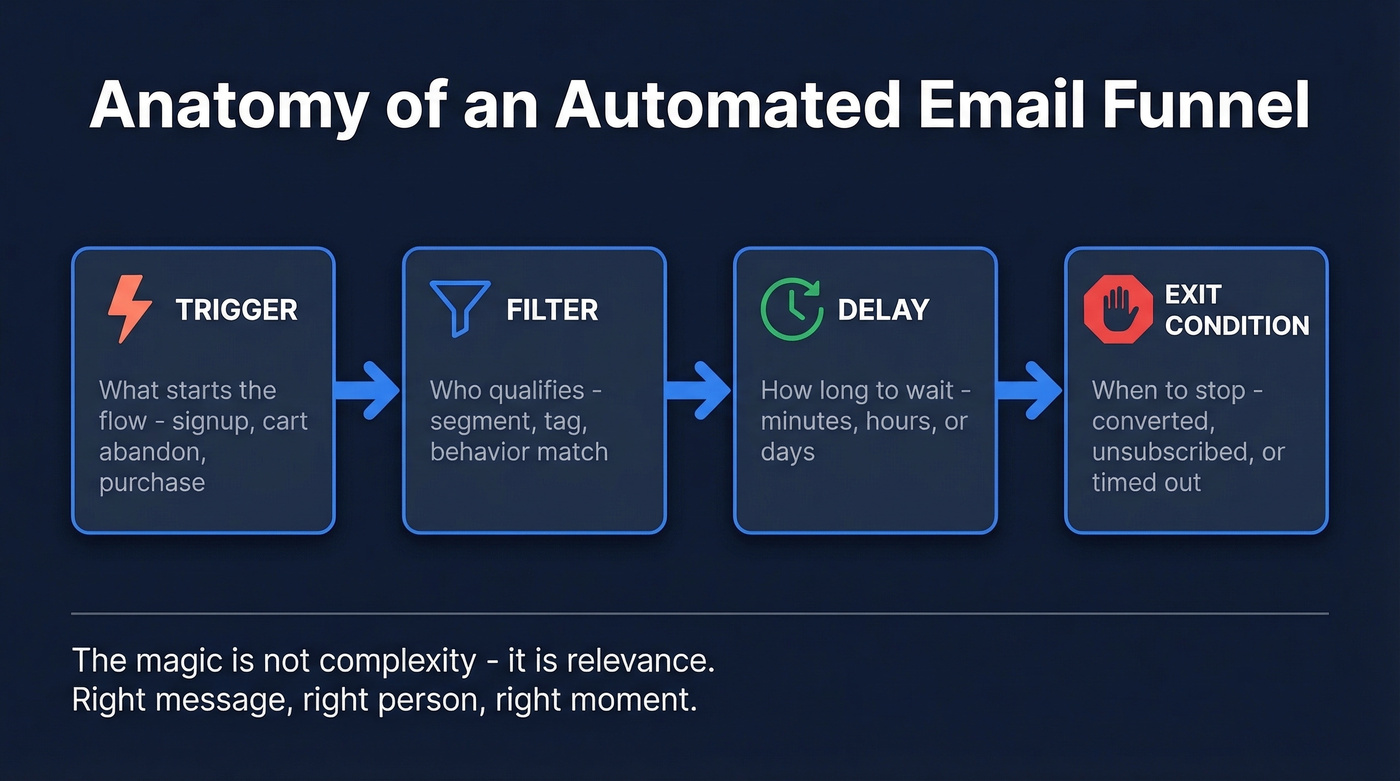
That's it. The magic isn't complexity - it's relevance. The right message hits the right person at the right moment without you touching a button, and that's what separates email sales funnels from generic batch-and-blast campaigns.
5 Workflows That Drive Revenue
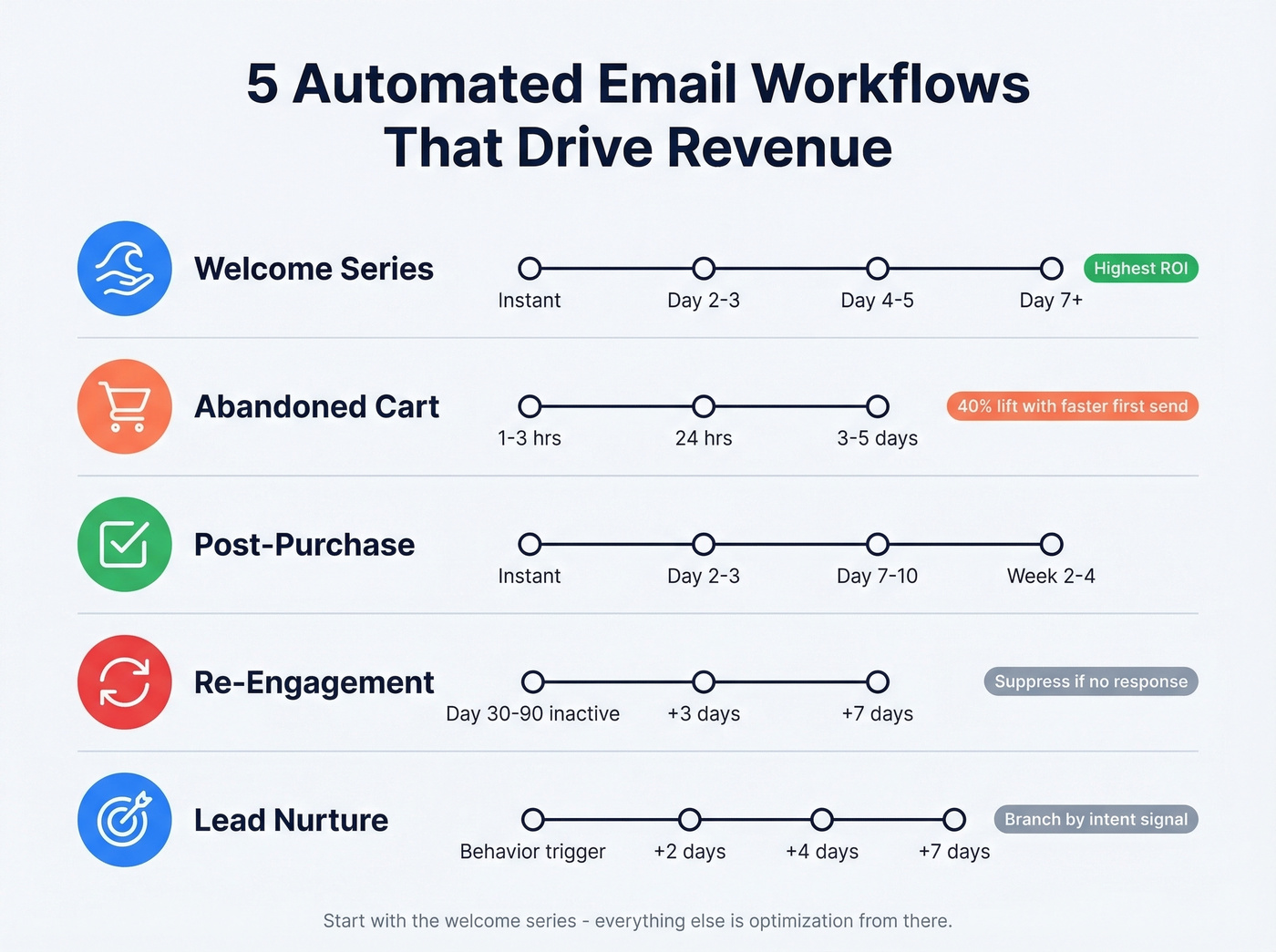
These five flows form the backbone of any serious email program. Each one maps to a specific email funnel stage, and together they cover the full customer lifecycle from first opt-in to win-back.
Welcome Series
Trigger: Subscribe or sign up.
- Email 1: Immediate (within 15 minutes - this is your peak engagement window)
- Email 2: Day 2-3 (brand story, top content, or product education)
- Email 3: Day 4-5 (social proof or case study)
- Email 4: Day 7+ (first offer or clear CTA)
Segment after Email 2 based on opens and clicks. People who engage get a faster path to conversion; people who don't get a softer touch. One case study reported a 104% increase in first purchases after implementing a 3-step welcome journey. This is the highest-ROI flow you'll build, and it takes about 30 minutes to set up in most ESPs.
If you want faster iteration, keep a swipe file of subject lines and test them inside this series.
Abandoned Cart
Trigger: Cart idle for 30-60 minutes.
- Email 1: 1-3 hours after abandonment (gentle reminder, show the product)
- Email 2: 24 hours (add urgency - shipping info, stock levels)
- Email 3: 3-5 days (incentive - discount or free shipping)
Test the first email at 1 hour vs. 24 hours. We've seen the 1-hour window outperform significantly for impulse-buy products, while considered purchases do better with a 24-hour gap. The difference can be dramatic - one eCommerce team we spoke with saw a 40% lift in recovery rate just by tightening that first send from 24 hours to 90 minutes.
Post-Purchase
Trigger: Order confirmed.
- Thank-you email: Immediate
- Product tips or usage guide: 2-3 days
- Review request: 7-10 days
- Cross-sell or refill reminder: 2-4 weeks
One warning here: watch for flow overlap. If someone buys during a welcome series, you don't want them getting a discount email and a "thanks for paying full price" email on the same day. Build exclusion logic into every flow that touches the same audience.
If you’re building this for B2B, tie post-purchase to your contact management rules so lifecycle stages stay clean.
Re-Engagement / Win-Back
Trigger: 30-90 days of inactivity (adjust based on your product's natural purchase cycle).
Send 2-3 emails max. If they don't re-engage, suppress or remove them from your active list. Keeping dead contacts around tanks your deliverability and inflates your ESP bill. This flow is as much about list hygiene as it is about revenue - sometimes the best outcome is a cleaner list, not a recovered subscriber.
If you need a deeper framework for retention and churn, map this to a simple churn analysis cadence.
Lead Nurture
Trigger: Engagement-based - downloaded a resource, attended a webinar, visited pricing.
This is where behavior-driven branching matters most. Someone who visited your pricing page three times needs a different email than someone who downloaded a top-of-funnel ebook. Keep a single CTA per email. Clay runs a 6-part onboarding sequence with numbered subject lines (1/6 through 6/6) - a smart pattern for SaaS that sets expectations and builds momentum through the series.
For B2B teams, this flow works best when it’s aligned to your lead scoring model and your intent based segmentation rules.
Email Funnel Stages
Each of the five workflows maps to a distinct stage in the buyer journey. Understanding these stages helps you write sharper copy and set smarter triggers.
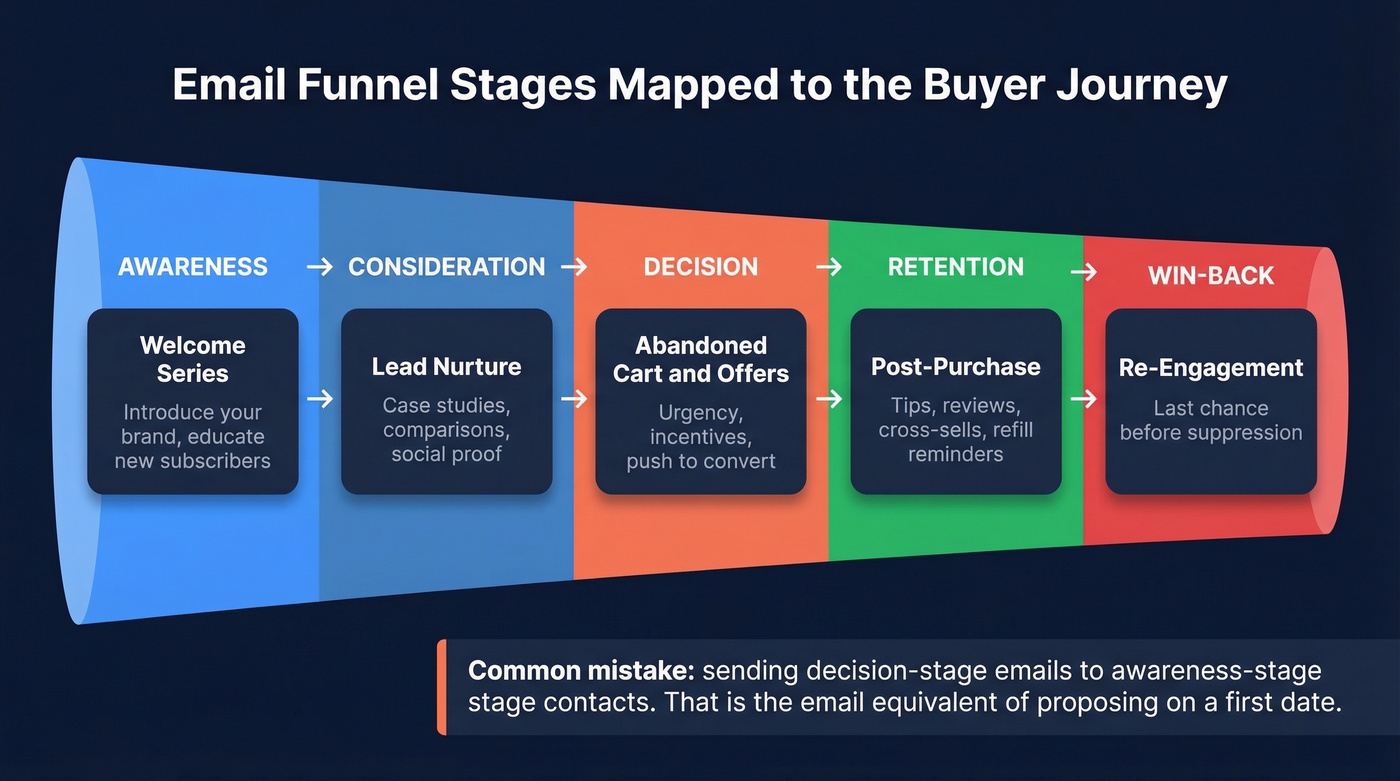
Awareness is where the welcome series lives - introducing your brand and educating new subscribers. Consideration is lead nurture territory, building trust through case studies, comparisons, and social proof. Decision is where abandoned cart and targeted offer emails push toward conversion with urgency and incentives. Retention happens through post-purchase flows that turn one-time buyers into repeat customers. And win-back is your last shot at recovering lapsed contacts before they churn permanently.
When you map your automation to these stages, you avoid the most common mistake: sending decision-stage emails to awareness-stage contacts. That's the email equivalent of proposing on a first date.
If you want a broader framework, compare this to the classic AIDA funnel and adapt the triggers accordingly.

Every workflow in your funnel fires emails to real people - or it fires into the void. Prospeo's 5-step verification delivers 98% email accuracy with catch-all handling, spam-trap removal, and honeypot filtering. One agency built to $1M ARR with under 3% bounce rates across every client campaign.
Verify your list before you automate a single trigger.
Mistakes That Kill Your Funnel
Look, most funnels don't fail because of bad copy. They fail because of bad architecture and bad data.
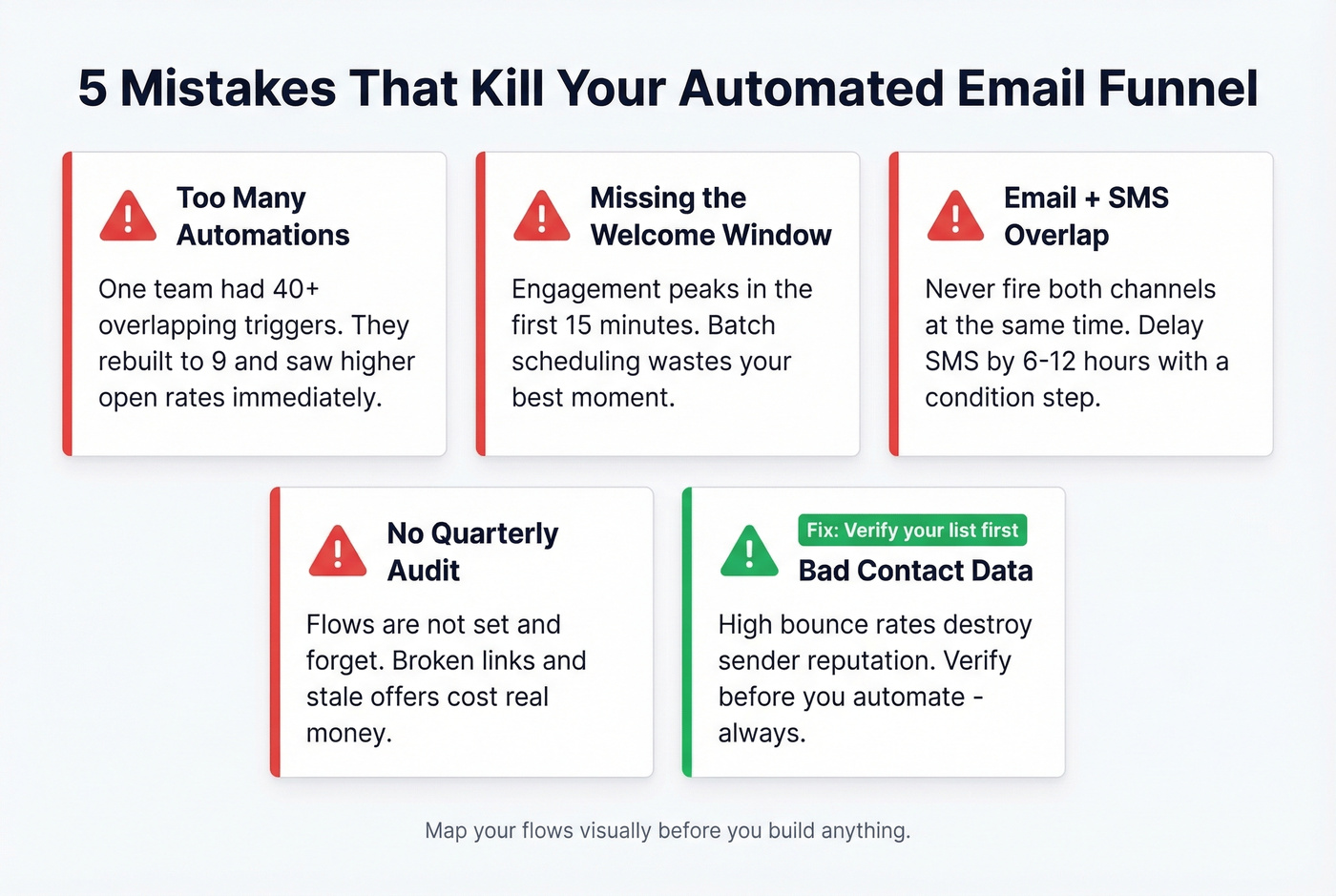
Too many automations. One team we worked with had 40+ triggers, many overlapping and sending duplicate messages in the same week. They rebuilt down to 9 automations and saw higher open rates and cleaner data immediately. Map your flows visually before you build anything.
Missing the welcome window. Subscriber engagement peaks in the first 15 minutes after opt-in. If your welcome email fires on a batch schedule instead of instantly, you're wasting your best moment.
Email + SMS overlap. Don't fire both channels simultaneously. Delay SMS by 6-12 hours and add a condition step - only send the text to people who didn't open the email.
No quarterly audit. Flows aren't "set and forget." Test links, update stale offers, review metrics. A quarterly workflow audit catches the broken stuff before it costs you real money.
Bad contact data. None of the above matters if a big chunk of your list bounces. High bounce rates destroy sender reputation, and once your domain's flagged, even your good emails land in spam. Stack Optimize built to $1M ARR using Prospeo-verified lists: 94%+ deliverability, bounce rates under 3%, zero domain flags across all clients. Verify before you automate. Always.
If you’re troubleshooting bounces and reputation, start with bounce rate benchmarks and then work through a full deliverability guide.
Your lead nurture flow needs real decision-maker emails, not generic inboxes. Prospeo's database gives you 300M+ profiles with 30+ filters - buyer intent, job changes, technographics - so every contact entering your funnel is verified and relevant. Data refreshes every 7 days, not 6 weeks.
Feed your funnel contacts that actually convert - starting at $0.01 per email.
Best Tools for Building Email Sales Funnels
You don't need to overthink this. Pick a tool that matches your complexity needs and budget, then actually build the flows.
ActiveCampaign is the power pick - deep branching, built-in CRM, behavioral targeting. But the Starter plan limits you to 5 actions per automation, which is useless for anything beyond a basic welcome series. You need the Plus plan at $59/mo to do real work. The consensus on r/MarketingAutomation is that it's powerful but the learning curve is steep and pricing ramps fast with list size. For teams that need serious automation logic and don't mind investing time in setup, it's the right call.
Brevo is the budget winner. The free tier gives you 300 emails/day with automation features, SMS, and a light CRM. Templates are basic, but for a team that needs reliable flows without a big bill, it's hard to beat.
Klaviyo dominates Shopify eCommerce but is overpriced for anything else. If you're not running an online store, skip it.
| Tool | Best For | Starting Price | Automation Notes | Key Limitation |
|---|---|---|---|---|
| ActiveCampaign | Advanced workflows | $15/mo | Deep branching, CRM | Starter: 5 actions max |
| Brevo | Budget teams | Free (300/day) | Automations + SMS | Basic editor |
| MailerLite | Simple flows | $9/mo | Clean, straightforward | Less branching |
| Mailchimp | Beginners | $13/mo | Easy templates | Automations limited |
| Klaviyo | eCommerce | $20/mo (500 contacts) | Strong Shopify triggers | Overpriced outside eComm |
| Omnisend | eComm budget | $16/mo (500 contacts) | Good Shopify/Woo | Weak outside eComm |
| Prospeo | Email verification | Free (75 emails/mo) | Verification layer | Pair with any ESP |
Prospeo isn't an ESP - it's the verification layer that makes your ESP work. Run your list through bulk verification before activating any automation, and you'll avoid the bounce-rate spiral that kills sender reputation.
If you’re scaling volume, keep an eye on email velocity so your automation doesn’t outpace your domain health.

Benchmarks Worth Knowing
A dataset of 14.7M impressions across 875 widgets gives us solid opt-in benchmarks: mean popup conversion is 3.2%, but the median is just 0.9% - meaning most popups underperform badly. The top 10% hit 8.5%+.
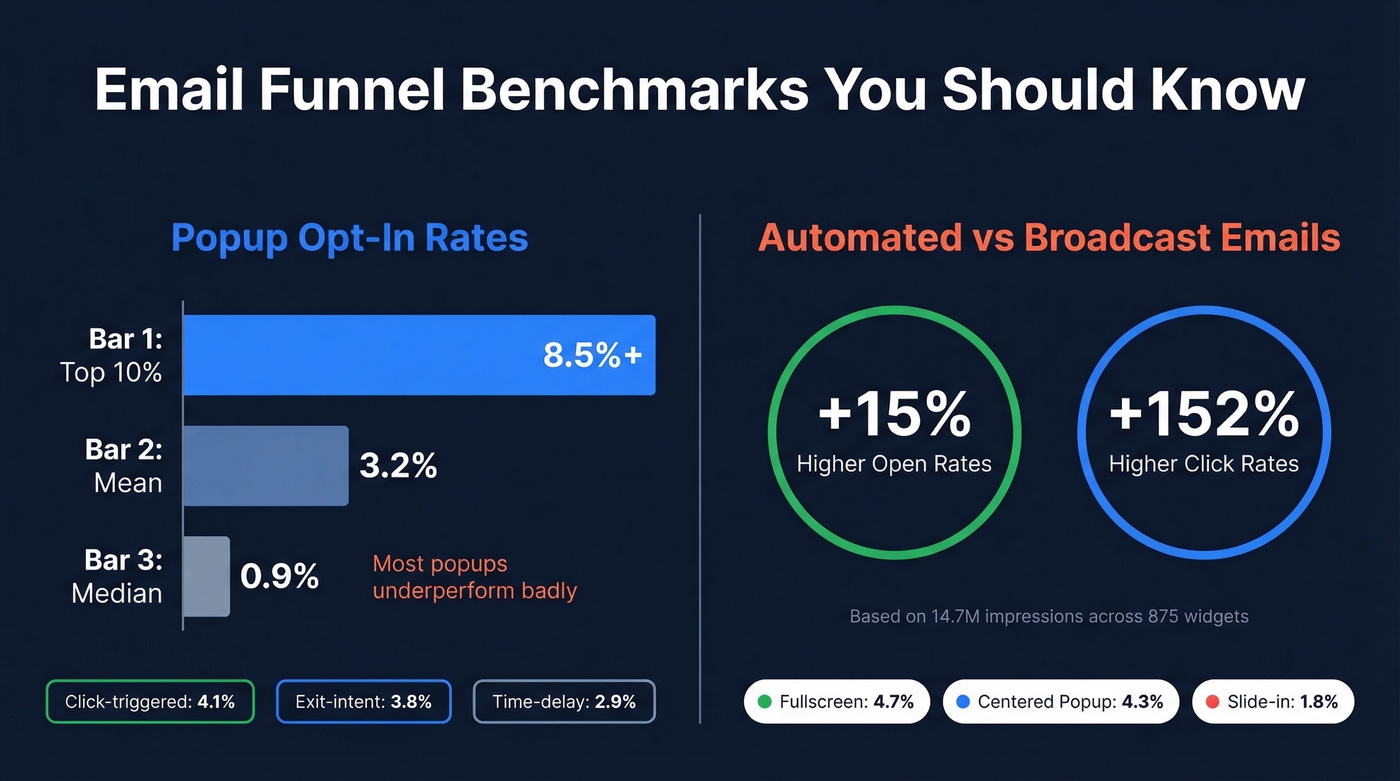
By trigger type, click-triggered popups convert at 4.1%, exit-intent at 3.8%, and time-delay at 2.9%. Fullscreen overlays hit 4.7%, centered popups 4.3%, slide-ins just 1.8%. And the automated vs. broadcast delta remains massive - those 152% higher click rates aren't a fluke. They're the structural advantage of sending relevant messages at the right time instead of blasting your whole list and hoping for the best.
To track performance cleanly, standardize your funnel metrics and calculate improvements with a consistent click rate formula.
Let's be honest: you don't need all five flows running by Friday. Pick one. Build it today. The welcome series is the highest-ROI starting point for any automated email funnel, and everything else is optimization from there.