

How to Build an Automated Follow-Up System That Doesn't Sound Like a Robot
48% of salespeople never follow up. Not once. Meanwhile, reps burn 41% of their time on non-revenue activities - scheduling, pipeline hygiene, chasing contacts who bounced. The gap between "we ran a campaign" and "we built an automated follow-up system" is where most pipeline goes to die.
Manual follow-up for 10 leads eats roughly 10 hours every two weeks. An automated sequence cuts that to minutes of setup. Here's how to build one that actually converts - without sounding like every other robotic drip clogging your prospect's inbox.
What You Need (Quick Version)
Three components: a CRM with automation (HubSpot CRM works fine), verified contact data (bad emails kill everything downstream), and a 5-touch multichannel sequence. Template's below.
You don't need a $300/month all-in-one platform. A CRM, a sequencing tool, and verified data can stay lean and still outperform most bloated stacks.
What Automated Follow-Up Actually Means
It's not a drip campaign. Basic sequences are time-based - send email two on day three regardless of what happened. A behavior-aware follow-up system combines five components:
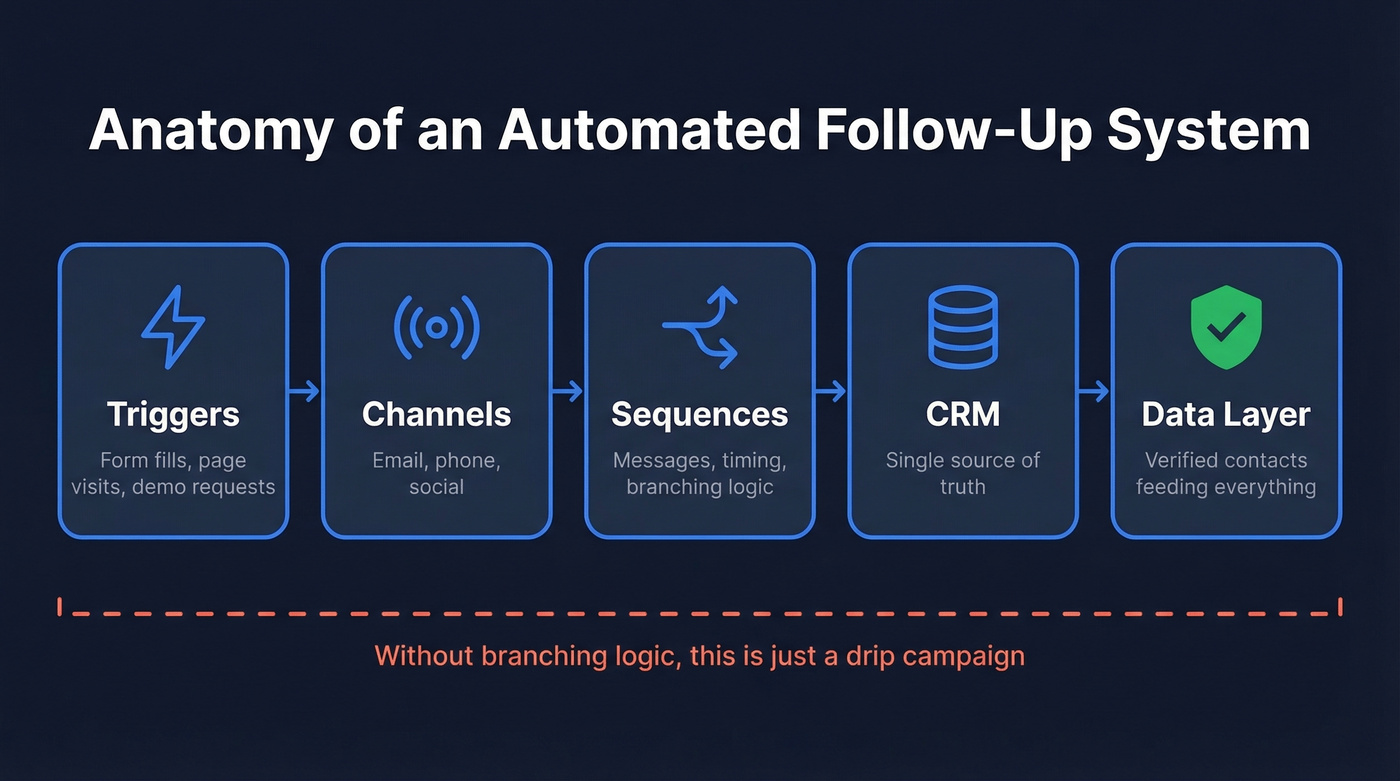
- Triggers - what starts the sequence
- Channels - email, phone, social
- Sequences - messages, timing, and branching logic
- CRM - single source of truth
- Data layer - verified contacts feeding the whole thing
Branching logic is what separates a real workflow from one that feels like spam. If they opened, go path A. If they didn't, go path B. That distinction matters more than most teams realize.
Benchmarks That Should Change Your Thinking
A Sales.co study of 2M+ cold emails found the average reply rate sits at 2.09%. Initial outreach drives 79.4% of all replies; follow-ups capture the remaining 20.6%. That's roughly one in five replies you'd lose completely without a system.
Sequences with 4-7 messages hit a 33% reply rate versus 25% for sequences with only 1-3 follow-ups. More touches, done well, genuinely move the needle. But timing matters more than most teams think. Monday gets the highest raw reply volume, while Thursday produces the highest positive reply rate at 10.5%. Informal tone generates 78% more positive responses than formal language. And the CTA "Want to see it in action?" hit a 30.05% positive rate versus 8.59% for a generic "send more info" ask.
Here's the thing: the most common frustration we hear from teams isn't about copy or tools. It's that their follow-up system either sounds robotic or requires so much manual babysitting that they stop using it within a month.

The #1 killer of automated follow-up systems isn't bad copy - it's bad data. Prospeo's 5-step verification delivers 98% email accuracy with a 7-day refresh cycle, so your sequences never run on stale contacts. Meritt cut their bounce rate from 35% to under 4% and tripled pipeline to $300K/week.
Stop building sequences on data that bounces. Fix the foundation first.
How to Build Your System in 5 Steps
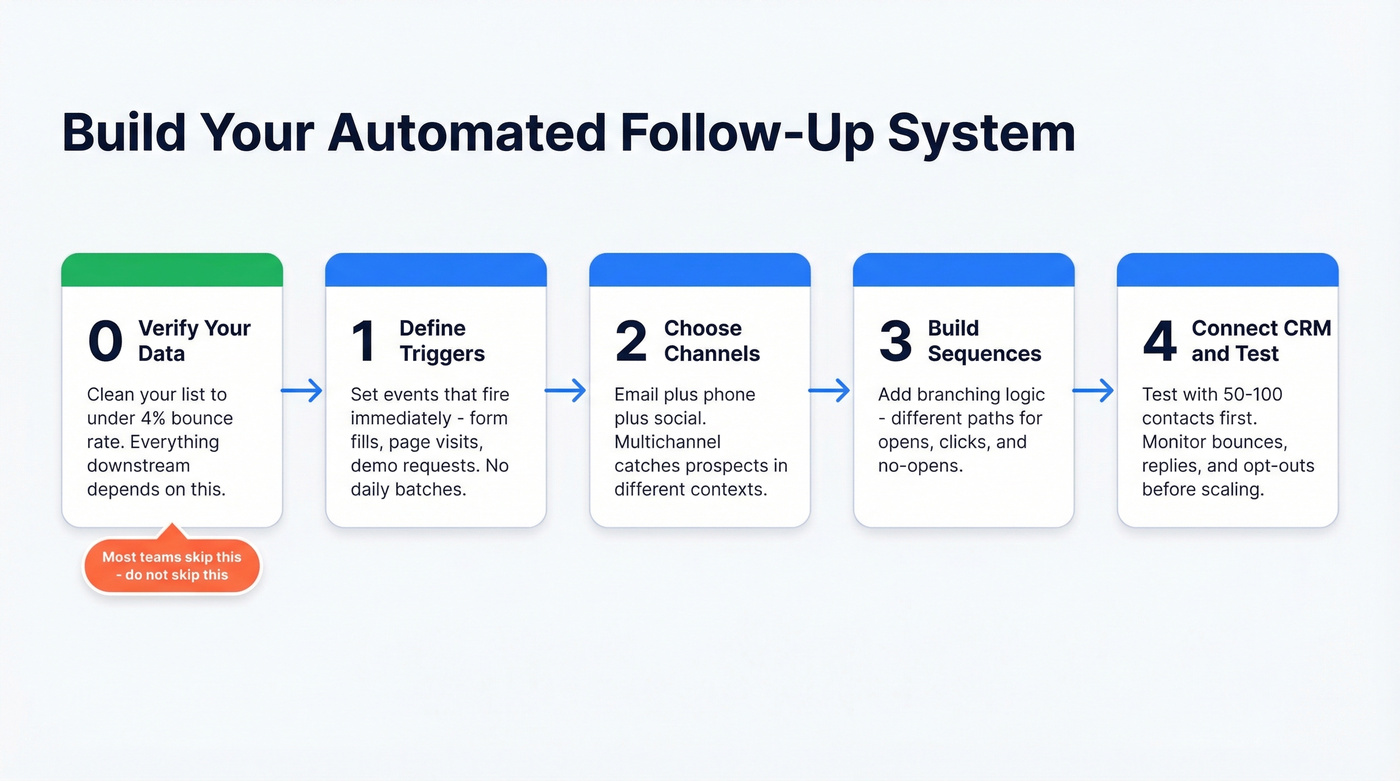
Step 0 - Verify Your Data First
Nothing else matters if your cold emails never reach the inbox. If your bounce rate is above 4%, stop building sequences and fix your list. (If you need a benchmark-driven breakdown, see bounce rate and the full email deliverability checklist.)
We've seen this play out dozens of times. Prospeo's 5-step verification - catch-all handling, spam-trap removal, honeypot filtering - delivers 98% email accuracy and integrates natively with Smartlead, Instantly, Lemlist, and HubSpot. Data refreshes every 7 days, compared to the 6-week industry average, so your sequences aren't running on stale contacts. Meritt cut their bounce rate from 35% to under 4% after switching, and their pipeline tripled from $100K to $300K per week.
Step 1 - Define Your Triggers
Triggers are the events that start a sequence: a form fill, webinar registration, pricing page visit, or demo request. The critical benchmark is the 5-minute rule - responding within 5 minutes increases your odds of making contact by 100x compared to waiting 30 minutes. Set your triggers to fire immediately, not on a daily batch. (If you want to operationalize this, use a simple lead scoring model and a clear lead status definition.)
Step 2 - Choose Your Channels
Email alone isn't enough. 54% of tech buyers prefer phone as a communication channel.
Go multichannel. Email + phone + social catches prospects in different contexts, and the combination signals persistence without desperation. Skip this step if you're selling a low-ACV product where phone outreach doesn't make economic sense - for deals under $5K/year, email and social are usually sufficient.
Step 3 - Build Your Email Sequence
This is where branching logic earns its keep. If a prospect opens your email but doesn't reply, they get a different follow-up than someone who never opened at all. If they click a link, they skip ahead to a phone call. The template in the next section gives you a starting framework, but you'll want to adapt the branches based on your sales cycle length and deal complexity - a 30-day enterprise cycle needs wider spacing than a 7-day SMB close. (For more copy patterns, pull from proven sales follow-up templates and cold email follow-up templates.)
Step 4 - Connect Your CRM and Test
Your CRM is the single source of truth. Every trigger, every reply, every status change lives there. If you're still evaluating options, start with a few examples of a CRM and pick what fits your workflow.
Before launching to your full list, test with 50-100 contacts. Monitor bounce rate (keep it under 4%), reply rate, and opt-out rate. If anything looks off, fix it before scaling. We've found that skipping this step is the number one reason teams blame "bad tools" when the real problem was bad data or broken triggers.
A Sequence You Can Copy
This 5-touch, 10-day multichannel sequence is based on the Rule of Five framework. Send on Mondays for raw reply volume, Thursdays for positive replies. Best windows: 8-10 AM or 4-5 PM local time. (If you want a deeper timing breakdown, use these best time to send cold emails benchmarks.)
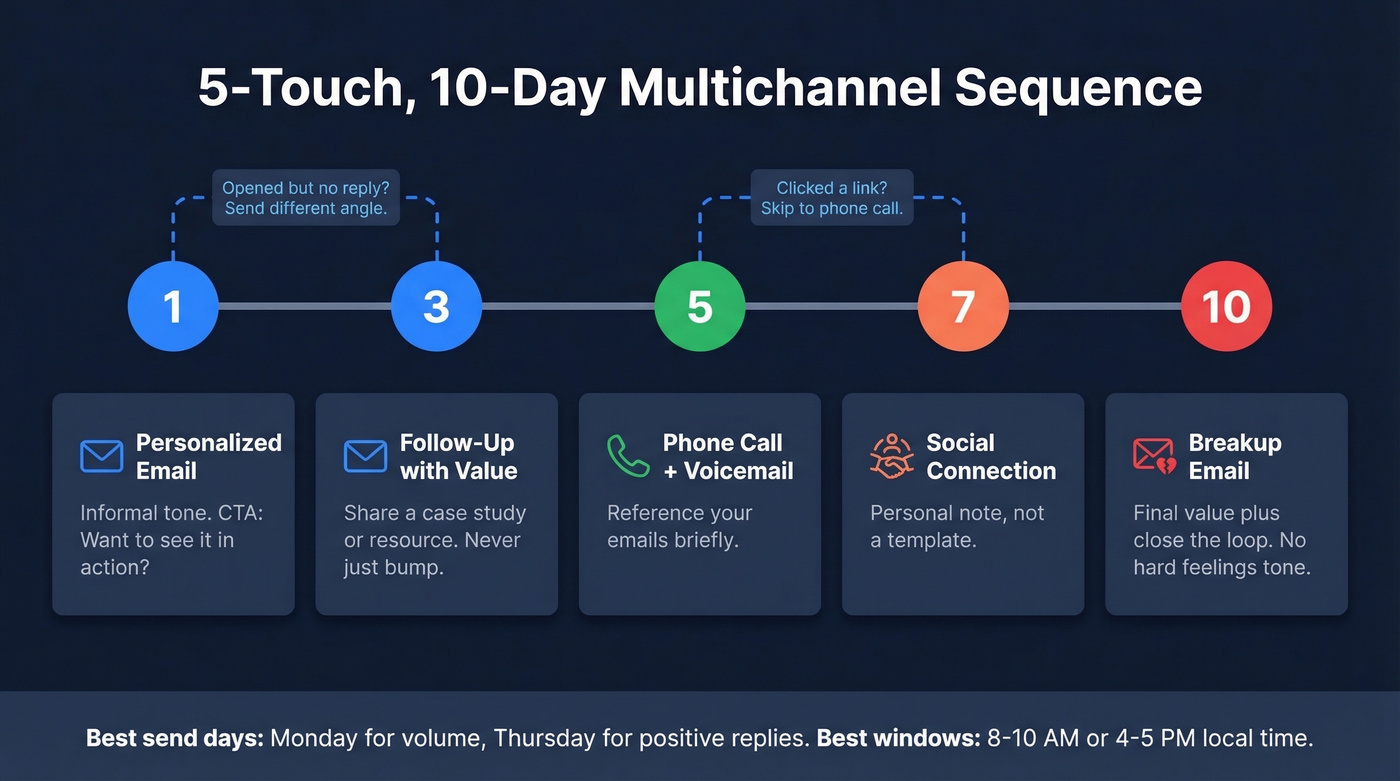
| Day | Channel | Action | Notes |
|---|---|---|---|
| 1 | Personalized email referencing their action | Informal tone. CTA: "Want to see it in action?" | |
| 3 | Follow-up with case study or resource | Add new value - never just "bump" | |
| 5 | Phone | Call + voicemail | Reference the emails briefly |
| 7 | Social | Connection request with note | Keep it personal, not templated |
| 10 | Breakup email - final value + close loop | "No hard feelings" tone works |
Let's be honest: most teams obsess over copy when the real difference-maker is branching logic and timing. A mediocre email sent at the right moment to a verified address will outperform brilliant copy that lands in spam or arrives two weeks late. Fix the system first, then polish the words.
Mistakes That Kill Your Reply Rate
"Bumping" with no new information. Every follow-up needs to add something - a case study, a stat, a new angle. "Just circling back" is the fastest way to get archived.
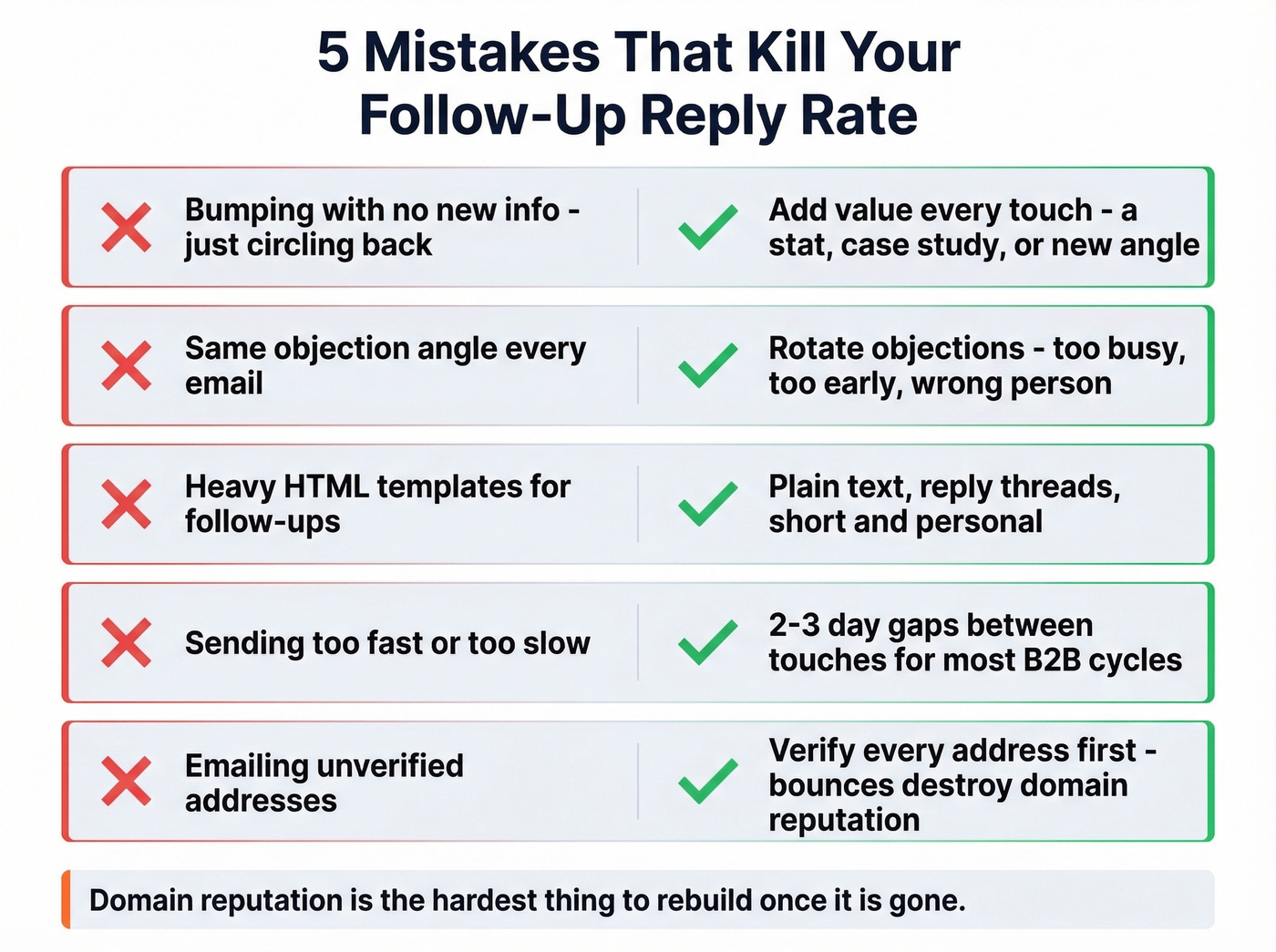
Not rotating objections. Each touch should anticipate a different reason they haven't replied. Too busy? Too early? Wrong person? Change the angle every time.
Emails that don't look like real replies. Plain text outperforms HTML templates for follow-ups. Keep them short, send them as reply threads, and ditch the heavy formatting.
Wrong frequency. Too fast feels desperate. Too slow and they've forgotten you. The 2-3 day gap in the template above is the sweet spot for most B2B cycles.
Emailing unverified addresses. Every bounce damages your sender reputation. Run your list through verification before you load a single contact into your sequencer. It takes minutes and saves your domain. The consensus on r/coldemail is pretty clear on this one - domain reputation is the hardest thing to rebuild once it's gone. (If you're troubleshooting, start with improve sender reputation and email reputation tools.)
Best Tools for Follow-Up Automation
You don't need one tool that does everything. You need the right combination.
For the data layer, Prospeo gives you verified contacts so your sequences actually land - 300M+ professional profiles, 143M+ verified emails, and 125M+ verified mobile numbers at roughly $0.01 per lead. HubSpot CRM is a strong starting point for pipeline management, and ActiveCampaign handles deeper email automation workflows. For teams doing high-volume cold outreach, Smartlead is worth a look at ~$39/mo. (If you're comparing platforms, start with follow up email software and broader SDR tools lists.)
One thing to watch: marketing automation can get expensive fast. HubSpot Marketing Hub Professional runs $890/mo, and higher-tier plans can require a $1,500 one-time onboarding fee. For most teams building their first automated follow-up system, you don't need that tier.
| Tool | Starting Price | Best For | Free Trial |
|---|---|---|---|
| Prospeo | Free (75 emails/mo); ~$0.01/email on paid | Data verification & enrichment | Free tier |
| HubSpot CRM | $15/seat/mo (free tier available) | Pipeline management | Free tier |
| ActiveCampaign | $15/mo | Email automation depth | 14-day trial |
| Smartlead | ~$39/mo | High-volume cold email | 14-day trial |
| Pipedrive | $14/user/mo | Visual pipeline | 14-day trial |
| Freshsales | $9/user/mo | Budget CRM | 21-day trial |
| Zoho CRM | $9-14/user/mo | Value all-in-one | 15-day trial |
| Close | $49/user/mo | Phone-heavy teams | 14-day trial |
| Keap | $249/mo (2 users) | All-in-one (pricey) | 14-day trial |
Your 5-touch sequence needs verified emails, direct dials, and fresh data to actually convert. Prospeo gives you all three - 143M+ verified emails, 125M+ mobile numbers, and native integrations with Smartlead, Instantly, and Lemlist. At $0.01/email, your entire follow-up stack stays under $100/mo.
Feed your automated sequences with data that actually connects to real buyers.
FAQ
How many follow-ups should I send?
Four to five touches is the sweet spot. Sequences with 4-7 messages hit a 33% reply rate versus 25% for shorter sequences. Beyond five, you hit diminishing returns and risk annoying prospects who simply aren't interested.
What's the best day and time for follow-ups?
Tuesday and Thursday between 8-10 AM or 4-5 PM local time are strong defaults. Monday generates the highest raw reply volume, but Thursday produces the highest positive reply rate at 10.5%. Avoid the 1-2 PM window entirely.
Do I need expensive software to automate follow-ups?
No. HubSpot CRM covers pipeline management, a sequencing tool like ActiveCampaign or Smartlead runs your sequences, and a free verification tier handles your first 75 emails per month at 98% accuracy. You can build a complete stack under $100/mo that competes with platforms costing five times more.
How is a follow-up sequence different from a drip campaign?
A drip campaign sends messages on a fixed schedule regardless of prospect behavior. A follow-up sequence uses triggers and branching logic to adapt - sending different messages based on opens, clicks, and replies. Behavior-aware sequences consistently outperform static drips because they feel personal rather than robotic.