The Economics-First B2B Acquisition Strategy for 2026
Most B2B acquisition strategy articles hand you a listicle of nine tactics with zero data on what any of it costs or returns. That's not a strategy. That's a buffet.
Here's what works when you let the economics lead: know your CAC benchmark, pick two or three channels with proven ROI, and fix your contact data before you launch anything outbound. Consider this - 65% of B2B marketers believe loyalty drives growth, and the Ehrenberg-Bass Institute's research says they're dead wrong.
The Quick Version
Three things move the needle in B2B customer acquisition:
- Know your industry's CAC benchmark so you set realistic targets. A $239 blended CAC in SaaS is a different universe from $1,143 in education.
- Prioritize two or three high-ROI channels - speaking engagements, thought leadership SEO, and webinars consistently outperform everything else - instead of spreading budget across nine.
- Fix your contact data before launching outbound. Bounce rates above 5% destroy sender reputation and waste SDR hours.
Why Acquisition Is the Only Growth Lever
The Ehrenberg-Bass Institute demonstrated that double jeopardy applies in B2B just as it does in consumer markets. Brands with higher market penetration automatically get higher loyalty. Not the other way around.
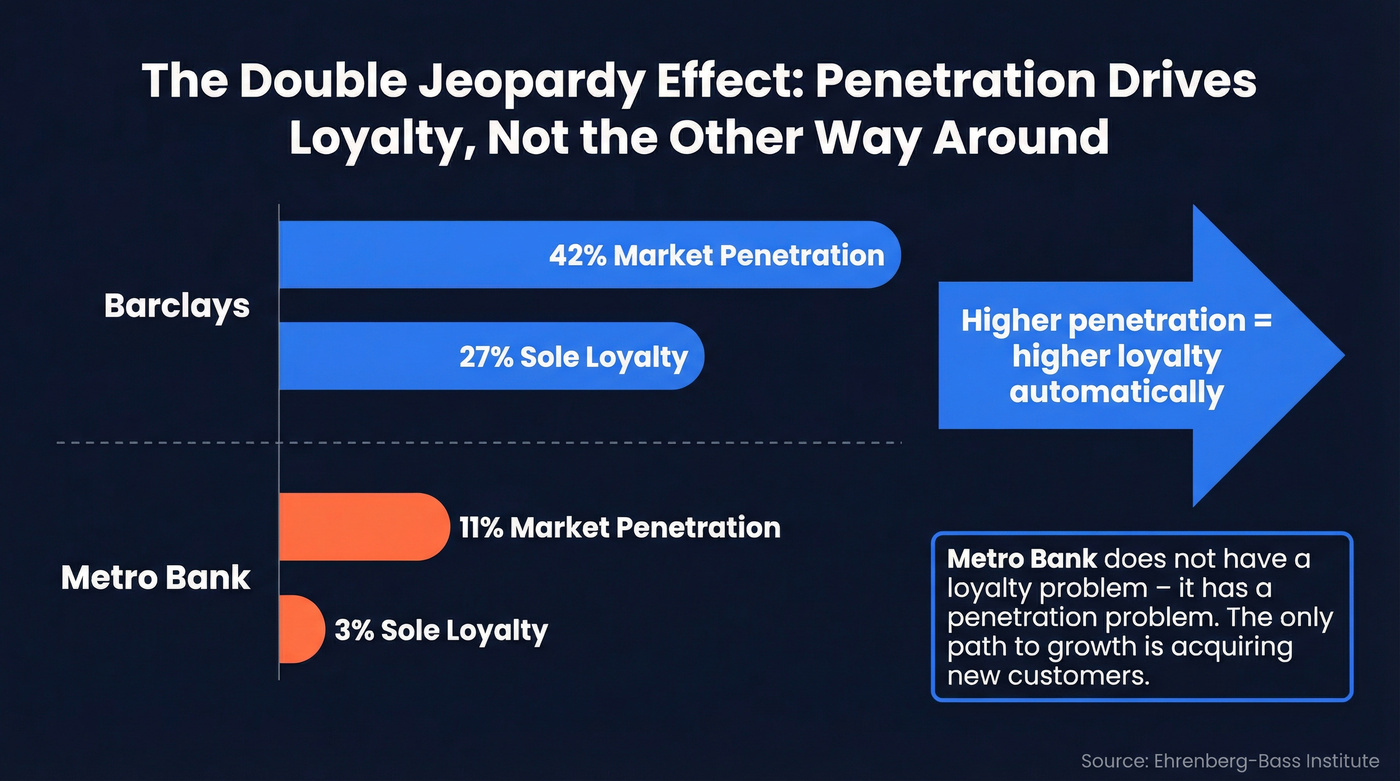
Look at UK business banking. Barclays has 42% penetration and 27% sole loyalty. Metro Bank has 11% penetration and just 3% sole loyalty. Metro doesn't have a loyalty problem - it has a penetration problem. The only path to growth is acquiring new customers, because loyalty follows market share.
The practical implication is blunt: track customer base size as your primary KPI. Shift budget and rep time toward net-new prospects. And remember - your biggest competitor isn't another vendor. It's "no decision." Most deals die not because a rival won, but because the buying group couldn't reach consensus.
How B2B Buying Changed in 2026
The buyer journey has compressed in ways that punish late movers:
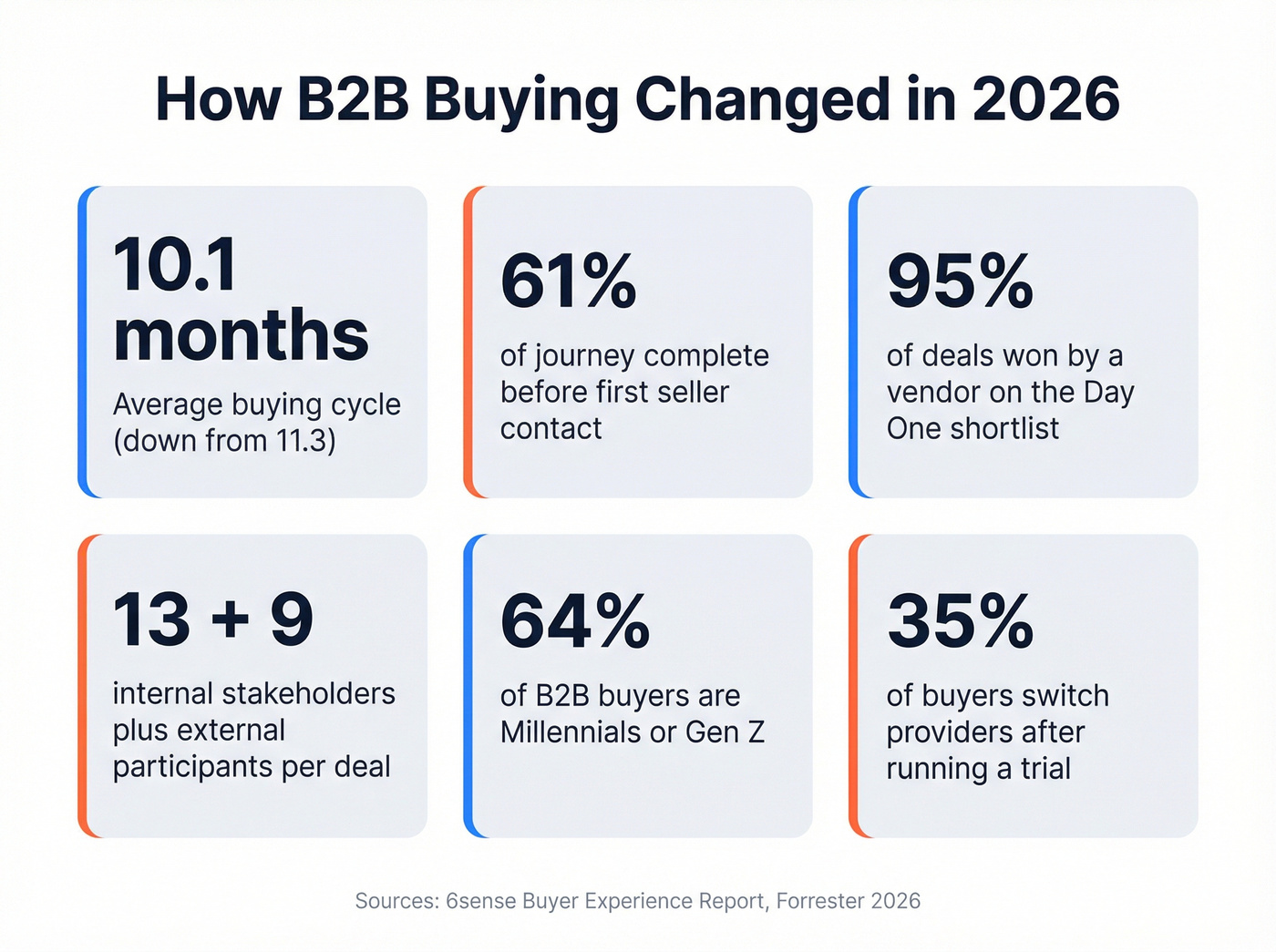
- Buying cycles shortened from 11.3 months to 10.1 months between 2024 and 2025, per 6sense's Buyer Experience Report. Economic pressure and AI-assisted research are the drivers.
- First contact with sellers now happens at 61% of the journey (down from 69%). That's six to seven weeks earlier than it used to be.
- 95% of the time, the winning vendor is already on the Day One shortlist. The pre-contact favorite wins roughly 80% of deals. If you're not shortlisted before a buyer starts evaluating, you've already lost.
- Buying groups have ballooned. Forrester's 2026 data shows an average of 13 internal stakeholders and 9 external participants influencing a purchase. If the purchase involves generative AI features, the buying group doubles.
- 64% of business buyers are now Millennials or Gen Z. They research differently, trust peer reviews over sales decks, and expect self-serve experiences before talking to a rep.
- 60%+ of buyers run trials before committing, and 35% end up choosing a different provider after the trial. Your product experience is now an acquisition channel.
Here's the thing: acquiring B2B customers in 2026 isn't about generating leads. It's about being known, trusted, and shortlisted before the buyer ever fills out a form. That requires showing up in research channels - not just demand capture forms.
The consistent pattern across B2B practitioner communities on Reddit and elsewhere reinforces this: most teams spread too thin across channels and never give any single channel enough time to compound. Pick fewer, go deeper.
What Acquisition Actually Costs
CAC varies wildly by industry, and most teams benchmark against nothing. FirstPageSage published CAC data across 29 B2B industries based on client analytics from January 2022 through August 2025:
| Industry | Organic CAC | Inorganic CAC | Blended CAC |
|---|---|---|---|
| B2B SaaS | $205 | $341 | $239 |
| Construction | $212 | $486 | $281 |
| Cybersecurity | $345 | $512 | $387 |
| Manufacturing | $662 | $905 | $723 |
| Legal Services | $584 | $1,245 | $749 |
| Financial Services | $644 | $1,202 | $784 |
| Real Estate | $660 | $1,185 | $791 |
| Education | $862 | $1,985 | $1,143 |
Organic CAC is consistently lower than inorganic (paid) CAC. B2B CAC has increased roughly 222% over the last eight years. Here's another way to feel that pain: many B2B teams now spend about $29 to acquire just $1 of new revenue.
If your acquisition costs feel like they're climbing, they are.

CAC is climbing 222% over eight years, and bad data makes it worse. Every bounced email burns budget and kills sender reputation. Prospeo delivers 98% email accuracy at ~$0.01 per lead - 90% cheaper than ZoomInfo - so your outbound spend actually converts.
Stop paying $29 to acquire $1 of revenue with broken contact data.
Which Channels Deliver the Best ROI
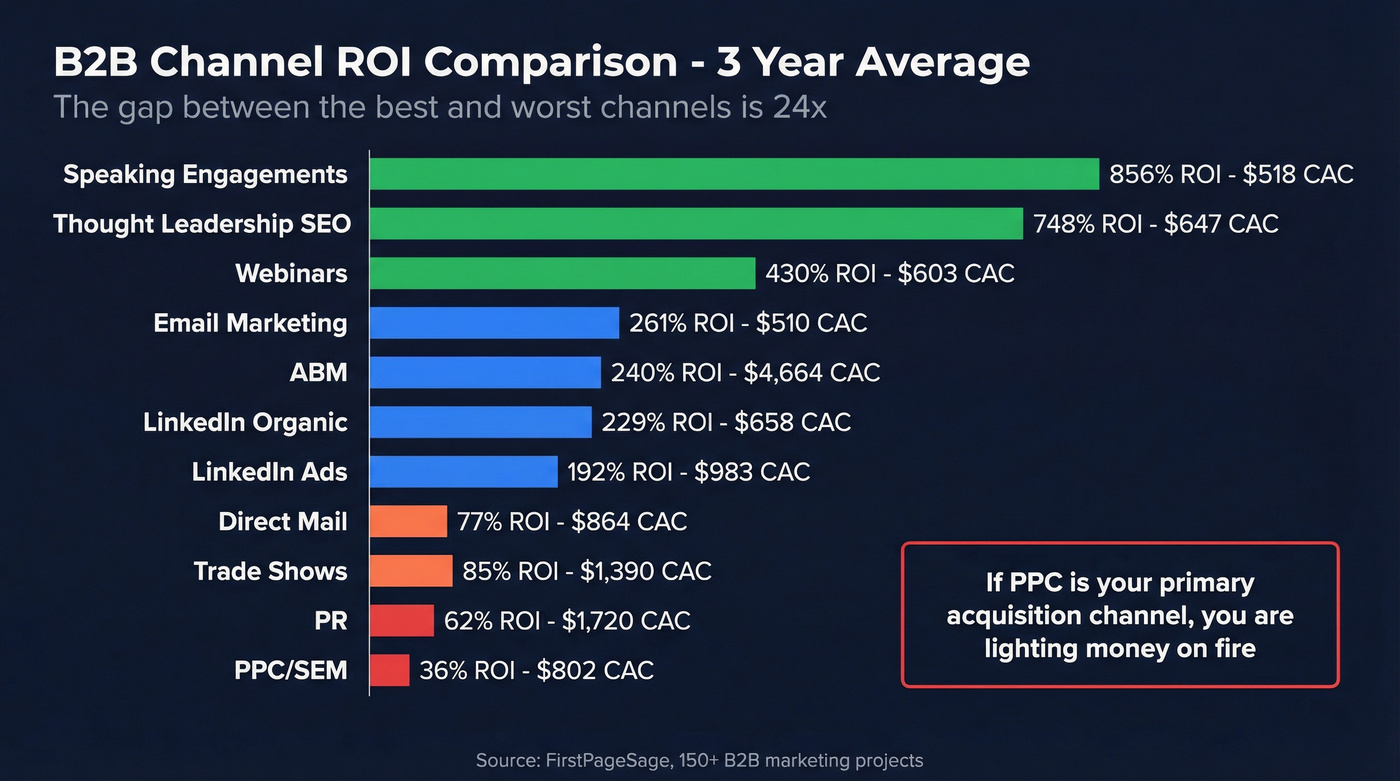
The gap between the best and worst channels is enormous. FirstPageSage's benchmarks across 150+ B2B marketing projects rank 11 channels by average CAC per customer and three-year average ROI:
| Channel | Avg CAC per Customer | 3-Year Avg ROI |
|---|---|---|
| Speaking Engagements | $518 | 856% |
| Thought Leadership SEO | $647 | 748% |
| Webinars | $603 | 430% |
| Email Marketing | $510 | 261% |
| ABM | $4,664 | 240% |
| LinkedIn Organic | $658 | 229% |
| LinkedIn Ads | $983 | 192% |
| Direct Mail | $864 | 77% |
| Trade Shows | $1,390 | 85% |
| PR | $1,720 | 62% |
| PPC/SEM | $802 | 36% |
The top three deliver 430-856% ROI. PPC/SEM, the channel most companies default to because it's easy to turn on, delivers 36%. That's about a 24x difference.
If PPC is your primary acquisition channel, you're lighting money on fire.
Thought leadership SEO takes four to six months to ramp, which is why impatient teams skip it. But once it compounds, CAC drops and ROI climbs quarter over quarter - we've watched this play out across dozens of B2B companies in our network, and the pattern is remarkably consistent. Speaking engagements require a subject-matter expert willing to get on stage. Webinars split the difference: faster to launch than SEO, more scalable than live events. Pick two or three that match your team's strengths, then go deep.
Building Your Acquisition Playbook
Step 1: Define your ICP. Use CRM data and attribution analysis, not gut feel. Interview sales about which segments close fastest. Interview customer success about which accounts have the lowest support burden. Most teams haven't refreshed their ICP in two or three years - update it annually.
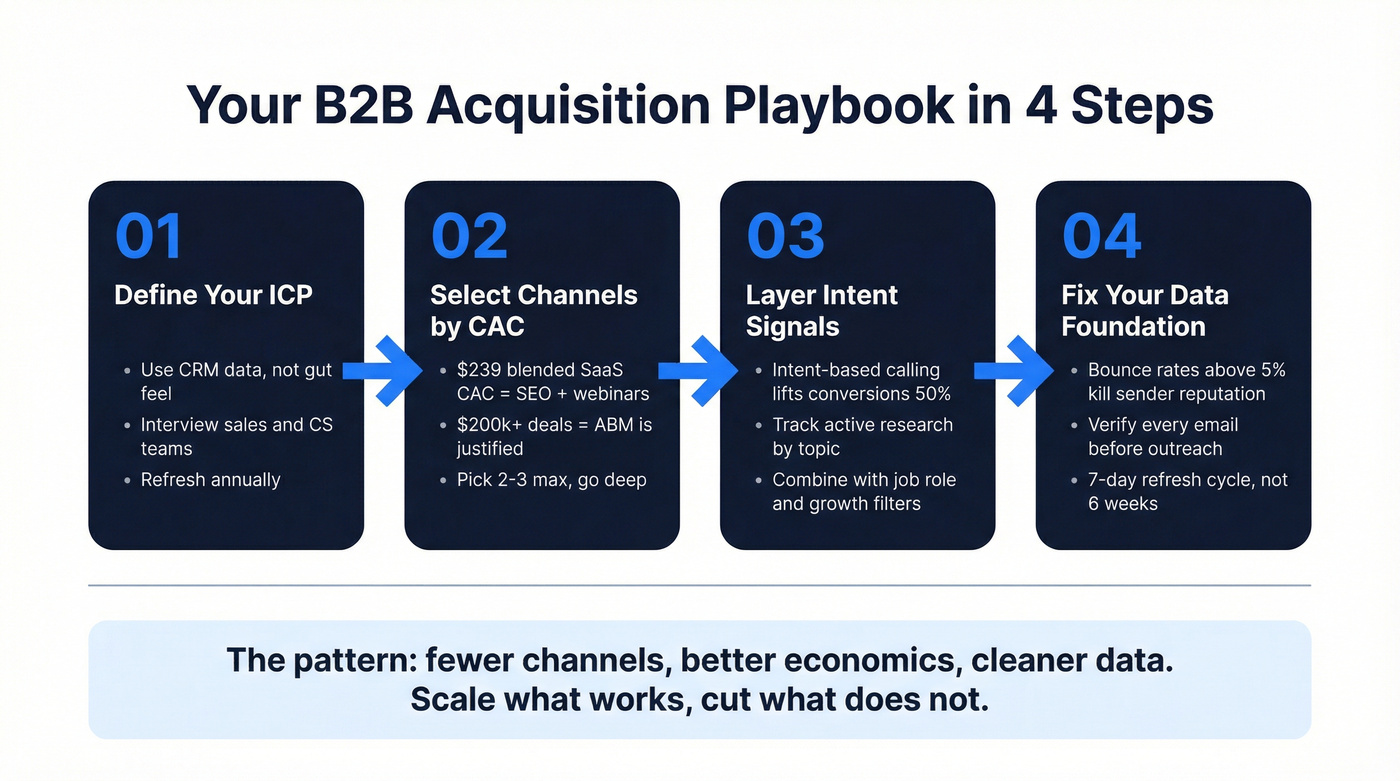
Step 2: Select channels based on CAC tolerance. If you're a B2B SaaS company benchmarking against a $239 blended CAC, you can't afford ABM at $4,664 per customer. Start with thought leadership SEO and webinars. For teams selling $200k+ enterprise deals, ABM's high CAC is justified by the contract value.
Step 3: Layer intent signals. Adding intent-based calling to outreach campaigns increases conversions by roughly 50%. Knowing which accounts are actively researching your category lets you prioritize outreach instead of spraying cold emails at everyone in your TAM. Prospeo tracks buyer intent across 15,000 topics via Bombora, so you can combine intent signals with job role and company growth filters in a single workflow.
Step 4: Fix your data foundation. This is where most acquisition strategies quietly fail. You can nail your ICP, pick the right channels, and build great content - then watch it collapse because a third of your prospect emails bounce. Snyk's 50-person sales team saw bounce rates drop from 35% to under 5% and AE-sourced pipeline increase 180% after switching to verified contact data with a 7-day refresh cycle, compared to the six-week industry average.
Three Mistakes That Kill Acquisition
Mistake 1: Letting your ICP decay. Markets shift. Your best-fit customer segment in 2024 isn't necessarily your best-fit in 2026. Update annually using CRM data, win/loss analysis, and cross-functional interviews.
Mistake 2: Marketing-sales silos. When marketing optimizes for MQLs and sales optimizes for pipeline, nobody optimizes for revenue. Shared KPIs and weekly cross-functional reviews are the difference between aligned acquisition and expensive chaos. (If you need a system, start with Revenue Operations alignment.)
Mistake 3: Ignoring data quality. The silent acquisition killer. We've seen teams run sophisticated ABM campaigns on lists where 30-40% of emails are invalid. Every bounced email damages your domain reputation, making the next campaign perform worse. It's a death spiral. Verify your prospect list before any campaign - skip this step and you're sabotaging everything downstream. Use an email checker tool and follow an email deliverability checklist before you scale volume.
Measuring What Matters
Stop tracking MQLs as your north star. MQLs measure marketing activity, not business growth.
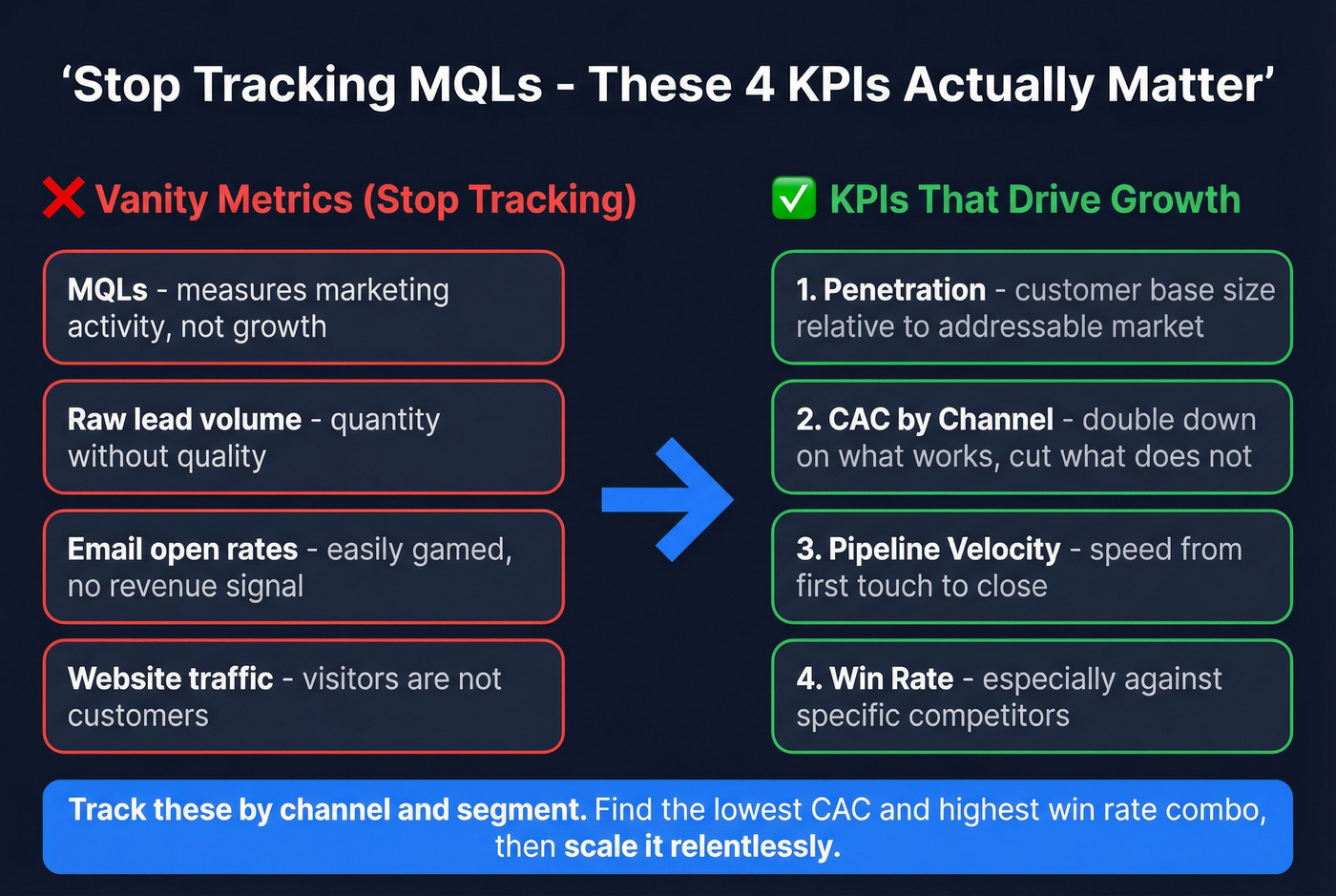
Four KPIs actually matter:
- Penetration - the size of your customer base relative to your addressable market.
- CAC by channel - so you can double down on what works and cut what doesn't. (If you want the math, use a CAC LTV ratio framework.)
- Pipeline velocity - how fast deals move from first touch to close. (See pipeline predictability for the operating cadence.)
- Win rate - especially against specific competitors, which tells you where positioning is strong or weak. (Track it with a competitive win rate model.)
Track these by channel and segment. The goal is to know exactly which combination of ICP, channel, and message produces the lowest CAC and highest win rate - then scale that combination relentlessly.
Let's be honest: if your average deal size is under $15k, you almost certainly don't need ABM. A tight ICP, two compounding channels, and clean contact data will outperform an expensive orchestration platform every time.
A strong B2B acquisition strategy isn't about doing more. It's about doing fewer things with better economics and cleaner data. Start with the benchmarks, pick channels the math supports, and never launch outbound on unverified contacts. If you're building outbound, use an outbound sales engine approach and bake in B2B contact data decay prevention from day one.
Step 3 of your acquisition playbook needs intent data layered on verified contacts. Prospeo combines Bombora intent signals across 15,000 topics with 30+ filters - job role, headcount growth, technographics - so you reach in-market buyers before they hit your competitor's shortlist.
Be on the Day One shortlist by reaching buyers already researching your category.
FAQ
What's a good CAC for B2B SaaS?
The blended average is $239 per FirstPageSage's 2026 benchmarks, with organic at $205 and inorganic at $341. If you're consistently above $300, you're likely over-indexed on paid channels - shift budget toward thought leadership SEO or webinars to bring the blend down.
Which acquisition channel has the highest ROI?
Speaking engagements deliver 856% three-year average ROI at a $518 CAC, followed by thought leadership SEO at 748%. Both require patience - which is exactly why they outperform quick-hit paid channels that most teams default to.
How do you build a B2B acquisition strategy from scratch?
Start with your ICP using CRM data, pick two channels your team can sustain for six-plus months, layer intent signals to prioritize outreach, and verify every contact before it enters a sequence. The economics should drive every decision - not what's trendy on marketing Twitter.
Why does data quality matter for customer acquisition?
Invalid emails above a 5% bounce rate damage your sender domain reputation, reducing deliverability on every subsequent campaign. Snyk cut bounce rates from 35% to under 5% and saw AE-sourced pipeline jump 180% - proof that clean data is a revenue lever, not just a hygiene task.