

B2B Lead Generation Best Practices: What Actually Works in 2026
Ninety-five percent of your target market isn't buying today. The average B2B deal takes 10.1 months to close, and the winning vendor lands on the buyer's Day One shortlist 95% of the time. The lead generation playbook from a few years ago - more MQLs, more form fills, more gated PDFs - doesn't cut it anymore.
The channels are degrading. Cold email reply rates are down. LinkedIn is noisier than ever. Paid ads are expensive and inconsistent. And 49% of marketers report declining traditional search traffic as AI-generated answers eat into organic clicks. The teams still generating pipeline have shifted to tighter ICP filtering, cleaner data, and disciplined multi-channel execution. Everyone else is generating spreadsheets.
What works now is a system built around shortlist presence, data quality, and follow-through.
The Three Shifts That Matter
Three things separate teams that generate pipeline from teams that generate noise:
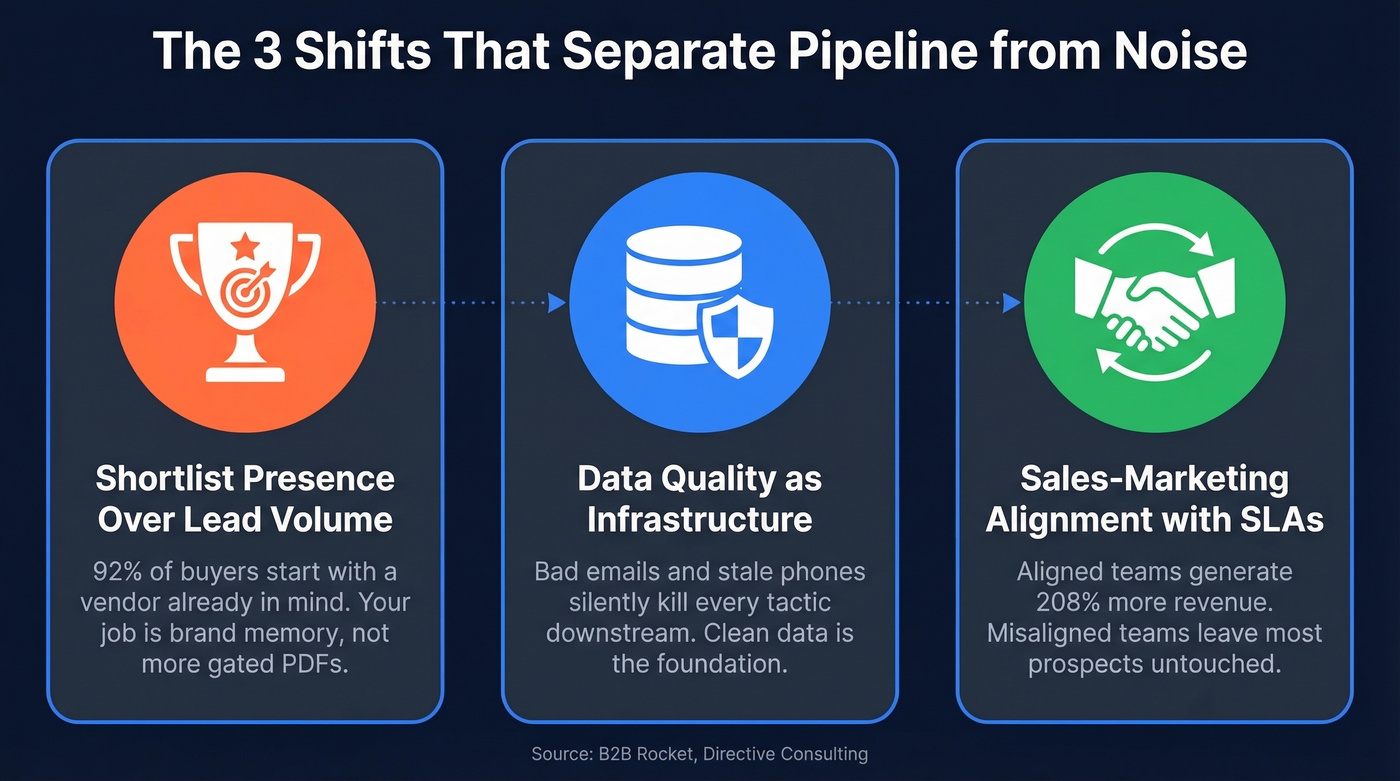
- Shortlist presence over lead volume. If 92% of buyers start with at least one vendor in mind, your job is brand memory - not more gated content.
- Data quality as infrastructure. Bad emails, stale phones, and duplicate records silently kill every tactic downstream.
- Sales-marketing alignment with SLAs. Aligned teams generate 208% more revenue from marketing efforts. Misaligned teams break the handoff and leave most marketing-engaged prospects untouched.
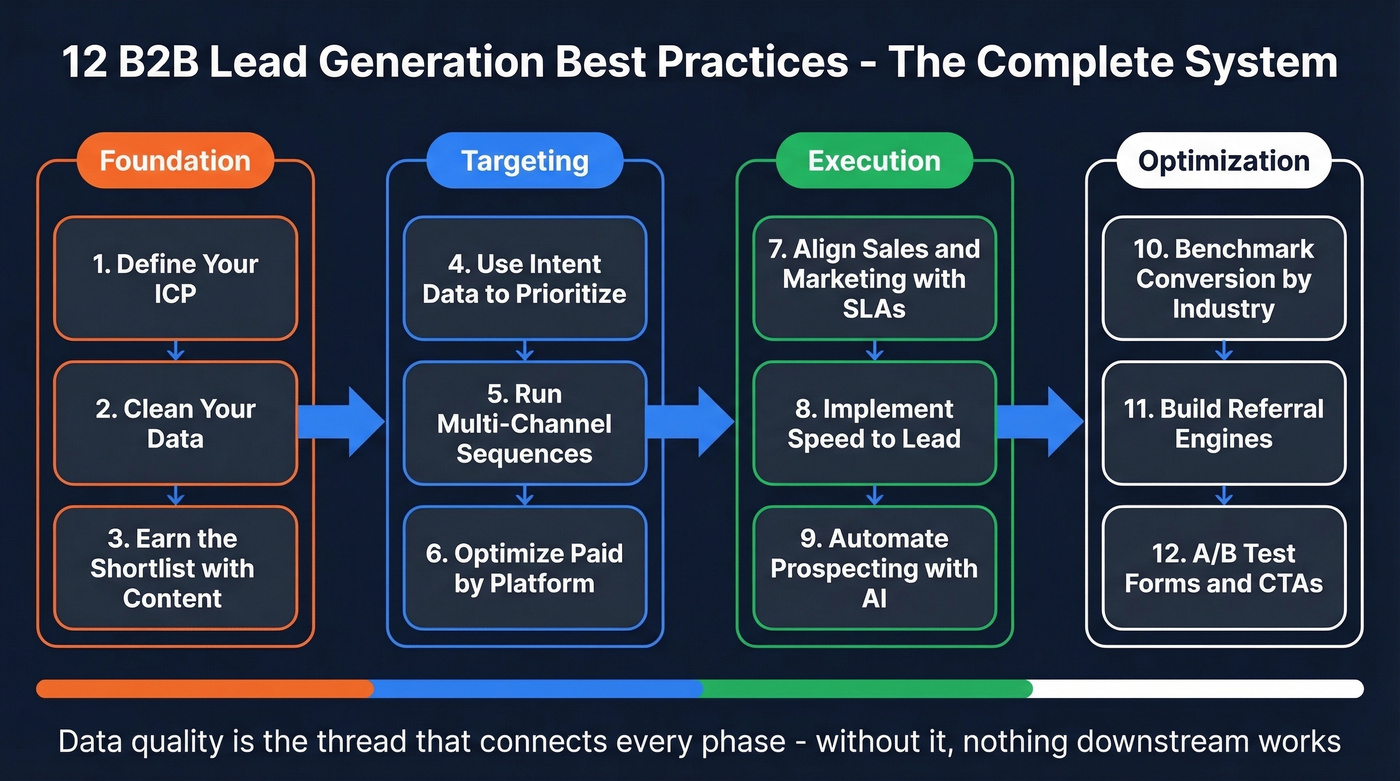
12 Strategies That Drive Pipeline
1. Define Your ICP Before You Build a List
The average B2B buying committee now includes 8-13 decision-makers. You can't target all of them equally.
Before you touch a database or write a single email, narrow your ICP to the five key players who actually influence the deal - the economic buyer, the champion, the technical evaluator, and one or two gatekeepers. Everything else flows from this. Skip it, and you'll generate leads that sales ignores. We've watched teams spend months optimizing outbound sequences when the real problem was that they were targeting the wrong people from the start. This single step does more to increase qualified leads than any tool or tactic you'll adopt later.
If you need a repeatable way to document and score it, use an ICP template.
2. Treat Data Quality as Infrastructure
Here's a scenario we've seen play out dozens of times: a team sends 5,000 cold emails, 800 bounce, and their domain reputation tanks overnight. Now every email - including replies to warm prospects - lands in spam. The problem wasn't the copy or the targeting. It was the data.
The results back it up. When agency Stack Optimize switched to Prospeo, client deliverability hit 94%+, bounces dropped below 3%, and they scaled to $1M ARR without a single domain flag.

Data quality isn't a nice-to-have. It's the foundation every other practice on this list depends on.
If you're troubleshooting bounces and inboxing, start with email deliverability fundamentals.
3. Create Content That Earns the Shortlist
If the winning vendor is on the Day One shortlist 95% of the time, your content strategy needs to optimize for one thing: being remembered. That means fewer gated whitepapers and more ungated content that builds brand association with the problem you solve.
Video is the format to bet on. B2B buyers are 2.2x more likely to trust brands that use video, and 78% of senior marketers already use it. If you're still relying entirely on blog posts and ebooks, you're leaving shortlist presence on the table.
Let's be honest: most B2B companies don't have a lead gen problem. They have a brand recall problem. You can run the most sophisticated outbound operation on the planet, but if the buyer has never heard of you, you're starting every conversation at a disadvantage. Spend 20% of your marketing budget on content that builds name recognition with zero gate. It'll pay off in pipeline six months from now.
If you're rebuilding positioning to improve recall, see B2B brand positioning.
4. Use Intent Data to Prioritize Accounts
Only 5% of your market is in-market at any given time. Intent data tells you which 5%.
Skip this if you have fewer than 500 accounts in your TAM. At that scale, you can manually track buying signals through job postings, press releases, and social activity. Intent data platforms pay off when you need to prioritize across thousands of accounts.
To operationalize this, build a simple model for identifying buying signals.
5. Run Multi-Channel Outbound Sequences
B2B buyers now engage across 10 channels before making a purchase - up from 5 in 2016. One channel isn't enough. Belkins estimates it takes 70+ touchpoints across six channels to earn a modern buyer's trust. That means email plus phone plus social plus retargeting plus direct mail plus events, orchestrated so each touch adds context rather than noise.
Email still delivers $36-$40 for every dollar spent, but only when the data behind it is clean. The teams winning at outbound in 2026 aren't doing more of one thing - they're doing a little of everything, consistently. One of the most actionable tips we can offer: sequence your channels so each touchpoint references the last, giving prospects a coherent narrative instead of disconnected pings.
If you want a proven structure, start with a B2B cold email sequence and layer channels on top.
6. Optimize Paid Acquisition by Platform
Not all paid channels perform equally for B2B. Here's where the benchmarks actually land:
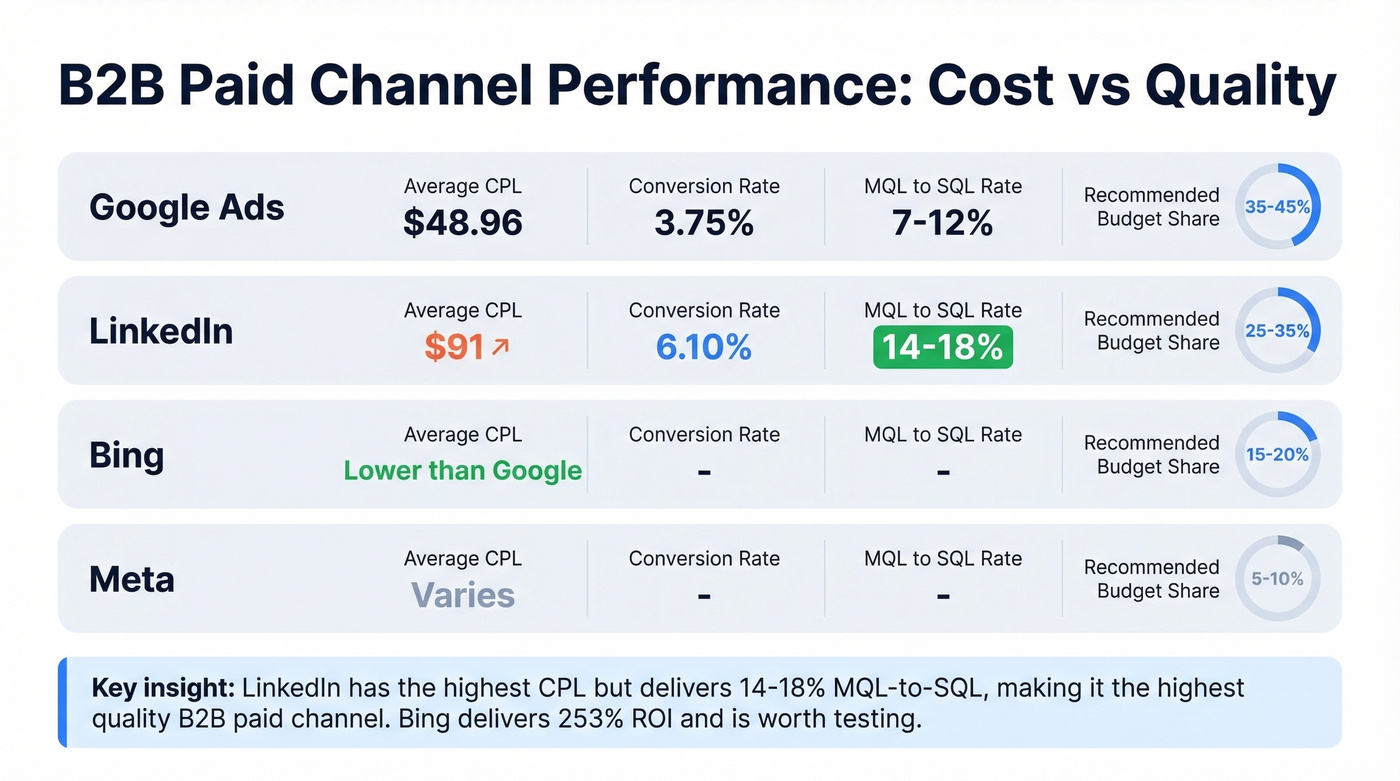
| Platform | Avg CPL | Conv. Rate | MQL-to-SQL | Budget Share |
|---|---|---|---|---|
| Google Ads | $48.96 | 3.75% | 7-12% | 35-45% |
| ~$91 | 6.10% | 14-18% | 25-35% | |
| Bing | Lower than Google | - | - | 15-20% |
| Meta | Varies | - | - | 5-10% |
LinkedIn's MQL-to-SQL conversion rate of 14-18% makes it the highest-quality paid channel for B2B, even though the CPL is higher. Bing delivers the best ROI at 253%, which makes it worth testing if you haven't already. Allocate budget based on where your buyers actually convert, not where it's easiest to spend.
7. Align Sales and Marketing with SLAs
An Influ2 analysis of 105 companies found that 53% have a broken handoff - sales follows up with fewer than 35% of marketing-engaged prospects. Only 11% of companies have truly effective alignment. That's a staggering amount of wasted effort.
The fix isn't a quarterly meeting. It's shared lead definitions, documented SLAs for follow-up timing, and weekly pipeline reviews where both teams look at the same numbers. Aligned teams see 208% more revenue and 24% faster growth. Misaligned teams just generate leads that rot in the CRM.
If you need a practical system for the handoff, map your lead generation workflow.
8. Implement Speed-to-Lead
Responding to an inbound lead within one hour makes you 7x more likely to qualify them. Responding within 60 seconds lifts conversion by 391%. Yet 44% of sales reps give up after a single follow-up, and 80% of deals require five or more touches.
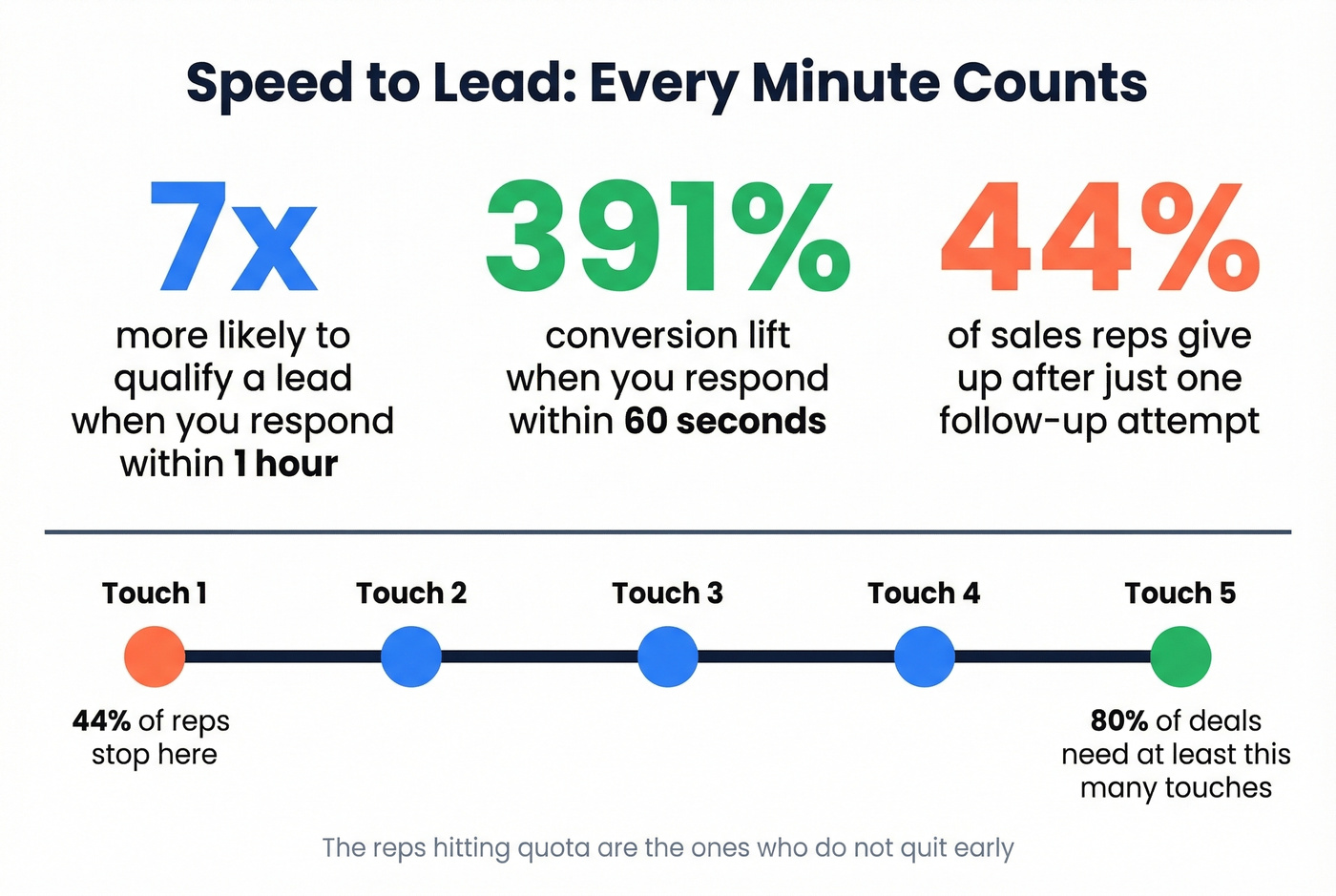
Speed-to-lead isn't just about the first response - it's about sustained follow-up discipline. Automate the initial response, then build a sequence that keeps the conversation alive for at least five touches. The consensus on r/sales is pretty clear: most reps quit way too early, and the ones who don't are the ones hitting quota.
For copy you can plug into your sequences, use these sales follow-up templates.
9. Automate Prospecting with AI
61% of marketers say marketing is experiencing its biggest disruption in 20 years, and 80% already use AI for content creation. But the real shift is agentic AI - systems that don't just assist but execute entire workflows: discover prospects, enrich contact data, draft personalized outreach, handle follow-ups, and update the CRM.
AI-driven prospecting can drive 50-70% improvements in lead quality and 20-30% shorter sales cycles when AI handles the research-and-enrich phase. It can also reclaim 4-7 hours per rep per week. Companies using marketing automation see a 451% increase in qualified leads. The reps who resist AI aren't saving their jobs - they're falling behind reps who use it.
If you're building this into outbound, start with AI cold email outreach.
10. Measure Conversion by Industry Benchmark
If you don't know what "good" looks like for your industry, you can't diagnose what's broken. Here are visitor-to-lead conversion benchmarks worth pinning to your dashboard:
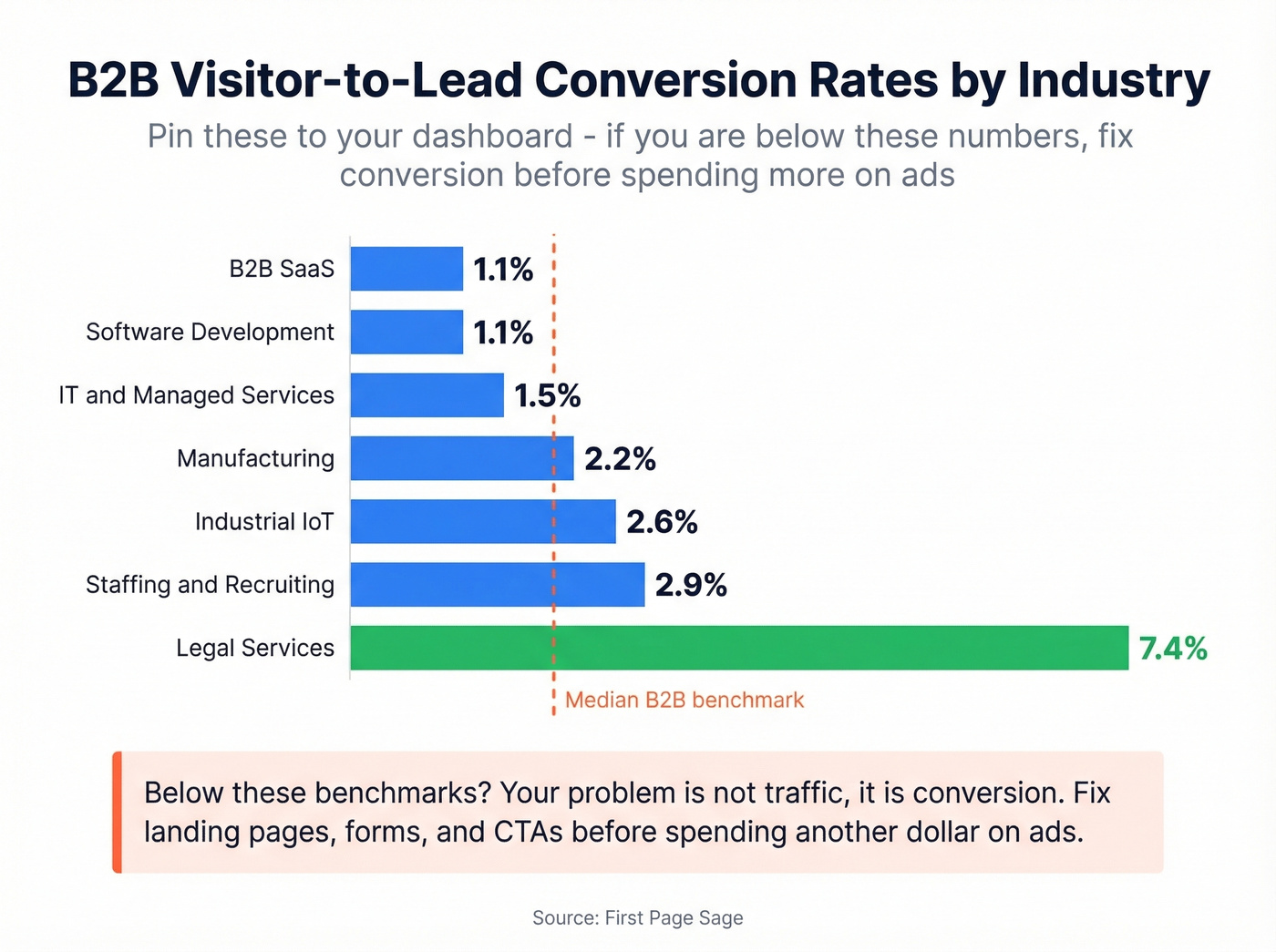
| Industry | Conversion Rate |
|---|---|
| B2B SaaS | 1.1% |
| Software Dev | 1.1% |
| IT & Managed Services | 1.5% |
| Manufacturing | 2.2% |
| Industrial IoT | 2.6% |
| Staffing & Recruiting | 2.9% |
| Legal Services | 7.4% |
If you're below these numbers, your problem isn't traffic - it's conversion. Fix your landing pages, forms, and CTAs before you spend another dollar on ads.
To go deeper on what “good” looks like across the funnel, track lead generation metrics.
11. Build Referral and Partnership Engines
Referrals and partnerships consistently deliver lower CPL than paid channels. Webinar leads cost roughly $72 each, compared to $92 for SEM and $811 for trade shows. Co-marketing with complementary vendors - joint webinars, shared content, reciprocal email sends - compounds over time and builds the kind of trust that paid ads can't replicate.
Here's the honest breakdown on referral programs: the upside is real (lowest CPL, highest trust, zero ad spend), but they're slow to build and hard to scale predictably. They require active relationship management. Every B2B team should have a referral engine running - it won't replace outbound, but it'll consistently deliver your highest-quality leads.
12. A/B Test Forms and CTAs Relentlessly
Conversion rate optimization is the second most-used optimization technique among marketers, with 50% actively running CRO programs. Yet most teams test their ad creative obsessively and never touch their forms.
Reducing form fields from seven to four, testing button copy, and experimenting with multi-step forms can move conversion rates more than any channel switch. In our experience, this is the single most overlooked lever in B2B lead gen. It's not glamorous, but it works.

Every best practice on this list breaks down without clean data. Prospeo refreshes 300M+ profiles every 7 days - not every 6 weeks - so your outbound hits real inboxes. 98% email accuracy, under 3% bounce rates, and zero domain flags.
Stop optimizing sequences on top of broken data.
Stack Optimize built a $1M agency on Prospeo data with 94%+ deliverability and zero domain flags. Snyk's 50 AEs grew pipeline 180% because they finally reached real buyers. Your multi-channel outbound deserves the same foundation.
Build your 2026 pipeline on data that actually connects.
Why Most Lead Gen Programs Fail
Organizations generate an average of 1,877 leads per month. Eighty percent never convert to customers. The problem usually isn't lead generation - it's what happens after capture.
Five post-capture failures kill most programs:
- Misaligned handoffs. Marketing and sales don't share a definition of "qualified." Leads get tossed over the wall with no context, and sales ignores them.
- Low-quality placements. Cheap syndication and content networks inflate volume but deliver contacts who never intended to buy. The MQL number looks great; the pipeline doesn't.
- Fragmented data. Your CRM, marketing automation, and intent platform don't talk to each other. Attribution is broken, and nobody knows which leads are real.
- Slow activation. Manual routing and delayed follow-up mean competitors engage your prospects first. Remember: 44% of reps give up after one touch, but 80% of deals need five or more.
- Generic nurture. Dropping every lead into the same drip sequence regardless of intent signal or buying stage is a recipe for unsubscribes.
Most lead gen failures aren't strategy problems. They're systems problems. Fix the plumbing before you redesign the kitchen.
The Lead Gen Tech Stack
You don't need 15 tools. You need four layers working together, and the data layer matters most.
| Layer | Tool | Starting Price |
|---|---|---|
| Data | Prospeo | Free; ~$0.01/email |
| Data | Apollo.io | Free; from $49/user/mo |
| Data | ZoomInfo | From ~$15K/yr |
| CRM | HubSpot | Free; from $15/user/mo |
| CRM | Salesforce | From $25/user/mo |
| Sequencing | Instantly | From $37/mo |
| Sequencing | Smartlead | ~$39/mo |
| Sequencing | Salesloft | $125+/user/mo |
| Intent | Bombora | Available in Prospeo plans |
| Intent | 6sense | Enterprise; ~$30K+/yr |
Pair a strong data layer with Instantly or Smartlead for sequencing, HubSpot or Salesforce for CRM, and you've got a stack that covers the full lifecycle without enterprise overhead. The data layer is where most teams underinvest and overpay - get that right and everything downstream performs better.
If you're evaluating providers, compare data enrichment services before you commit.
FAQ
What is B2B lead generation?
B2B lead generation is the process of identifying potential business buyers and capturing their contact information so sales can engage them. It spans inbound tactics like content and SEO, outbound methods like cold email and calling, and paid channels like Google and LinkedIn ads.
What's the difference between an MQL and an SQL?
An MQL meets marketing's engagement criteria - downloaded content, visited pricing, or hit a lead score threshold. An SQL has been vetted by sales as having budget, authority, need, and timeline. The gap between the two is where most programs leak revenue.
How long is the average B2B sales cycle?
The average B2B sales cycle runs 10.1 months. The winning vendor lands on the buyer's Day One shortlist 95% of the time, which means brand presence matters long before the first sales conversation.
What are the most effective tips for email outreach?
Start with list hygiene: verify every address before you send, warm your domain gradually, and personalize beyond the first name. Segment by intent signal and include a single, clear CTA per message. A multi-step verification process that handles catch-all domains and removes spam traps is non-negotiable if you're sending at any real volume.
How do I verify B2B contact data before outreach?
Use a verification tool that checks emails in real time rather than relying on stale databases. Look for multi-step verification with catch-all handling and spam-trap removal, and confirm the provider refreshes records at least monthly - weekly is the gold standard.