

B2B Lead Segmentation: Build Segments That Actually Convert
You've got 15,000 leads in a CSV. You blast the same sequence to all of them. Reply rate: 2%. Your sequences aren't broken - your segmentation is. Or rather, you don't have any.
B2B lead segmentation is where pipeline lives or dies, and most teams treat it as an afterthought - something they'll "get to" after building the list. That's backwards. HubSpot's 2026 State of Marketing Report ranks audience segmentation refinement as the single most-used optimization technique among marketers, edging out conversion rate optimization by a full percentage point.
The Short Version
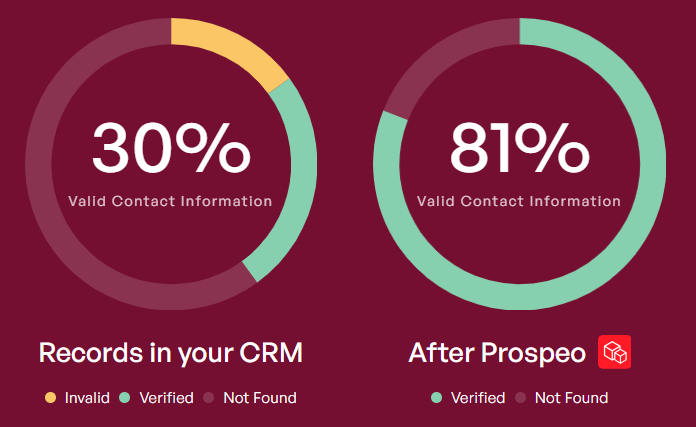
- Segmentation is a data quality problem first. If 40% of your contacts are outdated or targeting the wrong decision-makers, no model will save you. Start with clean, verified data.
- You need 3-5 meaningfully different segments, not 15. If your messaging doesn't change between two segments, they're the same segment. Merge them.
- The tool stack that matters: an enrichment layer for clean data, a CRM or MAP for segment management, and an intent data platform for in-market signals.
What Is B2B Lead Segmentation?
It's the practice of dividing your leads into distinct groups based on shared characteristics - firmographics, behavior, intent, tech stack, buying stage - so you can tailor messaging, prioritize outreach, and allocate resources where they'll actually convert. This isn't market segmentation, which is broader and more strategic. Lead segmentation happens after you've identified potential buyers and sits upstream of lead scoring: you segment first, then score within segments.
Why It Matters More in 2026
The B2B buying cycle has gotten longer, more complex, and more front-loaded. 92% of B2B buyers start their evaluation with at least one vendor already in mind. The winning vendor lands on the "Day One shortlist" 95% of the time. The average buying cycle now stretches to 10.1 months.
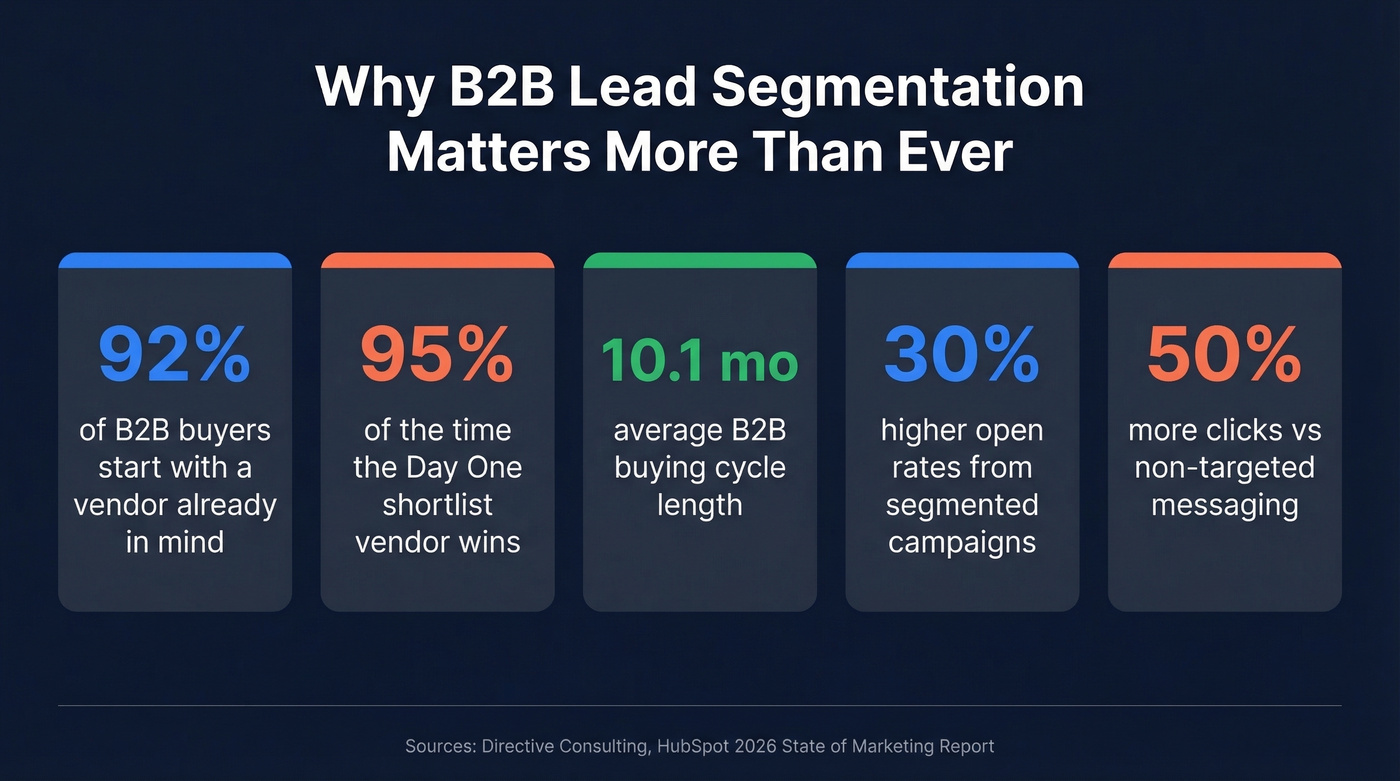
Buyers use an average of 10 channels during their journey. Proper segmentation ensures your message stays consistent and relevant across all of them. Segmented campaigns see 30% higher open rates and 50% more clicks than non-targeted messaging - that's the difference between a sequence that books meetings and one that gets archived.
We'll break down a concrete case study later, but here's the headline version: a mid-size B2B firm went from a 2% reply rate to 11% - and nearly tripled sales meetings in eight weeks - simply by cleaning their data and segmenting by industry, company size, and region. The segmentation wasn't fancy. It was just present.
Here's the thing: most teams don't have a segmentation problem. They have a data quality problem they've misdiagnosed as a messaging problem. Fix the data first, and segmentation becomes almost obvious.
The 7 Types of Segmentation
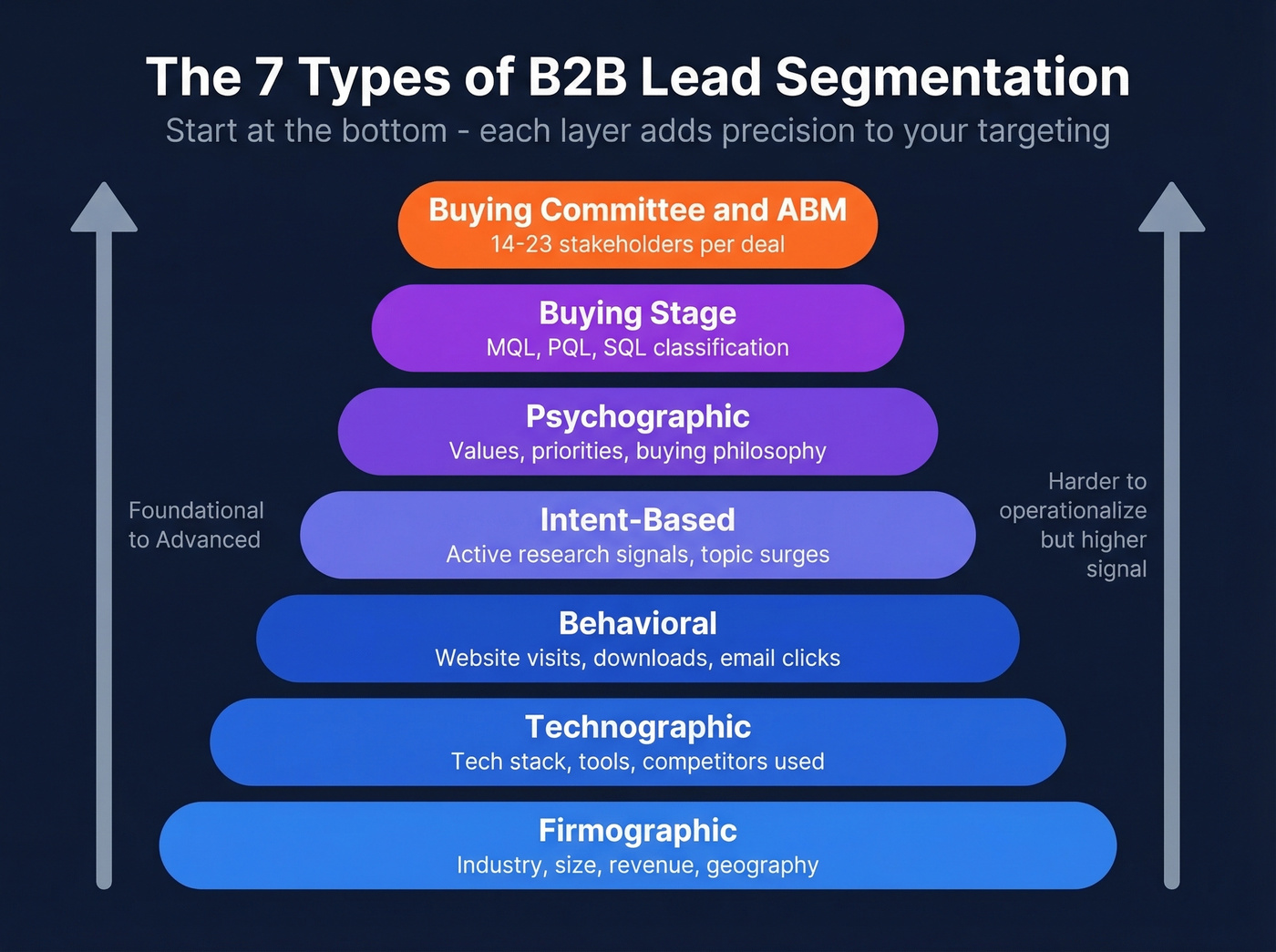
Not all segmentation dimensions are created equal. Here are the seven that matter, roughly ordered from foundational to advanced.
Firmographic
Industry, company size, revenue, geography, growth stage. This is the baseline. A 50-person SaaS startup and a 5,000-person manufacturing company need fundamentally different messaging, pricing, and sales motions. If you're only doing one type of segmentation, make it firmographic. (If you want a practical implementation checklist, see firmographic segmentation.)
Technographic
What tools does the prospect already use? Technographic segmentation lets you identify companies running a competitor's product, using complementary tech, or lacking a solution entirely. Tools with Wappalyzer-based technology filters let you build lists pre-segmented by tech stack without manual research. (More on the underlying data types in firmographic and technographic data.)
Behavioral
What has the prospect actually done? Website visits, content downloads, webinar attendance, email engagement, product trial activity. Behavioral signals tell you where someone is in their journey - not just who they are on paper. Ignoring behavior is like hiring based on resumes without interviews.
Intent-Based
Intent data captures signals that a company is actively researching a topic related to your solution. First-party intent from your own website and product analytics is the most reliable. Third-party intent from providers like Bombora, 6sense, or Demandbase catches buyers before they ever visit your site. (For a hands-on framework, see intent based segmentation.)
Psychographic
Values, priorities, risk tolerance, buying philosophy. Harder to operationalize at scale, but it shows up in how companies describe themselves. A company whose homepage leads with "enterprise-grade security" has different priorities than one leading with "move fast and ship." One Reddit practitioner put it well: "What the company says about itself" is one of the strongest segmentation signals you can use.
Buying Stage (MQL / PQL / SQL)
MQLs have engaged and meet basic criteria. PQLs show product usage or trial behavior indicating conversion likelihood. SQLs have been vetted by sales and are ready for a direct conversation. Applying the same outreach to all three wastes everyone's time.
Buying Committee & ABM
B2B decisions aren't made by individuals. Forrester's research shows buying groups now include 14 to 23 stakeholders. Segmenting by role within the buying committee - champion, economic buyer, technical evaluator, end user - lets you tailor messaging to each stakeholder's concerns. Targeting managers instead of VPs is one of the fastest ways to stall a deal, because managers can champion but rarely sign. (If you're formalizing this motion, use account-based selling best practices.)
How to Build Your Segmentation Model
Define Your TAM and SAM
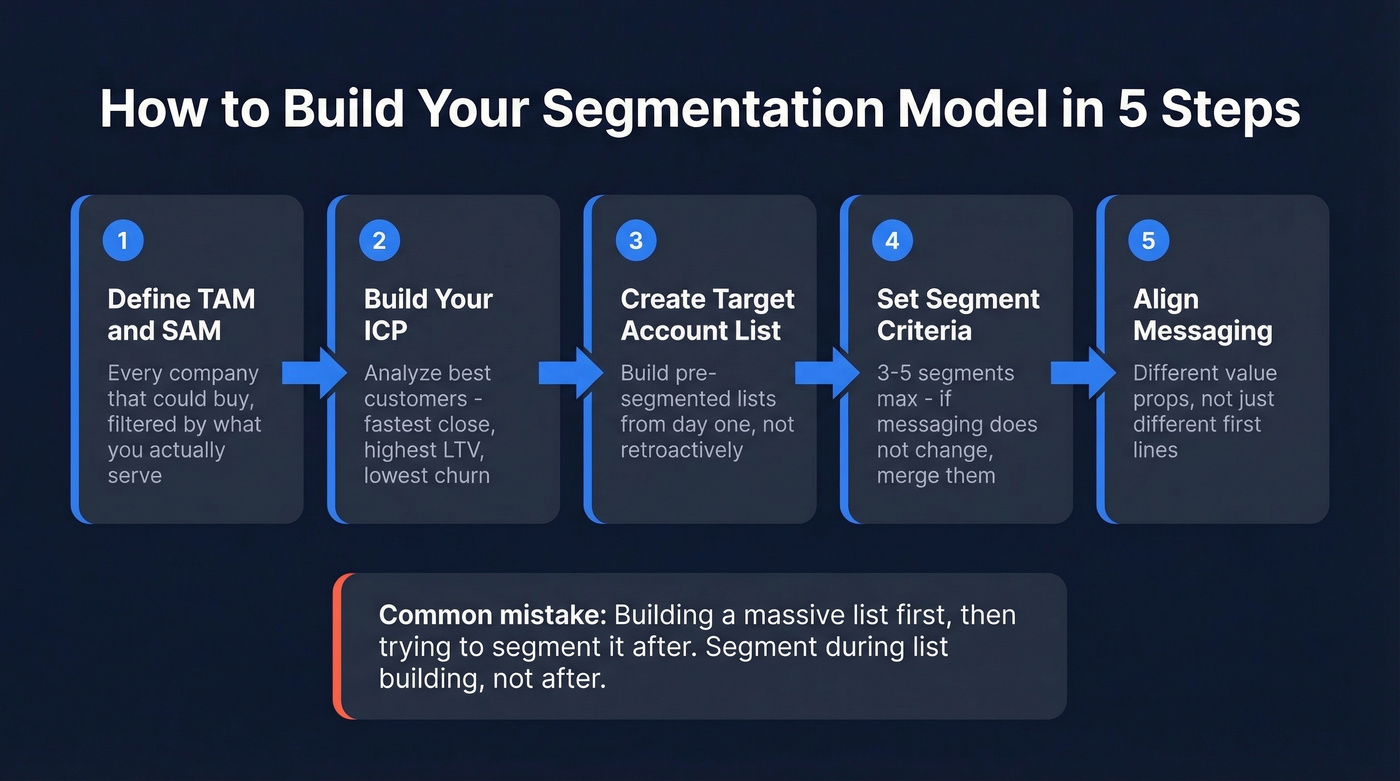
Start broad, then narrow. Your Total Addressable Market is every company that could theoretically buy. Your Serviceable Addressable Market filters that by geography, company size, industry, and other constraints you actually serve. The goal is to stop boiling the ocean before you start building lists. (If you need a clean definition and examples, see addressable market.)
Build Your ICP
Your Ideal Customer Profile is the subset of your SAM that looks like your best existing customers. Pull data from your CRM: which accounts closed fastest, had the highest LTV, and churned least? The patterns in that data - industry, headcount range, tech stack, growth stage - become your ICP criteria. (Use an ideal customer profile template to standardize this.)
Create Your Target Account List
This is where most teams go wrong. They build a massive list first, then try to segment it retroactively. That's painful and error-prone.
Instead, use your ICP criteria to build pre-segmented lists from the start - treating list segmentation as a list-building step, not a post-processing chore. Prospeo's 30+ search filters, including buyer intent, technographics, job change signals, headcount growth, and funding data, let you pull lists that are already segmented by the criteria that matter. You're not cleaning up a messy CSV after the fact; you're building clean segments from day one. (If you want the workflow, see how to automate target account lists.)
Set Segment Criteria and Scoring Rules
Now define what makes each segment distinct. Your "high-growth mid-market" segment might be companies with 200-1,000 employees, Series B+ funding, 20%+ headcount growth in the last 12 months, and active intent signals in your category. Your "enterprise expansion" segment might be 1,000+ employees, existing tech stack overlap, and multiple stakeholders engaged.
Keep it to 3-5 segments. If you can't articulate in two sentences how Segment A differs from Segment B, they're the same segment.
Align Messaging to Each Segment
Each segment needs its own angle - not just a different first line, but a different value proposition emphasis. What changes between a 50-person startup and a 500-person mid-market company isn't just the greeting. It's the pain points, the buying process, the budget authority, and the competitive alternatives they're evaluating. Map messaging to those differences or your segmentation is just taxonomy for its own sake.

Most segmentation fails because the underlying data is stale or wrong. Prospeo refreshes all 300M+ profiles every 7 days - not every 6 weeks like competitors - so your firmographic, technographic, and intent-based segments reflect reality, not last quarter's org chart.
Clean segments start with clean data. Get 75 verified emails free.
Using AI for Segmentation at Scale
Manual segmentation works until your list hits about 5,000 companies. After that, intuition breaks. You can't read 5,000 homepages and consistently assign segments.
Three signals matter most when classifying a company:
- What the company says about itself - homepage positioning is the strongest signal.
- What problem they solve - function and problem matter more than industry tags.
- Where the revenue comes from - the primary revenue driver is the "real segment."
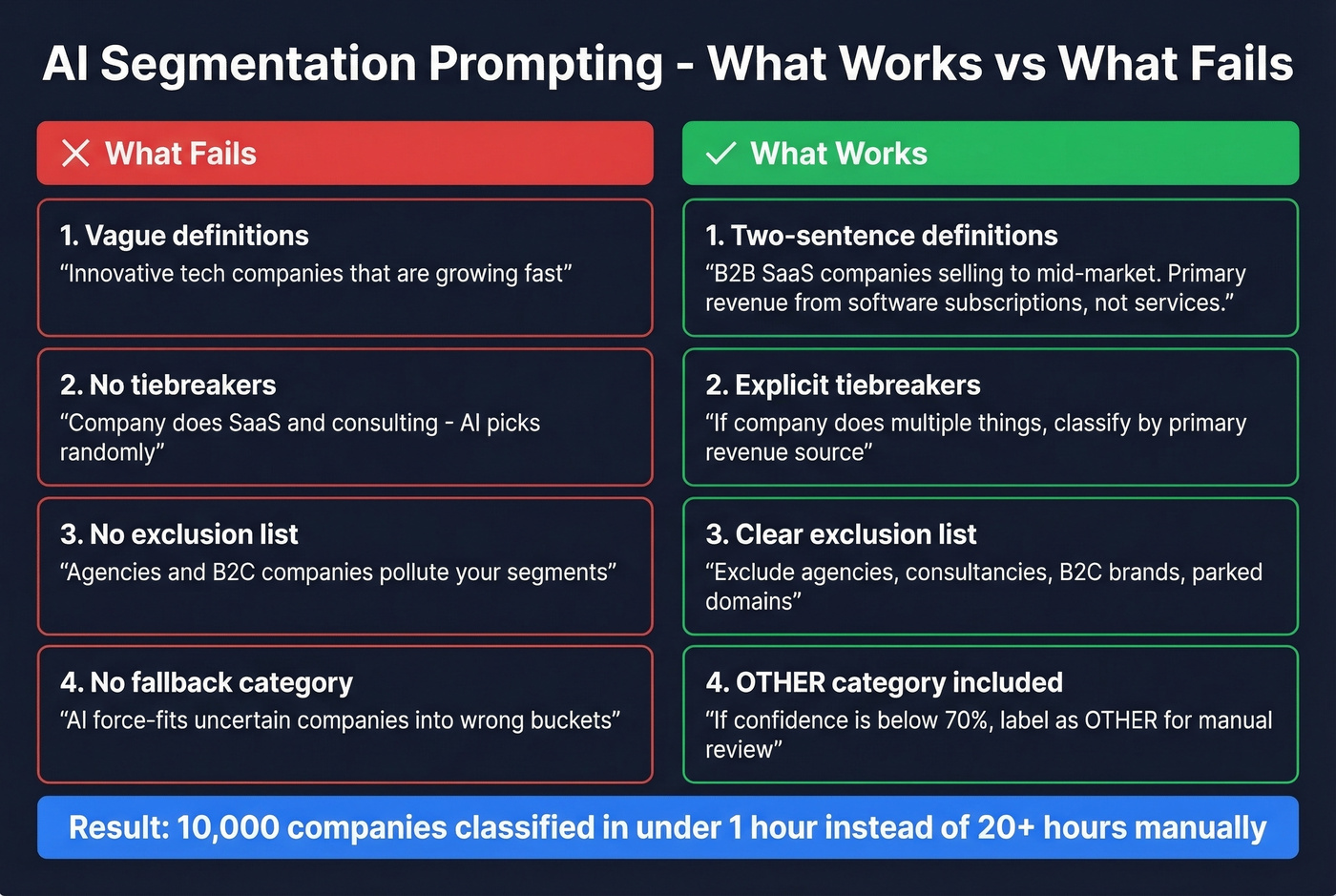
We've tested this extensively. Teams that give AI clear, two-sentence segment definitions with explicit tiebreakers get consistent results. Teams that hand over vague descriptions like "innovative tech companies" get garbage back. The AI is only as good as your rules.
AI prompting rules that actually work:
- Write two-sentence segment definitions. If you can't define it concisely, the AI can't apply it consistently.
- Add explicit tiebreakers, because companies do three things and the AI needs to pick one.
- Include an exclusion list - agencies, consulting firms, B2C companies, parked domains - to keep your dataset clean.
- Always include an "OTHER" category. If the AI isn't sure, it should say so rather than force-fitting a company into the wrong bucket.
We've seen teams go from spending 20+ hours manually tagging lists to processing 10,000 companies in under an hour with this approach. We've also watched teams burn months building 15-segment models that collapse into 3 when they actually write the emails. Consistency beats accuracy when you're segmenting at scale.
Tools for B2B Lead Segmentation
The right tool stack depends on where you are. Here's how it breaks down with real pricing:
| Tool | Category | Starting Price | Segmentation Strength |
|---|---|---|---|
| Prospeo | Enrichment + Intent | Free; ~$0.01/email | 30+ filters (intent, tech, growth), 98% accuracy |
| Apollo | Enrichment + Outreach | Free; ~$49/user/mo | Large DB, built-in sequencing |
| ZoomInfo | Enrichment + Intel | ~$15,000/yr | Deep firmographics, org charts |
| Cognism | Enrichment + Compliance | ~$1,000-3,000/mo | GDPR-focused, EU data |
| HubSpot | CRM + MAP | $890/mo (Professional) | Scoring; predictive at Enterprise |
| Salesforce | CRM + AI Scoring | $165/user/mo + $50 AI | Einstein scoring, enterprise workflows |
| 6sense | ABM + Intent | ~$19,000/yr (entry tier) | Account-level intent, predictive |
| Bombora | Intent Data | ~$25,000-50,000/yr | 15,000+ topics, standalone layer |
| Demandbase | ABM + Advertising | ~$30,000-100,000+/yr | Intent + ads + account scoring |

The enrichment layer is the foundation everything else sits on. If your contact data is 79% accurate (Apollo's benchmark) or even 87% (ZoomInfo's benchmark), your segments are rotting from the inside. Teams that start with enrichment before investing in ABM platforms see faster ROI - because a $19,000/year intent platform is worthless if the emails underneath it bounce. (If you're comparing vendors, start with data enrichment services.)
Skip the enterprise ABM platforms if you're under 50 employees or don't have a dedicated RevOps person to manage them. The consensus on r/sales is that most teams overspend on intent data before they've nailed basic firmographic segmentation. Get the basics right first.
Why build a massive list and segment it after the fact? Prospeo's 30+ search filters - buyer intent, technographics, headcount growth, funding, job changes - let you pull lists that are already segmented by the criteria that actually drive conversions. At $0.01 per email.
Build pre-segmented lists in minutes, not hours of CSV cleanup.
Real-World Results
The data cleanup turnaround. A mid-size B2B firm shared their story on r/b2bmarketing: they audited their outbound and discovered 40-50% of their contact data was outdated. They were targeting managers instead of VPs, sending to generic inboxes, and running zero segmentation by industry or company size. After rebuilding their contact database with verified data and segmenting by industry, company size, and region, reply rates jumped from 2% to 11%. Sales meetings nearly tripled in eight weeks. The lesson is simple: segmentation without data quality is theater.
The automation + scoring play. A MarketingSherpa case study documented a team that implemented CRM-based lead scoring with marketing automation and segmented outreach. Lead generation improved 75% in year one. A related case combined segmented "known contacts" lists with email priming and fast phone follow-up, hitting a 13.4% meeting conversion rate and 300% ROI. The pattern across both: segment first, then sequence, then follow up fast. (If you need plug-and-play sequences, use sales follow-up templates.)
Mistakes That Kill Your Pipeline
Dirty data. Dun & Bradstreet research shows up to 21% of B2B data is inaccurate. If one in five records is wrong, your segments are built on sand.
Over-segmentation. If your messaging doesn't change between two segments, merge them. Fifteen micro-segments with identical emails is just complexity for its own sake.
Ignoring behavioral signals. Firmographics tell you who someone is. Behavior tells you what they care about right now. Use both.
Static models. Markets shift, ICPs evolve, and data decays at roughly 30% per year. Leading teams refresh segments quarterly at minimum. If your model hasn't been updated in six months, it's lying to you.
No sales-marketing alignment. If sales and marketing define "qualified" differently, your segments will generate leads that sales ignores. Shared definitions and a feedback loop aren't optional - they're the whole point.
Segmenting after list-building. Building a 15,000-lead list and then trying to segment it retroactively is painful and lossy. Segment during list-building, not after. This one frustrates us more than any other mistake on this list because it's so easy to avoid.
Measuring Segmentation Success
| KPI | Benchmark |
|---|---|
| MQL to SQL conversion | 25-35% |
| Meetings per 100 surging accounts (30 days) | 5-10 |
| Enrichment rate on key fields | 80%+ |
| Reply rate delta (segmented vs. unsegmented) | Track monthly - this is your canary |
| Segment refresh cadence | Quarterly minimum |
The reply rate delta is the metric that tells you whether your segmentation is working or just adding overhead. If segmented sequences aren't outperforming unsegmented ones by a meaningful margin, either your segments aren't distinct enough or your messaging isn't adapting to them. Monthly tweaks, quarterly reviews, annual overhaul - that's the cadence that keeps segments alive.
FAQ
What's the difference between lead segmentation and lead scoring?
Segmentation groups leads by shared traits like industry, company size, or intent signals. Scoring ranks individual leads within those groups by conversion likelihood. You segment first to create meaningful cohorts, then score within each segment to prioritize outreach - they're sequential, not interchangeable.
How many segments should a B2B team maintain?
Three to five meaningfully different segments is the sweet spot for most mid-market teams. If your messaging, value proposition, and sales motion don't change between two segments, they're functionally identical - merge them and save the operational overhead.
How often should I refresh my segments?
Monthly tweaks to scoring thresholds, quarterly reviews of segment definitions, and an annual overhaul of your entire model. B2B contact data decays at roughly 30% per year, so a segment built on six-month-old criteria is already stale.
What's a good free tool for segmenting B2B leads?
Prospeo's free tier includes 75 email credits and 100 Chrome extension credits per month with access to 30+ search filters - enough to build and test segmented lists before committing budget. Apollo also offers a free plan, though its email accuracy sits at 79%, which means more bounces and dirtier segments out of the gate.
How does email list segmentation improve outreach?
Segmented email campaigns consistently drive 30% higher open rates and 50% more clicks because each recipient gets messaging tailored to their firmographic, behavioral, and intent profile. The lift comes from relevance, not clever subject lines - recipients engage when the message matches their actual situation.