

B2B Marketing: The 2026 Guide With Real Benchmarks and Opinions
86% of B2B purchases stall before they close. 81% of buyers end up dissatisfied with the vendor they chose. Those two numbers should terrify every B2B marketer - and they should reframe how you think about everything from content to cold email to your martech stack.
You don't need another Wikipedia-style definition. You need to know what's actually working, what the real benchmarks look like, and where to stop wasting budget.
The Short Version
If you're building or fixing a business-to-business marketing engine in 2026, here it is: SEO delivers the highest ROI at 748%. ABM works when you have clean data. Cold email isn't dead - it's just dead when your data is stale. And your martech stack probably has 20 tools too many.
A thread on r/b2bmarketing frames the 2026 mood well: cold email reply rates are down, LinkedIn is noisier, paid ads are expensive and inconsistent. The consensus? Clean data plus tighter ICP filtering - fewer leads, better conversations. The single highest-leverage investment most teams ignore is data quality. The rest of this guide gives you the numbers to back that up.
How B2B Buyers Actually Buy in 2026
The buying process has shifted in ways most marketing playbooks haven't caught up with.
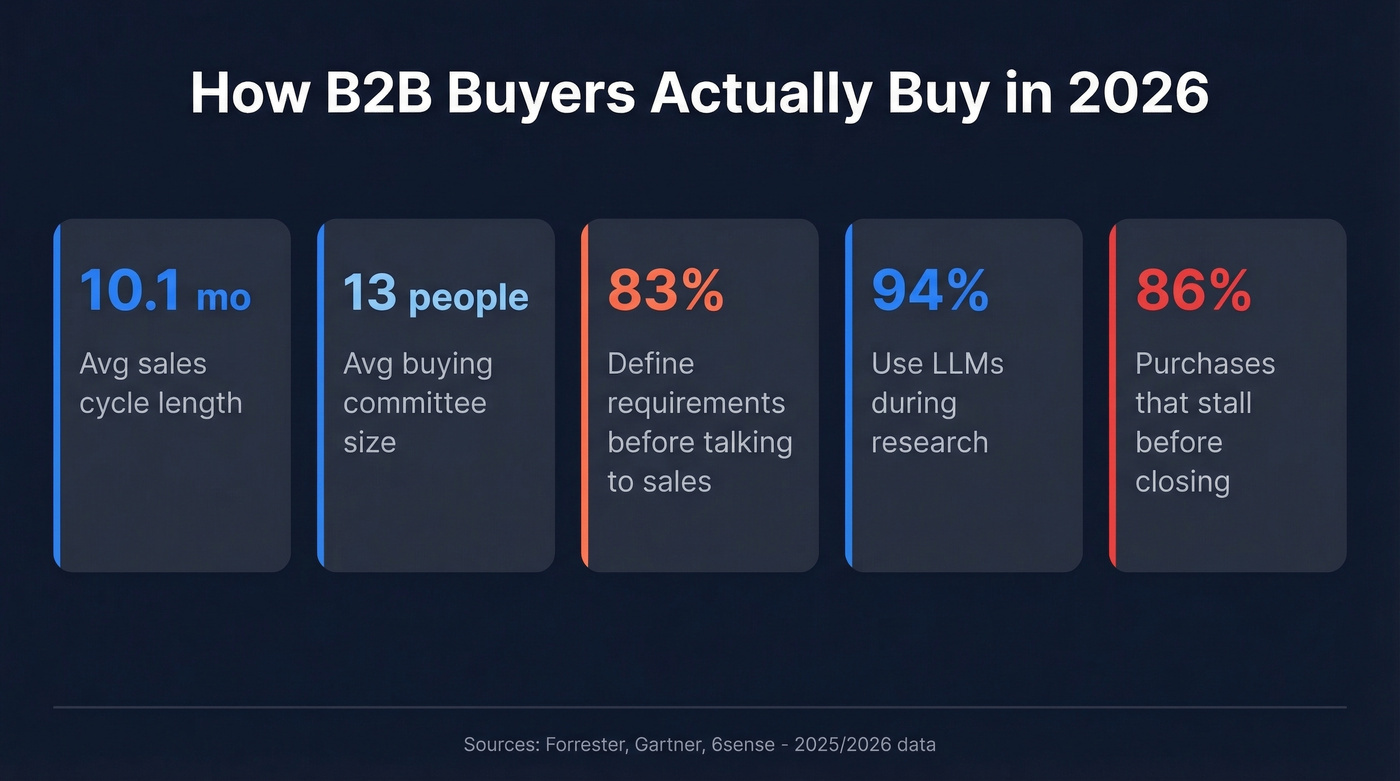
Average sales cycles compressed from 11.3 months in 2024 to 10.1 months in 2025, driven by economic pressure pushing buyers to engage sellers earlier. First contact now happens at 61% of the journey, pulled forward roughly six weeks compared to the prior year. Sounds like good news - until you realize buyers define their requirements 83% of the time before they ever talk to your sales team.
The buying committee keeps growing. Forrester puts the average at 13 people involved in a single purchase decision, with 89% of purchases spanning two or more departments. That's not a sales conversation. It's a consensus-building exercise across people who may never be in the same room.
Meanwhile, 94% of buyers now use LLMs during their research process, and 72% have encountered Google AI Overviews - 90% of those clicked at least one cited source. If your brand isn't showing up in AI-generated answers, you're invisible during the research phase that matters most. 41% of buyers prefer to do their own research online before engaging a vendor, and 86% say they're likely to use a ChatGPT-like tool for product research. Your marketing needs to be structured so AI tools can surface and cite it.
The uncomfortable reality: despite all this effort, 86% of purchases still stall, and 81% of buyers report dissatisfaction with the provider they ultimately chose. The buying process is broken, and most marketing teams are optimizing for the wrong stage of it.
B2B vs B2C: The Real Differences
The structural differences between selling to businesses and selling to consumers aren't academic - they dictate your entire go-to-market approach.
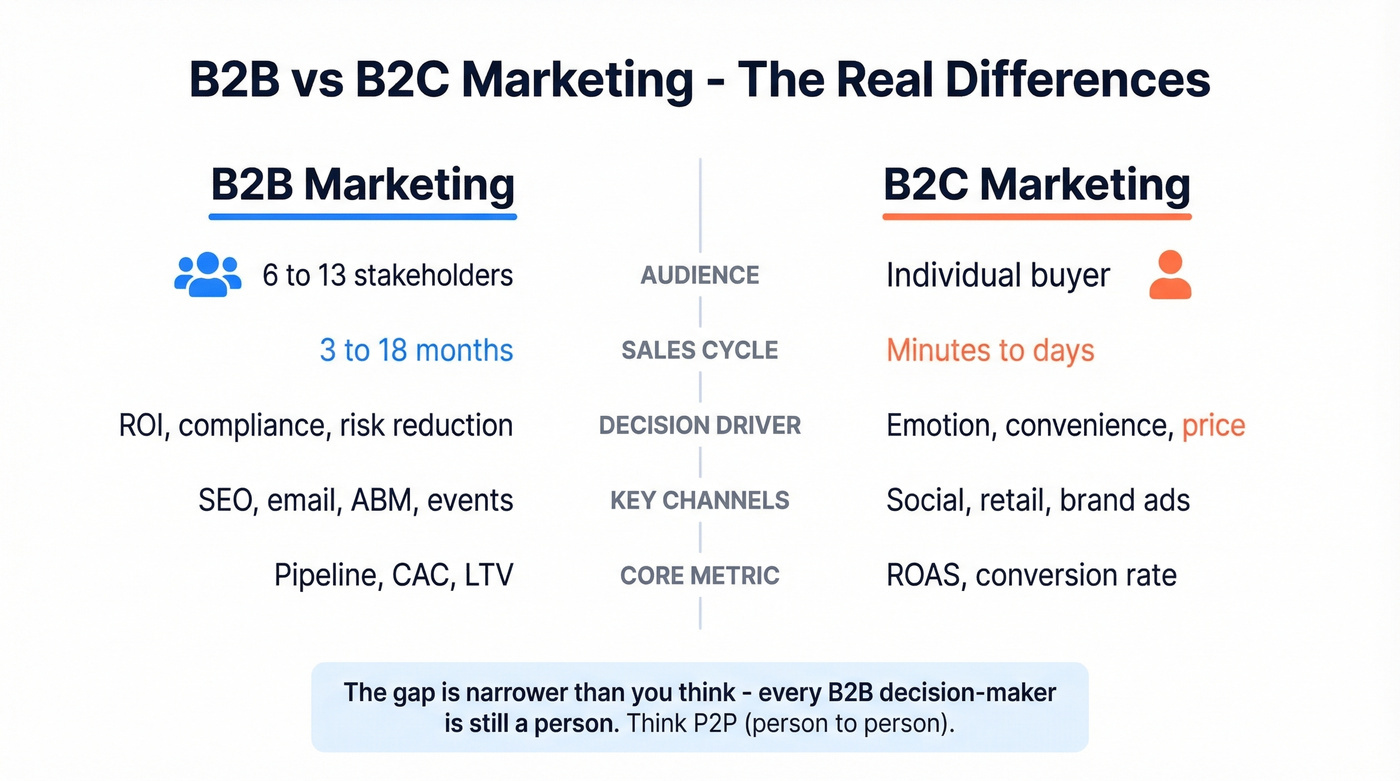
| Dimension | B2B | B2C |
|---|---|---|
| Audience | 6-13 stakeholders | Individual buyer |
| Sales cycle | 3-18 months | Minutes to days |
| Decision driver | ROI, compliance, risk | Emotion, convenience |
| Key channels | SEO, email, ABM, events | Social, retail, brand ads |
| Core metric | Pipeline, CAC, LTV | ROAS, conversion rate |
Gartner breaks the B2B buying process into six non-linear tasks: problem identification, solution exploration, requirements building, supplier selection, validation, and consensus creation. Buyers don't move through these sequentially - they loop back, stall, restart, and often run multiple tasks in parallel across different stakeholders.
That said, the gap between B2B and B2C is narrower than most textbooks suggest. Every decision-maker is still a person. They scroll social media, watch YouTube, and form opinions before they ever open a vendor's whitepaper. The best framing we've seen is "P2P" - person-to-person marketing that happens to involve business outcomes. The emotional resonance matters. The storytelling matters. You just need to layer ROI justification on top of it because your buyer has to defend the purchase to 12 other people.
Core B2B Marketing Strategies
SEO and GEO
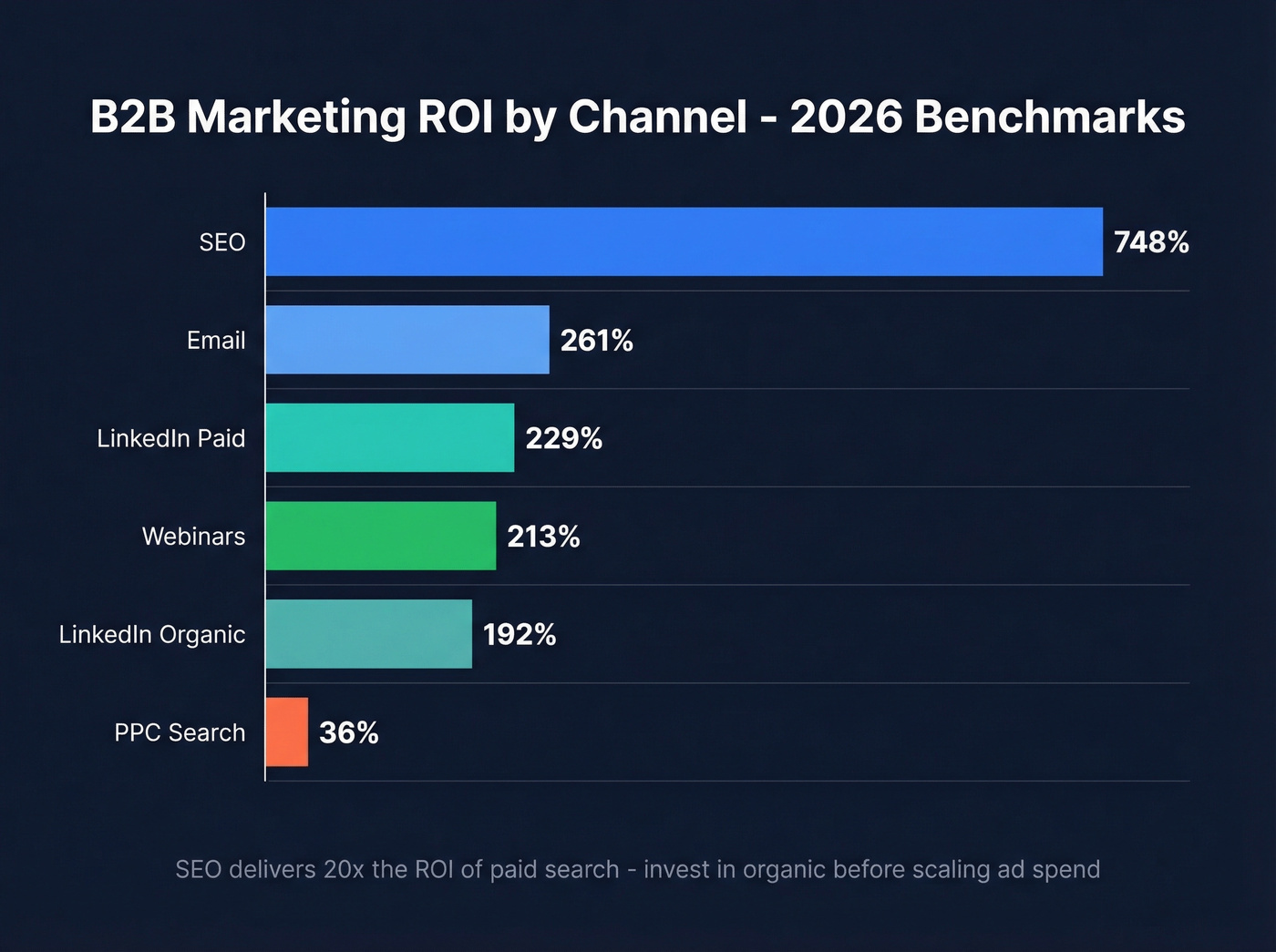
SEO remains the highest-ROI channel at 748%. That number isn't surprising when you consider that 71% of B2B researchers start with a generic Google search and 61% of decision-makers begin their buying process with web research.
What's changed is the emergence of Generative Engine Optimization - GEO. With AI Overviews now appearing in 72% of buyer research experiences, your content strategy needs to account for how LLMs parse and cite information. That means schema markup, conversational content structures, and building the kind of brand authority that makes AI tools reference you by name.
Here's the gap that should worry you: 9 in 10 marketers think they've mastered AI, but fewer than half have a defined AI strategy. That confidence-competence gap is where you'll lose rankings to competitors who actually operationalized their approach. The teams investing in structured data, topical authority, and citation-worthy content now will own the AI-generated results for the next three years.
Content Marketing
Most B2B content fails because it has no point of view.
Teams optimize for volume and traffic instead of building a chain from belief to memory to revenue. The result is a blog full of generic "ultimate guides" that rank for nothing and convert nobody. The fix is a content strategy framework that connects what your company believes, what your buyer needs to understand, and how you create value. A clear point of view frames you as a strategic partner rather than just another vendor in a comparison spreadsheet.
This isn't just philosophical. Hinge's research shows that firms conducting systematic research grow 3-10x faster and are up to 2x more profitable than firms that don't. 87% of B2B marketers planned to increase video investment heading into 2025, and the trend has only accelerated. Research-backed content with a genuine perspective compounds. Generic content decays.
Email Marketing
Email delivers 261% ROI, making it one of the highest-performing channels in business-to-business marketing. But that number masks a widening gap between teams doing email well and teams burning their domains with stale lists.
Cold email reply rates are declining across the board. The practitioners who are still winning with outbound share a common thread: clean data and tighter ICP filtering. Fewer sends, higher relevance, better conversations. Bounce rate isn't an abstract metric - we've seen teams take bounce rates from 35-40% down to under 5% by switching to verified data and keeping lists fresh (see email bounce rate benchmarks and fixes).
The most underutilized part of email marketing is middle-of-funnel nurturing. Everyone obsesses over top-of-funnel lead gen and bottom-of-funnel sales enablement, but the nurture sequences that keep you top-of-mind during a 10-month buying cycle? That's where email's compounding ROI actually lives. Segmented nurture flows tied to buying stage outperform blast newsletters by a wide margin.
Account-Based Marketing
ABM has moved from buzzword to proven revenue driver, but the execution gap is enormous. Contact-level ABM drives +74% more booked meetings and up to +118% lift in pipeline conversion. Yet only 13% of B2B teams hyper-personalize their ABM campaigns.
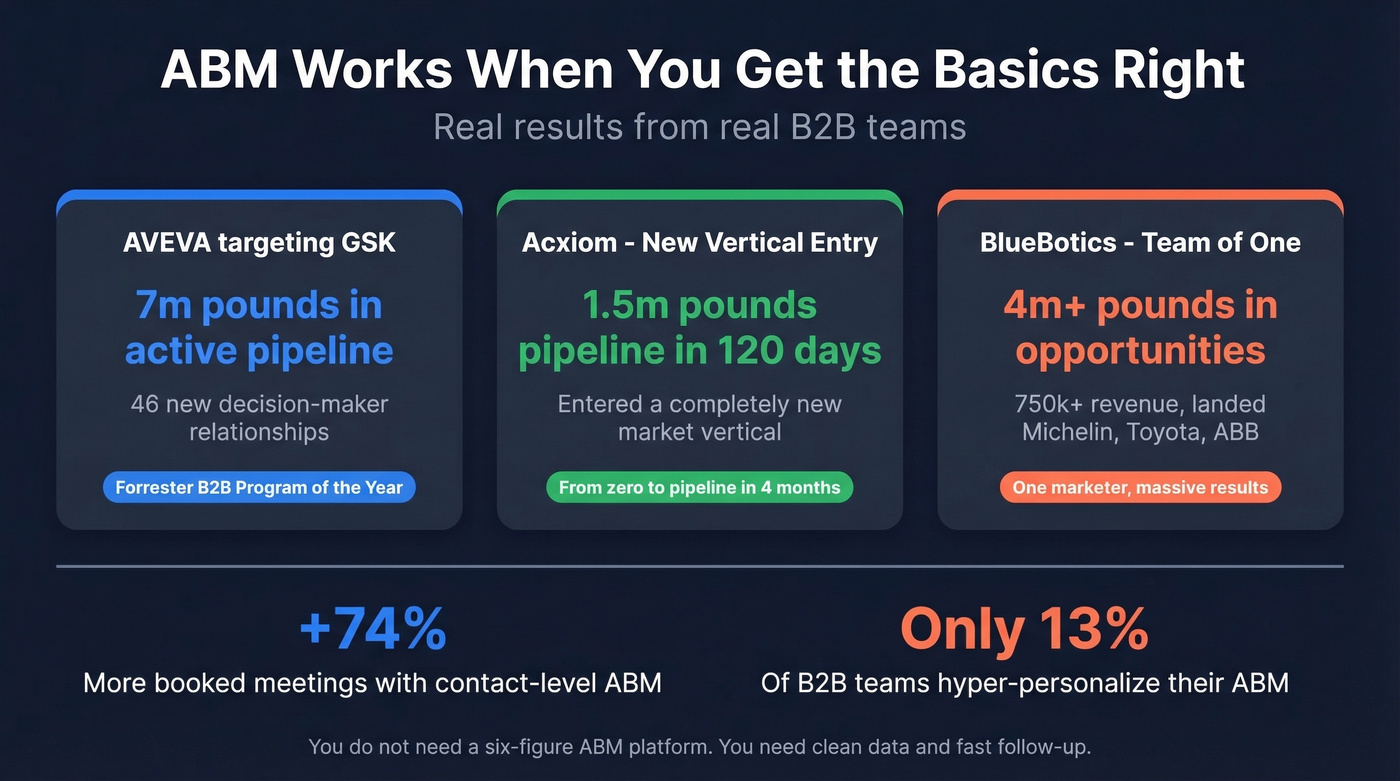
The case studies tell the story better than the averages. AVEVA ran a personalized ABM program targeting GSK that generated £7m in active pipeline, 46 new decision-maker relationships, and a Forrester B2B Program of the Year award. Acxiom built £1.5m in pipeline within 120 days entering a completely new vertical. BlueBotics - with a marketing team of one - generated £4m+ in opportunities and £750k+ in revenue, landing accounts like Michelin, Toyota Forklift, and ABB.
The common thread across these wins isn't a six-figure ABM platform. It's clean data on target accounts, genuinely personalized content, and a sales team that follows up fast. You don't need an enterprise ABM platform running $30K-$100K+/year. You need verified contact information and content that speaks to a specific business problem (pair this with account-based selling so sales runs the same play).
Paid Advertising
Paid search and LinkedIn ads are the two primary paid channels for B2B. PPC delivers a modest 36% ROI with roughly a four-month break-even - a fraction of what SEO and email produce. Median CPC for search ads sits at $5.26 with a 6.66% CTR, while LinkedIn ads run $3.94-$10+ per click with a CTR closer to 0.52%.
The real value of paid is speed. You can test messaging, validate ICP segments, and generate pipeline while your organic engine builds momentum. Treat it as a testing lab, not your primary growth lever.
Social and Community
LinkedIn generates 4 out of 5 B2B social media leads, with a visitor-to-lead conversion rate of 2.74% compared to 0.69% for Twitter and 0.77% for Facebook. 84% of buyers rely on social media for purchasing insights, which makes LinkedIn organic the closest thing to a free ABM channel that exists.
Community-led growth is the emerging trend worth watching. Dark social - Slack groups, private communities, peer conversations that don't show up in your attribution model - is where an increasing share of buying decisions actually happen. The teams building owned communities around their category are creating moats that no amount of ad spend can replicate.

You just read that cold email reply rates are down and bounce rates kill domains. Prospeo's 7-day data refresh and 98% email accuracy take bounce rates from 35%+ to under 5% - the same shift teams like Snyk used to grow AE-sourced pipeline 180%.
Stop burning your domain on stale data. Start at $0.01 per verified email.
B2B Marketing Benchmarks for 2026
Let's put the numbers in one place so you have something concrete to benchmark against.
ROI by Channel
| Channel | Avg ROI |
|---|---|
| SEO | 748% |
| 261% | |
| LinkedIn Paid | 229% |
| Webinars | 213% |
| LinkedIn Organic | 192% |
| PPC (Search) | 36% |
Paid Ad Benchmarks
| Metric | Search | |
|---|---|---|
| CPC | $5.26 | $3.94-$10+ |
| CTR | 6.66% | ~0.52% |
| CPL | $70.11 | $150-300 |
| CVR | 7.52% | 1-3% |
Funnel Conversion Rates
| Stage | Median | Top Quartile |
|---|---|---|
| Visitor to Lead | 1.5% | 8-15% |
| Visitor to Free Trial | 2-5% | 10-15% |
| Visitor to Demo | 1-3% | 8-12% |
| Trial to Paid | 15-20% | 35-50% |
| Demo to Close | 20-30% | 45-60% |
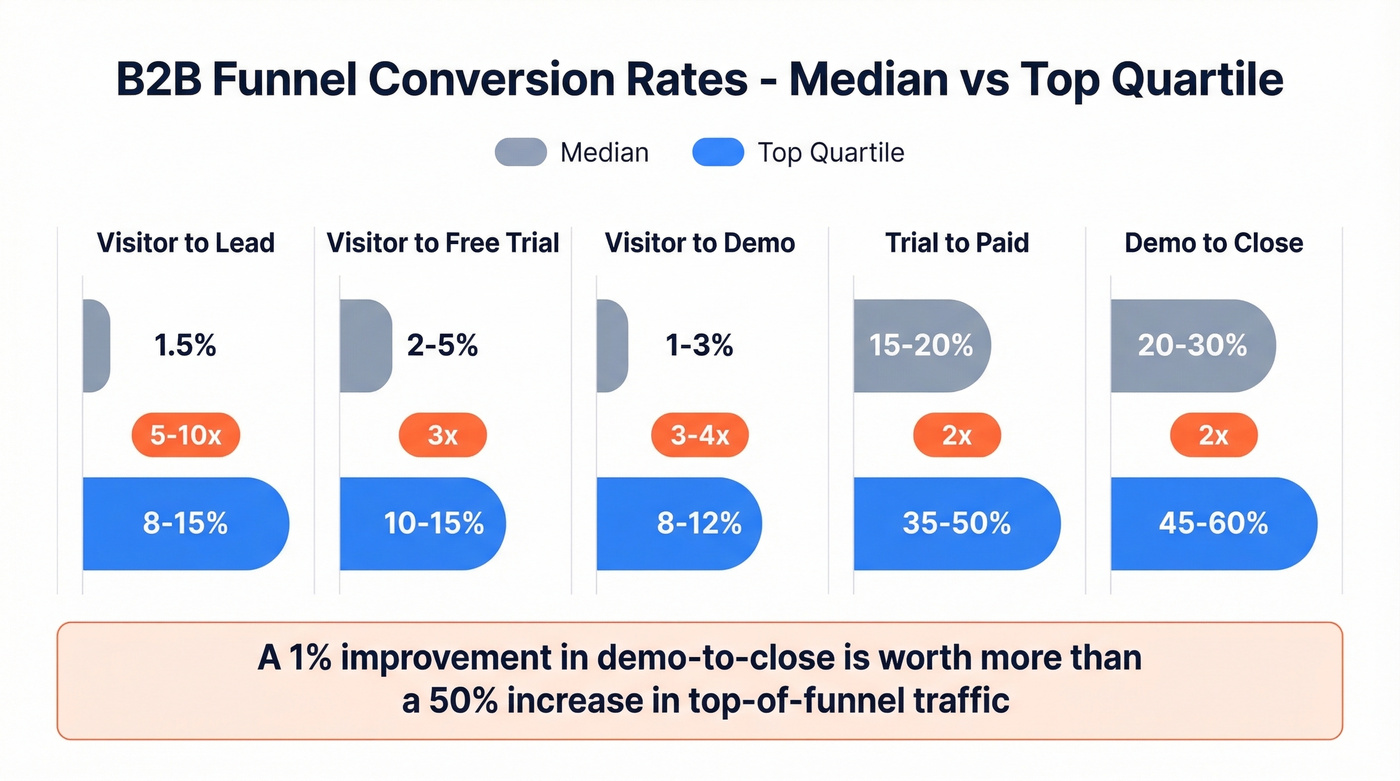
The average B2B website converts 1.5% of visitors into leads. Top performers hit 8-15%. That 5-10x gap between average and excellent is where most of your marketing ROI lives. Before you spend another dollar on traffic, audit your conversion rates at every stage. A 1% improvement in demo-to-close is worth more than a 50% increase in top-of-funnel traffic (use an AIDA lens to spot where attention drops).
AI in B2B Marketing
85% of marketers actively use AI for content and workflow augmentation. Fewer than half have a defined AI strategy. Most teams are using ChatGPT to write blog posts and calling it "AI adoption."
That's not a strategy - it's a shortcut.
The real value of AI in this space sits in three areas. Predictive lead scoring delivers up to 73% higher accuracy identifying high-intent accounts versus manual selection, and win rates jump +38% when predictive scoring guides prioritization. Tools like 6sense and Salesforce Einstein are leading here.
Real-time personalization through platforms like Dynamic Yield and Segment enables website and email experiences that adapt based on firmographic data, behavior signals, and buying stage. 80% of business buyers are more likely to purchase when the experience feels tailored - and AI makes that scalable in a way manual segmentation never could.
Conversational AI through tools like Drift qualifies inbound leads 24/7, routing high-intent visitors to sales while nurturing everyone else. These tools aren't replacing marketers - they're handling the repetitive qualification work that used to eat 30% of an SDR's day.
One more thing: 89% of buyers now purchase solutions with AI features built in. That's not a marketing trend - it's a product expectation. If your product doesn't have AI capabilities, your marketing will increasingly struggle to get past the requirements-building stage.
Building Your Martech Stack
The average marketing stack includes 30+ tools. Fewer than 10 deliver consistent value. We've seen teams spend more time managing integrations between their tools than actually using them to generate pipeline.
The framework that works best is a four-layer model.
Foundation - CRM, data warehouse, marketing automation. This is your system of record. Get this wrong and nothing else matters. For the data layer, you need verified contacts, not just a big database. Prospeo covers email finding across 143M+ verified emails, mobile numbers across 125M+ verified records, and CRM enrichment via API - all self-serve with no contracts.
Intelligence - Attribution, intent data, CDP. This is where you understand what's working and who's in-market. Intent data breaks into three types: first-party signals from your own website and product, second-party signals like job changes and funding events, and third-party signals from providers like Bombora tracking web searches and competitor interactions.
Activation - Content, paid media, personalization, outbound. This is where pipeline actually gets created. Choose tools based on your primary channels, not based on what looks impressive in a vendor demo.
Experience - UX, community, advocacy, customer marketing. The most neglected layer, and the one that determines whether customers expand and refer.
The consolidation case is compelling. One team that restructured their stack around this model saw reporting time drop 70%, tool spend decrease 34%, attribution accuracy improve 45%, and marketing velocity increase 52% within six months. Fewer tools, better integrated, with clean data flowing through all of them.
When evaluating any tool, apply three criteria: Does it align to a specific stage of the buyer journey? Does it integrate cleanly with your data architecture? Can it scale without locking you into a multi-year contract?
Data Quality: The Overlooked Strategy
Every channel degrades when the underlying data is stale. Your SEO-driven leads don't convert if the lead enrichment data appended to them is six months old. Your ABM campaigns fall flat when 30% of the emails bounce. Your sales team loses trust in marketing when the "qualified leads" they receive have wrong titles and dead phone numbers.
If your average deal size is above $5K and you're spending more on ad platforms than on data quality, your priorities are backwards. The highest-ROI investment isn't a new channel - it's making sure the channels you already have are running on accurate information.
B2B contact data decays 20-30% per year. Job changes, company moves, email domain switches - the data rots faster than most teams realize. And the industry-average refresh cycle among data providers is six weeks. By the time your database updates, a big chunk of it is already wrong.
The practitioners saying "clean data + tighter ICP filtering" aren't being vague. They're describing the single highest-leverage investment you can make: accurate, fresh contact data fed into tighter targeting. In our experience, the difference between a 35% bounce rate and a sub-5% bounce rate isn't a better email tool - it's better data upstream (see email deliverability for the downstream impact).

Real results back this up. Snyk took bounce rates from 35-40% down to under 5%, saw AE-sourced pipeline jump 180%, and now generates 200+ new opportunities per month. Meritt tripled pipeline from $100K to $300K per week and dropped bounce rates from 35% to under 4%. These aren't marginal improvements - they're the difference between a marketing engine that works and one that's slowly destroying your domain reputation.
ABM only works with clean data. Prospeo gives you 30+ filters - buyer intent, technographics, headcount growth, funding - across 300M+ profiles so you reach the right people in those 13-person buying committees.
Fewer leads, better conversations. That's the 2026 playbook.
Common Mistakes to Avoid
After years of watching teams build and rebuild their marketing engines, the same mistakes keep showing up. Here's the checklist.
The volume-over-quality mindset. More leads isn't better. More qualified leads is better. Teams that optimize for MQL volume end up flooding sales with contacts who were never going to buy, which destroys sales-marketing trust faster than anything else.
Sales-marketing misalignment. If your sales and marketing teams don't have a weekly sync with shared pipeline metrics, you're leaving revenue on the table. A 30-minute weekly call where both teams review what's converting and what's stalling is worth more than any attribution tool (tighten the handoff with sales follow-up templates).
No ICP definition. "We sell to mid-market SaaS companies" isn't an ICP. A real ICP includes firmographic criteria - size, industry, tech stack, growth signals - plus buyer personas with named titles and disqualification criteria. If you can't describe who you don't sell to, your ICP isn't defined (use an ideal customer profile template to make it concrete).
Optimizing for executives instead of buyers. Your CEO wants the brand campaign. Your board wants the thought leadership. But the person actually researching solutions is a director or senior manager who needs a comparison page, a pricing calculator, and a case study from their industry. Build for the buyer, not the boardroom.
Ignoring the middle of the funnel. Most teams track top-of-funnel traffic and leads alongside bottom-of-funnel revenue. The middle - where 86% of deals stall - is a black box. Instrument every stage (start with funnel metrics).
Treating SEO as an afterthought. 71% of B2B researchers start with a generic Google search. If you're not ranking for the terms your buyers search, you're invisible during the most critical phase of their journey.
Fear of iteration. The first version of your campaign, your landing page, your email sequence - it won't be right. Ship fast, measure honestly, iterate weekly. Perfection is the enemy of pipeline.
FAQ
What is B2B marketing?
B2B marketing is the practice of promoting products or services to other businesses rather than individual consumers - reaching decision-makers within organizations and convincing them your solution solves a real business problem. It involves longer sales cycles, larger buying committees averaging 13 people, and decision-making driven by ROI rather than emotion.
What's the difference between B2B and B2C marketing?
B2B targets buying committees of 6-13 stakeholders with 3-18 month sales cycles and ROI-driven messaging. B2C targets individuals making faster, often emotion-driven purchase decisions. Business-to-business efforts rely more heavily on content, email, and ABM, while B2C leans on social, retail, and brand advertising.
What's the highest-ROI B2B marketing channel?
SEO consistently delivers the highest ROI at roughly 748%, followed by email marketing at 261% and LinkedIn paid at 229%. Paid search delivers a lower 36% ROI but breaks even in about four months, making it useful for speed. The best-performing teams invest heavily in SEO and email while using paid as a testing channel.
How do I build a B2B marketing strategy from scratch?
Start with three things: a CRM, a verified contact database, and an email platform. Define your ICP with specific firmographic and persona criteria. Build content around a clear point of view. Measure conversion rates at every funnel stage - visitor to lead, lead to opportunity, opportunity to close. Skip the fancy tools until you've nailed the fundamentals.
Is ABM worth it for small teams?
Yes. BlueBotics generated £4m+ in opportunities with a marketing team of one. You don't need a $100K platform - you need clean data on target accounts, personalized content that addresses specific business problems, and a sales team that follows up within 24 hours. Start with 20-50 accounts and expand once you've proven the model.