

B2B Marketing Communication Strategy: A 7-Step Framework
Most B2B marketing communication strategies die as slide decks. Someone spends three weeks building a 30-page document, presents it to leadership, gets a round of applause, and watches it collect dust in a shared drive while reps keep writing emails from scratch. As one B2B marketer on Reddit put it, the early efforts felt like "posting content that disappeared into the void." Only 29% of B2B marketers rate their content strategy as "extremely or very effective" - the other 71% aren't failing because they lack ideas. They built a document instead of an operating system.
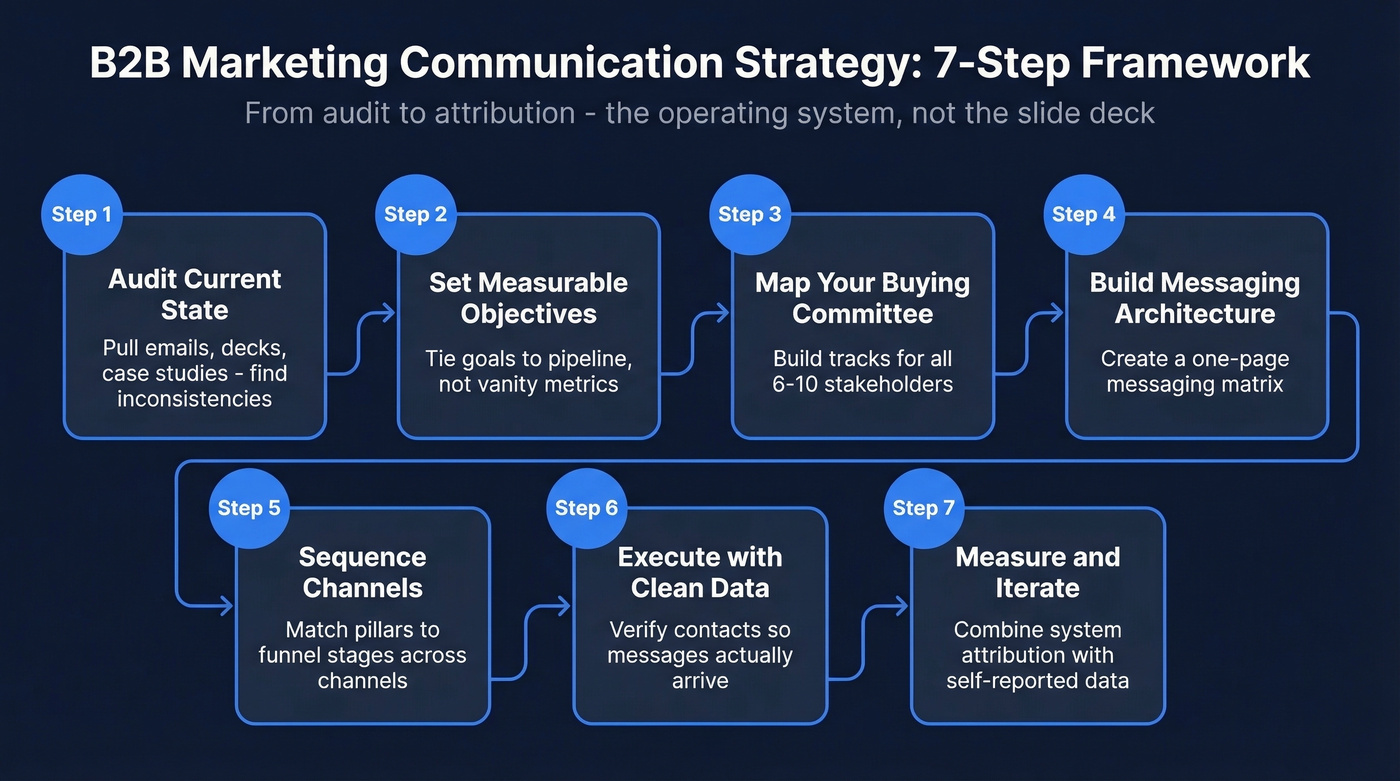
Here's the thing: the fix isn't more content. It's a tighter system. We've broken this down into seven steps that actually survive contact with a buying committee, a sales floor, and a quarterly review.
What This Strategy Actually Is
A B2B marketing communication strategy is the system governing what you say, to whom, through which channels, at every stage of the buyer journey. It's distinct from a marketing plan, which covers budgets, timelines, and campaign calendars.
The distinction matters because B2B buying is absurdly complex. A typical buying group includes 6-10 stakeholders, and more than 75% of B2B buyers say their last purchase was too complex. The journey can stretch to 11 months, with buyers spending roughly eight of those months researching before they ever talk to sales. Your strategy has to account for all of those people and all of that time - not just the one persona your SDRs are emailing. You're orchestrating consensus, not impulse.
7 Steps to Build Your Framework
Step 1: Audit Your Current State
Pull your last 20 outbound emails, your homepage copy, your most recent case study, and your sales deck. Read them back-to-back. If they don't sound like they came from the same company, you've found your first problem.
Run a PEST analysis on your external landscape, then do an internal messaging audit to surface gaps between what marketing writes and what sales actually says. We've done this exercise with our own outbound sequences and found three different value propositions floating around in the same campaign. It's more common than anyone wants to admit.
If you want a clean way to pressure-test differentiation, pair this with a lightweight competitive intelligence pass.
Step 2: Set Measurable Objectives
Among B2B marketers whose strategies are moderately effective or worse, 42% cite a lack of clear goals as the top reason their strategy underperforms - ahead of not tying the strategy to the customer journey or doing ineffective audience research.
Set objectives that tie directly to pipeline. "Increase MQL-to-SQL conversion by 15% in Q2" is a communication strategy objective. "Post more on social" isn't.
If you need benchmarks to sanity-check targets, start with funnel metrics and your average B2B lead conversion rate.
Step 3: Map Your Buying Committee
Most teams build messaging for a fictional single decision-maker. In reality, you're selling to a committee of 6-10 people with different priorities. The CFO cares about ROI. The IT lead cares about security and integration. The end user cares about daily workflow impact.
I've watched deals die in committee because the champion had nothing to hand IT. Build persona-specific message tracks for each stakeholder and arm your champion with security-focused materials, ROI calculators, and implementation timelines they can circulate internally. If your champion has to explain your product from memory in an internal meeting, you've already lost control of the narrative.
This is also where account-based selling best practices and the technical buyer vs economic buyer split become practical, not theoretical.
Step 4: Build Your Messaging Architecture
Think of this as a narrative system, not a brand guidelines PDF. Four or five content pillars - Innovation, Business Value, Trust/Compliance, Proof of Performance - break into sub-pillars, then into persona-specific message tracks, then into individual assets. If you need a narrative spine, the StoryBrand framework (character, problem, guide, plan, CTA, failure, success) works well as a starting scaffold.
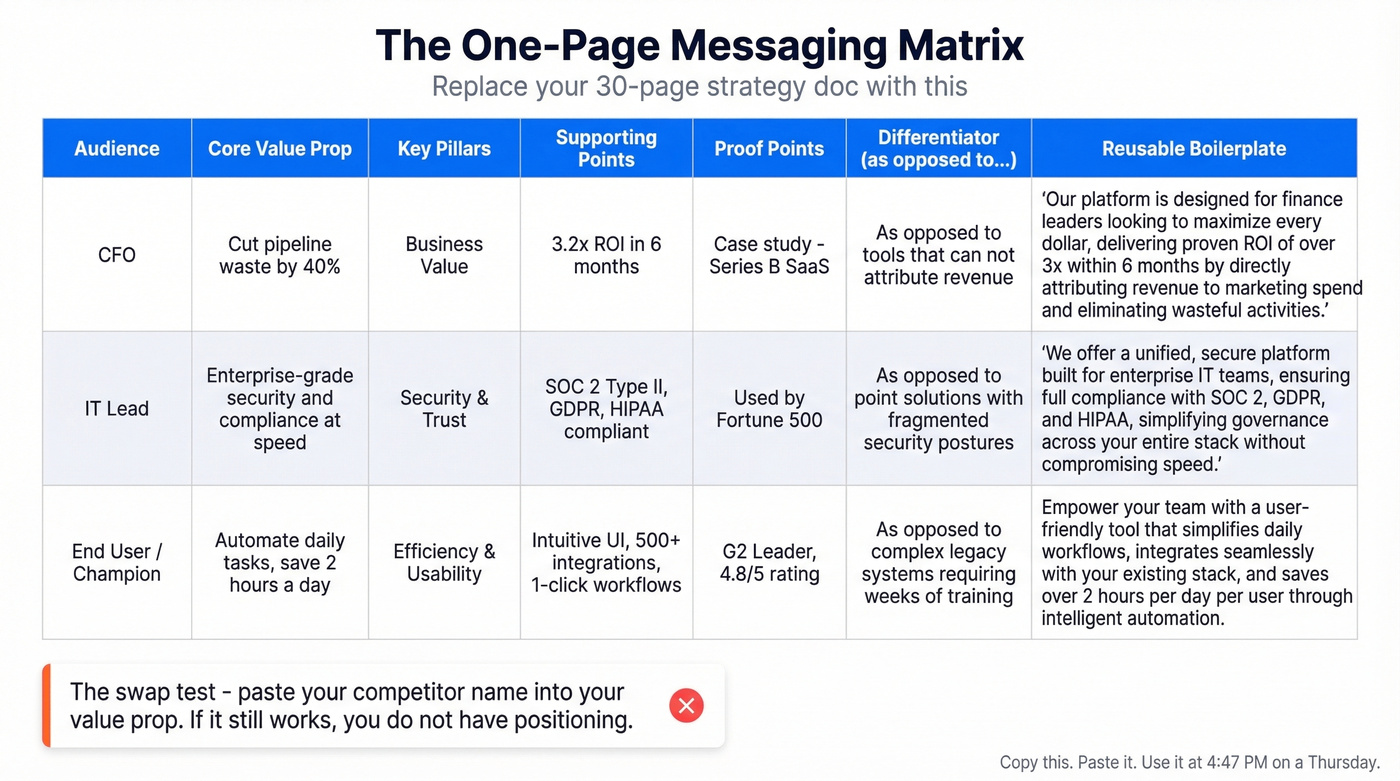
The critical piece most teams miss is the translation layer. Your framework can't read like an internal memo. It needs copy-ready phrases a rep can paste into an email at 4:47 PM on a Thursday without rewriting anything. Build a messaging matrix with these columns: audience, core value proposition, key pillars, supporting points, proof points, differentiator ("as opposed to..."), and reusable boilerplate. In our experience, that one-page matrix is the single most underused artifact in B2B marketing - and it replaces your entire 30-page strategy doc.
Let's be honest: if your sales team isn't using the messaging, the messaging doesn't exist. The matrix solves that by being short enough to actually reference and specific enough to actually copy from.
To make it deployable in the field, ship it alongside sales battle cards and a simple sales deck storytelling structure.
Step 5: Sequence Channels for Integrated Marketing
Only 6% of B2B marketers relied on one or two channels last year - 94% diversified. The question isn't whether to diversify, but how to sequence. An integrated approach means every channel reinforces the same core narrative rather than operating in silos.
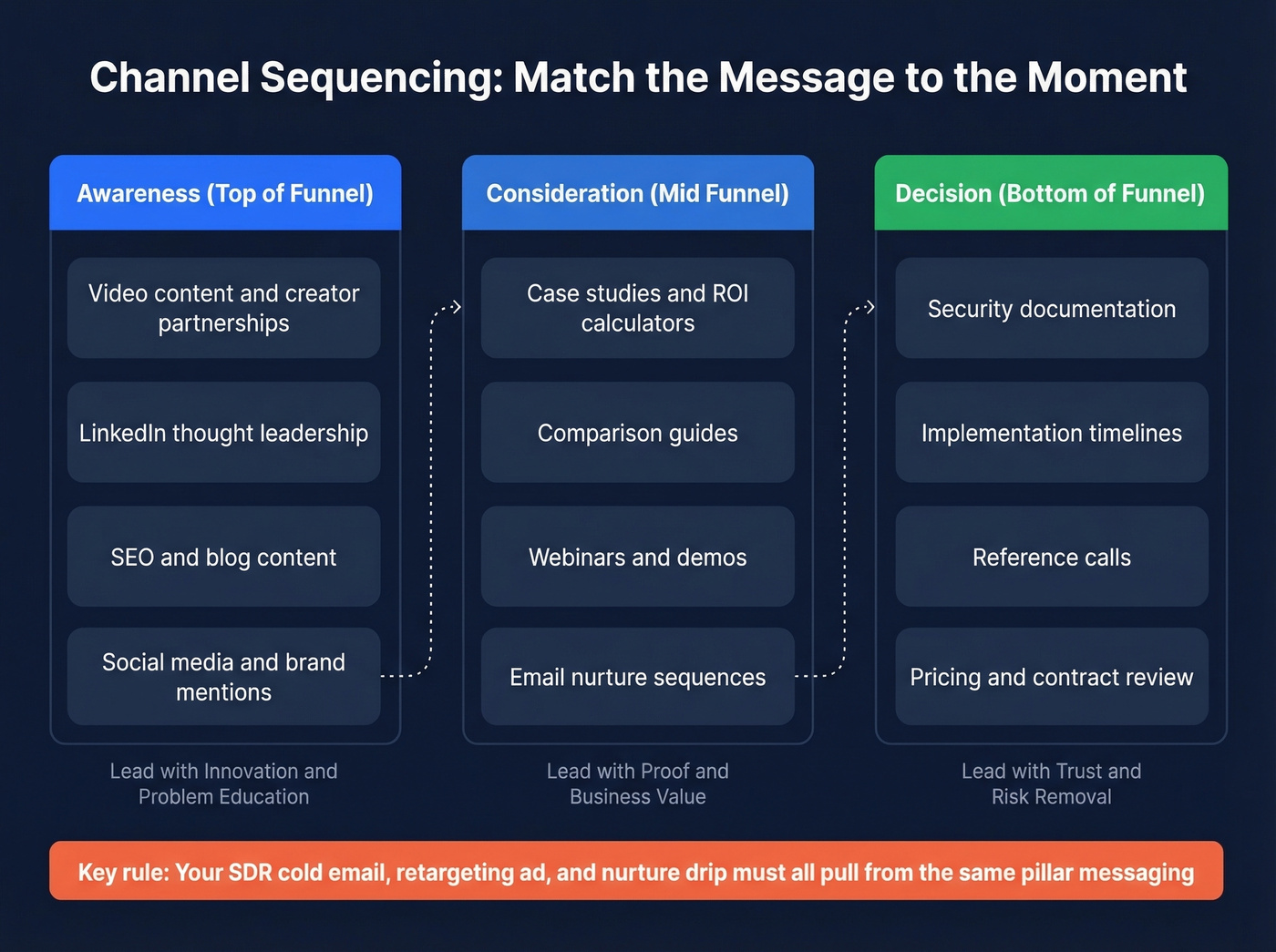
78% of senior B2B marketers already use video, and 55% partner with creators, SMEs, or industry voices. Use these formats for early-stage awareness. Mid-funnel consideration needs proof-heavy content: case studies, ROI calculators, comparison guides. Late-stage decision needs risk-removal assets - security docs, implementation timelines, reference calls. Match your messaging architecture to your channel sequence. The pillar that leads in awareness content isn't the same one that closes deals.
For teams running outbound alongside inbound, the channel sequence gets even more important. Your SDR's cold email, your retargeting ad, and your nurture drip should all pull from the same pillar messaging. When they don't, the buyer gets three different stories from the same company and trusts none of them.
If outbound is a core motion, build this around a repeatable B2B cold email sequence and tight sequence management.
Step 6: Execute with Clean Data
Your SDR just sent 500 emails and 47 bounced. That's not a minor inconvenience - it's a domain reputation problem that compounds with every campaign. Your messaging framework is worthless if 10% of your list never receives it.
If you're seeing this pattern, start with your email bounce rate and then work backward through your email deliverability guide.
Step 7: Measure, Attribute, Iterate
Track different KPIs at each funnel stage. Top-of-funnel: organic impressions, social reach, brand mentions. Mid-funnel: content downloads, MQLs, lead quality scores. Bottom-of-funnel: SQLs, opportunities created, win rate, sales cycle length.
We've seen the best results from teams that combine system attribution - multi-touch models like U-shaped or W-shaped - with self-reported attribution. Simply asking buyers "how did you hear about us?" captures off-platform influence no tracking pixel can see. For incremental impact, ask "if we hadn't done X, would we have seen Y% of deals?" That counterfactual question isolates real contribution.
For executive reporting, use a Marketing Income Statement format: report contributions across last-touch, multi-touch, and brand categories so your CFO sees marketing as a revenue function, not a cost center.

Step 6 is where most communication strategies break. You built the messaging matrix, sequenced the channels, mapped the buying committee - then 10% of your list bounces and tanks your domain. Prospeo's 98% email accuracy and 7-day data refresh means your carefully crafted messaging actually reaches the 6-10 stakeholders in every deal.
Stop letting bad data kill your communication strategy.
Messaging Mistakes That Lose Deals
Run these four diagnostics against your current messaging:
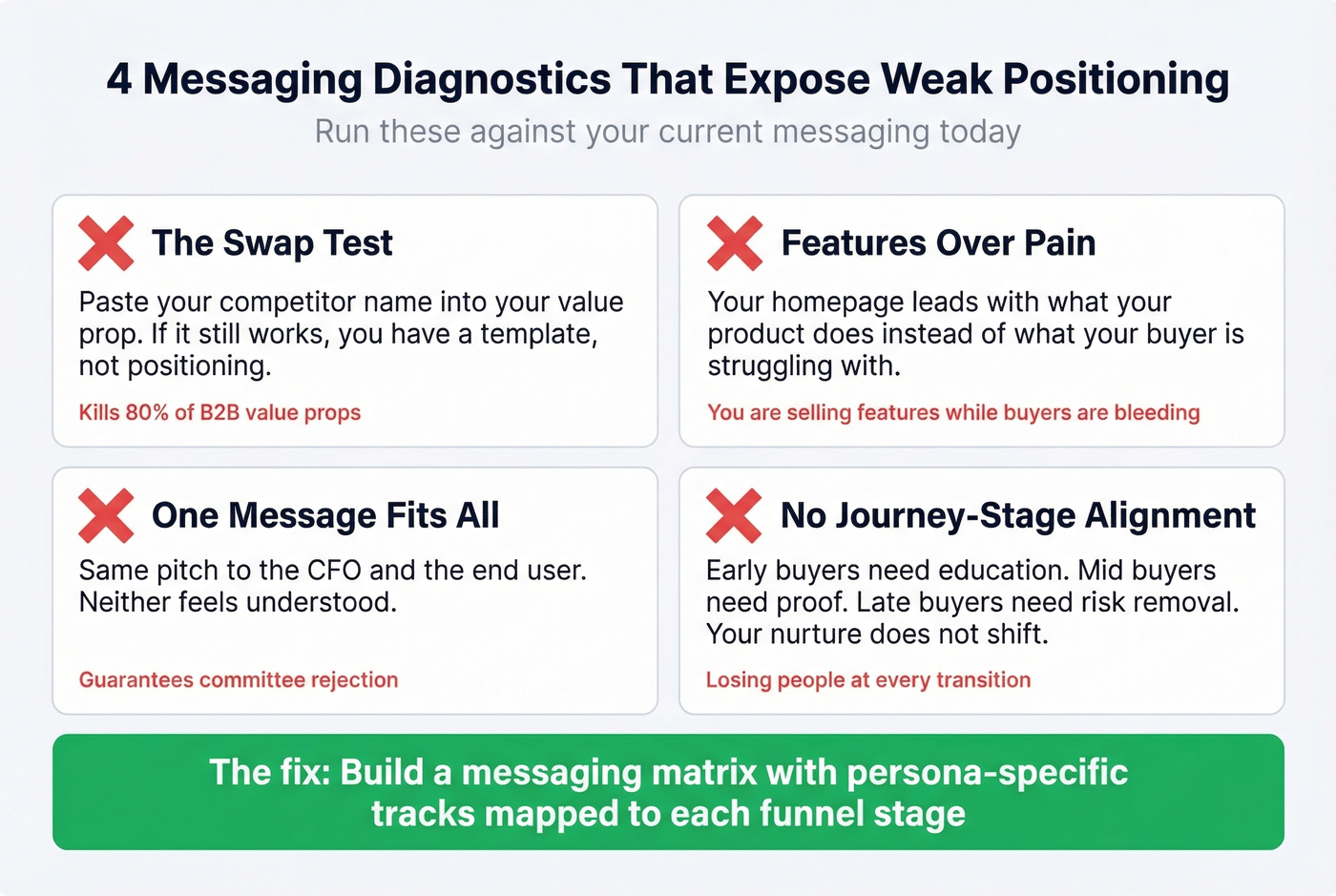
- The swap test. Paste your competitor's name into your value proposition. If it still works, you don't have positioning - you have a template.
- Features over pain. If your homepage leads with what your product does instead of what your buyer is struggling with, you're selling features while buyers are bleeding.
- One message fits all. Sending the same pitch to the CFO and the end user guarantees neither feels understood.
- No journey-stage alignment. Early-stage buyers need problem education. Mid-stage buyers need proof and ROI. Late-stage buyers need risk removal. If your nurture sequence doesn't shift tone across these stages, you're losing people at every transition.
The swap test alone kills about 80% of B2B value propositions we've reviewed. Try it right now with your own homepage. It's uncomfortable, but that discomfort is the point.
What's Changing in 2026
If your deals close under $10k, you don't need a 30-page communication strategy. You need the one-page messaging matrix from Step 4, clean data, and the discipline to iterate monthly. Save the elaborate frameworks for enterprise deals where committee dynamics actually justify the overhead.
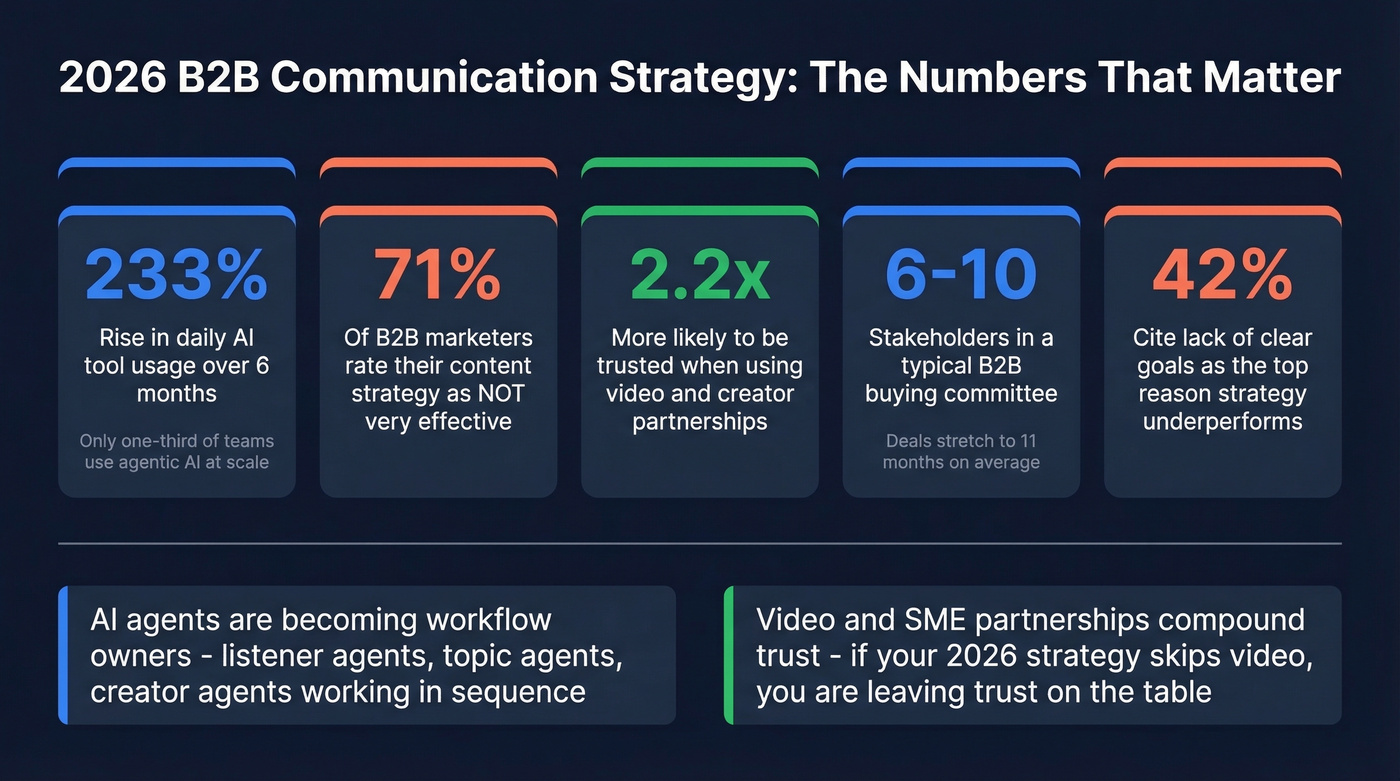
Two shifts worth building into your strategy now:
AI agents are becoming workflow owners. Listener agents monitor sales calls for pain points and competitor mentions. Topic agents turn those insights into content themes. Creator agents draft persona-specific assets aligned to your brand voice. Daily AI tool usage rose 233% over six months - but only about a third of B2B teams have implemented agentic AI at scale. That gap is your opportunity.
Video and creator partnerships continue to compound. Brands using video and influence are 2.2x more likely to be trusted. If your 2026 communication strategy doesn't include video or SME partnerships, you're leaving trust on the table.
You just built persona-specific message tracks for every stakeholder on the buying committee. Now you need verified emails and direct dials to reach them. Prospeo gives you 30+ filters - job role, buyer intent, technographics, department headcount - so your messaging hits the right CFO, IT lead, and end user at $0.01 per email.
Reach every stakeholder on the buying committee with data you trust.
FAQ
What's the difference between a communication strategy and a marketing plan?
A communication strategy defines what you say and to whom across the buyer journey. A marketing plan defines where, when, and how much you spend to distribute those messages. The strategy feeds the plan - without it, your plan is just a budget spreadsheet with no narrative backbone.
How often should I update my messaging framework?
Every quarter at minimum. Messaging has a shelf life of about six months. Run a quarterly resonance audit: test your pillars against current buyer conversations and competitor positioning to catch drift before it costs you deals.
What tools do I need to execute this strategy?
At minimum: a CRM like HubSpot or Salesforce, a verified contact data platform for accurate outreach, and an analytics tool for attribution. Add marketing automation as you scale - but don't skip the data quality layer, because every other tool depends on it.
How do I align sales and marketing messaging?
Build a shared messaging matrix (Step 4) that both teams contribute to. Have sales flag objections and competitor mentions weekly; marketing updates pillar messaging monthly based on those signals. The matrix becomes the single source of truth - no more reps freelancing copy that contradicts your positioning.