

The B2B Marketing Tech Stack Guide: What You Actually Need in 2026
At last count, there were 15,384 martech solutions on the market. You need maybe 15. The average B2B team uses only 33% of the capabilities they're paying for, and up to 25% of martech budgets go to tools that are underused or redundant. That's not a tech stack problem. It's a buying problem.
What You Actually Need
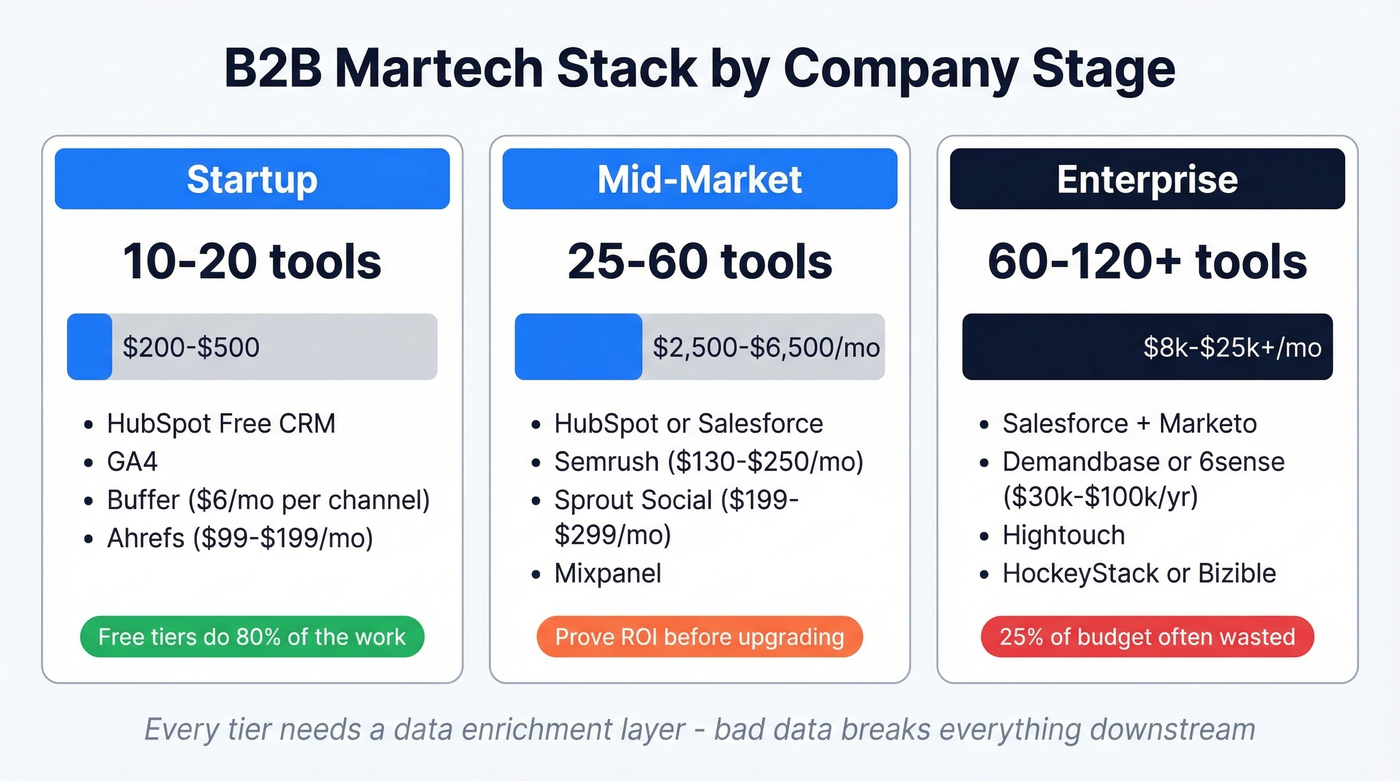
You don't need 30 tools. You need 10-15 that talk to each other. Here's the cheat sheet by company stage, based on operator benchmarks and what we've seen work across dozens of B2B teams.
| Stage | Tools | Core Stack | Monthly Cost |
|---|---|---|---|
| Startup | 10-20 | HubSpot Free, GA4, Buffer, Ahrefs | $200-$500 |
| Mid-Market | 25-60 | HubSpot/Salesforce, Semrush, Sprout, Mixpanel | $2,500-$6,500 |
| Enterprise | 60-120+ | Salesforce, Marketo, Demandbase, Hightouch | $8k-$25k+ |
Every tier needs an enrichment layer - bad contact data poisons automation, attribution, and pipeline numbers. The rest shifts based on complexity, headcount, and channel count. If you’re evaluating vendors, start with a quick scan of data enrichment services.
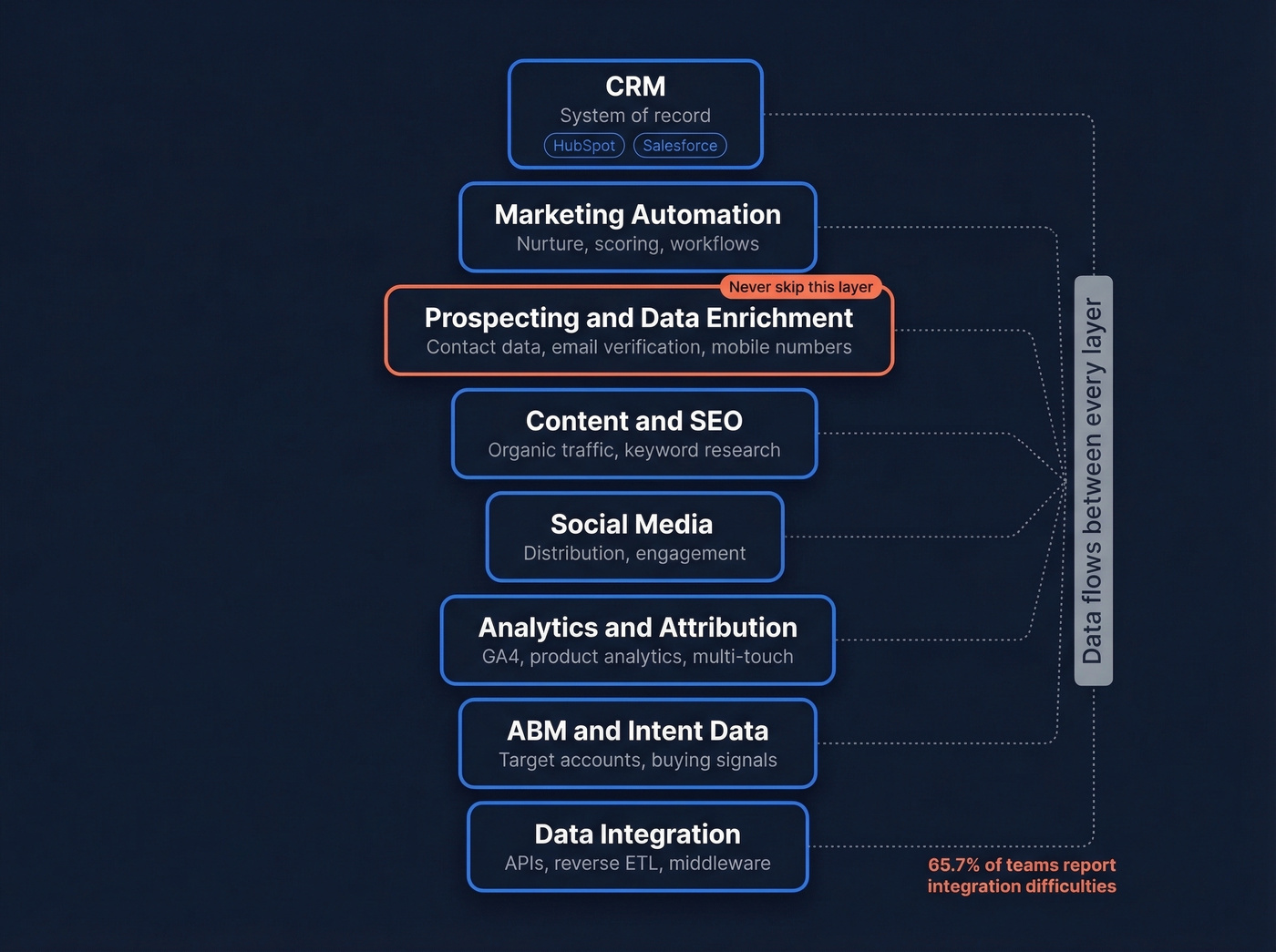
The 8 Layers of a B2B Martech Stack
Every stack has the same eight layers. Some deserve heavy investment. Others you cover with a free tool and revisit later.
CRM
Your system of record. HubSpot powers 45.8% of documented B2B stacks; Salesforce appears in 50%. If you’re still deciding, here are examples of a CRM to sanity-check fit and pricing.
HubSpot has a free CRM, with Marketing Hub pricing starting at $20/month/seat and Professional at $890/month for three seats. Salesforce entry plans start at $25/user/month, and costs scale fast with editions, seats, and add-ons. If you have fewer than 50 contacts, a spreadsheet is honestly fine - don't let anyone tell you otherwise.
Marketing Automation
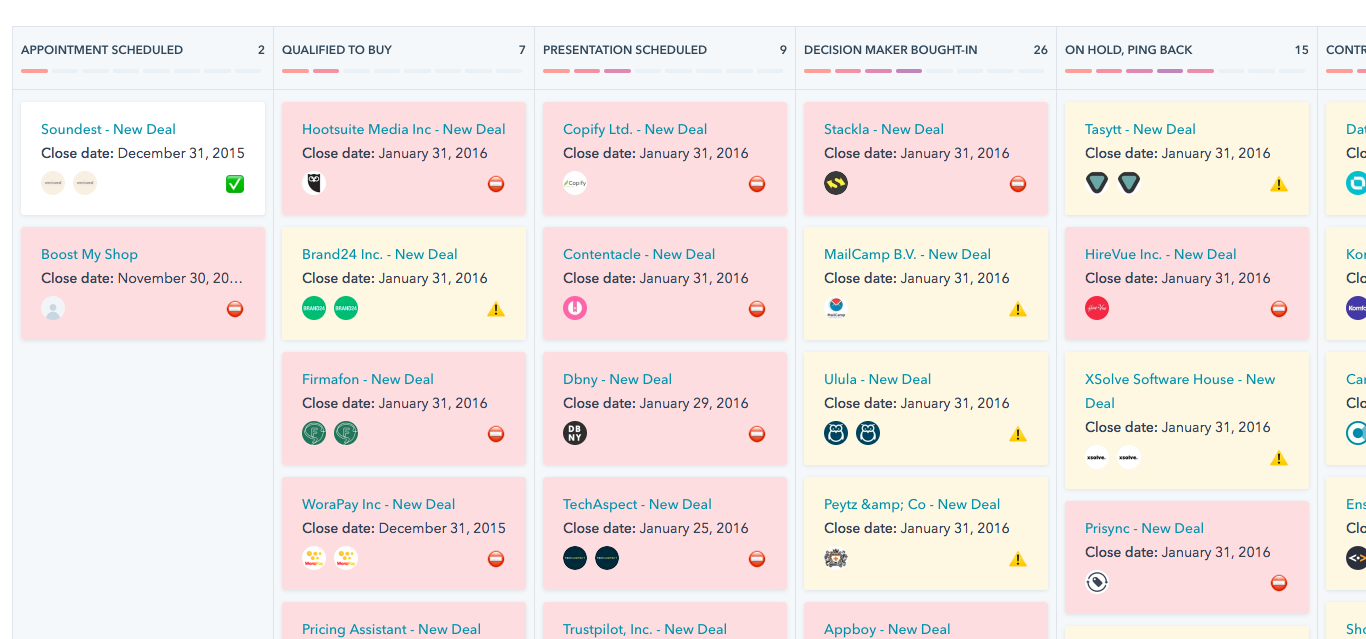
This is where nurture sequences, lead scoring, and lifecycle workflows live. The most popular B2B combo is HubSpot + LinkedIn Ads + GA4, used by 28.5% of mid-market companies. Marketo makes sense for complex multi-touch campaigns with branching logic across dozens of segments.
Pre-product-market-fit? Skip automation entirely. Manual outreach teaches you more about your ideal customer profile than any drip sequence ever will.
Prospecting & Data Enrichment
Stale data is the silent stack killer. Your automation, attribution, and pipeline numbers all break when contact data decays - and with a six-week industry refresh cycle, your database is always drifting out of date between updates. If you’re building lists, a dedicated sales prospecting database can reduce the amount of manual cleanup you do later.
Skip this if: Never. Every stack needs an enrichment layer.

Content & SEO
Ahrefs ($99-$199/mo) and Semrush ($130-$250/mo) are the two serious SEO platforms - pick one, not both. Jasper ($49-$69/mo) handles AI-assisted drafts, though most teams get similar results from ChatGPT Plus or Claude Pro at $20/mo. Skip this layer only if you're 100% outbound with no plans to build organic. If you want the long-term playbook, start with what is B2B content marketing.
Social Media
Here's the thing: most B2B teams overinvest in social relative to the pipeline it actually generates. Buffer at $6/mo per channel does 80% of what you need. Sprout Social ($199-$299/mo per seat) is the enterprise play with analytics and social listening. Before upgrading, prove social drives pipeline for your ICP - not just impressions.
Analytics & Attribution
Most teams overthink this. GA4 is free and non-negotiable. Mixpanel adds product analytics on a free tier, then roughly $20-$100+/mo based on usage. Looker Studio is free for dashboarding.
The real spend comes with multi-touch attribution - HockeyStack or Bizible run $10k-$60k/yr at enterprise scale. B2B sales cycles run 6-12 months with dozens of touchpoints, which is why attribution trust is low in a lot of orgs. If you're spending under $5k/mo on marketing, GA4 alone is enough. To keep reporting honest, align on a few funnel metrics everyone agrees to.
ABM & Intent Data
ABM and intent data are worth it once you have a real target-account motion: hundreds of accounts, clear ICP segmentation, and the people to run coordinated plays across ads, outbound, and web. If you’re formalizing the motion, use an intent based segmentation framework so “intent” doesn’t become a vague buzzword.
Demandbase and 6sense both run $30k-$100k+/yr. Bombora sells intent data standalone, typically $20k-$50k/yr depending on topics and seats. Intent signals break into first-party (site behavior), second-party (job changes, funding), and third-party (web searches, competitor visits). For teams not ready for that spend, Prospeo's intent data layer tracks 15,000 topics via Bombora at a fraction of the standalone cost.
Data Integration
The plumbing layer, and where most stacks quietly break - 65.7% of B2B teams report integration difficulties.
The emerging pattern is warehouse-as-system-of-record plus CDP-as-system-of-action. Reverse ETL tools like Hightouch (free to $350+/mo) bridge your warehouse to activation tools. Zapier (free to $20+/mo) and Clay ($149-$349+/mo) handle lighter workflows. If you’re mapping the build, this is the practical checklist to connect outreach tool to CRM without breaking attribution.
For teams with fewer than 10 tools, native integrations between HubSpot and your core stack will carry you. Don't buy middleware until you've outgrown what's built in.

You just read that stale data is the silent stack killer - and that 25% of martech budgets go to waste. Prospeo refreshes every record on a 7-day cycle (industry average: 6 weeks), delivers 98% email accuracy, and layers in intent data across 15,000 Bombora topics. One tool covers your prospecting, enrichment, and intent layers for ~$0.01/email.
Collapse three stack layers into one - starting on the free tier.
The Consolidation Wave
Marketing budgets are stuck at roughly 7.7% of company revenue, down from the 10% that used to be standard. CFOs want fewer invoices. The martech landscape saw 8.6% churn last year - 1,211 tools acquired or shut down.
If you’re feeling the squeeze, it helps to benchmark against broader lead generation trends before you cut channels that are actually compounding.
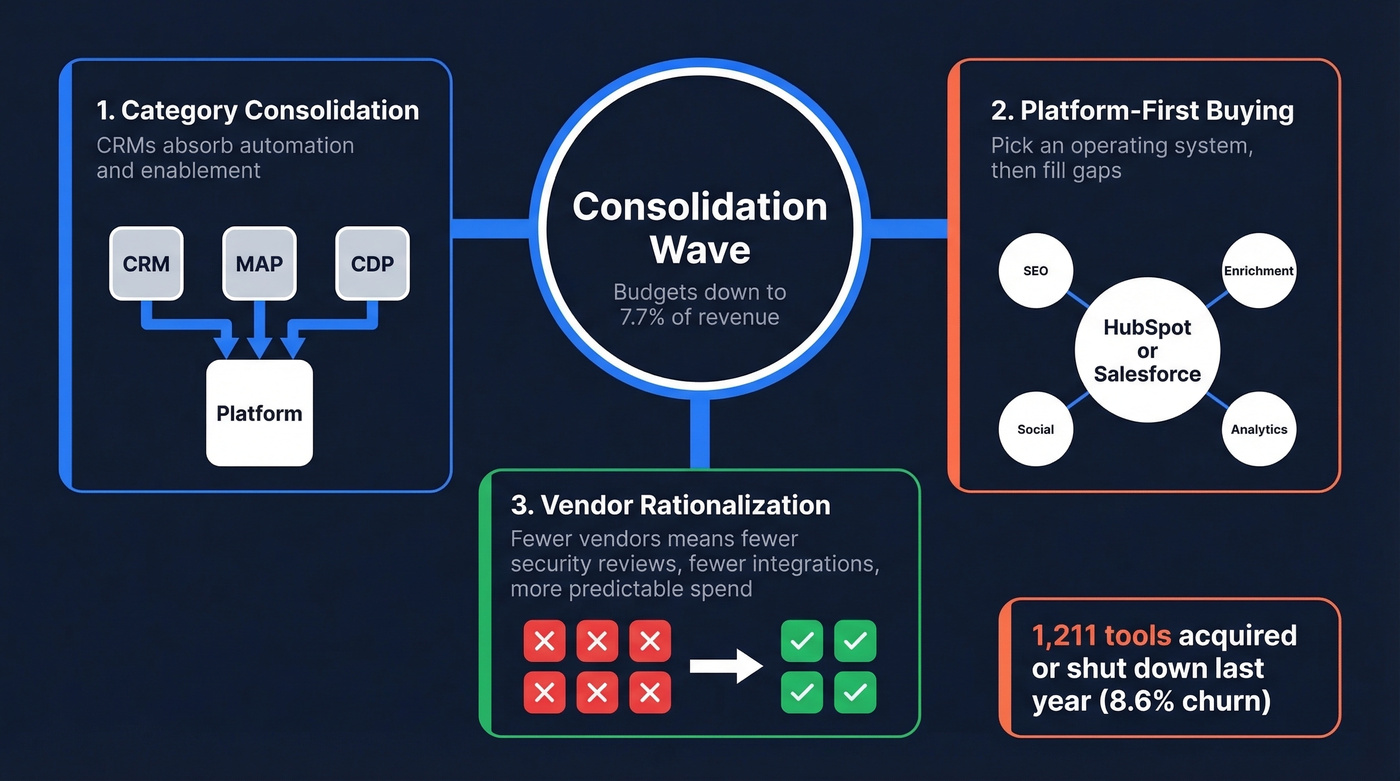
Three patterns are driving this. First, category consolidation: CRMs absorb automation, engagement, and enablement while MAPs expand toward CDP functionality. Second, platform-first buying: teams choose an operating system like HubSpot or Salesforce and fill gaps, rather than stitching 40 best-of-breed tools together. Third, vendor rationalization - buying more from fewer vendors means fewer security reviews, fewer integrations to maintain, and more predictable spend. Marketing technology now accounts for roughly 24% of total marketing budgets, and teams are demanding clearer ROI from every line item.

AI in Your 2026 Stack
The global AI marketing market is on track to hit $128B, and 78.4% of marketers now use AI tools in some capacity. But here's what most "AI stack" articles won't tell you: a starter AI stack costs roughly $134-$159/mo for Claude, Surfer, Buffer, and a video tool. That's less than one Sprout Social seat.
The real trend is what chiefmartec calls the "hypertail" - the explosion of custom-built apps and agents. Low-code platforms and AI coding assistants let marketing ops teams build exactly what they need instead of buying another SaaS product. We've seen teams replace $2k/mo in point tools with a custom workflow built in a weekend. The standalone AI point tool is already commoditizing. Generative AI isn't a separate category - it's a capabilities layer inside your existing CRM, MAP, and CMS.
Three Mistakes That Waste 25% of Your Budget
1. Buying for features, not workflows. 47% of martech decision-makers cite stack complexity as their biggest blocker. A 10-tool stack where everything connects beats a 30-tool stack where nothing does. We learned this the hard way watching teams spend months integrating tools they barely used. If you need a practical way to pressure-test the top of funnel, track lead generation metrics before you add another tool.
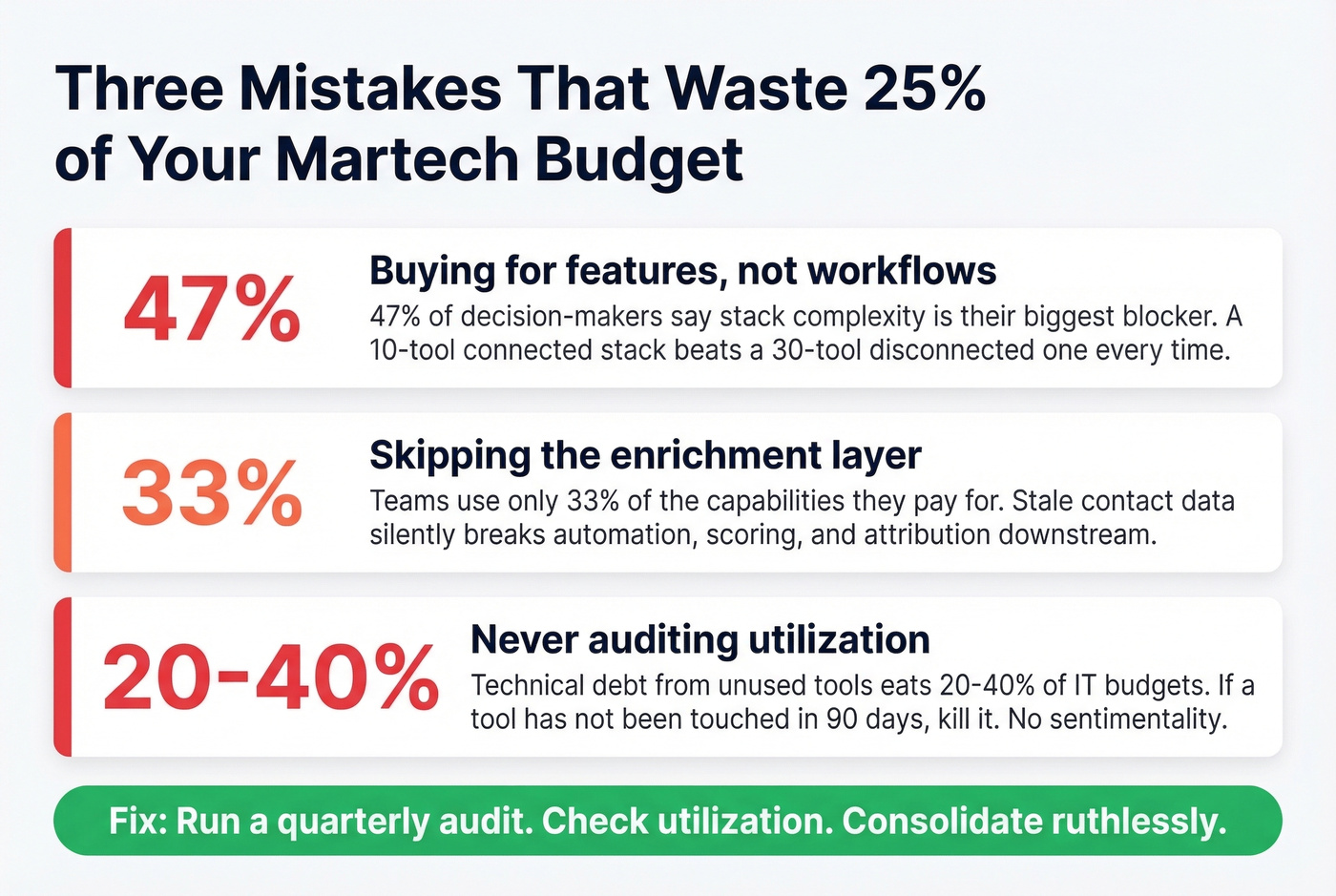
3. Never auditing utilization. Under 40% utilization is a red flag. Technical debt from unused tools consumes 20-40% of IT budgets. Run a quarterly audit: if a tool hasn't been touched in 90 days, kill it. No sentimentality.
The article above makes the case for consolidation: fewer tools, tighter integrations, clearer ROI. Prospeo replaces your standalone email finder, mobile data provider, and intent platform with a single database of 300M+ profiles, 125M+ verified mobiles, and native integrations to HubSpot, Salesforce, Clay, and more. Teams using Prospeo book 26% more meetings than ZoomInfo users at 90% lower cost.
Stop paying enterprise prices for your enrichment layer.
FAQ
How many tools does a B2B marketing tech stack need?
Early-stage teams run well with 10-20 tools; mid-market lands at 25-60; enterprise environments exceed 120. The number matters less than utilization - a tight stack where every tool gets used beats a bloated one where half collect dust.
What does a full martech stack cost?
Startups can build a functional stack for $200-$500/mo using free tiers. Mid-market teams spend $2,500-$6,500/mo, or $30k-$80k/yr. Enterprise stacks with ABM, intent data, and advanced attribution run $8k-$25k+/mo.
What's the most overlooked layer?
Data enrichment. Most teams invest heavily in CRM and automation but feed those systems stale contacts. The gap between weekly and six-week refresh cycles compounds across every downstream tool - your lead scoring, your nurture sequences, your attribution models all degrade together.
Is there a free enrichment tool worth using?
Prospeo offers 75 verified emails and 100 Chrome extension credits per month on its free tier - enough for founders and small teams running real outbound. Apollo also has a free plan, though its lower email accuracy means more bounces at scale.