

B2B Marketing Trends 2026: What's Working, What's Dying, and What the Data Says
84% of reps missed quota in 2024. Meanwhile, 89% of B2B buyers report at least one deal stalling in the past twelve months, and budgets are creeping up anyway. The B2B marketing trends shaping 2026 have sharper edges than anyone predicted - longer cycles, bigger committees, and AI that's useful but overhyped. The disconnect isn't about spend. It's about where the spend goes and which channels actually move pipeline versus which ones generate dashboards full of vanity metrics.
The Short Version
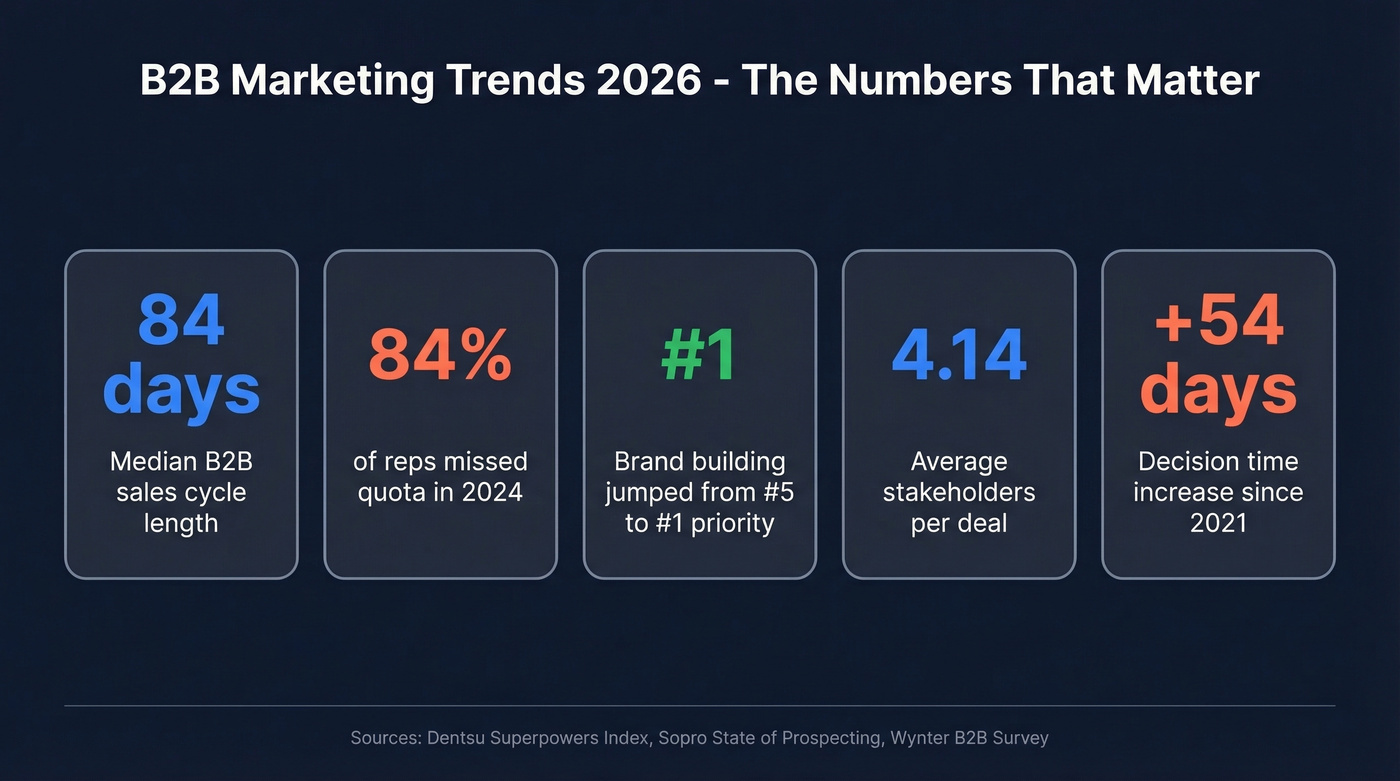
- Brand is the #1 priority again. Dentsu's Superpowers Index research across 14,000+ buyer interviews shows brand building jumped from #5 in 2023 to #1 in 2024. Decision timelines are up 54 days since 2021.
- AI adoption is real but narrow. 68% of B2B SaaS marketing teams use AI for content creation. Only 16% have integrated it into workflow automation.
- Buying committees have exploded. DMUs with 5+ members grew 180% in two years. The average deal now involves 4.14 stakeholders, and complex enterprise purchases can include up to 22 members.
- The benchmark that matters most: median B2B sales cycle is 84 days. Plan your attribution and pipeline forecasting accordingly.
- Action item for right now: audit your data quality and channel mix before locking 2026 budgets.
9 Trends Backed by Data
AI Adoption: Real But Narrow
A Wynter survey of 100 B2B SaaS marketing leaders at $50M+ revenue companies tells the real story. Content creation and copywriting account for 68% of AI usage. Research and data analysis come in at 20%. Marketing automation and workflow integration? Just 16%.
38% of teams exclusively use LLMs - no specialized AI tools, no fancy integrations. One respondent described replacing five freelance writers and saving $80,000/year by running ChatGPT drafts through human QC. That's the realistic AI story for most teams: humans with better first drafts, not autonomous agents running campaigns.
Forrester warns that many enterprises will scale back AI investments prematurely because ROI takes longer than expected. Treat AI as a productivity layer, not a strategy replacement. Use it for content velocity and research synthesis. Don't rip out your marketing automation stack and replace it with prompts - the 16% workflow integration number tells you the tooling isn't ready.
If you're using AI to scale outbound, pair it with AI Cold Email Outreach so the automation doesn't tank reply rates.
Brand Is Back as the #1 Priority
Brand building jumped from the #5 priority in 2023 to #1 in 2024, according to Dentsu's Superpowers Index - a study spanning 14,000+ buyer interviews and 25,000+ buying experiences globally. This isn't a soft trend. It's a structural shift driven by harder numbers.
Average decision time increased 54 days since 2021. The number of brands considered in buying journeys is up 62% over the same period. Dentsu estimates delayed opportunities cost the world economy roughly $1.9 trillion.
The performance linkage is concrete: a 10-point increase in the Superpowers Index score yields a 14% average uplift in dollar value per opportunity. Brand isn't a "nice to have" anymore - it's the difference between making the shortlist and never being considered. If you're thinking about the future of B2B go-to-market, brand investment is the foundation everything else builds on. Cutting brand spend to fund more bottom-funnel demand gen stopped working when cycles got longer.
To operationalize this, align messaging and differentiation with a clear B2B brand positioning strategy.
Self-Serve Buying Hits Enterprise
Forrester predicted that by end of 2025, more than half of large B2B transactions ($1M+ deals) would be processed through digital self-serve channels. Gartner projected 80% of B2B sales interactions would happen in digital channels by 2025. Those forecasts are now playing out in real time.
McKinsey's "rule of thirds" holds steady: at any stage of the buying process, roughly one-third of buyers prefer in-person, one-third prefer remote, and one-third prefer digital self-serve.
The organizational implications are uncomfortable. Only 12% of marketing leaders believe their current org design will help them meet revenue targets. The teams that win build frictionless digital buying experiences alongside their sales motions, not instead of them. More than 50% of younger buyers now rely on external sources and include 10+ external influencers in their purchase decisions - your self-serve experience needs to satisfy people who've already done their homework elsewhere.
If you're building a self-serve motion, tighten your go-to-market strategy so product, marketing, and sales don't drift.
Buying Committees Keep Growing
The Sopro State of Prospecting 2025 report, based on 400+ senior B2B decision-makers and analysis of 97.7M+ emails, quantifies what every seller already feels.
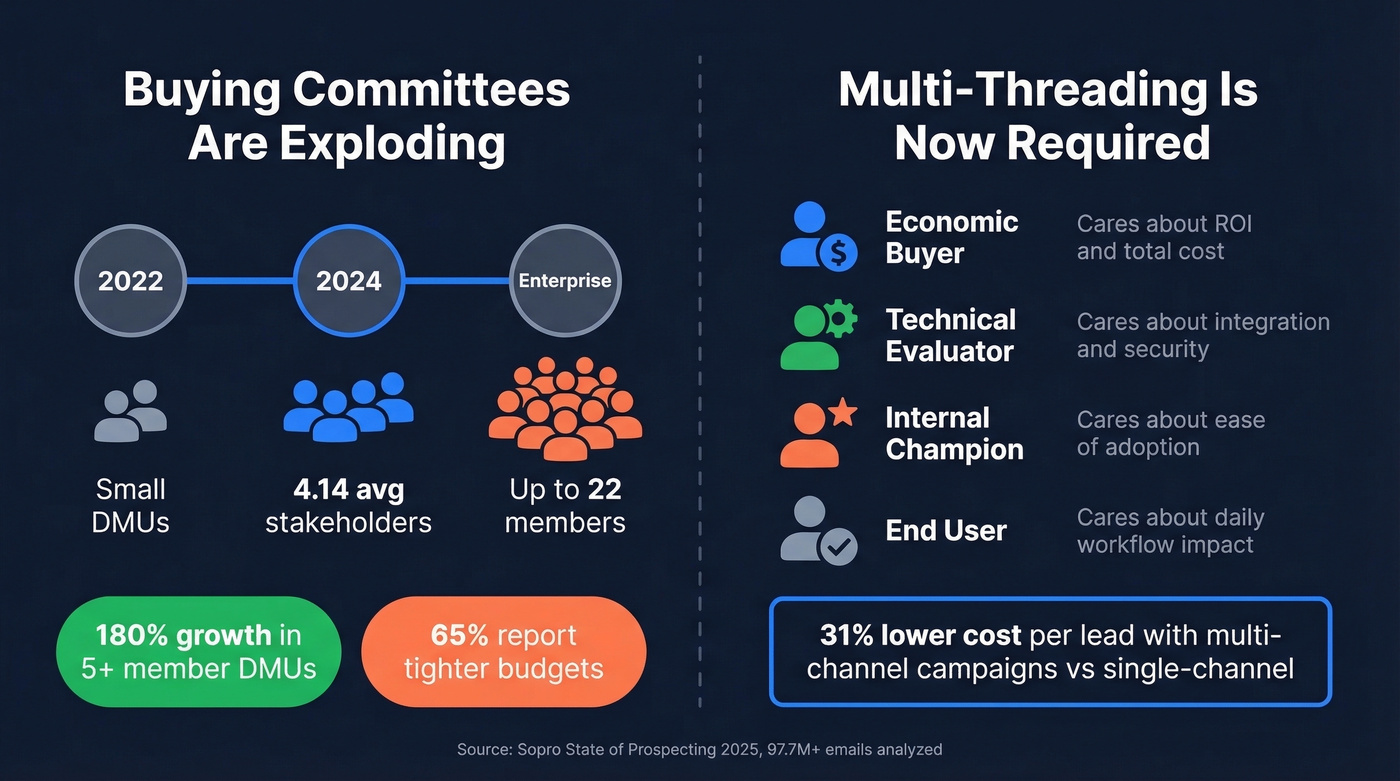
DMUs with 5+ members grew 180% in two years. The average buying committee now includes 4.14 stakeholders. Over one in five businesses have 6+ people involved, and 7% involve 10+ stakeholders. Combine bigger committees with tighter purse strings - 65% of respondents say buyers have tighter budgets - and you get the 54-day increase in decision time.
Here's the thing: if you're still building outbound campaigns targeting a single contact per account, you're structurally disadvantaged. Multi-threading across the economic buyer, the technical evaluator, and the internal champion isn't optional when four-plus people weigh in on every purchase. Account-based approaches aren't a buzzword anymore. They're the only approach that matches how deals actually close.
If you're shifting to ABM, use account-based selling best practices to structure multi-threading and stakeholder coverage.
Sopro's analysis of 21.6M multi-channel touchpoints found multi-channel campaigns achieved 31% lower cost per lead than single-channel outreach. That's the quantitative case for multi-threading in one stat.
The Channel Mix Is Shifting Hard
The channel performance data from the same Wynter survey paints a clear picture of where B2B marketers are moving money.
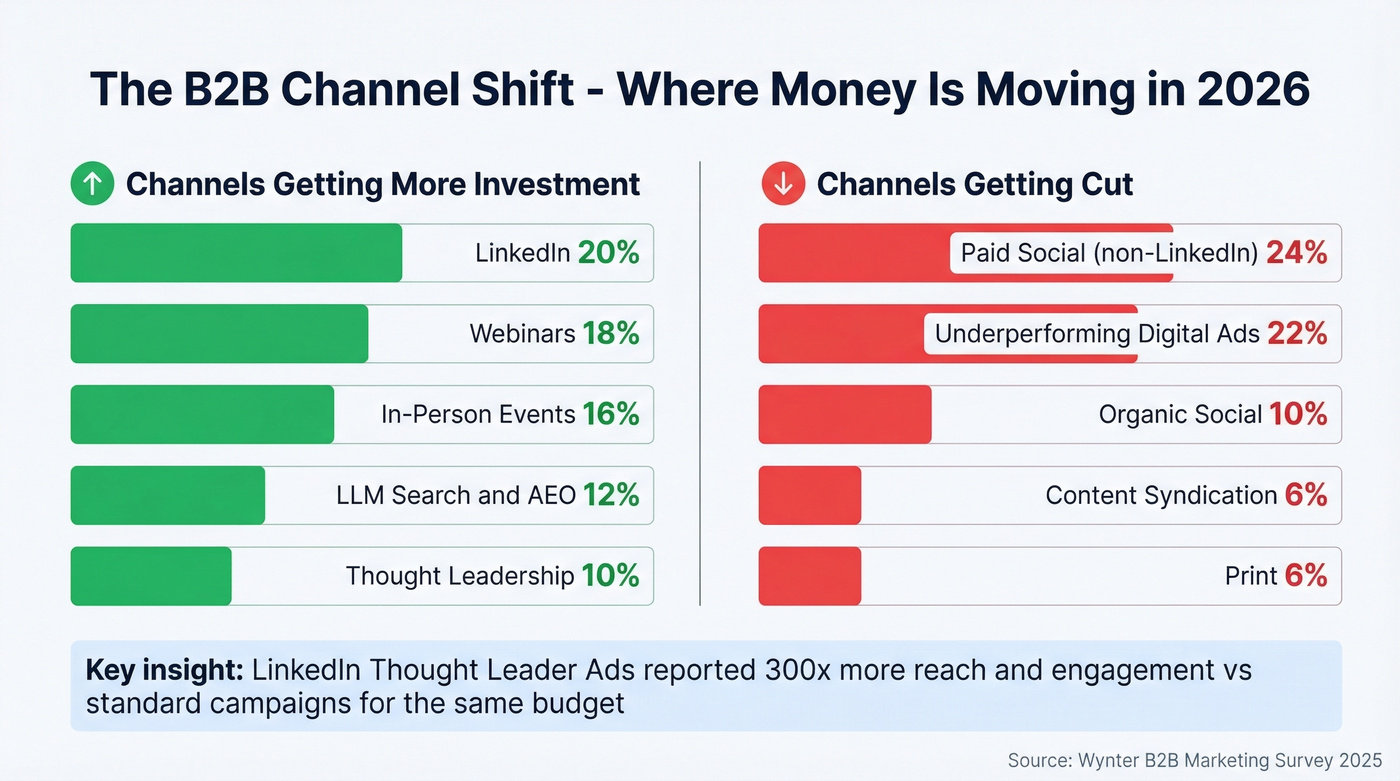
| What's Growing | % Investing More | What's Getting Cut | % Cutting |
|---|---|---|---|
| 20% | Paid social (non-LinkedIn) | 24% | |
| Webinars | 18% | Underperforming digital ads | 22% |
| In-person events | 16% | Organic social | 10% |
| LLM search / AEO | 12% | Content syndication | 6% |
| Thought leadership | 10% | 6% |
LinkedIn's dominance continues to grow, with targeted paid campaigns and thought leadership content leading the charge. One respondent reported that LinkedIn Thought Leader Ads delivered 300x more reach and engagement for the same budget as standard campaigns. That's a single data point, not a benchmark - but it's directional.
The cuts tell their own story. Nearly a quarter of teams are pulling back from paid social outside LinkedIn. And 20% of teams are already restructuring their search strategy to account for Answer Engine Optimization - structuring content so it surfaces in LLM-driven search results rather than just traditional SERPs.
To keep pipeline reporting honest as channels shift, track the right funnel metrics instead of vanity KPIs.
Personalization Beyond First Name
Forrester's data reveals a massive gap: 92% of B2B organizations personalize pre-sale interactions, but only 54% maintain that personalization post-sale. That drop-off is a retention and expansion problem hiding in plain sight.
When buying committees average 4+ stakeholders, personalizing for a single contact doesn't cut it. You need to tailor messaging for the economic buyer, the technical evaluator, the end user, and the internal champion - each with different pain points and decision criteria. This requires multi-dimensional data: job function, seniority, tech stack, intent signals. We've found that enrichment returning 50+ data points per contact gives teams the context to personalize across an entire buying committee rather than just mail-merging a first name into a template.
If you need a system for this, start with personalized outreach and build from there.
Data Quality: The Silent Pipeline Killer
Every trend on this list - bigger buying committees, longer cycles, multi-threaded outreach, personalization at scale - has a common dependency: accurate contact data. Bad data leads to bounced emails. Bounced emails burn your sender domain. A burned domain tanks deliverability across every campaign you run. When you're trying to reach 4+ stakeholders per deal, every bad email multiplies the damage.
We run outbound on Prospeo - 300M+ professional profiles, 98% email accuracy, data refreshed every 7 days versus the 6-week industry average. Snyk's results tell the story: bounce rate dropped from 35-40% to under 5%, AE-sourced pipeline jumped 180%, and the team generates 200+ new opportunities per month.
If you're diagnosing bounces and reputation issues, use this email deliverability guide to fix the root causes.
Let's be honest: if your average deal size is under $10k, you probably don't need ZoomInfo-level pricing for your data. But you absolutely need that level of accuracy. Most teams overpay for data platforms they use at 20% capacity, then wonder why their outbound underperforms. The fix isn't more spend - it's better data at the right price point.
If you're evaluating vendors, compare options in our roundup of data enrichment services.
Budgets Are Up but Cautious
The 6sense Science of B2B report surveyed 392 B2B marketers and found 52.3% increased budgets for 2025, with a median increase of 5%. The average increase was 22%, but that's skewed by outliers - the median tells the real story.
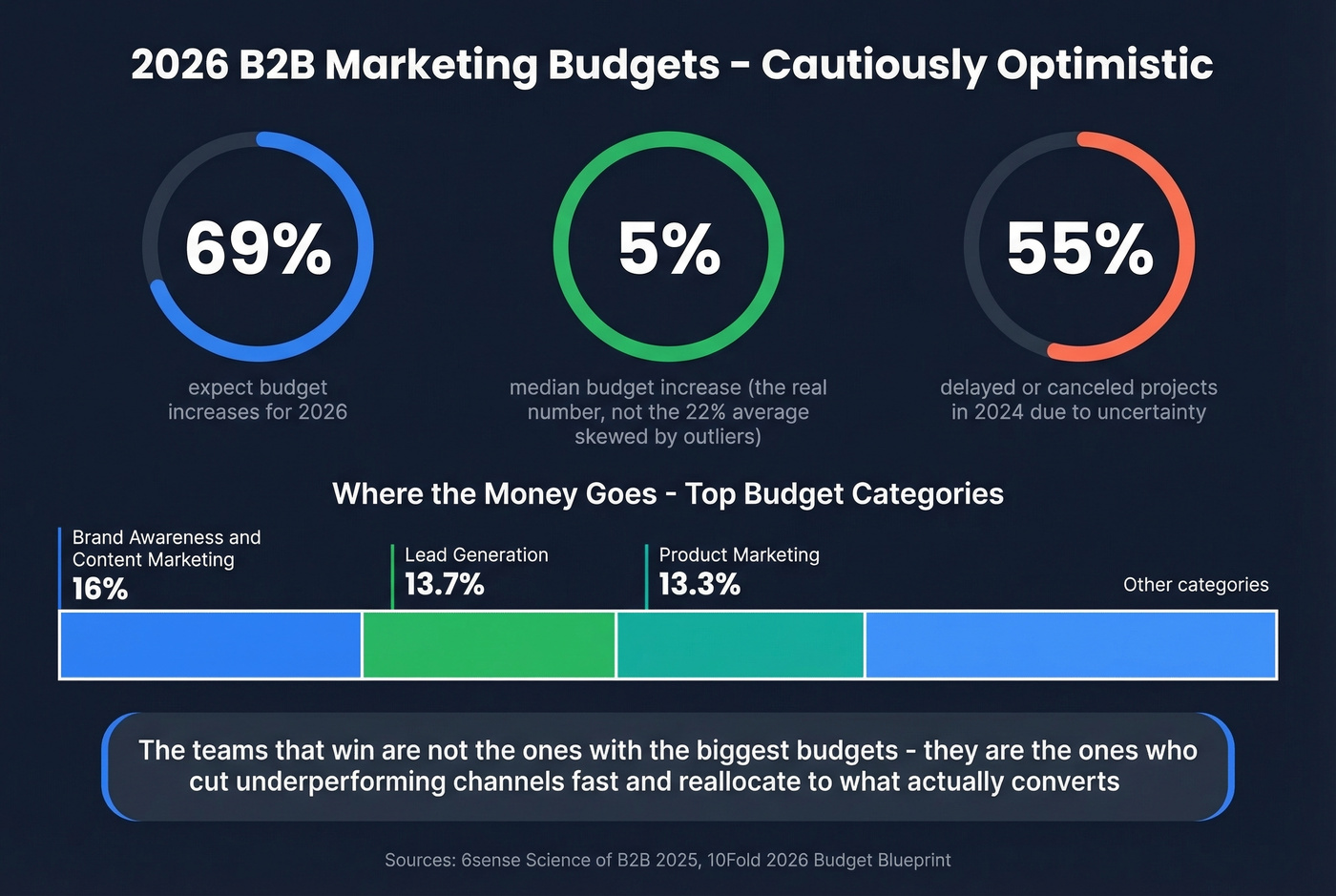
10Fold's 2026 budget blueprint (400 senior marketing executives across the US and Europe) shows 69% expect budget increases for 2026. Brand awareness and content marketing command the largest projected share at 16%, followed by lead generation at 13.7% and product marketing at 13.3%. The rebound is real but cautious - 29% of teams won't see increased funds despite pipeline pressure, and 55% delayed or canceled projects in 2024 due to economic uncertainty.
The teams that win aren't the ones with the biggest budgets. They're the ones who cut underperforming channels fast and reallocate to what's actually converting.
To pressure-test your plan, benchmark against sales pipeline benchmarks before you lock spend.
Owned Media Over Rented Platforms
The shift away from rented platforms - algorithmic social feeds you don't control - toward owned channels is accelerating. Webinars grew in importance for 18% of respondents, and in-person events remain a trust and deal-acceleration lever for 16% of teams.
The underlying logic is simple. When buying cycles stretch to 84 days and committees include 4+ people, you need channels that build sustained relationships, not one-off impressions. A webinar series that educates a buying committee over three months does more pipeline work than a retargeting campaign that annoys them for six weeks.
B2B influencer marketing is growing alongside this shift. Employee advocacy programs and customer-as-influencer models are gaining traction because they combine the trust of owned media with the reach of social distribution. Forrester notes that younger buyers include 10+ external influencers in their purchase decisions - your best "influencers" are probably your own customers and subject-matter experts, not paid spokespeople.
20% of teams are already restructuring their search strategy for AEO. If your content only lives on social platforms and gated landing pages, you're invisible to LLM-driven search. Build newsletters, communities, and ungated content that surfaces in both traditional and AI-driven discovery.

Multi-threading across 4+ stakeholders per deal requires verified contact data for every buyer on the committee. Prospeo gives you 300M+ profiles with 98% email accuracy and 125M+ verified mobiles - refreshed every 7 days, not every 6 weeks.
Stop targeting one contact per account. Reach the full buying committee.
2026 B2B Marketing Benchmarks
If your numbers are significantly below these ranges, you've got a structural problem - not a tactics problem.
| Metric | Benchmark | Context |
|---|---|---|
| Lead-to-customer | 2-5% | End-to-end conversion |
| MQL to SQL | 15-21% | Biggest pipeline bottleneck |
| Median sales cycle | 84 days | Pipeline velocity planning anchor |
| Win rate | 20-30% | Opportunity-to-close |
| Median deal size | $26,265 | Private SaaS |
| SEO visitor to lead | 2.1% | Highest organic channel |
| PPC visitor to lead | 0.7% | Lower than most expect |
| Events opp to close | 40% | Highest close rate channel |
Source for benchmark compilation. The MQL-to-SQL bottleneck at 15-21% is where most teams leak pipeline. We've seen teams with sub-15% rates throw money at top-of-funnel when the real problem is the sales handoff process. If you're below 15%, fix your lead scoring and handoff before spending another dollar on acquisition.
If you need a tighter process, implement a consistent lead scoring model before you scale spend.
The events data is striking. A 40% opportunity-to-close rate explains why 16% of teams call in-person events their most reliable pipeline generator. Events are expensive per lead but cheap per closed deal.
What to Stop Doing in 2026
Cutting underperforming channels is as important as investing in growing ones. The pattern across these trends is clear - teams are consolidating spend around fewer, higher-performing channels:
- Paid social outside LinkedIn - 24% of teams are already cutting this. If your Facebook and X ads aren't converting to pipeline, redirect that budget.
- Organic social for lead gen - Organic social builds brand awareness. Treating it as a pipeline channel is a measurement fiction for most B2B companies.
- Display and programmatic - 22% are pulling back. If your display campaigns can't show attribution to pipeline, they're probably not generating any.
- Content syndication - The leads are cheap but conversion rates are abysmal. Most syndicated leads don't know they opted in.
- Uninformed cold calling - Calling without verified numbers and intent signals burns rep hours. The fix isn't more dials - it's better data.
- Vanity metric dashboards - If your marketing dashboard leads with impressions and followers but can't show pipeline contribution, you're measuring the wrong things. Forbes' 2025 benchmarks piece makes the case for revenue-first measurement.
The through-line across every trend in this piece is the same: B2B buying got harder, slower, and more crowded. The teams winning in 2026 aren't doing more - they're doing fewer things with better data, stronger brand presence, and channels they actually own. Compared to what leaders predicted back in 2022, the market shifted faster toward digital self-serve and longer cycles than most forecasts expected.
Multi-channel campaigns cut cost per lead by 31%, but only if your data connects. Prospeo's 30+ filters - including buyer intent, technographics, and headcount growth - let you target in-market accounts before locking your 2026 budget on the wrong channels.
Audit your data quality now - 75 free verified emails, no contract required.
FAQ
What are the biggest B2B marketing trends in 2026?
Brand building returning as the #1 strategic priority is the headline shift, driven by sales cycles lengthening 54 days since 2021 and buying committees averaging 4+ stakeholders. Dentsu's research across 14,000+ buyer interviews confirms brand jumped from #5 to #1 in a single year. AI adoption, self-serve buying, and owned media growth round out the top trends.
How are B2B marketing budgets changing?
69% of senior marketing executives expect budget increases for 2026, with 42% anticipating 5-10% growth. Brand awareness and content marketing command the largest projected share at 16% of total spend, followed by lead generation at 13.7%. That said, 29% of teams won't see increases despite pipeline pressure.
Is AI actually changing B2B marketing?
Yes, but narrowly - 68% of B2B SaaS marketing teams use AI for content creation, while only 16% have integrated it into automation workflows. Most teams use LLMs for first drafts with human QC. Autonomous AI marketing agents aren't production-ready yet, so treat AI as a productivity layer, not a strategy replacement.
Which channels are declining for B2B teams?
Paid social outside LinkedIn tops the cut list, with 24% of teams pulling back. Underperforming digital ads (22% cutting), organic social as a pipeline channel (10%), and content syndication (6%) are also losing budget. LinkedIn, webinars, and in-person events are gaining investment instead.
How do you maintain data quality for multi-threaded outbound?
Use a provider with verified emails and frequent refresh cycles - stale data causes bounces that damage sender reputation across every campaign. Look for weekly refresh cycles rather than the 6-week industry average, and aim for 98%+ email accuracy. Teams that fix their data quality first typically see the fastest pipeline improvements.