

B2B Outbound Lead Generation Strategies That Work in 2026
Reply rates dropped 12% year-over-year according to Chili Piper's Outbound Benchmarks Report, and open rates are nearly meaningless now thanks to Apple privacy updates and Gmail spam filtering. The average B2B buying committee has ballooned to 10-11 people. Your single-threaded email to the VP isn't cutting it.
The B2B outbound lead generation strategies that work in 2026 aren't about doing more - they're about doing less, better, with infrastructure that supports volume. We've watched teams burn through a dozen domains in a month because they skipped warmup, then blame "cold email is dead" for their results. The pattern is always the same: reps are busy all day but pipeline is inconsistent because outreach, follow-ups, and context are scattered across Gmail, spreadsheets, and CRM notes nobody reads.
Outbound isn't broken. The way most teams run it is.
What You Need (Quick Version)
Three things separate high-performing outbound teams from everyone else:
- Deliverability infrastructure before volume. Domains, DNS, warmup, inbox rotation - this is the foundation. Skip it and nothing else matters. [Jump to cold email playbook →](#cold-email - the-operational-playbook)
- Data quality as the #1 lever. Bad emails burn domains. Outdated contacts waste rep time. B2B data decays 22-70% annually. [Jump to data quality →](#data-quality - the-silent-outbound-killer)
- Multi-channel cadences of 10-14 touches over 30 days. Email alone isn't enough. Phone, social, and email working together doubles your reply rate. [Jump to multi-channel →](#multi-channel-sequences - the-30-day-framework)
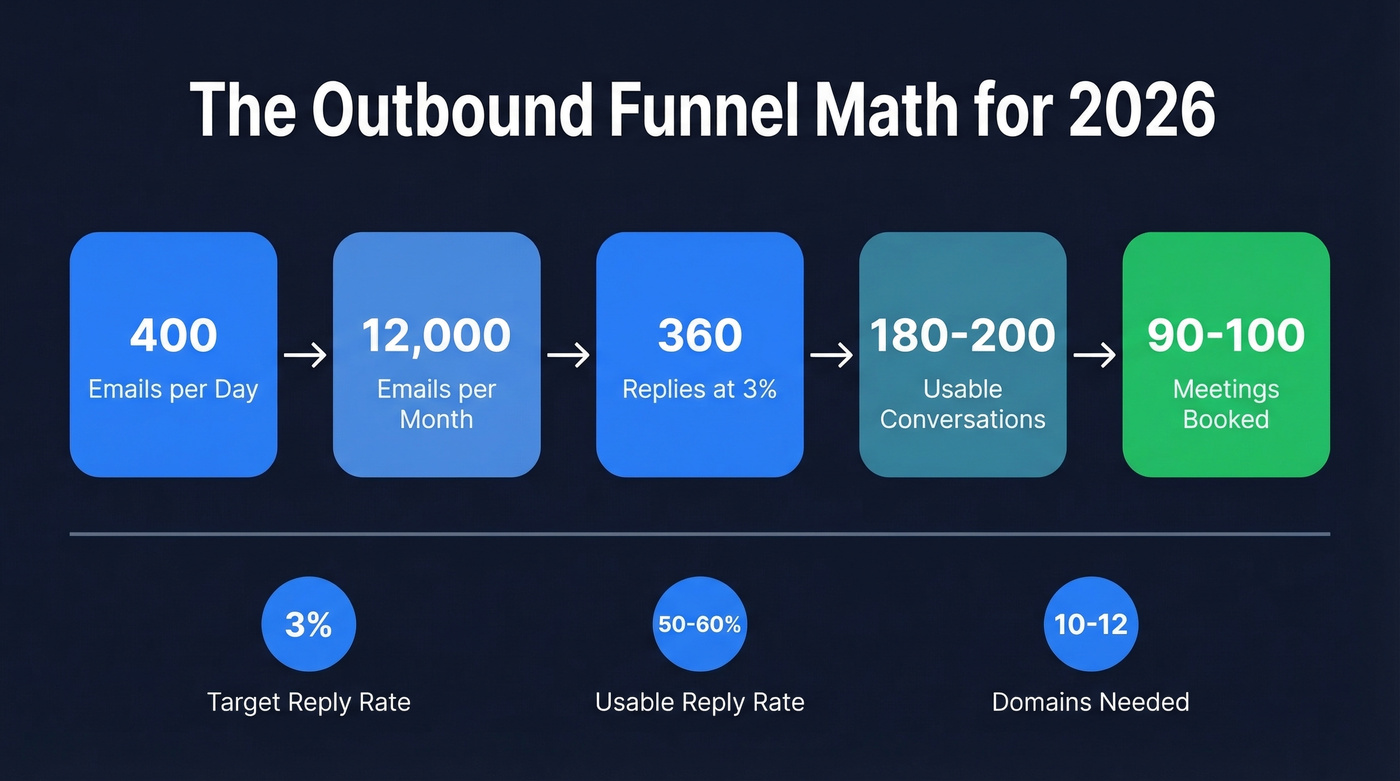
The funnel math: 400 emails/day → 12,000/month → 360 replies at 3% → 180-200 usable → 90-100 meetings. That's the target. Let's build toward it.
Outbound vs Inbound - When Each Wins
The debate is tired. The answer is both, but the timing matters.
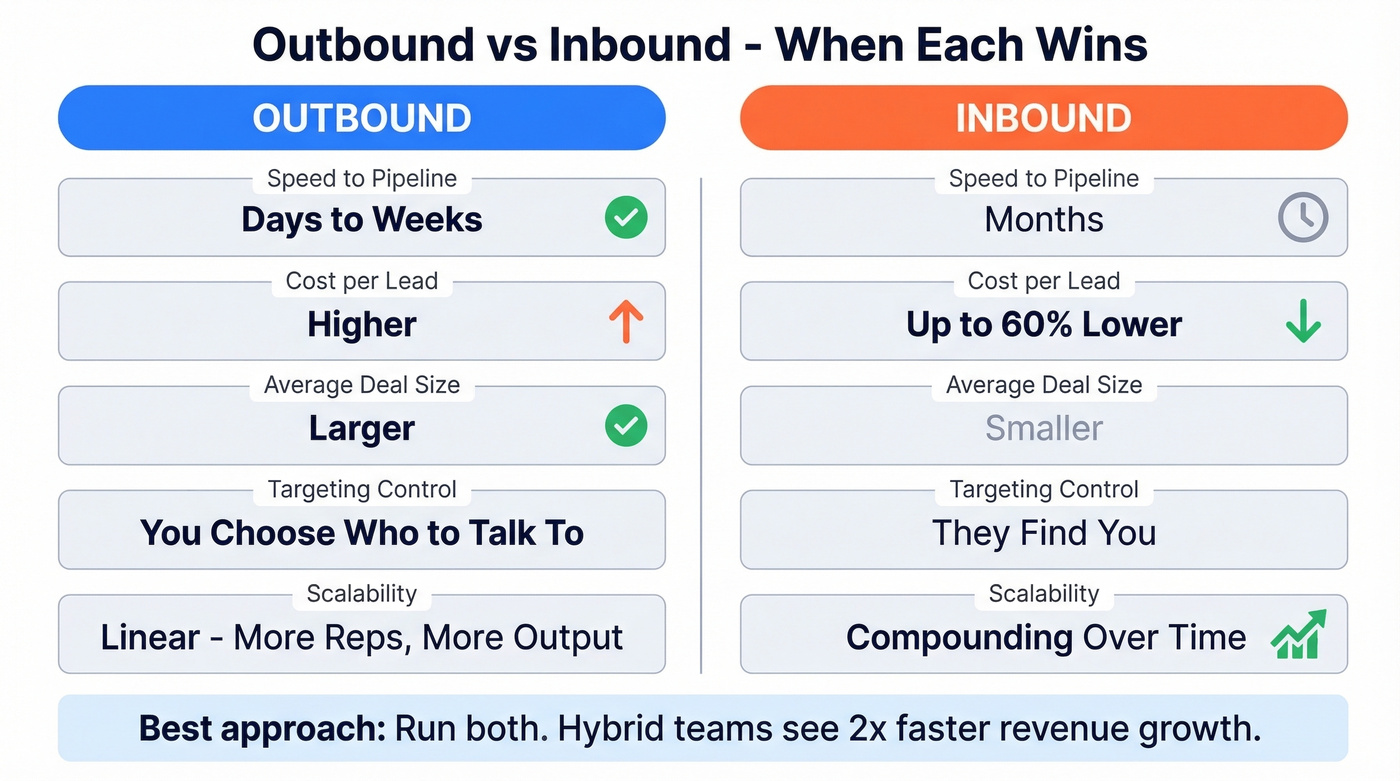
Companies running hybrid inbound + outbound see 2x faster revenue growth than those relying on a single motion. Layer inbound engagement signals onto outbound follow-up and you reduce cost per lead by 31%. Inbound leads cost up to 60% less, but outbound consistently yields larger deals and gives you control over who you're talking to.
| Dimension | Outbound | Inbound |
|---|---|---|
| Speed to pipeline | Days-weeks | Months |
| Cost per lead | Higher | Up to 60% lower |
| Avg deal size | Larger | Smaller |
| Targeting control | You choose | They choose you |
| Scalability | Linear (more reps) | Compounding |
For context on the inbound side: qualified-to-booked rates hit 62% median and 72% for top quartile - but only if you have the volume. Outbound conversion from initial contact runs 2-5%, which is why infrastructure and volume matter so much.
Here's the thing: 48% of reps stop after one touch, but 80% of sales require 5+ follow-ups. Outbound rewards persistence. Inbound rewards patience. Build both, but if you need pipeline this quarter, outbound is the only lever you can pull today.
Build Your ICP Before Your List
Most teams skip this step. They pull 10,000 contacts from a database, load them into a sequencer, and wonder why reply rates sit at 0.8%. The list isn't the problem. The targeting is.
Your ICP isn't a persona doc that lives in a Google Drive folder nobody opens. It's an operational filter that determines every contact you reach out to. Treat it as a 90-day program: Month 1, draft your ICP and map the buying committee. Month 3, refine based on what's converting. Month 6, double down on the segments and roles that actually book meetings. A dedicated lead generation strategist on your team - or an outsourced partner filling that role - can own this refinement loop and keep targeting sharp as your market shifts.
For each target account, map at least five roles across the buying committee: decision-maker, champion, influencer, signer, and end-user. With 10-11 people involved in the average B2B purchase, single-threading to one contact is a losing strategy.
The data backs this up: cohorts of 50 contacts or fewer increase reply rates by 2.76x. Smaller, tighter lists with a clear "why this company, why now" thesis outperform massive spray-and-pray campaigns every time. As one agency operator on r/b2bmarketing put it, "if you can't articulate why this company is interesting, don't email them."
Core Outbound Strategies for B2B Teams
Cold Email - The Operational Playbook
Cold email is still the highest-leverage outbound channel in 2026. But it's an infrastructure game now, not a copywriting game. The teams winning aren't writing better subject lines - they're running better operations. If you want a deeper build, start with a B2B cold email sequence that matches your volume and risk tolerance.
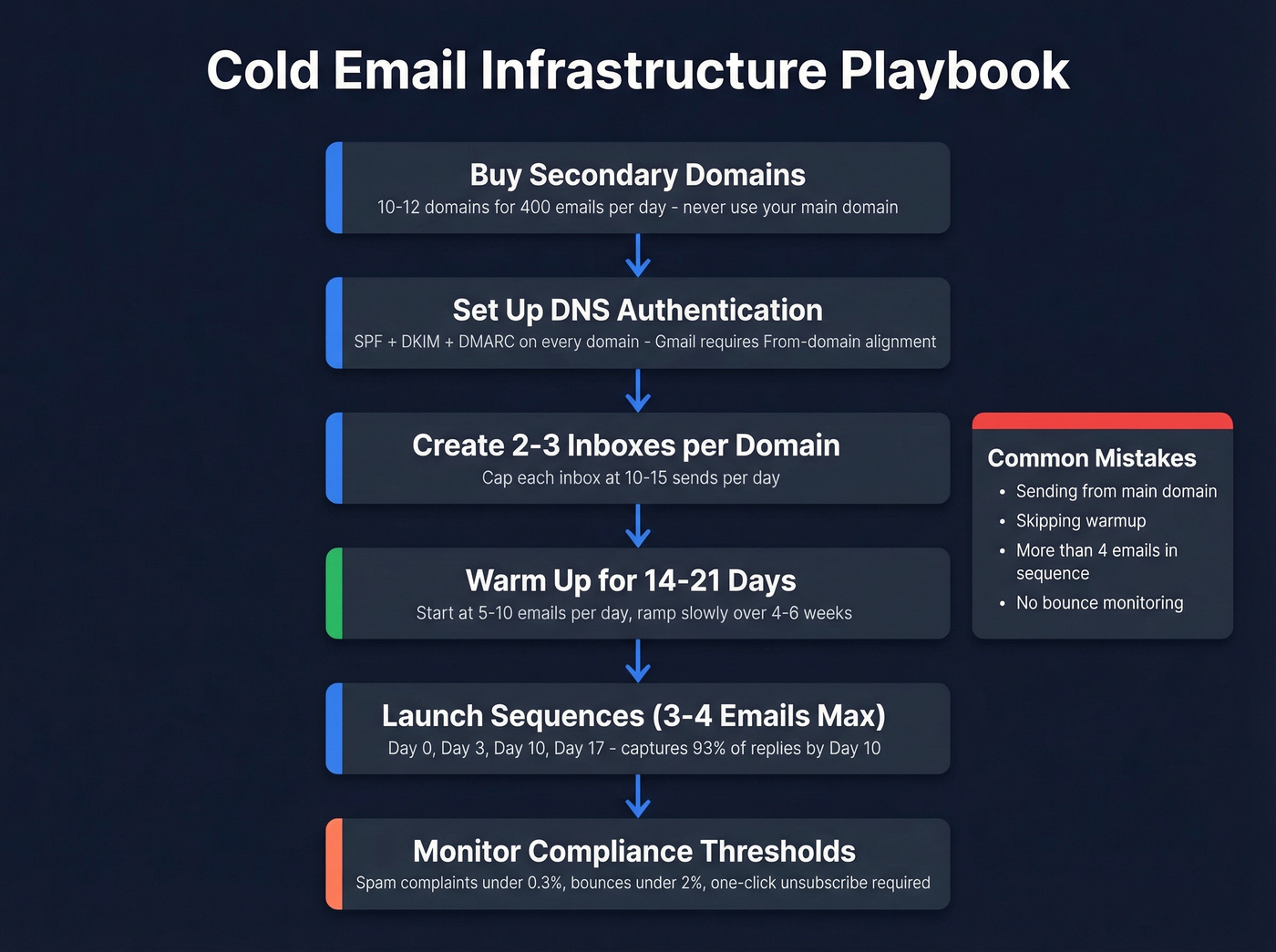
Domain and inbox scaling math. Never send cold email from your main business domain. Buy secondary domains - variations of your brand - set up 2-3 inboxes per domain, and cap each inbox at 10-15 emails per day. To hit 400 emails/day, you need roughly 10-12 domains. That sounds like a lot. It is. But it's the cost of playing the game without torching your primary domain's reputation.
DNS authentication is non-negotiable. Configure SPF, DKIM, and DMARC for every sending domain. DMARC p=none is an acceptable starting point, but you need all three in place before sending a single cold email. Gmail expects From-domain alignment with either SPF or DKIM - skip this and you're landing in spam from day one. If you’re troubleshooting, use this email deliverability guide and double-check DMARC alignment.
Warmup before you send. New inboxes need 14-21 days of warmup. Start at 5-10 emails/day and ramp to 10-15/day over 4-6 weeks. Keep warmup running even after you start live campaigns - it maintains your sender reputation. Warmup activity should represent about 15% of your sending volume. To avoid getting throttled, monitor your email velocity as you scale.
Sequence structure: less is more. The best-performing sequences are 3-4 emails max. Your first email does most of the work. The 3-7-7 cadence (Day 0 → Day 3 → Day 10 → Day 17) captures 93% of replies by Day 10. After four touches, don't delete the account - recycle it in six months with a fresh angle. Timing changes can flip a "no" into a "not right now." If you need copy you can ship fast, pull from these cold email follow-up templates.
Copy that converts. Subject lines under six words. Total email under 100 words. First line about them - a trigger, an observation, something specific. One value prop. One micro-yes CTA ("worth 10 minutes, or am I off base?"). Timeline-based hooks ("saw you're hiring 3 SDRs this quarter") outperform problem hooks by 2.3x on reply rate and convert to meetings at 3.4x the rate. Less poetry, more receipts. For more options, swipe from these cold email subject line examples.
The funnel math: 400 emails/day x 30 days = 12,000/month. At 3% reply rate = 360 replies. 50-60% are usable = 180-200 conversations. Convert half to calls = 90-100 meetings/month. A 2-4% reply rate at scale is genuinely good in 2026 - top performers hit 15-25% with tight ICP targeting and optimized hooks.
Bulk sender rules you can't ignore. Google, Yahoo, and Microsoft enforce spam complaints under 0.3%, bounces under 2%, and one-click unsubscribe headers (RFC 8058) for bulk senders. Violate these and your domains get throttled fast. Keep an eye on email bounce rate and use email reputation tools to catch issues early.
Cold Calling - When to Dial, When to Skip
Dial when: A prospect opened your email twice, clicked a link, or visited your pricing page. Warm calls convert. Cold calling also shines for high-value accounts where you need to multi-thread across the buying committee. Verified mobile numbers deliver a 30% pickup rate - the channel only works if you have the right numbers. If you want a tighter process, build a repeatable cold calling system.
Skip when: You're a solo founder with no SDR capacity, your deal size doesn't justify the time per touch, or you're selling into markets where phone culture is weak (parts of Northern Europe, for example).
Voicemail is a touchpoint, not a pitch. Leave your name, one sentence of context, and reference the email you sent. The goal is to make the next email feel familiar, not to close on a voicemail.
Multi-Channel Sequences - The 30-Day Framework
Email alone gets you a baseline. Adding phone and social doubles your email reply rate. The key is orchestrating 10-14 touches over 30 days across channels without sending 14 emails.
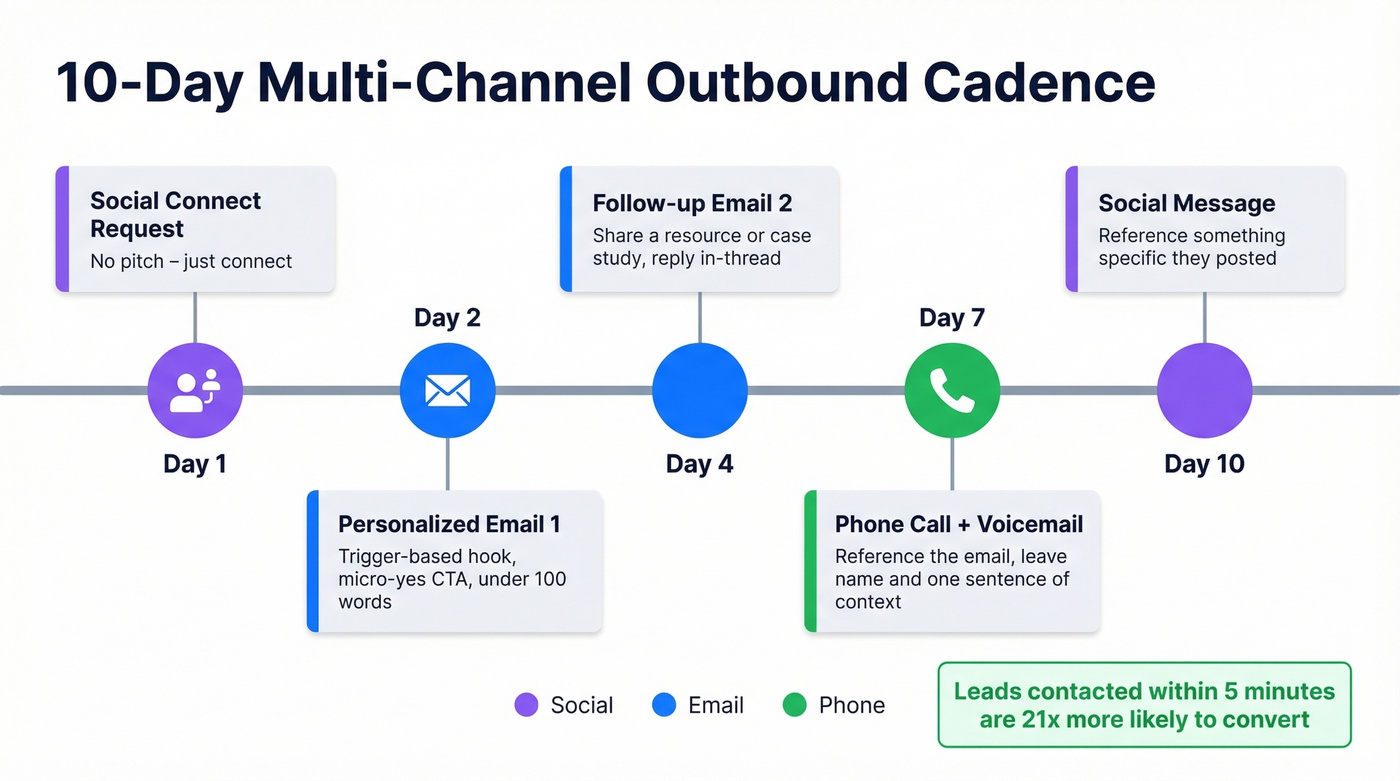
Here's a concrete 10-day starter cadence:
- Day 1: Social connect request - no pitch, just connect
- Day 2: Personalized email #1 with a trigger-based hook and micro-yes CTA
- Day 4: Follow-up email #2 with a resource or case study, reply in-thread
- Day 7: Phone call + voicemail referencing the email
- Day 10: Social message referencing something specific they posted
When a prospect engages with your email or visits your site, the clock starts. Leads contacted within 5 minutes are 21x more likely to convert than those contacted after 30 minutes. Build alerts for engagement signals and treat them like inbound leads.
Three principles that matter:
Sell one thing at a time. Each theme in your sequence should focus on one problem or value prop. When you switch themes, change your subject line too.
Phase out diminishing channels. Social connects work early in the sequence. By the second theme, they've either connected or they won't. Drop social and lean into email and phone for the back half.
Blank connection requests outperform pitchy ones. The connection request isn't the pitch - it's the door. The DM comes later, and its job is to increase email reply rates, not book meetings directly.
Social Selling - A Force Multiplier
Let's be clear about social selling's role in outbound: it amplifies email, it doesn't replace it. The purpose of a social DM isn't to book a meeting. It's to make your next email feel like it's coming from a real person instead of a sequence.
The "bubble-up" technique works well. After your initial email, engage with the prospect's content - a genuine comment, a share, a reaction. Then your follow-up email lands in a different context. They've seen your name. You're not a stranger anymore. This is also where personalized outreach tends to outperform generic “personalization tokens.”
First DM rule: context only. Reference something specific - a post they wrote, a company announcement, a mutual connection. No pitch. No calendar link. Save that for email, where the infrastructure supports it.

You just read that B2B data decays 22-70% annually. That's why Prospeo refreshes every 7 days - not every 6 weeks like competitors. 300M+ profiles, 98% email accuracy, and 5-step verification means your 400 emails/day actually land in inboxes instead of destroying your sender reputation.
Stop burning domains with bad data. Fix the foundation first.
Data Quality - The Silent Outbound Killer
Picture this: you build a list of 5,000 contacts, load them into your sequencer, and launch. Within a week, 800 bounce. That's a 16% bounce rate - eight times the 2% threshold that triggers domain penalties. Your sending reputation tanks. Your next campaign lands in spam. You've burned a domain.
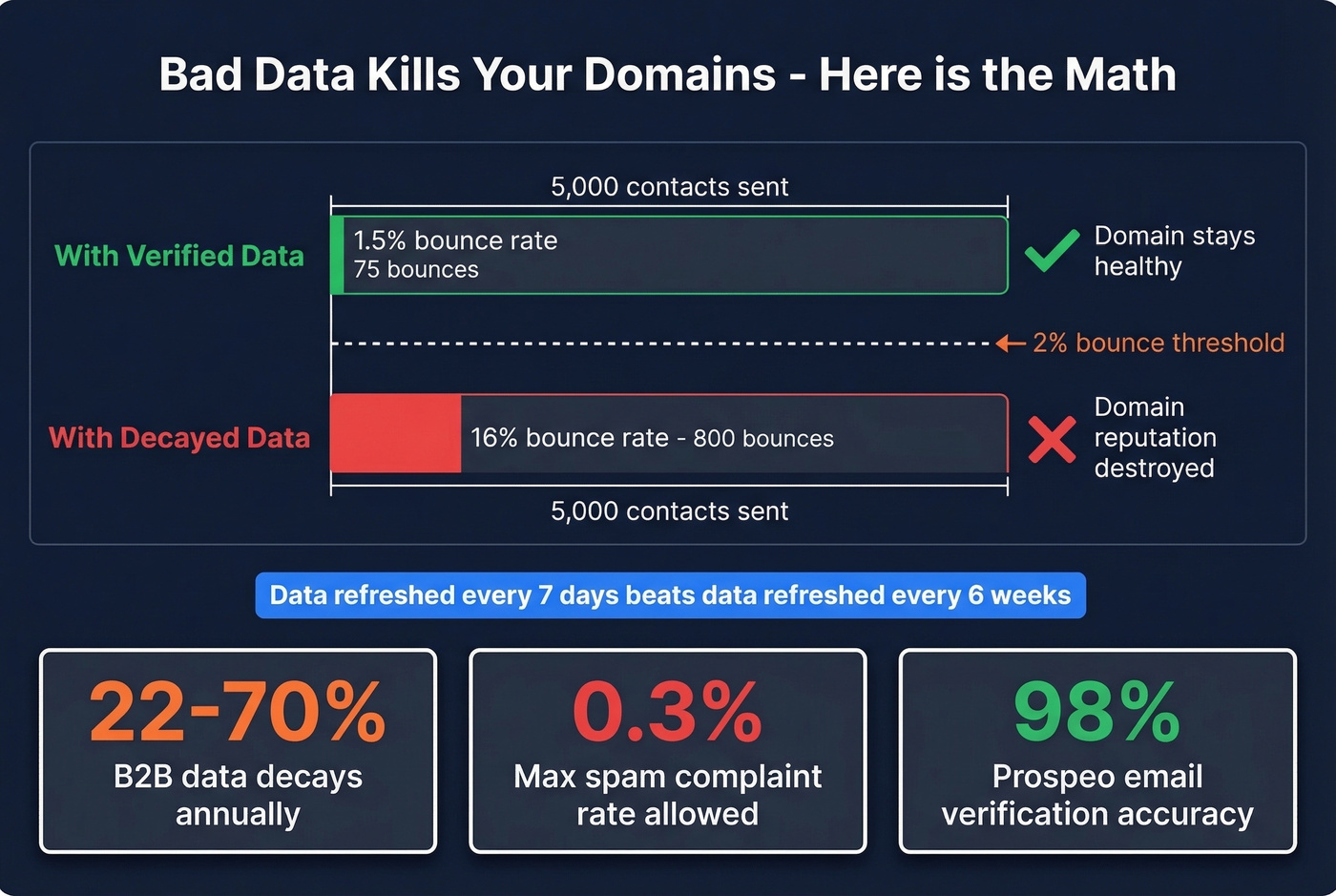
This isn't hypothetical. B2B data decays at 22-70% annually. People change jobs, companies get acquired, email servers get reconfigured. The data you bought three months ago is already rotting. Emails sent to large, untargeted lists get 67% fewer replies than smaller, segmented campaigns. If you’re fixing this at the source, start with data enrichment services and a clean lead generation workflow.
One practitioner on r/coldemail summed it up: "I was getting ~2% reply rates until I stopped blaming my copy and started auditing my data. Bounce rate was the real problem."
Building a Repeatable Lead Generation Engine
Your outbound tool stack depends on your stage, but the real goal is building a repeatable system where data, sequencing, and follow-up run on infrastructure rather than individual heroics. If you’re comparing options, these outbound lead generation tools are a good starting point.
| Tool | Category | Starting Price | Best For |
|---|---|---|---|
| Prospeo | Data + verification | Free (75 emails/mo) | Verified contacts + intent data |
| Smartlead | Email sequencing | $39/mo | Solo senders |
| Google Workspace | Sending domains | ~$7/user/mo | Inbox setup |
| Apollo | All-in-one prospecting | Free / $49/user/mo | SMB teams |
| Lemlist | Multi-channel sequences | ~$39-99/mo | Personalization |
| HeyReach | Social outreach | $49/mo | Scaled social |
| Clay | Data orchestration | $134/mo | Enrichment workflows |
| ZoomInfo | Enterprise GTM | $15,000-40,000/yr | Large orgs |
Solo founder ($0-100/mo): Prospeo's free tier for verified contacts, Smartlead for sequencing, Google Workspace for sending domains. Total: under $50/mo. This gets you to 400 emails/day if you scale domains over time.
Small team ($100-500/mo): Add Apollo or Lemlist for sequencing, HeyReach for social outreach. Apollo's 275M+ contact database and built-in sequencer make it the obvious all-in-one for teams that want simplicity. Lemlist wins if personalization is your edge.
Scaled team ($500-2,000/mo): Layer in Clay for waterfall enrichment across 100+ data sources, plus Outreach (~$100-150/user/mo) for execution. Clay's ~95% email accuracy and AI-powered research layer make it the best enrichment orchestrator on the market, though dedicated verification tools still deliver higher accuracy on the email side.
Look, ZoomInfo at $15,000-40,000/year makes sense for 500-person sales orgs running outbound, ABM, and intent from one platform. But if your average contract value is under $15k or your team is under 50 reps, you almost certainly don't need that level of spend. Most teams we talk to are better served by composable stacks at a fraction of the cost.
Adapting Outbound Playbooks by Vertical
The framework above applies broadly, but the best-performing teams tailor their playbooks to their market.
Enterprise accounts. Enterprise cycles are longer, buying committees are larger, and single-threaded outreach almost never works. Map 5-8 contacts per account, lead with executive-level pain points, and use account-based cadences where every touch references the same company-specific thesis. Intent data from providers like Bombora or 6sense helps you time outreach to active buying windows instead of guessing. If you’re formalizing this motion, follow account-based selling best practices.
E-commerce sellers. E-commerce buyers respond to revenue-impact messaging - AOV lifts, cart abandonment recovery, shipping cost reduction. Seasonality matters: time your outreach 60-90 days before peak selling periods (Q4, Prime Day) when budgets are being allocated. Shorter sales cycles mean you can run tighter 14-day cadences instead of the standard 30-day framework.
Software and dev tools. Technical buyers - CTOs, VPs of Engineering, DevOps leads - are allergic to marketing speak. Lead with technical specificity: reference their stack (visible through BuiltWith or Crunchbase technographics), mention a specific integration pain point, and link to documentation or a technical case study instead of a generic landing page. Developer-focused outbound converts best when the first touch demonstrates you understand their world, not when it promises to "transform their workflow."
Mistakes That Kill Your Outbound
Sending from your main domain. One spam complaint spike and your entire company's email reputation is compromised. Always use secondary domains.
No warmup or ramping too fast. Jumping from 0 to 50 emails/day on a fresh inbox is a guaranteed spam folder sentence. Budget 3-4 weeks before going live.
Sequences longer than four emails. After four touches, you're not persistent - you're annoying. Recycle the account in six months with a new angle.
Untargeted lists. Emails to large, unsegmented lists get 67% fewer replies. 200 well-researched contacts will outperform 5,000 scraped ones every time.
Ignoring deliverability metrics. Aim for spam complaints under 0.01% as your operational target - the 0.3% bulk sender ceiling is the penalty trigger, not the goal. Bounce rate must stay under 2%. Track weekly.
Single-channel only. Multi-channel sequences double email reply rates. If you're only emailing, you're leaving meetings on the table.
No benchmarking. Track reply rate by segment, positive reply rate, meeting conversion rate, and meetings-to-opportunity rate. If you're not reviewing these weekly and adjusting monthly, you can't optimize anything.
Compliance - CAN-SPAM, GDPR, CASL
Cold email is legal. But the rules vary by region, and the penalties are real.
| Regulation | Region | Consent Required | Opt-Out Deadline | Max Penalty |
|---|---|---|---|---|
| CAN-SPAM | US | No (opt-out model) | 10 business days | $53,088/email |
| GDPR | EU/EEA | Explicit opt-in | Immediate | EUR 20M or 4% revenue |
| CASL | Canada | Express or implied | Immediate | $10M CAD |
Every email needs a one-click unsubscribe - it's required by bulk sender rules and widely expected for compliance. Use your real name, company, and physical address. No aliases, no fake companies. "Re: our conversation" when you've never spoken creates compliance risk under CAN-SPAM's misleading-subject-line rule.
Maintain consent records, especially for GDPR and CASL - if you can't prove consent, you don't have it. Authenticate every domain with SPF, DKIM, and DMARC.
CAN-SPAM is relatively permissive - you don't need opt-in consent for B2B cold email in the US. GDPR is stricter. Legitimate interest can work for B2B, but you need to document your basis. If you're selling into the EU, talk to a lawyer before you launch.
Multi-threading a 10-person buying committee requires verified emails AND direct dials. Prospeo gives you both: 143M+ verified emails and 125M+ mobile numbers with a 30% pickup rate. Layer in buyer intent from 15,000 Bombora topics to nail the 'why now' in every first line.
Build the multi-channel cadences this article describes - with data that actually connects.
FAQ
What's a good cold email reply rate in 2026?
At scale, 2-4% is solid and realistic. Top performers hit 15-25% by combining tight ICP targeting with trigger-based hooks and the 3-7-7 cadence. Below 1% usually signals a deliverability or targeting problem, not a copywriting one.
How many emails can I send per day without hurting deliverability?
Cap at 10-15 emails per inbox per day, with 2-3 inboxes per domain. To reach 400/day, scale horizontally with more domains - never by pushing more volume through fewer inboxes. Warmup each inbox for 3-4 weeks before sending live campaigns.
How long should a cold email sequence be?
Three to four emails max. The first email does most of the work, and the 3-7-7 cadence captures 93% of replies by Day 10. After four touches, pause the account and recycle it in six months with a fresh angle.
What's the cheapest way to start B2B outbound prospecting?
Prospeo's free tier (75 verified emails/month), a sequencer like Smartlead ($39/mo), and Google Workspace for sending domains (~$7/mo) gets you running for under $50/month. Scale domains over time to increase daily send volume.
Is cold email still legal in 2026?
Yes, but compliance varies by region. CAN-SPAM requires opt-out in every email but doesn't require prior consent. GDPR requires a legal basis like legitimate interest or explicit opt-in. Authenticate every domain with SPF, DKIM, and DMARC, and include one-click unsubscribe in every message.