

B2B Sales Email Templates - The Full Playbook for 2026
You've got a swipe file full of "proven" B2B sales email templates, and your reply rate is still stuck at 2%. The templates aren't the problem. The consensus on r/coldemail is that once a "proven template" gets copied widely enough, it triggers pattern fatigue - prospects have seen the same structure dozens of times and their brain files it as spam before they finish the first line.
The fix isn't a better template. It's a better system around the template.
What You Need (Quick Version)
Three things matter, in this order.
Data and deliverability come first. Bad emails bounce, bounces torch your domain, and a torched domain means even perfect copy lands in spam. Pair a verified data source with a sending tool like Instantly or Smartlead.
Use 5-6 scenario-specific templates, not 50 generic ones. Each template should target a specific trigger, pain point, or relationship type.
Personalize with real signals, send to micro-segments of 20-50 prospects. The senders hitting 10.7%+ reply rates aren't blasting 2,000 contacts with the same email. As one sender who ran 17 million emails put it on r/b2bmarketing: sending to 50 people three times with tailored variations beat blasting 5,000 contacts every single time.
2026 Cold Email Benchmarks
| Metric | Average | Top Quartile | Elite (Top 10%) |
|---|---|---|---|
| Reply rate | 3.43% | 5.5%+ | 10.7%+ |
| Open rate | ~35% | ~46% | 50%+ |
| Email length | 80-150 words | Under 80 words | Under 80 words |
| Sequence length | 3-4 steps | 4-7 steps | 4-7 steps |
| Best send days | Tue-Wed | Tue-Wed | Wednesday |
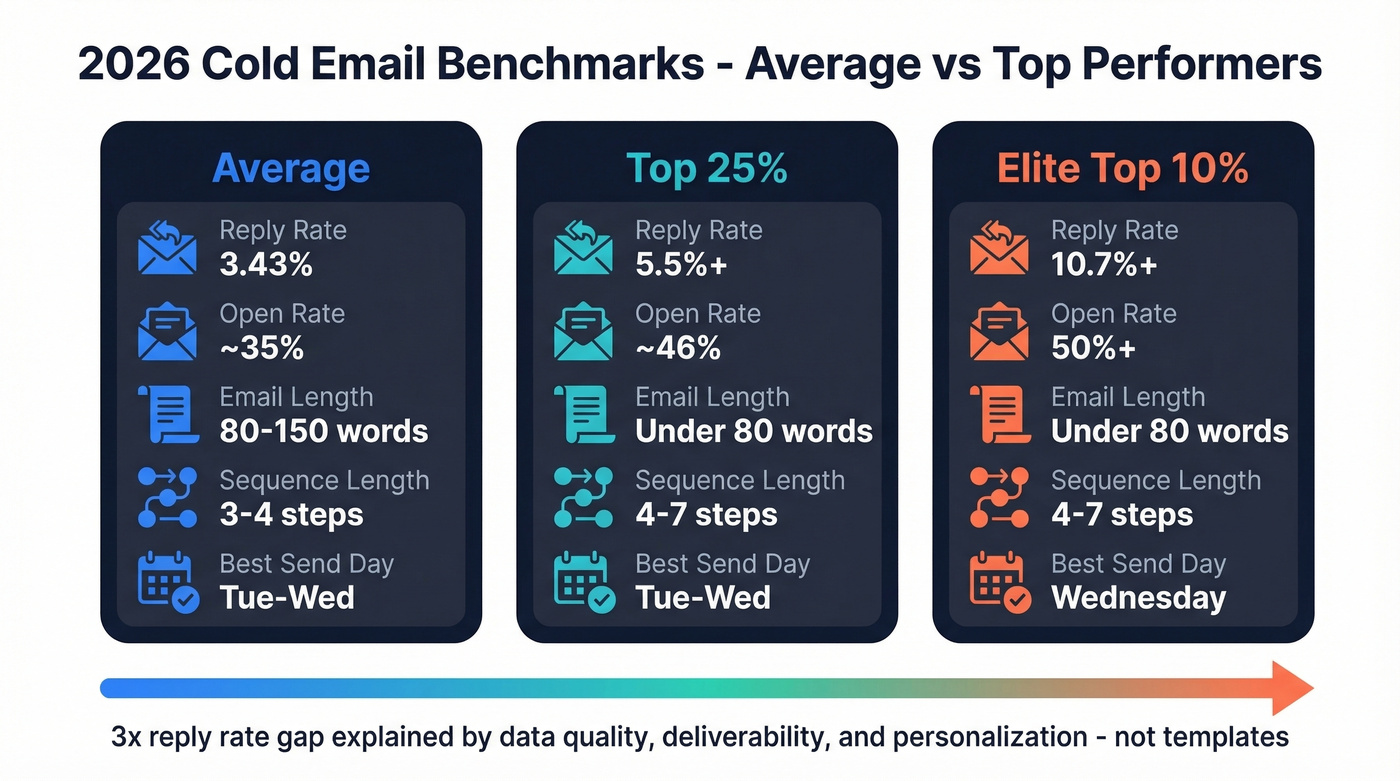
Reply rate data comes from Instantly's 2026 benchmark report, which analyzed billions of cold email interactions. Sopro's dataset of 151 million outreach points puts the average response rate at 5.1%, with most campaigns landing between 1% and 5%. Personalized subject lines alone pull 46% open rates vs 35% without - a 31% boost, per Belkins' analysis of 5.5 million emails.
The gap between average and elite is enormous. It's almost entirely explained by data quality, deliverability, and personalization. Not templates.
The Deliverability Checklist
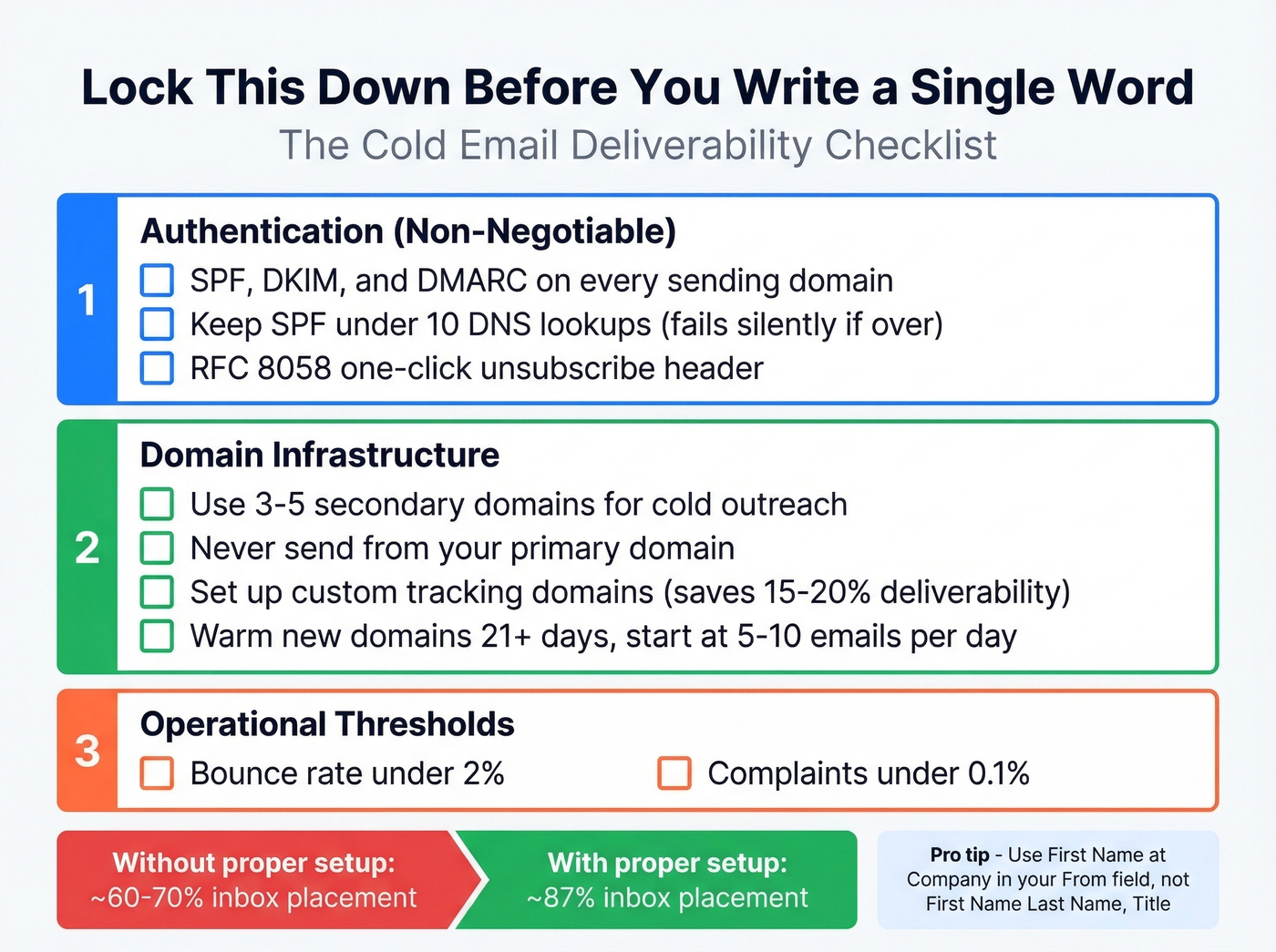
Your email copy is irrelevant if it lands in spam. Lock this down before you write a single word.
If you want the full system, start with an email deliverability guide and then audit your email bounce rate before you touch copy.
Authentication (non-negotiable)
- SPF, DKIM, and DMARC configured on every sending domain. Keep SPF under 10 DNS lookups or it'll fail silently.
- RFC 8058 one-click unsubscribe header - Google and Yahoo now enforce this for bulk senders.
Domain infrastructure
- Use 3-5 secondary domains for cold outreach. Never send cold email from your primary domain.
- Set up custom tracking domains. Generic tracking links from your sending tool can cost you 15-20% deliverability. (If you haven't done this before, see what a tracking domain is and how to set it up.)
- Warm new domains for at least 21 days, starting at 5-10 emails/day and ramping gradually over 4-6 weeks. (Also watch your email velocity so you don't spike volume.)
"From" field formatting - here's something most guides skip. "First Name at Company" outperforms "First Name Last Name, Title" for cold outreach because it reads like a person, not a pitch. Test "Sarah at Acme" vs "Sarah Johnson" and measure reply rates. The more corporate your From field looks, the more it triggers the prospect's sales-email filter.
Operational thresholds
Keep bounce rate under 2% and complaints under 0.1%. Exceed either and inbox providers start throttling you. With proper setup, you're looking at roughly 87% inbox placement. Without it, you'll hover around 60-70%.
The data quality step most teams skip: Every bounced email damages your sender reputation. Prospeo's 5-step verification catches invalid addresses, spam traps, and honeypots before they hit your sending tool. At 98% email accuracy, you're protecting deliverability and revenue at the same time. If you're cleaning lists after the fact, use a proper spam trap removal process.
We've seen this play out dramatically with agencies we work with - Meritt went from a 35% bounce rate to under 4% after switching their data source, and their pipeline tripled from $100K to $300K per week.

11 Templates by Scenario
Every template below follows the same principles: plain text, under 150 words, one clear idea, a soft CTA, and written at around a 6th-8th grade reading level. In practitioner benchmarks, simpler language performs 67% better in cold outreach, under-150-word emails perform 83% better, and 81% of your recipients will read this on a phone.
Choosing the Right Framework
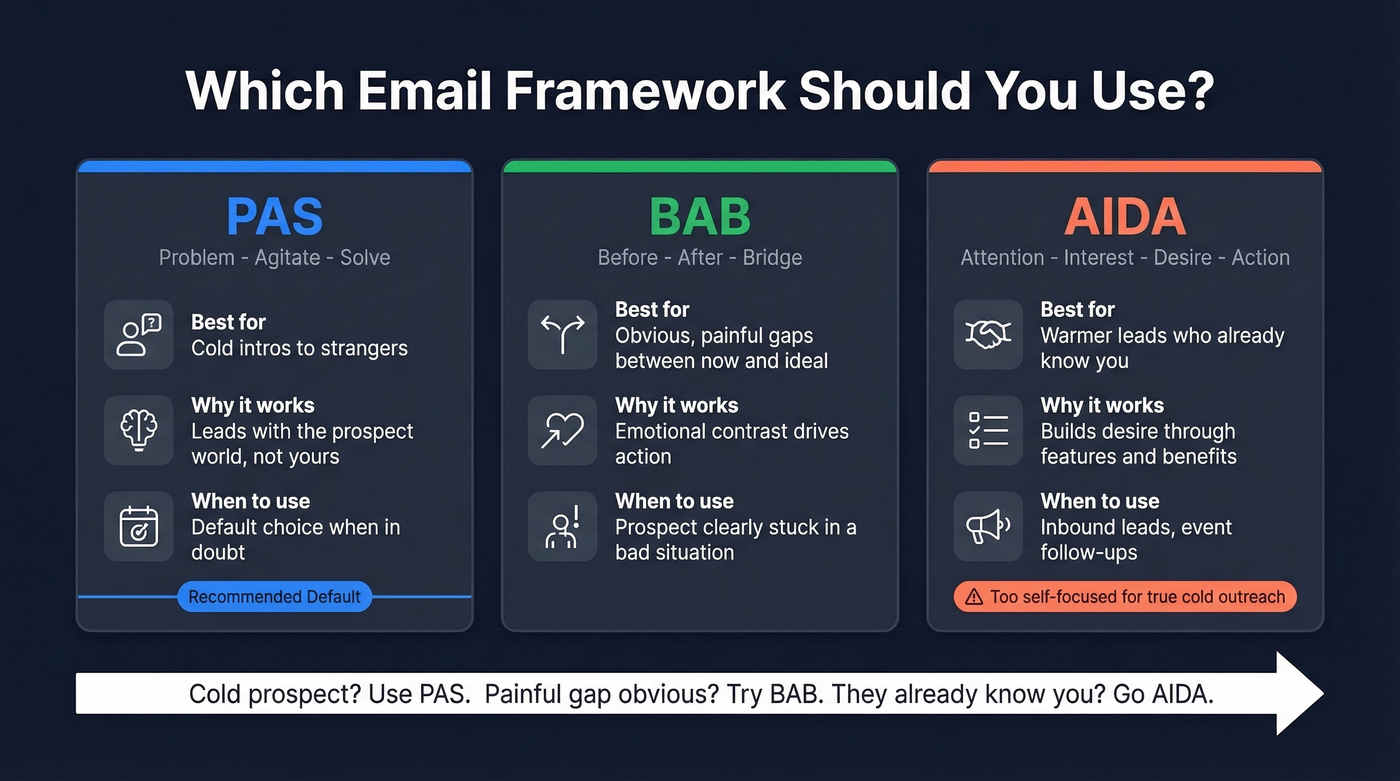
PAS (Problem-Agitate-Solve) is your default for cold intros - it leads with the prospect's world, not yours. BAB (Before-After-Bridge) works best when the emotional gap between current state and desired state is obvious and painful. AIDA (Attention-Interest-Desire-Action)) is better for warmer leads who already know you exist - it's too self-focused for true cold outreach. When in doubt, use PAS.
If you're building a full outbound motion (not just one email), map these templates into a B2B cold email sequence so each step has a job.
Cold Intro (Stranger to Meeting)
Template 1 - PAS Framework:
Subject: {{company}} + {{pain_point}}
Hi {{first_name}},
Most {{title_plural}} at {{industry}} companies tell us {{pain_point_statement}}. The usual fix - {{common_bad_solution}} - just creates more work.
We helped {{similar_company}} cut {{metric}} by {{result}} in {{timeframe}}.
Worth a quick look?
P.S. Saw {{personalized_detail}} - thought this might be especially relevant.
A personalized P.S. is often worth ~35% better performance. Don't skip it.
Template 2 - Direct Value Prop:
Subject: Quick question, {{first_name}}
Hi {{first_name}},
We help {{target_persona}} at {{company_type}} do {{specific_outcome}} without {{common_objection}}.
{{Customer_name}} saw {{specific_result}} in {{timeframe}}.
Open to hearing how?
No preamble, no "hope this finds you well." One idea, one proof point, one soft ask.
Trigger-Based Outreach
Trigger-based emails tie your outreach to something real happening in the prospect's world. They don't feel cold - and they consistently outperform generic templates by 2-3x. If you need a system for finding and operationalizing triggers, use a how to track sales triggers workflow.
Template 3 - Job Change:
Subject: Congrats on the new role
Hi {{first_name}},
Congrats on joining {{company}} as {{title}}. The first 90 days are usually when {{pain_point}} becomes a priority.
We've helped other new {{title_plural}} get {{outcome}} fast. Worth exploring?
Send this within 30 days of a prospect's job change. After 90 days, the "new role" angle feels stale.
Template 4 - Funding/Growth:
Subject: {{company}}'s Series {{round}}
Hi {{first_name}},
Saw {{company}} closed your Series {{round}} - congrats. Teams at this stage usually need to {{growth_challenge}} fast.
We helped {{similar_company}} do exactly that - {{specific_result}}.
Interested in a quick comparison?
Social Proof / Case Study
Template 5 - Specific Metric:
Subject: How {{customer}} hit {{metric}}
Hi {{first_name}},
{{Customer}} was dealing with {{same_problem_prospect_has}}. After {{timeframe}} with us, they {{specific_result}}.
I think we could do something similar for {{company}}. Worth 15 minutes?
Template 6 - Competitor Displacement:
Subject: Why {{competitor_customer}} switched
Hi {{first_name}},
{{Competitor_customer}} was using {{competitor_tool}} for {{use_case}}. They switched to us and saw {{improvement}}.
If you're running into similar issues with {{competitor_tool}}, happy to share what they learned.
Skip this template if you can't name a real customer who switched from the specific competitor your prospect uses. Vague competitor displacement emails backfire hard.
Pain-Point (Problem-Agitate-Solve)
Template 7 - Known Pain:
Subject: {{pain_point}} at {{company}}
Hi {{first_name}},
{{Pain_statement}} is costing {{persona_type}} teams an average of {{cost/time}}. Most fixes just add complexity.
We took a different approach - {{one_sentence_differentiator}}. {{Customer}} saw {{result}}.
Worth a look?
Referral / Mutual Connection
Template 8:
Subject: {{mutual_connection}} suggested I reach out
Hi {{first_name}},
{{Mutual_connection}} mentioned you're working on {{initiative}}. We helped them with {{related_outcome}} and they thought it'd be relevant for you.
Worth connecting?
This is usually the highest-converting template type when you genuinely have a mutual connection. If you have one, lead with it every time.
Re-engagement / Breakup
Template 9:
Subject: Should I close your file?
Hi {{first_name}},
I've reached out a few times and haven't heard back - totally fine. If {{problem}} isn't a priority right now, I'll stop reaching out.
If it is, I'm here. Either way, no hard feelings.
Follow-Up Sequence (Steps 2-3)
Template 10 - Step 2 ("Feels Like a Reply"):
Forgot to mention - {{new_relevant_detail_or_resource}}.
Thought it'd be useful given {{prospect_context}}.
Step 2 emails that feel like a natural reply rather than a formal follow-up outperform by ~30%. No subject line - it threads under the original.
Template 11 - Step 3 (New Value):
Subject: {{resource_or_insight}} for {{company}}
Hi {{first_name}},
Pulled together {{resource_type}} on {{topic_relevant_to_prospect}}. Thought you'd find it useful regardless of whether we connect.
{{Link_or_attachment}}
Each follow-up must add new value instead of just "bumping" the thread. That's the difference between persistence and annoyance.
What to Avoid
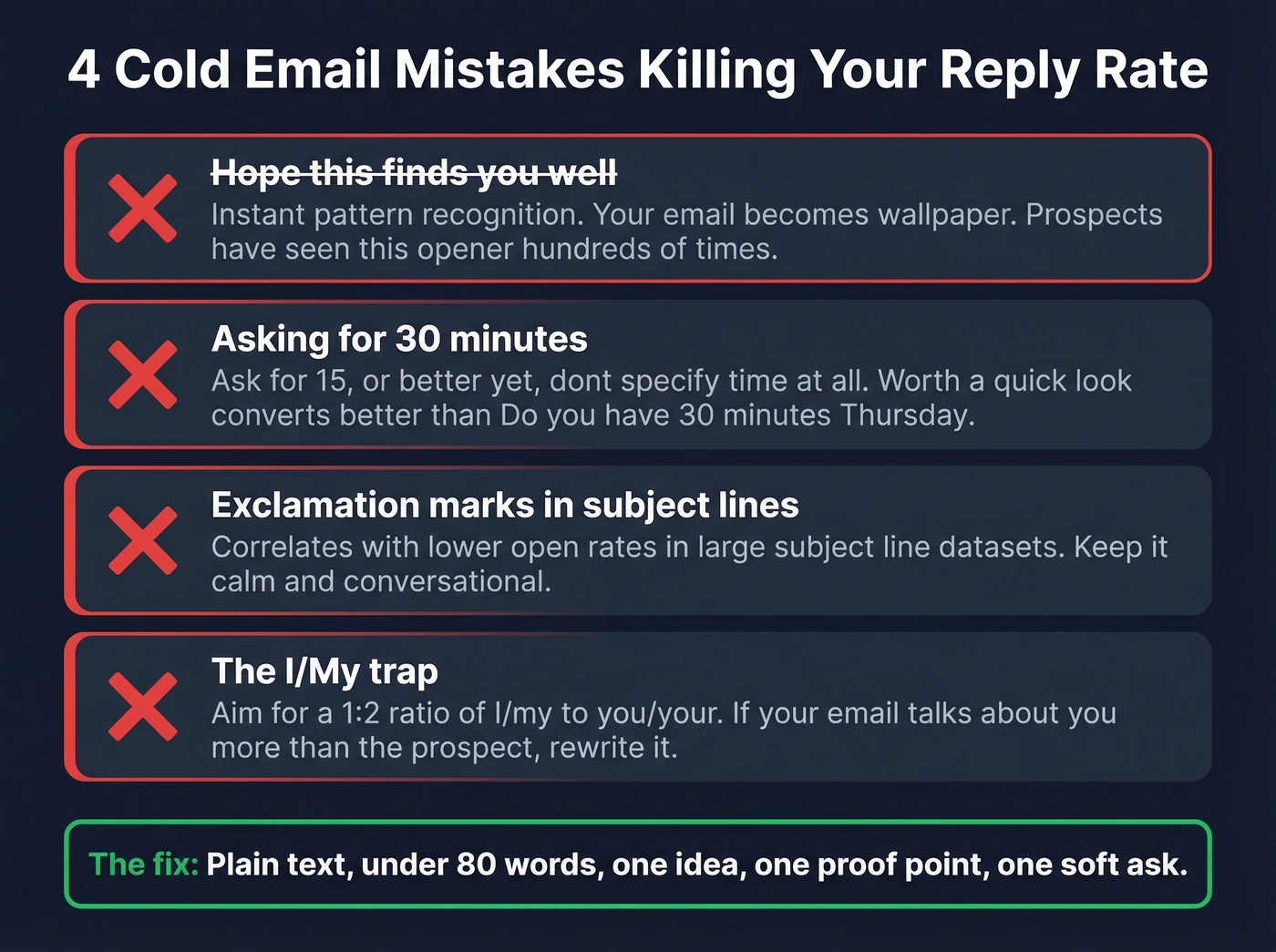
- "Hope this finds you well" - instant pattern recognition. Your email just became wallpaper.
- Asking for 30 minutes - ask for 15, or better yet, don't specify a time at all. "Worth a quick look?" converts better than "Do you have 30 minutes Thursday?"
- Exclamation marks - they correlate with lower open rates in large subject-line datasets.
- The "I/my" trap - aim for a 1:2 ratio of "I/my" to "you/your." If your email talks about you more than the prospect, rewrite it. (A quick refresher on email copywriting helps here.)

Every bounced email damages your sender reputation and kills reply rates - no template can fix that. Prospeo's 5-step verification delivers 98% email accuracy, catching spam traps and honeypots before they torch your domain. At $0.01 per email, clean data costs less than a single wasted send.
Fix your data before you fix your copy.
Subject Lines That Drive Opens
Belkins analyzed 5.5 million emails and the patterns are clear. Subject lines of 2-4 words hit a 46% open rate - "Quick question" outperforms "I'd love to discuss how we can help your team" by a wide margin. Personalized subject lines pull 46% opens vs 35% without, and reply rates jump from 3% to 7%. Questions tie for the top spot at 46% opens.
If you want more options to test, pull from these cold email subject line examples and keep a separate swipe file of email subject line examples for warmer sequences.
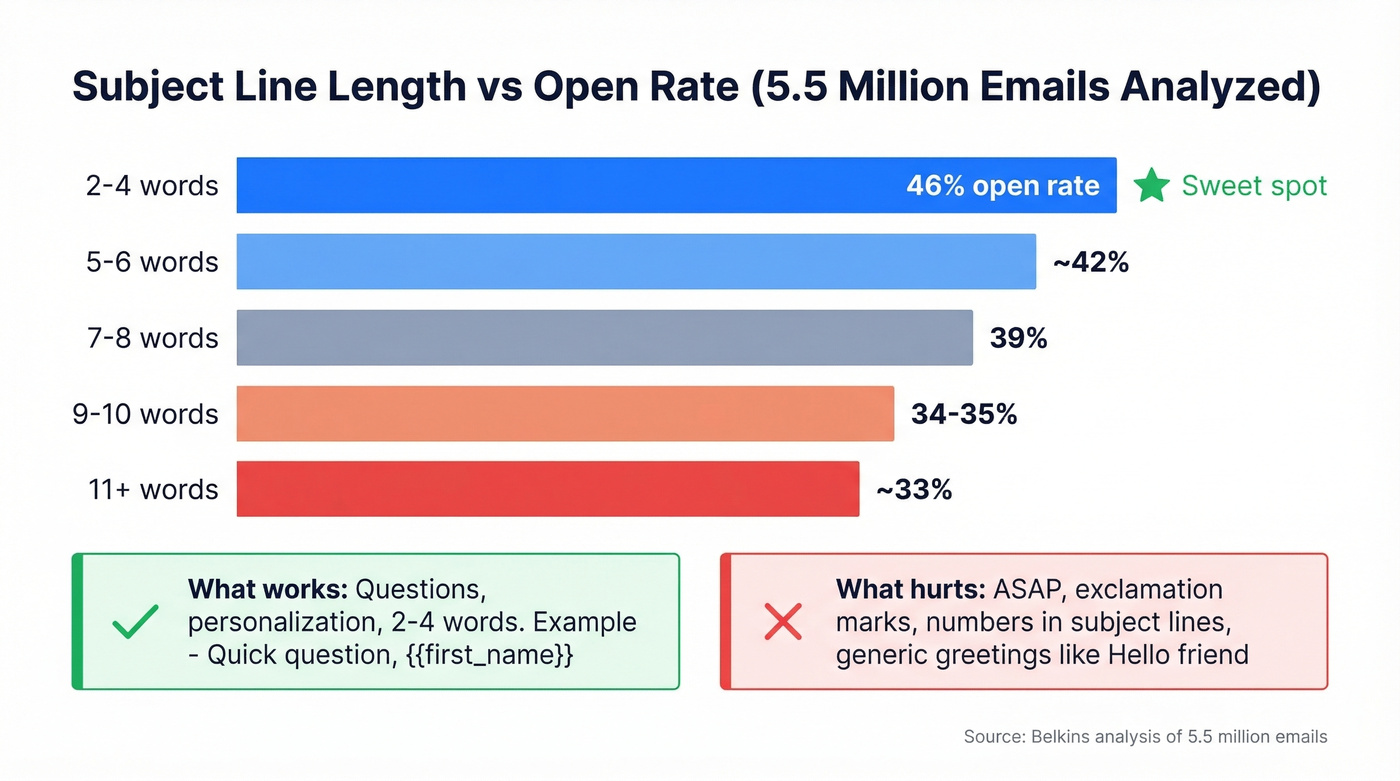
On the flip side, 7+ words drop to 39% opens. By 9-10 words, you're at 34-35%. Numbers in subject lines actually hurt slightly. And "ASAP," exclamation marks, and generic greetings like "Hello, friend" drag opens below 36%. Sopro's dataset suggests 6-10 words perform best, but Belkins' sample is 36x larger - go with 2-4 words.
The best subject line in the world won't save a bad email. But a bad subject line will kill a great one.
Personalizing at Scale
"Hey {{first_name}}, love what {{company}} is doing" isn't personalization. Prospects see through it instantly, and it actually hurts your reply rate because it signals laziness.
Here's the workflow we use that produces a ~3x response rate lift.
- Scrape a real signal. Pull a recent post, podcast appearance, or company announcement for each prospect.
- Generate a custom opener. Feed the signal into GPT-4o mini with a prompt that produces a 1-2 sentence personalized opening. Store it as a
{{custom_message}}merge field. - Export and send. Push the CSV into your sending tool. The custom field drops into the first line of your template.
If you're doing this across accounts, it helps to define your ideal customer profile first so your “signals” actually correlate with buying.
A/B testing is non-negotiable. Test one variable at a time - subject line, CTA, or opening line. Run each variant to 50-100 sends before declaring a winner. The 20/80 rule works well: test with 20% of your list, deploy the winner to the remaining 80%. Do this weekly. The teams hitting 10%+ reply rates aren't running the same email for months - they're iterating constantly.
Follow-Up Cadence That Works
58% of all replies come from Step 1. That's the good news - your first email does most of the heavy lifting. The remaining 42% trickle in across follow-ups, which is why you still need them.
The sweet spot is 4-7 touchpoints. Beyond 7, returns diminish sharply unless each touch introduces genuinely new value. It takes an average of 5 touches to engage a prospect, and reaching executives often requires ~9 touches vs ~4 for individual contributors.
Let's be honest: if your deal size is under $10K, you probably don't need a 7-step sequence. Three well-crafted emails with real personalization will outperform seven generic follow-ups every time. The teams obsessing over sequence length are usually compensating for weak first emails.
If you want plug-and-play follow-ups, use these sales follow-up templates and then refine your timing with a when should you follow up on an email cadence.
Legal Compliance Quick Reference
Cold email is legal in most jurisdictions. But the rules vary, and the penalties are real.
| Jurisdiction | Model | Cold Email OK? | Key Requirement | Max Penalty |
|---|---|---|---|---|
| US (CAN-SPAM) | Opt-out | Yes | Opt-out honored in 10 days | $53,088/email |
| EU (GDPR) | Legitimate interest | Yes, with LIA | LIA documentation required | 4% of global revenue |
| UK (PECR) | Similar to GDPR | Yes, B2B | Identify sender, opt-out | £500,000 |
| Canada (CASL) | Consent-based | Implied OK | 24-month relationship window | C$10M/violation |
For US outreach, CAN-SPAM is straightforward: include a physical address, don't use deceptive headers, and honor opt-outs within 10 business days. For EU prospects, you'll need to document a Legitimate Interest Assessment under Article 6(1)(f) - purpose test, necessity test, balancing test. Canada's CASL is the strictest: retain opt-out records for 3 years and honor unsubscribes within 10 business days.
Every email needs a one-click unsubscribe. This isn't just good practice - Google, Yahoo, and Microsoft now enforce it for bulk senders.
Trigger-based templates like job changes and funding rounds outperform generic outreach by 2-3x - but only if you can find those signals. Prospeo tracks buyer intent across 15,000 topics, job changes, headcount growth, and funding events with 30+ filters so every template hits the right person at the right moment.
Send the right template to the right trigger - automatically.
FAQ
How long should a B2B sales email be?
Under 80 words for cold outreach. Emails under 150 words perform 83% better than longer ones, and 81% are opened on mobile. Short, plain-text messages scan best on small screens. If you're writing more than a short paragraph, you're writing too much.
What's a good cold email reply rate in 2026?
The average is 3.43%. Top quartile campaigns hit 5.5%+, and elite senders exceed 10.7%. If you're below 3%, the issue is usually data quality or deliverability - not your template. Fix your bounce rate first, then optimize copy.
Is cold emailing legal?
Yes, in most jurisdictions. The US uses an opt-out model under CAN-SPAM - cold email is legal without prior consent as long as you include an unsubscribe option. The EU allows it under GDPR's legitimate interest provision. Canada requires implied or express consent under CASL. Always include a one-click unsubscribe and a physical mailing address.
What makes a B2B sales email template effective?
Three things, in order: verified data so the email reaches the inbox, a specific trigger or pain point that makes outreach relevant, and a soft CTA that asks for curiosity rather than commitment. A mediocre template sent to the right person at the right time outperforms a brilliant template sent to a bad list every time.
How do I verify emails before sending a campaign?
Use a dedicated verification tool before importing contacts into your sending platform. Prospeo runs a 5-step process that includes catch-all handling, spam-trap removal, and honeypot filtering - delivering 98% email accuracy. At roughly $0.01 per lead with 75 free credits monthly, it's the cheapest insurance against bounced emails torching your domain reputation.