

B2B Tech Marketing in 2026: Strategy, Benchmarks, and What Actually Drives Pipeline
95% of the time, the vendor that wins was already on the buyer's shortlist before a single sales conversation happened. That stat from 6sense's Buyer Experience Report should reshape how every B2B tech marketing team thinks about their job. The game isn't awareness anymore - it's influence, and influence compounds long before your SDR picks up the phone.
Here's what the data says about how B2B tech purchases actually happen, where most teams still get it wrong, and what to do about it.
The Short Version
- SEO and content come first. 748% ROI, one of the highest MQL-to-SQL rates of any core channel, and it compounds. Start here even though the payoff takes around 9 months.
- Email and outbound come second. 261% ROI with a 7-month break-even - but only if your contact data is clean and verified (see email deliverability).
- ABM is the operating model for high-value deals. If your average deal is north of $20K, ABM isn't optional (use account-based selling best practices to operationalize it).
Budget benchmark: 8-10% of ARR for most B2B SaaS companies. Early-stage teams often push 20-40%. The pipeline math and budget frameworks below will help you calibrate.
The 2026 B2B Tech Buyer
According to 6sense's Buyer Experience Report, the average buying cycle compressed from 11.3 months to 10.1 months year-over-year. Buyers now make first contact at 61% of their journey, down from 69% - several weeks earlier than the prior year.
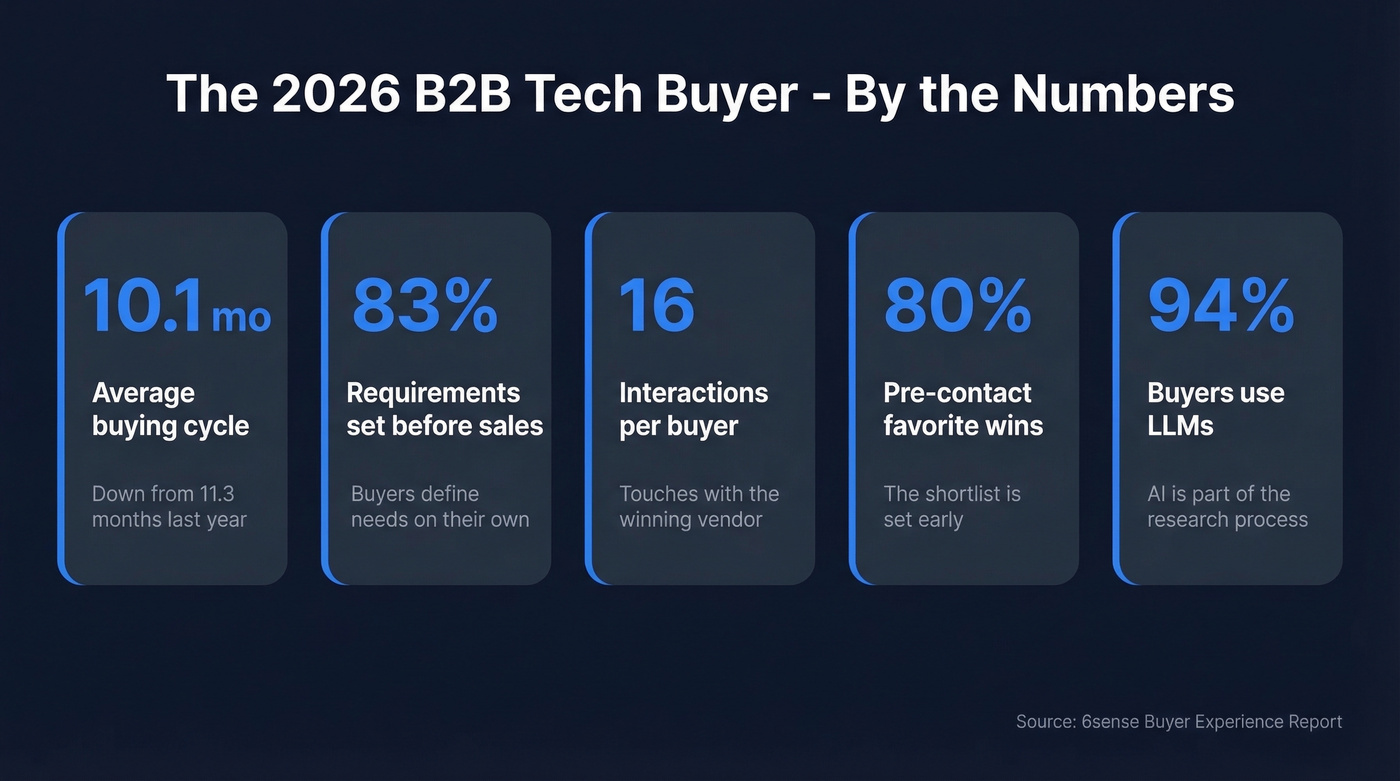
But timing matters less than this: buyers define their purchase requirements 83% of the time before they ever speak with sales. They average 16 interactions per person with the winning vendor. The pre-contact favorite wins roughly 80% of the time.
94% of B2B buyers now use LLMs during their purchasing process, and nearly 90% report that AI features are part of the solutions they ultimately acquire. Meanwhile, 86% of B2B purchases stall at some point, and 81% of buyers end up dissatisfied with the provider they chose.
That combination - buyers deciding early, researching with AI, and frequently regretting their choice - points clearly to where you should invest. Your content, brand presence, and thought leadership need to shape the shortlist months before a deal enters your pipeline. If you're only showing up when someone fills out a demo form, you've already lost.
Core B2B Tech Marketing Strategies
SEO and Content
SEO delivers 748% ROI over three years with a roughly 9-month break-even. Organic CAC runs about $205 versus $341 for paid acquisition, and SEO conversion rate sits around 2.1% compared to PPC's 1.0%. By every financial metric, it's still the highest-returning channel for technology marketers.
But the rules are forking. Google AI Overviews reduce click-through rates for the #1 organic position by 58% when they appear. Here's the nuance most people miss: 72% of buyers have already encountered AI Overviews, and 90% still click through to at least one cited source. Being cited in the overview matters more than ranking below it.
Content structured for AI consumption - clear answers, structured data, authoritative sourcing - gets cited in AI Overviews and LLM responses. Content that's just "long-form for the sake of ranking" will lose traffic steadily. One in three marketers already use AI for SEO optimization, and 40% expect to hire a dedicated AI search specialist in the next 12 months. That tells you where the discipline is heading. (If you need a baseline, start with what is B2B content marketing.)
Email and Outbound
Email marketing returns 261% ROI with a 7-month break-even. Email leads convert from MQL to SQL at 46% - second only to SEO among common benchmarks. For well-targeted cold email in tech sales, expect 40-55% open rates and 3-8% reply rates (compare against standard email open rate).
Below 30% open rate usually signals a list quality problem, not a messaging problem.
Speed matters enormously. Responding to inbound interest within the first hour increases conversion probability by up to 7x. But none of that matters if your contact data is garbage. When 30% of your emails bounce, your domain reputation tanks and your sequences stop landing in the inbox. We've watched teams burn through three sending domains in a quarter because they skipped verification. Data quality isn't a nice-to-have - it's the prerequisite for everything else in outbound. (If you're diagnosing issues, start with email bounce rate and how to improve sender reputation.)
Account-Based Marketing
ABM is becoming the default operating model for B2B tech companies selling $20K+ deals. The shift is from awareness to influence-driven, personalized engagement across multiple channels and touchpoints.
Real-time personalization using AI, dynamic multi-touch engagement across email, events, and content - this is where the 16-interactions-per-buyer stat becomes actionable. ABM gives you the framework to orchestrate those touches deliberately rather than hoping they happen organically. (If you're building the system, use intent based segmentation to prioritize accounts.)
The consensus on r/sales and r/b2bmarketing is that ABM isn't worth the investment for sub-$20K ACV deals. We agree. Below that threshold, the orchestration overhead eats the margin.
Paid Media
Skip this if your ACV is under $15K and you haven't maxed out organic channels. PPC returns just 36% ROI - the lowest of any major B2B channel. Its advantage is speed: roughly 4-month break-even versus 9 months for SEO. LinkedIn paid performs better at 229% ROI, with a visitor-to-lead conversion rate of 2.74% that dwarfs Twitter (0.69%) and Facebook (0.77%).
Use paid as a bridge while organic compounds. It's not a foundation.
Thought Leadership and Brand
Fewer, higher-impact assets beat a content calendar full of mediocre posts. One well-researched benchmark report will generate more pipeline than 20 SEO-optimized articles that say nothing new. Your founders, CMOs, and product leaders need to be visible voices in the market through original research, peer-to-peer conversations, and high-impact roundtables.
B2B influencer programs are emerging as a serious tactic here - treating subject-matter experts as contracted content creators who produce high-volume, authentic material. The broader skills shift is real too: the best technology marketing teams in 2026 blend creative storytelling with analytical rigor. Marketers who can write compelling narratives and build attribution models are the ones getting hired. (This is also where B2B brand positioning pays off.)
Webinars and Events
Webinars deliver 213% ROI on average, with B2B SaaS companies peaking at 430%. The MQL-to-SQL conversion rate sits around 30%. The key is treating webinars as pipeline events, not awareness plays - gate the replay, follow up fast, and score attendees based on engagement depth. If you're waiting 48 hours to follow up on a webinar lead, someone else has already booked the meeting.
Channel ROI at a Glance
| Channel | ROI | Break-Even | MQL-to-SQL |
|---|---|---|---|
| SEO | 748% | ~9 months | ~51% |
| 261% | ~7 months | ~46% | |
| LinkedIn (paid) | 229% | ~5-7 months | ~35-40% |
| Webinars | 213% | ~6-8 months | ~30% |
| LinkedIn (organic) | 192% | ~8-10 months | - |
| PPC | 36% | ~4 months | ~26% |
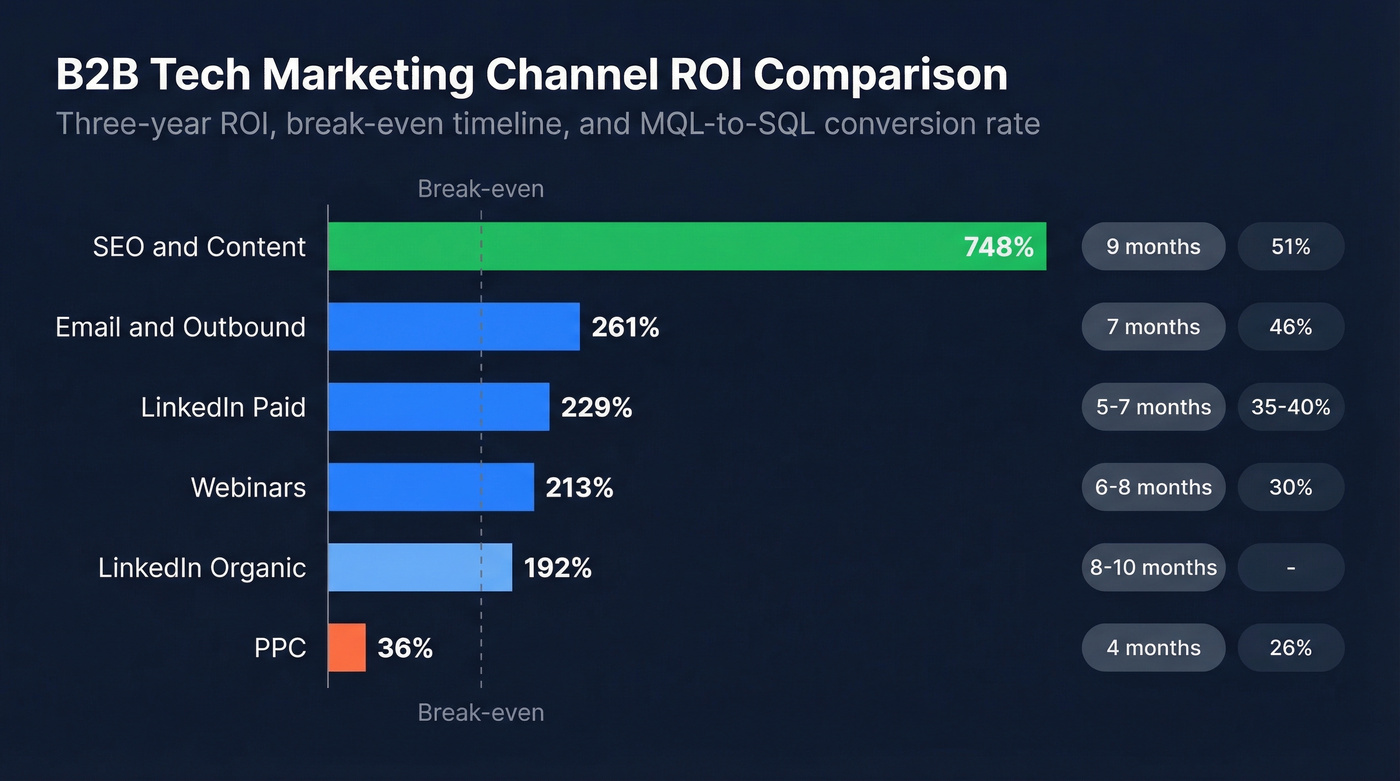
Here's the thing: if your ACV is under $12K, you probably don't need half these channels. SEO plus clean outbound email will outperform a scattered multi-channel approach every time. Complexity is the enemy of execution at that deal size.
AI's Role in B2B Tech Marketing
91% of marketing teams now use AI, up from 63% in 2025, according to Jasper's State of AI in Marketing 2026 survey of 1,400 marketers. But only 41% can confidently prove AI ROI - actually down from 49% last year. The expectation bar is rising faster than teams can clear it.
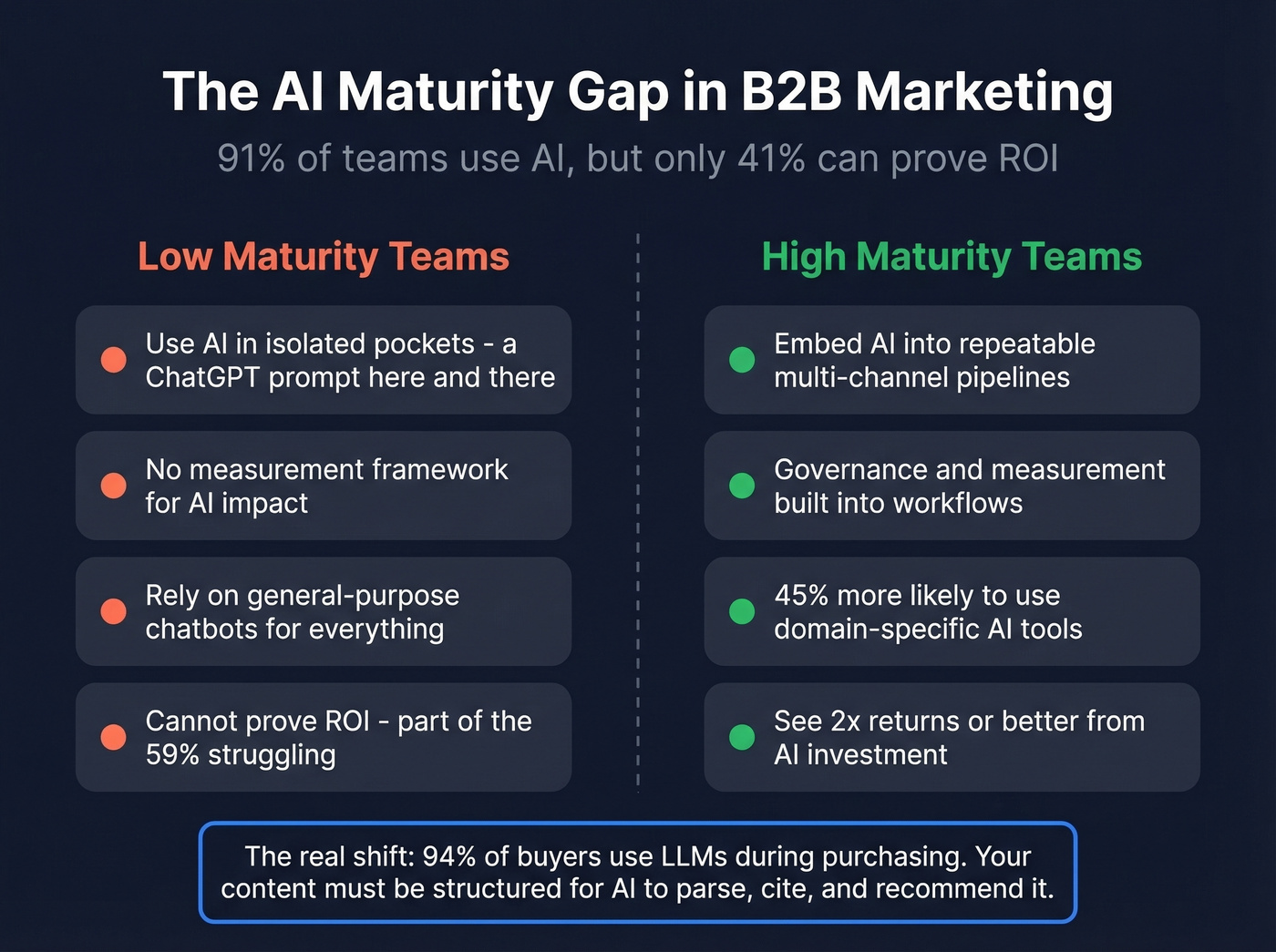
The 60% of teams that can prove ROI see 2x returns or better, and 95% plan to increase AI investment in the next 12 months. The gap isn't adoption. It's maturity.
High-maturity teams embed AI into repeatable pipelines with governance: multi-asset, multi-channel, multi-region workflows where AI handles the scaling and humans handle the strategy. They're 45% more likely to use domain-specific AI tools built for marketing rather than general-purpose chatbots. Beginners use AI in pockets - a ChatGPT prompt here, an image generator there - with no measurement framework.
The most underappreciated AI shift isn't on the marketing side. It's on the buying side. 94% of buyers use LLMs during their purchasing process, which means your content needs to be structured so AI systems can parse, cite, and recommend it. If your product pages and thought leadership aren't showing up in LLM responses, you're invisible to a growing share of your buyers.

You just read that below 30% open rate signals a list quality problem, not a messaging problem. Prospeo's 98% email accuracy and 7-day data refresh mean your outbound actually lands. Teams using Prospeo book 35% more meetings than Apollo users - because verified data is the prerequisite for every channel ROI number above.
Stop burning domains. Start with data that's verified this week.
Benchmarks That Actually Matter
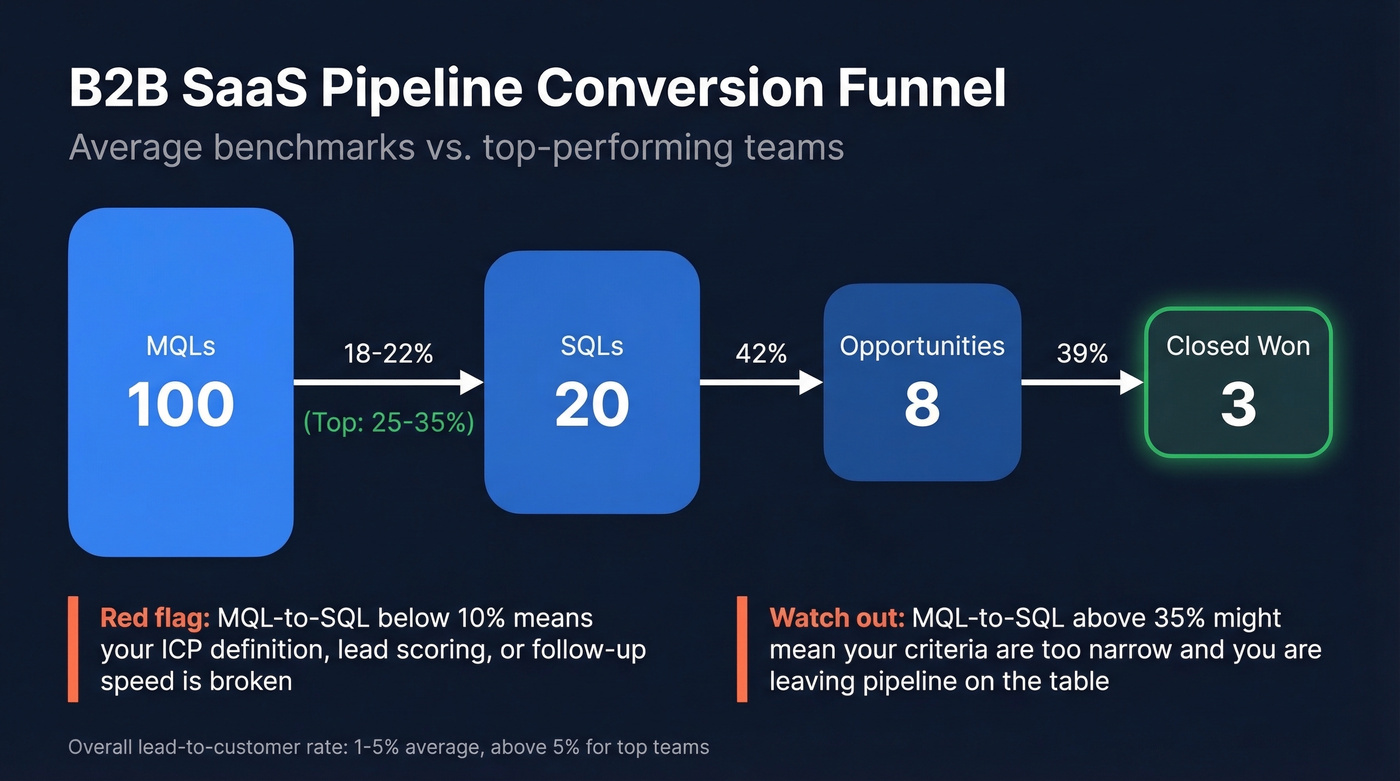
The metrics that matter aren't impressions or raw MQL counts. They're conversion rates through the pipeline and the quality of what enters it.
| Stage | Benchmark | Top Teams |
|---|---|---|
| MQL-to-SQL | 18-22% | 25-35% |
| SQL-to-Opportunity | ~42% | - |
| Opportunity-to-Close | ~39% | - |
| Lead-to-Customer | 1-5% | >5% |
| Marketing-sourced pipeline | 30-50% | - |
For PLG companies, the benchmarks look different: free-trial-to-paid conversion runs 8-12%, and visitor-to-trial sits around 9%.
If your MQL-to-SQL rate is below 10%, something's broken - your ICP definition, your lead scoring, or your follow-up speed. Above 35% might mean your MQL criteria are too narrow and you're leaving pipeline on the table. (Use an ideal customer profile template to tighten this up.)
Vanity vs. Business Metrics
| Vanity Metric | Business Metric |
|---|---|
| Impressions | Sales-accepted opportunities |
| Raw MQL volume | Pipeline in ICP accounts |
| Website traffic | Revenue influenced by marketing |
| Social followers | Meetings booked with target accounts |
We've seen teams celebrate a 40% increase in MQLs while pipeline actually shrank because the leads were outside their ICP. Measure what the business cares about.
How Much to Spend
The standard benchmark is 8-10% of ARR for B2B SaaS marketing budgets. But stage matters enormously.
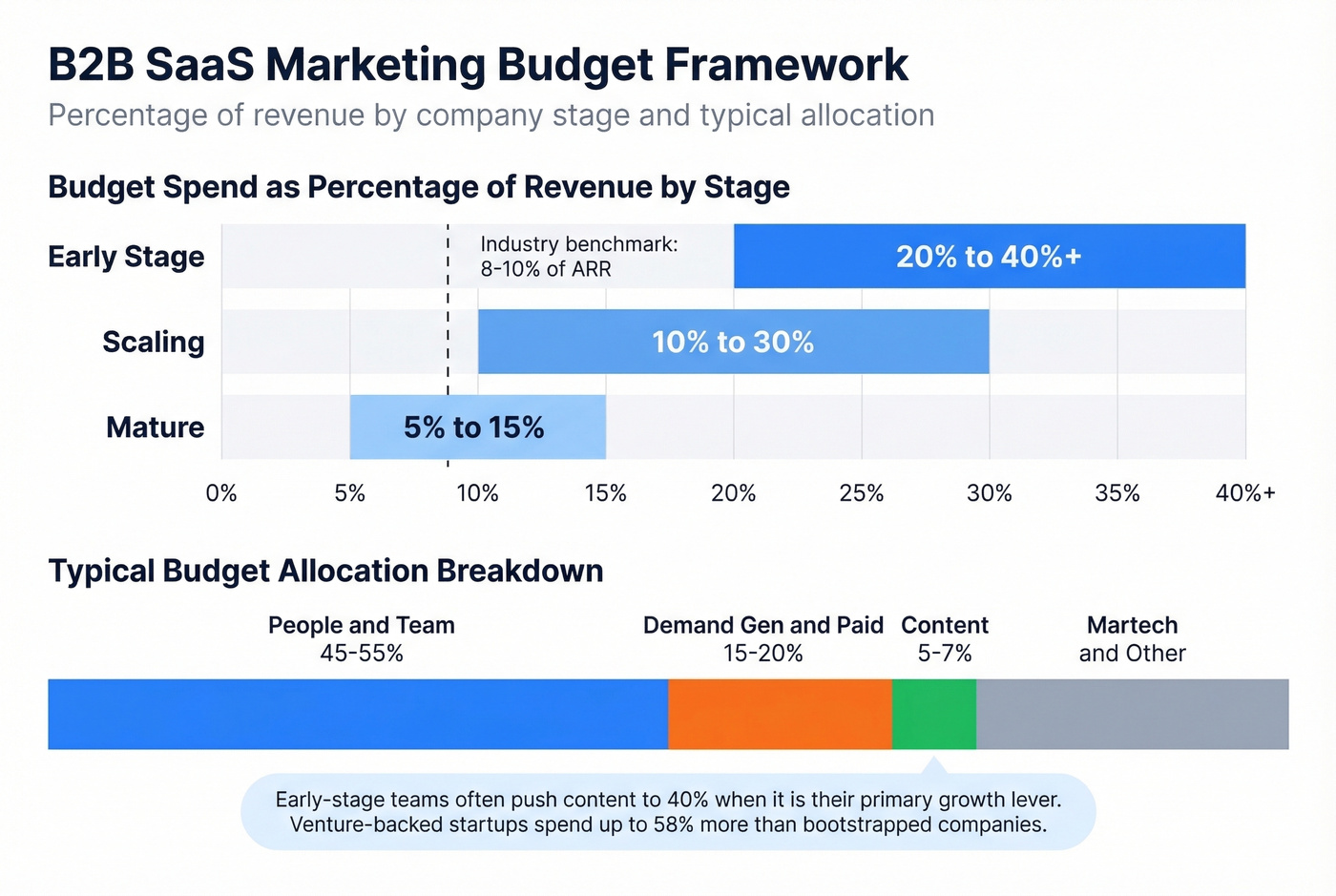
| Stage | % of Revenue |
|---|---|
| Early-stage | 20-40%+ |
| Scaling | 10-30% |
| Mature | 5-15% |
Venture-backed startups spend up to 58% more as a share of revenue than bootstrapped companies. That's not waste - it's buying growth velocity.
Allocation typically breaks down like this: people and team costs eat 45-55% of the budget, demand gen and paid channels take 15-20%, content gets 5-7% (though early-stage companies often push content to 40% when it's their primary growth lever), martech and tools run 4-6%, branding and product marketing take 8-10%, and events and PR get 3-5%.
The split between direct response and brand should run roughly 70/30. Teams that go 100% direct response eventually hit a ceiling because they've depleted the in-market audience without building the brand equity that shapes future shortlists.
Mistakes That Kill Pipeline
Unclear ICP. "We sell to mid-market SaaS companies" isn't an ICP. An ICP specifies industry, company size, tech stack, buying triggers, and the specific pain your product solves. Without this, every downstream activity is a guess.
Tactic-first planning. "We need to be on TikTok" or "Let's try ABM" without a strategy connecting tactics to pipeline goals is how budgets evaporate. Strategy defines which accounts to pursue and why. Tactics are just the delivery mechanism.
Vanity metrics addiction. Celebrating a 200% increase in website traffic while pipeline stays flat is a failure mode we've watched play out repeatedly. Measure pipeline in ICP accounts, sales-accepted opportunities, and revenue influenced by marketing.
Siloed sales and marketing. When buyers are 70% through their purchasing process before engaging sellers, the handoff between marketing and sales can't be a wall - it has to be a gradient. Shared ICP definitions, shared pipeline metrics, shared accountability for revenue.
Ignoring data quality. This is the silent pipeline killer. When 30% of your emails bounce, your domain reputation tanks, your sequences stop landing in inboxes, and your outbound program dies a slow death. Meritt tripled their pipeline from $100K to $300K per week after dropping their bounce rate from 35% to under 4% with Prospeo. Snyk saw AE-sourced pipeline jump 180% after fixing their data foundation with 98% verified emails and a 7-day refresh cycle - versus the 6-week industry average. There's a free tier, so there's no reason to keep sending to bad data.
ABM requires 16+ touches per buyer with the right people at the right accounts. Prospeo gives you 30+ filters - buyer intent powered by Bombora, technographics, headcount growth, funding - plus 125M+ verified mobile numbers with a 30% pickup rate. Build your shortlist before your competitors even know the deal exists.
Reach decision-makers directly for $0.01 per verified email.
Building Your Marketing Tech Stack
You don't need 15 tools. You need the right ones in each category, integrated cleanly.
| Category | Tools | Price Range |
|---|---|---|
| CRM | HubSpot, Salesforce | Free-$300+/user/mo |
| Data & Prospecting | Prospeo, Apollo | Free tier-$99/user/mo |
| Intent Data | Bombora, 6sense, Demandbase | $30K-$100K+/yr |
| SEO | Ahrefs, Semrush | $99-$999/mo |
| Attribution | HockeyStack | ~$20K-$60K+/yr |
The mistake most teams make is buying the most expensive tool in each category and then underutilizing it. Start with the tier you'll actually use. Upgrade when you hit the ceiling, not before. (If you're evaluating vendors, start with best B2B company data providers.)
Attribution - Measuring What Matters
Attribution in B2B tech marketing is messy. The buyer journey spans 10+ months and 16+ interactions per person. No model captures it perfectly, but some are better than others.
Single-touch models are simple but misleading - they give all credit to one moment in a long journey. HockeyStack's breakdown of multi-touch options is useful here. Linear gives equal credit to every touchpoint but overvalues minor interactions. Time-decay weights recent touches more heavily, which undervalues early brand-building. U-shaped emphasizes first and last touch but ignores mid-funnel nurture. W-shaped credits first touch, lead creation, and opportunity creation - and it's the best fit for complex B2B tech sales cycles where those three moments genuinely matter most.
Let's be honest: a W-shaped model that's 70% accurate is infinitely better than no attribution at all.
FAQ
What channels drive the highest ROI?
SEO leads at 748% ROI over three years, followed by email at 261% and LinkedIn paid at 229%. SEO has the longest break-even (~9 months) but compounds indefinitely. PPC breaks even fastest at about 4 months but delivers just 36% ROI - use it as a bridge, not a foundation.
How much should a tech company spend on marketing?
8-10% of ARR is the standard benchmark for B2B SaaS. Early-stage startups often invest 20-40%+ to build traction, while mature companies typically spend 5-15%. Venture-backed teams spend up to 58% more than bootstrapped peers.
What's a good MQL-to-SQL conversion rate?
Average MQL-to-SQL for B2B SaaS runs 18-22%, with top-performing teams hitting 25-35%. Below 10% signals problems with ICP definition, lead scoring, or follow-up speed. Above 35% might mean your qualification criteria are too narrow.
How is AI reshaping buyer behavior in 2026?
94% of B2B buyers now use LLMs during their purchasing process, meaning your content must be structured for AI consumption and citation. On the marketing side, 91% of teams use AI but only 41% can prove ROI - the gap is workflow maturity, not adoption.
How do you fix outbound data that's hurting deliverability?
Switch to a provider with real-time verification and frequent refresh cycles. Look for 98%+ email accuracy and a weekly refresh cadence - versus the 6-week industry average - to keep bounce rates under 5%. Most providers offer free tiers now, so you can test impact on deliverability before committing budget.