

B2B vs B2C: Key Differences With Real Numbers (2026)
B2B ecommerce is a $36 trillion market. B2C ecommerce is expected to hit $5.5 trillion by 2027. That's roughly a 6.5x gap - and it shapes everything from how you hire salespeople to how you price your product, build your funnel, and measure success.
These aren't academic distinctions. They determine your capital requirements, your team structure, and whether your unit economics actually work.
Quick Answer - At a Glance
B2B sells products or services to other businesses: software platforms, industrial equipment, consulting engagements. The buyer is a company, not a person. Sales cycles are long, deals are negotiated, and multiple stakeholders sign off before anything moves forward.
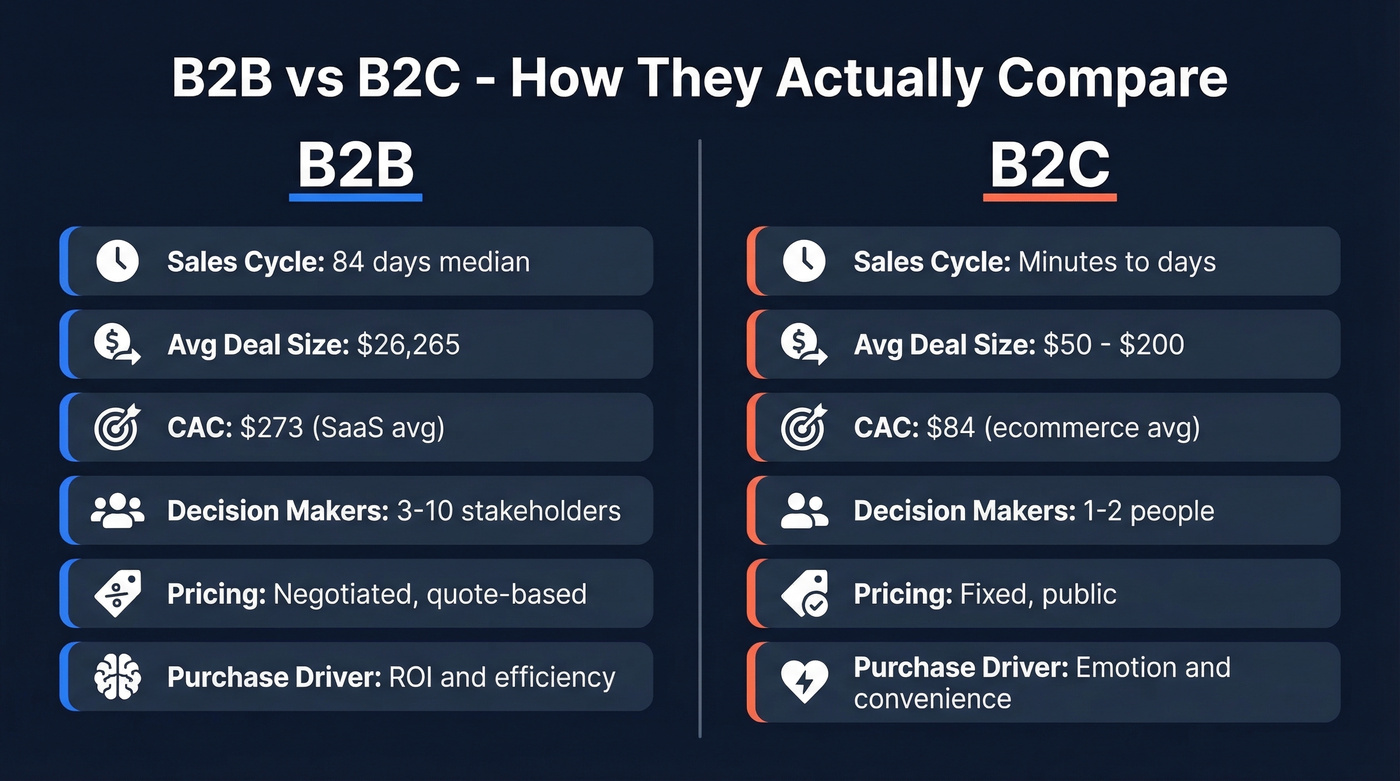
B2C sells directly to individual consumers: retail, streaming subscriptions, consumer apps. Decisions are faster, pricing is public, and volume drives the economics.
Here's how they compare across the dimensions that actually matter:
| Dimension | B2B | B2C |
|---|---|---|
| Target audience | Companies, buying committees | Individual consumers |
| Sales cycle | 84 days median (SaaS) | Minutes to days |
| Avg deal size | $26,265 (SaaS median) | $50-$200 typical |
| CAC | ~$273 (B2B SaaS), $900+ in regulated verticals | ~$84 (ecommerce retail) |
| Decision-makers | 3-10 stakeholders | 1-2 people |
| Pricing model | Negotiated, quote-based | Fixed, publicly listed |
| Top channels | Email, events, outbound | Social, paid ads, retail |
| Purchase driver | ROI, efficiency, risk | Emotion, price, convenience |
| Customer relationship | High-touch, ongoing | Transactional, brand-driven |
| Purchase frequency | Quarterly/annual contracts | Daily to monthly |
That table covers the surface. The numbers underneath tell a sharper story.
Where the Numbers Diverge
Sales Cycle Benchmarks
The median B2B SaaS sales cycle runs 84 days. But that median hides enormous variance.
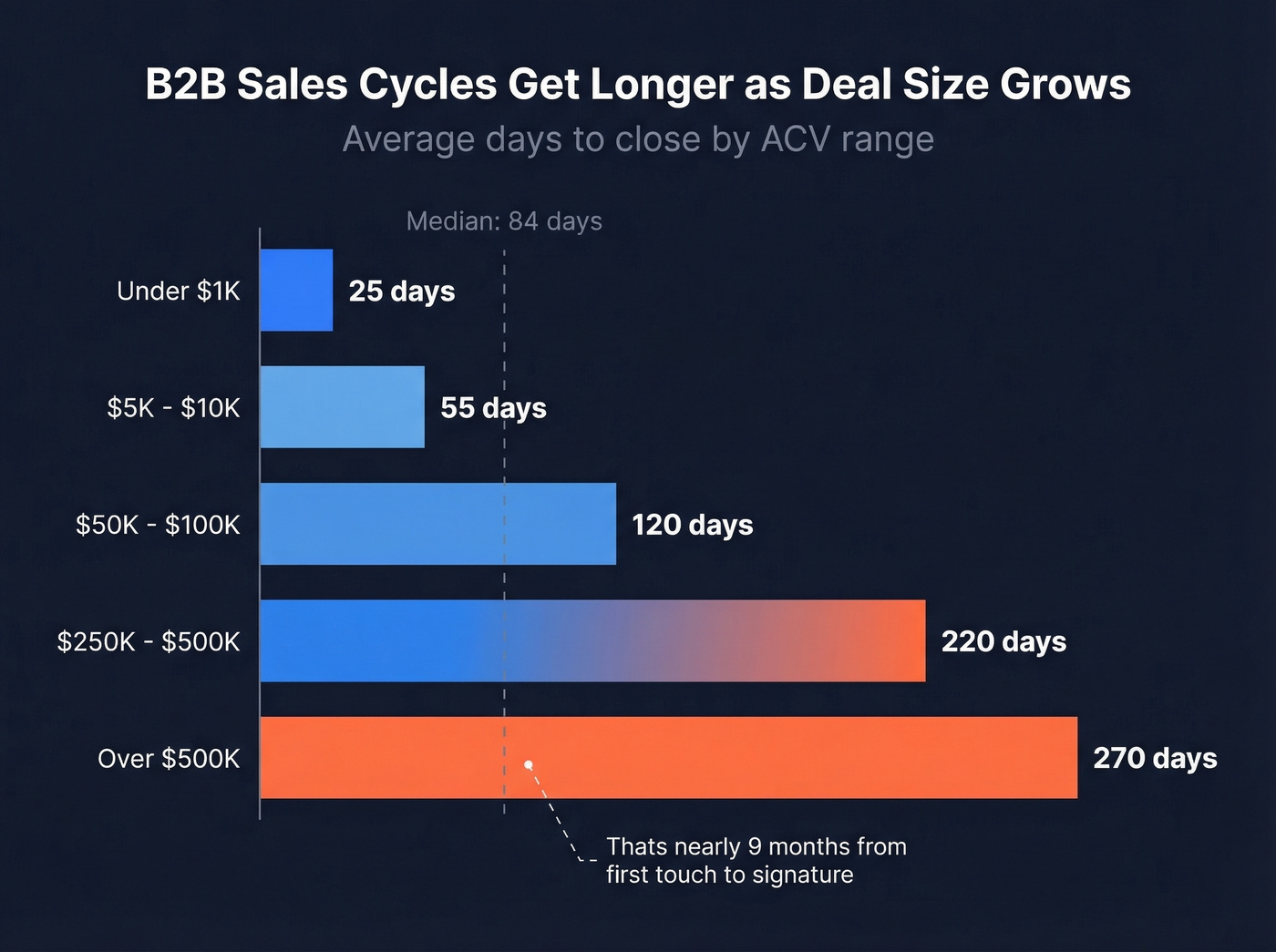
By deal size:
| ACV Range | Avg Cycle (Days) |
|---|---|
| Under $1K | 25 |
| $5K-$10K | 55 |
| $50K-$100K | 120 |
| $250K-$500K | 220 |
| Over $500K | 270 |
By industry:
| Industry | Avg Cycle (Days) |
|---|---|
| Software / SaaS | 90 |
| Financial Services | 98 |
| Healthcare | 125 |
| Manufacturing | 130 |
| Energy | 155 |
Company size matters just as much. Selling to a 1-10 person company takes about 38 days. Selling to a 10,001+ employee enterprise takes about 185 days. Ask any B2B sales leader what keeps them up at night and the answer is almost always pipeline - specifically, the gap between how long deals actually take and how long the board thinks they should take.
B2C is a different universe entirely. A consumer buying a $30 t-shirt decides in minutes. Even considered B2C purchases - a new laptop, a vacation package - rarely stretch past two weeks. The structural difference isn't just speed; it's that B2B cycles compound cost at every stage. Every extra week means more SDR touches, more demos, more legal reviews, more overhead burning while you wait for a signature.
Customer Acquisition Cost
Here's where the economics get stark.
B2B SaaS CAC averages roughly $273. Ecommerce retail CAC sits around $84. In regulated or high-consideration categories like legal services (~$915), financial services (~$923), and higher education (~$1,423), CAC routinely exceeds $900 per customer.
The healthy LTV:CAC ratio everyone targets is 3:1 to 4:1. In practice, the median SaaS company spends $2.00 to acquire every $1 of new ARR. Top-quartile performers hit $1.00 per $1 ARR. Bottom quartile? $2.82. That spread is the difference between a company that scales and one that burns cash until the runway disappears.
B2C CAC looks cheaper on paper, but the math works differently. You're often acquiring customers worth low hundreds in lifetime value, not five figures. Lower CAC, lower LTV, thinner margins - and you need exponentially more volume to make the unit economics work.
If you want to go deeper on the mechanics, see our breakdown of CAC.
Funnel Complexity
B2B funnels are where deals go to die slowly.
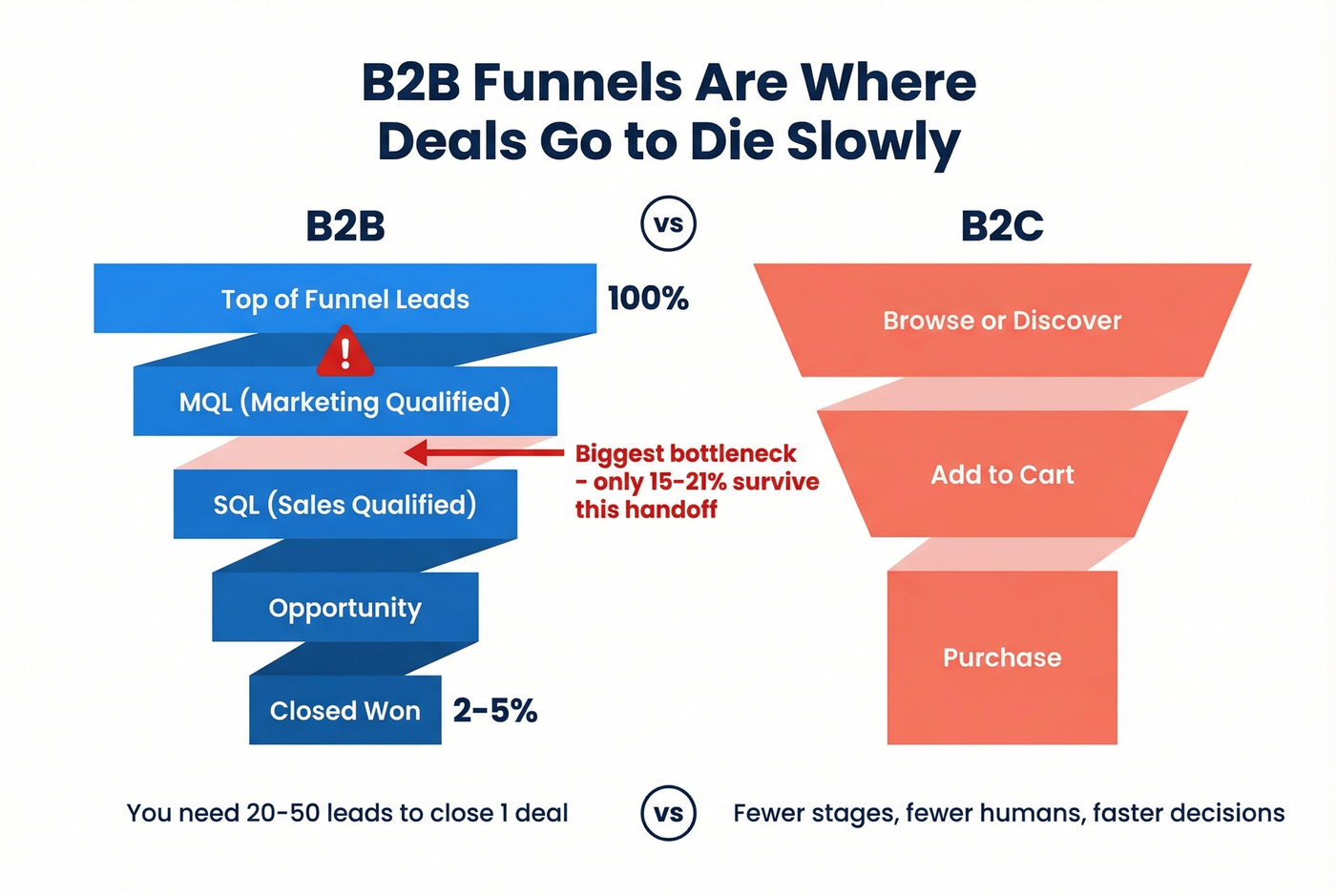
The overall lead-to-customer conversion rate in B2B SaaS runs 2-5%. The biggest bottleneck? MQL to SQL, where only 15-21% of marketing-qualified leads survive the handoff to sales. Typical win rates land at 20-30%.
Stack those conversion rates and you see why B2B pipeline math is brutal - you typically need 20-50 top-of-funnel leads to close a single deal, with each stage leaking volume as leads move from MQL to SQL to opportunity to close. In our experience, the MQL-to-SQL handoff is where most B2B teams hemorrhage pipeline, because marketing and sales rarely agree on what "qualified" means.
If you’re rebuilding your funnel, a B2B sales funnel template helps you benchmark each stage.
B2C funnels are simpler by design: browse, add to cart, buy. Cart abandonment is famously high in ecommerce, but the funnel has fewer stages and fewer humans involved. No procurement team. No legal review. No six-month evaluation cycle.
Pricing Models
B2C pricing is transparent. You can compare the price of a Nike shoe across 20 retailers in five minutes.
B2B pricing is opaque by design. The same SaaS product can be priced dramatically differently across segments - and both prices can be "correct" for their buyer type. Negotiation is the norm. Quote-based pricing means competitor intelligence is harder to gather, and customers often have no idea whether they're getting a fair deal. We've seen teams spend weeks just trying to benchmark whether their vendor's renewal quote is reasonable. In B2C, that comparison takes seconds.
If you sell in negotiated environments, it’s worth understanding the anchor in negotiation effect.
How B2B and B2C Marketing Differ
B2B and B2C marketing diverge not just in channel mix but in what actually persuades the buyer.
In B2B, 67% of buyers choose vendors based on demonstrated knowledge of their company and needs. Content does heavy lifting early in the cycle: 57% of B2B buyers say webinars are the most valuable early-stage format, followed by research reports (53%) and blog posts (52%). The top channels are email, industry events, and professional networks - places where you can reach specific decision-makers with targeted messaging.
If you’re building that engine, this guide on B2B content marketing is a good next step.
B2C marketing runs on broader reach. Social media, paid ads, influencer partnerships, retail placement - the goal is awareness at scale, not precision targeting. Emotional resonance and brand memorability drive purchase decisions more than ROI calculations.
The investment profiles look completely different too. A B2B SaaS company might invest heavily in a single research asset that generates pipeline for months. A B2C brand might put the same budget into short-burst creator campaigns designed to spike sales over a weekend. Neither is wrong. They're optimizing for different time horizons.
Here's the thing: B2B is moving toward B2C-style expectations. Gartner projects that data-driven tactics will replace intuition-based selling in 60% of B2B sales organizations. Buyers want self-serve research, transparent pricing, and frictionless purchasing - the same experience they get as consumers. The line between business and consumer marketing strategies is blurring faster than most org charts can keep up with.
If you’re leaning into that shift, data-driven selling is the operating model behind it.

B2B CAC averages $273 per customer - and bad data makes it worse. Every bounced email and wrong number inflates your acquisition cost. Prospeo delivers 98% email accuracy and 125M+ verified mobiles at $0.01/email, so your pipeline math actually works.
Stop burning budget on leads that bounce. Fix your B2B data layer.
How Each Model Builds Pipeline
The fundamental pipeline difference comes down to active versus passive acquisition.
B2C companies build pipeline by casting wide nets - paid acquisition, SEO, social media, retail distribution. You optimize landing pages, run A/B tests on ad creative, and let volume do the work. The customer finds you, or your ad finds them in a feed.
B2B pipeline building is an active hunt. You're identifying specific companies and decision-makers, enriching contact data, verifying emails, layering intent signals, and running multi-touch outbound sequences. Whether you're selling to businesses or consumers, the path to purchase involves problem recognition and research - but in B2B, that path also requires requirements definition and supplier selection with multiple stakeholders weighing in at each stage.
If you want a tactical playbook for that “active hunt,” start with these sales prospecting techniques.
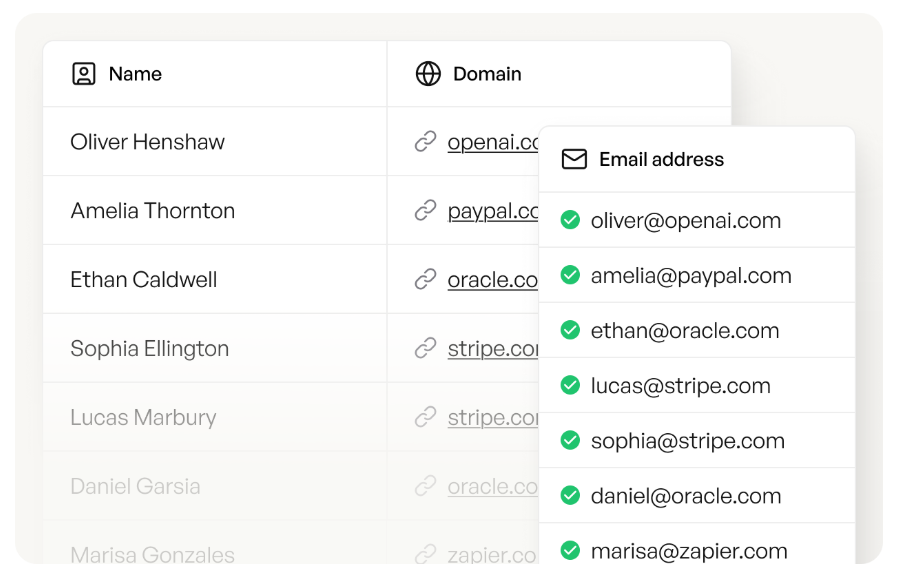
This is why data quality is existential in B2B outbound. If your list is bouncing at scale, you're not just wasting sends - you're destroying your domain reputation, which tanks deliverability for every future campaign. Prospeo maintains 300M+ professional profiles with 98% email accuracy on a 7-day refresh cycle, which matters when you're running outbound at volume. Bad data from a stale database doesn't just cost credits; it costs months of sender reputation recovery.
If deliverability is a recurring issue, use an email deliverability guide to diagnose the root causes.
B2C doesn't face this problem at the same scale. You're running ads to audiences, not emailing individual prospects. The data infrastructure is fundamentally different.
The B2B2C Model Nobody Covers
There's a model that sits between B2B and B2C, and most comparison articles ignore it entirely.
B2B2C means selling to a business while gaining direct access to that business's customers - and eventually, those end customers recognize you as the product they use. Think Affirm (sells through merchants, but consumers know Affirm by name), Instacart (partners with grocery stores, but customers use the Instacart app), or OpenTable (restaurants are the client, but diners interact with OpenTable directly).
This isn't traditional channel distribution. When a manufacturer sells through a supermarket, the manufacturer doesn't "own" the customer relationship. In B2B2C, the solution provider co-owns it. That's the strategic advantage - and the strategic risk.
The cautions are real. Business partners often prefer white-label arrangements; they're paranoid about you doing "other things" with their customers and data. A signed contract is just the beginning - if the intermediary doesn't actively promote adoption, the model fails. Data-sharing challenges, reduced margins from intermediary fees, and slower decision-making all add friction. B2B2C works brilliantly when both parties benefit from the end-customer relationship. It falls apart when one side feels exploited.
Where Both Models Are Converging
Let's be honest: B2B and B2C aren't two different worlds anymore. They're two points on a collapsing spectrum.
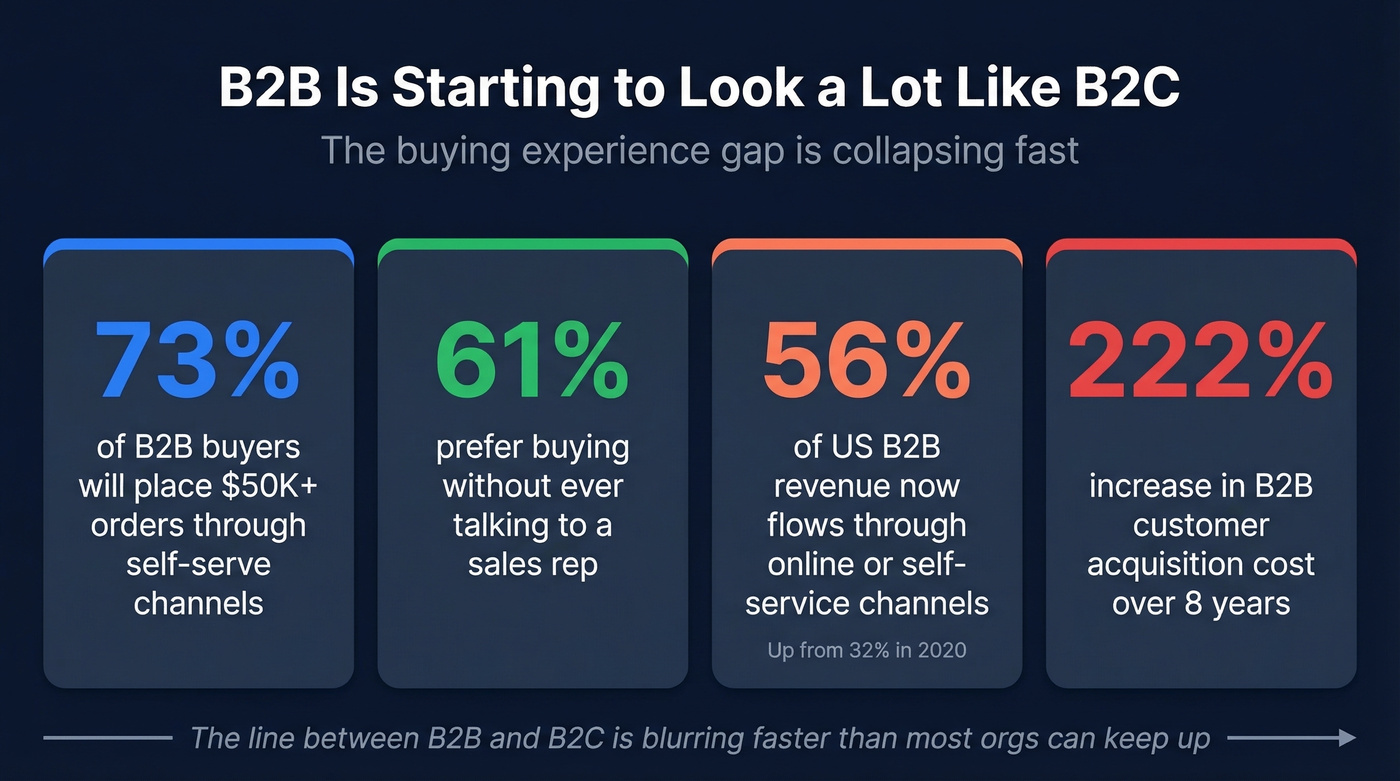
The data backs this up. 73% of B2B buyers are willing to place $50,000+ orders through digital self-serve channels. 61% prefer buying without ever talking to a rep. 56% of US B2B revenue now flows through online or self-service channels, up from 32% in 2020.
At the same time, B2B acquisition is getting harder and more expensive. CAC has surged 222% over eight years. The average B2B SaaS sales cycle has stretched from 107 days to 134 days. Buyers are doing more research independently before engaging sales, which means the buying experience gap is narrowing - just with higher stakes and more approvals on the B2B side. We've watched B2B companies cut their sales cycles by 30% simply by adding self-serve pricing pages, a move that would've been heresy five years ago.
The practical implication? B2B companies that build consumer-grade buying experiences - transparent pricing, self-serve trials, frictionless onboarding - will outperform those clinging to the "request a demo" model. And B2C companies moving upmarket into business sales need to understand that adding a procurement layer changes everything about their funnel.
Hot take: If your average contract value is under $15K, you probably don't need a traditional B2B sales motion at all. A self-serve product with good content marketing will outperform a team of SDRs at that price point every time. The distinction between selling to businesses and selling to consumers matters less than whether your deal size justifies human involvement in the sale. Tomasz Tunguz's analysis of self-serve vs. sales-led SaaS growth supports this threshold.
If you’re pressure-testing your pipeline assumptions, compare against these sales pipeline benchmarks.
How to Choose - A Decision Framework
If you're a founder deciding between a B2B or B2C model, or a professional considering a career switch, here's the framework that actually matters.
For founders, start with three questions. Is your product complex or technical? B2B. Is it mass-market and impulse-friendly? B2C. What's your capital situation? B2B means higher CAC but dramatically better LTV - you can build a sustainable business with 500 customers. B2C means lower CAC but brutal competition at scale - you might need 500,000 customers to hit the same revenue.
Real talk: B2B is harder to start but easier to scale. B2C is easier to start but brutally competitive at scale. That's the core tradeoff.
For career-switchers, the day-to-day feels different. B2B is relationship-driven with longer feedback loops and higher deal values. You'll spend weeks on a single account. B2C is volume-driven with faster iteration and broader creative latitude. You'll launch campaigns that reach millions and optimize in real time.
Neither is "better." B2B rewards patience, strategic thinking, and relationship building. B2C rewards speed, creative instinct, and data-driven optimization at scale. Pick the one that matches how you work, not just what pays more. And if you're building for B2B, invest in data infrastructure before you invest in headcount - the unit economics demand it. Skip the "build a big team first" playbook; the consensus on r/startups is that premature hiring in B2B is the fastest way to burn through a seed round.
If you’re investing in the data layer, start with data enrichment services.
You need 20-50 top-of-funnel leads to close one B2B deal. That math only works if your contact data connects you to real buyers. Prospeo's 30+ filters - intent data, technographics, job changes - let you skip the MQL graveyard and reach decision-makers directly.
Shrink your 84-day sales cycle by reaching the right people on day one.
FAQ
Can a company be both B2B and B2C?
Yes - Apple sells iPhones to consumers and enterprise device management to businesses. Amazon runs a consumer marketplace and AWS. Microsoft sells Xbox games and Azure cloud infrastructure. B2B2C is the formalized hybrid, where a single product serves both a business client and that client's end consumers simultaneously.
Which model is more profitable?
B2B typically delivers higher margins and lifetime value per customer - a median SaaS deal of $26,265 dwarfs a typical B2C customer worth low hundreds. But B2C generates higher transaction volume. The key metric is LTV:CAC ratio; healthy is 3:1 to 4:1 regardless of model.
Is B2B marketing harder than B2C?
Different, not harder. B2B involves longer cycles and more stakeholders, but you're targeting a smaller, more defined audience - which means less wasted ad spend. B2C requires broader reach and creative differentiation in crowded markets. Both are hard; the challenges sit in different parts of the funnel.
What tools do B2B teams use to find customers?
B2B teams rely on data platforms for verified contact information, CRMs for pipeline management, and intent data for identifying in-market buyers. Prospeo provides 98% verified email accuracy across 300M+ profiles with a 7-day refresh cycle and integrates directly with Salesforce, HubSpot, and major sequencing tools - making it a strong fit for outbound-heavy teams.
What's the biggest mistake when switching from B2C to B2B?
Assuming the same funnel works. B2C optimizes for single-click conversion from a single buyer. B2B requires multi-touch, multi-stakeholder nurturing across weeks or months. Teams that copy-paste their B2C playbook into B2B consistently underestimate cycle length and overestimate conversion rates.