

Benefits of Outbound Sales in 2026 (Backed by Data, Not Platitudes)
"Outbound is dead." You've seen the post on r/techsales - the one where a burned-out rep blames saturated markets, AI-generated emails, and call minimums that force quantity over quality. Here's what that post actually proves: lazy outbound is dead. The real benefits of outbound sales show up when teams invest in targeting, data quality, and multichannel execution - and those teams are generating more pipeline than ever.
36% of B2B tech companies reduced SDR headcount. The teams that survived are doing more with fewer reps and better data. The average cold email reply rate in 2026 is 3.43%, but top performers hit 10.7%. Below, we break down eight data-backed advantages, the ROI math you can take to your CFO, and why most outbound fails.
"Outbound Is Dead" - Let's Check the Data
The Reddit sentiment is real. Reps are burned out. Quotas are high. Buyers are fatigued.
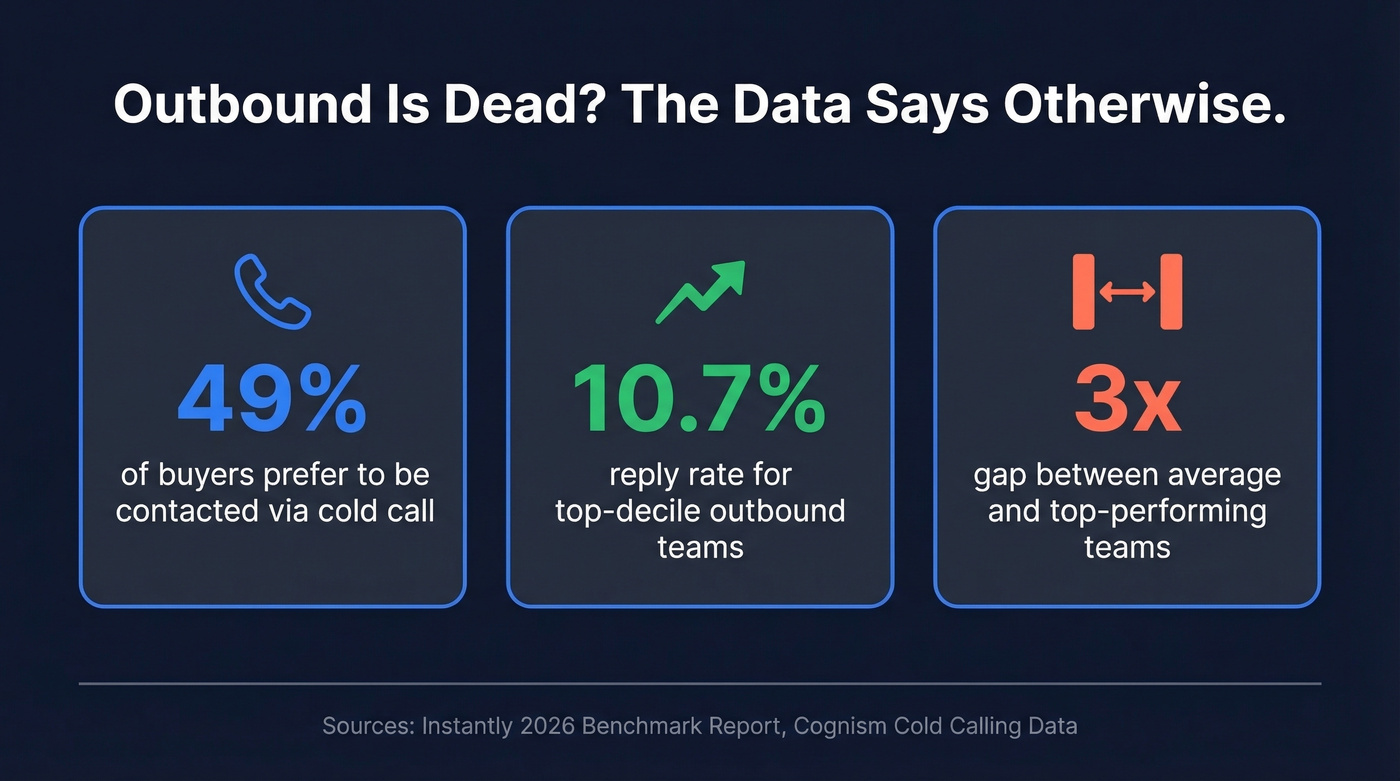
But the data tells a different story. 49% of buyers prefer to be contacted through a cold call. That's nearly half the market telling you they're open to outbound done right. The problem isn't the channel - it's the execution: unrealistic call minimums, zero personalization, stale data, and comp plans that reward inbound reps with late-stage deals while outbound reps grind earlier-stage opportunities at the same quota.
The Instantly 2026 benchmark report shows top-decile teams pulling a 10.7% reply rate. That's just over 3x the average. The gap between good and bad outbound has never been wider, which means the opportunity for teams willing to invest in quality has never been bigger.
What Is Outbound Sales?
Outbound sales is any motion where your team initiates contact with a prospect who hasn't raised their hand - cold calls, cold emails, social selling, direct mail. If you're reaching out first, it's outbound.
The contrast with inbound is straightforward: inbound waits for prospects to find you; outbound goes and finds them. Only ~3% of your target market is actively buying at any given time. Inbound captures that 3%. Outbound reaches the other 97% before your competitors do.
Here's the thing: outbound is most valuable in three specific situations - entering a new market where nobody's searching for your category, launching a product with zero existing demand, and targeting enterprise accounts that'll never fill out a form. If none of those apply, you can probably coast on inbound for a while. But the moment growth stalls, outbound is the only lever that scales on your timeline.
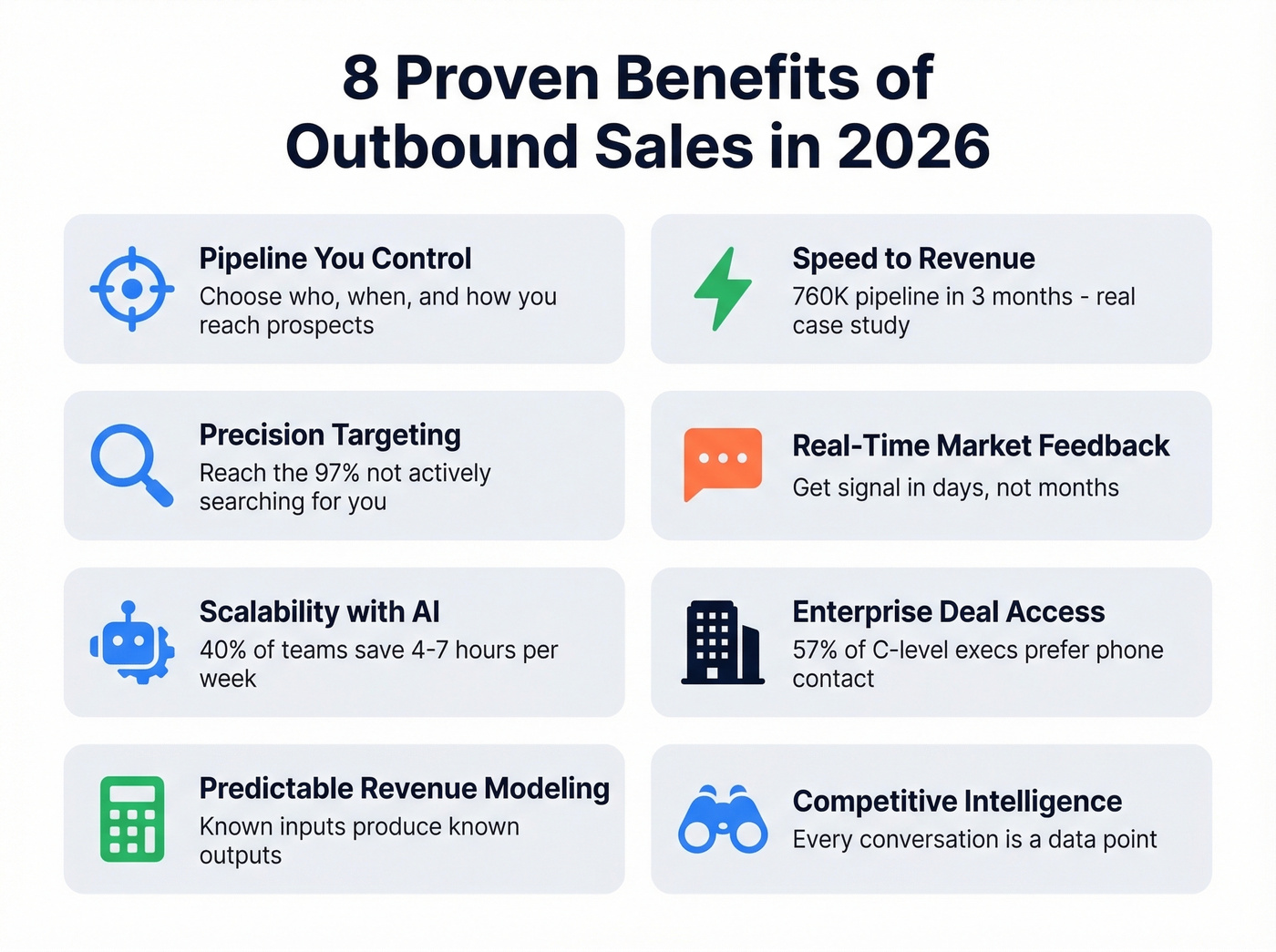
8 Proven Outbound Selling Advantages
1. Pipeline You Control
You choose who to target, when to reach them, and through which channel. 43% of organizations run hybrid inbound+outbound models, and the outbound arm is the controllable variable. When the CEO asks "how do we generate more pipeline this quarter?" - outbound is the lever you pull immediately.
Smart teams also use mid-funnel inbound signals - pricing page revisits, webinar drop-offs, content downloads - to trigger outbound sequences. That turns warm intent into booked meetings instead of letting it decay in a nurture drip.
2. Speed to Revenue
Basware generated £760,000 in pipeline within three months using multichannel outbound for a UK expansion. That's not an outlier - it's what happens when outbound compresses timelines. Deals closed within 50 days carry a 47% win rate versus 20% when they drag past 50 days. No content calendar or six-month SEO ramp delivers that speed.
3. Precision Targeting
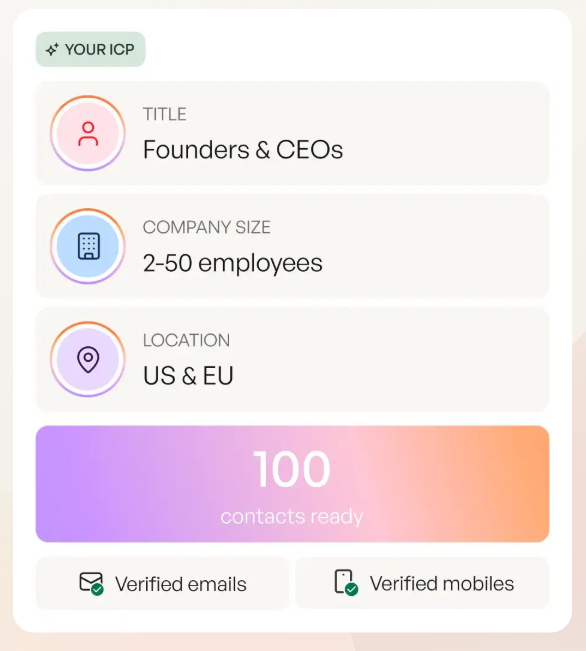
You reach the exact ICP - title, company size, tech stack, intent signals. No broad-net content hoping the right person stumbles across it. Remember: only ~3% of your market is actively buying. Outbound lets you reach the other 97% with a message tailored to their specific pain points. That's not spam. That's how you build pipeline in markets where nobody's searching for your category yet.
4. Real-Time Market Feedback
How long does it take to A/B test a blog post headline? Weeks, maybe months, and you need meaningful traffic to reach significance. Outbound gives you signal in days. 58% of cold email replies come from step 1 - if your first email isn't landing, you know within a week. Every reply, objection, and silence teaches you what resonates faster than any other channel.
5. Scalability with AI
AI handles research and first-draft personalization; reps handle relationships. 54% of revenue teams already use AI for outbound emails, and 45% use it for account research. Among teams using AI SDR tools, 40% save 4-7 hours per week on prospecting, and the best teams report up to 90% reduction in research time with 35% higher engagement rates. That's not incremental. That's a structural advantage. (If you're building this motion, start with a practical AI cold email outreach workflow.)
6. Enterprise Deal Access
Enterprise buyers don't fill out forms or download your ebook - you reach them or you don't.
57% of C-level executives prefer phone contact. Enterprise deals involve 6-25 decision-makers and require 15-20+ touchpoints. No inbound motion multi-threads across a buying committee of 15. That's an outbound job.
7. Predictable Revenue Modeling
Known inputs produce known outputs. It takes an average of 4.81 touches to get a response. If you need 20 meetings this month and your reply-to-meeting rate is 25%, you need ~80 replies. At a 3.43% reply rate, that's ~2,330 emails. Now you have a plan, not a hope. (To pressure-test your model, track funnel metrics end-to-end.)
8. Competitive Intelligence
Outbound conversations reveal what competitors are pitching, what buyers actually care about, and where the market is moving. Teams using conversation intelligence tools close deals 11 days faster and lift win rates by 10 percentage points on deals over $50k. Every outbound conversation is a data point, and the teams that capture and analyze those signals build compounding advantages over time. (This is where a formal competitive intelligence strategy pays off.)
2026 Outbound Benchmarks
The 3x gap between average and top-performing teams is the defining story of outbound in 2026. Here's what you should measure against:
| Metric | Average | Top Performers |
|---|---|---|
| Cold email reply rate | 3.43% | 10.7%+ (top 10%) |
| Cold call success rate | 2.3% | ~10% with structured frameworks |
| Touches to response | 4.81 | - |
| Sequence sweet spot | 4-7 steps | 4-7 steps |
| Optimal email length | <100 words | <80 words |
| Peak send day | Tues-Wed | Wednesday |
| AI for email drafts | 54% adoption | - |
| AI for research | 45% adoption | - |
Sources: Instantly 2026 Benchmark Report, Outreach Prospecting Survey, Cognism Cold Calling Data.
RevenueHero's benchmarks put 5-10% reply rates as the standard range. The gap isn't about luck - it's about data quality, message quality, and sequence design. Top performers keep emails under 80 words, send on Wednesdays, and run 4-7 step sequences. None of that is rocket science. It's discipline.

Precision targeting is outbound advantage #3 - but it only works if your data connects you to real people. Prospeo's 300M+ profiles with 30+ filters (intent, technographics, job change, headcount growth) let you reach your exact ICP. 98% email accuracy means your sequences actually land.
Stop sending emails into the void. Start with data that connects.
The Outbound ROI Math
Let's break this down with real numbers.
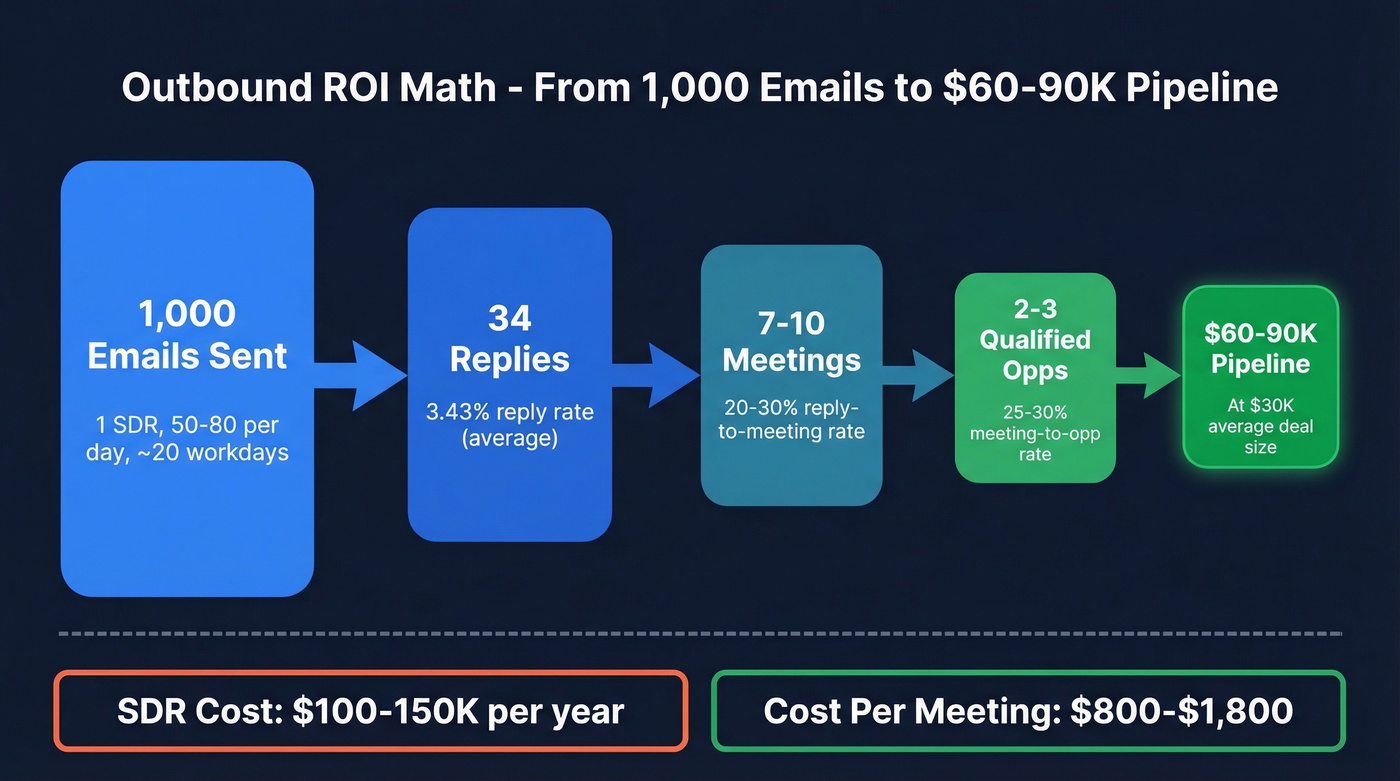
Start with 1,000 cold emails. At 3.43% reply rate, that's 34 replies. At 20-30% reply-to-meeting conversion, you get 7-10 meetings. At 25-30% meeting-to-opportunity conversion, that's 2-3 qualified opps per 1,000 emails.
A single SDR sending 50-80 personalized emails per day over ~20 workdays generates 1,000-1,600 emails per month - roughly 7-10 meetings monthly. At a $30k average deal size, that's $60-90k in monthly pipeline from one rep. A fully-loaded SDR runs $100-150k/year, putting your cost per meeting in the ~$800-$1,800 range.
You'll hear that inbound leads convert at 14.6% versus outbound's 1.7%. That stat is real but misleading - inbound captures the 3% already buying, while outbound creates demand in the other 97%. Different motion, different addressable market. Hybrid teams see up to 38% higher revenue growth than single-channel teams. You don't pick one. You run both. Outbound fills the top of the funnel while inbound nurtures and converts, and the compounding effect of running both is where real growth happens. (If you need a sanity check on conversion assumptions, use average B2B lead conversion rate benchmarks.)
For context, an e-invoicing company generated 3 million in pipeline within six months through outbound alone - proof that the math scales well beyond SMB deal sizes.
On the data cost side, many legacy providers charge ~$1/lead on data that's around 6 weeks old. Prospeo runs ~$0.01/lead with a 7-day refresh. On 10,000 leads per quarter, that's $100 versus $10,000 - a difference that changes the entire unit economics of your outbound motion.
Why Outbound Fails (And How to Fix It)
Most outbound doesn't fail because the channel is broken. It fails because of five predictable mistakes.
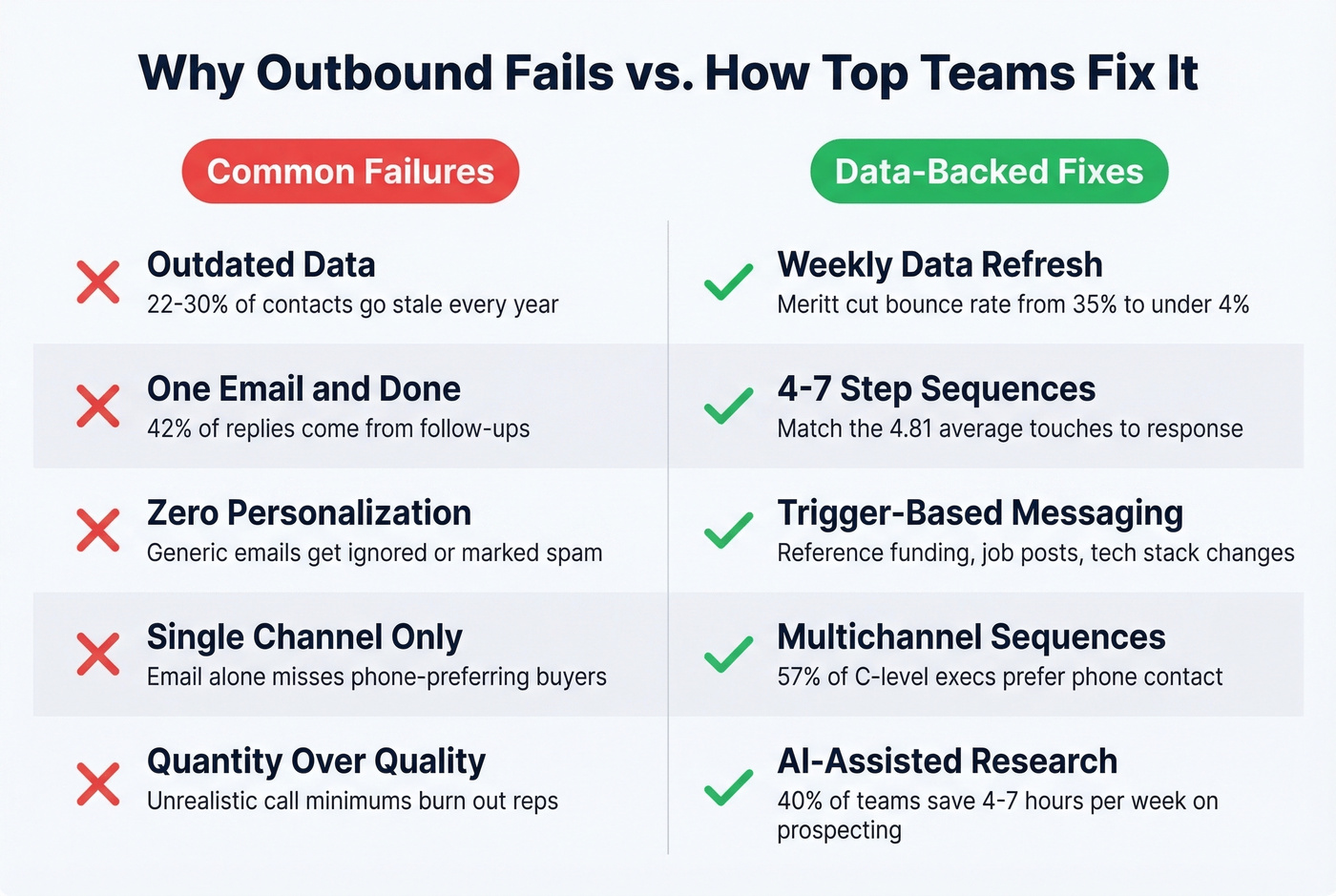
Outdated data. This is the silent killer. 22-30% of B2B contact data goes stale annually. In high-turnover industries, that number hits 70%. Reps lose an estimated 546 hours per year chasing bad data. We've seen this firsthand: Meritt went from a 35% bounce rate to under 4% after switching to a provider with a weekly refresh cycle, and Snyk saw AE-sourced pipeline jump 180% after cleaning up their data foundation. (If you're evaluating vendors, compare data enrichment services and B2B company data providers.)
Insufficient follow-up. 58% of replies come from the first email, but 42% come from follow-ups. If you're sending one email and moving on, you're leaving almost half your replies on the table. Run 4-7 step sequences minimum. (Use these sales follow-up templates to standardize the motion.)
Lack of personalization. Adding a company name isn't enough. Reference a specific trigger - a funding round, a job posting, a tech stack change. Use AI for research (45% of teams already do), then add a human layer that shows you actually understand the prospect's situation.
Single-channel outreach. Email-only outbound leaves money on the table. Multichannel sequences yield 3.5x higher response rates than email alone. Combine email, phone, and social touches in every sequence.
Unclear ICP. If you can't describe your ideal customer in two sentences, your outbound will be scattered. Define ICP by title, company size, tech stack, and buying triggers before you write a single email.
One more thing most teams miss: deliverability. Google and Yahoo's bulk sender requirements demand SPF/DKIM/DMARC authentication, one-click unsubscribe, and spam complaint rates under 0.3%. Send to bad data and your domain reputation tanks - which kills your entire outbound motion, not just one campaign. (For a full checklist, see our email deliverability guide.)
Your predictable revenue model breaks the moment bounce rates spike. Prospeo's 5-step verification and 7-day data refresh keep your outbound math honest - 98% email accuracy, under 4% bounce rates, and $0.01 per verified email. That's how teams like Snyk scaled to 200+ new opportunities per month.
Fix the data layer and your outbound pipeline fixes itself.
Outbound for SMB vs. Enterprise
The benefits of proactive prospecting apply across segments, but execution looks completely different.
SMB outbound runs fast - sales cycles of 1-3 months, 1-3 stakeholders, and you can often close on a single demo. The play is volume with precision: reach the right person, deliver the right message, move quickly.
Enterprise outbound is a different animal entirely. Sales cycles stretch to 6-12+ months, buying committees include 6-25 decision-makers, and you'll need 15-20+ touchpoints per account. B2B tech sales cycles expanded to 6.5 months in 2025, up from 4.9 months in 2019. That trend isn't reversing.
When does outbound become ABM? The general threshold is $50k+ ACV. Below that, systematic outbound targeting your ICP is the right motion. Above it, you're investing in tiered account strategies with intent signals and multi-threaded engagement across the buying committee. Skip ABM if your average deal size is under $50k - you'll burn resources on orchestration that doesn't pay back at that price point.
The Outbound Tech Stack
You don't need 15 tools. You need five categories covered well.
CRM: HubSpot for SMB and mid-market, Salesforce for enterprise. Everything flows here.
Sequencing: Outreach or Salesloft for enterprise teams needing governance. Instantly or Smartlead for volume-focused teams running multiple sending accounts.
Data and enrichment: This is the foundation layer - get it wrong and nothing downstream works. You need verified emails at 98%+ accuracy, fresh data on a weekly refresh cycle, and native integrations into your sequencer so contacts flow without manual exports. Prospeo covers all three with 300M+ profiles, 143M+ verified emails, and native connections to Salesforce, HubSpot, Instantly, Smartlead, and Lemlist. (If you're comparing platforms, start with our guide to the best outbound lead generation tools.)
Calling: Cognism's dialer works well for European mobile numbers. For US-focused teams, most sequencing platforms include built-in dialers that get the job done.
Conversation intelligence: Gong remains the standard. The 11-day faster close and 10pp win rate lift on larger deals make this a no-brainer once you have enough call volume.
Look, the stack matters less than the data feeding it. We've seen teams with a $200k tech stack underperform teams running three tools and clean data. The bottleneck is almost always data quality, not tool sophistication.
FAQ
Is outbound sales still effective in 2026?
Yes. Average cold email reply rate is 3.43% and top performers hit 10.7%. Hybrid inbound+outbound teams see up to 38% higher revenue growth than single-channel teams. Underfunded, single-channel outbound with stale data is dead; resourced, multichannel outbound is thriving.
What's a good cold email reply rate?
The 2026 average is 3.43%. Top quartile hits 5.5%+, and the top 10% exceeds 10.7%. If you're below 2%, check your data quality and email length - best performers keep emails under 80 words and send on Wednesdays.
How many touchpoints does outbound need?
On average, 4.81 touches to get a response. Multichannel sequences - email, phone, and social - yield 3.5x higher response rates than email alone. Run 4-7 step sequences minimum.
How do I keep bounce rates low?
Start with verified data - 22-30% of B2B contacts go stale annually. A 7-day refresh cycle and 98% email accuracy keep bounce rates under 4% for teams like Meritt and Snyk. Authenticate with SPF, DKIM, and DMARC, and keep spam complaints under 0.3%.
Should I outsource outbound or build in-house?
Build in-house if you can invest $100-150k/year per SDR and have a clearly defined ICP. Outsource for new markets or segments you haven't validated yet - but generic playbooks produce generic results. Own the strategy internally regardless.