

The Best Lead Generation Tools in 2026: 15 Picks With Real Pricing
You sent 2,000 cold emails last quarter. 400 bounced. Your domain reputation cratered, and the remaining 1,600 landed in spam. The tool that sold you "275 million contacts" didn't mention that a fifth of them were dead on arrival. That's not a lead generation problem - it's a data quality problem, and it's where most teams lose before they even start.
B2B contact data decays at roughly 3% per month. People change jobs, companies rebrand, emails get deactivated. Over a year, that's around 30-36% of your database going stale. A smaller, verified database will outperform a massive, unverified one every single time. The tool you pick matters less than the accuracy of the data it gives you. One Reddit user on r/sales summed up the frustration with incumbent tools perfectly: they called them "extortion for access to semi-accurate data." That sentiment is driving a real shift toward accuracy-first platforms - and it shaped how we evaluated everything below.
Here's what we've learned after testing and deploying more tools than we'd care to admit: the best lead gen tool isn't the one with the biggest database. It's the one that gives you contacts you can actually reach.
Our Picks (TL;DR)
If you don't want to read 3,000 words, here's where to start:
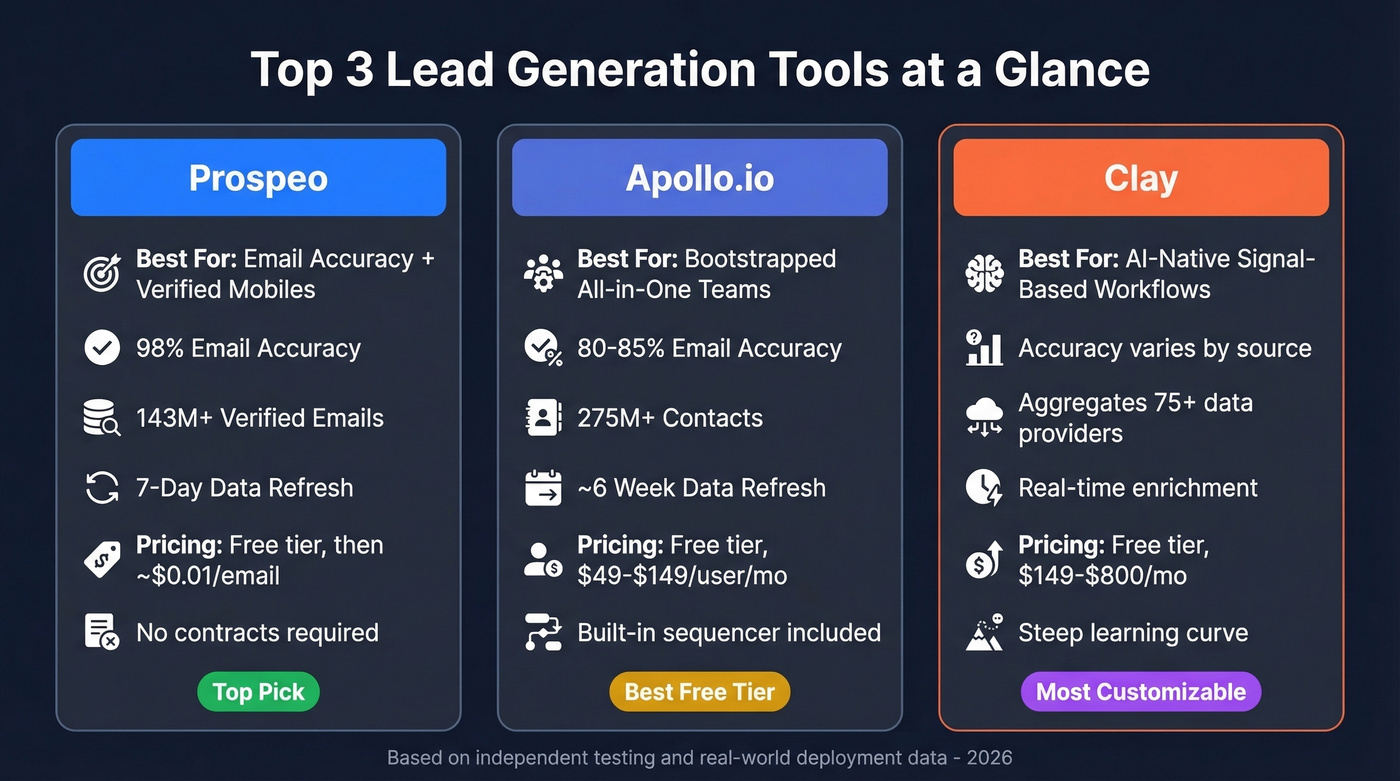
- Prospeo - Best for email accuracy and verified mobile data. 98% email accuracy, 7-day data refresh, free tier available. Start here if deliverability is your top concern.
- Apollo.io - Best free-tier all-in-one for bootstrapped teams. 275M+ contacts and a generous free plan, but accept the accuracy tradeoff (~80-85% on emails).
- Clay - Best for AI-native, signal-based prospecting workflows. The learning curve is real, but the customization is unmatched.
How to Choose a Lead Generation Tool
Before you compare features, get these five criteria straight. They'll save you from buying the wrong tool and spending three months migrating off it.
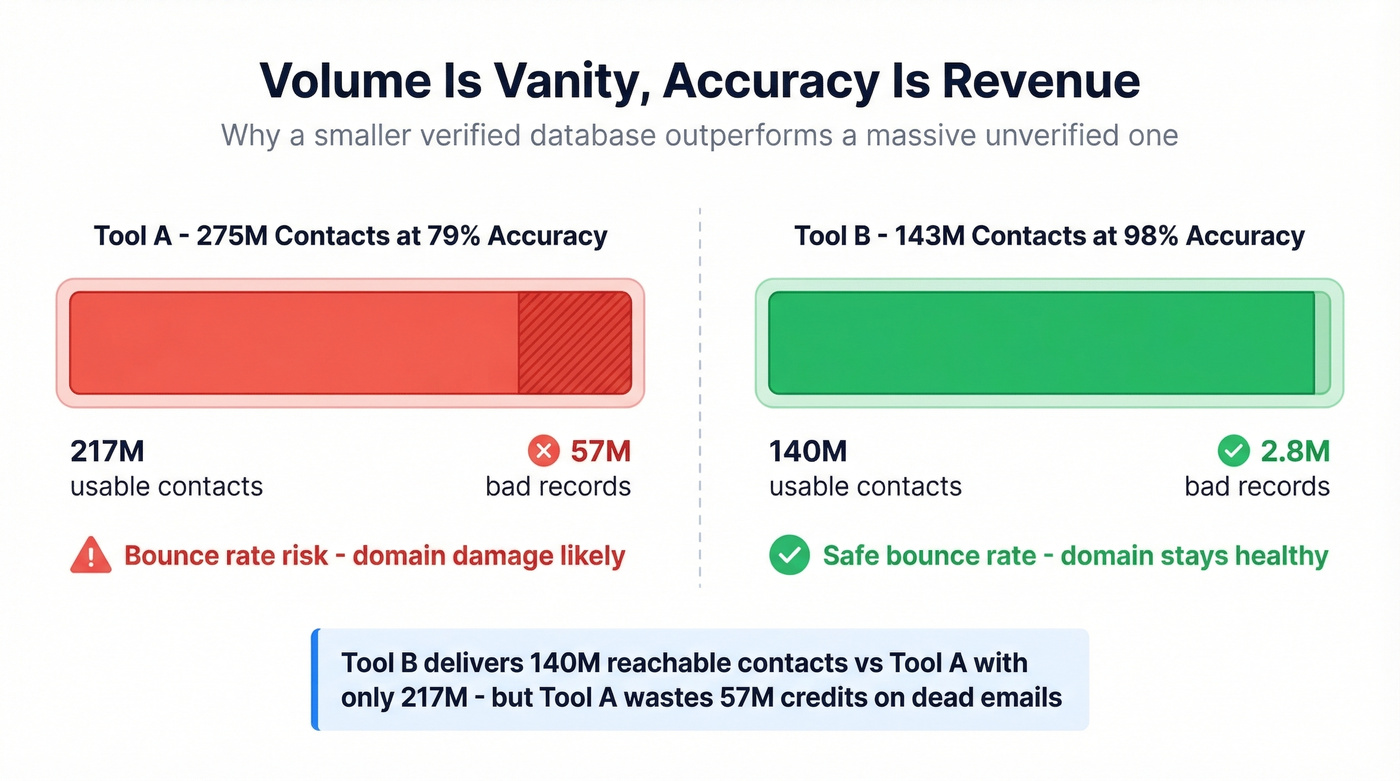
Email accuracy above 95%. Anything below that is a liability. Gmail and Yahoo's bulk sender requirements have been enforced since February 2024, and Microsoft followed with similar SPF/DKIM/DMARC rules in May 2025. A 5%+ bounce rate doesn't just waste credits - it damages your sender reputation for months. Here's the math that matters: a tool with 275M contacts at 79% accuracy gives you roughly 57M bad records floating in the database. A tool with 143M verified emails at 98% accuracy gives you 140M usable ones. Volume is vanity; accuracy is revenue.
Data freshness. Ask how often records are refreshed. The industry average is about six weeks. Some tools refresh quarterly or not at all. If someone changed jobs 45 days ago, you're emailing a dead address.
Pricing transparency. If you can't find pricing on the website, expect a long sales cycle and an annual contract. That's fine for enterprise - it's a dealbreaker for a 5-person team.
Deliverability context. Your lead gen tool should help you stay out of spam, not just find emails. Built-in verification, catch-all handling, and spam-trap removal are table stakes in 2026. (If you want a deeper playbook, start with an email deliverability guide and then tighten your email bounce rate controls.)
Integration with your existing stack. The best tool on the market is useless if it can't push contacts into your CRM or sequencer without a CSV export and a prayer. If you're rebuilding your process, use a simple lead generation workflow as the baseline.

Lead Gen Benchmarks Worth Knowing
Before you evaluate tools, know what "good" looks like.
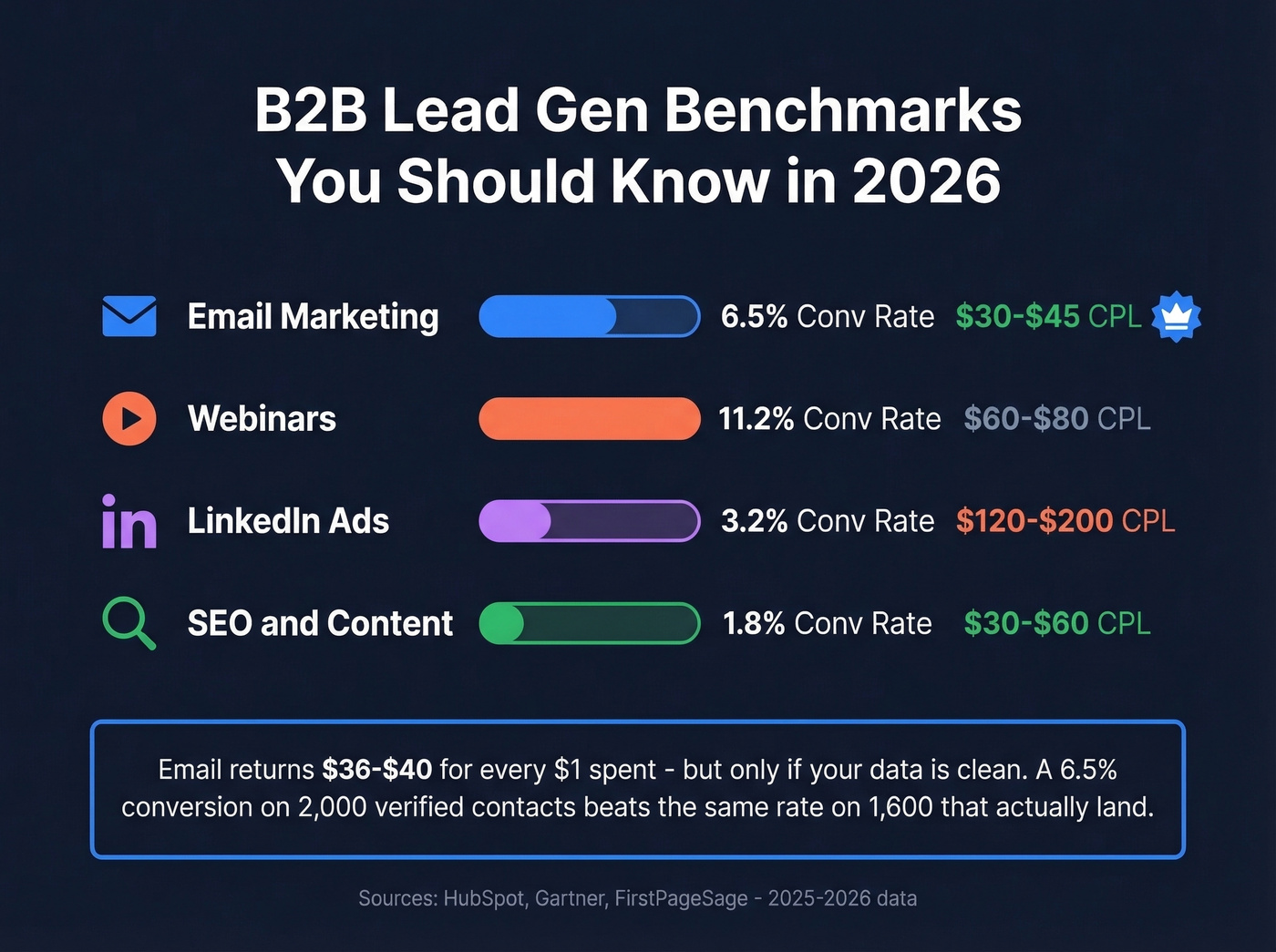
| Channel | Avg Conversion Rate | Avg CPL |
|---|---|---|
| Email marketing | 6.5% | $30-$45 |
| LinkedIn ads | 3.2% | $120-$200 |
| Webinars | 11.2% | $60-$80 |
| SEO / content | 1.8% | $30-$60 |
Email remains the highest-ROI channel in B2B, returning $36-$40 for every $1 spent. The average B2B cost per lead sits around $200, though that varies wildly by industry and motion. Demo request CPLs can hit $600-$800 for enterprise SaaS.
On the funnel side, strong teams convert MQL-to-SQL at 60%+ and lead-to-customer at 20%+. If your MQL-to-SQL conversion is below 40%, the problem isn't your data tool - it's your qualification criteria. (A practical starting point is a lightweight lead scoring model tied to your ICP.)
The takeaway: email is cheap and effective, but only if your data is clean. A 6.5% conversion rate on 2,000 verified contacts beats a 6.5% rate on 1,600 that actually landed after 400 bounced and torched your domain.

You just read that B2B data decays at 3% per month. Most lead gen tools refresh every 6 weeks - meaning you're emailing dead addresses by default. Prospeo refreshes every 7 days, delivers 98% email accuracy, and costs roughly $0.01 per verified email. No contracts, no sales calls.
Stop paying for bounces. Start with 75 free verified emails today.
The 15 Top Lead Generation Tools for 2026
B2B Data & Enrichment
Prospeo
Use this if: You need the highest email accuracy on the market and verified mobile numbers that people actually pick up.
Skip this if: You want an all-in-one platform with a built-in sequencer - pair Prospeo with Instantly or Lemlist for that.
Prospeo's database covers 300M+ professional profiles, 143M+ verified emails, and 125M+ verified mobile numbers, all on a 7-day refresh cycle. That refresh cadence is the real differentiator - most competitors update every 4-6 weeks, which means you're working with stale data by default. Email accuracy runs at 98%, backed by a proprietary 5-step verification process that includes catch-all handling, spam-trap removal, and honeypot filtering. (If you're comparing providers, this is also where data enrichment services can fill gaps.)
The proof points are concrete. Snyk's 50-person AE team went from a 35-40% bounce rate to under 5% after switching, generating 200+ new opportunities per month. That's not a marginal improvement - it's a completely different pipeline.

Pricing is refreshingly transparent: free tier with 75 verified emails per month, paid plans at roughly $0.01 per email, no contracts. The 30+ search filters include buyer intent powered by 15,000 Bombora topics, technographics, job changes, and headcount growth signals. Native integrations with Salesforce, HubSpot, Clay, Instantly, and Lemlist mean your data flows without manual exports. Teams report booking 26% more meetings compared to ZoomInfo and 35% more compared to Apollo - numbers that hold up across our own testing.
Apollo.io
Use this if: You're bootstrapped, need a free tier that's actually generous, and want prospecting + sequencing in one platform.
Skip this if: You're running high-volume outbound where a 15-20% bounce rate will tank your domain.
Apollo is the obvious starting point for most budget-conscious teams. The free tier gives you 10,000 credits per month, and the database covers 275M+ contacts. Paid plans run $49-$149/user/month. On G2, it holds a 4.7/5 rating across 9,476 reviews - the most-reviewed tool in the category.
Here's the thing: Apollo's email accuracy runs around 80-85% in independent testing. For a 10-person team sending 500 emails a week, that means 75-100 bounces weekly. Over a month, that's enough to trigger spam filters and damage your domain. A recurring concern on r/coldemail is that Apollo's database skews outdated.
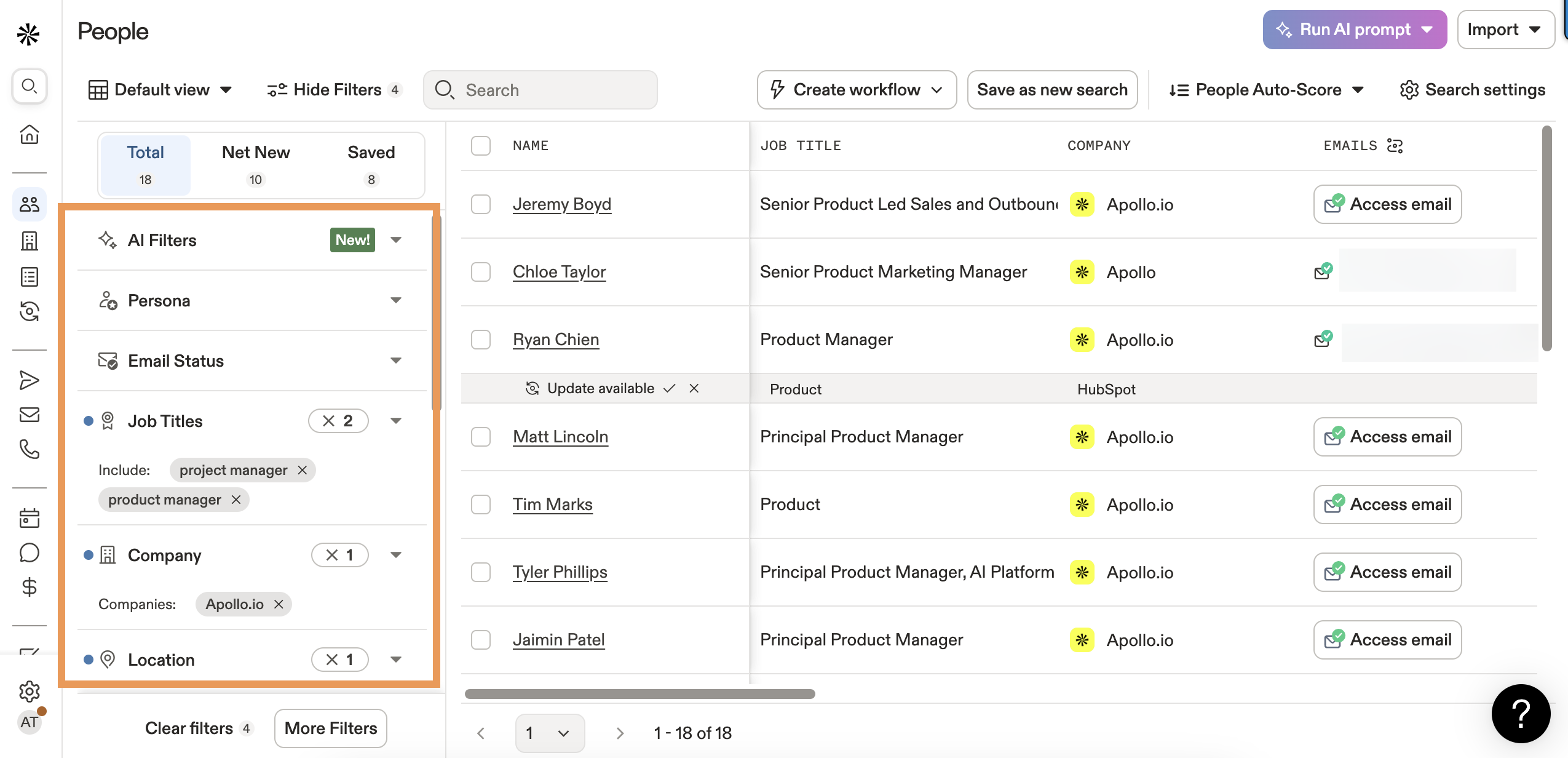
Apollo is excellent for getting started fast. It's risky as your sole data source at scale. We've seen teams pair Apollo's sequencer with a higher-accuracy data provider for the best of both worlds. (If you're building a dedicated outbound stack, see our guide to outbound lead generation tools.)
ZoomInfo
ZoomInfo is the incumbent, and it charges like one. A mid-market contract starts at $15,000/year and can climb to $30-50K+ once you add modules, seats, and intent data. Annual contracts, no public pricing, and a renewal process that Finance will flag every single year.
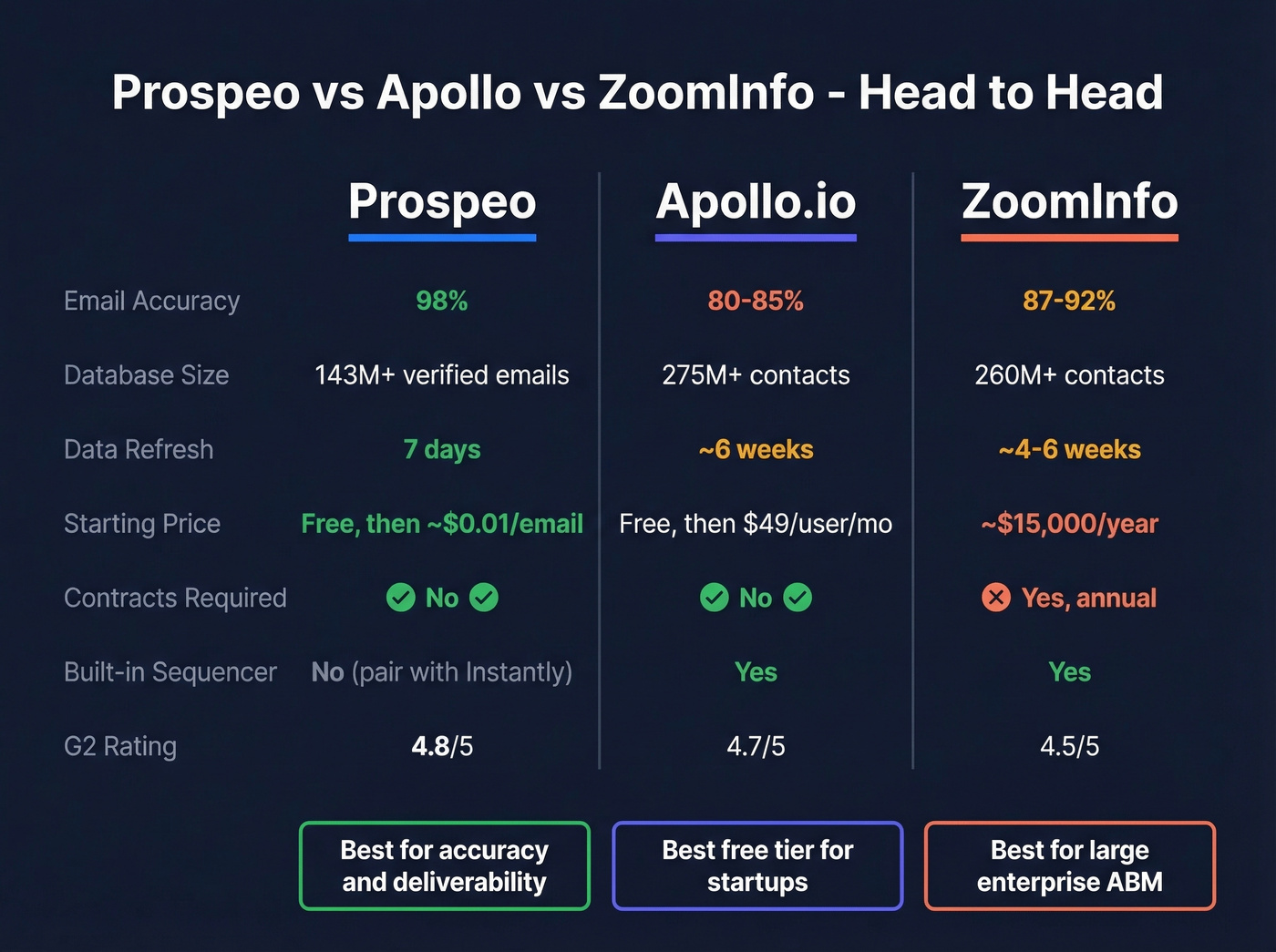
The data is deep - especially in North America - and the platform layers in Bombora intent data, org charts, and technographics that smaller tools can't match. G2 rating: 4.5/5 across 9,033 reviews. Accuracy runs ~87-92% on emails, which is solid but not best-in-class. On Reddit, the sentiment is harsher than the G2 score suggests - complaints about pricing relative to data quality are a recurring theme in r/sales.
Let's be honest: for 500+ person sales orgs running coordinated ABM, ZoomInfo is worth it. For everyone else, there are better ways to spend that budget. If your average deal size is under $15K, you almost certainly don't need ZoomInfo-level infrastructure.
Cognism
Cognism is the strongest option for teams selling into Europe. Diamond Data - their phone-verified mobile number product - delivers connect rates that most US-focused tools can't match in EMEA. GDPR compliance is built in, not bolted on.
Custom annual pricing ranges from ~$1,500 to $100,000+/year depending on team size and data volume. G2: 4.6/5 with 760+ reviews. Where Cognism wins over ZoomInfo: European data quality and mobile verification. Where ZoomInfo still wins: US database depth and workflow breadth. Best for mid-market and enterprise teams with significant European pipeline.
Lusha
Lusha's free tier (50 credits/month) makes it easy to test, and the credit-based model works well for individual reps doing quick lookups. Paid plans run $29.90-$69.90/user/month. The database covers 100M+ B2B contacts with decent accuracy for North American data. G2: 4.3/5 with 1,618 reviews.
The catch: credits burn fast at scale. A 10-person SDR team doing 50 lookups each per day will blow through even the premium plan's allocation. Best for small teams or individual contributors who need fast, lightweight contact lookups.
Email Finding & Verification
Hunter.io
Hunter does one thing well: finding and verifying emails by domain. The domain search is fast, the verification is reliable, and the interface stays out of your way. Free tier gives you 25 searches/month. Paid plans: Starter $49/mo, Growth $149/mo, Business $499/mo. G2: 4.4/5 with 550+ reviews.
It's not a full prospecting platform - no intent data, no mobile numbers, no sequencer. But if you need a lightweight email finder that integrates cleanly with everything else, Hunter is the reliable utility player. (If you're shopping around, compare options in our Hunter alternatives roundup.)
Snov.io
Snov.io bundles email finding, drip campaigns, and a lightweight CRM into one platform. For small teams that don't want to manage three separate tools, it's a solid bundle. Free plan available; paid tiers run $39-$738/month depending on volume. G2: 4.6/5 with 430+ reviews. The built-in drip campaigns are good enough to skip a dedicated sequencer for low-volume outreach. Best for teams under 5 people who want finding + outreach in a single tool.
CRM & Pipeline Management
HubSpot
Use this if: You want inbound lead generation and CRM in one platform, and you're building a content-driven funnel with forms, landing pages, email, and workflows.
Skip this if: You need outbound prospecting data - HubSpot isn't a B2B data provider. Pair it with a dedicated data tool for outbound.
HubSpot's free CRM is genuinely one of the strongest lead generation programs in B2B SaaS. It's not a loss leader with crippled features - it's a real CRM that handles contacts, deals, and basic reporting for teams that aren't ready to pay $25/user/month for Salesforce. Marketing Hub starts at $15/seat/month and scales up from there. (If you're still evaluating CRMs, here are more examples of a CRM by use case.)
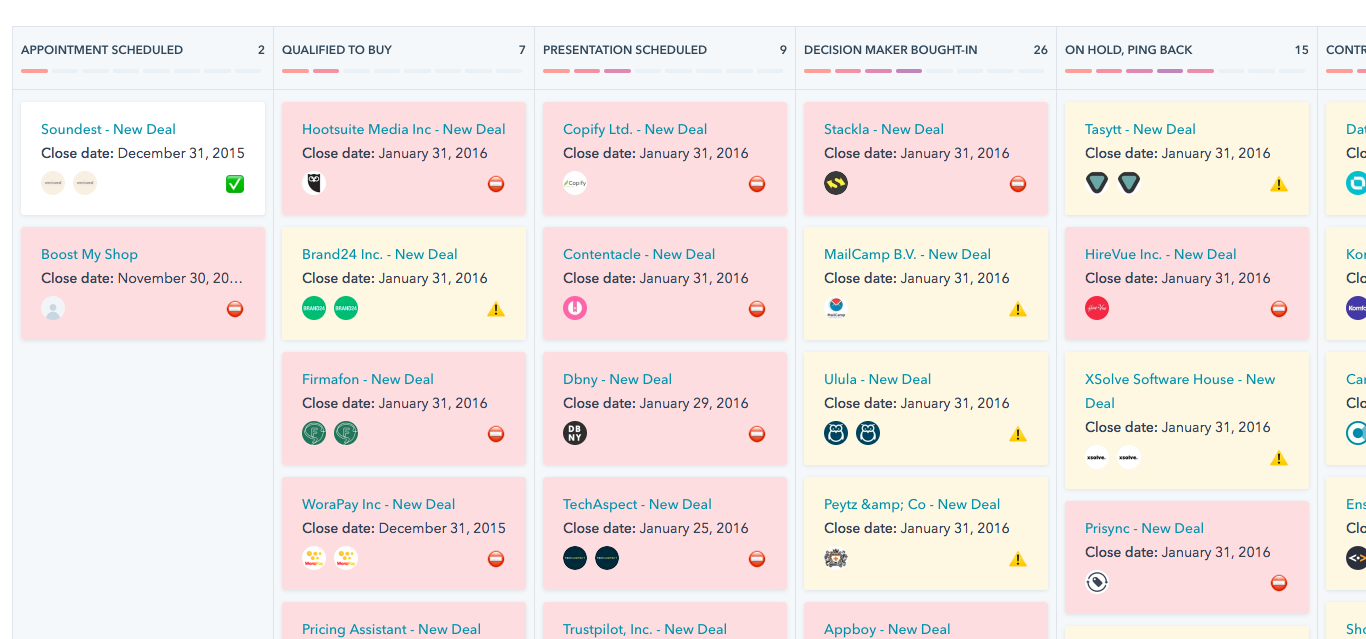
Where HubSpot shines is as the center of gravity for inbound. Forms, landing pages, email marketing, live chat, and workflow automation all live in one ecosystem. The reporting is clean, the UX is intuitive, and the integration marketplace is massive. Community sentiment on Reddit is overwhelmingly positive for the free CRM - the complaints start when teams hit the pricing jump to Marketing Hub Professional. For teams under 50 employees whose primary motion is inbound, HubSpot is probably the right CRM.
Salesforce Sales Cloud
The enterprise CRM standard. Starting at $25/user/month, it's overkill for small teams but indispensable for orgs already in the Salesforce ecosystem. If your company runs Salesforce, your lead gen tools need to integrate with it - not the other way around. (If you're budgeting, see the full Salesforce pricing breakdown.)
Pipedrive
From $14/seat/month billed annually, Pipedrive offers visual pipeline management that small sales teams love. Simple, fast, and it doesn't try to be everything. Best for teams of 2-15 reps who want deal tracking without the complexity of Salesforce or HubSpot's full suite.
Outbound Sequencing
Instantly
Instantly has become the default cold email infrastructure tool, and the G2 ratings reflect it: 4.8/5 across 4,040 reviews. Starting around $30/month, it handles email warmup, inbox rotation, and deliverability monitoring - the plumbing that keeps your outbound from landing in spam.
The key thing to understand: Instantly is a sequencer, not a data source. It needs contacts fed into it from upstream. The most common pairing we see is a verified data provider for accuracy plus Apollo for volume when budget allows. On r/coldemail, Instantly is consistently praised for deliverability - the main complaint is that the UI can feel clunky when managing dozens of inboxes. (If you're scaling volume, track email velocity to stay safe.)
AI-Native & Signal-Based
The real value of AI in lead gen isn't writing better emails - it's deciding who to contact, when, and why.
Clay
Most prospecting tools give you a static database and a search bar. Clay gives you a workflow builder. Instead of searching for leads, you build logic that triggers on job changes, funding events, hiring signals, and intent data - then chains multiple data sources together to enrich and qualify contacts automatically.
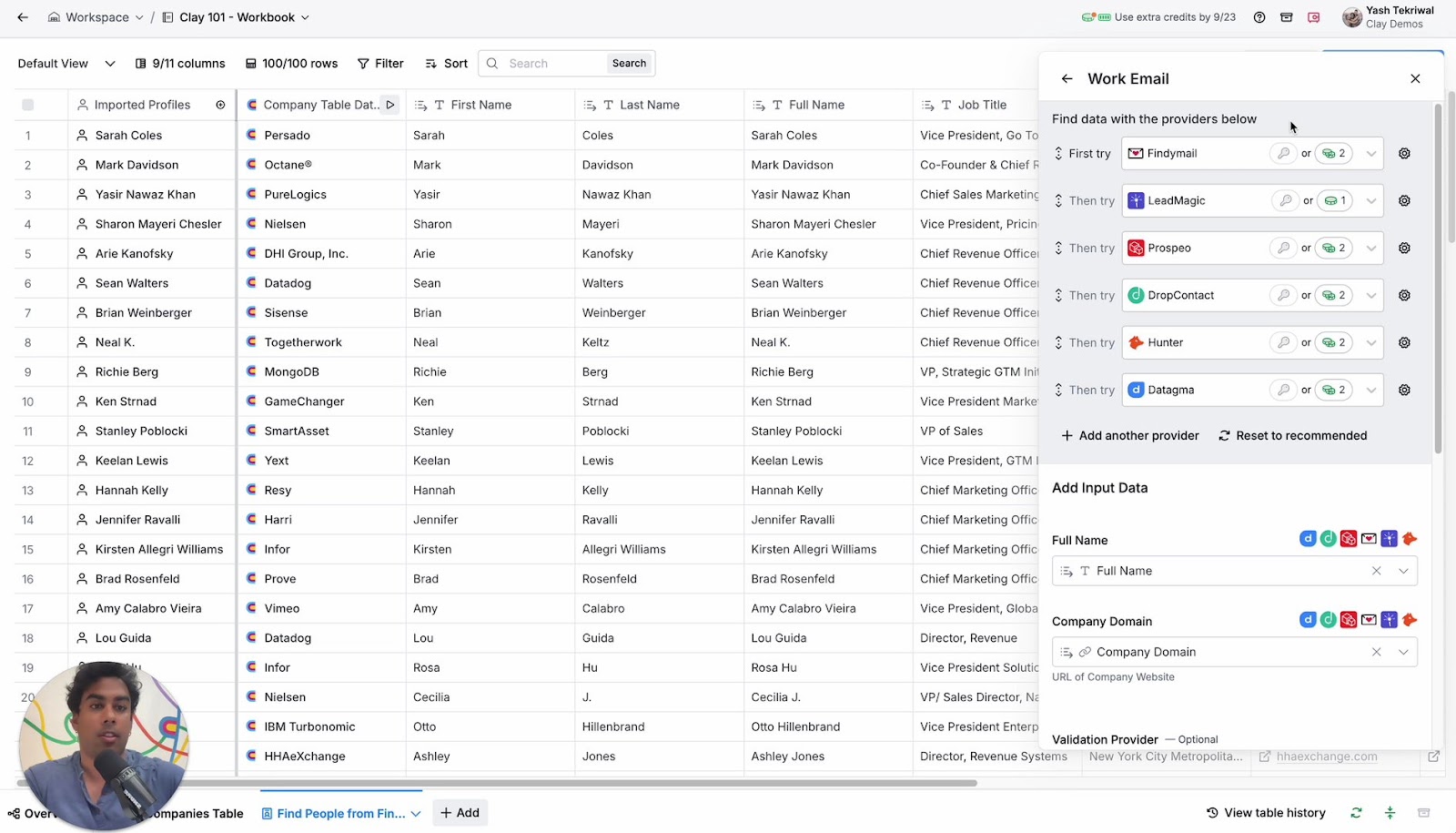
The learning curve is real - expect a week or two before your team is productive. But the customization is unmatched. Here's a concrete workflow that takes about two hours to set up: Clay monitors job changes at target accounts, enriches new contacts via a verified data source, then pushes verified emails to Instantly for a 3-touch sequence. That workflow runs on autopilot and surfaces warm leads your competitors are still manually searching for. (For a costed walkthrough, see Clay list building.)
Free tier available; paid plans start around $149/month. On Reddit, practitioners consistently name Clay as their favorite tool for experimentation - the community Slack is active and generous with workflow templates. Best for RevOps teams and growth operators who think in workflows, not just lists.
Trigify
Trigify monitors job changes, funding events, and hiring signals to surface leads at the right moment. It's an emerging tool favored by practitioners already comfortable with signal-based workflows. Pricing isn't public - expect $100-300/month for small teams based on comparable tools in the space. Best for teams that have outgrown static databases and want trigger-based prospecting. (If you're operationalizing triggers, use this playbook on how to track sales triggers.)
Other Notable Tools
Seamless.AI
Seamless.AI claims 1.7B+ contacts with real-time verification. Starting at ~$147/month on annual plans, it's got scale - G2: 4.4/5 with 5,318 reviews. The sales process is aggressive (expect persistent follow-ups), and accuracy varies by segment.
UpLead
UpLead focuses on real-time verified data at $99/month (170 credits) or $199/month (400 credits). G2: 4.7/5 with 780+ reviews. No annual contracts required. Best for mid-market teams who want pay-as-you-go without enterprise lock-in.
Kaspr
From ~€45/month (~$49), Kaspr covers 120M+ European contacts checked against 120 sources. GDPR and CCPA aligned. Best for teams targeting European markets who need a dedicated EU data source at a reasonable price.
RocketReach
Free plan available; paid tiers run ~$49-$209/month per user. G2: 4.5/5 with 760+ reviews. Solid email and phone finder without the platform overhead. Best for individual contributors who need quick lookups without committing to a full prospecting suite.
Side-by-Side Comparison
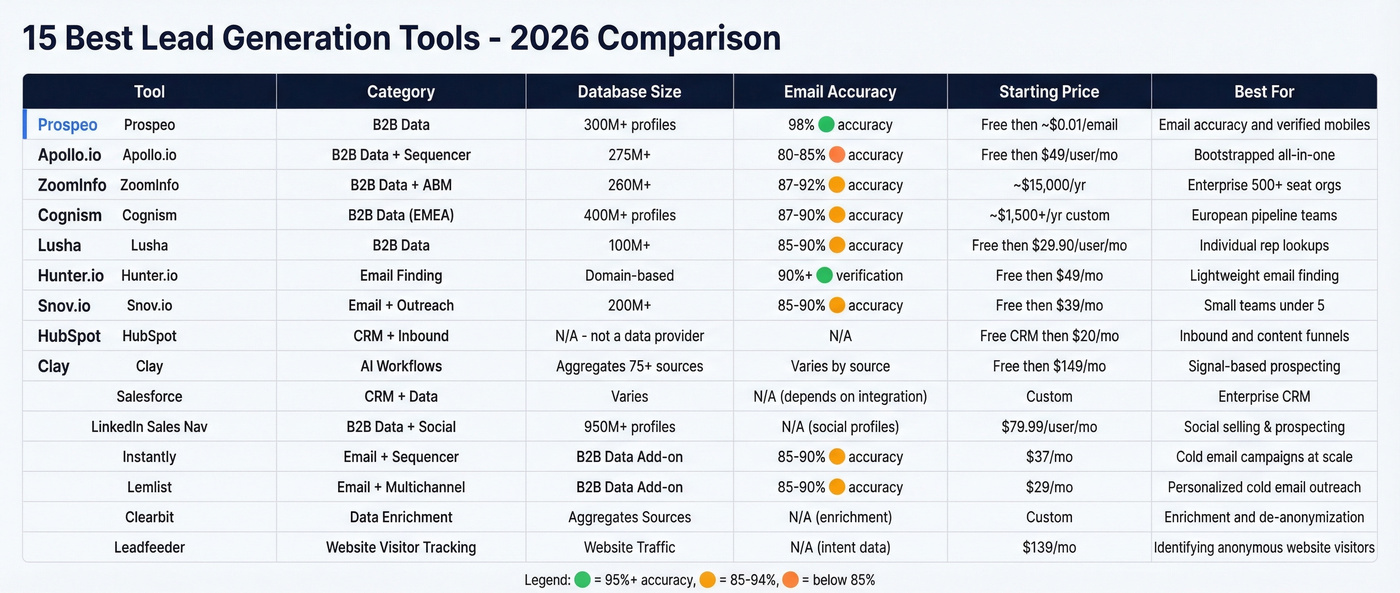
If you only look at one column, make it "Best For" - that's where the real decision lives.
| Tool | Category | Starting Price | G2 Rating | Best For | Our Pick? |
|---|---|---|---|---|---|
| Apollo.io | B2B Data | Free (10K credits) | 4.7/5 (9,476) | Budget all-in-one | ⭐ Best free tier |
| ZoomInfo | B2B Data | ~$15K/year | 4.5/5 (9,033) | Enterprise GTM | |
| Cognism | B2B Data | ~$1,500/year | 4.6/5 (760+) | European data | ⭐ Best for EMEA |
| Lusha | B2B Data | Free (50 credits) | 4.3/5 (1,618) | Quick lookups | |
| Hunter.io | Email Finding | Free (25/mo) | 4.4/5 (550+) | Domain email search | |
| Snov.io | Email + Outreach | Free; paid $39/mo | 4.6/5 (430+) | Small team bundle | |
| HubSpot | CRM + Inbound | Free CRM | 4.4/5 | Inbound lead gen | ⭐ Best inbound CRM |
| Salesforce | CRM | $25/user/mo | 4.4/5 | Enterprise CRM | |
| Pipedrive | CRM | $14/seat/mo | 4.3/5 | Simple pipeline mgmt | |
| Instantly | Sequencing | ~$30/mo | 4.8/5 (4,040) | Cold email infra | ⭐ Best sequencer |
| Clay | AI / Signals | Free; paid ~$149/mo | 4.6/5 | Custom workflows | ⭐ Best for workflows |
| Seamless.AI | B2B Data | ~$147/mo (annual) | 4.4/5 (5,318) | Large database | |
| UpLead | B2B Data | $99/mo | 4.7/5 (780+) | Pay-as-you-go | |
| Kaspr | B2B Data | ~€45/mo | - | European contacts | |
| RocketReach | Email + Phone | Free; paid ~$49/mo | 4.5/5 (760+) | Individual lookups |
Build Your Stack by Budget
Here's a contrarian take that'll save you months of tool-hopping: you need exactly three layers. A data source to find contacts. A verification layer to clean them. A sequencer to send outreach. No single tool does all three well.
Bootstrap ($0-100/month): Prospeo free tier (75 verified emails/month) + Apollo free tier (10K credits for volume) + HubSpot CRM free. This gives you verified data, broad coverage, and a real CRM to manage it all. Total cost: $0. (If you want more options in this tier, see our list of free lead generation tools.)
Mid-market ($200-500/month): A paid data plan for verified contacts and intent data + Clay for signal-based workflow automation + HubSpot or Pipedrive for CRM. Expect $200-400/month depending on volume.
Enterprise ($1,000+/month): Cognism or ZoomInfo for deep data and intent + a verification layer to clean everything before it hits your sequences + Salesforce for CRM. Even if you're paying for ZoomInfo's database, running contacts through an additional verification step catches the ~8-13% of emails that would otherwise bounce. At enterprise volume, that's thousands of saved sends per month.
The math is simple: 143M+ verified emails at 98% accuracy gives you more usable contacts than a 275M database at 80%. Prospeo's 5-step verification removes spam traps, honeypots, and catch-alls before they wreck your domain. Snyk cut their bounce rate from 35% to under 5% and added 200+ opportunities per month.
Pick the lead gen tool that protects your domain and fills your pipeline.
Mistakes That Kill Lead Gen ROI
The tool is rarely the bottleneck. The process is. Here are the five failures we see most often.
No shared definition of "qualified lead." Marketing says MQL, sales says "not ready." If your teams can't agree on what a qualified lead looks like, no tool will fix the handoff. Define it in writing, with specific criteria, before you buy anything. (A fast way to align is an ideal customer profile template plus scoring.)
Slow lead activation. Speed-to-lead is a revenue KPI, not a vanity metric. If an inbound lead waits 24 hours for a response, your competitor has already booked the meeting.
Fragmented attribution. When your CRM, marketing automation, and intent platform don't talk to each other, you can't tell which channel is actually driving pipeline. Fix the plumbing before you add more tools.
Generic nurture sequences. Sending the same 5-email drip to every lead regardless of intent signals is a waste of everyone's time. Layer in intent data and behavioral triggers - the tools exist, most teams just don't configure them.
Misaligned handoffs. No SLAs between marketing and sales. No follow-up cadence. No feedback loop. This is the most common failure point, and it's entirely a people problem. Speed and alignment beat tool selection every time.
FAQ
What's the best free lead generation tool?
Apollo offers the most generous free tier at 10,000 credits per month, but email accuracy is a concern at scale - expect 15-20% bounce rates. HubSpot CRM is free and excellent for inbound lead management. Prospeo's free plan includes 75 verified emails monthly with 98% accuracy, which makes it better suited for teams running real outbound campaigns.
How much do lead generation tools cost?
Most B2B data platforms run $49-$149/user/month, while enterprise solutions like ZoomInfo start at $15,000+/year with annual contracts. Credit-based options charge roughly $0.01 per verified email with no contracts, making it possible to run verified outbound for under $100/month.
What's a good email accuracy rate?
Anything below 95% is a liability - you'll damage your sender reputation and trigger spam filters. Top-tier tools hit 97-98%. B2B data decays at ~3% per month, so refresh frequency matters as much as initial accuracy. Ask vendors how often they refresh records, not just how many they have.
Do I need more than one tool?
Yes. Most effective teams run three layers: a data source for contacts, a verification layer to clean the data, and a sequencer to send outreach. No single platform does all three at a high level. Trying to force one tool to handle everything usually means compromising on accuracy or deliverability.
What's the difference between inbound and outbound lead gen tools?
Inbound tools like HubSpot capture leads who come to you through content, forms, and chat. Outbound tools like Apollo and Prospeo help you find and contact prospects directly. Most B2B teams need both motions running simultaneously - inbound for long-term pipeline, outbound for immediate revenue.