

Building Sales Relationships Is a System, Not a Personality Trait
The pre-contact favorite wins the deal roughly 80% of the time. And 95% of the time, the winning vendor was already on the buyer's Day One shortlist. That means the relationship that closes the deal almost never starts on a cold call - it starts weeks or months before a rep ever says hello.
If your approach to building sales relationships is just being likable on discovery calls, you're showing up too late to a game that's already been decided.
The Short Version
Relationship selling in 2026 is a data-informed discipline. Your framework comes down to three moves: reach the right person with accurate, fresh data; lead every touchpoint with insight instead of asks; and use AI and automation for admin so human time goes to actual conversations. Stop trying to connect with everyone. Focus on the 5-10 accounts that matter this quarter, and go deep.
What Relationship Selling Is NOT
There's a thread on r/salestechniques that frames "relationship building" as an excuse for weak closing - essentially arguing that sales is about winning, not empathy. It's a blunt take, and it's half right.
Relationships without closing discipline is procrastination. You become the prospect's favorite vendor who never gets the PO. But closing without relationships is churn. You'll hit quota this quarter and lose the account next year when a competitor shows up with better service and an actual relationship with the champion.
Use this framing if your team treats relationship selling as a reason to avoid tough discovery questions and clear next steps. Skip it if you're already closing well but struggling with expansion and renewals - that's where relationship depth pays off and where strong client relationships compound over time.
Why Relationships Matter More Now
The data is unambiguous. 82% of sales professionals say relationship building is the most important part of selling. But 59% of business buyers aren't satisfied with the effort sales teams make to understand their goals. And 84% of sales reps didn't meet their quota last year. There's a massive gap between what sellers say they value and what buyers actually experience.
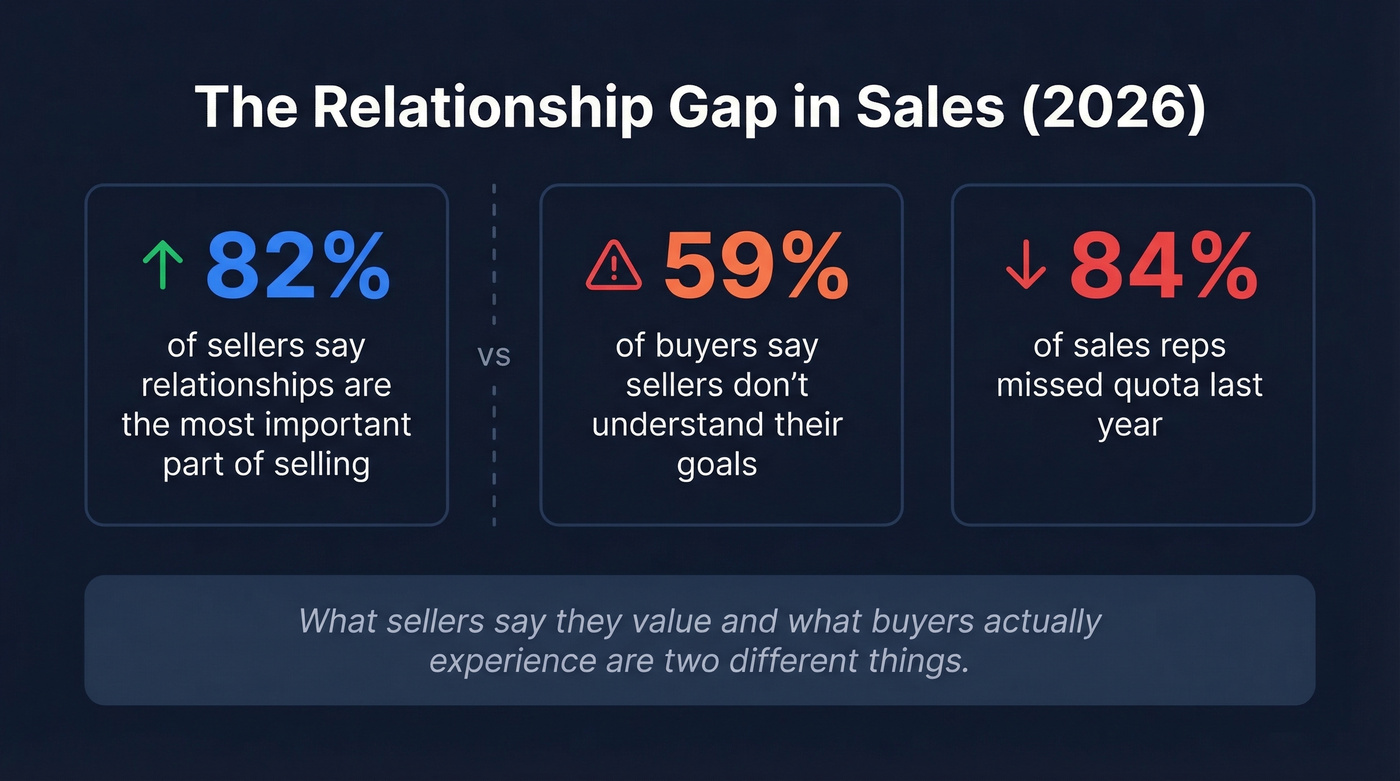
The results prove it.
Buyers have shifted the power dynamic. 96% research before engaging a rep. 71% prefer independent research over talking to sales at all. And 73% of B2B buyers actively avoid sellers who send irrelevant outreach. The window where a rep can actually influence a deal is shrinking, which means every touchpoint inside that window has to carry more weight - especially when you're engaging corporate buyers who have multiple stakeholders and higher switching costs.
Here's the thing: cold email performance is cratering. 69% of cold email senders report their performance declined year-over-year. The reps who still break through aren't the ones sending more volume. They're the ones who've already built enough credibility that the prospect opens the email in the first place.
Relationships Start Before First Contact
Buying cycles have compressed from 11.3 months to 10.1 months in just one year. The point of first contact shifted from 69% of the journey to 61% - about six to seven weeks earlier. Buyers are engaging sooner, deciding faster, and arriving with opinions already formed.
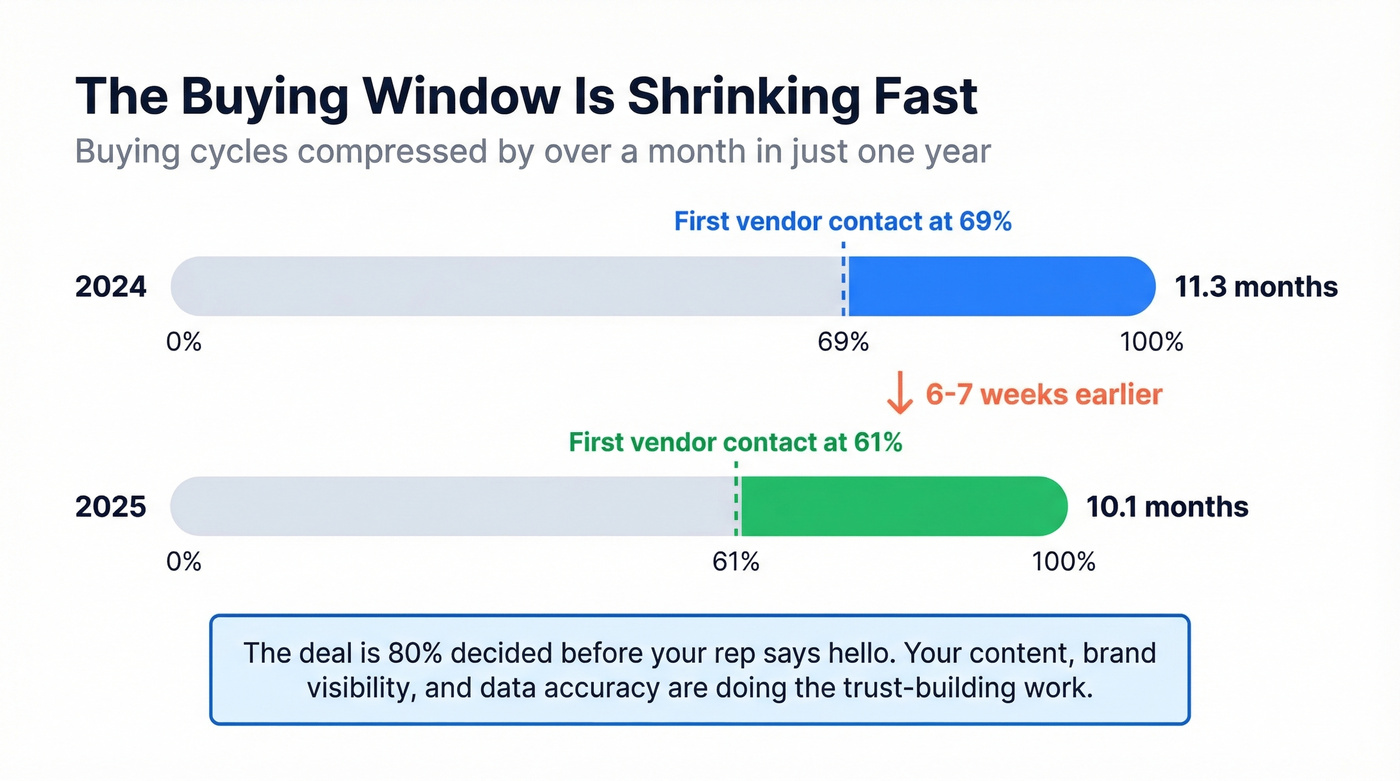
That means your pre-contact presence - content, brand visibility, intent signals, and data accuracy - is doing the trust-building work before your reps ever pick up the phone. One global insurance carrier proved this at scale: after systematically strengthening relationship touchpoints with independent agents before any sales conversation, they improved success ratios on both prospect and cross-sell opportunities. Pre-contact investment pays off across industries.
The operational checklist for pre-contact relationship building:
- Publish insight, not brochures. Buyers who've read your content before a call already trust you more. One useful blog post outperforms ten product one-pagers.
- Monitor intent signals. Know which accounts are actively researching your category. Reaching out when they're in-market feels helpful; reaching out when they're not feels like spam. (If you need a system, start with identifying buying signals.)
- Get the contact data right. You can't build a relationship with someone who left the company two months ago. A bounced email doesn't just waste a credit - it signals to the prospect's organization that you haven't done your homework. Prospeo refreshes its 300M+ profiles on a 7-day cycle, compared to the industry average of six weeks, so you're reaching the right person with a 98% verified email instead of a bounce notification.


You can't build a relationship with a bounced email. Prospeo's 300M+ profiles refresh every 7 days - not every 6 weeks - so your first touchpoint lands with the right person, at the right company, with a 98% verified email. That pre-contact credibility the article talks about? It starts with data that's actually current.
Stop showing up late to deals that were decided without you.
Core Skills for Stronger Sales Rapport
Once you're in front of the right person, the skills that separate good relationship sellers from mediocre ones aren't mysterious. They're just rarely practiced with discipline. We've watched teams transform their win rates by nailing one deceptively simple habit first.
The Sundown Rule comes first. Sam Walton's principle: respond to every request by the end of the day. In 2026, that means within hours, not days. In our experience, this is the single most underrated trust-builder in sales - fancy discovery frameworks and rapport techniques mean nothing if the prospect waits three days for a follow-up email. Consistency in responsiveness builds more trust than any single brilliant message, and it's the easiest thing to fix on any team because it requires zero new skills, just discipline. (If you want to operationalize this, keep sales meeting follow-up email templates ready.)
Active listening is a skill, not a trait. People retain 25% to 50% of what they hear. That means your prospect is forgetting half of what you say, and you're forgetting half of what they say. Take notes. Paraphrase back. Ask follow-up questions that prove you actually heard them.
Mirroring and matching - adjusting your pace, energy, and communication style to match the prospect's - is one of the most effective rapport techniques in sales. One warning from SBI's framework: mirror tone and cadence, not accents. That crosses a line fast.
Tough discovery questions are where trust actually forms. The reps who build the deepest connections are the ones who ask "What happens if you don't solve this problem?" - not the ones who nod along and agree with everything. (A good starting point: a tight set of discovery questions.)
The Framework: Move Fast, Build Deep
We've adapted a framework from HeyReach's relationship selling model that captures the core tension. You need two pillars running simultaneously.
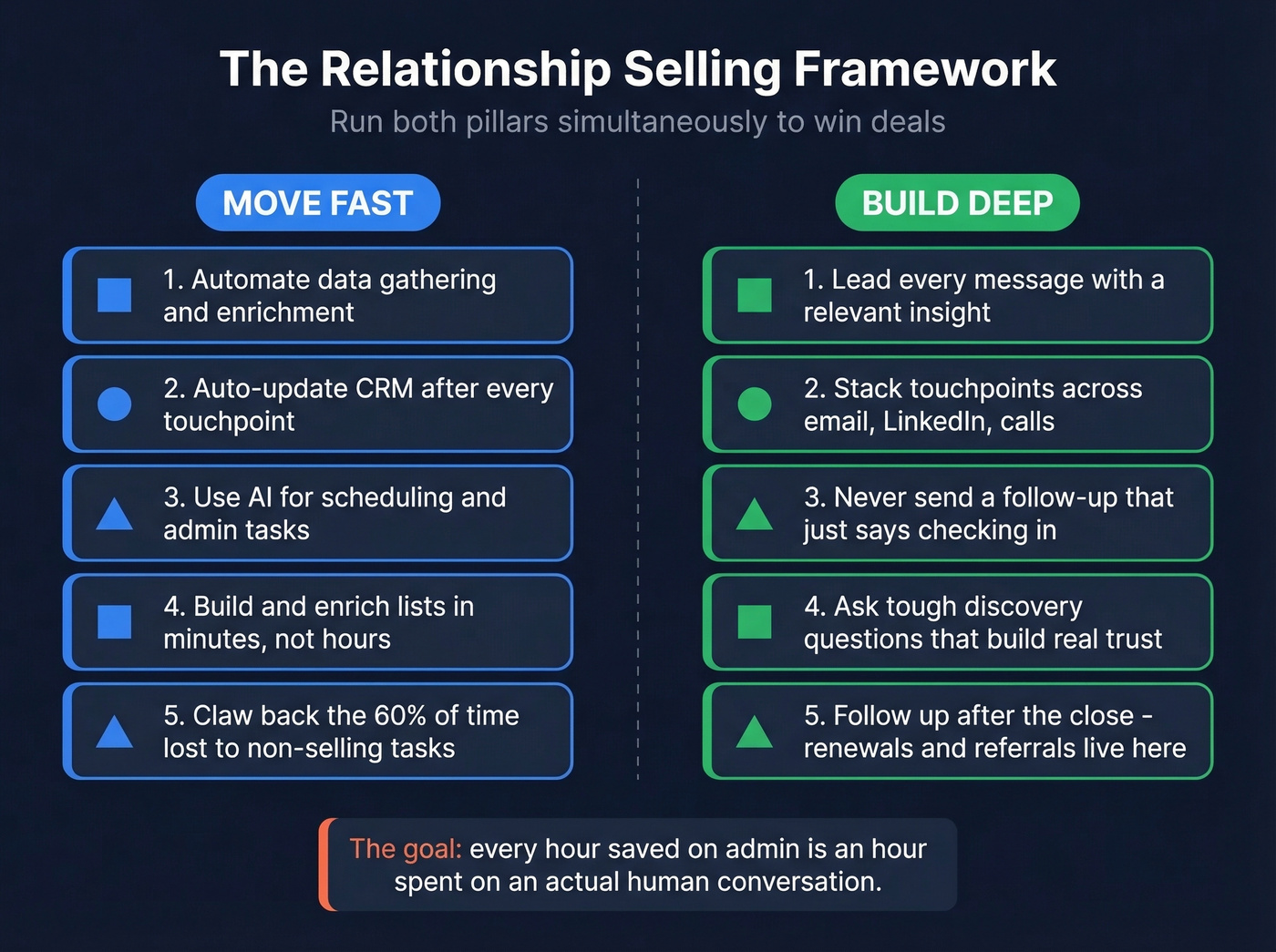
Move Fast - automate everything that isn't a human conversation. Data gathering, CRM updates, scheduling, list building, enrichment. Reps spend 60% of their time on non-selling tasks. Every hour you claw back from admin is an hour available for actual relationship building. (This is where sales process optimization pays off fast.)
Build Deep - lead with insight, stack touchpoints across channels, and follow up with something new every time. Never send a follow-up that just says "checking in." That's not relationship selling; it's inbox pollution. (If you need alternatives, see how to say just checking in professionally.)
Let's break this down with a real example.
Generic cold email: "Hi Sarah, I'd love to schedule 15 minutes to show you how we can help your team. Are you free Thursday?"
Context-rich cold email: "Hi Sarah - saw your team just closed a Series B. Congrats. We helped [similar company] cut their ramp time from 10 weeks to 4 after their last funding round. Happy to share the playbook if it's useful."
The second email takes 90 seconds longer to write. It converts at multiples of the first. And it starts a relationship instead of a transaction - which matters because 77% of B2B buyers say their latest purchase was "very complex or difficult" (Gartner). They don't need another vendor pitching features. They need someone who understands their situation.
Mistakes That Kill Sales Relationships
Three patterns destroy trust faster than anything else.
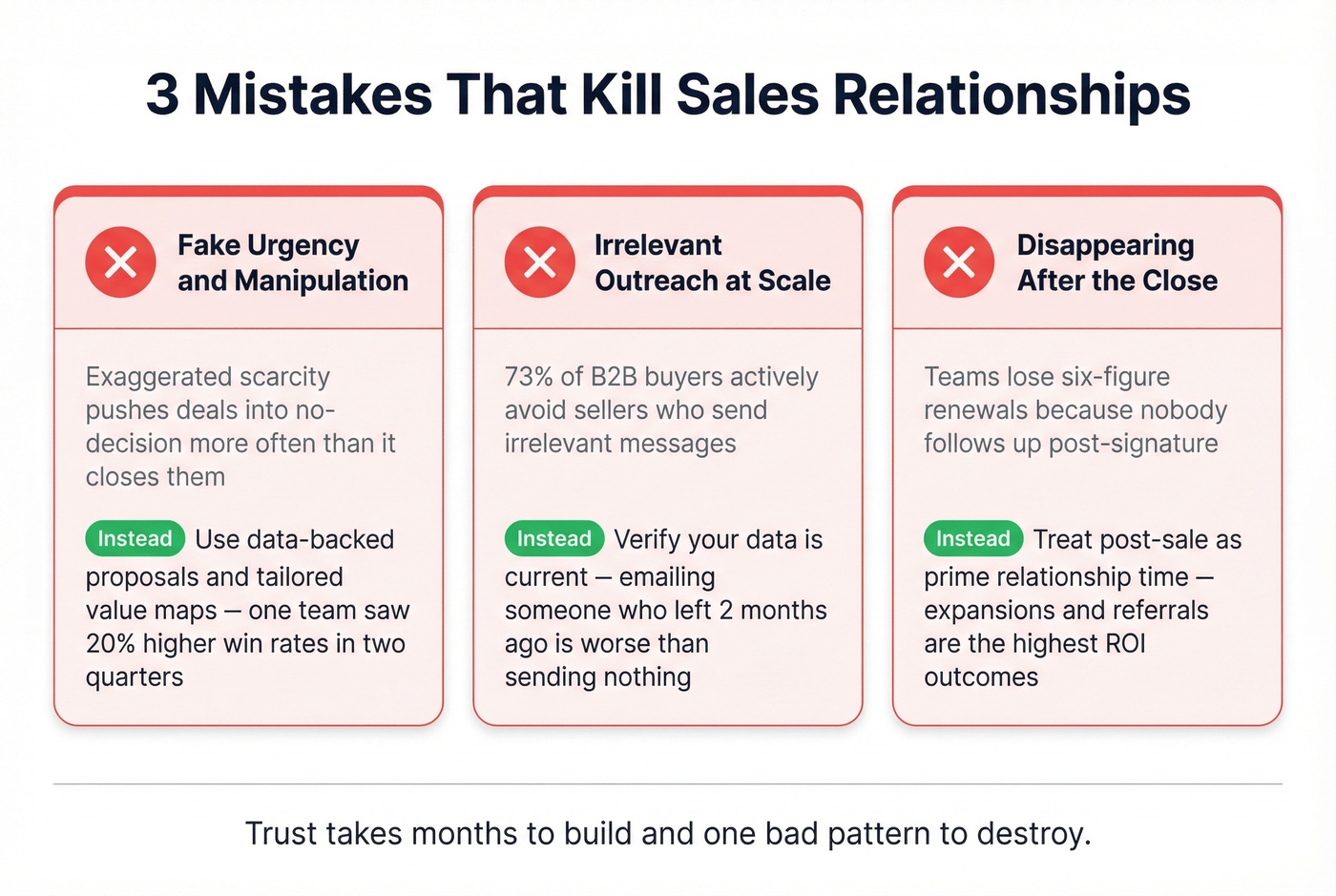
1. Fake urgency and manipulation tactics. HubSpot's research on closing mistakes warns against exaggerated scarcity and aggressive urgency - they push deals into "no decision" more often than they close them. One sales leader reported a 20% win-rate improvement over two quarters by replacing urgency-based CTAs with data-backed proposals and tailored value maps.
2. Irrelevant outreach at scale. Remember that 73% avoidance rate? This is where it comes from. Personalization isn't optional anymore - it's table stakes. Sending a personalized email to someone who left the company two months ago is worse than sending nothing at all. (If you want a practical playbook, use personalized outreach.)
3. Disappearing after the close. We've seen teams lose six-figure renewals because no one followed up after the contract was signed. The relationship doesn't end at signature. Teams that treat post-sale as someone else's problem lose expansion revenue and referrals - the two highest-ROI outcomes of relationship selling. Renewals, expansions, and introductions happen when you've earned trust across the account, not just with one champion. (Track it like a metric: renewal rate.)
Tools for Relationship Selling in 2026
Sellers who partner with AI tools are 3.7x more likely to meet quota. The right stack handles the "Move Fast" pillar so your reps can focus on "Build Deep."
| Category | Tool | Starting Price | Best For |
|---|---|---|---|
| CRM | HubSpot | Free; paid from $20-$90/user/mo | Teams starting out |
| CRM | Salesforce | From $25/user/mo (Starter) | Scaling orgs |
| CRM | Pipedrive | From $14.90/user/mo | Small teams wanting less data entry |
| CRM | Freshsales | From $15/user/mo | Budget-conscious teams |
| CRM | Salesflare | From $29/user/mo | Auto-enriching CRM for small B2B teams |
For most teams starting relationship selling in 2026, HubSpot's free CRM paired with Prospeo's free tier gives you a complete stack at zero cost. Prospeo's 30+ search filters - including buyer intent powered by Bombora, technographics, job change signals, and headcount growth - let you identify accounts that are actually in-market before you spend time on outreach. Native integrations with HubSpot, Salesforce, and popular outreach tools mean the data flows straight into your workflow without manual exports. (If you're evaluating vendors, start with data enrichment services.)
Hot take: If your average deal size is under $10k, you probably don't need a $15k/year data platform. A free CRM, a solid prospecting tool, and disciplined follow-up will outperform an enterprise stack that your team barely uses. (If you’re building the outbound motion, use these sales prospecting techniques.)
The article is clear: the window to influence a deal is shrinking, and every touchpoint has to count. Prospeo's 30+ filters - buyer intent, job changes, headcount growth, technographics - let you identify the 5-10 accounts that matter this quarter and reach decision-makers with direct dials that actually connect (30% pickup rate vs. 12.5% industry average).
Go deep on the accounts that matter instead of spraying emails into the void.
AI and the Future of Sales Relationships
A practitioner on r/sales raised a fear worth taking seriously: AI tools like Gemini can remember preferences and tailor information unique to personal tastes, knowing prospects better than any human rep could.
The numbers support the shift. 94% of sales leaders with AI agents say they're essential for meeting business demands. And nearly 90% of buyers report AI features are now part of the solutions they acquired - meaning AI isn't just a seller tool, it's a buyer expectation. AI will handle context retention, meeting prep, follow-up drafting, and pattern recognition better than humans.
What stays human? Judgment calls when a deal goes sideways. Vulnerability - admitting you don't have the answer and bringing in someone who does. Creative problem-solving that doesn't fit a template. And accountability: when something breaks post-sale, the buyer wants a person, not a chatbot. AI makes the relationship-building system faster. It doesn't replace the human at the center of it. (For a stack overview, see best generative AI sales tools.)
FAQ
What's the difference between relationship selling and transactional selling?
Relationship selling prioritizes long-term trust, repeat business, and expansion revenue, typically improving renewal rates by 15-30% compared to transactional motions. Transactional selling optimizes for speed and volume on individual deals. Use relationship-led approaches for complex B2B cycles; transactional works better for sub-$5k one-time purchases.
How do you build sales relationships remotely?
Lead every virtual touchpoint with insight, not small talk - video calls build rapport 2-3x faster than email alone. Follow up within 24 hours with something useful, and stack touchpoints across channels: email, phone, video, and a quick Loom walkthrough. Consistency matters more than charisma on a screen.
What tools help with building sales relationships?
A CRM like HubSpot or Salesforce for tracking interactions and stakeholder maps, plus a prospecting platform with verified contact data so you're reaching the right person. Bad data kills relationships before they start.
How long does it take to build a meaningful sales relationship?
Most B2B relationships require 6-8 meaningful touchpoints over 4-12 weeks before a buyer considers you a trusted advisor, not just another vendor. The timeline compresses when you lead with relevant insight and reach out while the account is actively in-market - intent signals can cut the trust-building window nearly in half.