

Business Development Representative: The Definitive 2026 Guide
You've been scrolling job boards for 20 minutes, and every other listing says "Business Development Representative." The title sounds important. The salary range looks decent. But nobody's telling you what the job actually feels like at 2:47 PM on a Tuesday when you've made 38 calls and booked zero meetings.
Let's fix that.
What You Need (Quick Version)
A business development representative (BDR) generates outbound pipeline by prospecting into cold accounts, qualifying potential buyers, and booking meetings for account executives to close. That's the job in one sentence. Everything else - the cadences, the tech stack, the multi-threading - is execution detail.
What you'll earn: Median OTE sits at $83K nationally. Top performers clear $130K+ with accelerators. Entry-level base runs around $55K. (If you want the math behind OTE, see OTE.)
Where it leads: Account executive in 12-18 months is the default path, but Customer Success, Revenue Operations, and Marketing/Demand Gen are all viable exits. The BDR seat is the best sales education money can buy - except you're the one getting paid.
What Does the Role Actually Mean?
A business development representative sits between marketing and the closing team. The role exists for one reason: fill the pipeline with qualified opportunities that account executives can work.
Some companies expand the BDR mandate to include partnership development and market research, but in SaaS - where most of these roles live - the job is pipeline generation. Unlike traditional field sales reps who manage the full cycle from prospecting through close, BDRs specialize in the top of the funnel. That specialization is what makes the role so effective as a training ground.
The day-to-day breaks into four core activities:
- Prospecting - identifying and researching target accounts that fit your company's ideal customer profile
- Lead qualification - determining whether a prospect has the budget, authority, need, and timeline to buy (frameworks like MEDDIC help)
- Nurturing - multi-touch follow-up that keeps you top of mind across a buying cycle that can stretch weeks or months
- Booking meetings - the measurable output, getting a qualified prospect on a call with an AE
Where does the BDR sit organizationally? 80% report to sales, not marketing. And 85% are primarily or exclusively focused on outbound - meaning you're not waiting for inbound leads to trickle in. You're hunting. That distinction shapes everything from your daily workflow to how your quota gets set.
The BDR function has grown steadily. 79% of organizations grew or maintained their BDR teams in the past year, with 58% actively expanding. Companies aren't cutting this role. They're investing in it.
BDR vs SDR - What's the Difference?
Here's the honest answer: most companies use these titles interchangeably. A Senior Director of Revenue Enablement quoted by Sales Enablement Collective put it bluntly - many orgs don't separate BDR and SDR at all. They just have "inbound SDRs" and "outbound SDRs."
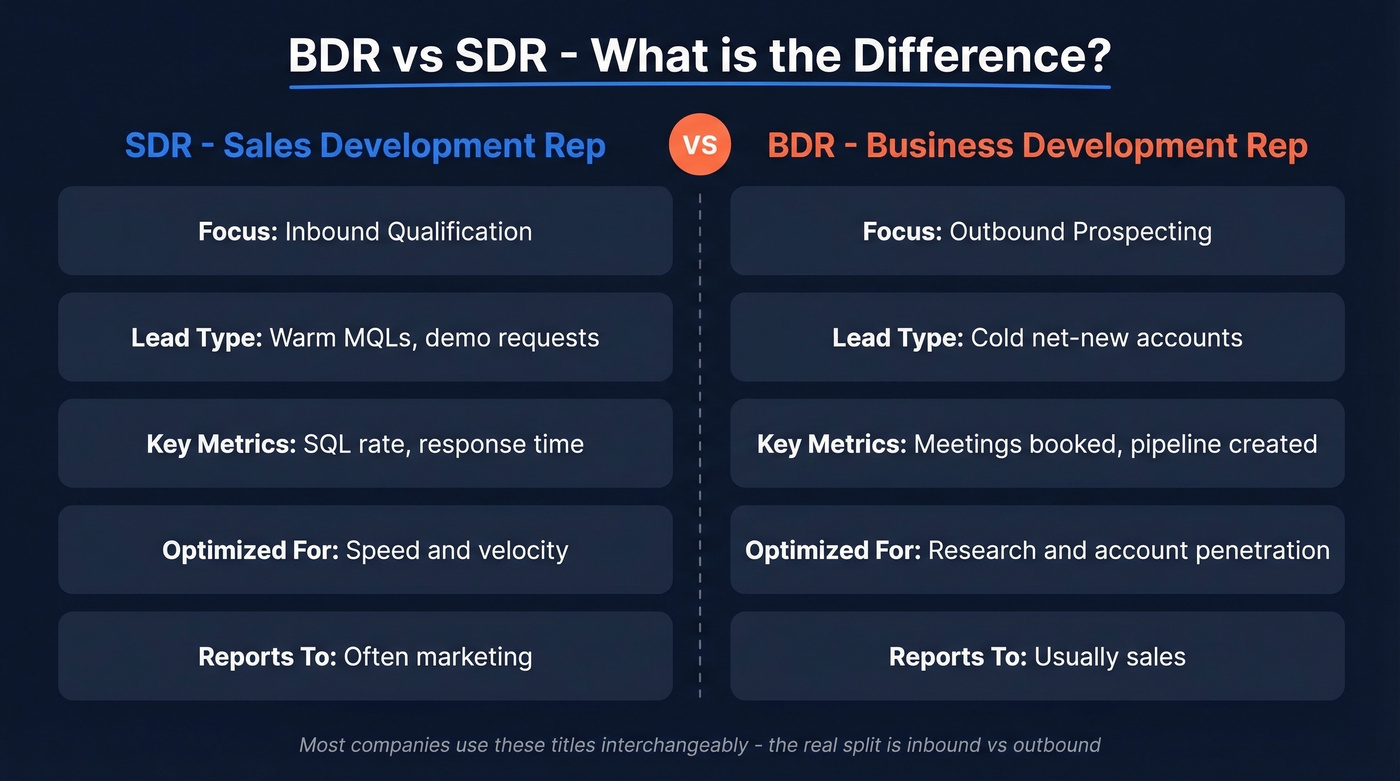
When companies do draw a line, the split usually looks like this:
| Dimension | SDR | BDR |
|---|---|---|
| Primary focus | Inbound qualification | Outbound prospecting |
| Lead type | Warm MQLs, demos | Cold net-new accounts |
| Key metrics | SQL rate, response time | Meetings booked, pipeline |
| Optimized for | Speed and velocity | Research, account penetration |
| Reports to | Often marketing | Usually sales |
SDRs respond to demand that already exists. Someone fills out a form, requests a demo, or downloads a whitepaper - the SDR qualifies that interest and routes it to an AE. Speed matters here. Only 7% of teams respond within five minutes, and the average response time is a brutal 42 hours. That gap is where deals die.
BDRs create demand from scratch. You're building target account lists, researching stakeholders, mapping org charts, and running multi-channel cadences against people who've never heard of your company. It's harder, it's slower, and it requires a fundamentally different skill set - patience, research depth, and creative outreach that cuts through noise. (If you want a tactics refresher, see sales prospecting techniques.)
Which should you hire first? If inbound volume is rising and your AEs are drowning in unqualified leads, hire an SDR. If inbound isn't enough - or you're pushing into mid-market and enterprise accounts where nobody's raising their hand - hire a BDR. Most scaling companies eventually need both.
For the rest of this guide, we'll use "BDR" as the primary term, but nearly everything applies to SDRs doing outbound work too.
A Typical Day on the Job
It's your first week. Your manager hands you a list of 100 accounts and says "start calling." You have no idea what a good day looks like.
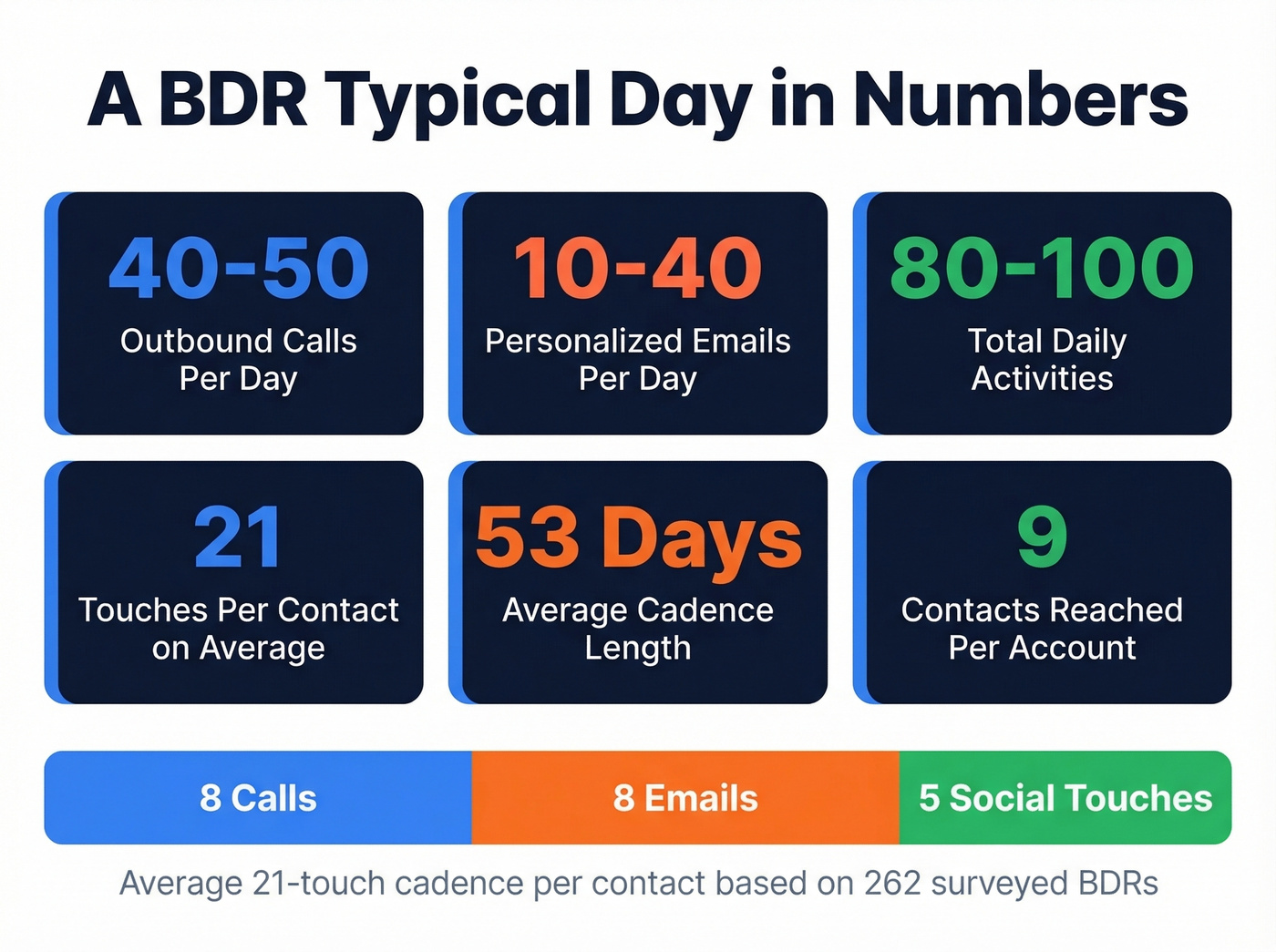
The average BDR runs a cadence of roughly 21 attempts per contact - about 8 calls, 8 emails, and 5 social touches - stretched across 53 days before moving on. That's not a suggestion. That's what benchmark data from 262 surveyed BDRs shows.
Your daily activity targets will look something like this: 40-50 outbound calls, 10-40 personalized emails, and enough social touches to hit 80-100 total activities per day. One Reddit poster starting their first BDR week reported expectations of 60 calls, 30 emails, and 30 social messages daily, which tracks with the upper end of industry norms. (Need a clean ramp plan? Use a 30-60-90 day plan.)
Here's where it gets real. Cold email reply rates run between 1% and 5% for most teams. Effective sequences built with genuine personalization can push that to 12%, but that's the exception, not the baseline. You'll send a lot of emails that disappear into the void.
On the phone side, expect 18+ dials to reach a single live person. Callback rates sit below 1%. This is why multi-threading has become non-negotiable - BDRs now reach out to an average of 9 individuals per account, up from 6.4 the prior year. You can't bet your quota on one contact picking up.
Meeting output varies widely. 5-25 meetings per month is the range, with outbound-focused reps averaging around 15. And 58% of BDRs are juggling more than 75 accounts per quarter, so time management isn't optional - it's survival.
The first 90 days are the hardest. Not because of the rejection, but because you don't yet know what "good" looks like. Once you internalize the benchmarks above, you can stop guessing and start measuring.
The job is repetitive, rejection-heavy, and deeply measurable. Every activity gets tracked. Every meeting gets scrutinized. But that transparency is also what makes the role a launchpad - when you perform, everyone sees it.
KPIs and Performance Benchmarks
Numbers matter more in this role than almost any other in the company.
| Metric | Benchmark |
|---|---|
| Calls per day | 40-50 |
| Emails per day | 10-40 |
| Total activities/day | 80-100 |
| Meetings booked/month | 5-25 |
| Attempts per contact | 21 |
| Cadence length | 53 days |
| Quota attainment (avg) | 88% |
| Cold email reply rate | 1-5% |
| Dials to connect | 18+ |
Average quota attainment across BDR teams runs at 88%. That's the team average - individual performance swings wildly. Supported BDRs (those with dedicated enablement, coaching, and tooling) hit 95% of quota versus 80% for unsupported reps. The gap isn't talent. It's infrastructure.
If you're a BDR manager reading this, that 15-point spread is the strongest argument you'll ever make for budget.
Data quality directly impacts your connect rate. Teams using verified mobile numbers report pickup rates around 30%. Every bad number is a wasted dial, and at 18+ dials per connect, you can't afford waste. We've seen this firsthand working with outbound teams - the difference between a 4% bounce rate and a 35% bounce rate isn't marginal. It's the difference between a rep who hits quota and one who burns out. (If you're troubleshooting bounces, start with email bounce rate.)
The SLA gap is also worth flagging. Only 7% of teams respond to inbound interest within five minutes. The average is 42 hours. If your org can close that gap, your conversion rates will look dramatically different from the benchmarks above.

You need 18+ dials to reach one person and cold emails reply at 1-5%. Bad data makes those numbers worse. Prospeo gives BDRs 98% verified emails and 125M+ direct dials with a 30% pickup rate - so every activity in your cadence actually reaches a real buyer.
Stop burning 80 daily activities on dead contacts.
Salary and Compensation in 2026
Let's talk money.
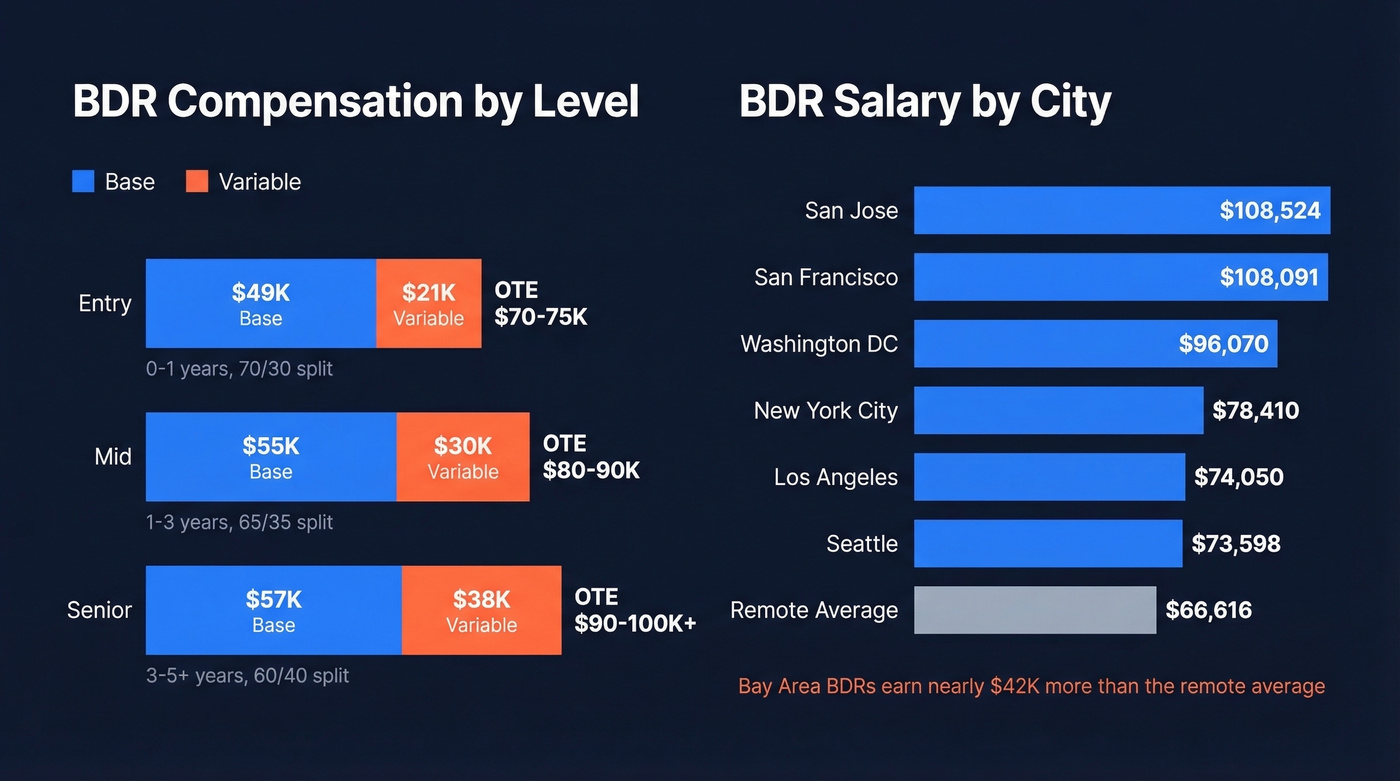
The median base salary for a BDR is $55,000, with a total OTE of $83,000. Top performers with accelerators and overachievement bonuses clear $130K+. PayScale's data from 919 salary profiles shows a base range of $42K at the 10th percentile to $77K at the 90th.
Compensation structure shifts as you gain experience:
| Level | Experience | OTE Range | Base/Variable Split |
|---|---|---|---|
| Entry | 0-1 year | $70K-$75K | 70/30 |
| Mid | 1-3 years | $80K-$90K | 65/35 |
| Senior | 3-5+ years | $90K-$100K+ | 60/40 |
The variable component gets more aggressive as you move up. Entry-level reps earn 70% base and 30% variable - the company is protecting you while you ramp. By the senior level, you're at 60/40, which means your paycheck swings meaningfully based on performance.
Commission models fall into three buckets. Activity-based plans pay $150-$200 per demo or meeting booked - straightforward and common for newer reps. Opportunity-based plans pay roughly $200 per Sales Accepted Opportunity, tying your comp to lead quality, not just volume. Revenue-based plans pay 1-4% of closed contract value, which aligns you directly with the AE's outcome. Most companies start BDRs on activity-based comp and graduate them to opportunity or revenue-based models.
Location matters enormously:
| City | Annual Salary |
|---|---|
| San Jose | $108,524 |
| San Francisco | $108,091 |
| Washington DC | $96,070 |
| New York City | $78,410 |
| Los Angeles | $74,050 |
| Seattle | $73,598 |
| Remote (avg) | $66,616 |
San Jose and San Francisco BDRs earn nearly $42K more than the remote average. That delta has compressed since 2020, but it hasn't disappeared. If you're optimizing for take-home pay relative to cost of living, remote roles in lower-cost markets often win.
One more data point: promotion timelines increased 28% post-pandemic. The average BDR now waits 15-16 months for a promotion, up from roughly 12. Plan accordingly.
Essential Skills for BDRs
The skills that separate top performers from average reps split cleanly into two categories.
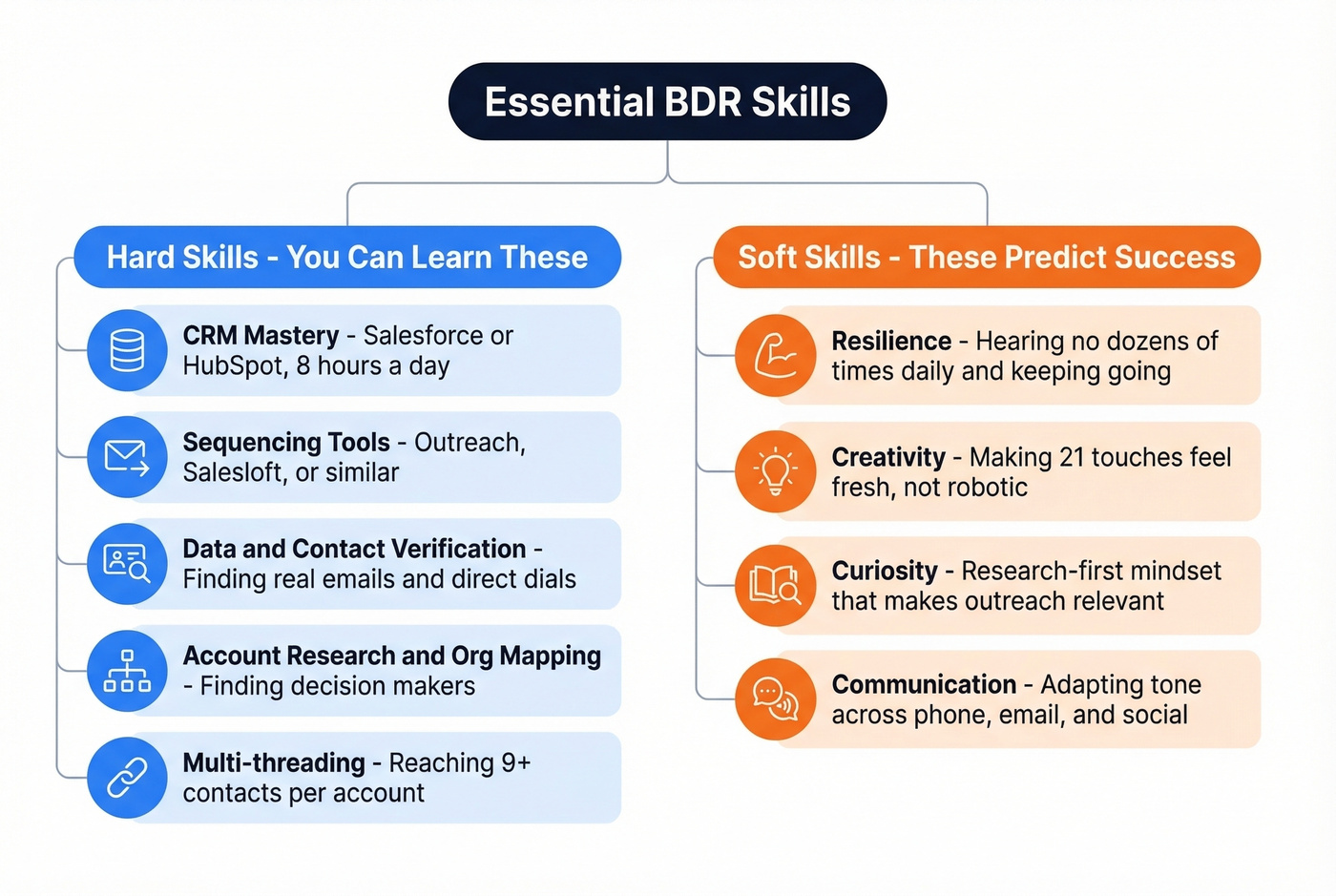
Hard skills you can learn:
- CRM proficiency in Salesforce or HubSpot - you'll live in your CRM eight hours a day (see examples of a CRM)
- Sequencing tools like Outreach or Salesloft until they feel like second nature
- Data tools for finding and verifying prospect contact information (more on data enrichment services)
- Research and account mapping - understanding org charts, identifying decision-makers, finding the right entry points
- Multi-threading across 9+ contacts per account with systematic tracking
Soft skills that predict success:
- Resilience - you'll hear "no" (or more often, nothing at all) dozens of times per day (build it like a system: resilience in sales)
- Creativity across channels - the 21-touch cadence reality means the same templated email sent eight times won't cut it
- Curiosity that drives a research-first mindset, making outreach feel relevant instead of spammy
- Communication across phone and written channels, adapting your message to different personas
- Time management that keeps you productive when juggling 75+ accounts with no one watching
The BDRs who get promoted fastest aren't the ones who make the most calls. They're the ones who make the smartest calls.
The Modern BDR Tech Stack
Your stack determines your ceiling. A rep with great instincts and terrible data will always lose to a mediocre rep with verified contact information and a solid sequencer.
Here's the thing - we've watched teams spend months optimizing their cadence copy while running on a contact database with 30%+ bounce rates. That's like tuning a race car engine and filling it with cooking oil. Fix the data first. Everything else follows.
| Pillar | Tools | Approx. Cost |
|---|---|---|
| Data & Intelligence | Prospeo, ZoomInfo, Apollo | Free-$15K+/yr |
| Engagement | Outreach, Salesloft | $100-$200+/user/mo |
| Conversation Intel | Gong | $100-$150+/user/mo |
| CRM | Salesforce, HubSpot | Free-$165+/user/mo |
| Dialers | Orum, Nooks | $150-$300+/seat/mo |

Data & Intelligence is the foundation. Your outbound results are only as good as your contact data. Prospeo maintains 300M+ professional profiles with 143M+ verified emails at 98% accuracy and 125M+ verified mobile numbers refreshed every 7 days. The free tier gives you 75 verified emails per month - enough to test before committing. At roughly $0.01 per email versus $1+ per lead at legacy providers, it's built for reps who need enterprise-grade data without enterprise pricing. (If you're comparing stacks, start with best sales prospecting databases.)
ZoomInfo (~$15K/year starting) offers one of the deepest US databases and strong intent signals, but comes with annual contracts and module complexity that most individual BDRs won't need. It's a great tool for large teams with budget; it's overkill for a five-person SDR pod.
Apollo (free tier with 50 credits/month, paid plans from ~$49/user/mo) covers 220M+ contacts and bundles a basic sequencer - solid for teams that want everything in one place and don't mind trading some data accuracy for convenience.
If you're building a BDR stack from scratch, start with three things: a CRM, a verified data provider, and a sequencing tool. Everything else is optimization. (For a broader shortlist, see SDR tools.)
Engagement platforms like Outreach and Salesloft ($100-$200+/user/mo) automate your multi-channel cadences and track every touchpoint. Gong ($100-$150+/user/mo) records and analyzes your calls so you can coach yourself - our team found it especially useful for ramping new reps who can study what top performers actually say on calls. Salesforce ($25-$165+/user/mo) and HubSpot (free to $150/user/mo) are the CRM layer where everything gets logged. Parallel dialers like Orum and Nooks ($150-$300+/seat/mo) let you call 5-10 prospects simultaneously - essential when you need 18+ dials per connect.
Career Paths After the BDR Role
You've been in the seat for 14 months. You're hitting quota. Your manager keeps saying "soon" about the AE promotion but nothing's happening.
Here's the playbook - and it's not just one path.
The standard promotion criteria across most SaaS companies: hit 90%+ quota for two consecutive quarters, then make your case. But "making your case" requires more than pointing at a dashboard. Shadow AEs on discovery calls. Learn to talk ROI, not features. Track your SQLs through to closed-won ACV so you can show pipeline impact, not just meeting volume. And tell your manager you want the promotion early - don't wait for them to bring it up.
| Path | Timeline | OTE Range | Best For |
|---|---|---|---|
| Account Executive | 12-18 months | $120K-$180K | Natural closers |
| Customer Success | 15-20 months | $80K-$110K | Relationship builders |
| Revenue Operations | 18-24 months | $90K-$130K | Systems thinkers |
| Marketing/Demand Gen | 18-24 months | Varies | Creative strategists |
Account Executive
The default path. High performers make the jump in 10-12 months; the average is 12-18. AE base salary runs $60K-$80K, with mid-market OTE of $120K-$180K.
You'll manage 20-50 active deals and get measured on quota attainment, win rate, and cycle length instead of activity volume. The transition from "book the meeting" to "close the deal" is bigger than most BDRs expect - discovery skills, negotiation, and forecast accuracy become your world. If you've been coasting on volume without learning to qualify deeply, the AE seat will expose that fast.
Customer Success Manager
Skip this path if you love the thrill of the hunt. But if you find yourself energized by the relationship side of sales - the follow-up calls where a prospect opens up about their real problems, the moments where you're genuinely helping someone think through a decision - CS is your lane.
The transition typically takes 15-20 months. Base salary ranges from $55K-$75K with total comp of $80K-$110K. Your BDR experience in multi-threading and account research translates directly to managing retention, expansion, and customer health.
Revenue Operations
Picture your typical Tuesday, but instead of making calls, you're figuring out why the team's connect rate dropped 4% last week. You're rebuilding the lead routing logic. You're auditing the CRM data that everyone else ignores.
The analytical BDRs - the ones who build their own dashboards and obsess over conversion rates - thrive here. Expect an 18-24 month timeline with base of $65K-$85K and total comp of $90K-$130K. The leverage is enormous: you're not carrying a quota, you're making every quota-carrier more effective.
Marketing and Demand Gen
Here's a stat that surprises people: some of the best demand gen marketers started as BDRs. They wrote cold emails that actually got replies. They built creative sequences that cut through noise. They learned, through thousands of reps, what messaging makes a prospect stop scrolling.
If that sounds like you, the 18-24 month timeline mirrors RevOps. Comp varies widely, but the BDR experience - understanding what actually gets prospects to respond - is an unfair advantage on the demand gen side.
AI and the Future of the Role
Let's address the elephant in the room. 60% of BDRs are already using AI tools, and 62% say it enhances their productivity. Only 13% see AI as a threat to their role.
The reps themselves aren't worried - and the data backs them up.
79% of organizations grew or maintained their BDR teams last year. 58% expanded. The BLS projects roughly 142,100 openings per year for adjacent sales representative roles. Companies aren't replacing BDRs with AI. They're arming them with it.
I'll stake my reputation on this: AI won't replace BDRs. It'll replace BDRs who don't use AI. The reps who use AI for account research, email personalization, cadence optimization, and call prep will outperform those who don't by a widening margin. But the human elements - reading a room on a cold call, building genuine rapport with a skeptical VP, multi-threading across a complex buying committee - those aren't getting automated anytime soon.
The smart play is to treat AI as a force multiplier. Use it to do the research that used to take 20 minutes per account in 2 minutes. Use it to draft personalized first lines that you then edit with your own voice. Use it to analyze call recordings and identify patterns in your wins. Then bring the human judgment that no model can replicate.
How to Land a Job
You don't need a degree. Most SaaS companies prioritize coachability, communication skills, and resilience over formal education.
Treat the interview like a sales call. You're the product. Research the hiring manager. Come with specific questions about their ICP, tech stack, and quota structure. Ask what separates their top performers from average ones.
Demonstrate resilience in real time. Hiring managers throw curveball questions and role-play scenarios specifically to see how you handle pressure. Your reaction matters more than your answer.
Prospect your way in. The best roles get filled through referrals before they hit job boards. Connect with BDR managers at companies you're targeting. Ask for 15-minute informational calls. If you can't prospect your way into an interview, that tells the hiring manager something.
Use adjacent experience. Retail, hospitality, customer support - any role where you handled rejection and talked to strangers translates. Certifications like the AIBMC's Certified Business Development Manager can differentiate you, but they're not required.
Ask for feedback after every interview, whether you get the offer or not. The BDRs who improve fastest treat rejection as data.
The consensus on r/sales is pretty consistent: the BDR role is the fastest path into tech sales if you can survive the first 90 days. After that, the compounding skills and network effects kick in. The grind is real, but so is the upside.
Multi-threading 9 contacts per account means you need accurate data across entire org charts. Prospeo's 300M+ profiles with 30+ filters - including job changes, department headcount, and buyer intent - let BDRs build target lists in minutes, not hours.
Cut your list-building time and triple your pipeline output.
FAQ
Is a BDR role a good career?
Yes - median OTE is $83K with a clear path to account executive ($120K-$180K OTE) within 12-18 months. 79% of companies grew or maintained their BDR teams in the past year, and the role builds foundational sales skills that transfer to four distinct career paths including Customer Success, RevOps, and Marketing.
What's the difference between a BDR and an SDR?
Most companies use the terms interchangeably. When they distinguish, BDRs typically handle outbound prospecting to net-new accounts while SDRs qualify inbound leads from demo requests and MQLs. The real distinction is workflow and lead source, not title.
How many calls should a BDR make per day?
Industry benchmarks range from 40-50 calls per day, with 80-100 total activities including emails and social touches. Expect 18+ dials to reach a single live connection. Teams using parallel dialers like Orum or Nooks push call volume significantly higher.
What tools do BDRs need for prospecting?
A modern stack starts with a CRM (Salesforce or HubSpot), a verified data provider for accurate emails and direct dials, and a sequencing tool like Outreach or Salesloft. AI-powered dialers and conversation intelligence platforms like Gong round out the stack at scale.
What does a typical day look like?
A typical day involves 40-50 outbound calls, 10-40 personalized emails, and social touches totaling 80-100 activities. Between outreach blocks, you'll research accounts, update your CRM, prep for meetings, and debrief with your manager on pipeline progress.