

Business Pain Points: What the 2026 Data Says (and How to Find Your Real Ones)
It's Q1 planning, and the wheels are starting to wobble.
CAC is up 40% year-over-year. Sales blames marketing for bad leads. Marketing blames sales for not following up. Nobody's looked at the contact database - which hasn't been updated in years - and now 30% of outbound emails are bouncing. Everyone's treating symptoms. Nobody's diagnosing the actual business pain points.
Here's the contrarian thesis: you don't have 17 problems. You have two or three root causes, and the rest are symptoms. The 2026 data backs this up.
Quick version: The three most common pain points right now:
- Inflation and rising costs - 45% of SMBs call it their #1 challenge
- Hiring qualified people - 88% report few or no qualified applicants
- Cash flow tightening - only 24% of small businesses feel "very comfortable" with cash flow, down from 31% last quarter
Most businesses think they have a dozen pain points. They actually have two or three generating a cascade of symptoms. This article gives you the data, a diagnostic framework, and the five mistakes that keep teams stuck treating the wrong problems.
What Is a Business Pain Point?
A business pain point is any persistent problem that costs you money, time, or growth. That's the simple version. The useful version needs sharper categories.
The Nielsen Norman Group's three-level model breaks pain points into interaction-level problems like a single broken workflow, journey-level friction across a multi-step process, and relationship-level failures - systemic trust or alignment breakdowns that compound over months. Most teams only see interaction-level problems: the CRM is slow, the emails bounce, the report takes too long. The real damage happens at the journey and relationship levels, where small frictions stack into structural dysfunction that nobody owns.
There's also a critical distinction between customer pain points and internal organizational challenges. This article focuses on the internal side - the operational, financial, and structural problems that erode your margins and stall your growth.
The Numbers Right Now
Four major sources paint a consistent picture heading into 2026: the U.S. Chamber/MetLife Small Business Index, NFIB's monthly survey, Gusto's 2025 SMB research, and the Federal Reserve's survey of business resource organizations.
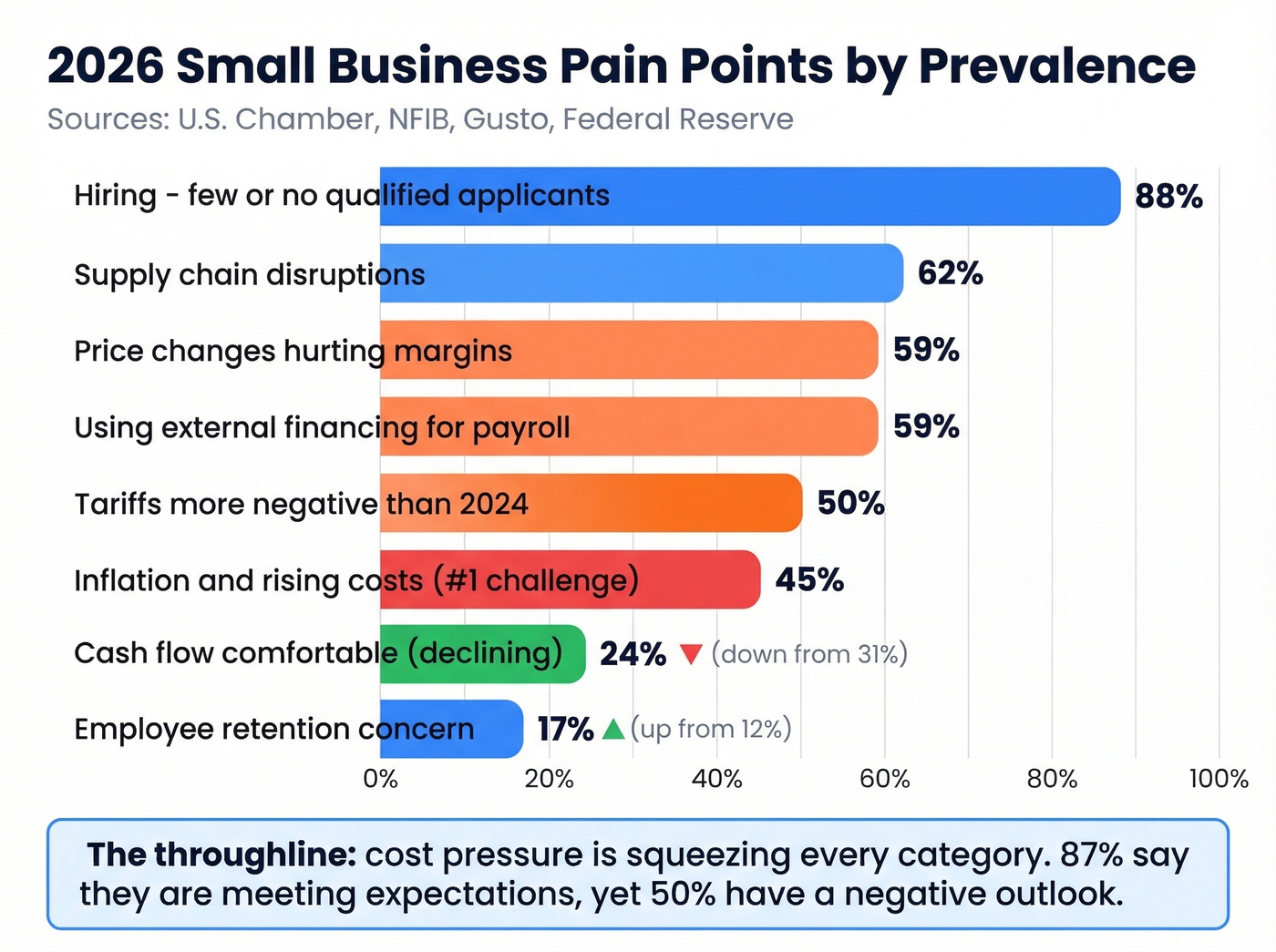
| Pain Point | Source | Prevalence |
|---|---|---|
| Inflation / rising costs | U.S. Chamber Q4 2025 | 45% cite as #1 |
| Hiring qualified people | NFIB Feb 2026 | 88% few/no applicants |
| Supply chain disruptions | NFIB Feb 2026 | 62% affected |
| Price pressure on margins | Gusto 2025 | 59% say price changes hurt more than last year |
| Employee retention | U.S. Chamber Q4 2025 | 17% (up from 12% YoY) |
| Cash flow tightening | U.S. Chamber Q4 2025 | 24% "very comfortable" (down from 31%) |
| Insurance costs | NFIB Feb 2026 | 13% - highest since 2018 |
| Tariff impact | Gusto 2025 | 50% say tariffs were more negative than 2024 |
Cost pressure is the throughline. Talent concerns are rising fast. Attracting talent jumped from 6% to 14% as a top challenge in just one year, while retention went from 12% to 17% over the same period. These aren't separate problems - they're two faces of the same workforce squeeze.
There's a paradox in the data worth sitting with: 87% of small businesses say they're meeting or exceeding expectations, yet 50% have a negative economic outlook. They're surviving but not confident about what's next.
A Federal Reserve survey of 143 business resource organizations confirmed the same themes: tariffs, rising prices, tighter lending, and hiring challenges driven partly by immigration-policy-related worker availability concerns. The Gusto survey adds a troubling detail: 59% of small businesses are using external financing - but for payroll and short-term expenses, not growth. When financing covers operating costs instead of expansion, you're running to stand still.
The 4 Categories of Pain Points
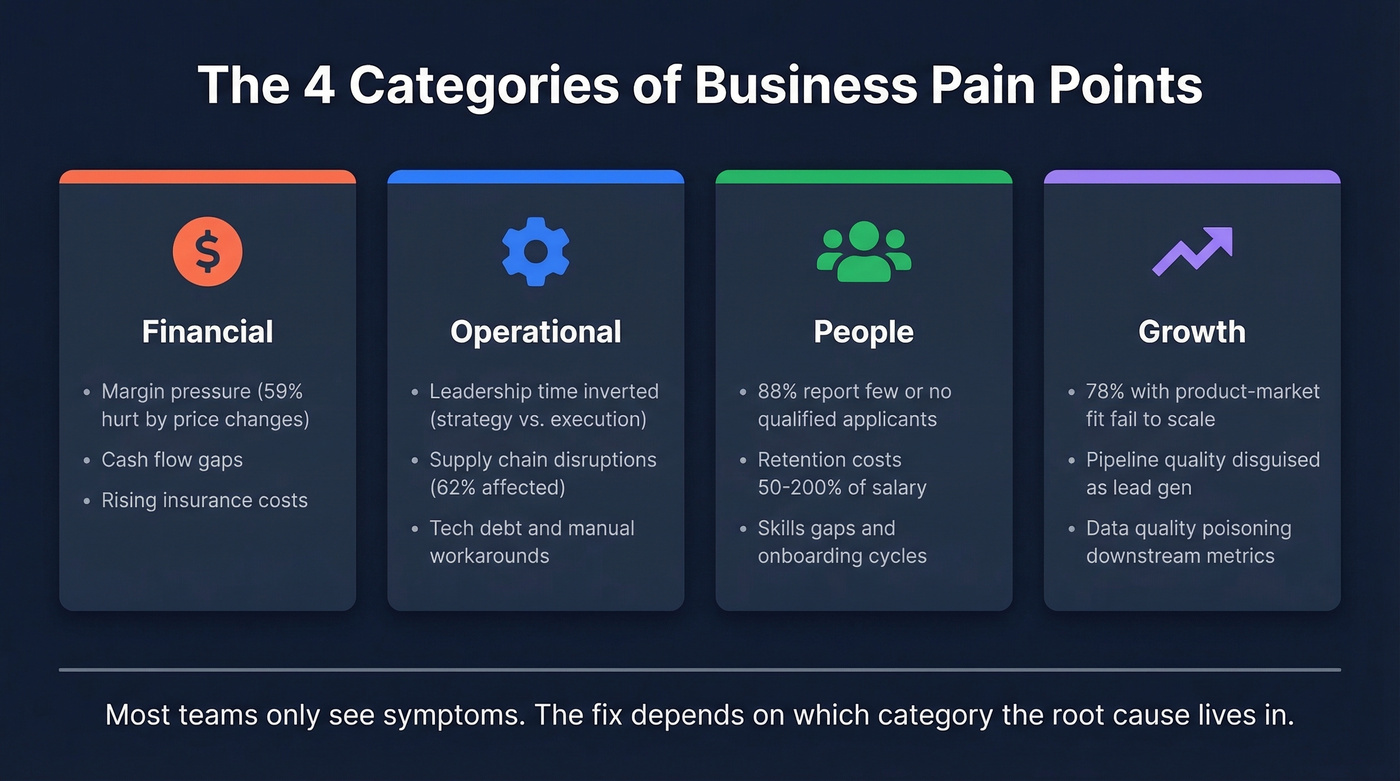
Every business pain point falls into one of four buckets. Knowing which bucket yours lives in determines what kind of fix it needs.
Financial Pain Points
Margin pressure is one of the defining stories of 2026. 59% of small businesses say price changes have hurt them more this year than last, and 58% expect to raise prices. But raising prices only works if your customers don't leave - and in a market where half of owners have a negative economic outlook, that's not guaranteed.
Cash flow gaps are the silent killer. One bad quarter, one late-paying client, and the whole thing tightens. The gap between accrual profitability and cash-in-bank reality is where businesses quietly die.
If you're trying to quantify the upstream driver behind rising acquisition costs, start with your Cost to Acquire Customer math and work backward.
Operational Pain Points
Here's a useful benchmark: a CEO should spend roughly 70% of their time working on the business and 30% working in it. VPs should be at 50/50, managers at 30/70, entry-level at 10/90. In practice, most SMB founders are completely inverted - buried in day-to-day operations with no time for strategy.
If your leadership team's ratio is flipped, that's not a time management problem. It's a structural one.
Supply chain disruptions remain stubbornly persistent, with 62% of small businesses reporting some degree of impact. Tech debt compounds the problem - when your systems can't talk to each other, every disruption requires manual intervention that eats hours nobody budgeted for.
If your "systems can't talk to each other" problem is really a process issue, map it as sales process optimization before you buy more tools.
People Pain Points
88% of businesses trying to hire report few or no qualified applicants. The downstream effects - productivity gaps, institutional knowledge loss, constant onboarding cycles - multiply the cost of every departure. Industry estimates put the cost of replacing a knowledge worker at 50-200% of their annual salary when you factor in ramp time, slipped deals, and cultural drag.
Even when you can hire, quality is the real constraint. Skills, ownership, and consistency matter more than headcount.
If retention is the symptom, run a quick churn analysis on customers and employees to spot the pattern.
Growth Pain Points
78% of companies that achieve product-market fit still fail to scale. McKinsey's framework breaks scaling into three areas: the engine room (your product and GTM motion), accelerators (market expansion and partnerships), and the cockpit (leadership, people, and data infrastructure). Most companies stall in the engine room because their go-to-market motion doesn't industrialize.

Pipeline quality is a growth challenge that masquerades as a lead generation problem. If your SDRs spend half their time on bounced emails and disconnected numbers, the issue isn't "we need more leads" - it's data quality. Stale contact data poisons every downstream metric: reply rates, meetings booked, pipeline generated.
If you're diagnosing why pipeline isn't converting, compare your symptoms to common sales pipeline challenges before you scale outbound volume.
Warning signs that your growth problem is actually a data problem: sales concentration in a few reps who manually verify their own lists, high early attrition in outbound sequences, and a bounce rate above 5%.
If bounce is creeping up, benchmark it against email bounce rate norms and fix the root cause first.

The article says it clearly: stale contact data poisons every downstream metric. If 30% of your emails bounce, that's not a lead gen problem - it's a data quality problem. Prospeo's 98% email accuracy and 7-day refresh cycle eliminate the root cause.
Stop treating symptoms. Fix the data that feeds your entire pipeline.
The Cost of Doing Nothing
The status quo is the most expensive option. That's not a platitude - it's math.
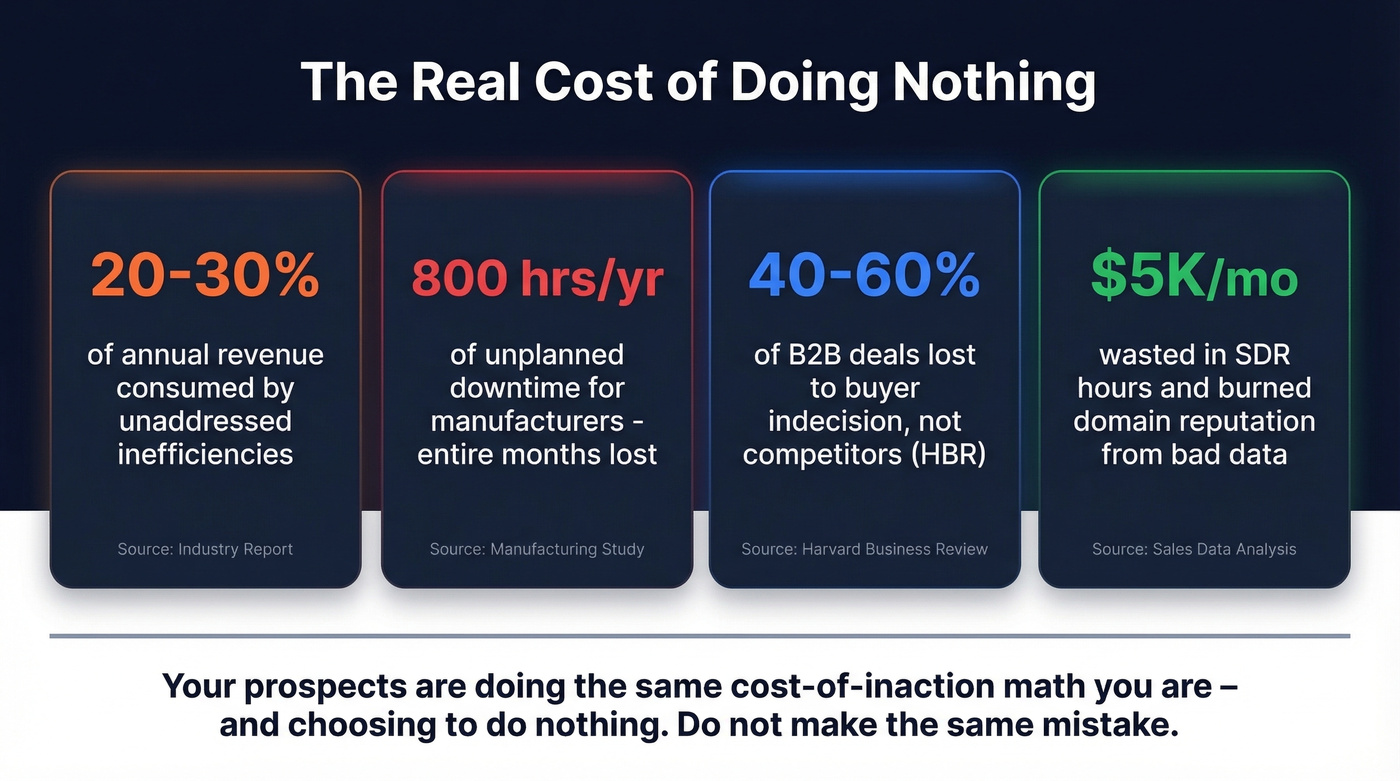
Unaddressed internal inefficiencies can consume 20-30% of a company's annual revenue. For manufacturers specifically, unplanned downtime can hit 800 hours per year - entire months of lost production. On the sales side, HBR authors Matthew Dixon and Ted McKenna have documented that 40-60% of B2B deals are lost to customer indecision, not to competitors. Your prospects are doing the same cost-of-inaction calculation you are - and choosing to do nothing.
The irony is painful: you're losing deals because buyers won't act on their challenges, while you're simultaneously not acting on yours.
Look, if your average deal size is under $25K, the cost of inaction on data quality alone probably exceeds the cost of every tool you'd need to fix it. Most teams agonize over a $200/month subscription while hemorrhaging $5K/month in wasted SDR hours and burned domain reputation.
If domain reputation is taking hits, start with an email deliverability guide and work outward.
How to Find Your Real Pain Points
Stop brainstorming in a conference room. Start with structured diagnosis. The most damaging problems are the ones nobody has named yet - they hide inside workarounds, tribal knowledge, and "that's just how we do it" processes.
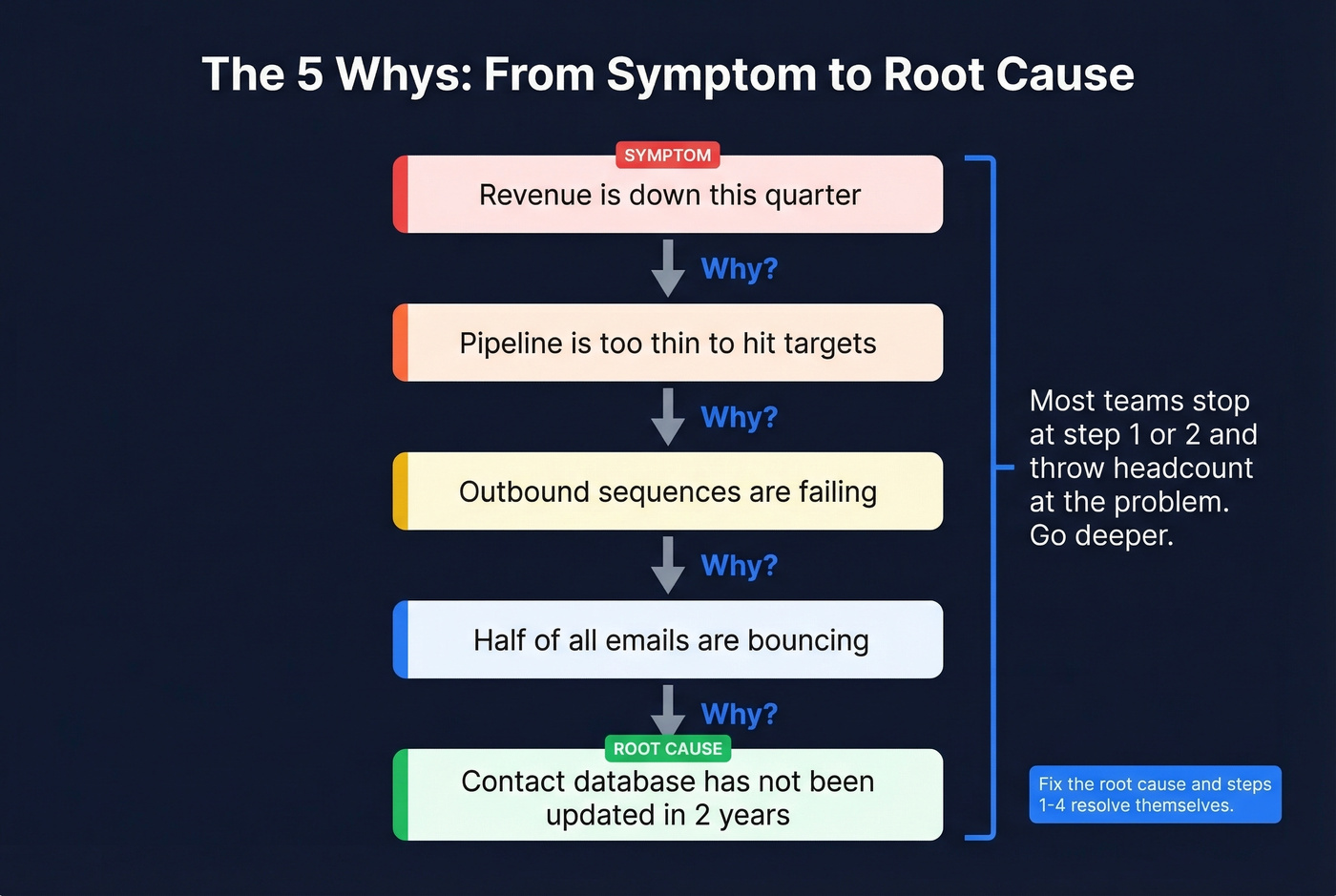
Run the 5 Whys
Take your most obvious problem and ask "why" five times. Revenue is down. Why? Pipeline is thin. Why? Outbound is failing. Why? Half the emails are bouncing. Why? The contact database hasn't been updated in years. Now you've found something you can actually fix.
Interview Across Functions
Schedule 20-30 minute conversations with people in different roles. Use open-ended prompts: "What's the most frustrating part of your workflow?" and "What workarounds have you built?" In our experience, the workarounds question reveals more than any formal survey - people build workarounds around the real friction, not the perceived ones. We've run this exercise with our own team and consistently found that the problems people complain about in Slack aren't the problems actually costing us money.
If you need a tighter way to define "bad leads" across teams, align on an Ideal Customer Profile before you change targeting.
Prioritize with Impact vs. Effort
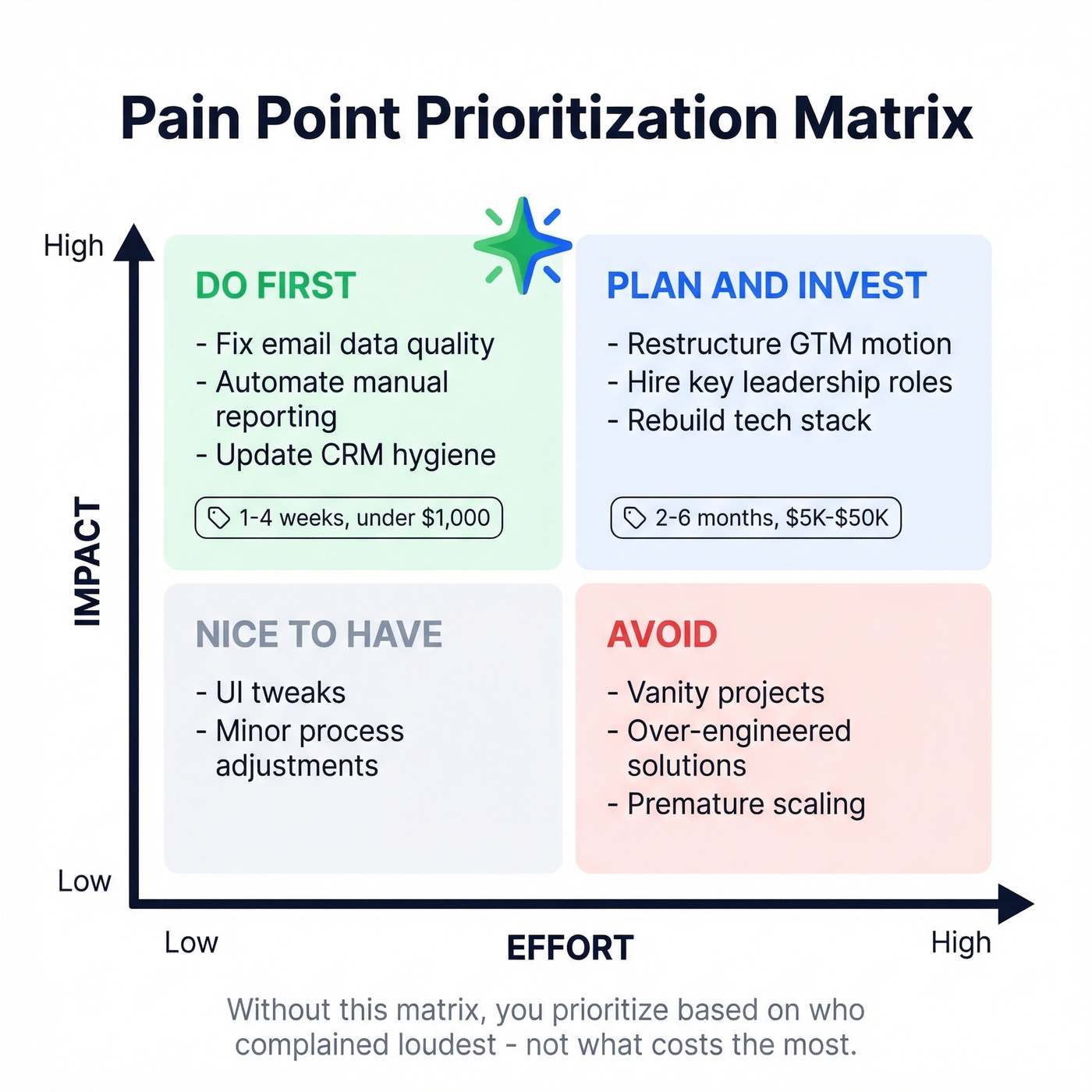
Plot each pain point on two axes: how much it costs you and how hard it is to fix. Start with the high-impact, low-effort quadrant. Quick wins typically take 1-4 weeks and under $1,000. Structural fixes run 2-6 months and require $5K-$50K in investment. Without this matrix, you'll prioritize based on who complained loudest - and that person is almost never pointing at the most expensive problem.
If you're prioritizing pipeline fixes, it helps to track pipeline health metrics alongside the matrix.
5 Mistakes That Make Problems Worse
1. Treating symptoms instead of root causes. You see declining revenue and hire more SDRs. But the real problem is a 35% email bounce rate destroying your domain reputation. More reps sending to bad data just accelerates the damage.
2. Not involving the right people. Leadership sees the P&L. Frontline reps see the workflow friction. If you only ask one group, you get half the picture.
3. Failing to align on the problem definition. "We need better leads" means something different to marketing, sales, and RevOps. We've seen teams build three different solutions to three different interpretations and solve none of them.
If RevOps is the missing owner, define the role and responsibilities of a RevOps Manager before you rebuild the process.
4. Ignoring technology as part of the solution. Teams throw headcount at problems that a $200/month tool would fix. Manual data cleaning, spreadsheet-based reporting, copy-paste prospecting - these are technology problems wearing people-problem costumes. Skip this mistake if you're already running a modern stack, but if your team is still exporting CSVs and manually deduping in Google Sheets, you're burning money.
If you're evaluating fixes for stale records, compare data enrichment services before you commit to a workflow.
5. No framework - just gut feel. Gut-feel prioritization consistently overweights the most recent complaint and underweights the most expensive problem. The consensus on r/sales is that most teams don't even know their bounce rate, let alone track it as a KPI.
Let's walk that 5 Whys example to its conclusion. Revenue is down, pipeline is thin, outbound is failing, emails are bouncing at 35%, and the contact database is two years stale. That's the root cause. The fix isn't more reps or more leads - it's better data. Prospeo customers have documented this exact turnaround: Snyk's AE-sourced pipeline jumped 180% and GreyScout saw a 140% pipeline increase after switching, with bounce rates dropping from 35-40% to under 5% in both cases.
Pipeline quality masquerading as a lead gen problem is one of the most expensive misdiagnoses in B2B. Teams using Prospeo's 300M+ verified profiles book 35% more meetings than Apollo users - because clean data at $0.01/email fixes the root cause, not the symptom.
Diagnose your real pain point: it's the data layer underneath everything else.
FAQ
What are the most common business pain points in 2026?
Inflation (45%), hiring difficulty (88% report few or no qualified applicants), supply chain disruptions (62%), cash flow pressure, and employee retention - based on NFIB, U.S. Chamber, and Gusto surveys. Cost pressure and the talent squeeze are the two dominant root causes generating most downstream symptoms.
What's the difference between a pain point and a symptom?
A pain point is the root cause; symptoms are what you notice first. "Revenue is down" is a symptom. "Our contact database bounces 35% of outbound emails" is the underlying problem. Use the 5 Whys technique to trace any visible symptom back to its structural origin.
How do I prioritize which pain points to fix first?
Use an impact vs. effort matrix. Plot each issue by cost and difficulty, then start with high-impact, low-effort items - your quick wins. Switching to a verified data source with 98% email accuracy and a weekly refresh cycle is a low-effort fix that immediately improves pipeline quality.
Are B2B and B2C pain points different?
Yes. B2B clusters around pipeline complexity, long sales cycles, and data quality. B2C centers on conversion friction, support responsiveness, and price sensitivity. The diagnostic framework - 5 Whys, cross-functional interviews, impact vs. effort priorititization - works identically for both.