

Candidate Sourcing: Strategy, Tools, and the Data Problem Nobody Talks About
You send 200 outreach emails to sourced candidates. Sixty bounce. Another 40 land in spam. The hiring manager asks why the pipeline's empty, and you're staring at a spreadsheet full of dead addresses.
That's not a messaging problem - it's a data problem. With 70% of the talent market sitting passively on the sidelines, the recruiters who win at candidate sourcing aren't sending the most emails. They're reaching verified inboxes with messages worth reading.
The Short Version
Align with your hiring manager before you touch a single tool - this step is 4x more influential than any other driver of talent acquisition performance. Source passive candidates with personalized "Why you, why now" outreach. Verify your contact data before sending anything. If your bounce rate sits above ~5%, your data is the bottleneck, not your copy.
What Is Candidate Sourcing?
Candidate sourcing is the proactive, top-of-funnel work of identifying, engaging, and attracting potential candidates before they ever hit a formal application. It's the pipeline-building phase - everything that happens before structured interviews begin.
Finding people and getting them interested? That's sourcing. Evaluating, negotiating, and closing? That's recruiting. Sourcing feeds the pipeline; recruiting converts it.
| Sourcing | Recruiting | |
|---|---|---|
| Goal | Build qualified pipeline | Hire the right person |
| Funnel stage | Top of funnel | Mid to close |
| Activities | Search, outreach, engage | Screen, interview, offer |
| Key metric | Response rate, pipeline volume | Time-to-fill, offer acceptance |
| Ownership | Sourcer / recruiting coordinator | Recruiter / hiring manager |
If your pipeline is thin, you have a sourcing problem. If candidates drop off after interviews, you have a recruiting problem. Different fixes entirely.
How to Build a Sourcing Strategy
Most guides start with "pick your channels" or "write Boolean strings." The real starting point is much less exciting - and much more important.
1. Lock in hiring manager alignment first. Developing relationships with hiring managers is the #1 driver of talent acquisition performance - 4x more influential than any other factor. Run a kickoff meeting. Get explicit on must-haves versus nice-to-haves. Agree on what "qualified" looks like before you source a single name.
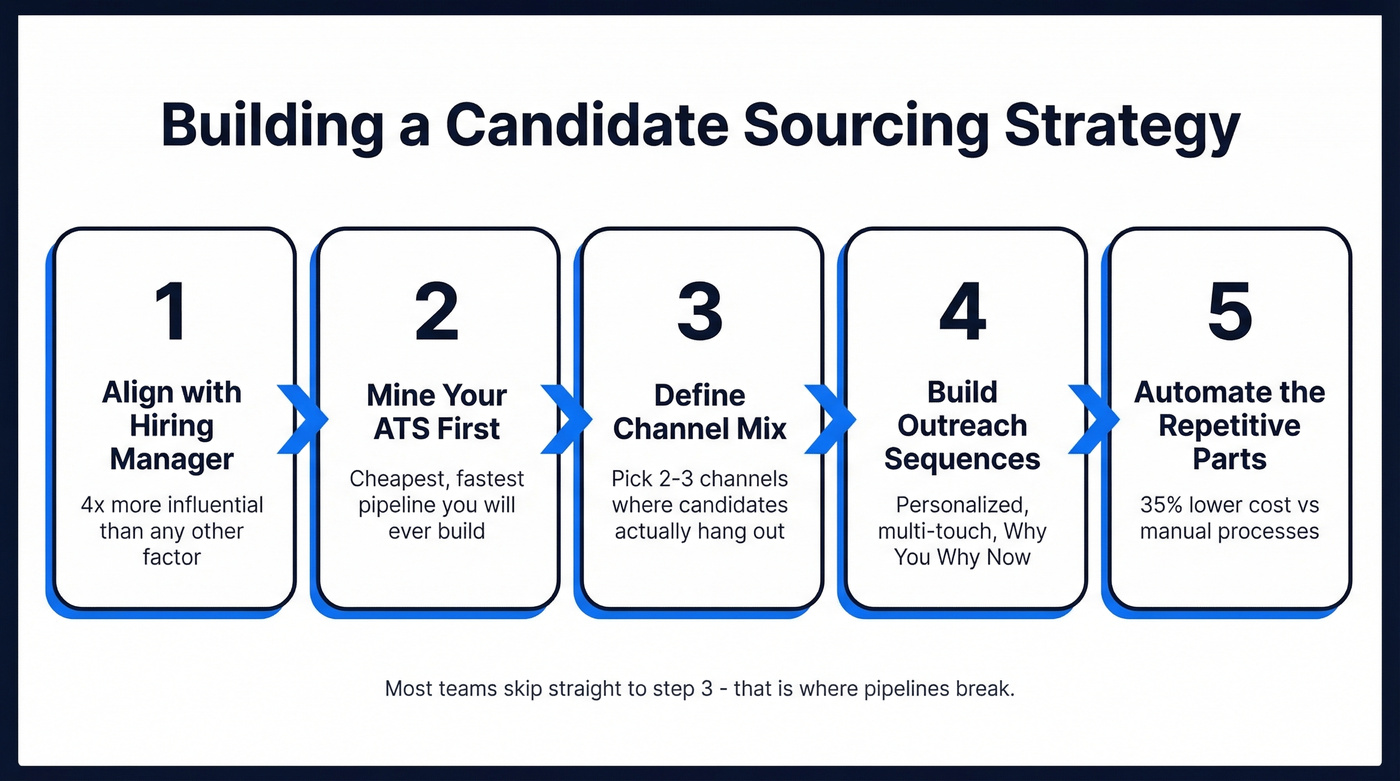
2. Mine your ATS before going external. Your database already has prior applicants, silver-medal finalists, and sourced candidates who weren't ready last time. This is the cheapest, fastest pipeline you'll ever build, and most teams skip it entirely.
3. Define your channel mix. Pick 2-3 channels based on where your target candidates actually spend time - GitHub and Stack Overflow for engineers, Dribbble for designers, niche Slack communities for product managers, alumni networks for executive roles. Single-channel dependence is one of the most common sourcing failures we see.
4. Build your outreach sequences. Personalized, multi-touch, and anchored in "Why you, why now." (If you're also running outbound, the same sequencing principles apply - see sequence management.)
5. Automate the repetitive parts. Non-automated recruitment processes carry a 35% higher cost. Use your ATS for pipeline tracking, email sequencing, and candidate tagging. Save your human judgment for evaluating fit and crafting personalized messages.
Passive Candidate Sourcing
Passive candidates aren't applying to your jobs or browsing job boards. But they're reachable - if you understand the spectrum. Think of them in three tiers:
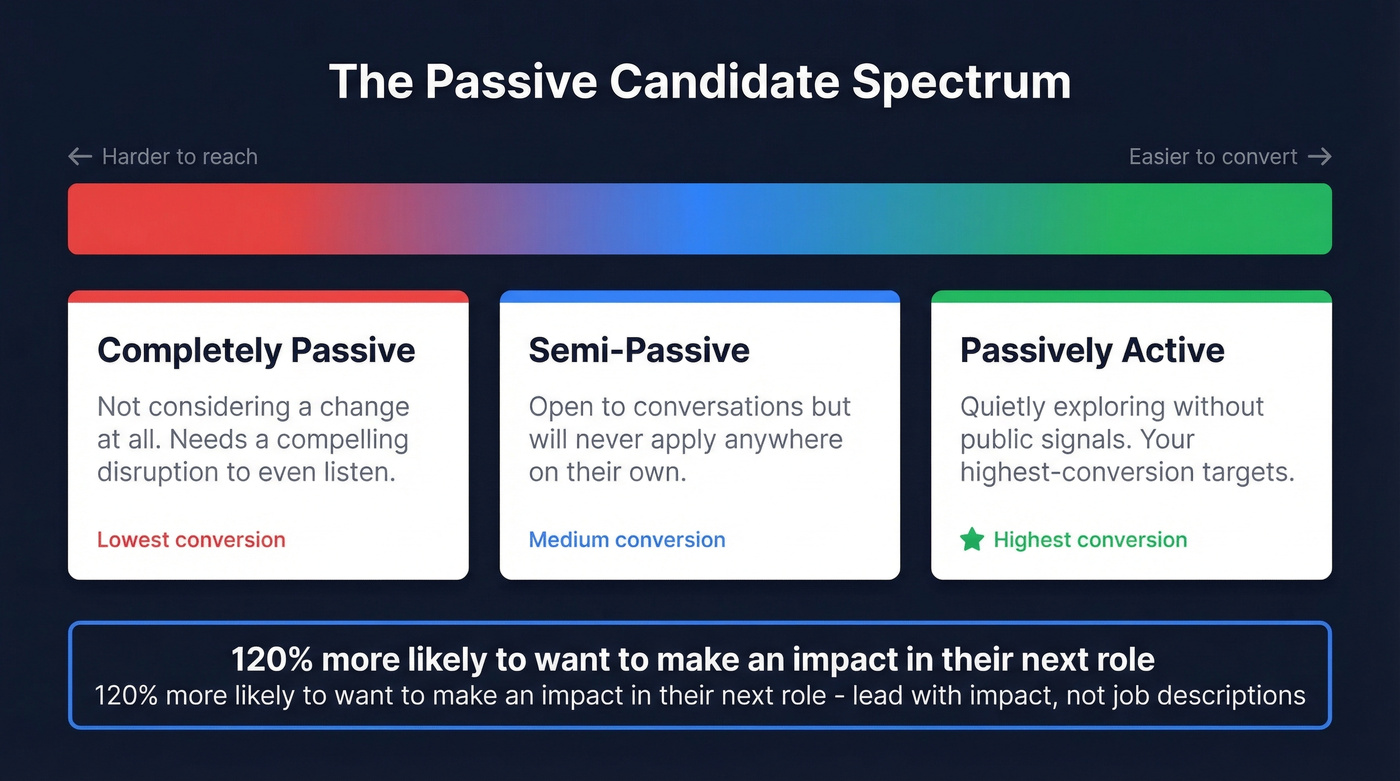
- Completely passive - not considering a change at all, need a compelling disruption
- Semi-passive - open to conversations but won't apply anywhere
- Passively active - quietly exploring without public signals, and these are your highest-conversion targets
Passive candidates are 120% more likely to want to make an impact in their next role. That tells you exactly how to message them: lead with the impact of the role, not the job description.
The "Why You, Why Now" Framework
Every outreach message should answer two questions. Why you - what specifically about this person's background makes them a fit. Why now - what's happening at your company that makes this the right moment.
Look for excellence signals beyond titles and keywords: conference speakers, open-source contributors, high-growth company alumni, published researchers. These are the markers of high performers who won't show up in a basic keyword search.
Before: "Hi Sarah, I came across your profile and thought you'd be a great fit for our Senior Engineer role. Let me know if you're interested!"
After: "Sarah - your talk at QCon on distributed caching caught my attention. We're rebuilding our real-time data layer at [Company] and need someone who's solved exactly that problem. Worth a 15-minute call this week?"
One critical step before you hit send: verify your list. A 35% bounce rate doesn't just waste your outreach - it damages your sender reputation and tanks future deliverability for every email you send after that. (If you're diagnosing deliverability issues, start with email bounce rate and then work through an email deliverability guide.)

A 35% bounce rate doesn't just kill your outreach - it flags your domain and tanks every future email you send. Prospeo's 5-step email verification delivers 98% accuracy, so your carefully crafted candidate messages actually reach real inboxes. At $0.01 per verified email, cleaning a 1,000-candidate list costs less than a coffee.
Stop sourcing into the void. Verify every email before you hit send.
Boolean Search Cheat Sheet
Boolean search is still one of the most powerful sourcing skills in 2026. The core operators - AND, OR, NOT - are simple to learn but take practice to master.
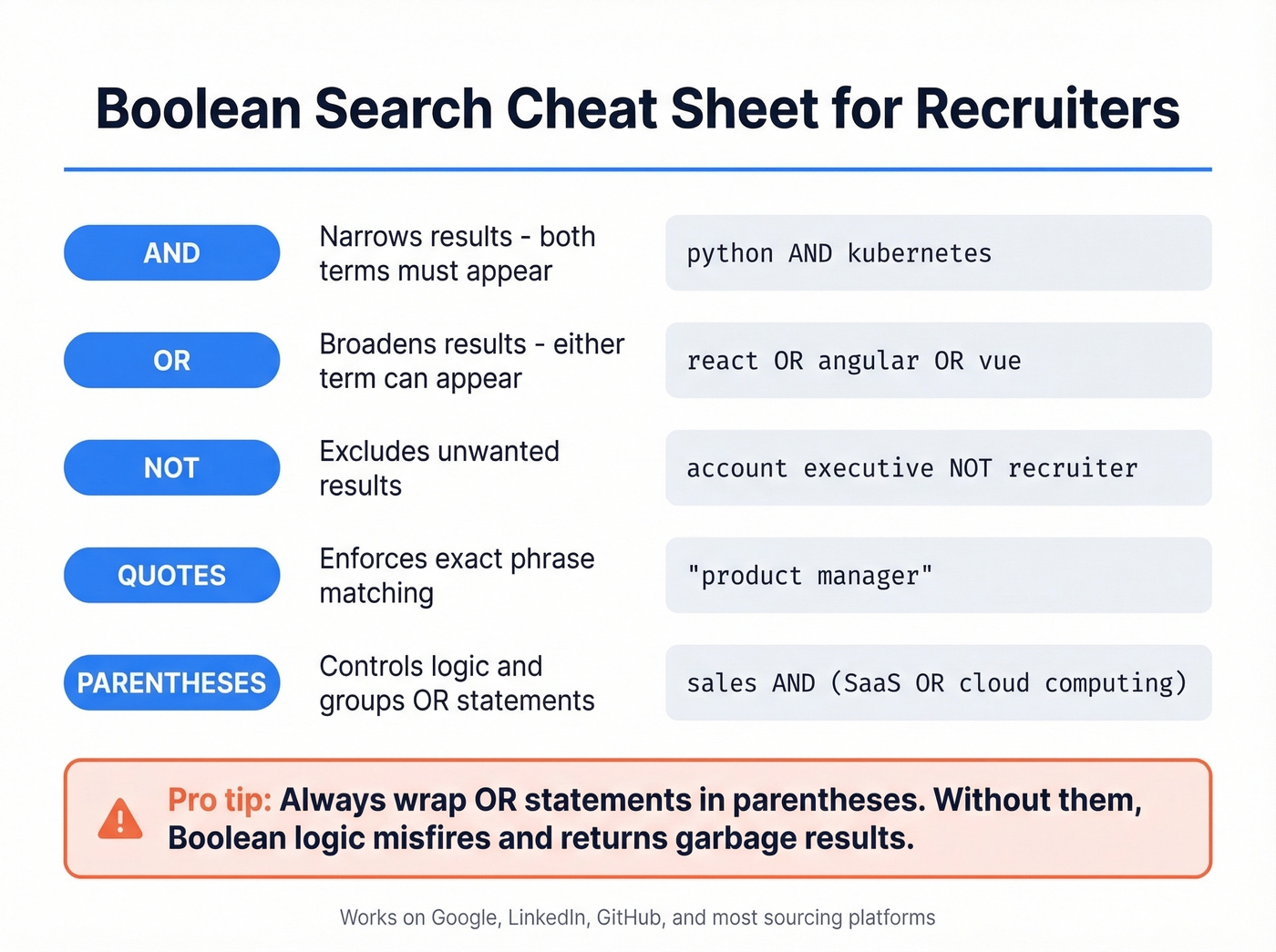
Core operators:
- AND narrows results:
python AND kubernetes - OR broadens results:
react OR angular OR vue - NOT excludes:
"account executive" NOT recruiter - "Quotes" enforce exact phrases:
"product manager" - Parentheses control logic:
sales AND (SaaS OR "cloud computing")
Always wrap OR statements in parentheses. Without them, Boolean logic can misfire and return garbage results. You can also use Google's search bar with the same operators plus site: to target specific platforms like GitHub or professional networks.
Ready-to-Use Strings
If you don't want to build strings from scratch, a boolean string generator can save time - several free tools let you input job titles, skills, and exclusions, then output a ready-to-paste query. But understanding the logic yourself means you can troubleshoot when results look off.
Software Engineer (backend, Python/Go):
("software engineer" OR "backend engineer" OR "SDE") AND (python OR golang OR go) AND (AWS OR GCP OR Azure) NOT (intern OR junior OR recruiter)
Account Executive (SaaS, mid-market):
("account executive" OR "AE" OR "sales executive") AND (SaaS OR "B2B software") AND ("mid-market" OR "commercial") NOT (SDR OR BDR OR manager)
Marketing Manager (demand gen):
("marketing manager" OR "demand generation" OR "growth marketing") AND (HubSpot OR Marketo OR "marketing automation") NOT (intern OR coordinator OR agency)
AI Tools for Sourcing in 2026
The AI recruitment market hit $661M in 2023 and is projected to exceed $1.1B by 2030. 45% of organizations now use at least one AI tool in their hiring workflow, up from 29% in 2022.
Here's the thing: AI without governance is just automated spam. The EU AI Act and EEOC guidance increase compliance pressure to document how AI tools are evaluated for bias and impact. Before you buy any AI sourcing tool, run it through this checklist:
- Identity discipline - Does it deduplicate, merge records, and track source attribution?
- Consent-safe outreach - Does it enforce suppression lists, throttle sends, and propagate opt-outs?
- Workflow completion - Does it handle the full loop from reply to screen to schedule with clean ATS writeback?
- Evidence retention - Can you export logs and configuration history for audits?
- Operability - Can your ops team own the rules and rollback without vendor support?
Let's be honest: most recruiting teams with fewer than 10 open roles at a time don't need a $2,000/month AI sourcing platform. A solid Boolean search workflow, a verified contact database, and a good outreach sequencer will outperform an expensive AI tool that nobody on your team has time to configure properly. We've seen this play out repeatedly with the teams we work with. (If you're using AI to scale outreach, keep your guardrails tight - AI cold email outreach covers what to automate vs. what not to.)
Best Candidate Sourcing Tools
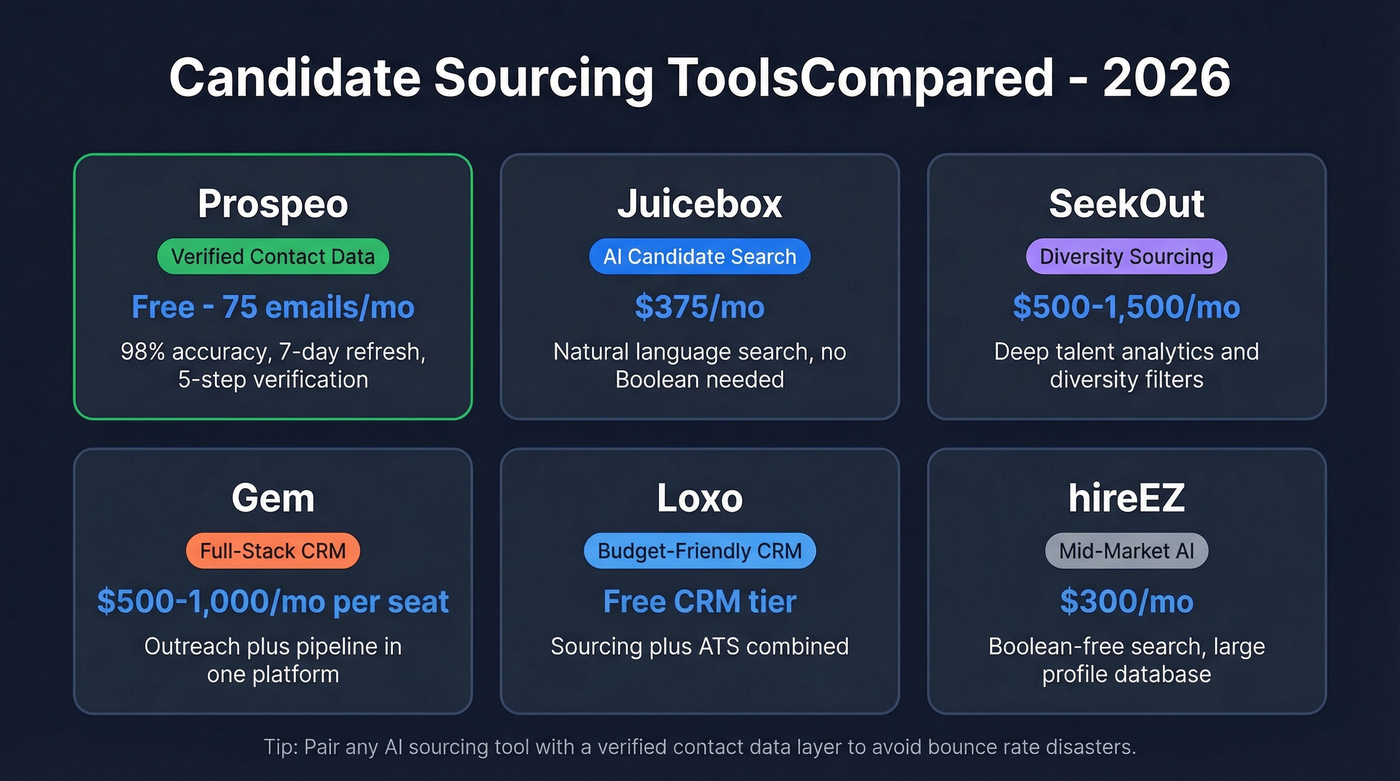
| Tool | Best For | Starting Price | Key Differentiator |
|---|---|---|---|
| Prospeo | Verified contact data | Free (75 emails/mo) | 98% accuracy, 7-day refresh |
| Juicebox | AI candidate search | $375/mo (250 credits) | Natural language search |
| SeekOut | Diversity sourcing | ~$500-1,500/mo | Deep talent analytics |
| Gem | Full-stack sourcing CRM | ~$500-1,000/mo per seat | Outreach + pipeline in one |
| Loxo | Budget-friendly CRM | Free CRM tier | Sourcing + ATS combined |
| hireEZ | Mid-market AI sourcing | ~$300/mo | Boolean-free search + large profile database |
Prospeo
Your sourcing tool finds the candidates. Prospeo makes sure you can actually reach them. With 300M+ professional profiles, 143M+ verified emails, and 125M+ verified mobile numbers, it's the data accuracy layer that sits underneath every other tool in your stack. (If you're comparing data sources, start with data enrichment services and best B2B company data providers.)
98% email accuracy, a 7-day data refresh cycle, and a 30% mobile pickup rate across all regions. The proprietary 5-step verification process includes catch-all handling, spam-trap removal, and honeypot filtering - no reliance on third-party email providers. (If you're cleaning lists at scale, spam trap removal is the unsexy step that saves domains.)
Snyk's 50-person AE team was running a 35-40% bounce rate before switching. After Prospeo, they dropped under 5%, AE-sourced pipeline jumped 180%, and they were generating 200+ new opportunities per month. That's not a marginal improvement - that's a different business.
Free tier gives you 75 emails/month plus 100 Chrome extension credits/month. Paid plans run ~$0.01 per email with no contracts and no sales calls required. Pair it with any AI sourcing tool on this list and you've got verified contact data flowing into your sequences.
Juicebox
Juicebox takes a different approach to talent search - you describe who you're looking for in plain English, and its AI translates that into a candidate list. Genuinely useful for recruiters who hate writing Boolean strings or want to explore adjacent talent pools they wouldn't have thought to search. Starter plans run $375/month for 250 credits, Growth at $950/month adds Talent Insights, and an Agents add-on at $300/month automates sourcing workflows. There's a free tier for limited searches. The tradeoff: you're paying for the AI search layer, not for verified contact data - you'll still need a verification tool downstream.
SeekOut
Use this if you're building a diversity-focused sourcing program or need deep talent analytics beyond basic search. SeekOut's filtering for underrepresented talent pools and pipeline composition dashboards are genuinely best-in-class. Skip this if you're a small team that just needs emails and phone numbers - you'll pay enterprise pricing for capabilities you won't use.
Gem
Full-stack sourcing CRM that combines candidate discovery, outreach sequencing, and pipeline analytics in one platform. Best for teams that want one platform instead of stitching together three tools - but you'll pay a premium for that convenience.
Loxo
Free CRM tier with built-in sourcing makes Loxo attractive for agencies and small teams watching their budget. Worth testing if you're currently managing candidates in spreadsheets - it's the fastest path from zero infrastructure to a real pipeline.
hireEZ
AI sourcing platform aimed at mid-market recruiting teams with Boolean-free search. Pricing starts around $300/month. We haven't tested hireEZ deeply enough to recommend it confidently, but it's on our radar for teams that need volume sourcing without enterprise pricing.
Passive candidates don't answer InMails - they answer direct emails and phone calls. Prospeo gives you 143M+ verified emails and 125M+ verified mobile numbers with a 30% pickup rate, refreshed every 7 days. Find the direct contact data your ATS doesn't have, so your 'Why you, why now' message actually lands.
Get verified emails and direct dials for every candidate you source.
Mistakes That Kill Your Sourcing

Skipping hiring manager alignment. You source 50 candidates, the hiring manager rejects 45 for criteria they never mentioned. Fix: structured kickoff with explicit must-haves before you source a single name.
Single-channel dependence. Relying on one platform means you're fishing in one pond. Fix: 2-3 channels minimum. The same Google search techniques recruiters use for candidates also work for sales prospecting - the Boolean operators are identical, so cross-functional teams can share playbooks. (If you want a channel-mix baseline, borrow from sales prospecting techniques.)
Generic mass outreach. "I came across your profile" is the recruiting equivalent of "Dear Sir/Madam." Fix: lead with a specific excellence signal. (Tighten the first impression with better email subject lines examples.)
Ignoring your existing talent pool. Your ATS has silver-medal candidates from last quarter. Search internally before going external.
Sending on unverified data. A 30% bounce rate damages your domain reputation and makes future emails less likely to land. Fix: verify every list before sequencing. This is the single most common mistake we see, and it's the easiest to solve. (If you're trying to recover deliverability, improve sender reputation is the playbook.)
Metrics That Actually Matter
Track these five numbers and you'll know whether your sourcing is working:
- Response rate - Aim for 15-25% on personalized email outreach; generic InMail hovers around 5-10%. Below 10% means your messaging or targeting needs work.
- Contact-to-interview conversion - Of candidates who respond, how many reach a first interview? This measures qualification accuracy.
- Time-to-fill (sourced vs. inbound) - Top teams often target 14-21 day hiring cycles. If sourced candidates close faster than inbound, your sourcing is adding real value.
- Cost-per-sourced-hire - Include tool costs, recruiter time, and outreach infrastructure. Compare against job board and agency spend.
- Bounce rate - Above ~5% means your data is the problem. Fix the data layer first, then optimize everything else.
FAQ
What's the difference between sourcing and recruiting?
Sourcing is the top-of-funnel work of finding and engaging candidates before they enter a formal process. Recruiting covers intake through offer acceptance. If it happens before structured interviews, it's sourcing; everything after is recruiting.
How do you source passive candidates effectively?
Look for excellence signals - conference speakers, open-source contributors, high-growth alumni - then personalize every message around "Why you, why now." Combine multiple channels rather than relying on a single platform. Expect 15-25% response rates on well-targeted, personalized outreach.
What tools do recruiters need for sourcing in 2026?
Two to three tools beat a bloated stack every time: one AI search tool like Juicebox or SeekOut for discovery, one data verification layer for email accuracy and verified mobiles, and one outreach sequencer. Most teams under 10 open reqs don't need more than that.
How do I verify candidate contact information before outreach?
Start with your sourcing tool's built-in data, then cross-reference with a dedicated verification platform. Chrome extensions that pull emails directly from professional profiles are the fastest workflow - but always run results through a verification step before adding them to a sequence. Aim for under 5% bounce rate.