

Client Prospecting in 2026: The Data-Backed Playbook
Two hundred dials. Zero meetings. Your SDR team spent the week burning through an unverified list, leaving voicemails for people who changed jobs six months ago. The average cold-calling success rate sits at 2.3%, and 75% of B2B buyers say they'd rather not talk to a rep at all. If your client prospecting playbook still references "post-pandemic buyer expectations," you're behind.
Here's what actually works right now.
Three Things That Separate Pipeline Builders from Wheel Spinners
- Verified data before you dial or send. 85% of buyers have already set purchase requirements before they talk to any vendor. You can't afford to waste touches on bad contacts.
- A structured cadence of 15-17 touches over 20-24 days. Not random follow-ups. A deliberate, multi-channel sequence with built-in timing rules.
- A connected tool stack that kills manual research. Tab-hopping between six tools destroys momentum. Your CRM, data layer, sequencer, and intent signals need to talk to each other.
What Does Client Prospecting Actually Mean?
Simple: it's the sales-led, one-to-one outbound activity of identifying and contacting potential buyers to start a conversation. Calls, emails, social touches - owned by SDRs and BDRs, not marketing. The goal isn't to close on the first touch. It's to qualify in or out, then hand warm opportunities to AEs.
| Prospecting | Lead Generation | |
|---|---|---|
| Owned by | Sales (SDRs/BDRs) | Marketing |
| Motion | 1:1 outbound | 1:many inbound |
| KPIs | Meetings booked, SQLs, pipeline | MQLs, cost-per-lead |
| Channels | Calls, email, social, referrals | Content, ads, events, SEO |
Both feed the pipeline, but the handoff between them - the MQL-to-SAL lifecycle - is where most orgs leak deals. Outbound prospecting is where the craft lives, and it's where most teams underinvest.
The Conversion Math You Need Before Anything Else
Before you pick tools or write sequences, you need your numbers. We've used this framework with multiple teams and it holds up:
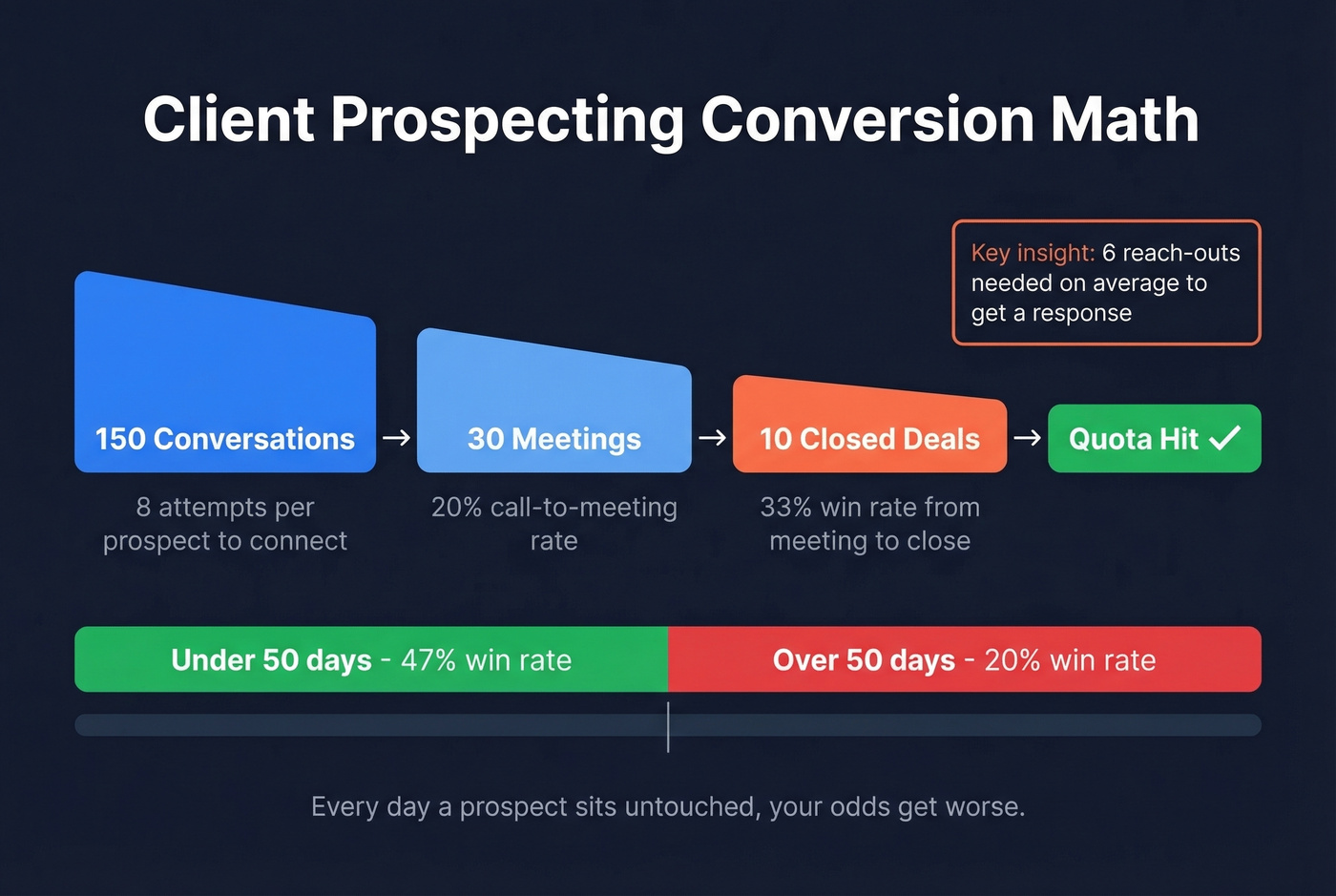
5 calls to 1 meeting (20% conversion). That's a solid benchmark for a well-targeted list. Below 10%? Your list is the problem, not your pitch.
3 meetings to 1 close (~33% win rate). This varies by deal size and sales cycle, but it's a useful starting point for capacity planning.
Work backward from your quota. Need 10 closed deals this quarter? That's 30 meetings, which means 150 meaningful conversations - and now you know exactly how many dials, emails, and social touches your team needs weekly. It takes an average of 8 call attempts to reach a prospect and 6 reach-outs to get a response. Deals closed within 50 days carry a 47% win rate; beyond 50 days, that drops to 20%. Every day a prospect sits untouched in your CRM, your odds get worse.
Channels That Work in 2026
Cold Calling
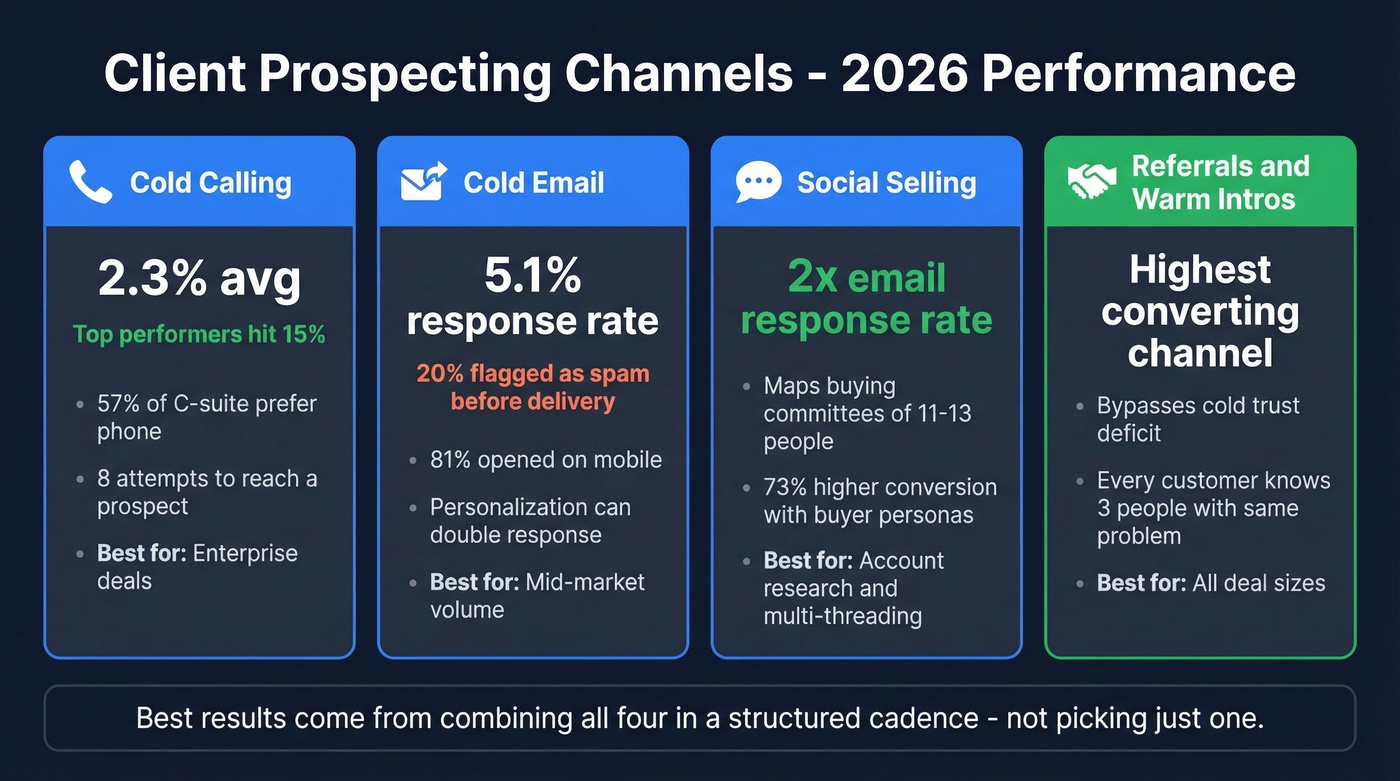
That 2.3% average sounds brutal. But 57% of C-level executives and VPs actually prefer phone outreach over other channels, and top cold callers convert up to 15% of calls into meetings once they reach a live person. The problem isn't the phone - it's calling unverified numbers and reading from a script that sounds like a script. With a good list and a strong opener, cold calling still books more meetings per hour than any other channel for enterprise deals. We've seen this firsthand: reps who switch from a purchased list to verified direct dials see their connect rates jump overnight, sometimes tripling within a week. (If you need a repeatable process, build a cold calling system instead of winging it.)
Cold Email
Average response rate: 5.1%, with most campaigns falling between 1% and 5%. Advanced personalization can double that. But nearly 20% of cold emails get flagged as spam before they're ever seen, and 81% of the emails that do land are opened on mobile. If your message doesn't scan in three seconds on a phone screen, it's dead. If you're building sequences from scratch, start with a proven B2B cold email sequence.
Social Selling
"We noticed you're hiring three SDRs - scaling outbound?" That kind of message delivers roughly 2x the response rate compared to cold email. It's not a replacement for calling and emailing - it's a force multiplier. For accounts with buying committees of 11-13 stakeholders, social gives you visibility across the org chart. Companies using detailed buyer personas before outreach see 73% higher conversion rates from response to MQL, and social research is what makes those personas possible. (If you're going deeper on enterprise accounts, use account-based selling best practices to structure the work.)
Referrals, Events, and Warm Intros
The highest-converting channel in any pipeline, and the most underused.
A warm intro from a mutual connection bypasses the trust deficit that cold outreach has to overcome. Build referral asks into your post-close process - every happy customer knows three people with the same problem. Industry events and community Slack groups create natural conversation starters: "We met at [event], you mentioned [problem]" is one of the highest-converting openers in any channel.
Sizing Your Approach by Deal Value
Most guides treat client prospecting as one-size-fits-all. It's not. Your deal size should dictate your entire approach.
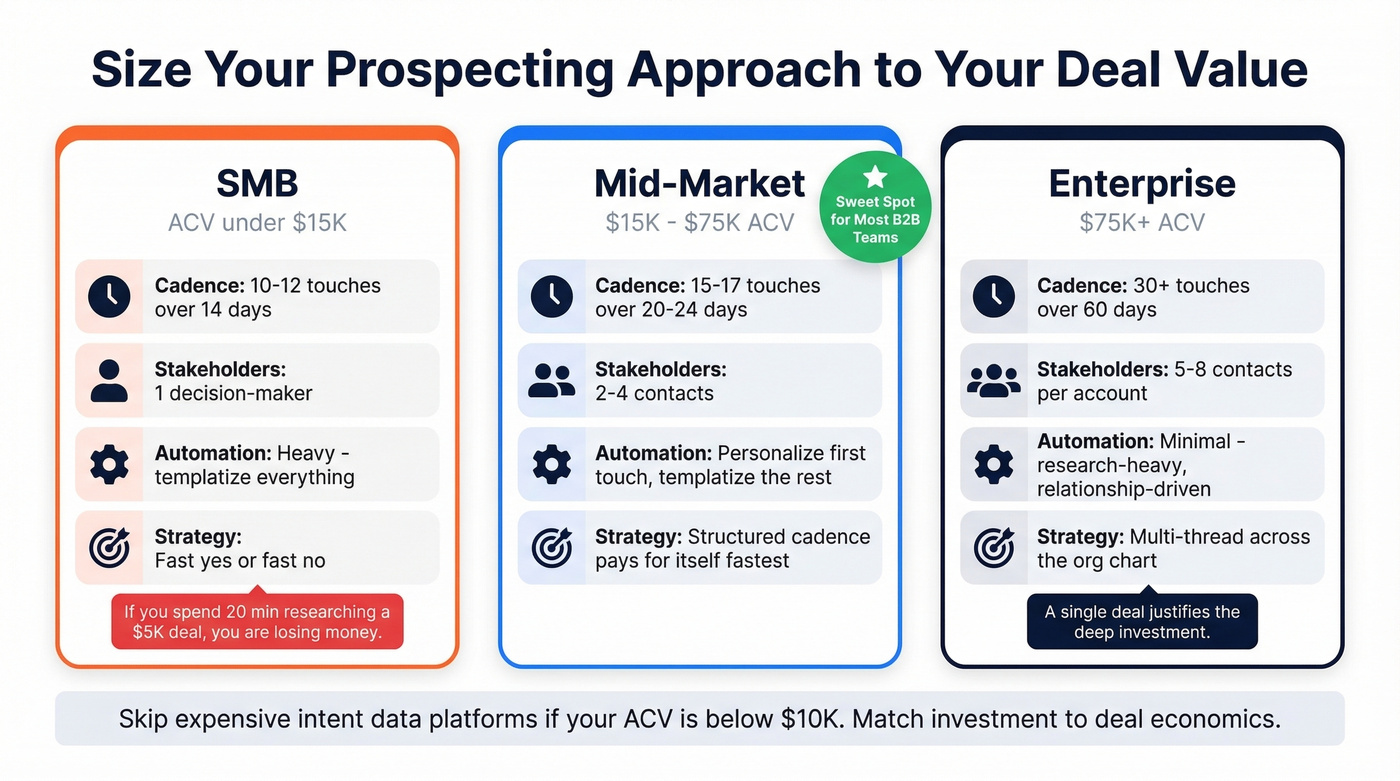
SMB (ACV under $15K): High volume, short cadence. 10-12 touches over 14 days. Automate heavily. One decision-maker, fast yes or fast no. If you're spending 20 minutes researching a $5K deal, you're losing money.
Mid-Market ($15K-$75K): The sweet spot for structured cadences. 15-17 touches over 20-24 days. Two to four stakeholders. Personalize the first touch, templatize the rest. This is where most B2B teams live, and where a solid cadence pays for itself fastest.
Enterprise ($75K+): Low volume, high depth. Multi-thread into 5-8 contacts per account. Research-heavy, relationship-driven. A single enterprise deal can justify 30+ touches over 60 days. This is where account-based prospecting earns its keep. (If you're selling six-figure deals, align your motion to enterprise B2B sales realities.)
Skip the expensive intent data platforms if your average contract value sits below $10K. Match your investment to your deal economics.

You just did the conversion math: 150 conversations to hit 10 closed deals. Now imagine 35% of those dials hitting disconnected numbers and 20% of emails bouncing. Prospeo's 125M+ verified mobiles deliver a 30% pickup rate, and 98% email accuracy means your reps spend every touch talking to real buyers - not voicemail boxes of people who left six months ago.
Stop burning cadence touches on dead data. Fix the list first.
Building Your Tool Stack
The "connected prospecting stack" has replaced the all-in-one platform for most modern teams. Instead of paying $40K/year for a monolithic tool you use 30% of, you wire together specialized tools that each do one thing well. (If you're evaluating options, start with a ranked list of SDR tools.)
| Stack Layer | Tool | Price Range |
|---|---|---|
| CRM | HubSpot / Salesforce | HubSpot: free CRM; Sales Hub ~$20-$150+/seat/mo. Salesforce: ~$25-$330+/user/mo. |
| List Building | Apollo / Clay | Apollo: free-$300+/mo. Clay: ~$149-$800+/mo. |
| Sequencing | Smartlead / Instantly | ~$30-$100+/mo |
| Intent Signals | Bombora / 6sense | Bombora ~$2K-$10K+/mo; 6sense $30K-$100K+/year |
Here's the thing: bad data is the upstream cause of every downstream prospecting problem - bounces, domain damage, wasted rep time. Prospeo's database covers 300M+ professional profiles with 143M+ verified emails and 125M+ verified mobile numbers, running a 7-day data refresh cycle compared to the six-week industry average. The Chrome extension pulls verified emails and phone numbers from any website or CRM in one click. (If you're comparing vendors, see the landscape of data enrichment services.)
The proof: Snyk's 50 AEs went from a 35-40% bounce rate to under 5% after switching, generating 200+ new opportunities per month with AE-sourced pipeline up 180%.
For list building, Apollo is the default choice to go from zero to a working list in minutes - the consensus on r/salestechniques calls it the easiest starting point, though data quality varies by industry. Clay is "LEGO pieces for data" - setup-heavy but unmatched for weirdly specific lists. Lusha works as a quick phone lookup at ~$36-59/mo, though it's hit or miss depending on region. Cognism runs ~$1K+/mo and shines for European data with strong GDPR compliance. Amplemarket ties data, enrichment, outreach, and deliverability together for teams that want fewer tools. (If you want a broader comparison set, use a sales prospecting database shortlist.)
The key: every tool must sync activity back to your CRM. A disconnected stack is just expensive tab-hopping. If you’re fixing the plumbing, follow a checklist to connect outreach tool to CRM.
The article above recommends a connected stack over a monolithic platform. Prospeo plugs directly into HubSpot, Salesforce, Smartlead, Instantly, Lemlist, and Clay - so your list-building, enrichment, and sequencing layers share clean data refreshed every 7 days. At $0.01 per email, you get enterprise-grade prospecting data without the enterprise contract.
Wire Prospeo into your stack and start booking meetings this week.
How to Build a Prospecting Cadence
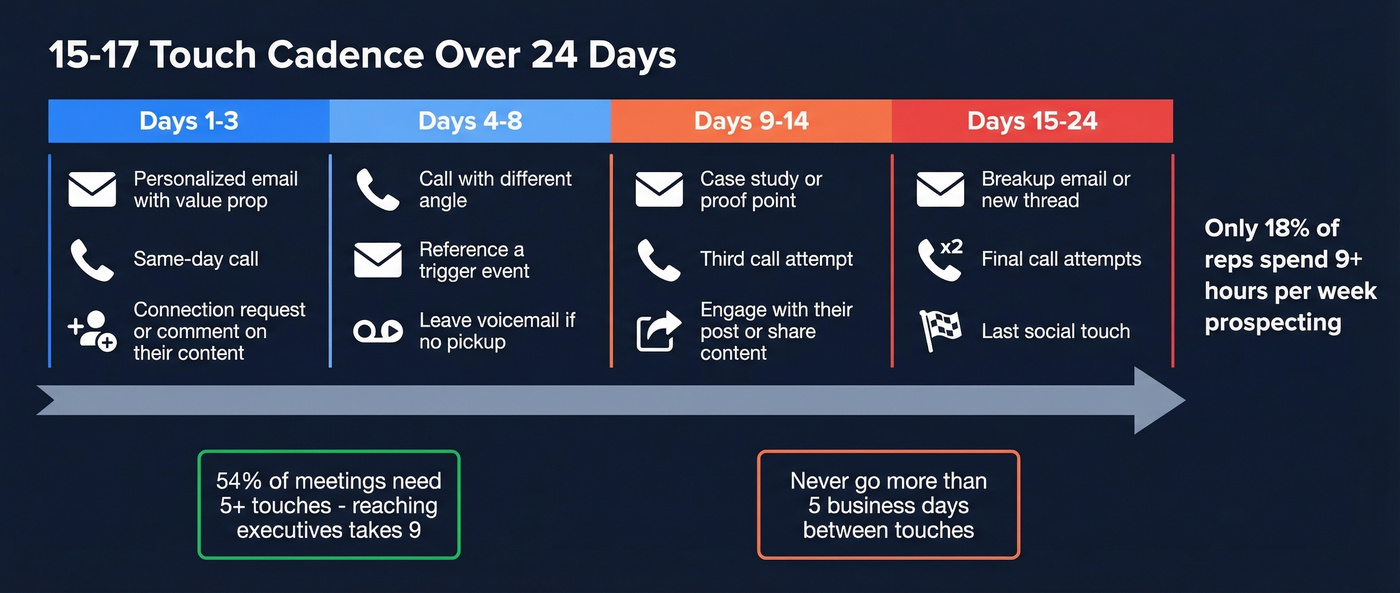
Only 18% of reps spend 9+ hours per week prospecting. That's nowhere near enough. A structured cadence forces consistency and prevents the "I'll follow up when I have time" trap that kills pipeline. If you need more patterns, borrow from these sales prospecting techniques.
| Days | Channel | Action |
|---|---|---|
| 1-3 | Email, Call, Social | Personalized hook + value prop. Same-day call. Connection request or comment on their content. |
| 4-8 | Call, Email, Voicemail | Different angle, reference a trigger event or intent signal. Leave a voicemail if no pickup. |
| 9-14 | Email, Call, Social | Case study or proof point. Third call attempt. Engage with their post or share relevant content. |
| 15-24 | Email, Call x2, Social | Breakup email or new thread. Final call attempts. Last social touch. |
That's 15-17 touches across 20-24 days, mixing channels so you're not just another unread email. The critical rule: never go more than five business days between touches. 54% of initial meetings require more than five touch points, and reaching executives typically takes 9. Most reps give up after 2-3. Don't be most reps.
Email and Call Best Practices
Write at an 8th-grade reading level. That's not dumbing it down - it's respecting your prospect's time. Professionals receive 120+ emails per day and respond to roughly 25% of them.
Keep subject lines to 6-7 words. Personalized emails lift open rates by 29%, but personalization means more than "{first_name}." Reference a specific trigger - a job change, a funding round, a tech stack signal. Maintain a 1:2 ratio of "I/my" to "you/your" in your copy. Most reps write emails that are 80% about themselves. Flip it. The prospect doesn't care about your platform's features - they care about the problem those features solve for them. (If you want swipeable options, use these email subject line examples.)
Don't ask for a meeting in your first message. A softer CTA - a relevant resource, a quick question, a two-sentence insight - gets more replies than "Are you free for 15 minutes Tuesday?" Save the meeting ask for touch 2 or 3, after you've earned a sliver of attention. And since 81% of emails are opened on mobile, keep paragraphs to 1-2 sentences. If your email requires scrolling on a phone, it won't get read.
AI in Prospecting: What It Actually Changes
Let's be honest about AI in prospecting: it replaces the worst parts of the job, not the job itself. 45% of high-performing teams now use hybrid human-AI SDR models, and 40% report saving 4-7 hours per week. Teams using AI-powered prospecting report up to 35% improvement in engagement rates. (If you're implementing it, start with a practical guide to AI cold email outreach.)
The real win is research automation. LivePerson cut prospect research time from 20 minutes to 2 minutes per contact - a 90% reduction. That's time reps reinvest into actual conversations.
Where AI falls short: writing emails that don't sound like AI wrote them, and making judgment calls about when to push and when to back off. The best results come from using AI for research and first-draft messaging, then having reps personalize the last 20% before hitting send. Whether you're prospecting in a niche vertical or running high-volume outbound across industries, AI handles the grunt work so your team can focus on the human side.
Five Mistakes That Kill Pipeline
Blasting untargeted lists. Emails to large, unsegmented lists get 67% fewer replies. Segmented campaigns see 14.31% higher open rates. Target tighter, convert higher.
Skipping email verification. A bounce rate above 2% damages your domain reputation. Verify every address before it enters your sequencer - a 5-step verification process catches invalid addresses, spam traps, and honeypots before they torch your deliverability. (If you're troubleshooting, start with email bounce rate benchmarks and fixes.)
Ignoring the spam complaint threshold. Your spam complaint rate must stay below 0.01%. That's 1 complaint per 10,000 emails. One bad batch can put you in the penalty box for weeks. (To harden your setup, use an email deliverability guide and fix issues upstream.)
Giving up after 2 touches. Most reps quit before the prospect even notices them. 54% of meetings require 5+ touches. Build the cadence, trust the cadence.
Forgetting compliance. GDPR fines run up to 4% of global annual revenue or EUR 20M, whichever is higher. If you're prospecting into the EU without proper consent mechanisms and opt-out enforcement, you're playing a game you can't afford to lose.
FAQ
What's the difference between prospecting and lead generation?
Prospecting is sales-led, one-to-one outbound - calls, emails, social touches - owned by SDRs and BDRs. Lead generation is marketing-led demand capture through content, ads, and events. Different teams, different KPIs, same pipeline goal.
How many touches does it take to book a meeting?
Expect 5 touches to engage a typical prospect and 9 to reach a C-level executive. A full client prospecting cadence involves 15-17 attempts over 20-24 days across email, phone, and social channels.
What's a good cold email response rate in 2026?
The average sits at 5.1%, with most campaigns landing between 1% and 5%. Advanced personalization - trigger-based, not just first-name tokens - can double that. Keep subject lines to 6-7 words and save the meeting ask for touch two or three.
How do I keep my emails from landing in spam?
Keep your bounce rate below 2% and spam complaint rate below 0.01% (1 per 10,000 emails). Verify every address before sending, and segment your lists instead of blasting large untargeted groups.
Do I need AI tools for prospecting?
For the right tasks, yes. 45% of high-performing sales teams use hybrid human-AI SDR models, cutting research time by up to 90% per contact. AI handles data enrichment and first-draft messaging; humans handle judgment, relationships, and closing.