

Client Retention Strategies: The Playbook for Service Businesses
It's Thursday afternoon. Your client sends a one-line email: "Can we hop on a call next week to discuss our options going forward?" You know exactly what that means. Not a single thing went wrong with your work - but somewhere in the last six months, they stopped feeling like a priority.
We've watched agencies lose six-figure accounts over this exact pattern. The number-one reason clients leave isn't poor results or pricing. It's perceived indifference. They don't feel like you care. And the fix isn't harder work - it's better systems.
If you implement three strategies from this article, make them structured onboarding, a communication cadence, and quarterly business reviews. Everything else is a multiplier on those three. You don't need 23 tactics. You need three or four, executed consistently, quarter after quarter.
Why Clients Leave (It's Not What You Think)
You close a deal, deliver solid work for three months, then get absorbed by new business development. The client doesn't hear from you unless they reach out first. Six months later, they're "exploring other options."
They didn't leave because your deliverables were bad. They left because nobody called to ask how things were going. Clients can forgive a missed deadline. They can't forgive feeling forgotten.
Here's the thing: that's actually good news. It means retention is a systems problem. Systems are fixable.
The Math Behind Retention
Customer acquisition costs have risen over 200% in the last decade. For legal services, acquiring a new client runs $750-$1,300, while retaining an existing one costs $100-$500. That's a 3-10x gap. If you want to pressure-test your acquisition math, start with cost to acquire customer.
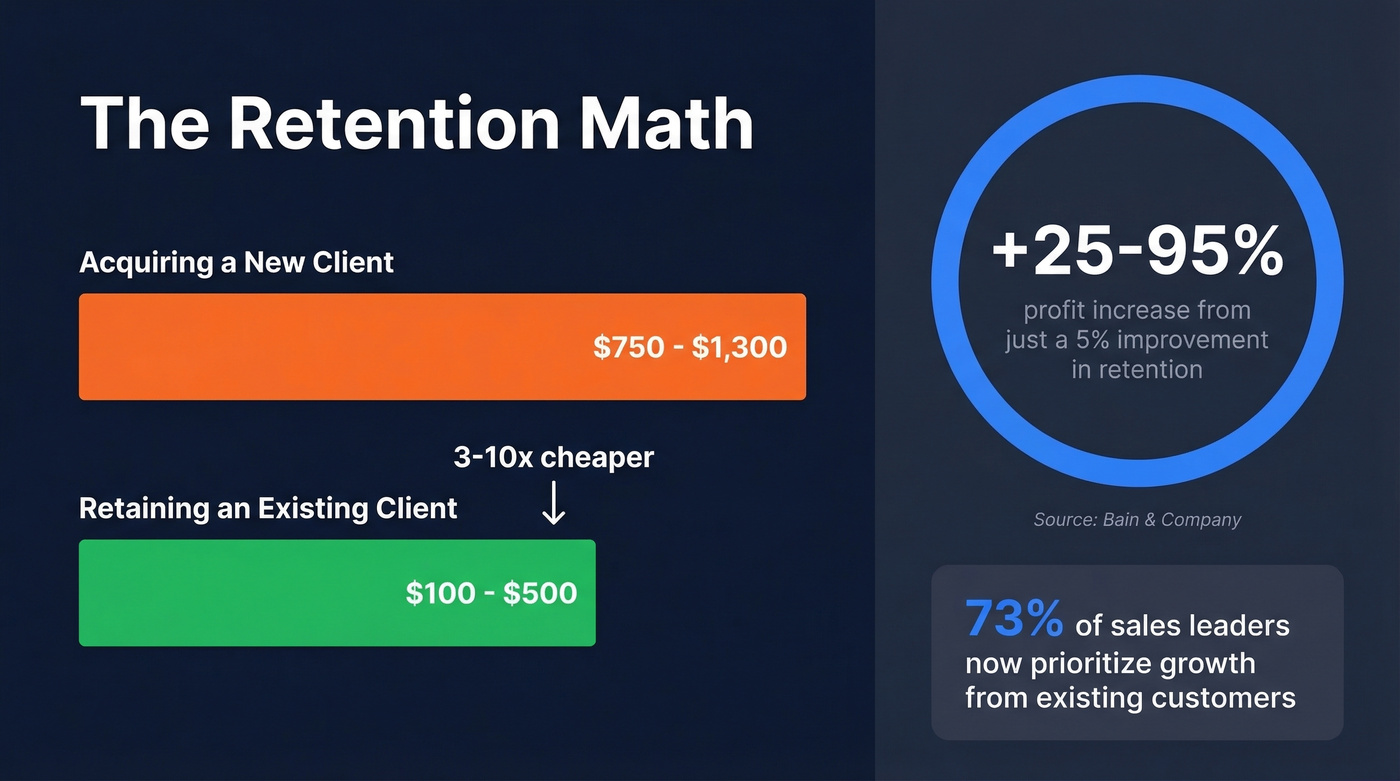
A Gartner survey of 243 CSOs and senior sales leaders found 73% are now prioritizing growth from existing customers, with 57% ranking account retention and growth as a top-three priority heading into 2026. Bain & Company's widely cited research shows a 5% increase in retention can boost profits by 25-95%. That's not a rounding error - that's the difference between a flat year and a breakout one. It's why every serious customer retention strategy for B2B teams starts with the economics of keeping what you've already won.
How to Calculate Client Retention Rate
E = clients at end of period. N = new clients acquired during period. S = clients at start of period. Start Q1 with 50 clients, add 12 new ones, end with 55: CRR = ((55 - 12) / 50) x 100 = 86%.
The uncomfortable part: 44% of businesses don't calculate retention rate at all. Beyond CRR, track net revenue retention for expansion, churn rate for the inverse view, customer lifetime value for dollar impact, and NPS as a leading indicator as a leading indicator.
If you want a deeper diagnostic on why accounts are leaving, run a simple churn analysis alongside your retention reporting.

44% of businesses don't track retention - often because their CRM data is stale. Prospeo enriches your existing accounts with 50+ data points on a 7-day refresh cycle, so you always know who's still there, who changed roles, and who the new decision-maker is. 83% of records come back with verified contact data.
Stop losing clients because your contact data expired before the contract did.
Retention Benchmarks by Industry
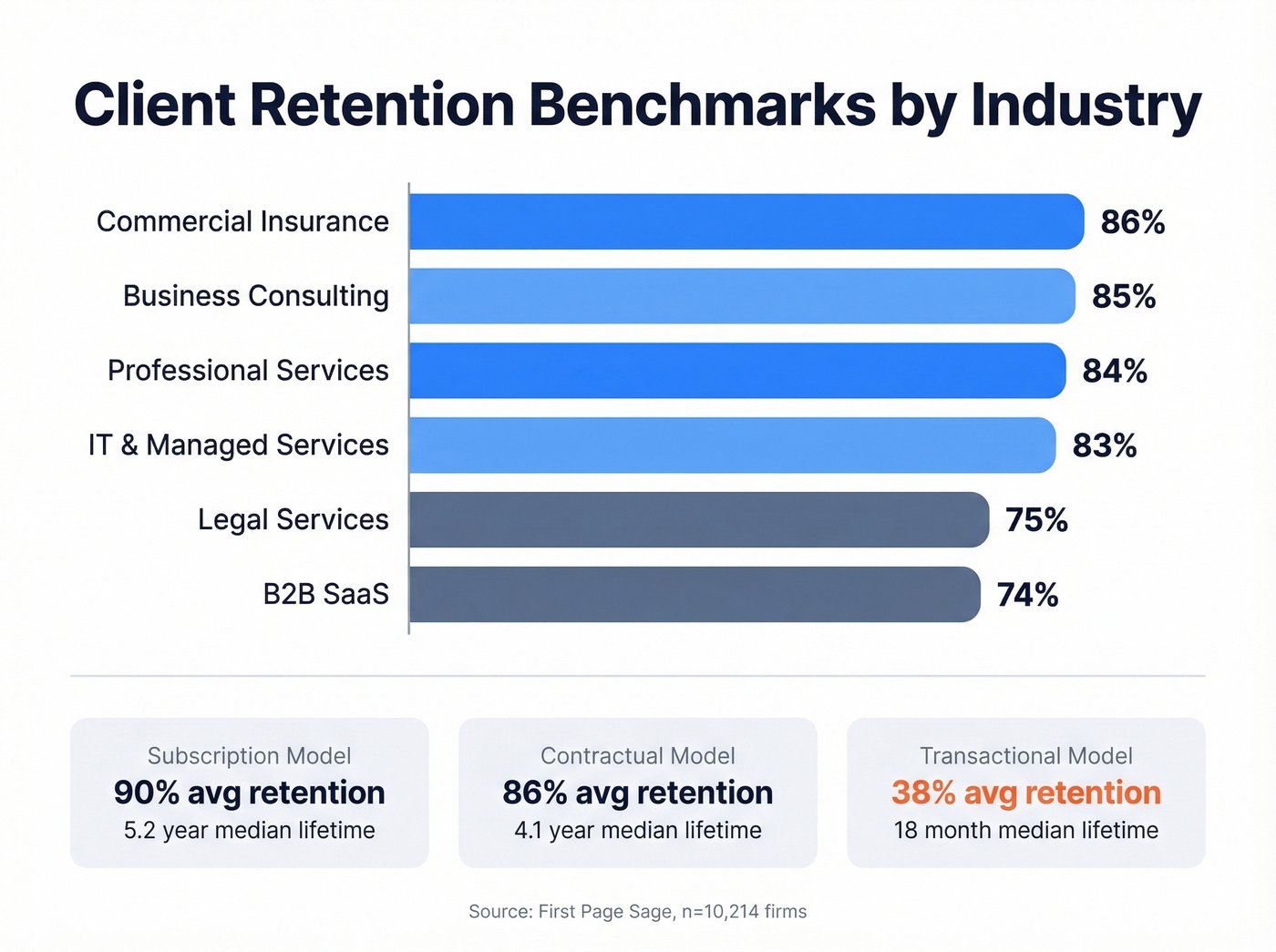
Knowing your number is useless without context. Here's where service businesses land, based on a First Page Sage study of 10,214 firms:
| Industry | Avg Retention |
|---|---|
| Commercial Insurance | 86% |
| Business Consulting | 85% |
| Professional Services | 84% |
| IT & Managed Services | 83% |
| Legal Services | 75% |
| B2B SaaS | 74% |
And here's how business model shapes the picture:
| Business Model | Avg Retention | Median Lifetime |
|---|---|---|
| Subscription | 90% | 5.2 years |
| Contractual | 86% | 4.1 years |
| Transactional | 38% | 18 months |
For agencies, the tiers look roughly like this: top performers hold 97%+ monthly retention, average agencies sit at 90-95%, and struggling agencies fall below 90%. B2B SaaS benchmarks tend to skew lower than professional services because of shorter contract cycles and easier switching - worth keeping in mind if you serve software companies. If you’re measuring renewals specifically, track renewal rate separately from retention.
Strategies That Actually Move the Needle
Nail the First 90 Days
Onboarding optimization alone correlates with a +10% retention improvement. Yet most service businesses treat onboarding as a single kickoff call and a shared Google Drive folder.
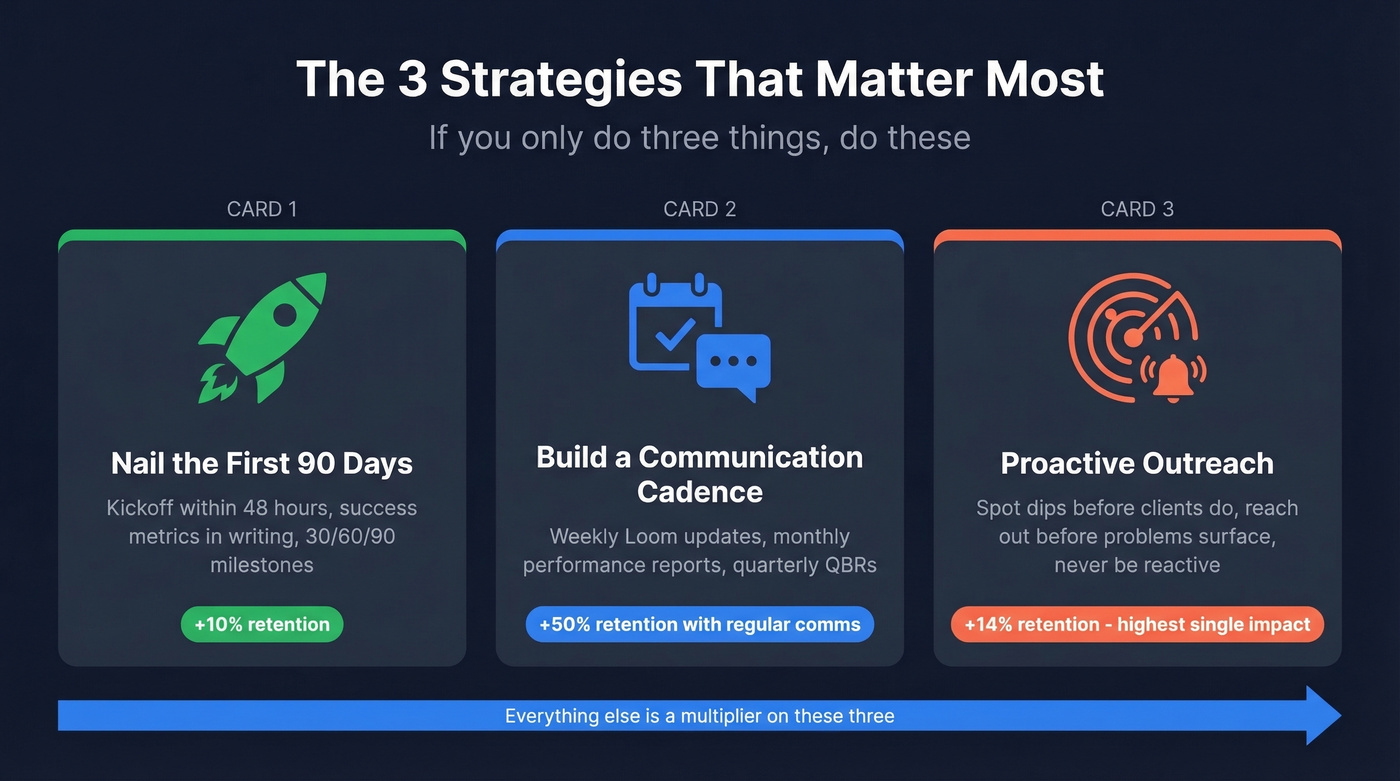
Build a real system: kickoff call within 48 hours, success metrics defined in writing before work begins, and 30/60/90-day milestones with clear deliverables. The first 90 days are when the client is most engaged and most anxious - use that window to build trust, not coast on goodwill from the sales process. If you want a ready-made structure for those milestones, adapt a 30/60/90-day plan to your delivery team.
Build a Communication Cadence
The "disappearing after the sale" pattern kills more accounts than bad work ever will. In our experience, the accounts that churn fastest are the ones where the weekly update gets skipped three weeks in a row, and nobody notices until the client sends that dreaded "let's discuss options" email.
Fix it with structure: a quick Loom or Slack update weekly, a performance report tied to agreed metrics monthly, and a full QBR quarterly. A 3-minute Loom video every Monday morning takes almost no effort and signals you're actively thinking about their business. If you want to systemize that format, borrow a few ideas from Loom video cold email workflows and repurpose them for client updates. Thomson Reuters found that firms with regular personalized communication see 50% higher retention. The data backs the habit.
Run QBRs Worth Attending
72% of senior executives think QBRs are a waste of time. But companies that hold regular customer reviews see 60-70% higher retention than those that don't. The gap between those two facts? Structure.
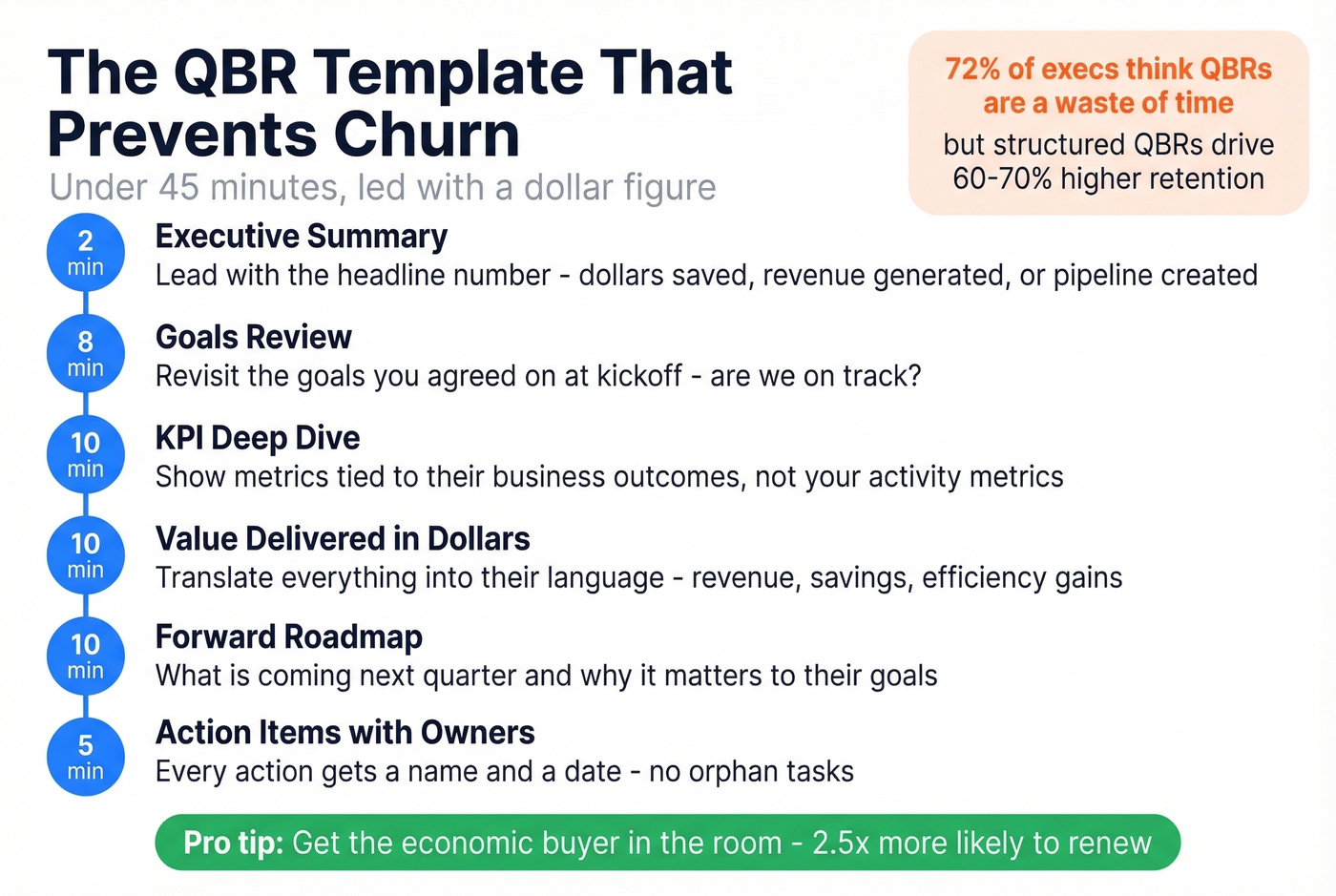
We've found the QBRs that prevent churn are under 45 minutes and led with a dollar figure. Executive summary in 2 minutes, goals review, KPIs, value delivered in dollar terms, forward roadmap, and action items with owners. Get executives in the room - B2B customers with strong executive participation are 2.5x more likely to renew. If you need a tighter agenda, pull from these QBR questions and keep only what drives decisions.
Demonstrate ROI in Their Language
If your client can't articulate your ROI to their boss, they'll churn. Full stop.
Stop reporting in your metrics and start reporting in theirs. Don't say "we generated 47 MQLs." Say "we generated 47 qualified leads, 12 of which entered pipeline, representing $340K in potential revenue against your $8K monthly spend." For a consulting engagement, don't say "we completed the process audit." Say "we identified $220K in annual cost savings across three workflows, with implementation starting next month." The client's internal champion needs ammunition for budget conversations. Give it to them. If you want a clean way to tie activity to outcomes, use a simple pipeline health scorecard.
Proactive Outreach Before Problems Surface
Proactive customer success outreach correlates with a +14% retention improvement - the single highest-impact tactic in the data. Reach out when you spot a dip in engagement, a missed milestone, or a change in their team. "Hey, noticed your open rates dropped this week - here's what we're adjusting" beats waiting for the angry email every time. Reactive firefighting feels heroic but signals you weren't paying attention.
Let's be honest: if your deal size is under $25K and you're only doing one retention initiative, skip the QBR and invest everything in proactive outreach. A well-timed Slack message prevents more churn than a polished slide deck. If you need language that doesn’t feel awkward, keep a few sales follow-up templates on hand and adapt them for existing clients.
Get Executive Sponsors Involved
The day-to-day contact loves you, but the VP who signs the check has no idea what you do. When budget cuts come, you're the first line item to go.
Identify the economic buyer, the champion, and the end users. Make sure the economic buyer hears from you at least quarterly - even if it's just a 5-minute email summary of results. That 2.5x renewal likelihood with executive participation isn't theoretical. It's the difference between surviving a reorg and getting cut. If your team struggles to map stakeholders, use the MEDDPICC economic buyer framework as a shortcut.
Personalize Beyond the Account
McKinsey's personalization research shows 71% of consumers expect personalization. In B2B services, that means knowing the humans, not just the logo.
Notice when your client's VP gets promoted - and say something about it. Send a note when their company hits a milestone. Know that your day-to-day contact is training for a marathon. These micro-touches cost nothing and create loyalty that no competitor can undercut with a lower price. Some firms take this further with client advisory boards, giving their best accounts a voice in shaping the service itself.
Create a Feedback Loop (and Close It)
Seeking feedback isn't the hard part. Closing the loop is.
When you run an NPS or CSAT survey, follow up on every response - especially the neutral ones. "You gave us a 7. What would make it a 9?" Then actually do something about it and tell them you did. NPS and CSAT are tools for driving action, not vanity metrics for your board deck.
Make Switching Expensive (the Right Way)
High switching costs correlate with >80% retention rates. But switching costs don't mean lock-in contracts and penalty clauses - that's hostage-taking, not retention.
The right kind of switching cost is depth: deep integration into their tech stack, shared workflows and SOPs built around your service, institutional knowledge about their business that a new vendor would take six months to rebuild. When leaving you means re-training a new team and rebuilding processes from scratch, the switching calculus changes entirely.
Keep Your Data Clean
For agencies running outbound campaigns, bad data is a silent retention killer. One bounce spike tanks domain reputation. Dead deliverability means the client's campaign flatlines - and they blame you, not the data. If you’re seeing issues, start by diagnosing your email bounce rate.
Before any outbound campaign goes live for a client, run the list through a verification tool. Prospeo checks emails against a 300M+ database with 98% accuracy and refreshes data every 7 days. Stack Optimize built from $0 to $1M ARR using this approach, maintaining 94%+ deliverability and zero domain flags across all their clients. That's what data quality as a retention strategy looks like in practice.

Offboard Gracefully
Not every client relationship lasts forever. Run an exit interview, provide a clean transition document, and leave the door open. Chewy became famous for sending flowers to customers after their pets passed away. You don't need to go that far, but a thoughtful offboarding experience turns a lost client into a future referral source - and the r/sales community will tell you that boomerang clients are some of the best revenue you'll ever close.
Mistakes That Kill Client Accounts
Disappearing after the sale. The cardinal sin. No follow-up, no check-in, no proactive communication. The client assumes you've moved on to shinier accounts.
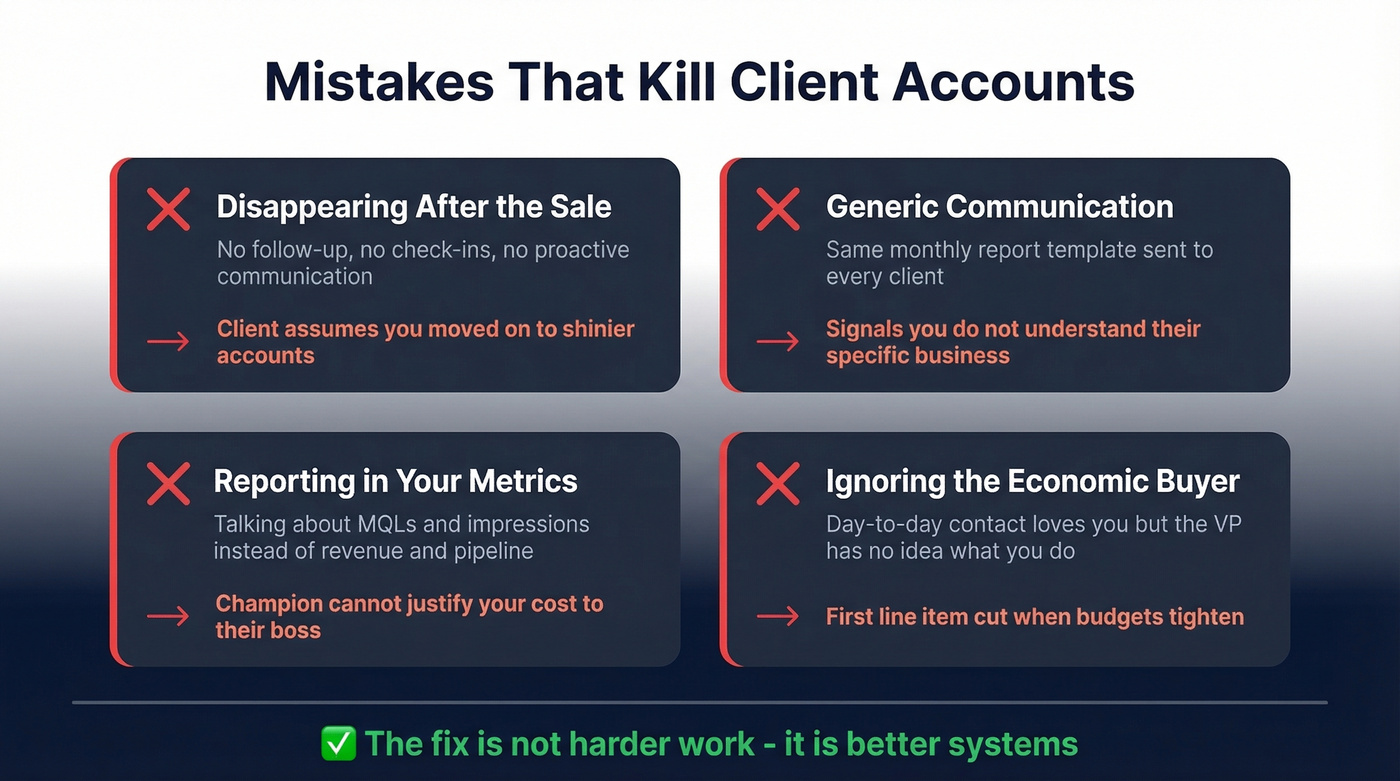
Generic communication. Sending the same monthly report template to every client signals you don't understand their specific business. If your reports could belong to any client with the logo swapped out, they're not working.
Ignoring negative feedback. A client who complains is a client who still cares. The ones who leave quietly are the ones you never get back.
Surprising clients at renewal. If the first time you discuss pricing or scope changes is at renewal, you've already lost. Seed these conversations months in advance.
Not rewarding loyalty. Your longest-tenured clients should get your best attention, not your newest ones. Loyalty that goes unrecognized eventually goes elsewhere.
Your client's executive sponsor just left and you didn't notice - that's how accounts churn silently. Prospeo tracks job changes across 300M+ profiles so you can spot stakeholder turnover the week it happens, not the quarter you lose the deal.
Detect champion changes before they become cancellation emails.
FAQ
What's a good client retention rate?
For most service businesses, 80%+ annually is healthy. Business consulting averages 85%, commercial insurance 86%, and top agencies hold 97%+ monthly. Below 80% signals a systemic onboarding or communication issue that needs immediate attention.
How do you calculate client retention rate?
CRR = ((clients at end of period - new clients acquired) / clients at start of period) x 100. Starting with 100 clients, gaining 20, ending with 108 gives you 88%. Track it monthly at minimum, with quarterly deep-dives tied to your QBR cycle.
What's the difference between client and customer retention?
Client retention applies to relationship-based service businesses - consulting, agencies, legal - where engagements are ongoing and high-touch. Customer retention is broader and includes transactional models like e-commerce and SaaS. The strategies overlap, but retaining clients leans harder on communication cadence and executive relationships.
Which retention tactics work best for sales-led teams?
Proactive outreach (+14% retention lift), executive sponsor engagement (2.5x renewal likelihood), and QBRs that quantify ROI in the client's own language. When account managers own retention - not just CSMs - renewal rates climb because the relationship stays warm from close through expansion.
How can outbound agencies improve client retention with better data?
Agencies lose clients when bounce rates spike and campaigns underperform. Verifying emails before every send - at 98% accuracy with a 7-day refresh cycle - keeps deliverability above 94%. Clean data means consistent results, which means clients stay. Stack Optimize scaled to $1M ARR with zero domain flags using exactly this approach.