

How to Close More Leads: 5 Fixes That Actually Move the Needle
80% of new leads never convert into sales. And 92% of buyers already have a vendor in mind before they talk to you. The window to close more leads is razor-thin - and shrinking.
Here's the thing: most teams don't need a new playbook. They need to fix three things this quarter - qualification rigor, follow-up cadence, and contact data quality. Everything else is optimization.
Know Your Baseline
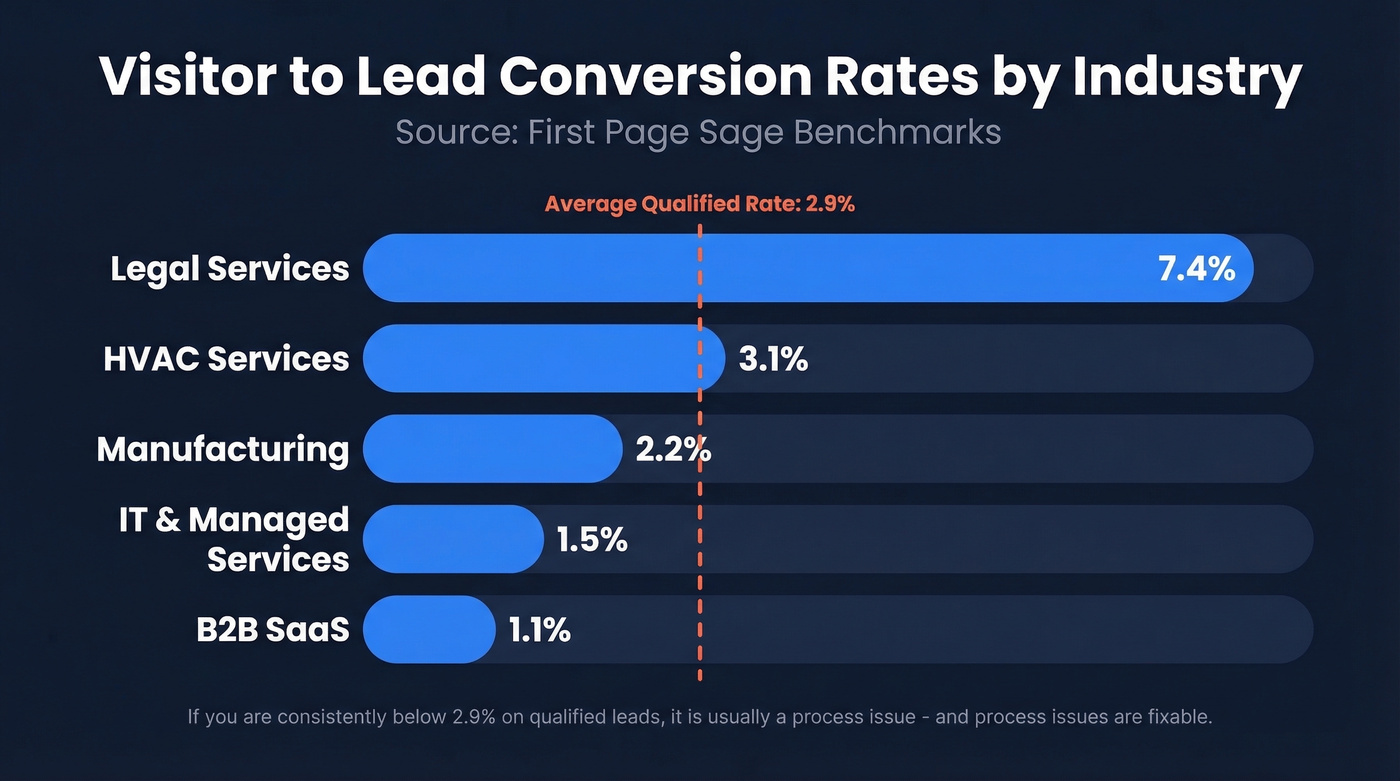
Before you fix anything, know where you stand. These are the visitor-to-lead conversion rates First Page Sage benchmarks across industries:
| Industry | Visitor → Lead |
|---|---|
| B2B SaaS | 1.1% |
| IT & Managed Services | 1.5% |
| Manufacturing | 2.2% |
| HVAC Services | 3.1% |
| Legal Services | 7.4% |
Across all industries, the average qualified lead conversion rate is 2.9% based on 100M+ data points. If you're consistently below that on qualified leads, it's usually a process issue - and process issues are fixable faster than market conditions.
Five Fixes That Improve Lead Conversion
1. Qualify Harder, Not Wider
Most teams don't lose deals at the close. They lose them at qualification - talking to the wrong people, at the wrong time, on deals that were never real. If you need a tighter system, start with lead scoring and a clear Ideal Customer Profile.
We've seen this pattern over and over: reps build rapport, fill the top of the funnel, then watch deals go cold because nobody mapped the buying committee. With 6-10+ stakeholders in modern B2B purchases, pitching without that map is pitching into a void. Stop learning closing techniques. Start disqualifying faster.
| Framework | Best For | Deal Size | Key Question |
|---|---|---|---|
| BANT | SMB / transactional | Under $10K | Do they have budget and authority? |
| CHAMP | Consultative / mid-market | $10-50K | What challenge are they solving? |
| MEDDIC | Enterprise / committee | $50K+ | Who's the economic buyer and champion? |
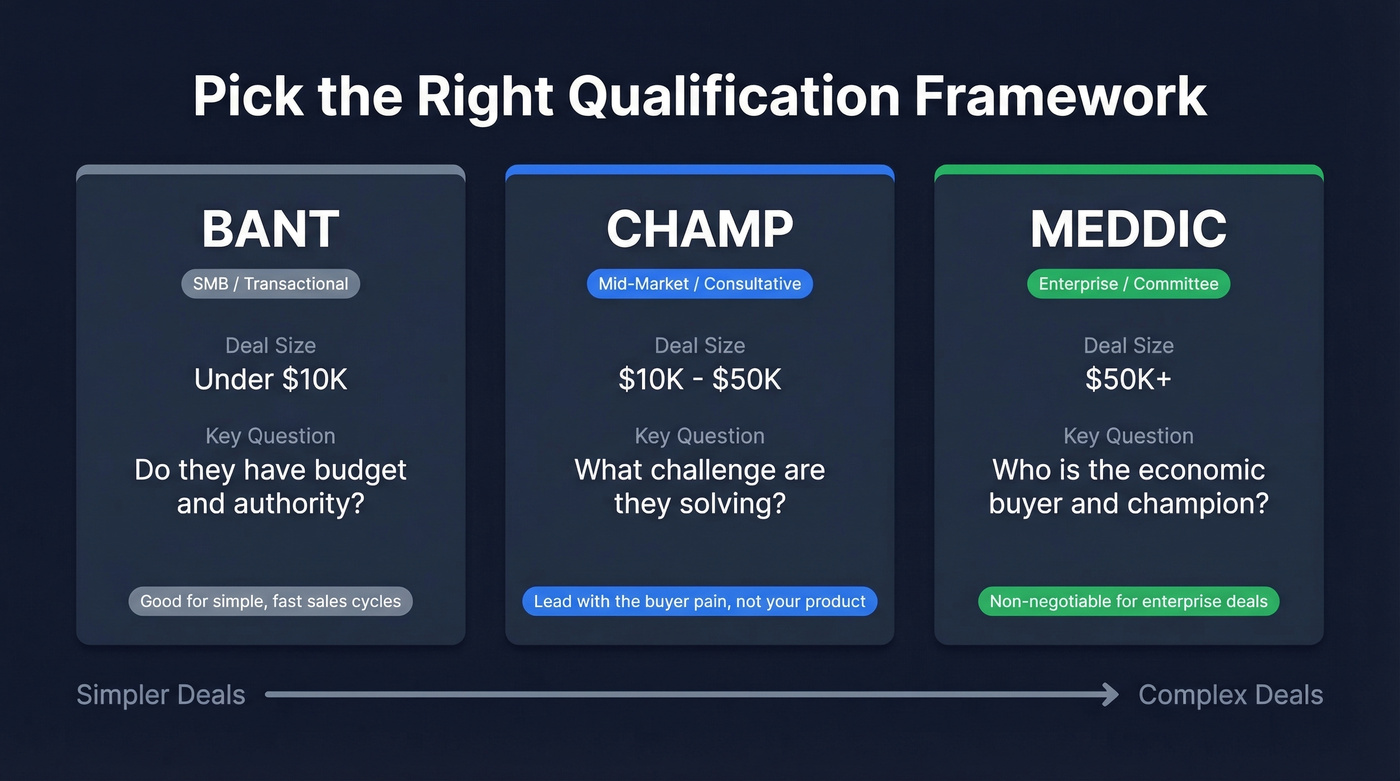
MEDDIC is non-negotiable for enterprise. If you sell transactional deals, BANT is fine. Everything in between, lead with the buyer's pain using CHAMP. (If you're running MEDDIC, keep a bank of MEDDIC discovery questions ready.)
2. Respond in Minutes, Not Hours
Conversion rates are 8x higher when you respond within 5 minutes. Only 7% of companies hit that window. And 78% of buyers choose the first company that responds - not the best company, the fastest one.
This isn't about being pushy. It's about being present when intent is highest. If your inbound leads sit in a queue for two hours, you've already lost to the competitor who called in three minutes. If you want to operationalize this, build it into your lead status rules and your lead generation workflow.
3. Follow Up Like Your Pipeline Depends on It
Because it does.
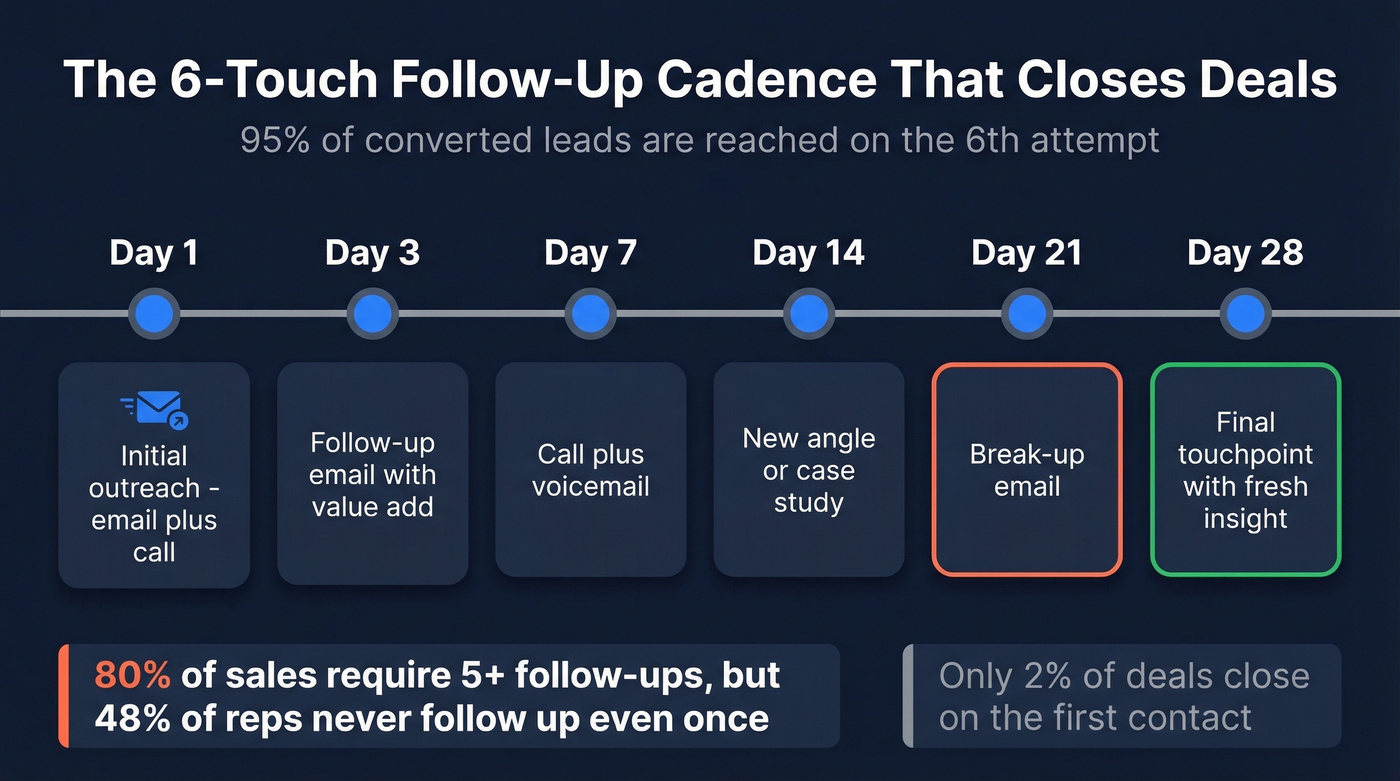
80% of sales require 5+ follow-ups, but 48% of reps never follow up once after a cold call. 95% of converted leads are reached on the 6th attempt. The gap between average and great isn't talent - it's persistence.
A cadence that works:
- Day 1: Initial outreach (email + call)
- Day 3: Follow-up email with value add
- Day 7: Call + voicemail
- Day 14: New angle or case study
- Day 21: Break-up email
- Day 28: Final touchpoint with fresh insight
If your average deal size tops $5K and you're not running at least a six-touch sequence, you're leaving money on the table every single week. If you need copy you can deploy fast, pull from these sales follow-up templates. But here's what kills even the best cadence: bounced emails. Run your list through a verification tool like Prospeo's email finder before launching any sequence - high bounce rates wreck deliverability and waste your best follow-up touches.
4. Shut Up and Listen
Gong's data is unambiguous: top-closing B2B reps talk only 43% of the time versus 65% for average performers. That's a 22-point gap, and it's entirely behavioral.
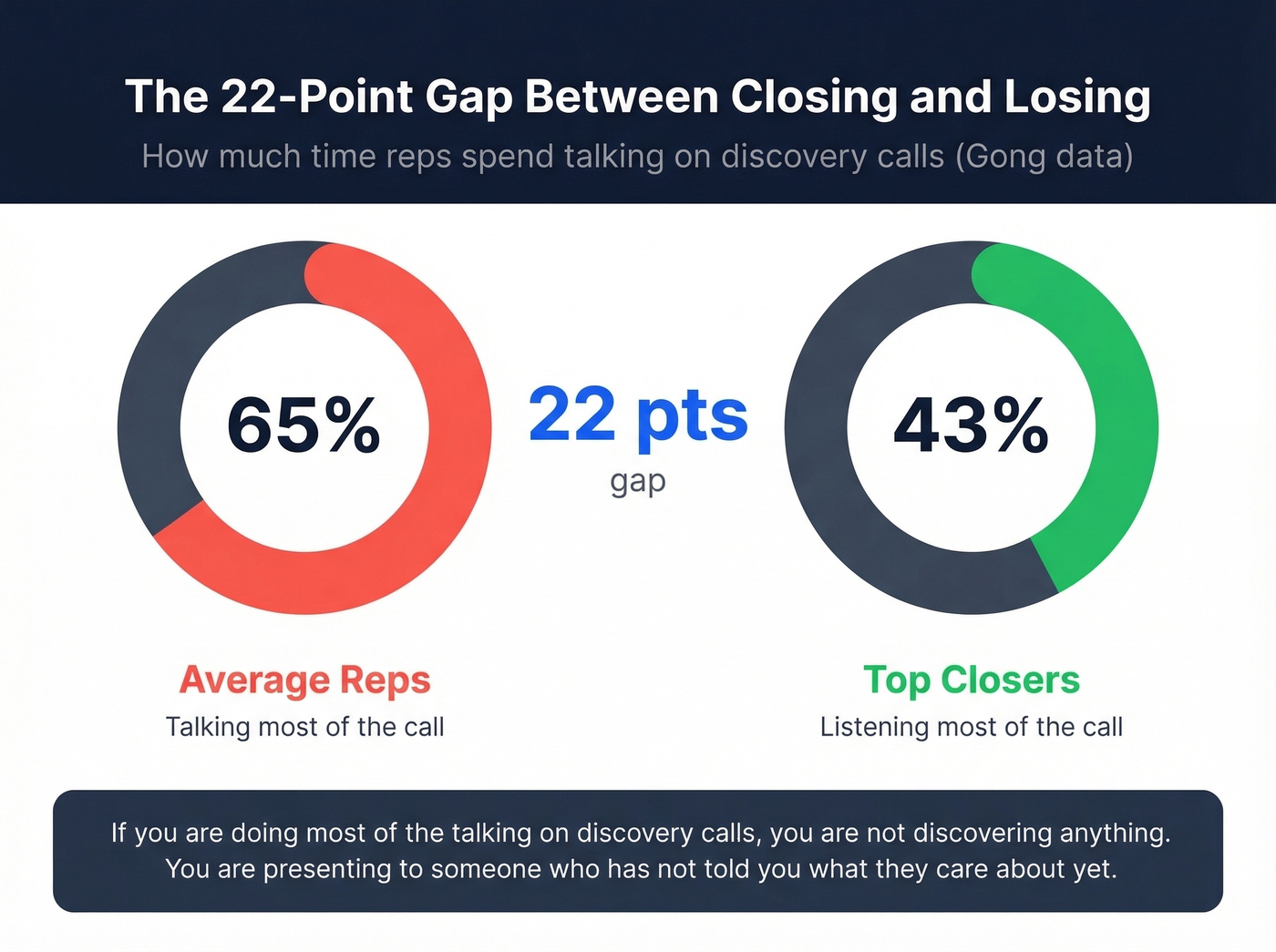
If you're doing most of the talking on discovery calls, you're not discovering anything. You're presenting to someone who hasn't told you what they care about yet. I've sat in on calls where the rep spent 20 minutes on a product demo before asking a single question about the prospect's situation. The prospect was polite. They never replied to the follow-up. Tighten your discovery with a structured set of discovery questions.
5. Fix Your Data Before Your Pitch
Every fix above assumes one thing: that you can actually reach the people you're trying to sell to. Bad contact data silently kills your pipeline. Emails bounce, phone numbers ring dead, and your carefully crafted cadence goes nowhere.
When Snyk's 50-person AE team switched to Prospeo, their bounce rate dropped from 35% to under 5% and AE-sourced pipeline jumped 180%. That's not a marginal improvement - it's the difference between a sequence that works and one that destroys your sender reputation.

Your follow-up cadence is worthless if half your emails bounce. A 98% email accuracy rate and data refreshed every 7 days - not the roughly six-week cycle most providers run - is what separates pipeline that converts from pipeline that evaporates. If you're diagnosing issues, start with email bounce rate and an email deliverability guide.

Your 6-touch cadence means nothing if half your emails never arrive. Prospeo delivers 98% email accuracy on a 7-day refresh cycle - not the 6-week lag most providers run. Snyk's 50 AEs dropped bounce rates from 35% to under 5% and grew AE-sourced pipeline 180%.
Stop losing deals to dead data. Verify your list before you hit send.
Close for the Committee
Let's be honest: roughly 80% of B2B buying decisions don't die from rejection. They stall because the committee can't reach consensus. With an average buying cycle of 10.1 months, you're not closing a person. You're closing a group of 6-10 stakeholders who all need to feel safe saying yes.
Three approaches built for this reality:
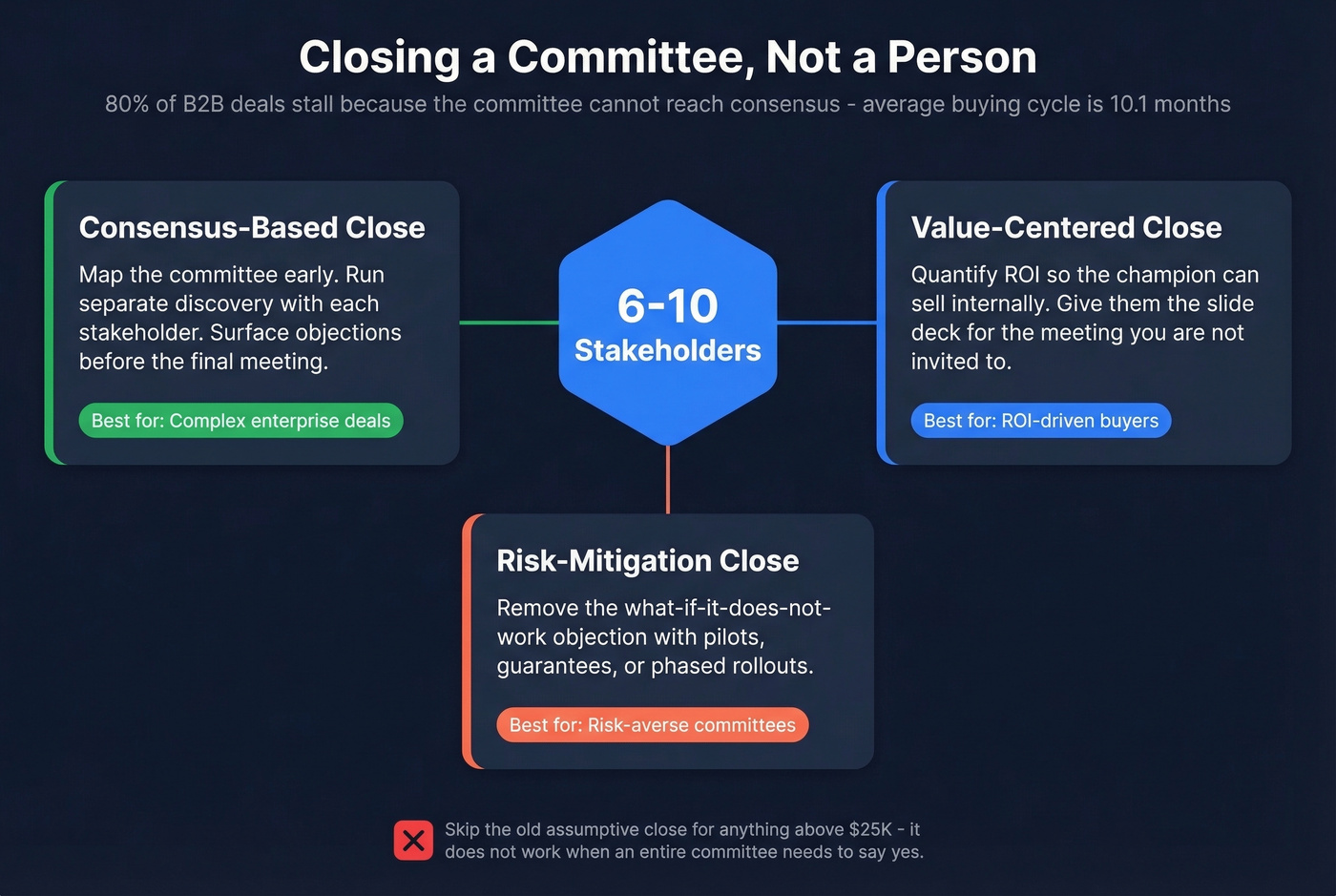
- Consensus-based close: Align all stakeholders before the ask. Map the committee early, run separate discovery with each, and surface objections before the final meeting.
- Value-centered close: Quantify ROI so the champion can sell internally. Give them the slide deck they'll use in the meeting you're not invited to.
- Risk-mitigation close: Remove the "what if it doesn't work" objection with pilots, guarantees, or phased rollouts.
The old assumptive close doesn't work when an entire committee needs to say yes. Skip it if you're selling anything above $25K. For a more step-by-step framework, see these steps to close a sale.
The Bottom Line
If you want to close more leads in 2026, stop obsessing over scripts and start fixing the system: qualify ruthlessly, respond instantly, follow up relentlessly, listen more than you talk, and make sure your data actually reaches real people.
Closing a 6-10 person buying committee means reaching every stakeholder - not just the one who replied. Prospeo's 300M+ profiles and 30+ filters (job role, department, company) let you map the full committee with verified emails and direct dials in minutes, not days.
Map the entire buying committee with verified contact data for ~$0.01/lead.
FAQ
What's a good lead-to-close rate for B2B?
The average qualified lead conversion rate across industries is 2.9%, with top performers hitting 5-7% on well-qualified pipeline. If you're under 2% on qualified leads, that usually signals a process or data quality issue worth fixing before you invest in more top-of-funnel volume.
How many follow-ups does it take to close a deal?
Most B2B deals require 5-12 follow-ups before closing, with 95% of conversions happening after the 6th attempt. Yet most reps quit after two. Persistence beats talent when the majority of your competition gives up early.
How does bad contact data affect close rates?
Bounced emails and dead phone numbers waste every follow-up attempt and damage your sender reputation, making future emails less likely to land. Cleaning your list with a verification tool before launching sequences keeps deliverability high and ensures your cadence actually reaches decision-makers. We've seen teams cut bounce rates from 35%+ down to under 5% just by switching to a provider with a 7-day data refresh cycle.