

Cold Acquisition: The Complete Multi-Channel Playbook for 2026
Most guides on cold acquisition focus on cold calling alone. That's like writing a basketball playbook that only covers free throws. The full system - data, deliverability, multi-channel sequencing, compliance, and measurement - is what turns strangers into pipeline. With 6-7 decision-makers involved in a typical B2B tech purchase, reaching one person through one channel doesn't cut it anymore.
You need a system that touches multiple stakeholders across multiple surfaces. Here's the playbook for building that system.
What You Need (Quick Version)
If you're short on time, cold acquisition in 2026 comes down to three pillars:
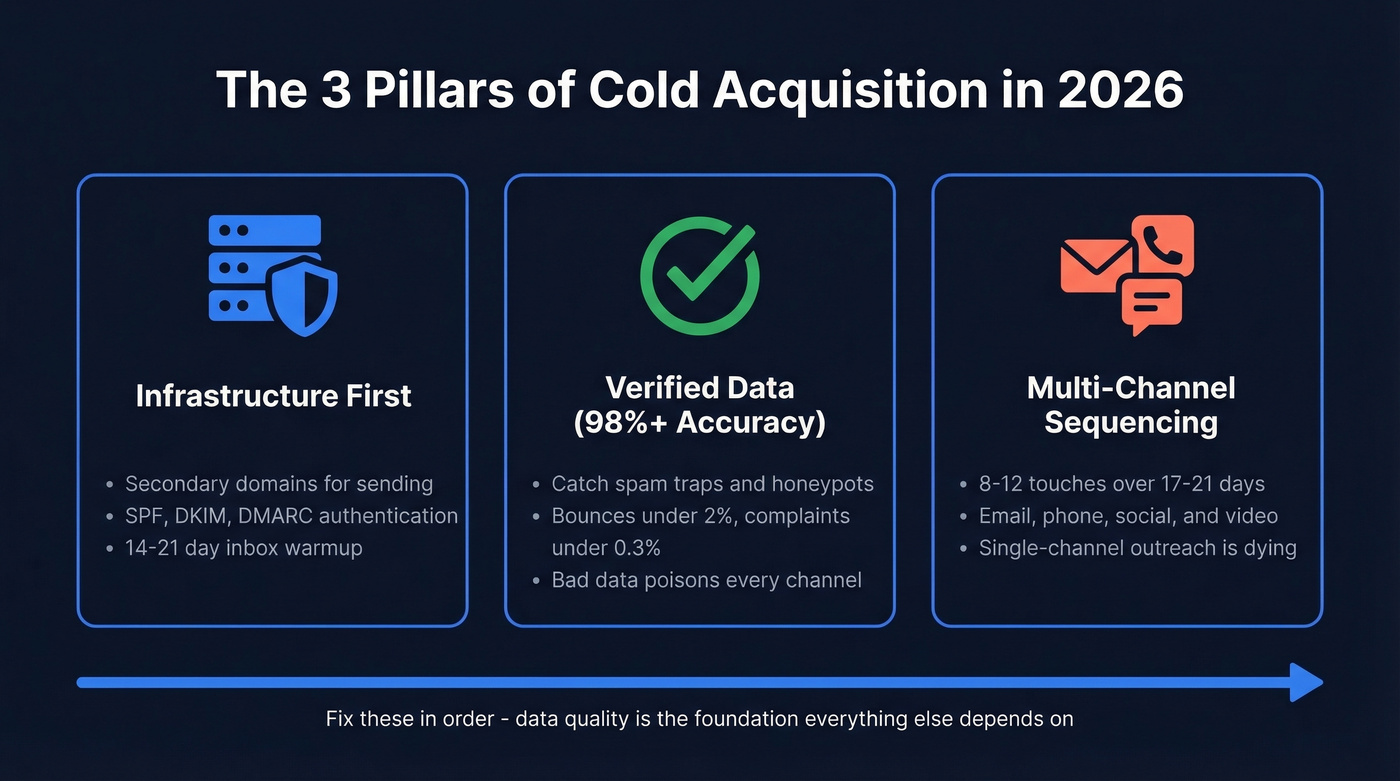
- Infrastructure first. Secondary domains, proper authentication (SPF/DKIM/DMARC), warmed-up inboxes. Without this, your emails hit spam regardless of how good your copy is.
- Verified data. Your email accuracy needs to be 98%+ before you send a single message. Bad data poisons every channel downstream - email bounces, wrong phone numbers, wasted rep time.
- Multi-channel sequencing. 8-12 touches across email, phone, and social over 17-21 days. Single-channel outreach is dying, and the lift from adding even one additional channel is measurable.
If you fix nothing else, fix your data. The cadence, the copy, the call scripts - all of it falls apart when you're reaching out to the wrong people at the wrong addresses.
Why Cold Outreach Still Works
There's a narrative that cold outreach is dead. It's wrong, but it's understandable. Decision-makers receive 100+ sales emails per week. Spray-and-pray mass automation gets less than 1% reply rates. That approach deserves to die.
Research-led outreach anchored to real business signals - funding rounds, leadership changes, hiring surges - consistently hits 7-10% reply rates, with elite teams reporting 15-25%. That's a 10-25x gap between lazy and intentional.
The economics still work. Outbound sales CAC runs about $1,980 per customer, higher than SEO ($290) or referrals ($150). But outbound is controllable and scalable in ways organic channels aren't. You can't will SEO to produce 50 more meetings next month. You can absolutely scale a prospecting system to do that - if the infrastructure is right. CAC across all channels rose 40-60% between 2023 and 2025, which makes efficiency non-negotiable. The teams winning aren't spending more; they're spending smarter, with verified data, proper deliverability, and multi-channel coordination that compounds each touch.
Here's the thing: if your average contract value is under $5k, you probably don't need a full multi-channel system. A simple email-only setup with great data will outperform a sloppy multi-channel effort every time. The system described here is for teams where the deal size justifies the infrastructure investment.

The Three Core Channels
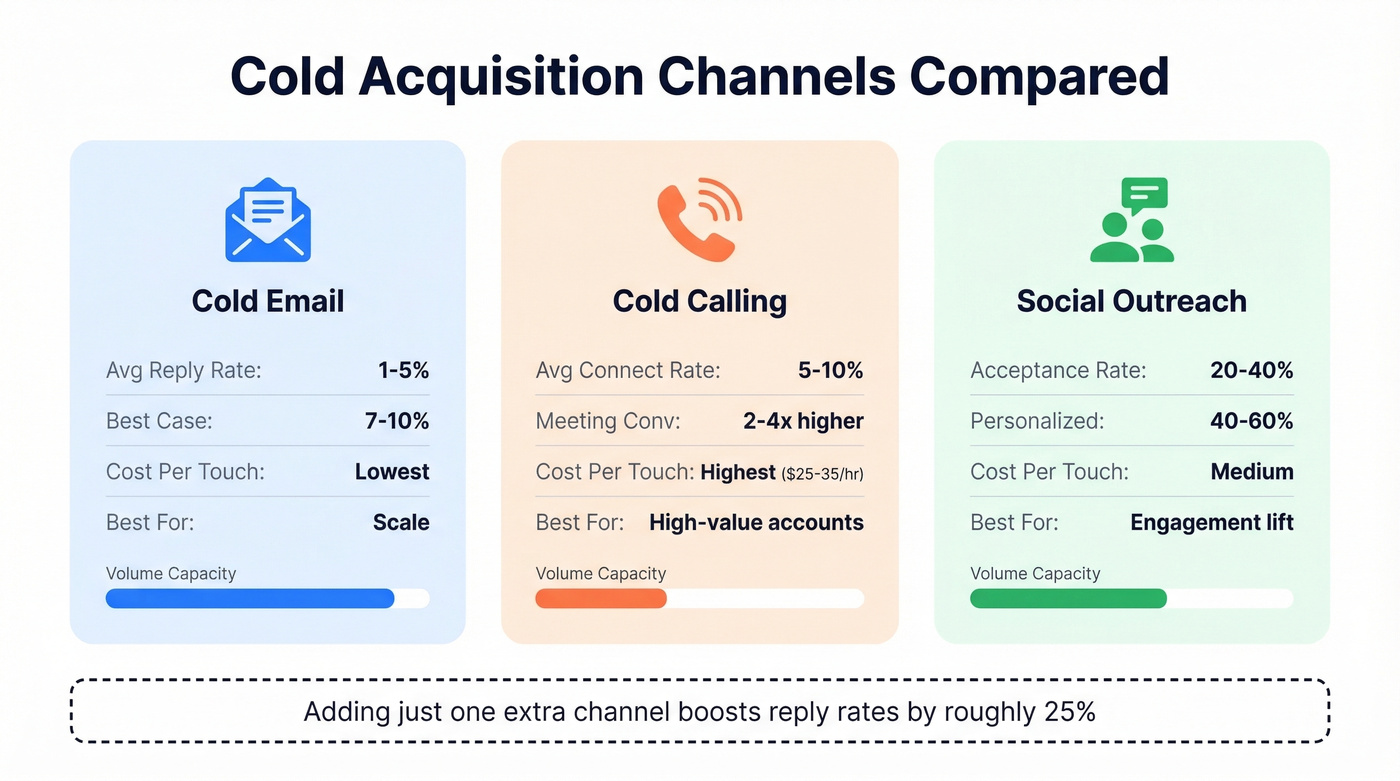
| Channel | Avg Reply/Connect | Best Case | Cost Per Touch | Best For |
|---|---|---|---|---|
| Cold Email | 1-5% reply | 7-10% (research-led) | Lowest | Scale |
| Cold Calling | 5-10% connect | 2-4x meeting conv. | Highest | High-value accounts |
| Social | 20-40% acceptance | 40-60% (personalized) | Medium | Engagement lift |
Cold Email
Cold email remains the scale layer. A well-built infrastructure can push 12,000 emails per month. At a solid 3% reply rate, that's 360 replies, which funnels down to roughly 90-100 meetings. We've seen teams hit these numbers consistently when infrastructure and data are dialed in.
The benchmark range for reply rates sits at 1-5% on average, with 2-4% being solid at scale. The teams hitting 7-10% are sending fewer emails to better-targeted prospects, spending five minutes researching each account before writing a word.
Deliverability is the new copywriting. The best subject line in the world doesn't matter if it lands in spam. The consensus on r/coldemail backs this up - technical setup matters more than your copy. Secondary domains, proper authentication, validated lists, and gradual warmup are table stakes. If you want a deeper checklist, use this email deliverability guide as your baseline.
Cold Calling
Cold calling didn't die - bad cold calling did.
The average success rate sits around 2-2.3%, which sounds terrible until you realize that when you actually connect, the meeting conversion rate is 2-4x higher than email. The phone compresses sales cycles because it creates real-time dialogue. You get objections, context, and qualifying information in three minutes that would take a week of email back-and-forth. With verified data and intent signals, most "cold" calls in 2026 are actually warm - you already know the prospect's role, company stage, and likely pain points before you dial.
The modern framing for cold calls is qualifying and learning, not closing on the first dial. Use this 30-second opener framework:
- First 10 seconds - Pattern interrupt. State your name, company, and one specific reason you're calling this person (not their company - them). "Hi Sarah, this is James at Acme. I saw your team just posted three SDR roles in DACH - that's why I'm calling."
- Next 10 seconds - Permission check. "Did I catch you at an okay time, or should I call back in 20 minutes?" This respects their time and reduces hang-ups.
- Final 10 seconds - Value hook. One sentence about what you help similar companies do. "We helped [similar company] cut their SDR ramp time from 10 weeks to 4 - I wanted to see if that's relevant to your hiring push."
After the call, score yourself on three dimensions: Did you reach the right person? Did you learn something new about the account? Did you earn a next step? It takes about eight touchpoints on average to secure an initial meeting, though top performers compress that to five. If your team needs scripts for handling pushback, keep a cold call rejection playbook handy.
Cost-wise, cold calling is the most expensive channel. Domestic outsourced callers run $25-$35/hour, offshore $8-$12/hour. Reserve it for high-value accounts where the deal size justifies the cost per touch.
Social Outreach
Social outreach - primarily on professional networks - serves as the engagement multiplier. Blank connection requests get 20-40% acceptance rates. Personalized notes push that to 40-60%. The real value isn't the acceptance itself; it's the omnichannel lift. Adding a social touch to an email-only sequence boosts reply rates by roughly 25%.
Use social to warm up prospects before the first email, engage with their content between touches, and create familiarity that makes your outreach feel less cold. It's a supporting channel, not a primary one. For more examples, borrow a few patterns from this personalized outreach guide.
Building a Multi-Channel Cadence
The sweet spot for a cold acquisition cadence is 8-12 touches across 3 channels over 17-21 days. The channel mix that works for most teams breaks down to roughly 45% email, 25% phone, 20% social, and 10% video. Multi-channel sequences convert at 4-7% with 30%+ higher meeting conversion than single-channel approaches.
If you want a dedicated framework for building the actual sequence, start with a B2B cold email sequence and then layer in phone + social touches.
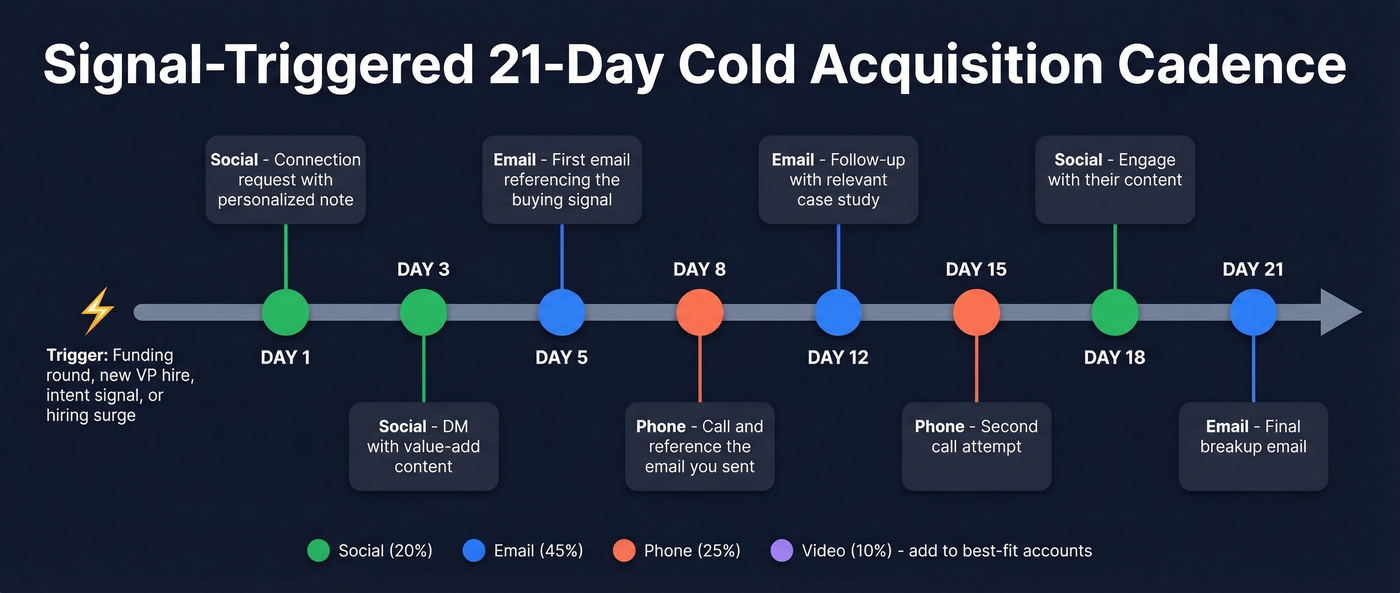
That 10% video allocation means 1-2 personalized video messages per sequence - tools like Loom or Vidyard let you record a 60-second screen share referencing the prospect's specific situation. It's the highest-effort touch, so save it for your best-fit accounts.
Here's an example signal-triggered cadence:
| Day | Channel | Action |
|---|---|---|
| 1 | Social | Connection request (personalized) |
| 3 | Social | DM with value-add |
| 5 | First email - reference signal | |
| 8 | Phone | Call - reference email |
| 12 | Follow-up with case study | |
| 15 | Phone | Second call attempt |
| 18 | Social | Engage with their content |
| 21 | Final breakup email |
The key word is "signal-triggered." Don't start this cadence for every prospect in your CRM. Start it when you see a buying signal - a funding announcement, a new VP hire, a technology adoption that maps to your solution, or intent data showing research activity in your category. Companies actively researching topics in your category are 3-5x more likely to take a meeting than those that merely match your firmographic filters. To operationalize this, build a simple scoring model around identifying buying signals.
The sequence above is a template, not a script. Enterprise deals with long sales cycles might stretch to 30 days with more phone touches. SMB deals with lower contract values might compress to 14 days and lean heavier on email.
Cold Email Infrastructure
This is where most teams fail before they even start. The infrastructure isn't glamorous, but it's the difference between 60% and 92% deliverability - a gap that one practitioner documented after implementing proper list validation.
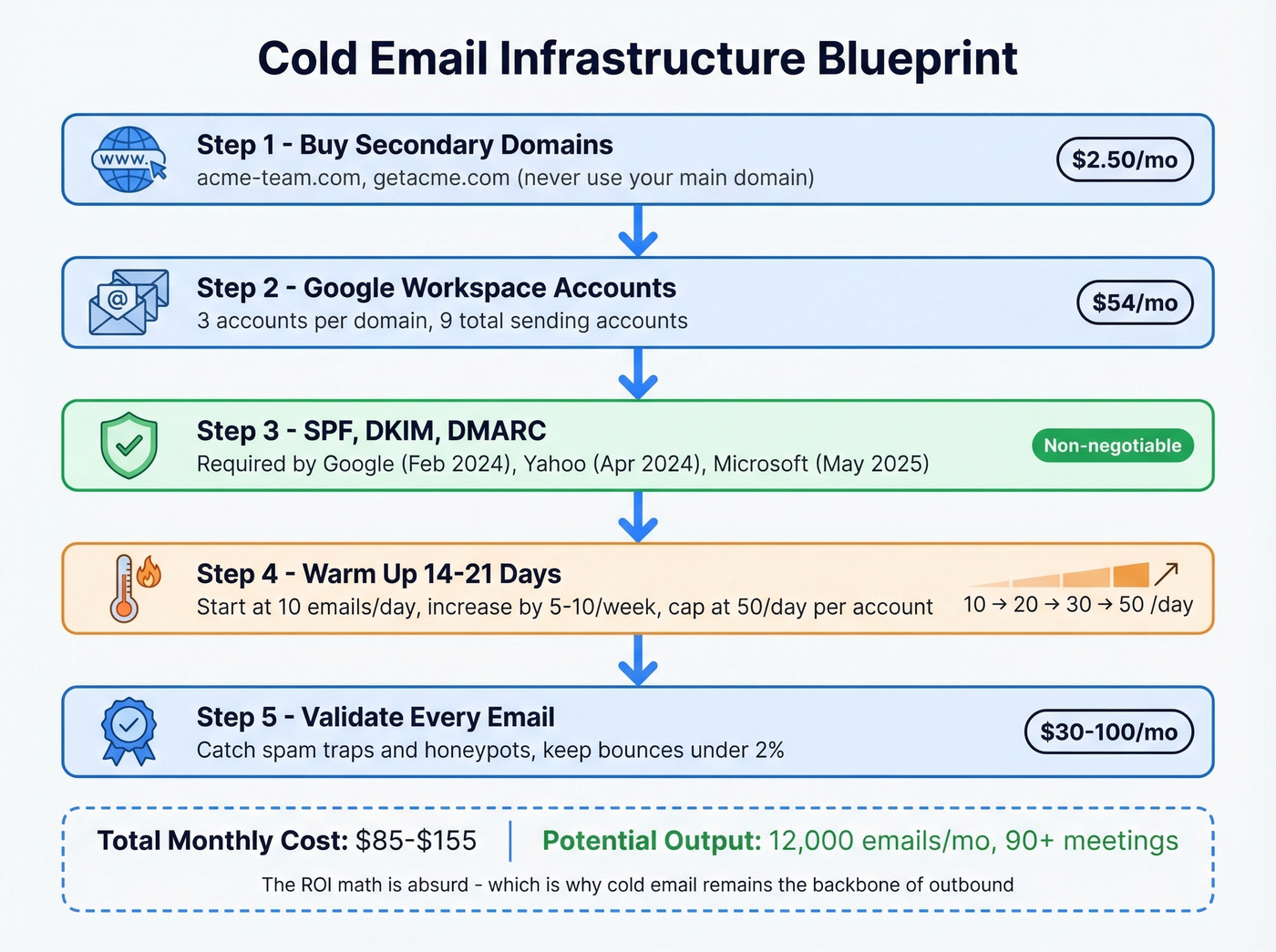
Step 1: Never use your main domain. Buy 2-3 secondary domains similar to your primary. If you're acme.com, buy acme-team.com and getacme.com. This protects your primary domain's reputation if something goes wrong.
Step 2: Set up Google Workspace accounts. Create 3 accounts per domain at $6/month each. That gives you 9 sending accounts across 3 domains - enough to scale to ~450 emails per day at full capacity.
Step 3: Configure SPF, DKIM, and DMARC. These authentication protocols are non-negotiable. Google started enforcing bulk sender requirements in February 2024, Yahoo followed in April 2024, and Microsoft joined in May 2025. Without all three configured, your emails get rejected or filtered. If you need a quick technical check, follow this guide on how to verify DKIM is working.
Step 4: Warm up for 14-21 days. Start at 10 emails per day per account and increase by 5-10 per week. Cap at ~50 emails per account per day. Keep warmup running even after you start sending real campaigns.
Step 5: Validate every email before sending. Use a verification tool that catches spam traps and honeypots - not just basic syntax checks. Operational thresholds are strict: keep bounces under 2% and spam complaints under 0.3%. (If you’re troubleshooting, start with email bounce rate benchmarks and fixes.)
The infrastructure costs break down like this:
| Component | Monthly Cost |
|---|---|
| 3 secondary domains | ~$2.50/mo (amortized) |
| 9 Google Workspace accounts | $54/mo |
| Sending tool (Instantly/Smartlead) | $30-$100/mo |
| Total | $85-$155/mo |
For a system that can generate 90+ meetings per month at scale, the ROI math is absurd - which is exactly why cold email remains the backbone of outbound.

You just read it: bad data poisons every channel downstream. Prospeo delivers 98% email accuracy and 125M+ verified mobile numbers on a 7-day refresh cycle - so your cold acquisition cadence reaches real buyers, not dead inboxes.
Stop burning touches on bad data. Start every cadence with verified contacts.
Data Quality: The Foundation
Inaccurate B2B data wastes 27.3% of sales reps' time - roughly 546 hours per year per rep spent chasing wrong numbers, bounced emails, and people who left the company six months ago. And 44% of prospects disengage because messaging feels irrelevant, which almost always traces back to bad data, not bad copy.
Let's be honest: if your bounce rate is above 4%, you don't have a messaging problem. You have a data problem. Every bounced email damages your sender reputation, which tanks deliverability for the emails that would have landed. Bad data doesn't just waste the bad contacts - it poisons the good ones too. (This is also why data enrichment services and verification belong in the same workflow.)
In our experience, the data refresh cycle matters more than most teams realize. People change jobs, get promoted, and switch email addresses constantly. A database that refreshes every 6 weeks is serving you stale contacts for 5 out of every 6 weeks. That staleness shows up directly in your bounce rate and connect rate. Prospeo runs a 7-day refresh cycle and delivers 98% email accuracy across 300M+ professional profiles - Stack Optimize built from $0 to $1M ARR using that data, keeping client deliverability at 94%+ with bounce rates under 3% and zero domain flags.
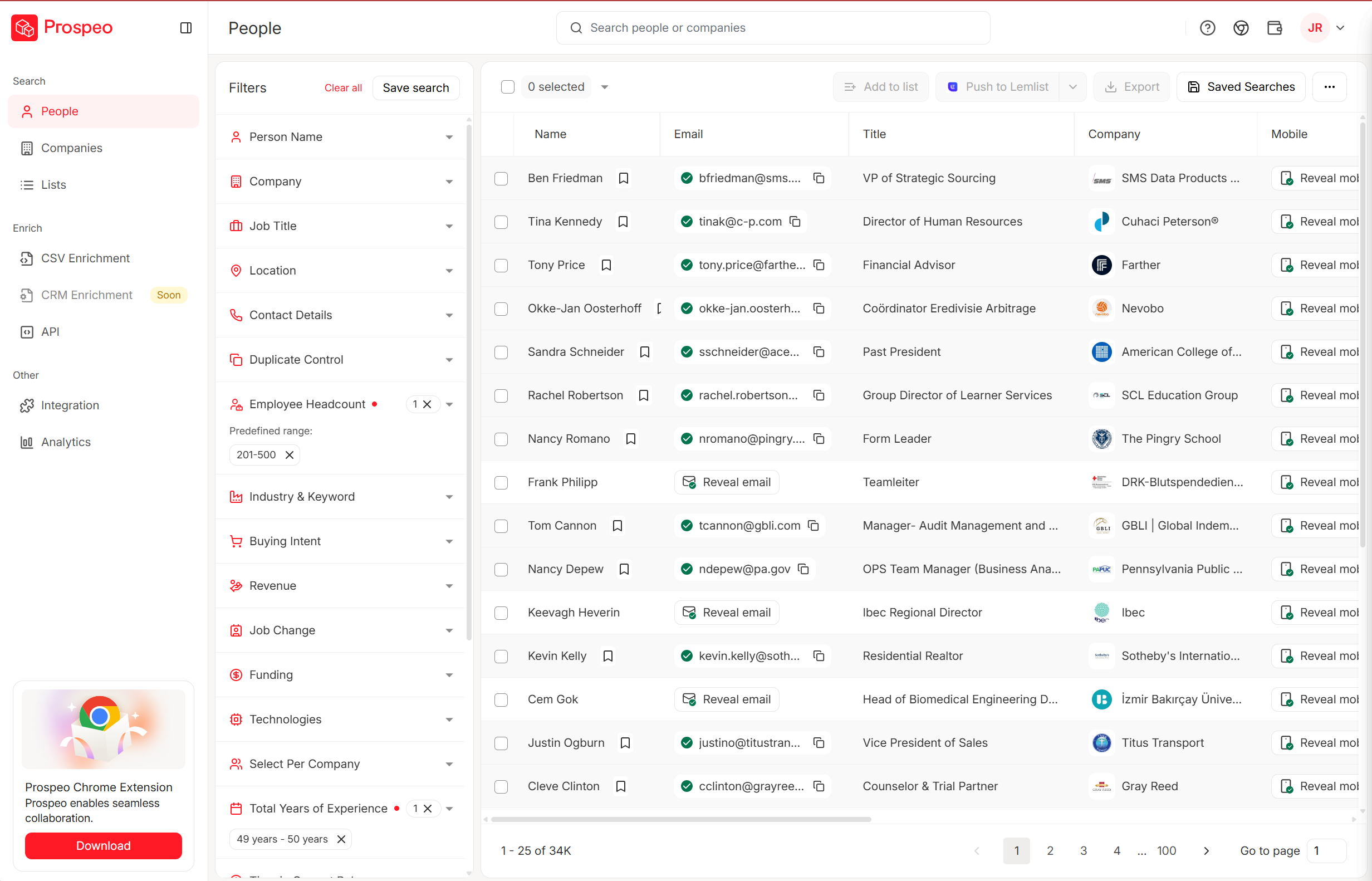
Multi-channel cold acquisition demands accurate emails, direct dials, and intent signals in one place. Prospeo gives you 30+ filters - buyer intent, job changes, headcount growth - plus 143M+ verified emails and 125M+ mobiles at $0.01/lead.
Build your entire cold acquisition list in minutes, not hours.
Compliance You Can't Ignore
Compliance isn't optional, and the penalties are severe enough to sink a small company.
| Law | Penalty Per Violation | Key Rule |
|---|---|---|
| TCPA | $500-$1,500 | Prior consent for autodialed/prerecorded calls; AI voices included |
| TSR | Up to $50,120 | DNC compliance, calling hours, disclosures |
| National DNC | Up to $53,088 | Scrub lists every 31 days minimum |
| GDPR (EU) | Up to EUR 20M / 4% revenue | Legitimate interest or consent |
The operational checklist that keeps you safe:
- Calling hours: 8 a.m. to 9 p.m. recipient's local time. Not yours - theirs.
- DNC scrubbing: Every 31 days minimum. Set a calendar reminder.
- AI voice calls: The FCC ruled in February 2024 that AI-generated voices count as "artificial/prerecorded voice" under TCPA. If you're using AI voice agents for cold calls, you need prior express written consent.
- Consent revocation: Prospects can revoke consent through "any reasonable method," and you must honor it within 10 business days. A broader opt-out scope provision takes effect April 11, 2026 - review your consent collection processes now.
- Reassigned Numbers Database: The FCC's RND safe harbor gives callers a defense when numbers have been reassigned, but only if you check the database before dialing.
- Microsoft enforcement: Bulk sender authentication (SPF/DKIM/DMARC) became mandatory for Outlook.com in May 2025. This affects deliverability, not just compliance.
Federal compliance is the floor, not the ceiling. States like Connecticut, Texas, and Virginia have their own mini-TCPA laws with additional requirements. If you're calling across state lines - and you almost certainly are - comply with the strictest applicable standard.
The fact that so many teams ignore compliance is actually an opportunity. When your competitors get flagged, blacklisted, or fined, your clean infrastructure and compliant processes become a competitive advantage.
Mistakes That Kill Campaigns
We've seen these patterns destroy campaigns that should have worked:
- Targeting wrong accounts despite "ICP fit." Your ICP says "50-200 employee SaaS companies" but you're emailing bootstrapped lifestyle businesses alongside VC-backed growth companies. Same firmographics, completely different buying behavior. (If you need a tighter definition, use an ideal customer profile template with scoring.)
- No segmentation within ICP. The same message to a VP of Sales and a VP of Marketing at the same company. Different pain points, different language.
- Generic messaging. "I noticed your company is growing" isn't personalization. Referencing their specific Q3 hiring push for SDRs in the DACH region is.
- Relying on one channel. Email-only sequences leave 30%+ of potential meetings on the table.
- Volume over fit. 10,000 emails to a loosely defined list will always underperform 2,000 emails to a tightly researched one.
- Stale ICP. Markets shift. The ICP you defined 18 months ago doesn't reflect where your best customers come from today.
- Pitching too early. The first touch should earn attention, not ask for a meeting. Lead with insight, not your product.
- Sending from your primary domain. This one still surprises me. Teams burn their main company domain's reputation and then wonder why internal emails land in spam. Skip this mistake - it's the most expensive one to fix.
The Cold Acquisition Tool Stack
The right stack depends on your budget and team size, but a functional setup looks like this:
| Function | Recommended Tools | Budget |
|---|---|---|
| Data & verification | Prospeo, LeadIQ, ListKit, Kickbox | $39-$200/mo |
| Email sending & warmup | Instantly.ai, Smartlead, Saleshandy | $30-$100/mo |
| Multi-channel sequencing | ManyReach, Lemlist, ReachInbox | $50-$150/mo |
| CRM | HubSpot (free tier), Salesforce | $0-$75/mo |
| Cold calling | Power dialer of choice | Variable |
On the sending side, Instantly and Smartlead are the most recommended tools on Reddit for warmup and sending. Both handle multi-inbox rotation and warmup automation. For multi-channel sequencing, ManyReach and ReachInbox are gaining traction among practitioners for combining email and social touches in a single workflow. If you’re comparing categories, this list of SDR tools is a good starting point.
The evaluation criteria that actually matter: data accuracy, CRM integration depth, automation reliability, and analytics tied to revenue outcomes. Lead scoring and intent data become essential as you scale past the first few reps.
What It Actually Costs
Cold acquisition stacks up against other channels like this:
| Channel | Avg CAC |
|---|---|
| Outbound sales | $1,980 |
| LinkedIn ads | $982 |
| Paid search (B2B) | $802 |
| SEO | $290 |
| Referrals | $150 |
Outbound is the most expensive per-customer channel, but also the most predictable and scalable. If you want to go deeper on the math and definitions, use this cost to acquire customer guide.
For teams building in-house, the infrastructure runs $85-$155/month for email. Add a data platform ($39-$200/month), a CRM (free to $75/month), and rep time, and a solo founder can run a functional outbound system for under $500/month. A team of 3-5 SDRs with proper tooling runs $3,000-$5,000/month in software before salaries.
Outsourcing is a different equation entirely. CIENCE packages run $4,200-$9,000/month with implementation fees of $5,000-$25,000. Traditional providers charge $25-$35/hour domestically. The target to aim for: a 3:1 LTV-to-CAC ratio. If your average deal is worth $6,000+ in lifetime value, outbound math works.
FAQ
What's the difference between cold acquisition and cold calling?
Cold calling is one tactic - dialing someone who hasn't heard from you. Cold acquisition is the full system: email, phone, social, and video coordinated across channels to convert prospects who haven't engaged with your brand. Effective programs in 2026 always combine at least three channels over 17-21 days.
Is cold acquisition legal?
Yes, with guardrails. The TCPA, TSR, and National DNC Registry govern calling in the US. Cold email is legal under CAN-SPAM and requires legitimate interest under GDPR for EU prospects. Penalties reach $53,088 per incident, so scrub DNC lists every 31 days and authenticate all sending domains.
What reply rate should I expect from cold email?
Average B2B cold email reply rates sit at 1-5%, with the overall average around 3%. Research-led campaigns targeting real business signals consistently hit 7-10%, and elite teams push 15-25%. The gap comes down to data quality and per-prospect research time.
How many touches does it take to book a meeting?
Plan for 8-12 touches across 3 channels over 17-21 days. 80% of sales happen after the fifth contact attempt - persistence across channels separates pipeline builders from email senders. Top performers compress this to five touches by leading with strong intent signals.
What's a good free tool for building prospect lists?
Prospeo's free tier gives you 75 verified emails per month plus 100 Chrome extension credits - enough to test data accuracy on real campaigns. Pair it with a free CRM like HubSpot and a sending tool like Instantly's starter plan, and you've got a complete cold acquisition stack under $200/month.