

Cold Call Outreach: The Data-Backed Playbook That Actually Books Meetings
It's Tuesday morning. You've got 80 dials queued up, a script you half-believe in, and a CRM full of numbers that may or may not ring. By noon, you've connected with six people, left 30 voicemails, and booked zero meetings.
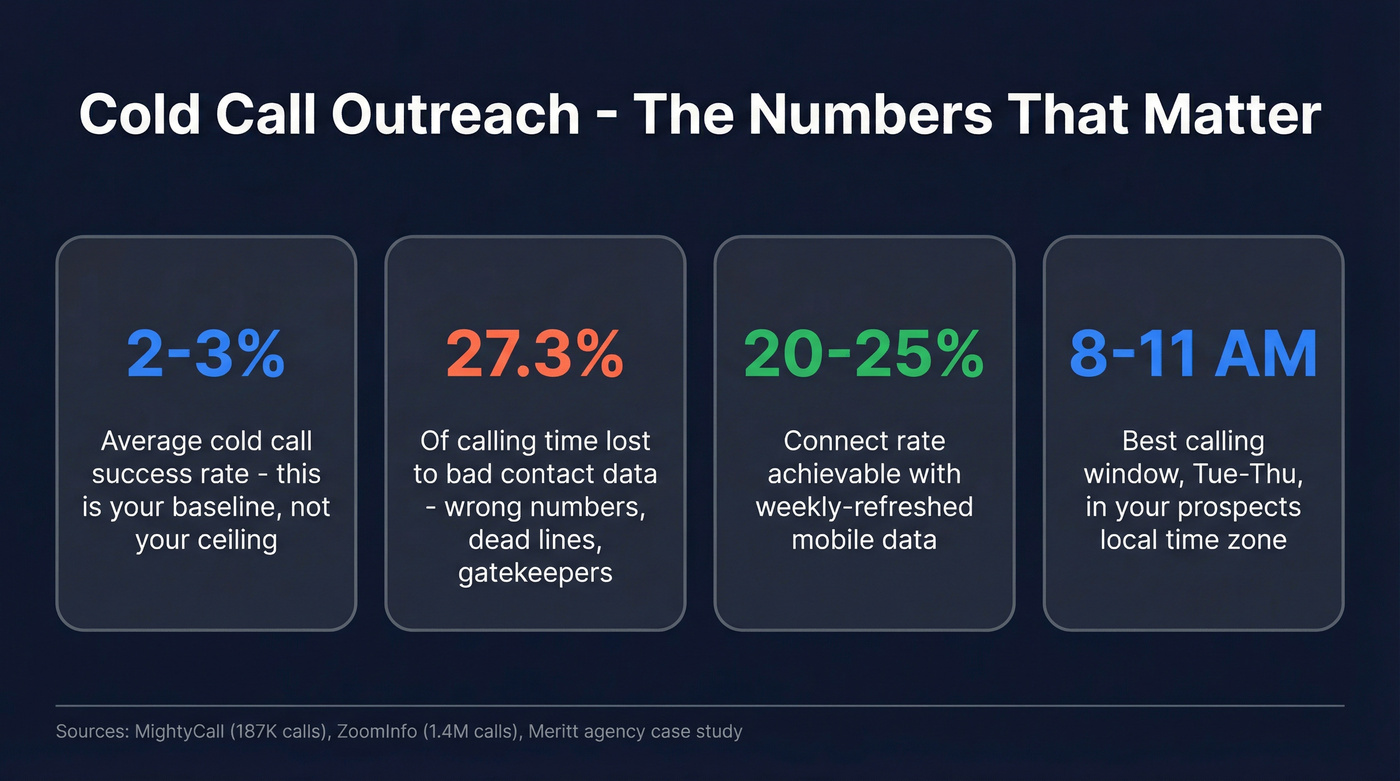
The average cold call outreach success rate sits at 2-3%, which means most reps aren't failing - they're operating exactly at baseline. The gap between baseline and top-performer territory isn't talent or grit. It's data, timing, and structure. Reps lose 27.3% of their calling time to bad contact data - wrong numbers, disconnected lines, gatekeepers at switchboards. That's a quarter of your day gone before you even pitch.
The Short Version
- Fix your data first. Bad numbers kill cold calling faster than bad scripts. B2B contact data decays at roughly 2% per month. A six-month-old list is about 13% stale.
- Call Tuesday through Thursday, 8-11 AM local time. This window outperforms every other slot across multiple large-scale studies.
- Use a pattern interrupt opener. "This is a cold call - give me 18 seconds" kept 30% of prospects on the line past 30 seconds in one practitioner's tracked test of 820 dials. Meanwhile, "Did I catch you at a bad time?" converts at 0.9%. Stop using it.
Fix Your Data Before Your Script
A benchmark study across 9 phone data providers using 307 verified contacts found accuracy ranged from 63% to 91% and coverage from 26% to 92%. The formula that actually matters: true effectiveness = accuracy x coverage. A provider with 90% accuracy but 30% coverage gives you usable numbers for fewer than one in three prospects. That's brutal math.
B2B data decays at roughly 1.9% per month - about 22.5% annually. If your data provider refreshes quarterly, a meaningful chunk of your list is already dead before the next update arrives.
We've seen this play out firsthand. Meritt, an agency running Prospeo data with its 7-day refresh cycle, saw their connect rate triple to 20-25% after switching from a provider with longer refresh windows. When you're working with 125M+ verified mobile numbers and a 30% pickup rate, you're fixing the single biggest variable in cold calling before you ever pick up the phone. (If you're evaluating vendors, start with B2B company data providers and data enrichment services.)

When to Call
| Day | Best Time Slot | Key Stat |
|---|---|---|
| Monday | 8 AM local | 30.4% success rate (187K calls analyzed) |
| Tuesday | Morning | Strongest demo-booking day |
| Wednesday | Morning | Tue + Wed account for 44% of demos (1.4M calls) |
| Thursday | Morning | Still strong; performance drops later in the day |
| Friday | Any | Worst day across every dataset we've reviewed |
The MightyCall study defined "success" as calls lasting 30+ seconds that connected - not meetings booked. ZoomInfo's research tracked actual demos set. Both converge on the same window: Tuesday through Thursday, mornings. Block your calendar accordingly. (If you want the email equivalent, see best time to send cold emails.)
Openers That Actually Work
| Opener Type | Success Rate | Context |
|---|---|---|
| "How have you been?" | 10.01% | Gong-style benchmark - disarms, feels personal |
| Pattern interrupt | 30% stayed 30s+ | Reddit practitioner, 820 dials over one month |
| Stating reason for call | 2.1x lift | Benchmark finding - explain why you're calling |
| "Did I catch you at a bad time?" | 0.9% | Same benchmark set - decreases meeting chances 40% |
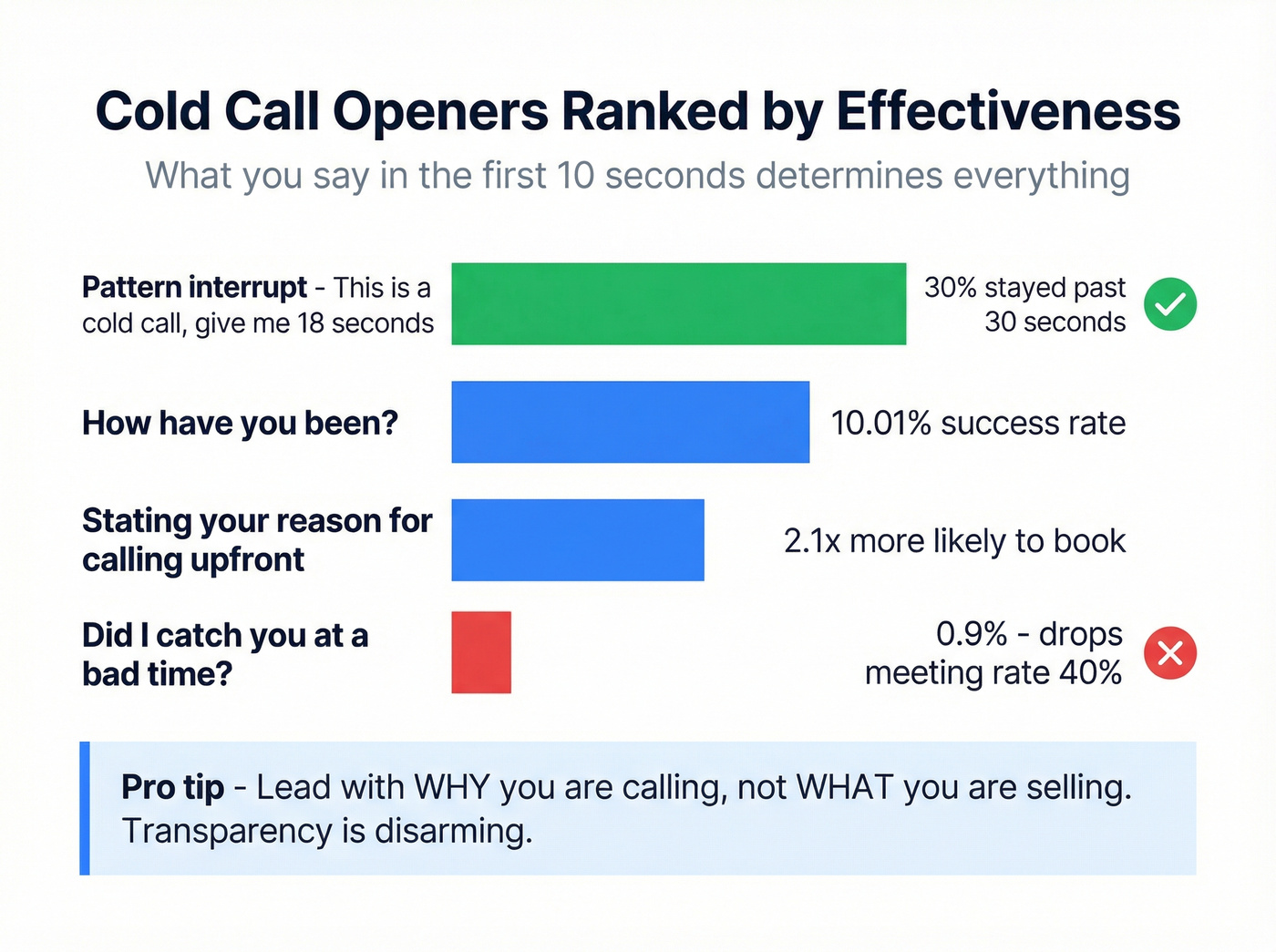
The pattern interrupt - "Hey, this is a cold call. I know that's annoying. Give me 18 seconds and I'll earn the next 2 minutes or hang up" - works because transparency itself is disarming. Nobody expects honesty from a cold caller.
Stating your reason for calling early (not your product pitch, your reason) lifts success 2.1x. Lead with the "why," not the "what." For executive prospects, company-based personalization triples reply rates - reference their earnings call or a recent hire, not their job title. (More ideas: personalized outreach and sales prospecting techniques.)
Here's the thing: listening matters more than any opener. The best cold callers sound like interviewers, not presenters. If you're building a repeatable motion, use a documented cold calling system.

You just read that bad data eats 27% of your calling time. Prospeo's 125M+ verified mobile numbers refresh every 7 days - not every quarter. That's how Meritt tripled their connect rate to 20-25% and grew pipeline from $100K to $300K/week.
Fix your data before your next dial block.
Scripts and Objection Handling
Don't memorize scripts - internalize frameworks. The Problem-Solution-Benefit structure is the most versatile: open with a pain point your prospect likely faces, bridge to how it gets solved, land on a tangible outcome. The whole thing fits in 30 seconds. Follow the 80/20 rule: 80% value, 20% pitch. (For tighter talk tracks, borrow from these sample elevator pitches and talk track examples.)
Your only goal on the cold call is earning 90 more seconds, then a meeting. Not a close.
Getting Past the Gatekeeper
The best gatekeeper strategy is calling mobile numbers directly. Every minute navigating a switchboard is a minute you could've spent with a decision-maker. But when you do hit a gatekeeper:
- Seniority tone: "Hi Sarah. It's [Name] calling for John." Then silence. Confidence implies authority.
- "Help me" routing: "I'm trying to reach the right person for [topic]. Could you point me to whoever handles that?"
- Skip long explanations. Keep it vague: "Just following up on something I sent over."
Handling "Not Interested"
Acknowledge it, clarify whether it's timing or relevance, then respond with a time-boxed micro-commitment: "If I could quickly show you how to [benefit], would you give me 90 seconds?" (If this is a recurring blocker, see how to reduce sales objection rate.)
For "we already have a vendor," pivot to a specific gap the competitor doesn't solve. For "no budget," reference an ROI metric that made other teams find budget after the fact. The consensus on r/sales is that "not interested" usually means "you haven't said anything interesting yet" - it's rarely a final answer.
The Voicemail Question, Answered
Leave voicemails - but exactly two. An analysis of 300M+ cold calls found that voicemails reduce your future connect rate by 28% but double your email reply rate, from 2.73% to 5.87%. That tradeoff is worth it in a multi-channel cadence.
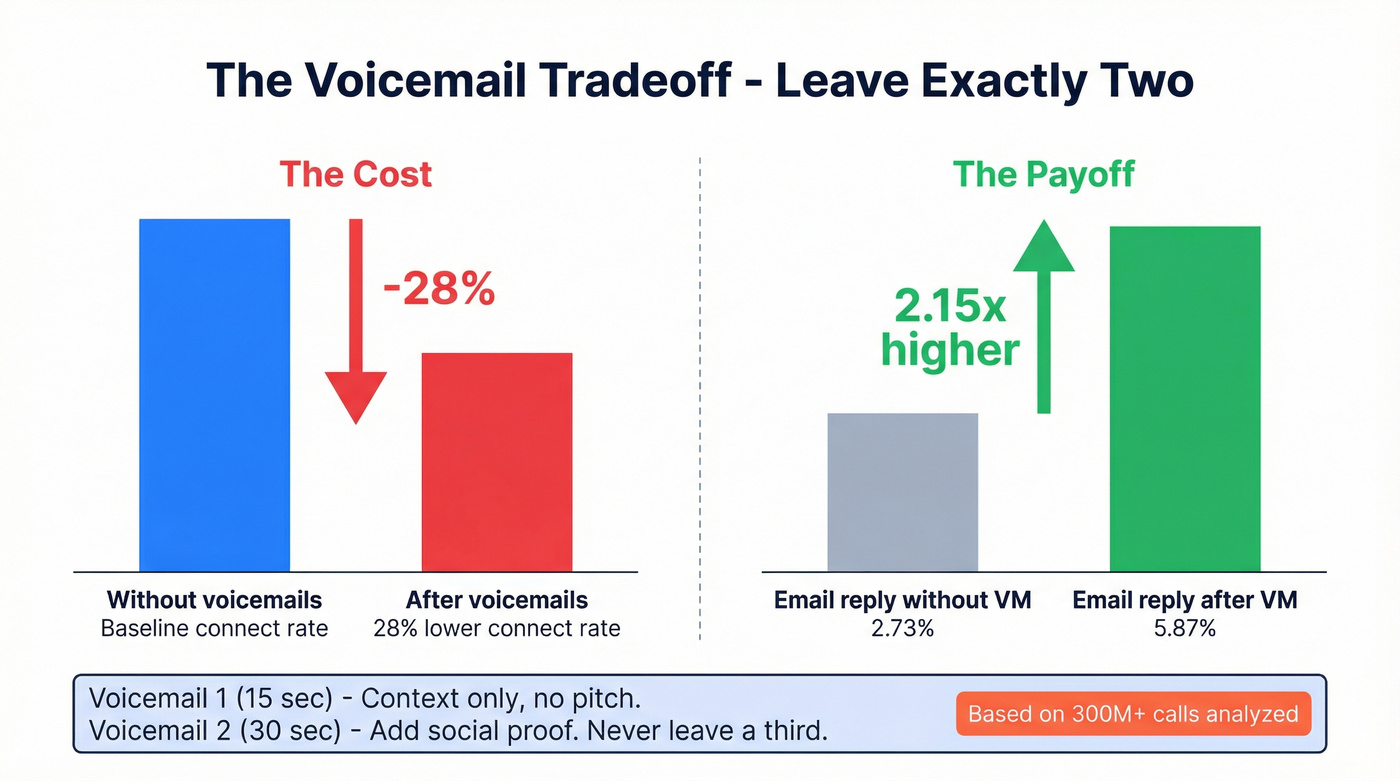
Voicemail #1 is about 15 seconds, context only, no pitch: "Hey [Name], [Your Name] from [Company]. Sending you a quick email - take a look when you get a chance." Voicemail #2 comes later, roughly 30 seconds, and adds social proof. No third voicemail. Ever.
One Reddit practitioner tracked 310 voicemails and got 7 callbacks - about 2%. When they replaced voicemails with a message on a professional network within 5 minutes of the missed call, response rate jumped to 14%. The voicemail's job isn't to get a callback. It's to prime the email.
Multi-Channel Sequences That Book Meetings
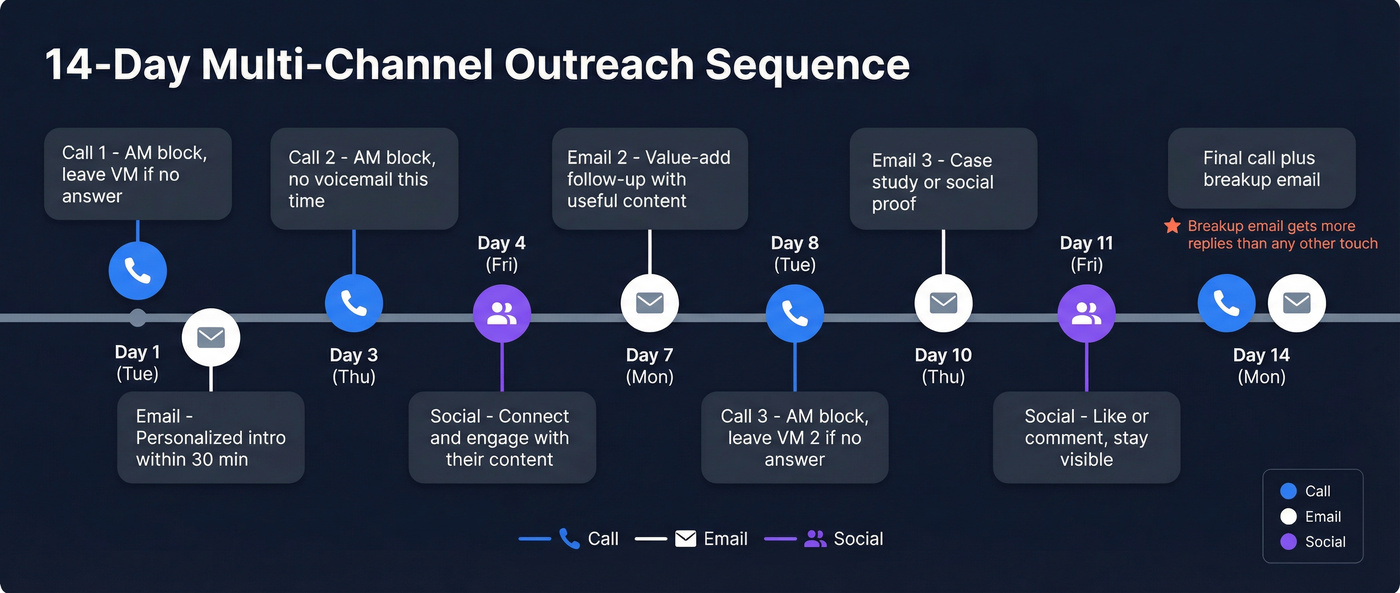
Let's be honest: 44% of reps give up after one follow-up. That's insane. High-performing outbound sequences run 8-12 touchpoints over 21-27 days. Here's a 14-day starter we've used as a baseline:
| Day | Channel | Action |
|---|---|---|
| 1 (Tue) | Call | First attempt, AM - leave VM #1 if no answer |
| 1 (Tue) | Personalized intro within 30 min of call | |
| 3 (Thu) | Call | Second attempt, AM - no voicemail |
| 4 (Fri) | Social | Connect + engage with their content |
| 7 (Mon) | Value-add follow-up with relevant content | |
| 8 (Tue) | Call | Third attempt, AM - leave VM #2 if no answer |
| 10 (Thu) | Case study or social proof angle | |
| 11 (Fri) | Social | Like/comment - stay visible |
| 14 (Mon) | Call + Email | Final attempt + breakup email |
In our experience, the breakup email on Day 14 gets more replies than any other touch in the sequence. Something about "closing the loop" triggers a response from prospects who were passively interested but never replied. We don't fully understand the psychology, but we've seen it consistently across dozens of campaigns.
One thing to flag: verify your email list before launching the cadence. Bounced follow-up emails torch your domain reputation faster than any spam filter. Skip this step at your own peril. (Related: email deliverability guide and email bounce rate.)

Every touchpoint in that multi-channel sequence needs a real number and a verified email. Prospeo delivers 98% email accuracy and a 30% mobile pickup rate - at $0.01 per email. No contracts, no stale data, no burned domains.
Build sequences on data that actually connects you to decision-makers.
Caller ID and Compliance
Avoid "Spam Likely"
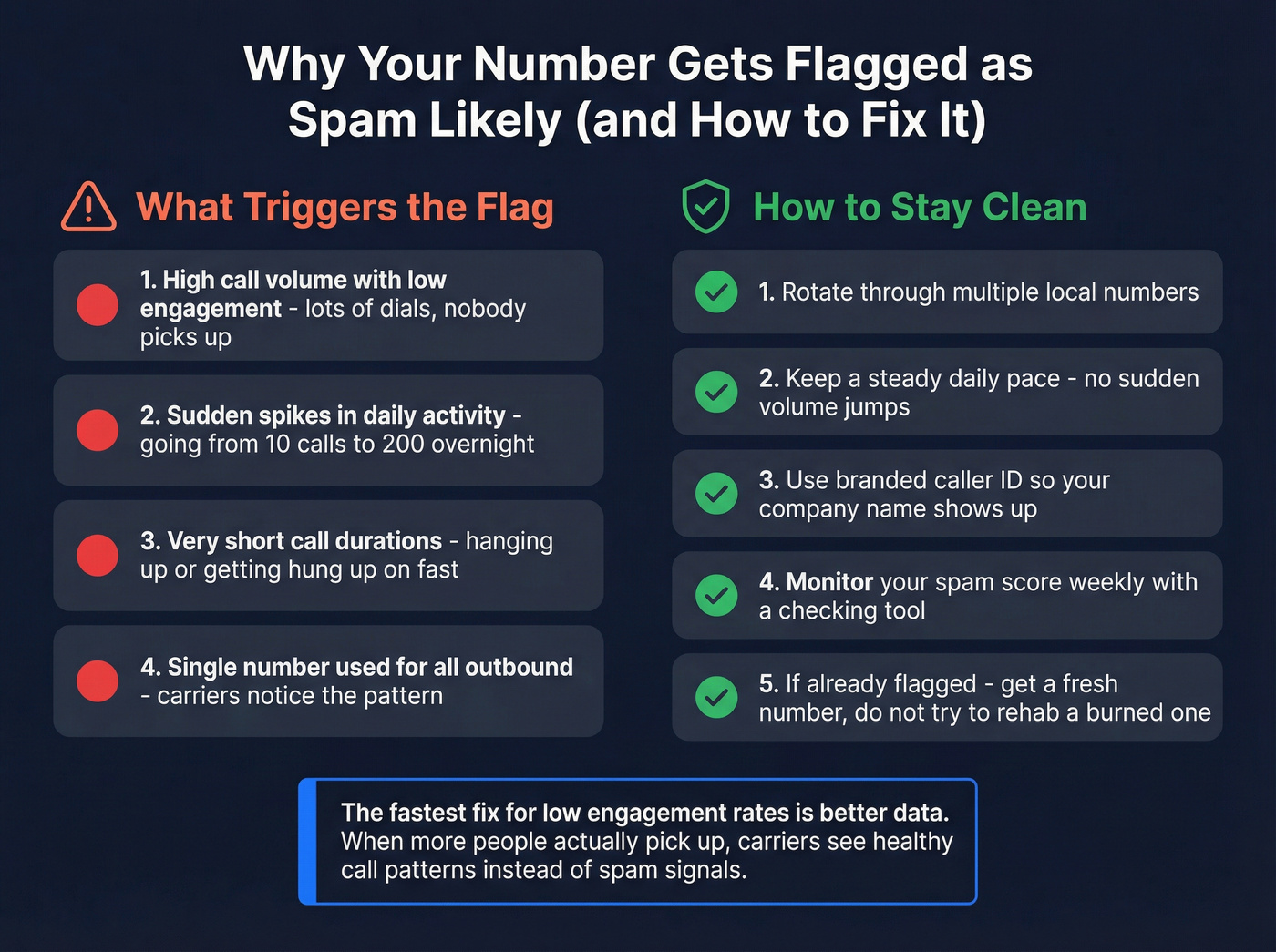
Your number gets flagged when carriers detect high volume with low engagement, sudden spikes in activity, and short call durations. Rotate through multiple numbers, maintain a steady daily pace, use branded caller ID where available, and monitor spam scores regularly. If you're already flagged, getting a clean number is faster than trying to rehabilitate a burned one.
US Compliance: TCPA + DNC
TCPA violations carry $500 per violation, $1,500 for willful violations. DNC penalties run up to $53,088 per infraction as of the latest FTC inflation adjustment. Scrub every list against the National DNC Registry, maintain an internal DNC list, honor opt-outs immediately, and call only 8 AM-9 PM in the prospect's local time zone. Never spoof caller ID.
UK Compliance: PECR + TPS
UK rules distinguish between corporate subscribers and individual subscribers, with individuals getting stronger protections. Screen all numbers against TPS and CTPS registers before calling. UK GDPR applies to personal data even in B2B contexts, so you can't just ignore it because you're selling to businesses.
The ICO notes this guidance is under review due to the Data (Use and Access) Act effective 19 June 2025, but the current PECR rules and TPS/CTPS screening requirements still apply in 2026.
FAQ
How many cold calls does it take to book a meeting?
Expect roughly 40-100 dials per booked meeting depending on data quality and whether you're reaching direct dials or switchboards. One practitioner tracked 820 dials that produced 12 meetings - about 72 calls each. Teams using fresher mobile data routinely cut that ratio in half.
Is cold calling still legal in 2026?
Yes. B2B live calls are legal in both the US and UK with compliance guardrails. In the US, scrub against the DNC Registry, follow TCPA rules, and call only 8 AM-9 PM local time. In the UK, screen TPS/CTPS registers and distinguish corporate from individual subscribers.
What's the best way to get verified phone numbers for cold calling?
Use a data platform with frequent refresh cycles - stale data is the fastest way to burn calling hours. Look for providers offering weekly refreshes rather than monthly or quarterly, and prioritize verified mobile numbers over general office lines. Pair phone data with verified email for multi-channel follow-up, and you've eliminated the biggest variable in your outbound workflow.