

Cold Calling Scripts That Actually Work in 2026
It's 10:15am on a Tuesday. You've got 50 numbers loaded, a coffee going cold, and 83 seconds per call to make something happen. That's the average cold call duration - not a lot of runway. The cold calling scripts below are built for that constraint: short enough to survive a real conversation, structured enough to move prospects toward a meeting.
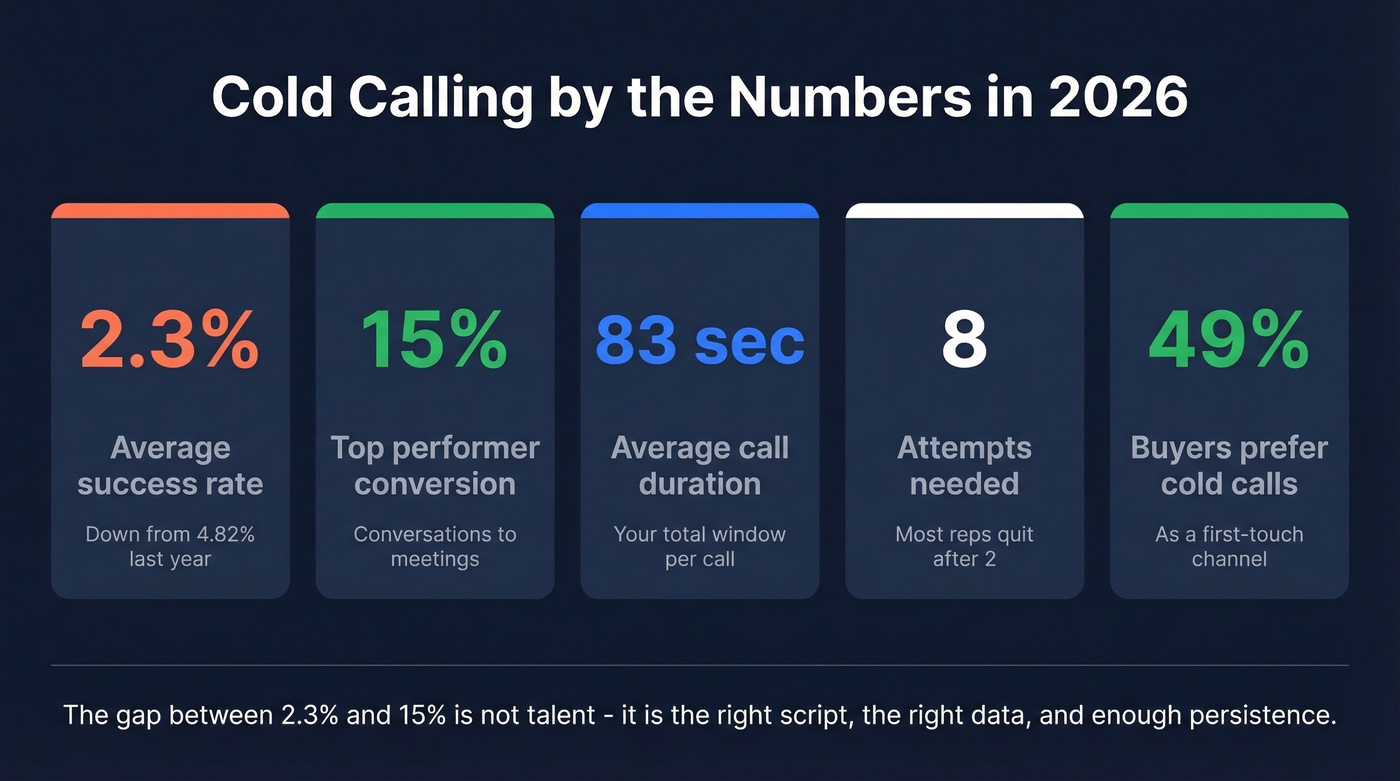
The average cold calling success rate sits at 2.3% - down from 4.82% just a year earlier. Top performers still push 15% of conversations into meetings. The difference isn't talent. It's having the right script for the right scenario, knowing how to handle the first objection, persisting through 8 attempts when most reps quit after 2, and dialing numbers that actually connect. Let's break down all four.
What You Need (Quick Version)
Three scripts cover roughly 80% of real-world cold calling situations:
- The permission-based opener - your default for every call. "Appreciate I caught you out of the blue here - you got a minute?" Disarms the prospect, earns you 15 more seconds.
- The "send me an email" rebuttal - saves the most dying calls. Ask what one thing they'd need to see to justify a call next week.
- The voicemail-to-email play - leaving one voicemail can more than double your email reply rate, based on Gong's analysis of 300M+ calls.
And here's the thing no script article tells you: none of these work if a big chunk of your phone numbers are wrong. Before you optimize scripts, verify your data. When Meritt switched to verified mobile numbers through Prospeo, their connect rate jumped to 20-25%. That's not a script change - that's a data change.
The Only Cold Call Structure You Need
Every effective cold call script follows the same three-part skeleton, whether you're calling a Series A founder or a VP of Procurement at a Fortune 500. An ex-Oracle SDR manager broke it down simply: Who -> Why -> What.
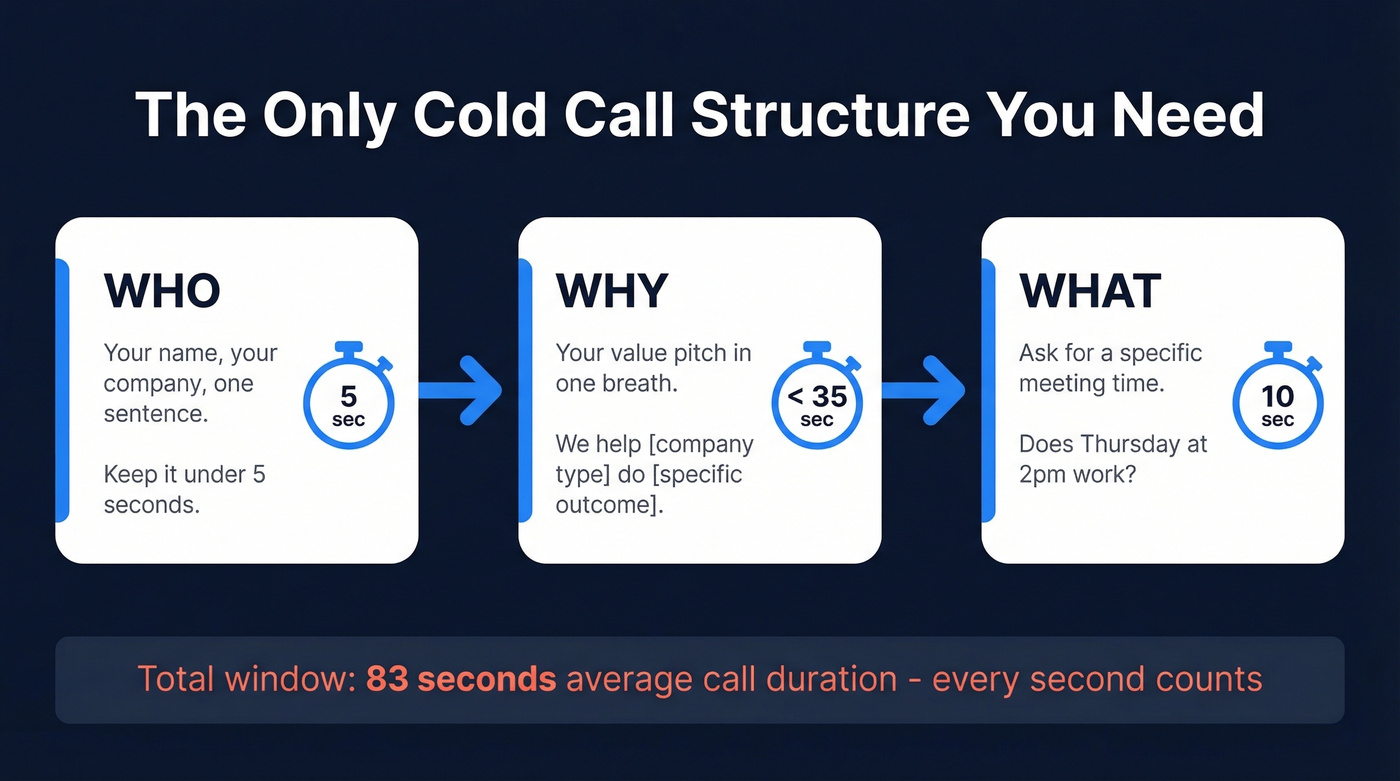
Who you are. Your name, your company, one sentence. Don't linger here - nobody cares about your company's founding story at 10am on a Tuesday.
Why you're calling. This is your value pitch, and it needs to land in under 35 seconds. "We help [type of company] do [specific outcome]." If you can't explain why you're calling in one breath, your pitch is too long. (If you need help tightening it, steal from these sample elevator pitches.)
What you want. A 15-20 minute meeting. Not a demo. Not a "quick chat whenever works." A specific time slot: "Does Thursday at 2pm work?" Scheduling same-week reduces no-shows - the further out you book, the more likely they ghost.
The structure is simple on purpose. You don't need a 12-step framework. You need three clear beats and the discipline to shut up after the ask.
Hot take: If your deal size is under $10k, scripts matter less than volume. Nail the Who -> Why -> What skeleton, then spend your optimization energy on data quality and dial count - not wordsmithing the perfect opener.
Scripts for Every Scenario
The Permission-Based Opener
This is your default. Use it on every call until you have a reason not to.
"Hey [Name], this is [Your Name] from [Company]. Appreciate I caught you out of the blue here - you got a minute?"
Why it works: it's self-aware. You're acknowledging the interruption instead of pretending the prospect was waiting by the phone. The consensus on r/sales is that this style of opener buys you a few extra seconds compared to diving straight into a pitch. When your total window is 83 seconds, those extra seconds are the difference between a brush-off and a booked meeting.
The Direct Opener
Some reps find the permission-based approach too soft. If that's you, go direct.
"Hey [Name], this is [Your Name] from [Company]. We help [type of company] [achieve outcome]. Worth a quick chat?"
Use this when you're calling into industries where directness is the norm - construction, logistics, financial services. Skip the pleasantries, get to the point.
The Trigger-Event Script
Trigger events are one of the highest-converting cold call contexts you can have. Funding rounds, hiring surges, job changes, new tech adoption - these all signal a company is in motion.
"Hey [Name], I noticed [Company] just [trigger - raised a round / opened a new office / hired 15 SDRs]. That usually means [implication - you're scaling outbound / building a new team / rethinking your stack]. We help companies in that exact spot [achieve outcome]. Can I get 15 minutes on your calendar this week?"
The trigger does the heavy lifting. It proves you did your homework and gives the prospect a reason to believe you're relevant right now, not just another dialer working a list. (If you want a system for finding and operationalizing triggers, see tracking sales triggers.)
The Referral Script
Nothing beats a name the prospect trusts. Skip this only if you don't have a genuine connection.
"[Mutual connection] suggested I reach out - they mentioned you're [dealing with X / looking at Y]. We helped them [specific result], and they thought it'd be worth a conversation. Got 15 minutes this week?"
Don't fake referrals. "I see you're connected to [person] on social media" isn't a referral - it's a stalk. Only use this when someone genuinely pointed you toward the prospect.
The Follow-Up Call Script
For prospects who've already engaged - opened your emails twice, clicked a link, downloaded something.
"Hey [Name], this is [Your Name] from [Company]. I sent you something last week about [topic] and it looked like it caught your eye. Wanted to see if it sparked any questions - got a minute?"
One practitioner on r/sales described calling prospects 4 times during a 2-week, 4-email sequence, prioritizing people who'd opened emails 2+ times. That's the right instinct - warm dials convert at multiples of cold ones. (Pair this with proven sales follow-up templates.)
The Executive Briefing Script
This is Anthony Iannarino's approach, designed for enterprise and C-suite conversations - not high-volume SDR work. 57% of C-level executives and VPs prefer phone over any other channel, so the audience is receptive if you lead with value.
"Hey [Name], this is [Your Name] from [Company]. I'm reaching out because we've put together a 25-minute executive briefing on [2-3 trends impacting their industry]. Even if we never work together, you'll walk away with the deck and some data points your team can use. Can I get 25 minutes on your calendar?"
Two risk reversals make this work: the meeting is short, and they keep the deck regardless. Iannarino credits a version of this script with helping grow a business from $3M to $7.8M in a year.
The SaaS Appointment-Setting Script
A tight B2B SaaS variant that follows problem -> proof -> ask.
"Hey [Name], this is [Your Name] from [Company]. Most [their role] at [their company type] tell us [specific problem - e.g., their reps spend 40% of call blocks on wrong numbers]. We helped [similar company] [specific result]. Worth 15 minutes to see if we can do the same?"
Keep it under 30 seconds. The proof point is doing the selling - your job is just to get the meeting. (More frameworks like this in our talk track examples.)
The Discovery Script
Once you're past the opener and the prospect is engaged, shift into discovery mode. The 70/30 rule applies: they should be talking 70% of the time.
"That's great to hear. Can I ask - how are you currently handling [problem area]? ... And what's working well? What's not? ... If you could fix one thing about that process, what would it be?"
Don't interrogate. Ask one question, listen to the full answer, then ask a follow-up that builds on what they said. The goal isn't to qualify them out - it's to understand enough to make the meeting pitch specific. (If you want a deeper bank of prompts, use these discovery questions.)
A note on verticals: These scripts are built for B2B outbound. If you're in real estate, insurance, or recruitment, the Who -> Why -> What structure still applies - swap the value pitch for your vertical's language and the meeting ask for whatever your next step looks like.
Gatekeeper Scripts
49% of buyers actually prefer cold calls as a first-touch channel. But you've got to get through the gatekeeper first.
The Direct Ask
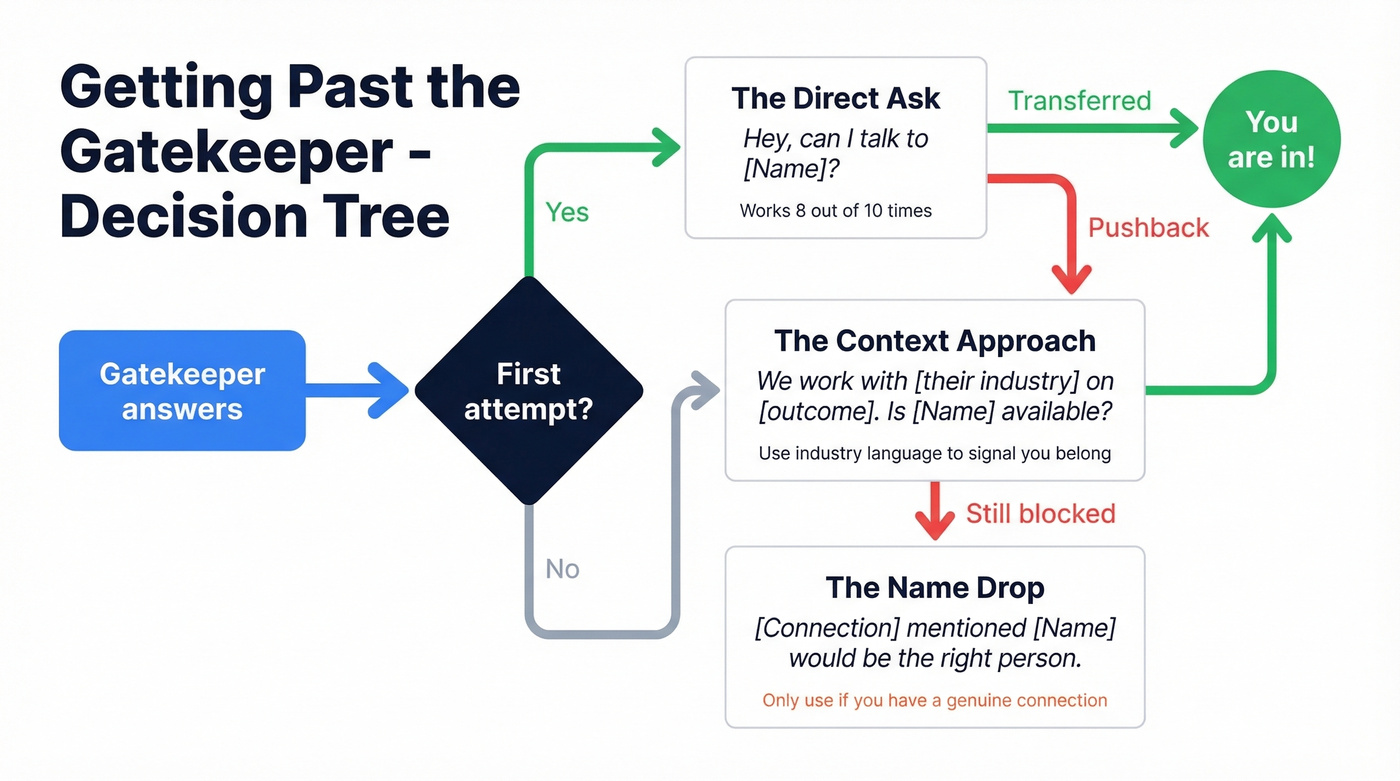
This works 8 out of 10 times according to practitioners on r/sales. It's the simplest approach and the most effective.
"Hey, can I talk to [Name]?"
That's it. No elaborate story, no "I'm hoping you can help me out," no clever misdirection. Simplicity transfers more calls than scripts that telegraph "I'm a salesperson trying to get around you."
The Context-Based Approach
When the direct ask gets pushback:
"Hey, I'm [Your Name] from [Company]. We work with [their industry] on [outcome]. I was hoping to connect with [Name] about [specific topic]. Is she available?"
Industry familiarity changes how gatekeepers respond. If you know the vertical's language, use it - it signals you belong in the conversation.
The Name-Drop
Use sparingly, and only when it's genuine.
"[Colleague/mutual connection] mentioned [Name] would be the right person to talk to about [topic]. Can you put me through?"
Skip this if you don't actually have a name to drop. Gatekeepers can smell a bluff.
Objection Handling Scripts
Most cold calls die at the first objection. Not because the objection is fatal, but because the rep doesn't have a response loaded. Within your 83-second window, you get one shot at a rebuttal - make it count.
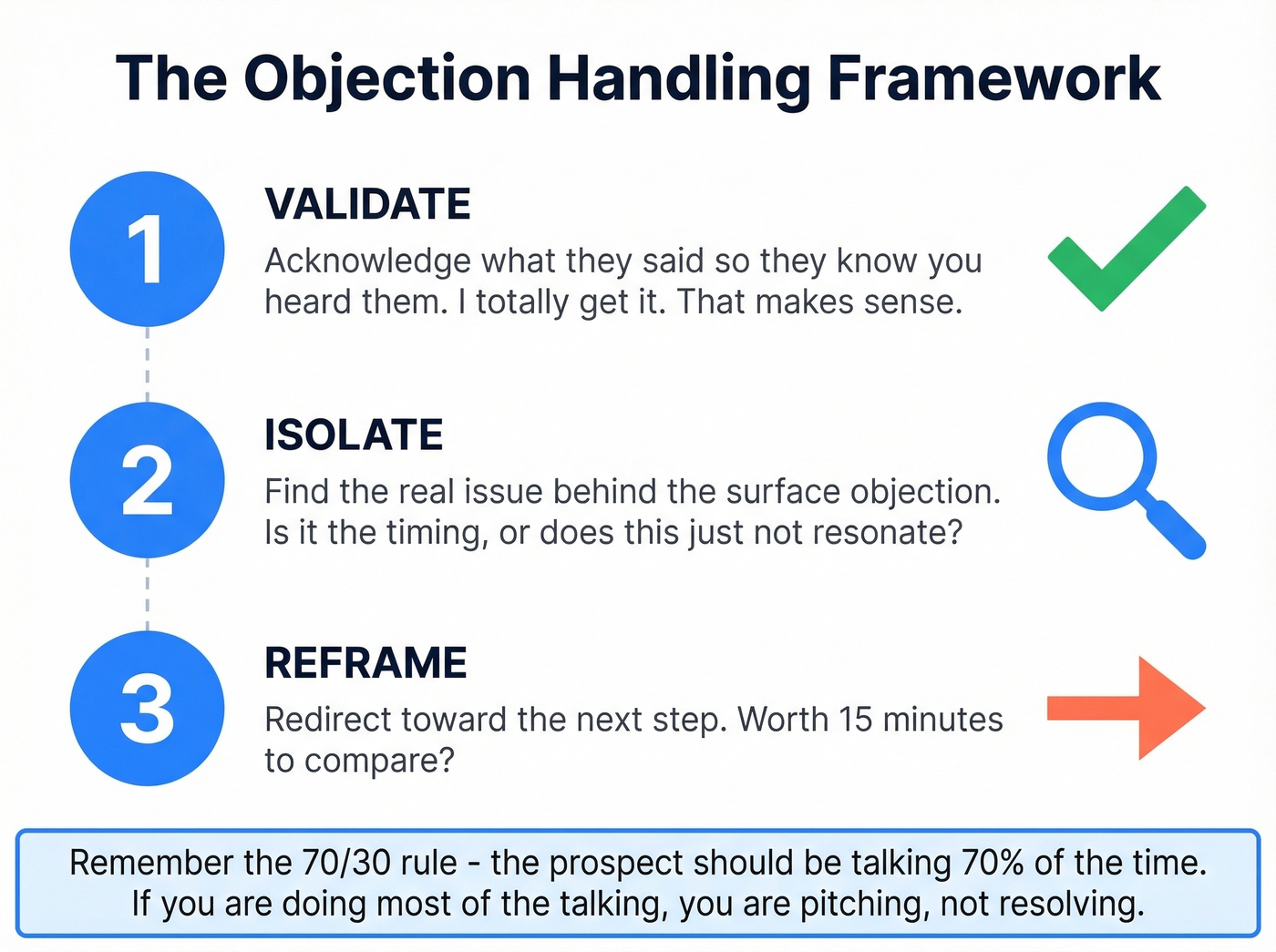
The fix is a simple framework - Validate -> Isolate -> Reframe - and a handful of rebuttals you can deploy without thinking. Validate what they said so they know you heard them, isolate the real issue behind the surface objection, and reframe toward the next step. The 70/30 talk ratio applies here too - if you're doing most of the talking during objection handling, you're pitching, not resolving. (More on reducing pushback in how to reduce sales objection rate.)
The 8 Most Common Objections
| Objection | Script | Why It Works |
|---|---|---|
| "I don't have time" | "Totally get it. Can I have just 30 seconds? If it's not relevant, I'll let you go." | Micro-commitment lowers guard |
| "Send me an email" | "Happy to. What's the one thing you'd need to see to justify a call next week?" | Turns brush-off into qualification |
| "We use [competitor]" | "Makes sense - a lot of our customers started there. Worth 15 min to compare?" | Re-sells the time, not the switch |
| "No budget" | "Understood. If budget weren't a factor, is this something you'd want to explore?" | Isolates real vs. reflexive objection |
| "I need to talk to my boss" | "Of course. Would it help if I joined that conversation? I can keep it to 15 minutes." | Moves you closer to decision-maker |
| "Call me next quarter" | "I hear you. What's changing next quarter that makes it a better time?" | Surfaces the real timing concern |
| "We handle it in-house" | "That's great - most teams we work with started that way. What's the biggest headache?" | Opens a discovery conversation |
| "Not interested" | "Fair enough. Is it the timing, or does [problem] just not resonate?" | Pattern interrupt re-opens dialogue |
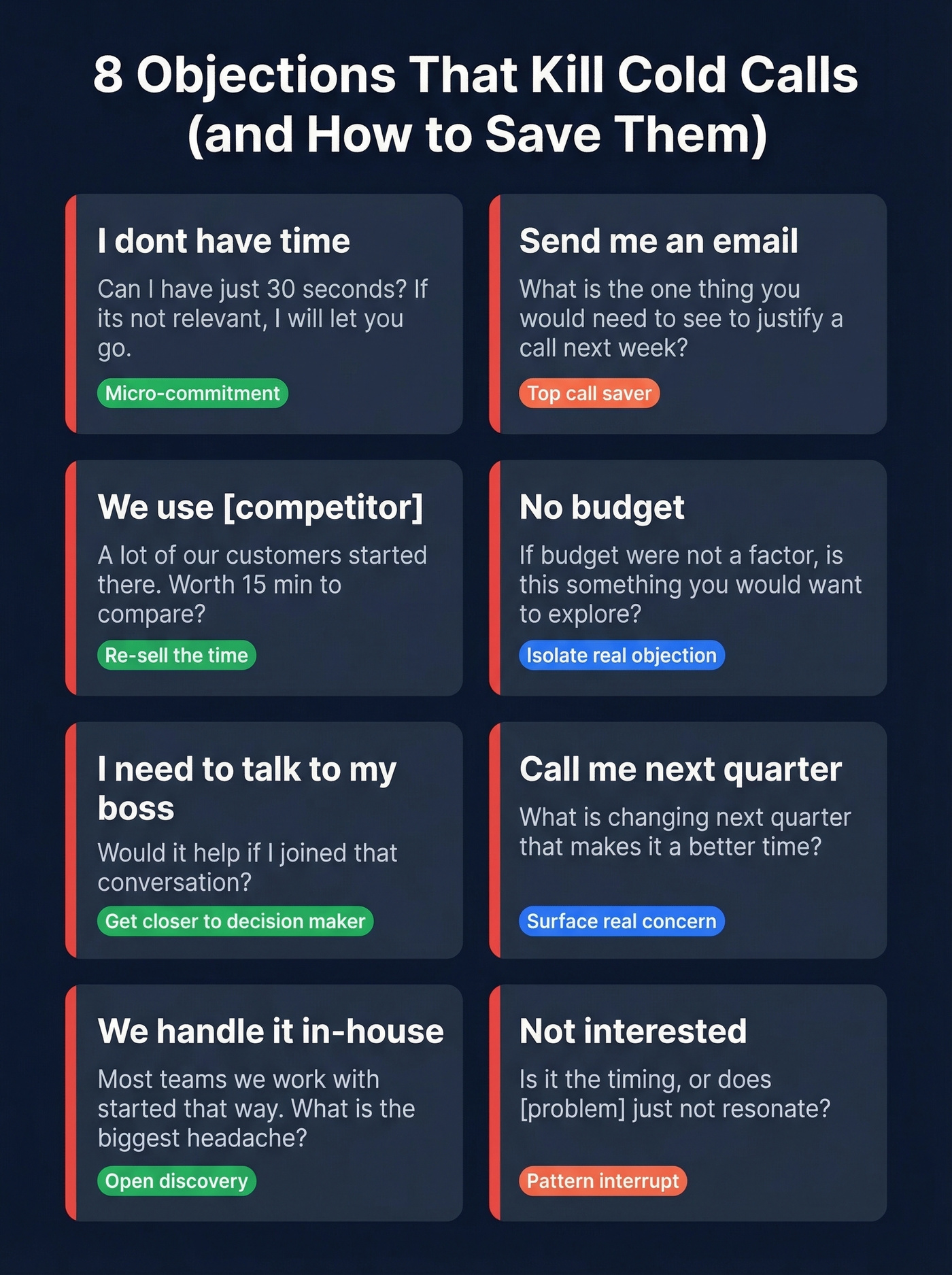
The "send me an email" rebuttal saves more calls than any other single response. Most reps hear it and comply - they send a generic email that gets ignored. Asking what they'd need to see forces the prospect to articulate their actual concern, which gives you something to work with.

Meritt tripled their pipeline when their connect rate jumped to 20-25% using Prospeo's verified mobile numbers. 125M+ direct dials, 30% pickup rate, refreshed every 7 days - not every 6 weeks.
Stop perfecting scripts for numbers that don't ring. Fix the data first.
Voicemail Scripts That Double Reply Rates
You'll hit voicemail 80% of the time. That's not a failure - it's a setup for the email that follows. Gong's analysis of 300 million cold calls tells the story:
- 0 voicemails: 2.73% email reply rate
- 1 voicemail: 6.11% email reply rate
- 2 voicemails: 5.34% email reply rate
- 3+ voicemails: 2.2% email reply rate
Leave exactly 1-2 voicemails per prospect, then stop. Three or more actually hurts your reply rate below the baseline. InsideSales data suggests a well-crafted voicemail can lift callbacks up to 22%. (If you want the email side of this to convert, use these cold email follow-up templates.)
Four Voicemail Templates
The Pain-Point Voicemail:
"Hey [Name], [Your Name] from [Company]. Most [their role] at [company type] tell us [specific pain point] is eating 30% of their team's time. We've got a way to fix that. I'll shoot you an email with the details - keep an eye out."
The Social Proof Voicemail:
"Hey [Name], [Your Name] from [Company]. We just helped [similar company] [specific result]. Thought it'd be relevant for your team. Sending you a quick email now."
The Ultra-Short Callback:
"Hey [Name], [Your Name], [Company]. Quick question about [topic]. I'll try you again, or feel free to call me back at [number]."
The Voicemail-to-Email Bridge:
"Hey [Name], [Your Name] from [Company]. I know cold voicemails are a pain - so I'm sending you an email right now with [one specific thing]. If it's relevant, let's talk. If not, no hard feelings."
The Voicemail-to-Email Sequence
The tactical play: leave the voicemail, then send the follow-up email within 5 minutes referencing it. "Just left you a quick voicemail - here's what I mentioned." This one-two punch is why voicemail can more than double your email reply rate. The voicemail primes them to open the email. The email does the selling.
Best Days, Times, and Cadence
Best Days
ZoomInfo analyzed more than 1.4 million outbound calls to new business accounts. The results are unambiguous: Tuesday, Wednesday, and Thursday are the best days overall, and Tuesday + Wednesday drive 44% of total demos.
| Day | What the data shows | Verdict |
|---|---|---|
| Monday | Highest call-to-demo efficiency (1.19%) | Strong start |
| Tuesday | One of the best overall days; big demo driver | Best day |
| Wednesday | One of the best overall days; big demo driver | Best day |
| Thursday | One of the best overall days | Solid fallback |
| Friday | Worst on every metric | Skip it |
Friday is the worst day to cold call. Full stop. Every metric - connection rate, demo rate, positive call rate - tanks on Friday. I know there's a popular take on Reddit that "Friday afternoons are great because gatekeepers are gone." The data says otherwise. Don't waste your best talk tracks on the worst day.
Best Times + Cadence Blueprint
10-11am is the primary window, with 2-3pm as a strong secondary. These are the hours when prospects are at their desks, past the morning rush, and not yet in end-of-day mode.
For cadence, think multi-touch over 2 weeks. It takes an average of 8 attempts to reach a prospect. Most reps give up after 2. That gap between 2 and 8 is where pipeline lives. A solid 2-week sequence looks like 4 calls, 4 emails, and 1-2 voicemails - front-loaded on Tuesday and Wednesday mornings. (If you’re building the full motion, start with a cold calling system.)
Delivery Matters More Than Words
You can have the perfect script and still blow the call if your delivery is off. We've listened to hundreds of recorded cold calls across our team and our customers' teams, and the pattern is always the same - the words are fine, the delivery kills it. This is the gap between reps who convert at ~2% and reps who convert at 15%.
Slow down. Speak almost uncomfortably slowly, especially in the first 10 seconds. Nervous reps speed up, which signals "I'm a cold caller rushing through my pitch before you hang up." Slowing down signals confidence and gives the prospect time to process.
Smile before you dial. It sounds ridiculous, but smiling physically changes your vocal tone. Your voice lifts, you sound warmer, and the prospect's mirror neurons respond. Stand up if you can - posture affects tone more than you'd think.
Practice the opener 50 times. Not 5 times. Fifty. Record yourself, listen back, and fix the spots where you stumble or sound robotic. The opener needs to feel like a conversation, not a recitation. By rep 50, it will.
Mirror their energy. If the prospect answers with a fast, clipped "Yeah?" - match that pace. If they're relaxed and conversational, slow down and match. Mirroring builds unconscious rapport in seconds.
Pause after the ask. When you say "Does Thursday at 2pm work?" - stop talking. The silence feels eternal, but it gives the prospect space to say yes. Most reps fill the silence with more pitch, which undermines the close.
Fix Your Data Before Your Script
Here's a scenario that plays out constantly: an SDR manager messages the team Slack channel asking why connect rates are tanking. The team blames the script. They workshop new openers, run role-plays, bring in a trainer. Connect rates don't budge.
Then someone audits the call list and finds that 30-40% of the numbers are disconnected, outdated, or flat-out wrong.
Your script is only as good as the number you're dialing. Prospeo's mobile finder gives you 125M+ verified mobile numbers with a 30% pickup rate - refreshed every 7 days, not the industry-standard 6 weeks. When Meritt switched, their connect rate jumped to 20-25%. GreyScout cut rep ramp time from 8-10 weeks to 4 weeks just by fixing the data layer. (If you’re comparing providers, start with data enrichment services.)
You can have the best permission-based opener in the world, and it won't matter if you're calling a number that belonged to someone who left the company six months ago. Fix the data first. Then optimize the script.
Trigger events, job changes, hiring surges - Prospeo tracks 15,000 intent topics and lets you filter by funding, headcount growth, and tech stack so every cold call has a reason behind it.
Turn every dial into a trigger-event call with real-time buyer signals.
Mistakes That Kill Your Calls
Not researching the prospect. Spend 2-3 minutes per prospect before you dial. Their role, recent company news, a trigger event - anything that lets you personalize the first 15 seconds. SoPro's analysis of 151 million outreach data points found that 81% of decision-makers engage with cold outreach when it's tailored to them. Generic calls get generic brush-offs. (More ways to do this in sales prospecting techniques.)
Sounding scripted. Frameworks beat memorization every time. Know the structure (Who -> Why -> What), but let the words come naturally. If you sound like you're reading, the prospect checks out before you finish your opener. Try pattern-interrupt openers like "Mind if I take 20 seconds to tell you why I'm calling?" to break the robotic cadence.
Pitching too early. The opener earns you the right to ask a question - not to deliver a 90-second monologue about your product. Use the LARA framework (Listen, Acknowledge, Respond, Ask) to stay in conversation mode instead of pitch mode.
Giving up after 2 attempts. It takes 8 attempts to reach a prospect. Most reps stop at 2. If you aren't building multi-touch sequences that span calls, emails, and voicemails over 2 weeks, you're leaving pipeline on the table.
Not reviewing your calls. Record yourself - most dialers have this built in. Listen to your first 15 seconds. That's where most calls die, and that's where small delivery tweaks compound into dramatically better results. (If you’re ramping new reps, plug this into a 30-60-90 day plan for sales reps.)
Dialing bad numbers. This is the silent killer. If 30-40% of your call block is wasted on wrong numbers, disconnected lines, and outdated data, no amount of script optimization will save your connect rates. Audit your data source before you audit your talk track.
FAQ
What's the average cold calling success rate?
The average sits at 2.3%, down from 4.82% the prior year. Top performers convert up to 15% of conversations into meetings. The gap comes down to script quality, data accuracy, timing, and persistence - most reps quit after 2 attempts when it takes 8.
What's the best time to make cold calls?
10-11am is the highest-performing window, followed by 2-3pm. Tuesday and Wednesday are the best days - they drive 44% of total demos booked based on ZoomInfo's 1.4M-call analysis. Avoid Friday entirely - it's the worst day on every metric.
How do you get past a gatekeeper?
Use a direct ask: "Hey, can I talk to [Name]?" Practitioners report this works 8 out of 10 times. Avoid overly clever lines - simplicity transfers more calls than scripts that telegraph "I'm a salesperson trying to get around you."
Should you leave a voicemail on a cold call?
Yes - but only 1-2 per prospect. Gong's 300M-call analysis shows one voicemail more than doubles your email reply rate (2.73% to 6.11%). Three or more drops it to 2.2%. The voicemail's job isn't to get a callback - it's to prime the prospect to open your follow-up email.
How can I improve my connect rate on cold calls?
Start with your data. If 30-40% of numbers are wrong, no script will help. Tools like Prospeo's mobile finder provide verified numbers refreshed weekly with a 30% pickup rate - teams like Meritt saw connect rates jump to 20-25% after switching. Pair clean data with Tuesday/Wednesday 10-11am call blocks for maximum reach.